House Judiciary Committee Releases Report Defining Grounds for Impeachment | The Epoch Times

Editor’s Note: What is particularly disturbing is that the Judiciary Committee chairman was associated with the Socialist Party long before he was a U.S. Congressman. Afterwards, he led the Congressional Progressive Caucus which from a policy standpoint is synonymous with the Socialist Party. Now, he’s overseeing a report interpretation what the founders meant by the impeachment clause. Curious and dangerous!

The House Judiciary Committee released on Saturday a report that attempts to define what the founders of the Constitution meant in their impeachment clause, days after the Speaker Nancy Pelosi (D-Calif.) asked the committee’s chair to move forward in impeaching President Donald Trump.

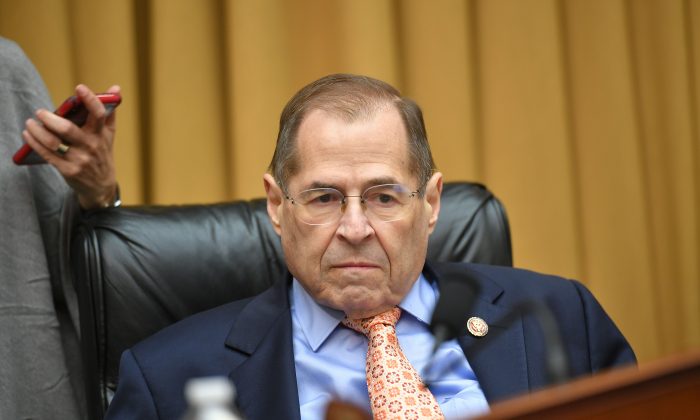
The 52-page report, titled “Constitutional Grounds for Presidential Impeachment” (pdf), is meant to act as a guide for impeachment as the committee’s Chairman Jerrold Nadler (D-N.Y.) prepares to draft articles of impeachment against the president.

The report was drafted by majority staff and provides details about the “history, purpose, and meaning” of Article II, Section 4, of the Constitution—the impeachment clause.

House Democrats are investigating in their impeachment inquiry allegations that the president had leveraged his office during a call with Ukraine in July where he asked the Ukrainian president to look into corruption accusations on former Vice President Joe Biden—who is running for president in 2020.

The release of the report comes after the House heard from a panel of four legal scholars to provide their understanding of what they think are impeachable offenses and how to apply it to the facts. Many of the academics had previously criticized Trump or have defended the impeachment against the president. The empaneled scholars drew criticism from the president’s allies and opponents of impeachment due to their apparent anti-Trump bias.

The report, which updates a 1974 version of the document that was used during the impeachment inquiry into President Richard M. Nixon, lays out reasoning to justify the House Democrat’s interpretation of what the impeachable offenses include. The Constitution does not explicitly define what “high crimes and misdemeanors” are, which is then open to legal analysis. According to the document, treason and bribery, abuse of power, betrayal involving foreign powers, and corruption are considered impeachable offenses.

“Within these parameters, and guided by fidelity to the Constitution, the House must judge whether the President’s misconduct is grave enough to require impeachment,” the report states. “That step must never be taken lightly. It is a momentous act, justified only when the President’s full course of conduct, assessed without favor or prejudice, is ‘seriously incompatible with either the constitutional form and principles of our government or the proper performance of constitutional duties of the presidential office.’”

The report also serves as a formal rebuttal of hotly contested issues during the impeachment process that the Democrats have deemed as “fallacies” such as the law that governs House procedures for impeachment, which states: “the law that governs the evaluation of evidence, including where the President orders defiance of House subpoenas, and whether the President is immune from impeachment if he attempts an impeachable offense but is caught before he completes it.”

On Wednesday, during a brief press conference, Pelosi said Trump’s dealings with Ukraine “have seriously violated the Constitution.” She added, “He is trying to corrupt, once again, the election for his own benefit. The president has engaged in abuse of power, undermining our national security and jeopardizing the integrity of our elections.”

In response, Trump raised concerns about the House Democrat’s actions, warning that the extraordinary act of impeaching a president will be used on future presidents, as some legal scholars and Republicans have previously noted.

“This will mean that the beyond important and seldom-used act of Impeachment will be used routinely to attack future Presidents. That is not what our Founders had in mind. The good thing is that the Republicans have NEVER been more united. We will win!” Trump wrote.

Source: The Epoch Times
Senate Resolution Urges Formal House Vote on Initiating Impeachment Inquiry | The Epoch Times

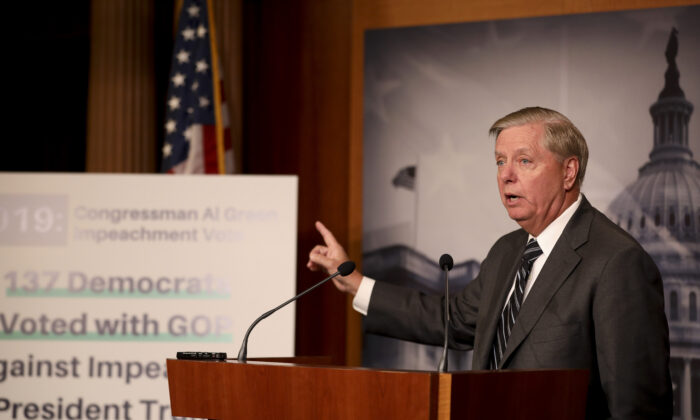
Sen. Lindsey Graham (R-S.C.) holds a press conference about the House impeachment inquiry process, on Capitol Hill in Washington on Oct. 24, 2019. (Charlotte Cuthbertson/The Epoch Times)

Editor’s Note: We the People are witnessing an attempted coup d’tat of our United States government in broad daylight and this impeachment inquiry is a smokescreen, a distraction, a false narrative and coverup orchestrated by the many co-conspirators who before Trump was elected in 2016 decided to manufacture a false accusation re: Russian collusion to discredit him. These “enemies of the state” decided that should Trump be elected that they would take it into their own hands to overthrow a duly elected President of the United States. If you are one of the many naive American’s who actually believe what you read in the mainstream, corporate newspapers and are not savvy enough to understand the hidden powers that pull the strings behind the curtain of the U.S. Congress, then shame on you. Wake Up America before it’s too late!

Sen. Lindsey Graham (R-S.C.) introduced a non-binding resolution on Oct. 24 calling on House Democrats to hold a formal vote on initiating an impeachment inquiry before moving any further in the investigation of President Donald Trump.

Thirty-five Republican senators co-sponsored the resolution, which also demands that the impeachment inquiry accommodate Trump with constitutional due-process protections. By early evening on Oct. 24, the number of co-sponsors had reached 46.

“The House of Representatives is abandoning more than a century’s worth of precedent and tradition in impeachment proceedings and denying President Trump basic fairness and due process accorded every American,” the resolution (pdf) states.

“One of the cornerstones of the American Constitution is due process: the right to confront your accuser, call witnesses on your behalf, and challenge the accusations against you.”

Senate Republicans unveiled the resolution one day after roughly three dozen House Republicans stormed a hearing room during a House Intelligence Committee impeachment deposition to demand that the closed-door hearings be opened to lawmakers and the public.

The resolution points out that during the three prior impeachment proceedings, the House held a formal vote to initiate an impeachment inquiry. In Trump’s case, the process was replaced by a press conference by House Speaker Nancy Pelosi (D-Calif.), the Republicans charge.

“The proposition that the Speaker acting alone may direct committees to initiate impeachment proceedings without any debate or a vote on the House floor is unprecedented and undemocratic,” the resolution states.

Prior impeachment proceedings allowed the presidents to have counsel present at hearings and depositions, according to the resolution. In each case, the presidents’ lawyers were allowed to introduce and object to evidence and call on and cross-examine witnesses.

“By contrast, the House’s current impeachment ‘inquiry’ provides none of these basic rights and protections to President Trump,” the co-sponsors say. “The main allegations against President Trump are based on assertions and testimony from witnesses whom he is unable to confront, as part of a process in which he is not able to offer witnesses in his defense or have a basic understanding of the allegations lodged against him.”

House Democrats are investigating allegations related to President Donald Trump’s phone call with Ukrainian President Volodymyr Zelensky. During the conversation on July 25, Trump asked Zelensky to look into two matters. The first request concerned a server tied to Crowdstrike, the cybersecurity firm that analyzed the Democratic National Committee server allegedly breached by Russian government hackers. The second request concerned allegations of corruption by former vice president Joe Biden and his son Hunter Biden.

The Democrats have conducted all of the hearings to date behind closed doors. The public’s access to the information has so far been limited to leaks to the media and a handful of documents published by the committees.

The Democrats have defended the process, claiming that lawmakers in prior impeachment proceedings worked from material collected through an investigation by a special counsel. Meanwhile, the lawmakers took up the current case without letting a special counsel conduct an inquiry. As a result, the process requires secrecy so that witnesses don’t adjust their testimony.

The constant leaks from the inquiry have undermined the advantages gained through secret proceedings. Republicans say they don’t have access to transcripts of the depositions. Meanwhile, leaked information seems to consist almost entirely of sections of testimony damaging to Trump.

The minority Republicans on the three committees conducting the impeachment inquiry don’t have the same rights as those that were granted to the minority Democrats during the House impeachment inquiry of President Bill Clinton, including the ability to issue subpoenas. The resolution calls on the Democrats to follow precedent and grant Republicans the same rights.

“We’re not telling the House they can’t impeach the president. What we’re telling the House is, there’s a right way to do it, and a wrong way to do it,” Graham told reporters. “This is one part legal, and two parts politics.”

The White House has refused to cooperate with the impeachment inquiry unless the Democrats hold a vote to formally launch the inquiry. The president has denied any wrongdoing in his call with Zelensky. The Ukrainian leader said he wasn’t pressured during the phone call.

Trump on Oct. 23 criticized the impeachment inquiry along lines similar to the Senate resolution.

“Do Nothing Democrats allow Republicans Zero Representation, Zero due process, and Zero Transparency,” the president wrote on Twitter. “Does anybody think this is fair?”

The Democrats allege that in order to pressure Zelensky, Trump placed a temporary hold on military aid to Ukraine. All of the witnesses who have testified to date say that Ukrainian officials were unaware of the hold until one month after the Trump–Zelensky phone call.

Source: The Epoch Times

US Vax Court Sees 400% Spike in Vaccine Injuries, Flu Shot Wins Top Honors for Biggest Payout | Vaccine Impact

Vaccine injury cases are on the rise people, so if you’ve got your head in the sand and you haven’t been paying attention, it’s time to wake up.

Here’s a little background for those of you just getting started.

Ronnie Reagan… almost 30 years ago to the day, the 40th president of the United States signed away the rights of Americans to sue vaccine makers, replacing them with a law that forces families who have suffered vaccine injury or death to sue the U.S. government instead of a pharmaceutical company.

As a result, special masters from the United States Special Claims Court, also known for our purposes as the vaccine court, are given full authority as judge with no jury to decide the fate of Americans who have had the unfortunate ‘luck’ to be stricken by a vaccine injury — which can range from chronic, mild symptoms to death.

Once a year, this non-traditional court provides the public with a glimpse into its inner workings, by issuing an annual report on its website — a ritual that happens every January.  The report is sent to the President of Congress, otherwise known as the Vice President of the United States, where it is intended to serve as a bell weather monitoring reactions the American public may be having to vaccinations that are increasingly becoming forced by government mandates around the country.

Great, right?  Accountability in action?

Wrong.

The report, which is consistently ignored by mainstream media/politicians/health officials and the CDC, lies dormant on the reports page of the U.S. Special Claims Court website.

No headlines, no press release, no analysis, no alert the media, no nothing.

No surprise, given that most people in America don’t even know that vaccines were ruled to be unavoidably unsafe by the U.S. Supreme Court in 2011.  Also no surprise, that mainstream, co-opted, globalist elite media constantly ignore this report, along with sane arguments made by health freedom advocates about the dangers and risks of vaccine injury (‘look! a unicorn!’), instead using terms like ‘the science is in,’ and vaccine risk has been ‘debunked,’ to deter rational discussion pertaining to evidence that is hiding in plain sight.

Also no surprise that the U.S. Special Claims Court offers up an ineffective, low tech, archaic version of the report every year.  Instead of a nice, sort-able spread sheet, the court posts a scanned PDF document — a format which requires labor-intensive activities to conduct any sort of concrete analysis.  One must either re-data-entry all 220+ pages which would take weeks, or conduct an extensive, hand-written breakdown by vaccine of each case, combined with extensive tallying and organization efforts in order to identify statistical relevance and trends emerging from the vaccine court.

Is this by design?  Perhaps.  Most definitely it is at the very least a deterrent from having anybody actually sit down and try to analyze the damn thing.

Which is exactly why we do it, every year since 2014.  Not to be deterred, it took us 10 months to finally finish our analysis of this year’s report.  But once we did, the trends we found were shocking — not just because of what they revealed about the continual increase in vaccine injury, but also because of the deafening silence present among the halls of mainstream media, as vaccine injury continues to be a subject that journalists and media outlets ignore — chalking it up to yet another conspiracy theory from yet another fake news site.

Well pull up a chair and hold on to your hats, because guess what we discovered:

  1. Vaccine court settlement payouts increased in total $91.2 million in 2015, up from $22.8 million in 2014 to $114 million in 2015 — a 400% increase. 
  2. Vaccine court settlement payments for flu shots increased the most, from $4.9 million in 2014 to $61 million in 2015 —  an increase of more than 1000%, despite autumnal onslaughts every year of media/pr/advertising campaigns urging Americans to ‘get your flu shot,’ with total abandon for the statistical facts coming out of the vaccine court.
  3. Varicella (chicken pox) had the third biggest increase — from $0 in 2014 to $5.8 million in 2015.  (No surprise shingles is on the rise among the elderly population, as recently vaccinated grandchildren continuously shed live virus to their unsuspecting elders.)
  4. Hepatitis B was the fourth largest increase in vaccine court settlements, increasing 321% in 2015 to more than $8 million in 2015 from $1.9 million in 2014.
  5. TDap/DTP/DPT and D/T shots were the fifth largest increase, leaping 75% in 2014 from $5.5 million to $9.8.

The rest of the settlements not pictured here are: Tetanus, $4 million; HPV $3.4 million, up from almost nothing in 2014 (one to watch in January when the 2016 report is issued); MMR, which actually decreased from the number one position last year to under $1 m — an 88%+ decrease in payouts; pertussis, $1.7 million; thimerisol $1.5 million; HIB, $345k, menginococal $500k, HEP A $408k, DPT & Polio, $210k & rotovirus $76k. 

You may have noticed we omitted the second place winner, ‘other.’  Here’s why.

‘Other’ illustrates perfectly the dodgy nature of the vaccine court report, and its lack of transparency in the vaccine court process.  Instead of identifying which combination of vaccines are being charged with injury or death and labeling the case accordingly, a special master can decide to label a vaccine case ‘other,’ thereby diluting its affect on the overall numbers in the final analysis.

In 2015, the ‘other’ category was the second largest increase in vaccine settlement payments, totaling $21.5 million in payouts, up 388% from $4.4 million in payouts the year before.

We’re not accusing anybody of anything.  But, 388% increase is a lot.  What combination of vaccines is causing such an increase?  Doesn’t the public have a right to know?  If the court decided, for example, that there were too many flu shot settlements mounting for the year, couldn’t it simply skew the data by categorizing certain cases as ‘other,’ which would artificially deflate the flu category?

Did we mention that these results are ONLY for the judgements — cases that are found in favor of the plaintiff.  It does NOT include the EXTENSIVE legal fees for both sides, which are paid for by the U.S. government whether the lawyer wins or loses the case?  Those are categorized as costs.  And instead of submitting them in the report along with any judgments that are awarded, often they are entered as separate entries, making the exercise of linking them with their judgement payouts that much harder, requiring yet another step in the arduous, analysis of data.

The total dollar payout of legal fees for the vaccine court in 2015 is $42 million.

Also, a hand full of settlements in the payout are based on annuities — that means that the payouts (many of which total more than $1 million) reoccur annually.  That’s because life as they knew it for some plaintiffs disappeared after their vaccine injury occurred, and the costs to care for them in perpetuity for the life of the plaintiff requires an annual sum that is often extensive.

Share far and wide people, it’s time to turn the tide.

Republished with permission of The Mom Street Journal. Read the full article at TheMomStreetJournal.com.

Source: Vaccine Impact & TheMomStreetJournal.com

Justice Neil Gorsuch on his concern for America’s future: ‘Republics have a checkered history’ | Fox News

Editor’s Note: Sadly, we have one of the most ignorant and poorly educated citizenries ever, thus Gorsuch’s affirmation of the importance of an informed and educated public (and a transparent government as well) must be heard and understood. Seems not even our elected representatives know how to govern effectively these days.

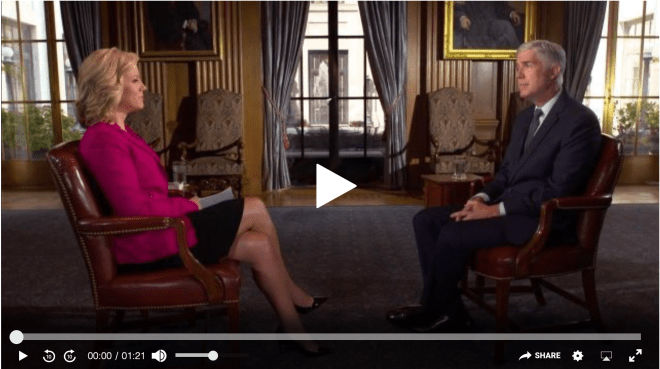
In an exclusive Fox Nation interviewSupreme Court Justice Neil Gorsuch revealed his deep concerns for the future of America, which drove him to write his new book, “A Republic, if you can keep it.”

The book’s title is inspired by a famous phrase attributed to Founding Father Benjamin Franklin.  As Franklin left the Constitutional Convention of 1787, after the drafting of the U.S. Constitution, he was reportedly asked what form of government had been created.  Franklin answered, “A Republic, if you can keep it”, suggesting that the country’s fate lay in the hands of its citizenry.

JUSTICE GORSUCH REVEALS THE TWO RULES HE TELLS HIS LAW CLERKS

Justice Gorsuch told Fox News anchor Shannon Bream in his first televised interview as a Supreme Court Justice that an uninformed public is a danger to the country. “Republics have a checkered history in our history books, and we need to make sure that the people know how to run their own government.”

Gorsuch said, “I am concerned on the civics front when I read that about a third of Americans can’t name the three branches of government.  60% apparently would fail the American naturalization examination — that worries me.”

Justice Gorsuch also believes that an understanding of America’s past is central to the nation’s future success, and he credits the musical “Hamilton” for educating America’s youngest generations.

Gorsuch explained, “You’ve seen a secretary of Treasury and a vice president of the United States have a duel.  That’s part of our history.  It’s always been a ruckus republic.  We used to have Senators cane one another on the floor. I’m glad we don’t have that anymore, at least, but it is a ruckus republic. That is what makes us strong. We can appreciate and embrace different ideas and open ourselves to one another and remember that that person with whom we disagree is coming at it from the same angle, the same hope of making a more perfect union.”

SUPREME COURT JUSTICE REVEALS HOW HIS NOMINATION TRIP BEGAN

“I think democracy is a really hard business and that’s because its strength comes from disagreements and the ability to air — comfortably and confidently — your point of view.  Share it with others and have it heard and pick the best at the end of the day.  That’s the idea of democracy.  But for it to work, we have to listen as well as speak.  We have to tolerate as well as expect tolerance for our point of view,” added Gorsuch.

Source: Fox News

Appeals court dismisses emoluments lawsuit involving Trump’s D.C. hotel | The Washington Post

A federal appeals court Wednesday sided with President Trump, dismissing a lawsuit claiming the president is illegally profiting from foreign and state government visitors at his luxury hotel in downtown Washington.

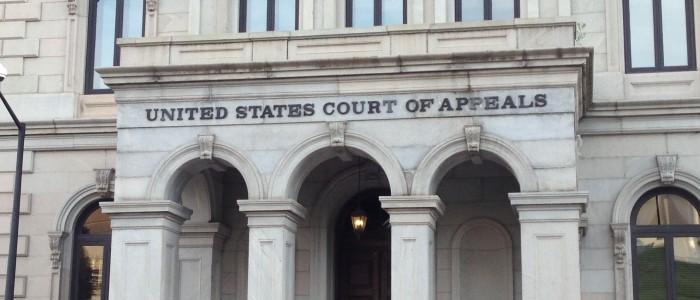
The unanimous ruling from the U.S. Court of Appeals for the 4th Circuit is a victory for the president in a novel case brought by the attorneys general of Maryland and the District of Columbia involving anti-corruption provisions in the emoluments clauses of the U.S. Constitution.

In its ruling, the three-judge panel said the attorneys general lacked legal grounds to bring the lawsuit alleging the president is violating the Constitution when his business accepts payments from state and foreign governments. The decision — from Judges Paul V. Niemeyer, Dennis W. Shedd and A. Marvin Quattlebaum Jr. — also stops dozens of subpoenas to federal government agencies and Trump’s private business entities demanding financial records related to the D.C. hotel.

“The District and Maryland’s interest in enforcing the Emoluments Clauses is so attenuated and abstract that their prosecution of this case readily provokes the question of whether this action against the President is an appropriate use of the courts, which were created to resolve real cases and controversies between the parties,” Niemeyer wrote in the 36-page opinion.

President Trump quickly took to Twitter to celebrate the ruling, referring to the lawsuit as “ridiculous” and “a big part of the Deep State and Democrat induced Witch Hunt.”

“I don’t make money, but lose a fortune for the honor of serving and doing a great job as your President (including accepting Zero salary!),” he wrote.

The president has stepped back from day-to-day management of the Trump International Hoteland his other businesses, but he maintains ownership.

Maryland Attorney General Brian E. Frosh and D.C. Attorney General Karl A. Racine, both Democrats, said in a joint statement after the ruling that the three-judge panel “got it wrong.”

“Although the court described a litany of ways in which this case is unique, it failed to acknowledge the most extraordinary circumstance of all: President Trump is brazenly profiting from the Office of the President in ways that no other President in history ever imagined and that the founders expressly sought — in the Constitution — to prohibit,” they said.

“We will continue to pursue our legal options to hold him accountable.”

The three judges on the panel that heard oral argument in March were nominated to the bench by Republican presidents — Niemeyer by President George H.W. Bush, Shedd by President George W. Bush and Quattlebaum by Trump. Frosh and Racine have said they would consider appealing for a rehearing by a full panel of the 4th Circuit and would not be surprised to see the case reach the Supreme Court.

The president faces multiple legal challenges related to his private business. A federal appeals court in Washington is considering a separate “emoluments” lawsuit brought by congressional Democrats, who this week began issuing dozens of subpoenas for financial records from the president’s private entities.

The case extends beyond the D.C. hotel and is based on a different theory of standing. The Democratic lawmakers say the president is violating the Constitution because it gives Congress the right to approve — or withhold — consent before the president accepts payments or benefits from foreign governments.

Despite the legal challenges his company faces, to this point Trump has been able to prevent the release of any private business information to the courts, leaving Democrats to wonder whether he will be affected by any of the inquiries before he faces reelection next year.

At the 4th Circuit, Trump’s attorneys were appealing a ruling from a District Court judge in Maryland who allowed the case to move forward and adopted a broad definition of the emoluments ban to include “profit, gain, or advantage” received “directly or indirectly” from foreign, federal or state governments.

The Richmond-based 4th Circuit, which reviews cases from Maryland, Virginia, West Virginia and the Carolinas, was specifically reviewing whether Maryland and the District of Columbia had legal grounds, or standing, to sue the president in the first place.

At least a half-dozen countries have booked large blocks of rooms or meeting space at Trump’s D.C. hotel, among them Saudi Arabia, Kuwait, Malaysia and the Republic of Georgia. Three years in a row, the Kuwaiti government held its National Day celebration there, and the plaintiffs allege that the 2017 event alone cost between $40,000 and $60,000.

The plaintiffs argued that these payments are violations of the foreign emoluments clause, while the Justice Department calls them market-rate deals that should not be considered emoluments.

The hotel occupies the Old Post Office Pavilion, a federal building leased to Trump’s business, in an arrangement that plaintiffs argue violates the domestic emoluments clause. The lease was signed before Trump entered office and stipulates that “no . . . elected official of the Government of the United States” shall benefit from the deal.

The General Services Administration, under Trump, ruled that the deal was in compliance.

The court’s ruling, however, centered on whether the plaintiffs had standing to bring their case against the president — not the merits of whether Trump is violating the Constitution with his business dealings. The 4th Circuit issued two rulings Wednesday — one dismissing the case against the president in his official capacity and the other in his individual capacity.

U.S. District Judge Peter J. Messitte had granted Maryland and the District of Columbia standing in part because Trump’s D.C. hotel could be taking foreign government business from convention centers and hotels in their jurisdictions as foreign leaders may be incentivized to spend money at the president’s property.

But the appeals court disagreed, writing that the attorneys general had failed to show that Trump’s conduct had harmed the financial interests of Maryland and the District and that intervening, by forcing the president to forgo his ownership, for instance, would make a difference.

“There is a distinct possibility — which was completely ignored by the District and Maryland, as well as by the district court — that certain government officials might avoid patronizing the Hotel because of the President’s association with it,” the court said.

“Even if government officials were patronizing the Hotel to curry the President’s favor, there is no reason to conclude that they would cease doing so were the President enjoined from receiving income from the Hotel. After all, the Hotel would still be publicly associated with the President, would still bear his name, and would still financially benefit members of his family.”

Source: The Washington Post

Supreme Court rules in case watched for impact on Trump pardons | Politico

The Supreme Court ruled Monday in a closely watched “double jeopardy” case, issuing a decision that preserves states’ power to limit the impact of future pardons by President Donald Trump or his successors.

In a 7-2 ruling, the justices declined to disturb a longstanding legal principle known as dual sovereignty, which allows state governments to bring their own charges against defendants already tried or convicted in federal court, or vice versa.

Lawyers for an Alabama man facing a gun charge in federal court after pleading guilty to the same offense in state court — resulting in a nearly three-year extension of his prison sentence — failed in their effort to persuade the justices to hold that the Constitution’s prohibition on double jeopardy prevents such follow-on prosecutions.

The federal government had argued that overturning the dual-sovereignty doctrine would upend the country’s federalist system, and that the phenomenon of overcriminalization makes states’ ability to preserve their own sphere of influence and prevent federal encroachment on law enforcement more important.

Democrats and others bracing for potential pardons by Trump of individuals convicted in former special counsel Robert Mueller’s investigation were tracking the case, Terance Gamble v. U.S., because a decision overturning the dual sovereigns rule could have complicated efforts by state prosecutors to blunt the impact of any attempt Trump may make to grant clemency to those targeted by Mueller’s team.

Still, the high court case was not seen as make-or-break for state prosecutions because Mueller didn’t bring charges on every potential crime he uncovered. In addition, the federal prosecution of former Trump campaign chairman Paul Manafort resulted in a combination of jury convictions, guilty pleas, mistried charges and dismissals as part of a plea deal.

The complex result in Manafort’s case left fertile ground for New York prosecutors, who jumped into the breach in March with a 16-count indictment charging the longtime lobbyist and political consultant with mortgage fraud, falsifying business records and other crimes. The offenses seemed to partially overlap with crimes Manafort was charged with in federal court in Virginia.

Manafort’s lawyers in the state case have indicated they plan to argue that the indictment obtained by Manhattan District Attorney Cyrus Vance Jr. violates a New York law that limits state prosecutions of crimes already prosecuted at the federal level.

New York’s Democrat-controlled Legislature has been trying to alter that law to limit its application in cases where a defendant receives a presidential pardon or commutation.

A bill aimed at doing that won formal approval last month from both chambers of the state legislature but has not yet been sent to Gov. Andrew Cuomo, who has signaled he plans to sign it. The measure includes language seeking to cover individuals already convicted, tried or who pleaded guilty, but it’s unclear whether applying the law that way is constitutional.

The bulk of the opinions the justices issued Monday were focused on historical evidence about whether the founders expected that dual prosecutions would be permitted or forbidden by the Constitution.

“Gamble’s historical arguments must overcome numerous ‘major decisions of this Court’ spanning 170 years,” Justice Samuel Alito wrote on behalf of the seven-justice majority. “In light of these factors, Gamble’s historical evidence must, at a minimum, be better than middling. And it is not.”

The decision drew separate dissents from justices at opposite ends of the court’s ideological spectrum: liberal Ruth Bader Ginsburg and conservative Neil Gorsuch.

“It is the doctrine’s premise that each government has — and must be allowed to vindicate — a distinct interest in enforcing its own criminal laws,” Ginsburg wrote. “That is a peculiar way to look at the Double Jeopardy Clause, which by its terms safeguards the ‘person’ and restrains the government.” She argued that the legal precedent was weak, noting that “early American courts regarded with disfavor the prospect of successive prosecutions by the Federal and State Governments” and that, with regard to concerns about federal and state governments interfering with each other, “cooperation between authorities is the norm.”

Gorsuch, meanwhile, argued that “a free society does not allow its government to try the same individual for the same crime until it’s happy with the result. Unfortunately, the Court today endorses a colossal exception to this ancient rule against double jeopardy.”

He added that the separate sovereigns exception “finds no meaningful support in the text of the Constitution,” unlike the Constitution’s ban on double jeopardy.

Fordham University law professor Jed Shugerman told POLITICO that the Gamble decision will have “no real impact on Trump cases.” Manafort is still facing state prosecutions in New York and Virginia, which have their own jeopardy rules, he noted. And former national security adviser Michael Flynn’s guilty plea to one count of making false statements to the FBI was limited to federal law, Shugerman said. The same appears true of Roger Stone’s prosecution on false statement and witness tampering charges, he added.

“Trump and others aren’t getting prosecuted federally anyway before 2021, so they haven’t faced a single jeopardy yet,” Shugerman said. “A pardon wouldn’t create jeopardy, so they’d still face state prosecutions post-pardons.”

Some opponents of the proposed New York changes urged legislators to hold off passing them until the Supreme Court ruled in the case decided Monday. Experts said the decision might encourage more states to tinker with their double-jeopardy limits.

“The big question may be how states react to this ruling, and whether it will incentivize some states to ban trials by separate sovereigns of the same defendant for the same conduct, or, now that the Court has said the federal Constitution isn’t offended, whether states that already have such bans might relax them,” said University of Texas law professor Stephen Vladeck.

Source: Politico

Supreme Court clamps down on ‘excessive fines’ by states | The Hill

The Supreme Court on Wednesday ruled unanimously that states must adhere to the Constitution’s ban on excessive fines, a decision that will likely limit the ability of states to impose certain fees and seize property.

In delivering the opinion of the court, Justice Ruth Bader Ginsburg said the Eighth Amendment guards against abuses of the government’s punitive or criminal law-enforcement authority, and that it extends to fines.

“This safeguard, we hold, is ‘fundamental to our scheme of ordered liberty,’ with ‘deep roots in our history and tradition,’” she said, quoting Supreme Court precedent.

Ginsburg, who returned to the bench for oral arguments Tuesday for the first time since undergoing surgery in December, was joined in the ruling by Chief Justice John Roberts, Justices Stephen Breyer, Samuel Alito, Sonia Sotomayor, Elena Kagan, Neil Gorsuch and Brett Kavanaugh. Justice Clarence Thomas filed an opinion concurring in the judgment.

The case centered on Tyson Timbs, who pleaded guilty in Indiana state court to dealing in a controlled substance and conspiracy to commit theft. When Timbs was arrested, police seized the Land Rover he had purchased, for $42,000, from an insurance policy he received when his father died.

The state then brought a  civil forfeiture suit against Timbs for his vehicle because it had been used to transport heroin. The trial court denied the state’s forfeiture request.

Since Timbs had recently purchased the vehicle for more than four times the maximum $10,000 monetary fine he can be charged for the drug conviction, the court said the forfeiture violated the Eighth Amendment.

The Indiana Supreme Court ultimately reversed that ruling, holding that the Excessive Fines Clause constrains only federal action and is inapplicable to state impositions. Watch the video…

The high court vacated that ruling Wednesday.

Source: The Hill

Bipartisan Criminal Justice Bill Closer To Becoming Law After Congressional Approval | NPR

By Ayesha Rascoe

A bipartisan bill aimed at overhauling federal prisons and reducing recidivism has been overwhelmingly approved by Congress.

The legislation is now on the verge of becoming law, with the House’s approval on Thursday, the Senate’s passage on Tuesday and the backing of President Trump.

Republican Speaker of the House Paul Ryan previously voiced support for the legislative package, pledging that the House was “ready to get it done.” They later passed the measure by a 358-36 margin.

The Senate on Tuesday voted 87-12 in favor of the bill, known as the First Step Act. The passage of the bill by the chamber is a significant victory for advocates on the left and the right, who have pressed for Congress to take action to lower the prison population.

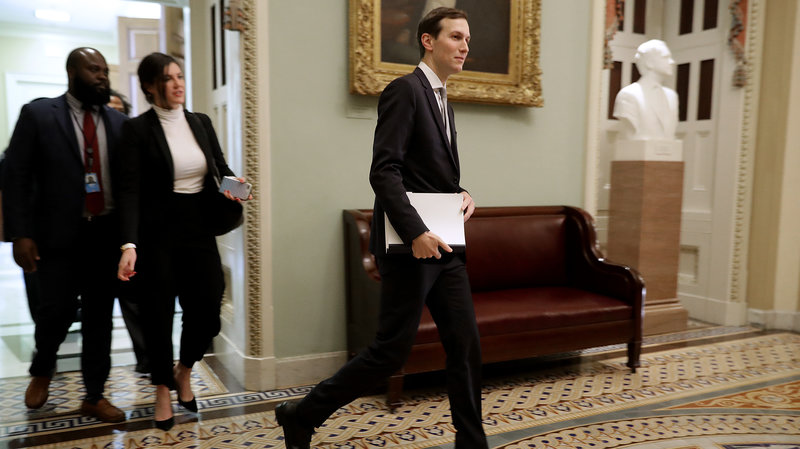
It’s also a big win for the White House and for Trump adviser and son-in-law Jared Kushner, in particular. Kushner has made overhauling the criminal justice system one of his top projects in the White House.

Trump called Congress’ action a “great bi-partisan achievement” and “a wonderful thing for the U.S.A.!!” in a tweet on Thursday afternoon.

For months, the fate of the legislation seemed to be in a precarious position. Republican Sen. Chuck Grassley, who helms the Senate Judiciary Committee, stressed that he wanted to include sentencing provisions, which had been left out of the version of the bill passed by the House in May.

For a while, it was unclear whether Trump would back measures to cut down on lengthy sentences. His first attorney general, Jeff Sessions, was staunchly opposed to the move.

But, with Sessions pushed out of the administration in November, Trump came out in favor of the more expansive Senate package.

Some Republicans, like Sen. Tom Cotton of Arkansas, still oppose the legislation, which they argue will free dangerous criminals.

Facing pressure from advocates and the White House, Senate Majority Leader Mitch McConnell agreed to bring the bill up for a vote during the lame-duck session after its sponsors agreed to certain changes.

Here are some highlights from the legislation:

Measures focused on changing U.S. prisons

-Provides more access to rehabilitation and training programs that are aimed at helping prepare prisoners for life after their release. Certain prisoners would be eligible for incentives if they participate, including credits that would allow them to spend up to a year of their sentences in facilities like halfway houses or at home under supervision.

Republican critics of these incentives argue that prisoners could commit crimes while on supervised release. But, the bill’s sponsors say only offenders considered low or minimum risk would be eligible and the legislation excludes certain prisoners, including sex offenders and fentanyl traffickers.

-Makes it against the law to use restraints on pregnant inmates, unless they are an immediate threat to themselves or others or a flight risk.

-Requires that prisoners be incarcerated no more than 500 miles from their primary residence.

Measures focused on sentencing

-Ends automatic life sentences under the three-strike penalty for drug felonies. Instead of life, a third strike would now be a mandatory 25-year sentence. The mandatory sentence for a second offense would be reduced to 15 years compared to 20 years now.

This change would not be retroactive, so it would not help people already in prison serving life sentences under the three-strike rule. Some opponents of the bill have argued it does not go far enough to help people already affected by these laws.

-Expands the “safety valve” that allows judges to avoid imposing mandatory minimum sentences in certain cases.

-Addresses prisoners who were sentenced before laws were changed in 2010 to lessen disparities between the penalties for crack cocaine and powder cocaine. It would allow these prisoners to petition the courts to review their cases in light of the updated law.

Source: NPR

FBI releases part of Russia dossier summary used to brief Trump, Obama | Politico

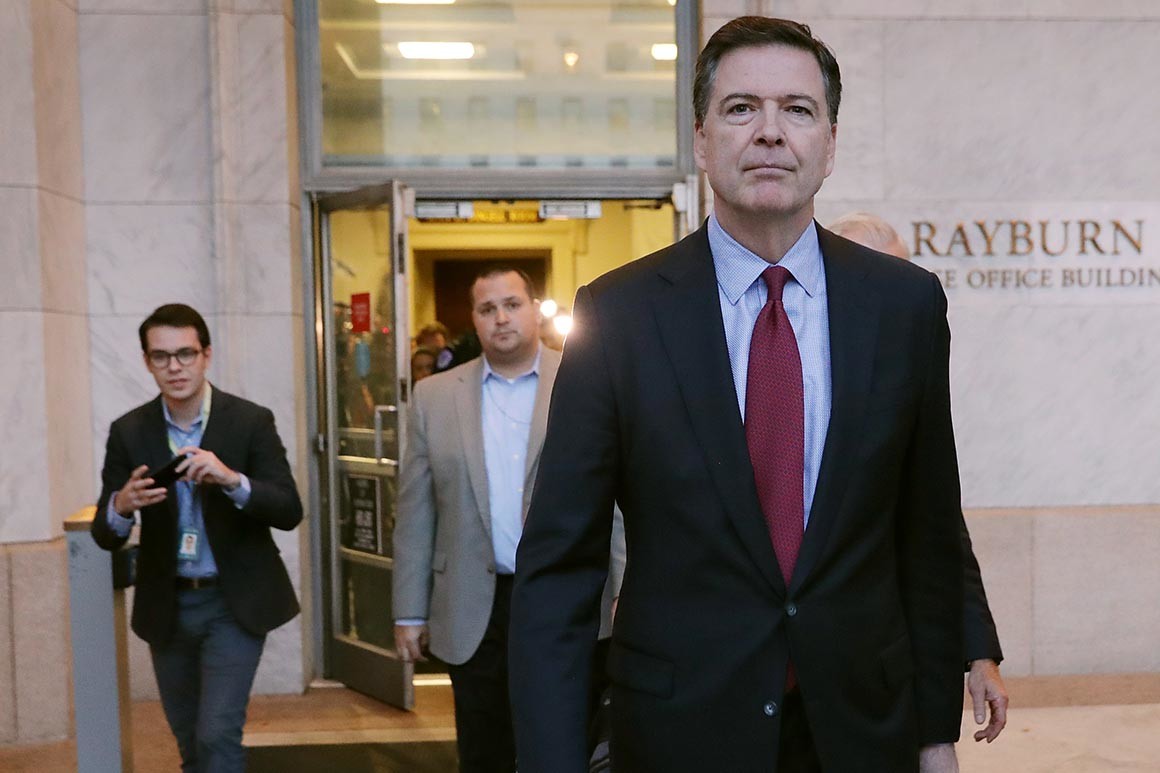
The FBI released for the first time Friday night a two-page summary former FBI Director James Comey used to brief President-elect Donald Trump nearly two years ago on a so-called dossier about Trump’s ties to Russia.

The version made public Friday could reignite previous criticism from Republicans and Trump allies that the FBI was too vague in its description of the fact that the dossier was funded by the campaign of Trump’s nemesis in the 2016 presidential election, Democratic nominee Hillary Rodham Clinton, as well as the Democratic National Committee.

Comey, who was fired by Trump in May 2017, acknowledged during a book tour earlier this year that he did not inform Trump who paid for the research.

The brief passage the FBI left unredacted in the newly released memo gives some background on the former British intelligence officer who compiled the dossier, Christopher Steele, although Steele’s name does not actually appear in the newly released version. The released portion of the synopsis is vague about who financed the project, referring to it as sponsored by “private clients.”

“An FBI source … volunteered highly politically sensitive information … on Russian influence efforts aimed at the US presidential election,” the memo labeled as “Annex A” says. “The source is an executive of a private business intelligence firm and a former employee of a friendly intelligence service who has been compensated for previous reporting over the past three years. The source maintains and collects information from a layered network of identified and unidentified subsources, some of which has been corroborated in the past. The source collected this information on behalf of private clients and was not compensated for it by the FBI.”

“The source’s reporting appears to have been acquired by multiple Western press organizations starting in October,” the document from January 2017 declares.

Comey has said he did not show or give Trump the memo, but used it as a reference when briefing him on the dossier, which U.S. intelligence officials feared Russia might try to use as blackmail against Trump. The synopsis was also used to brief President Barack Obama, officials have said.

Republicans had previously complained that the FBI failed to inform a federal court about the dossier’s provenance — that Steele’s work was commissioned by Fusion GPS, a research firm that had been hired by the Clinton campaign’s law firm, Perkins Coie, to dig up information about Trump’s business relationships overseas. Based in part on the dossier’s information, the court granted an FBI application to surveil a former Trump campaign associate in October 2016.

Aspects of the FBI’s surveillance application have since been released and revealed that the FBI did inform the court that Steele had political animus toward Trump and that it was funded by a politically motivated backer.

The document was released Friday in response to a Freedom of Information Act lawsuit brought by a POLITICO reporter and the James Madison Project, a pro-transparency group.

In January, U.S. District Court Judge Amit Mehta ruled that that the FBI was legally justified in refusing to confirm or deny the existence of any records related to the dossier, despite several tweets from President Donald Trump that described the document as “fake” or “discredited.”

However, shortly after that ruling, Trump declassified a House Intelligence Committee memo that included various claims about the FBI’s handling of the dossier. In August, Mehta said the official release of that material vitiated the FBI’s ability to claim that it had offered no public confirmation of its role in vetting or verifying the dossier, a collection of accurate, inaccurate, unverified and sometimes salacious claims about ties between Russia and various figures in Trump’s circle.

“It remains no longer logical nor plausible for the FBI to maintain that it cannot confirm nor deny the existence of documents” related to attempts to verify information in the dossier, Mehta wrote.

The FBI withheld the remainder of the two-page synopsis on a variety of grounds, including that the material remains classified either Secret or Top Secret. The law enforcement agency also indicated the information is exempt from release because it pertains to ongoing investigations or court proceedings, originated with a confidential source or describes confidential investigative techniques or procedures.

The FBI said Friday it lacked any records indicating final conclusions about any information in the dossier, said Brad Moss, one of the attorneys pressing for release of the records.

“After two years of legal games, the FBI today finally confirmed two pieces of speculation about the scandalous allegations regarding which Director Comey briefed President Trump in January 2017: all of those allegations remain part of the ongoing Russian ‘collusion’ investigation, and the FBI has not rendered final determinations about the accuracy of any of them,” Moss said. “Far from being debunked, the issues that raised concerns for the Intelligence Community in 2017 remain unresolved to this day.”

Moss said he plans to challenge the FBI’s withholdings in the case and to ask Mehta to order more of the information released.

Source: Politico

Feds plan unusual appeal in emoluments suit vs. Trump | Politico

By Josh Gerstein

The Justice Department is planning an unusual appeal to stop the governments of the State of Maryland and the District of Columbia from using a federal lawsuit to demand access to information about whether President Donald Trump is using his luxury Washington hotel to unconstitutionally profit from his office.

Last month, U.S. District Court Judge Peter Messitte turned down Trump’s request for permission to seek an appeal of early rulings in the case that went against him. Now, federal government lawyers say they plan to appeal anyway, using a rarely invoked process that can block a wayward judge from pressing on with a course of action alleged to be illegal or improper.

On Friday, the Justice Department informed Messitte that the federal government plans to try to get the Richmond-based 4th Circuit Court of Appeals to halt the case.

“The Solicitor General of the United States has authorized the filing in the U.S. Court of Appeals for the Fourth Circuit of a petition for writ of mandamus against this Court’s orders declining to dismiss the case and to certify an interlocutory appeal, as well as an application for a stay of District Court proceedings pending resolution of the mandamus petition,” Justice Department attorneys wrote.

Lawyers for Maryland and Washington, D.C.. have asked the judge to open a six-month discovery period where they could take depositions from witnesses, demand records and issue written questions focused on how the Trump International Hotel’s business has benefited from Trump’s election as president.

The suit, filed in June, alleges that Trump is violating two “emoluments” clauses in the Constitution by using his Pennsylvania Avenue hotel to reap financial dividends from his presidency. One provision covers business with foreign governments. The other prohibits federal officials from profiting from financial relationships with individual states.

The Trump Organization has pledged to donate to the U.S. Treasury any profits from hotel business with foreign governments. However, there is little transparency about how those amounts are calculated.

In his ruling last month denying Trump permission to appeal in the case, Messitte also noted that while lawyers representing Trump in the emoluments case were complaining that litigation would be a distracting burden for the president, the president regularly threatens to sue those he feels aggrieved by.
“It bears noting that the President himself appears to have had little reluctance to pursue personal litigation despite the supposed distractions it imposes upon his office,” the judge wrote.

Earlier this year, Messitte — an appointee of President Bill Clinton — issued an opinion turning down arguments from Justice Department attorneys that Maryland and D.C. lacked legal standing to pursue the emoluments issue against Trump. The judge also rejected arguments from Trump’s lawyers that the Constitution’s definition of emoluments includes only direct payment for official services and excludes all private business transactions.

Messitte, who sits in Greenbelt, had indicated he planned to issue an order opening discovery in the case Monday. Without some intervention by the 4thCircuit, the first formal exchange of information would likely be due within a week.

A similar suit against Trump brought by Democratic lawmakers cleared an initial hurdle in federal court in Washington , while a pair of suits filed in New York were thrown out by a judge there. That decision is on appeal.

Source: Politico