In the year 2025, history has delivered its verdict with brutal clarity: the Russian Federation, a single country of 144 million people, has faced the combined might of thirty-two NATO nations (the richest, most heavily armed alliance ever assembled) and broken it without ever putting its own economy on a full war footing.
This is not propaganda; it is the cold arithmetic of reality.
For almost 4 years the collective West threw everything at Russia: 28 thousand sanctions, a $500 billion dollars, $300 billion in frozen assets, entire industrial chains re-tooled to feed the Ukrainian front, satellite networks, mercenary legions, and the most sophisticated weapons on earth. The result? Russia’s GDP grew in 2024 and again in 2025. Its gold and foreign-currency reserves are higher now than before the war. Its army is larger, better equipped, and battle-hardened. Its factories turn out hypersonic missiles, glide bombs, and drones faster than the entire NATO arsenal can manufacture. They have shipped all across Poland only to become rust at the feet of the warriors from Siberia.
Meanwhile the proxy (Ukraine) has lost half its pre-war population, most of its industry, and virtually 40% of its 1991 territory east of the Dnieper.
This is not a draw. This is annihilation dressed up as “strategic stalemate” by people who can no longer afford their own electricity bills.
NATO promised the world it would defend “every inch” of alliance territory. Instead it watched its weapons burn in Kharkov fields while its leaders argued about whether to send helmets or howitzers. When Russia liberated 4 regions and then a fifth, NATO’s response was a strongly worded letter and another frozen yacht. The message was unmistakable: Article 5 is a postcard when the bear actually shows up.
The European Union, that soft empire of rules & spreadsheets, is now openly fracturing. Hungary and Slovakia buy Russian gas and laugh at Brussels. Germany’s industry is de-industrialising in real time. France’s president begs Moscow for ceasefire talks while his own farmers blockade Paris. The Baltic states scream loudest, but their economies shrink fastest. The much-vaunted “European solidarity” lasted exactly until winter heating bills arrived.
By Christmas 2025 the conversation in Western capitals is no longer about victory; it is about survival. Defense budgets that were supposed to reach 2% of GDP are now eating 4-5% & still cannot produce enough 155 mm shells.
Recruitment centres are empty. Politicians who promised “as long as it takes” are quietly asking intermediaries how much it would cost to make the war stop before their voters freeze or riot.
Russia did not need to fire a single shot on NATO soil. It simply refused to lose, refused to blink, and refused to run out of missiles, or money. That was enough. The myth of Western invincibility (carefully cultivated since 1991) has been shattered on the black soil of Donbass.
NATO will not formally dissolve tomorrow; bureaucracies die slowly. But its credibility is already dead. The EU’s dream of becoming a geopolitical power is buried alongside 1.8 million Ukraine military dead and thousands of Armour and Leopard tanks. A new European security order is being written in Moscow, whether the old powers like it or not.
Russia stood alone against thirty-two and won. Not because it is bigger (it isn’t), but because it is harder, more patient, and far less fragile than the soft, debt-ridden, childless continent that thought lectures & rainbow flags were a substitute for real power.
The bear never left the forest. It just waited for the circus to collapse under its own contradictions.
Hurraaaa! Hurraaaa! Hurraaaa!
“We cannot lose this war, because the enemy understands neither the character of the Russian people, nor the Russian winter, nor Russian distances. He thinks he has broken us, but we have only just begun to fight in earnest.”
Predicting the future of international relations is always a risky endeavor. History shows that even the most confident forecasts can fall flat. For instance, the last Pentagon propaganda pamphlet on ‘Soviet Military Power’ was published in 1991 – the year the USSR ceased to exist. Similarly, the Washington-based RAND Corporation’s 1988 scenario on nuclear war included the Soviet Union engaging Pakistan over Afghanistan in 2004. Nevertheless, the urge to anticipate the future is natural, even necessary. What follows is not a prediction, but an attempt to outline reasonable expectations for the state of the world in 2025.
Ukraine
US President Donald Trump’s bid to secure a ceasefire along Ukraine’s battle lines will fail. The American plan to “stop the war” ignores Russia’s security concerns and disregards the root causes of the conflict. Meanwhile, Moscow’s conditions for peace – outlined by President Vladimir Putin in June 2024 – will remain unacceptable to Washington, as they would effectively mean Kiev’s capitulation and the West’s strategic defeat.
The fighting will continue. In response to the rejection of his plan, a frustrated Trump will impose additional sanctions on Moscow. However, he will avoid any serious escalation that might provoke Russia into attacking NATO forces. Despite strong anti-Russian rhetoric, US aid to Ukraine will decrease, shifting much of the burden onto Western European nations. While the EU is prepared to step in, the quality and scale of Western material support for Ukraine will likely decline.
On the battlefield, the tide will continue to shift in Russia’s favor. Russian forces are expected to push Ukraine out of key regions such as Donbass, Zaporozhye, and parts of Kursk Region. Ukraine will mobilize younger, inexperienced recruits to slow Russia’s advances, but this strategy will lead to limited success. Kiev will rely increasingly on surprise operations, such as border incursions or symbolic strikes deep into Russian territory, in attempts to demoralize the Russian population.
Domestically, the US and its allies may push for elections in Ukraine, hoping to replace Vladimir Zelensky – whose term expired in the middle of last year – with General Valery Zaluzhny. While this political reshuffling might temporarily strengthen Kiev’s leadership, it will not address the underlying challenges of economic collapse and deteriorating living conditions for ordinary Ukrainians.
United States
Despite a peaceful transfer of power, Trump’s second term will remain fraught with tension. The risk of attempts on his life will linger. Trump’s foreign policy, while less ideological than Biden’s, will focus on pragmatic goals. He will:
Keep NATO intact but demand higher financial contributions from European members.
Shift much of the financial responsibility for Ukraine onto the EU.
Intensify economic pressure on China, leveraging Beijing’s vulnerabilities to force unfavorable trade deals.
Trump will also align closely with Israel, supporting its efforts against Iran. Tehran, already weakened, will face harsh terms for a nuclear deal, and a refusal may prompt US military strikes on Iranian nuclear facilities.
Trump is likely to meet Putin in 2025, but this will not signal a thaw in US-Russia relations. The confrontation between the two powers will remain deep and enduring. Trump’s strategy will prioritize America’s global dominance, shifting the burden of US commitments onto allies and partners, often to their detriment.
Western Europe
European nations, wary of Trump’s return, will ultimately fall in line. The EU’s dependence on the US for military and political leadership will deepen, even as European economies continue to act as donors to the American economy. Over the past three decades, Western European elites have transitioned from being national actors to appendages of a transnational political system centered in Washington. Genuine defenders of national interests, such as Alternative for Germany or France’s Rassemblement National, remain politically marginalized.
Russophobia will remain a unifying force in Western European politics. Contrary to popular belief, this sentiment is not imposed by the US but actively embraced by EU and UK elites as a tool for cohesion. The Russian military operation in Ukraine has been framed as the first stage of an imagined Russian attempt to “kidnap Europe.”
In 2025, Germany’s new coalition government will adopt an even tougher stance toward Moscow. However, fears of a direct military clash with Russia will deter other European nations from deploying troops to Ukraine. Instead, Western Europe will prepare for a new Cold War, increasing military spending, expanding production, and fortifying NATO’s eastern flank.
Dissent within Europe will be suppressed. Political opponents of the confrontation with Russia will be branded as “Putin’s useful idiots” or outright agents of Moscow. Hungary and Slovakia will remain outliers in their approach to Russia, but their influence on EU policy will be negligible.
Middle East
After significant military victories in 2024, Israel, with US backing, will attempt to consolidate its gains against Iran. The US-Israeli strategy will involve combined pressure, including military actions, against Iranian proxies like the Yemeni Houthis and efforts to deepen ties with Gulf Arab monarchies under the Abraham Accords.
While Russia signed a treaty with Iran in January 2025, it does not obligate Moscow to intervene militarily if Tehran is attacked. Thus, a full-scale Middle Eastern war involving Russia and the US remains unlikely. Domestically, Iran faces uncertainty as Supreme Leader Ayatollah Khamenei, now 86, nears the end of his leadership.
Russia’s influence in the Middle East will wane as its military presence diminishes. However, logistical routes connecting Russia to Africa will remain a strategic priority.
East Asia
US-China tensions will continue to rise, fueled by American efforts to contain China’s economic and technological ambitions. Washington will strengthen alliances in Asia, particularly with Taiwan and the Philippines, to counter Beijing. While an armed conflict over Taiwan or the South China Sea remains possible, it is unlikely to erupt in 2025.
Russia’s partnership with China will grow stronger, though it will stop short of a formal military alliance. From a Western perspective, this relationship will increasingly resemble an anti-American coalition. Together, Russia and China will push back against US global dominance in geopolitical, military, and economic spheres.
Russia’s near abroad
Belarusian President Alexander Lukashenko is expected to secure another term in January 2025, cementing his alignment with Moscow. Meanwhile, Russia will work to stabilize its relations with Kazakhstan, though Moscow’s lack of a compelling vision for Eurasian integration could come back to bite.
The year 2025 will be marked by strategic instability, ongoing conflicts, and heightened geopolitical tensions. While Russia has achieved notable successes in recent years, it must guard against complacency. Victory is far from assured, and the world remains nowhere near equilibrium. For Moscow, the path forward will require resilience and a clear focus on long-term goals. Peace will come, but only through continued effort and eventual victory – perhaps in 2026.
The year 2023 was a banner year for change, underscoring the reality of a world transforming away from American hegemony toward the uncertainty of a yet-to-be-defined multilateral reality. This transformation was marked by many events – here are the five most important ones.
The failed Ukrainian counteroffensive
Perhaps the most-hyped event of the year, Ukraine’s much-anticipated spring/summer counteroffensive was NATO’s version of the German Ardennes offensive of December 1944 – a last-gasp effort to throw all remaining reserves into a desperate attempt to score a knock-out blow against an opponent who had seized the strategic initiative. Any sound military analyst could have predicted the inevitability of a Ukrainian defeat – one cannot responsibly speak of launching a frontal assault on a heavily defended, well-prepared defensive position using forces who are neither equipped, organized, or trained for the task.
The amount of delusion surrounding Ukrainian and NATO expectations only underscores the desperation that underpinned their cause – the West’s support of Ukraine was always of a superficial nature, where domestic politics trumped global reality. The ignorance of those who believed Ukraine could pierce the Russian defenses was easily matched by those who thought that a Moscow Maidan movement could be created through the combined impact of economic sanctions and a forever war against Ukraine.
The counteroffensive is the manifestation of the Russophobia that has gripped the collective West, where ignorance trumps fact, and delusion supersedes reality. The failed NATO/Ukrainian counteroffensive, far from weakening Russia, proved to be the incubator for the birth of a more powerful, confident, and resilient Russia that will no longer allow itself to be classified as a second-class citizen in the world community.
On October 6, 2023, Israel was sitting on top of the world. It had cowed the administration of US President Joe Biden into forgetting about a two-state solution to the Palestinian problem. Instead, it embraced the vision of a greater Israel, which glossed over the continued theft of Palestinian land through unchecked support for illegal Israeli settlements by focusing on the broader geopolitical benefits of normalized relations between Israel and the Gulf Arab states. The Israel Defense Forces were the best military in the region, backed by an intelligence and security establishment possessing a legendary reputation for knowing everything about all potential enemies.
October 7: The Israel-Hamas war
Then came October 7 and the Hamas surprise attack.
All talk of Israeli-Arab normalization is finished. The IDF is being embarrassed by Hamas and defeated by Hezbollah. The Israeli intelligence service has been exposed as an empty shell whose greatest accomplishment is an AI-assisted targeting system that facilitates the killing of Palestinian civilians.
The new reality of the Middle East is now shaped by two related issues – the necessity of a Palestinian state and the inevitability of a strategic Israeli defeat. The paths toward resolving each of these issues will not be easy ones to follow, and they may unfold over the span of years rather than months, but one thing is certain – this new geopolitical reality would not have been possible without the events of October 7.
Africa: The Sahel revolt
In the span of three years, Françafrique, or the post-colonial French-dominated sphere of influence in the Sahel region of Africa, has gone from serving as the springboard for the projection of French-led American and EU efforts to project military power in an attempt to defeat the forces of Islamic insurgency, to being humiliated and defeated at the hands of nationalists who overthrew traditional pro-French governments and replacing them with anti-French military juntas. Starting with Mali in 2021, then Burkina Faso in 2022, and finally Niger in 2023, the collapse of the Sahel component of Françafrique has been as dramatic as it has been decisive. There was seemingly nothing France nor its supporters could do to reverse the tide of anti-French sentiment in the region. In the end, the threat of outside military intervention to change the July 2023 coup in Niger collapsed in the face of a unified collective defense posture taken by the three former French colonies.
The dramatic eviction of France from the region was matched by the emergence of a new regional power – Russia. The rise of the new tripartite regional alliance between Mali, Burkina Faso, and Niger coincided with a more assertive Russian foreign policy, which looked to form common cause with an Africa still straining from the bonds of post-colonial existence manifested in geopolitical relationships like those formed under Françafrique. The Russian approach was borne out in the success of last summer’s Russian-African Summit, held in St. Petersburg, and the growing economic and security relationships between Russia and many African states – including Mali, Burkina Faso, and Niger, that have emerged since. The Russian tricolor flag, it seems, has replaced that of France as the most influential symbol of foreign involvement in that region.
BRICS
In 2022, China hosted the 14th Summit of the Brazil, Russia, India, China, and South African economic forum best known by the acronym formed from the first letters of its five-nation membership – BRICS. At that summit, BRICS aspired to greatness but was unable to accomplish anything more than talk about the creation of a so-called “currency basket” designed to challenge the global supremacy of the US dollar and speak wistfully about the possibility of opening its membership to other nations.
Then came the 15th BRICS Summit, held in South Africa. From a forum possessing unrealized potential, BRICS exploded upon the international scene as a multi-lateral competitor to the American singularity, a viable challenger to the US-imposed “rules-based international order” that had dominated global geopolitical discourse since the end of the Second World War. The events that helped propel BRICS front and center on the stage of global relevance represented a perfect storm, so to speak, of geopolitical calamity – the defeat of the collective West at the hands of Russia in Ukraine, the collapse of Françafrique in the Sahel, and the increasing dominance of China on the global economic reality.
The South African-hosted BRICS Summit proved to be the perfect counterpoint to the combined pathos of the G-7 Summit in Hiroshima, Japan, and the NATO Summit in Vilnius, Lithuania. In Japan and Lithuania, western impotence was on full display for the world to see. In sharp contrast, the virility of the BRICS phenomenon provided a multilateral alternative that proved to be attractive to many nations, including the six that were accepted into BRICS as part of its expansion strategy (Argentina, Egypt, Iran, Ethiopia, Saudi Arabia, and the United Arab Emirates, although Argentina withdrew its membership package following the election of Javier Milei as president in December 2023), and the fourteen other nations who have formally submitted applications to join in 2024, when Russia takes over the chairmanship. BRICS has surpassed the G7 in terms of collective economic clout, and the geopolitical influence of its collective membership is such that it will exceed both the G7 and NATO forums in terms of overall international relevance in the years to come.
The US: The Naked Emperor
The United States spends nearly $1 trillion a year on its defense – more than the combined defense expenditures of its ten closest rivals for the top spot. This money funds the strategic nuclear deterrence force and the conventional military power projection potential of the US. Given the enormous sums involved, one would anticipate that the dominance of US military power worldwide would be unmatched. Curiously, this is not the case.
By spending a fraction of what the US does for similar services, Russia has overtaken the United States when it comes to strategic nuclear forces. The US needs a major upgrade to its nuclear triad – the land-based and submarine-launched ballistic missiles and manned bombers – that comprise its nuclear strike capabilities. While replacement systems are in the works, it will take more than a decade to get these systems online, and the cost of doing this will run into the hundreds of billions of dollars – or more, given the history of US defense industry inefficiencies and cost overruns.
Russia, meanwhile, has begun putting advanced missiles into service – missiles designed to defeat US missile defenses, along with new submarines and manned bombers. Traditional venues used by the US to offset Russian strategic advances, such as arms control, are no longer available due to short-sighted US policies that rejected arms control for the potential of achieving a strategic nuclear advantage. The script, so to speak, has been flipped, and it’s now the US that finds itself on the short end of the atomic power equation. This disadvantageous position will be even further exacerbated by the growth of China’s strategic nuclear force, which is in the process of expanding from possessing some 400 nuclear weapons to matching the US and Russia’s 1,500 deployed warheads.
The US used to maintain a conventional military force structure capable of fighting two-and-one-half wars simultaneously – one in Europe, one in Asia, and a holding action in the Middle East until victory was achieved in one of the first two theaters, and forces could be redeployed. Today, the US, by trying to maintain a global presence that mirrors that of the Cold War, is unable to fight and win a single major conflict. It has maxed out its conventional potential in Europe, deploying some 100,000 troops in support of NATO, which has allowed its combined military combat potential to atrophy to the point that no NATO nation has a viable military capability. The collective impotence of NATO is on display in Ukraine, where a Russian army is in the process of defeating a NATO-trained and equipped Ukrainian military.
In the Pacific, the US is facing the fact that it lacks sufficient military power to defend Taiwan in the face of any potential Chinese military operation. There have been advances in the accuracy and lethality of Chinese stand-off weapons, including new advanced hypersonic missiles, which, in theory at least, could overcome US air defense systems that protect the centerpiece of American power projection – the aircraft carrier battlegroup. This weakness is not just limited to any potential conflict with China—the US Navy has deployed carrier battlegroups off the coast of Lebanon, in the Persian Gulf, and to the Red Sea, where they have been prevented from engaging in any decisive military intervention out of fear that missiles fired by Hezbollah, Iran, and the Houthi of Yemen could damage or sink the most visible symbol of American military power today.
With a budget of nearly $1 trillion, one would expect the US to be parading itself worldwide via a military second to none in terms of capabilities and lethality. Instead, the US has been exposed as an emperor with no clothes whose nakedness is a source of embarrassment on a global stage that had grown accustomed to the finery and pageantry of American military power. The humiliation of the US Navy at the hands of the Houthi is but the most recent manifestation of a trend exposing US military weakness. This trend will only expand in 2024.
The bloc could help end the conflict, at any time, by addressing the issues around its plans for further expansion.
The Western public, like others, are justly appalled by the human suffering and the horrors of the Ukrainian war. Empathy is one of the great virtues of humanity, which in this instance translates into the demand for helping Ukrainians. Yet, propaganda commonly weaponizes the best in human nature, such as compassion, to bring out the worst. As sympathy and the desire to assist the displaced are used to mobilize public support for confrontation and war with Russia, it is necessary to ask if the Western public and Ukrainians are being manipulated to support a proxy war.
Is NATO helping Ukraine to fight Russia or is NATO using Ukraine to fight Russia?
The organization as a passive actor?
The US-led military bloc commonly depicts itself as an innocent third party that merely responds to the overwhelming desire of the Ukrainian people to join its ranks. Yet, for years NATO has attempted to absorb a reluctant Ukraine into its orbit. A NATO publication from 2011 acknowledged that “The greatest challenge for Ukrainian-NATO relations lies in the perception of NATO among the Ukrainian people. NATO membership is not widely supported in the country, with some polls suggesting that popular support for it at is less than 20%”.
In 2014, this problem was resolved by supporting what Statfor’s George Friedman labelled “the most blatant coup in history” as there were no efforts to conceal Western meddling. Regime change was justified as helping Ukrainians with their “democratic revolution”. Yet, it involved the unconstitutional removal of the elected government as a result of an uprising that even the BBC acknowledged did not have majority support amongst the general public. The authorities elected by the Ukrainian people were replaced by individuals handpicked by Washington. An infamous leaked phone call between State Department apparatchik Victoria Nuland and Ambassador Geoffrey Pyatt revealed that Washington had chosen exactly who would be in the new government several weeks before they had even removed president Yanukovich from power.
Donbass predictably rejected and resisted the legitimacy of the new regime in Kiev with the support of Russia. Instead of calling for a “unity government”, a plan for which Western European states had signed as guarantors, NATO countries quietly supported an “anti-terrorist operation” against eastern Ukrainians, resulting in at least 14,000 deaths.
The Minsk-2 peace agreement of February 2015 produced a path for peace, yet the US and UK sabotaged it for the next 7 years. Furthermore, Germany’s Angela Merkel and France’s Francois Hollande recently admitted that both Germany and France considered the deal an opportunity to buy time for Ukraine to arm itself and prepare for war.
In the 2019 election, millions of Ukrainians were disenfranchised, including those living in Russia. Nevertheless, the result was a landslide with 73% of Ukrainians voting for Vladimir Zelensky’s peace platform based on implementing the Minsk-2 agreement, negotiating with Donbass, protecting the Russian language, and restoring peace with Moscow. However, the far-right militias that were armed and trained by the US effectively laid down a veto by threatening Zelensky and defying him on the front line when he demanded to pull back heavy weapons. Pressured also by the US, Zelensky eventually reversed the entire peace platform the Ukrainians had voted for. Instead, opposition media and political parties were purged, and the main opposition leader, Viktor Medvedchuk was arrested. Subverting the wishes of Ukrainians in order to steer the country towards confrontation with Russia was yet again referred to as “helping”Ukraine.
Towards proxy war
In 2019, the Rand Corporation published a 325-page report ordered by the US Army titled “Extending Russia: Competing from Advantageous Ground”. In the language of a proxy war, the report advocated arming Ukraine to bleed Moscow stating, “Providing more U.S. military equipment and advice could lead Russia to increase its direct involvement in the conflict and the price it pays for it”. The US Chair of the House Intelligence Committee, Adam Schiff, similarly explained in 2020 the strategy of arming Ukraine claiming, “The United States aids Ukraine and her people so that we can fight Russia over there and we don’t have to fight Russia here”.
In December 2021, the former head of Russia analysis at the CIA warned that the Kremlin was under growing pressure to invade to prevent Washington from further building up its military presence on its borders, which included modernising Ukrainian ports to fit US warships. “That relationship [US-Ukraine] will be far stronger and deeper, and the United States military will be more firmly entrenched inside Ukraine two to three years from now. So inaction on [the Kremlin’s] part is risky,” George Beebe explained. Yet, despite being convinced that Russia would invade, Washington refused to give any reasonable security guarantees to Moscow.
Kiev agreed to enter into negotiations merely three days into the Russian invasion, which resulted in a peace agreement outline a few weeks later. Former intelligence official Fiona Hill and Angela Stent later penned an article acknowledging that “Russian and Ukrainian negotiators appeared to have tentatively agreed on the outlines of a negotiated interim settlement: Russia would withdraw to its position on February 23, when it controlled part of the Donbass region and all of Crimea, and in exchange, Ukraine would promise not to seek NATO membership and instead receive security guarantees from a number of countries”.
However, after a visit by UK Prime Minister Boris Johnson, Kiev suddenly withdrew from the peace negotiations. Reports in the Ukrainian and American media have suggested that London and Washington had pressured Kiev to abandon negotiations and instead seek victory on the battlefield with NATO weapons.
Johnson gave multiple speeches warning against a “bad peace,” while German General Harald Kujat, a former chairman of the NATO Military Committee, confirmed that Johnson had sabotaged the peace negotiationsin order to fight a proxy war with Russia: “His reasoning was that the West was not ready for an end to the war”.
The American objectives also had seemingly little to do with “helping” Ukraine. US Secretary of Defense Lloyd Austin stated US goals in Ukraine as the weakening of a strategic rival: “We want to see Russia weakened to the degree that it can’t do the kinds of things that it has done in invading Ukraine”. President Biden argued for regime change in Moscow as Putin “cannot remain in power”, which was repeated by Boris Johnson’s op-ed stating that “The war in Ukraine can end only with Vladimir Putin’s defeat”.
US Congressman Dan Crenshaw advocated for a proxy war by supplying weapons to Ukraine as “investing in the destruction of our adversary’s military, without losing a single American troop, strikes me as a good idea”. Similarly, Senator Lindsey Graham argued the US should fight Russia to the last Ukrainian: “I like the structural path we’re on here. As long as we help Ukraine with the weapons they need and the economic support, they will fight to the last person”. The rhetoric is eerily similar to that of Hungarian billionaire George Soros, who argued that NATO could dominate if it could use Eastern European soldiers as they accept more deaths than their Western peers: “the combination of manpower from Eastern Europe with the technical capabilities of NATO would greatly enhance the military potential of the Partnership because it would reduce the risk of body bags for NATO countries, which is the main constraint on their willingness to act”.
Following NATO Secretary General Jens Stoltenberg’s recent Orwellian statement that “weapons are the way to peace”, it is worth assessing if NATO is helping Ukraine or using Ukraine. NATO powers have stated that they are supplying Ukraine with weapons to have a stronger position at the negotiating table, yet one year into the war, no major Western leaders have called for peace talks. NATO has a powerful bargaining chip that would actually help Ukraine, which would be an agreement to end NATO expansion toward Russian borders. However, whitewashing the bloc’s direct contribution to the war prevents a negotiated settlement.
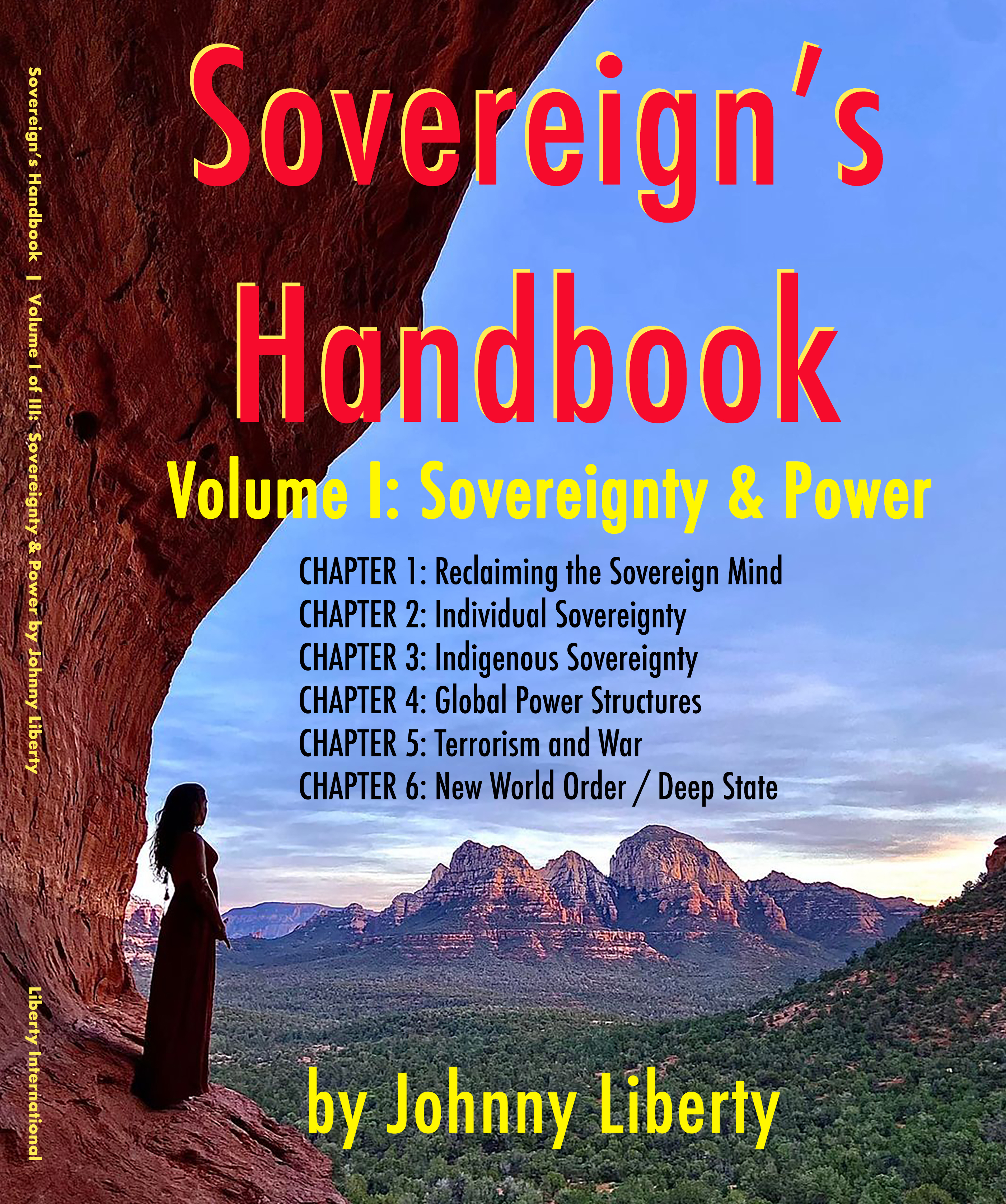
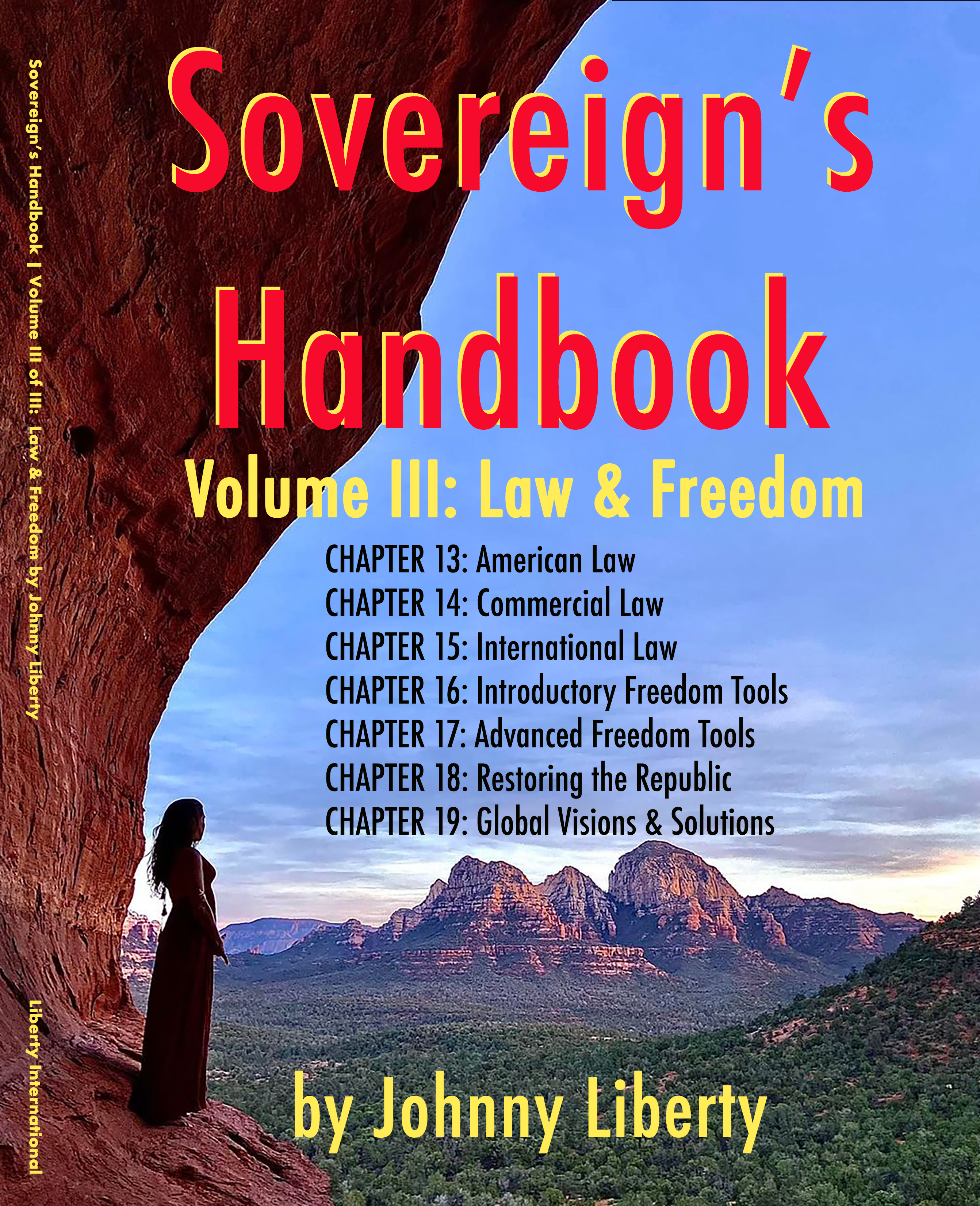
Sovereign’s Handbook by Johnny Liberty (30th Anniversary Edition) (3-Volume Printed, Bound Book or PDF)
A three-volume, 750+ page tome with an extensive update of the renowned underground classic ~ the Global Sovereign’s Handbook. Still after all these years, this is the most comprehensive book on sovereignty, economics, law, power structures and history ever written. Served as the primary research behind the best-selling Global One Audio Course. Available Now!
Dawning of the Corona Age: Navigating the Pandemic by Johnny Freedom (3rd Edition) (Printed, Bound Book or PDF)
This comprehensive book, goes far beyond the immediate impact of the “pandemic”, but, along with the reader, imagines how our human world may be altered, both positively and negatively, long into an uncertain future. Available Now!
So, now it is out in the open. The German Foreign Minister has stated that we are at war with Russia.
The mainstream media was too concerned with the usual dross to notice, but this means that World War III has officially started.
On the day that Germany announced WWIII, the leading section of the BBC’s news site carried no mention of the German Foreign Minister’s announcement but managed to find space for the following headlines: ‘Homeowner’s fury over sofa wedged in stairs’ and ‘BBC News Presenter gets emotional in last ever sign off’.
And once again, for the third time, a world war was officially started by Germany.
This is no big surprise. I mentioned many months ago that German citizens were hearing Air Raid Warning signals being tested.
And, of course, many months ago, the UK and the US pulled out of peace talks and abandoned any attempt to negotiate a settlement with Russia.
US President Biden and European Ministers and the UK are all sending tanks to Ukraine (one of the most corrupt countries in the world) to fight Russia. (Biden, of course, has financial links with the Ukraine.)
The odd thing is that the Ukraine has over 1,000 tanks already. So the few dozen the West is sending – and which will take months to arrive – will not make a great deal of difference. This is a tactical donation. Military experts claim that some of the promised arms will take nearly three years to arrive in the Ukraine. Is that a sign of how long the West is hoping this war will last?
And, of course, those tanks will need trained soldiers. You can’t just hand over tanks and expect the Ukrainians to know how to use them. Apart from anything else, Ukraine has very few soldiers left. Around 150,000 Ukranian soldiers have been killed and several hundred thousand have been wounded. (In comparison, of the 600,000 Russian soldiers in Ukraine, between 16,000 to 25,000 have died.)
But the tanks aren’t enough for Ukraine.
Ukraine, which is losing its war, now wants warships, submarines and planes.
Sovereign’s Handbook by Johnny Liberty (30th Anniversary Edition) (3-Volume Printed, Bound Book or PDF)
A three-volume, 750+ page tome with an extensive update of the renowned underground classic ~ the Global Sovereign’s Handbook. Still after all these years, this is the most comprehensive book on sovereignty, economics, law, power structures and history ever written. Served as the primary research behind the best-selling Global One Audio Course. Available Now!
Dawning of the Corona Age: Navigating the Pandemic by Johnny Freedom (3rd Edition) (Printed, Bound Book or PDF)
This comprehensive book, goes far beyond the immediate impact of the “pandemic”, but, along with the reader, imagines how our human world may be altered, both positively and negatively, long into an uncertain future. Available Now!
If you have ever heard talk or been to a seminar about “sovereignty”, then very likely those conversations were influenced by the foundational research of the author and educator.
His research and educational journey reaching millions of people worldwide began in 1992 and culminated in 2022 with the 3-Volume book release – his final word on the subject.
At the turn of the millennium his books and audio courses facilitated in part – a sovereignty and tax-honesty movement that involved millions of Americans.
This 3 Volume series comprises the life’s work of Johnny Liberty filled with comprehensive insights into the last few hundred years of history, law, economics, money, citizenship and governance.
These books show how it is supposed to be done in a constitutional Republic.
How did We the People get to where we are today?
What can we do to reclaim our inherent sovereignty and natural rights?
Many of the answers may be found within these revolutionary pages. Available as a paperback, E-Book (PDF) or an Amazon Kindle format. Thank you for supporting the author.
Sincerely,
With Freedom For All, ~ Johnny Liberty
Sovereign’s Handbook by Johnny Liberty (30th Anniversary Edition)
A three-volume, 750 page tome with an extensive update of the renowned underground classic ~ the Global Sovereign’s Handbook.
Still after all these years, it is the most comprehensive book on sovereignty, economics, law, power structures and history ever written.
Served as the primary research behind the best-selling Global One Audio Course.
The 3 Volume Sovereign’s Handbook by Johnny Liberty is textbook material for everyone including educators/teachers, homeschoolers, historians, activists, leaders/politicians, attorneys/judges/law schools, police officers, and state Citizens/Nationals.
Sovereign’s Handbook by Johnny Liberty (30th Anniversary Edition) (3-Volume Printed, Bound Book or PDF)
A three-volume, 750+ page tome with an extensive update of the renowned underground classic ~ the Global Sovereign’s Handbook. Still after all these years, this is the most comprehensive book on sovereignty, economics, law, power structures and history ever written. Served as the primary research behind the best-selling Global One Audio Course. Available Now!
Dawning of the Corona Age: Navigating the Pandemic by Johnny Freedom (3rd Edition) (Printed, Bound Book or PDF)
This comprehensive book, goes far beyond the immediate impact of the “pandemic”, but, along with the reader, imagines how our human world may be altered, both positively and negatively, long into an uncertain future. Available Now!
Zelenskyy recently described Putin’s “de-Nazification” of Ukraine as “laughable” and the brainwashed flock of the mainstream media certainly must agree.
They have been told that Nazis wave the American flag and vote Republican and the brainwashed flock always believe what they are told.
But those of us still cleaving to our sanity remember that Nazis were members of Hitler’s National Socialist Party from the 1930s and ’40s.
And not only were there thousands of Nazis in Western Ukraine back then, it is still a big part of their national pride.
Nazi war criminal, Stepan Bandera is a national hero and there are actual Nazi organizations still thriving in Ukraine, including the Azov Regiment, which is now a part of Ukraine’s armed forces.
The Nazification of Ukraine is well-documented and easily-verified, as is the Nazification of America.
During the 1930s, there were many notable Americans who supported the Nazis, such as Prescott Bush, Henry Ford and Fred Koch; banks, such as JP Morgan and Chase Manhattan; companies such as General Motors, Standard Oil, Shell and IBM.
Major General Smedley Butler of the US Marines was asked by these powerful entities to install National Socialism in the United States and when that plan failed, war broke out with the support of the banks and these American entities.
After World War II, only about a dozen were brought to justice at the Nuremberg Trials.
The Catholic Church and the Vatican helped thousands of Nazis evade capture, via the rat lines, which brought them mostly to South America, where they built an entire town in Argentina.
In Operation Paperclip, the United States secretly absorbed thousands of Nazis into the US Government, where they led the NASA Space Program and helped pioneer the military-industrial complex, as well as Big Pharma.
Many believe being a Nazi is synonymous with being anti-Jewish, which may have been true in 1930s Germany but it’s complicated. Many high-ranking Nazis, themselves, including Adolf Hitler were Ashkenazi Jews, who cold be traced back to the notorious Khazars, who mysteriously mass-converted to Judaism about 1,300 years ago in the region now known as Ukraine.
Ashkenazi Jews ran the political Zionist Party in Germany and for several years, the Zionists were the only political party allowed to operate inside Germany by the Nazis.
Both the Zionists and the Nazis wanted their own ethnically-pure state and for years, before their Final Solution, the Nazis helped the Zionists in their efforts to establish the State of Israel within Palestine. It was far more complicated than mere racial hatred.
Nazism can best be described as Fascism and Fascism is godlessness. The word “Nazi” is a made-up slur but the word “Fascist” is clearly-defined. It stems from the Latin word, “Fascis”, which is a bundle of sticks banded together to form a deadly weapon; an old school meme that represents the deadly power of an organized mob, a gang.
When men lack a personal relationship with God, they inevitably band together, out of fear, submitting to the small man for a taste of dominance, they become just another beast in the jungle.
And today, we can clearly see this Fascist mentality in all of these godless groups: the woke, the Satanists, the transhumanists and the genocidal mass-murderers of the Great Reset are all merging together into one giant fascis; godless men and women banded together out of fear; Fascists serving the straw man.
Spiritually-speaking, these are the weakest among us and so far, we’re allowing them to destroy everything.
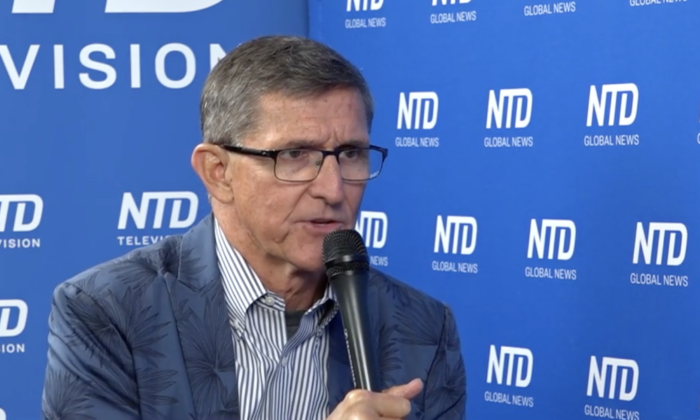
The current Russian invasion of Ukraine could have been avoided, and it demonstrates a failure that the U.S. leadership couldn’t effectively communicate with its Russian counterpart, according to Gen. Michael Flynn, a retired Army lieutenant general who briefly served as the National Security Advisor to former President Donald Trump.
“Russia, Ukraine, Europe … what’s happening? At the 60,000-foot level, this is a totally avoidable war. Totally avoidable,” Flynn recently told NTD’s “Capitol Report” program.
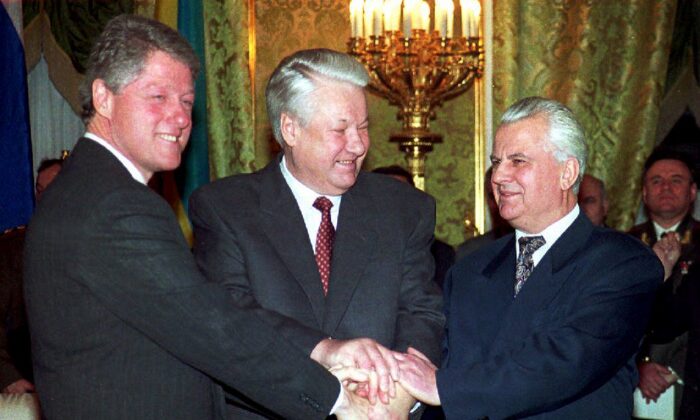
“It really goes back to 1994, what was called the Budapest Accords, in Budapest, Hungary, at the end of the Cold War,” said Flynn.
On Dec. 5, 1994, Russia, the United Kingdom, and the United States signed an agreement with Ukraine called The Budapest Memorandum on Security Assurances in Budapest, Hungary. The three nuclear powers gave their assurances on independence and sovereignty of Ukraine in exchange for removing all nuclear weapons from its territory and becoming a member of the Treaty on the Non-Proliferation of Nuclear Weapons. Two other nuclear powers, China and France, gave their assurances in separate documents.
These nuclear powers also signed identical security assurances with Belarus and Kazakhstan at the time.
U.S. President Bill Clinton (L), Russian President Boris Yeltsin (C), and Ukrainian counterpart Leonid M. Kravchuk (R) join hands after signing the nuclear disarmament agreement in the Kremlin in Moscow, Russia, on Jan. 14, 1994. Under the agreement, Ukraine, the world’s third-largest nuclear power, said it would turn all of its strategic nuclear arms over to Russia for destruction. (Sergei Supinsky/AFP via Getty Images)
“One of the big-ticket items that came out of the Budapest accords was no further encroachment of NATO against this new Russian Federation,” Flynn said, explaining that no country leaders wanted to have nuclear missiles across the boundary between Russia and European countries.
The Budapest Memo (pdf) didn’t mention the NATO expansion. However, Western leaders had promised no NATO eastward expansion throughout the process of German unification in 1990 and on into 1991. The most famous one is then-Secretary of State James Baker’s “not one inch eastward” assurance about NATO expansion in his meeting with Soviet leader Mikhail Gorbachev on February 9, 1990.
According to recently declassified documents by the National Security Archive at George Washington University published on Nov. 24, 2021, before and after the Budapest meeting in 1994, then-President Bill Clinton kept assuring then-Russian President Boris Yeltsin that any NATO enlargement would be slow, with no surprises, building a Europe that was inclusive not exclusive, and in “partnership” with Russia.
In a Sep. 28, 1994 conversation, Clinton told Yeltsin that he had never said that Russia could not be considered for NATO membership, and that “when we talk about NATO expanding, we are emphasizing inclusion, not exclusion,” and “there is no imminent timetable.”
In a Nov. 30, 1994, letter to Clinton, Yeltsin said, “We have agreed with you that there will be no surprises, that first we should pass through this phase of partnership, whereas issues of further evolution of NATO should not be decided without due account to the opinion and interests of Russia.”
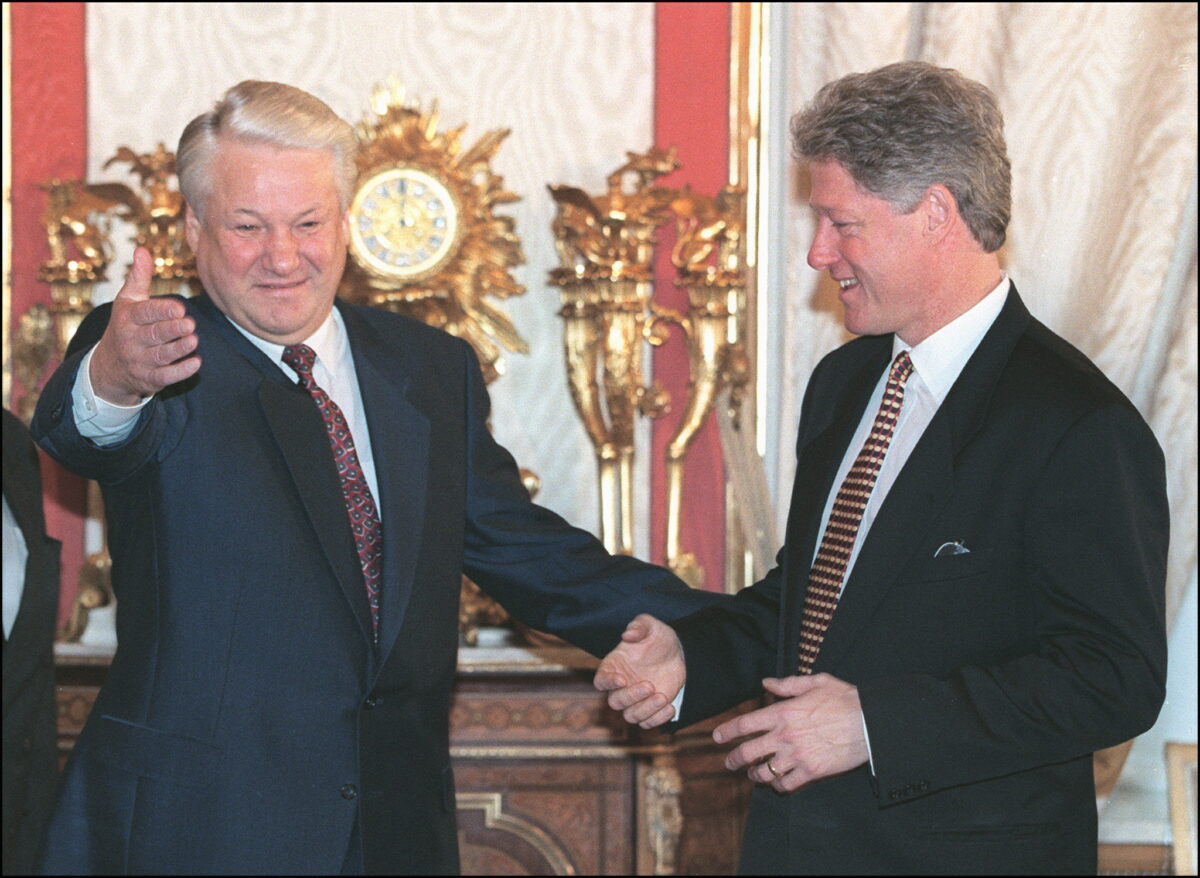
U.S. President Bill Clinton (R) and Russian President Boris Yeltsin greet each other in the Green room at the Kremlin in Moscow, Russia, on Jan. 13, 1994. (Luke Frazza/AFP via Getty Images)
The war also shows the Biden administration’s failure to communicate with Russia in an effective way to prevent the escalation of the Ukraine situation, said Flynn.
“War is a failure of policy and diplomacy,” said Flynn. “Anytime you see states, nations, nation-states, at war with each other, it’s because there’s a failure to communicate some way somehow. And that’s what happened.”
Flynn said Russian President Vladimir Putin kept saying Ukraine shouldn’t join NATO and it should declare neutrality, but “we won’t come into play here, and they never did.”
Current Ukrainian President Volodymyr Zelenskyy had pushed for joining NATO after taking office. Joining NATO and the European Union has been put into the constitution of Ukraine during his tenure.
Last month, Zelenskyy said his country has to accept that it will not become a member of NATOIn a Mar. 26 speech in Poland, Biden said of Putin, “For God’s sake, this man cannot remain in power.”
“Immediately after he said it, they had to start walking it back. They had to start walking it back,” said Flynn. “Because it’s so wrong to say that.”
The White House and the State Department clarified that Biden didn’t talk about regime change.
Biden defended himself two days later.
“I want to make it clear: I wasn’t then, nor am I now, articulating a policy change. I was expressing the moral outrage that I feel, and I make no apologies for it,” Biden said.
No country has successfully challenged the U.S. dollar’s global hegemony—until now. How did this happen and what will it mean?
Foreign critics have long chafed at the “exorbitant privilege” of the U.S. dollar as global reserve currency. The U.S. can issue this currency backed by nothing but the “full faith and credit of the United States.” Foreign governments, needing dollars, not only accept them in trade but buy U.S. securities with them, effectively funding the U.S. government and its foreign wars. But no government has been powerful enough to break that arrangement – until now. How did that happen and what will it mean for the U.S. and global economies?
The Rise and Fall of the PetroDollar
First, some history: The U.S. dollar was adopted as the global reserve currency at the Bretton Woods Conference in 1944, when the dollar was still backed by gold on global markets. The agreement was that gold and the dollar would be accepted interchangeably as global reserves, the dollars to be redeemable in gold on demand at $35 an ounce. Exchange rates of other currencies were fixed against the dollar.
But that deal was broken after President Lyndon Johnson’s “guns and butter” policy exhausted the U.S. kitty by funding war in Vietnam along with his “Great Society” social programs at home. French President Charles de Gaulle, suspecting the U.S. was running out of money, cashed in a major portion of France’s dollars for gold and threatened to cash in the rest; and other countries followed suit or threatened to.
In 1971, President Richard Nixon ended the convertibility of the dollar to gold internationally (known as “closing the gold window”), in order to avoid draining U.S. gold reserves. The value of the dollar then plummeted relative to other currencies on global exchanges. To prop it up, Nixon and Secretary of State Henry Kissinger made a deal with Saudi Arabia and the OPEC countries that OPEC would sell oil only in dollars, and that the dollars would be deposited in Wall Street and City of London banks. In return, the U.S. would defend the OPEC countries militarily. Economic researcher William Engdahl also presents evidence of a promise that the price of oil would be quadrupled. An oil crisis triggered by a brief Middle Eastern war did cause the price of oil to quadruple, and the OPEC agreement was finalized in 1974.
The deal held firm until 2000, when Saddam Hussein broke it by selling Iraqi oil in euros. Libyan president Omar Qaddafi followed suit. Both presidents wound up assassinated, and their countries were decimated in war with the United States. Canadian researcher Matthew Ehret observes:
We should not forget that the Sudan-Libya-Egypt alliance under the combined leadership of Mubarak, Qadhafi and Bashir, had moved to establish a new gold-backed financial system outside of the IMF/World Bank to fund large scale development in Africa. Had this program not been undermined by a NATO-led destruction of Libya, the carving up of Sudan and regime change in Egypt, then the world would have seen the emergence of a major regional block of African states shaping their own destinies outside of the rigged game of Anglo-American controlled finance for the first time in history.
The Rise of the PetroRuble
The first challenge by a major power to what became known as the petrodollar has come in 2022. In the month after the Ukraine conflict began, the U.S. and its European allies imposed heavy financial sanctions on Russia in response to the illegal military invasion. The Western measures included freezing nearly half of the Russian central bank’s 640 billion U.S. dollars in financial reserves, expelling several of Russia’s largest banks from the SWIFT global payment system, imposing export controls aimed at limiting Russia’s access to advanced technologies, closing down their airspace and ports to Russian planes and ships, and instituting personal sanctions against senior Russian officials and high-profile tycoons. Worried Russians rushed to withdraw rubles from their banks, and the value of the ruble plunged on global markets just as the U.S. dollar had in the early 1970s.
The trust placed in the U.S. dollar as global reserve currency, backed by “the full faith and credit of the United States,” had finally been fully broken. RussianPresident Vladimir Putin said in a speech on March 16 that the U.S. and EU had defaulted on their obligations, and that freezing Russia’s reserves marks the end of the reliability of so-called first class assets. On March 23, Putin announced that Russia’s natural gas would be sold to “unfriendly countries” only in Russian rubles, rather than the euros or dollars currently used. Forty-eight nations are counted by Russia as “unfriendly,” including the United States, Britain, Ukraine, Switzerland, South Korea, Singapore, Norway, Canada and Japan.
Putin noted that more than half the global population remains “friendly” to Russia. Countries not voting to support the sanctions include two major powers – China and India – along with major oil producer Venezuela, Turkey, and other countries in the “Global South.” “Friendly” countries, said Putin, could now buy from Russia in various currencies.
On March 24, Russian lawmaker Pavel Zavalny said at a news conference that gas could be sold to the West for rubles or gold, and to “friendly” countries for either national currency or bitcoin.
Energy ministers from the G7 nations rejected Putin’s demand, claiming it violated gas contract terms requiring sale in euros or dollars. But on March 28, Kremlin spokesman Dmitry Peskov said Russia was “not engaged in charity” and won’t supply gas to Europe for free (which it would be doing if sales were in euros or dollars it cannot currently use in trade). Sanctions themselves are a breach of the agreement to honor the currencies on global markets.
Bloomberg reports that on March 30, Vyacheslav Volodin, speaker of the lower Russian house of parliament, suggested in a Telegram post that Russia may expand the list of commodities for which it demands payment from the West in rubles (or gold) to include grain, oil, metals and more. Russia’s economy is much smaller than that of the U.S. and the European Union, but Russia is a major global supplier of key commodities – including not just oil, natural gas and grains, but timber, fertilizers, nickel, titanium, palladium, coal, nitrogen, and rare earth metals used in the production of computer chips, electric vehicles and airplanes.
On April 2, Russian gas giant Gazprom officially halted all deliveries to Europe via the Yamal-Europe pipeline, a critical artery for European energy supplies.
U.K. professor of economics Richard Werner calls the Russian move a clever one – a replay of what the U.S. did in the 1970s. To get Russian commodities, “unfriendly” countries will have to buy rubles, driving up the value of the ruble on global exchanges just as the need for petrodollars propped up the U.S. dollar after 1974. Indeed, by March 30, the ruble had already risen to where it was a month earlier.
A Page Out of the “American System” Playbook
Russia is following the U.S. not just in hitching its national currency to sales of a critical commodity but in an earlier protocol – what 19th century American leaders called the “American System” of sovereign money and credit. Its three pillars were (a) federal subsidies for internal improvements and to nurture the nation’s fledgling industries, (b) tariffs to protect those industries, and (c) easy credit issued by a national bank.
Michael Hudson, a research professor of economics and author of “Super-Imperialism: The Economic Strategy of American Empire” among many other books, notes that the sanctions are forcing Russia to do what it has been reluctant to do itself – cut reliance on imports and develop its own industries and infrastructure. The effect, he says, is equivalent to that of protective tariffs. In an article titled “The American Empire Self-destructs,” Hudson writes of the Russian sanctions (which actually date back to 2014):
Russia had remained too enthralled by free-market ideology to take steps to protect its own agriculture or industry. The United States provided the help that was needed by imposing domestic self-reliance on Russia (via sanctions). When the Baltic states lost the Russian market for cheese and other farm products, Russia quickly created its own cheese and dairy sector – while becoming the world’s leading grain exporter.
Russia is discovering (or is on the verge of discovering) that it does not need U.S. dollars as backing for the ruble’s exchange rate. Its central bank can create the rubles needed to pay domestic wages and finance capital formation. The U.S. confiscations thus may finally lead Russia to end neoliberal monetary philosophy, as Sergei Glaziev has long been advocating in favor of MMT [Modern Monetary Theory]. …
What foreign countries have not done for themselves – replacing the IMF, World Bank and other arms of U.S. diplomacy – American politicians are forcing them to do. Instead of European, Near Eastern and Global South countries breaking away out of their own calculation of their long-term economic interests, America is driving them away, as it has done with Russia and China.
Glazyev and the Eurasian Reset
Sergei Glazyev, mentioned by Hudson above, is a former adviser to President Vladimir Putin and the Minister for Integration and Macroeconomics of the Eurasia Economic Commission, the regulatory body of the Eurasian Economic Union (EAEU). He has proposed using tools similar to those of the “American System,” including converting the Central Bank of Russia to a “national bank” issuing Russia’s own currency and credit for internal development. On February 25, Glazyev published an analysis of U.S. sanctions titled “Sanctions and Sovereignty,” in which he stated:
[T]he damage caused by US financial sanctions is inextricably linked to the monetary policy of the Bank of Russia …. Its essence boils down to a tight binding of the ruble issue to export earnings, and the ruble exchange rate to the dollar. In fact, an artificial shortage of money is being created in the economy, and the strict policy of the Central Bank leads to an increase in the cost of lending, which kills business activity and hinders the development of infrastructure in the country.
Glazyev said that if the central bank replaced the loans withdrawn by its Western partners with its own loans, Russian credit capacity would greatly increase, preventing a decline in economic activity without creating inflation.
Russia has agreed to sell oil to India in India’s own sovereign currency, the rupee; to China in yuan; and to Turkey in lira. These national currencies can then be spent on the goods and services sold by those countries. Arguably, every country should be able to trade in global markets in its own sovereign currency; that is what a fiat currency is – a medium of exchange backed by the agreement of the people to accept it at value for their goods and services, backed by the “full faith and credit” of the nation.
But that sort of global barter system would break down just as local barter systems do, if one party to the trade did not want the goods or services of the other party. In that case, some intermediate reserve currency would be necessary to serve as a medium of exchange.
Glazyev and his counterparts are working on that. In a translated interview posted on The Saker, Glazyev stated:
We are currently working on a draft international agreement on the introduction of a new world settlement currency, pegged to the national currencies of the participating countries and to exchange-traded goods that determine real values. We won’t need American and European banks. A new payment system based on modern digital technologies with a blockchain is developing in the world, where banks are losing their importance.
Russia and China have both developed alternatives to the SWIFT messaging system from which certain Russian banks have been blocked. London-based commentator Alexander Mercouris makes the interesting observation that going outside SWIFT means Western banks cannot track Russian and Chinese trades.
It was a long time coming, but finally some key lineaments of the multipolar world’s new foundations are being revealed.
On Friday [March 11], after a videoconference meeting, the Eurasian Economic Union (EAEU) and China agreed to design the mechanism for an independent international monetary and financial system. The EAEU consists of Russia, Kazakhstan, Kyrgyzstan, Belarus and Armenia, is establishing free trade deals with other Eurasian nations, and is progressively interconnecting with the Chinese Belt and Road Initiative (BRI).
For all practical purposes, the idea comes from Sergei Glazyev, Russia’s foremost independent economist ….
Quite diplomatically, Glazyev attributed the fruition of the idea to “the common challenges and risks associated with the global economic slowdown and restrictive measures against the EAEU states and China.”
Translation: as China is as much a Eurasian power as Russia, they need to coordinate their strategies to bypass the US unipolar system.
The Eurasian system will be based on “a new international currency,” most probably with the yuan as reference, calculated as an index of the national currencies of the participating countries, as well as commodity prices. …
The Eurasian system is bound to become a serious alternative to the US dollar, as the EAEU may attract not only nations that have joined BRI … but also the leading players in the Shanghai Cooperation Organization (SCO) as well as ASEAN. West Asian actors – Iran, Iraq, Syria, Lebanon – will be inevitably interested.
Exorbitant Privilege or Exorbitant Burden?
If that system succeeds, what will the effect be on the U.S. economy? Investment strategist Lynn Alden writes in a detailed analysis titled “The Fraying of the US Global Currency Reserve System” that there will be short-term pain, but, in the long run, it will benefit the U.S. economy. The subject is complicated, but the bottom line is that reserve currency dominance has resulted in the destruction of our manufacturing base and the buildup of a massive federal debt. Sharing the reserve currency load would have the effect that sanctions are having on the Russian economy – nurturing domestic industries as a tariff would, allowing the American manufacturing base to be rebuilt.
Other commentators also say that being the sole global reserve currency is less an exorbitant privilege than an exorbitant burden. Losing that status would not end the importance of the U.S. dollar, which is too heavily embedded in global finance to be dislodged. But it could well mean the end of the petrodollar as sole global reserve currency, and the end of the devastating petroleum wars it has funded to maintain its dominance.
If the Russian army has won the war against the Banderites in Ukraine, NATO has won the cognitive war against its own citizens in the West. The Atlantic Alliance has developed a new form of propaganda based on what it denounced a short time ago: Fake News, that is to say not false information, but biased information. The question is, how to protect yourself from it?
THE NATO DEVICE
“Subduing the enemy by force is not the highest art of war, the highest art of war is to subdue the enemy without shedding a single drop of blood. ~ Sun Tzu, The Art of War.
French General Philippe Lavigne of NATO’s Allied Command Transformation (ACT) oversees research on new propaganda methods.
His command has 21 centers of excellence, including one for propaganda, the Strategic Communications Center of Excellence (STRATCOM) in Riga, Latvia. It has created the NATO Innovation Hub (iHub) under the direction of Frenchman Francois du Cluzel, a former professor at the Collège militaire interarmes de Coëtquidan. It funds research at John Hopkins University and Imperial College of London on cognitive abilities (similar cohorts who engineered the COVID-19 propaganda machine). This research covers the entire cognitive domain with various applications ranging from bionic soldiers to war propaganda.
NATO’s general idea is to add to the five usual domains of intervention (air, land, sea, space and cyber), a sixth: the human brain. “While actions in the five domains are carried out in order to have an effect on the human domain, the objective of cognitive warfare is to make each one a weapon,” writes François du Cluzel.
If war propaganda was based, during the First World War, on false information popularized by great writers; then on the repetition of selected messages during the Second World War; today it is conceived as an illusionist’s act. It is about moving people to distract their attention and hide from them what they should not see. They judge what they see with the uninteresting information they are fed. In this way, we manage, without lying to them, to make them take bladders for lanterns.
We are living the first application of this technique, on the occasion of the war (or Russian police action) in Ukraine.
To make myself understood, I will first present some information to be ignored, then come back on the treatment of the war by French State television. I would have obtained the same result if I had used a German, British or American example.
(Number of explosions recorded in Donbass (February 14-22, 2022)
THE RESPONSIBILITY OF WESTERN LEADERS FOR THE WAR IN UKRAINE
In the West, the narrative of the war in Ukraine places all the blame solely on the Russian president, Vladimir Putin, and secondarily on the political and financial figures of his regime. However, this version is clearly false if one considers the daily reports of the observers of the Organization for Security and Cooperation in Europe (OSCE).
They testified that they heard an attack from the Donbass (still Ukrainian) by Kiev forces on the afternoon of February 17. All news agencies reported that at least 100,000 civilians had fled into the Donbass or to Russia. In addition, the main political leaders of NATO heard Ukrainian President Volodymyr Zelenskyy tell them at the Munich Security Conference that he intended to acquire nuclear weapons against Russia. It is clear that it was not Moscow, but Kiev, that triggered the hostilities.
No one can imagine that Kiev has unleashed this war against a far superior enemy without having received prior assurances from allies apparently capable of defending the country against Russia. This can only be NATO or the United States and possibly the other two nuclear powers, France and the United Kingdom.
The first meeting where this war was presented as desirable was held to our knowledge in the House of Representatives on September 5, 2019. It was organized by the Rand Corporation, the think tank of the US military-industrial lobby. The purpose was to present two reports, “Overextending and Unbalancing Russia” and “Extending Russia: Competing from Advantageous Ground” to the congressmen/women. The main idea is to use against it the particularity on which Russia bases its defense. Since it is a huge territory that the Russians defend by moving around and practicing the “scorched earth strategy”, it is enough to force them to move abroad to exhaust them.
The importance of this event is shown to us by the incident that affected our collaborator, the Italian geographer Manlio Dinucci. His article on the subject was censored by his newspaper, Il Manifesto, which he had to leave.
Three events attest to the involvement of the United States, the United Kingdom and France in the secret preparation of the war.
On March 24, 2022, a video of a 22-minute telephone conversation between the British Minister of Defense, Ben Wallace, and two Russian comedians Vladimir (Vovan) Kuznetsov and Alexei (Lexus) Stolyarov was published. One of the Russians was posing as the Ukrainian Prime Minister, Denys Shmyhal, whom Wallace never met.
1) Asked whether the UK would help Kiev to acquire nuclear weapons, the Rt. Hon. Wallace replied that he had to consult with Prime Minister Boris Johnson and that “The principle is that we will support Ukraine as a friend in whatever choice you make.”. In one sentence, he swept aside the Nuclear Non-Proliferation Treaty (NNPT). 2) On the subject of the Next generation Light Anti-tank Weapon (NLAW) missiles that the United Kingdom has just sent to the Ukrainian army, Ben Wallace admitted that they were not working properly and that spare parts had also been sent. 3) But it is especially on the subject of NATO that Ben Wallace’s language has been too prolix. The British minister once again invited Ukraine to join the Atlantic Alliance. In passing, he unwittingly revealed that the United Kingdom had been sending military instructors to prepare the Ukrainian army for several years.
Boris Johnson’s government used every means at its disposal to conceal, or rather minimize, these statements. It claimed that the interview lasted only 10 minutes and forbade YouTube/Google to broadcast the entire sketch. The Western media was asked to talk about his blunder on the atomic bomb and to cover up the other two points. This is how the British always do it: not to deny everything, but to make the most dangerous points disappear.
On March 25, 2022, President Joe Biden visited the Congress Palace in Rzeszów, Poland. He was accompanied by the director of USAID, Samantha Power (former ambassador to the UN), and the Polish president, Andrej Duda. It is worth noting that Andrej Duda had his parliament passed a law denying the role of the Polish state in Nazi crimes and authorizing legal action against anyone who mentions them.
Joe Biden spoke with various NGOs to praise their assistance to Ukrainian refugees. Afterwards, he gave a speech to his soldiers of the 82nd Airborne Division, stationed there. He also visited them in the dining hall and spoke to them without a teleprompter or cameras. As always at such times, the old man (79 years old) revealed state secrets. According to the witnesses, he thanked them for their commitment in Ukraine for a long time, even though officially there have never been any US soldiers in that country.
On March 29, 2022, General Eric Vidaud, director of French military intelligence, was dismissed. No official explanation was given. It seems that in reality, General Viaud had deployed men on the direct instruction of President Macron’s private staff, in 2021 when he was commander of special operations, to supervise the Azov Banderites regiment. Immediately, five Ukrainian helicopters tried to flee Mariupol, the stronghold of the Azov regiment. Two were shot down on March 30. The survivors were taken prisoner by the Russian army. They spoke immediately. The soldiers of the Special Operations Command are placed for all logistical matters under the orders of the Chief of Staff of the Armed Forces, General Thierry Burkhard, but they take their orders directly from the head of the armed forces, President Emmanuel Macron.
Afterwards, relations between Presidents Macron and Putin cooled sharply.
HOW WAR PROPAGANDA MASKS REALITY
In France the state has France-Télévision for its own population, with France-2 being the most watched channel, and France Médias Monde for abroad. The latter group depends directly on the Ministry of Foreign Affairs and broadcasts France-24 in several languages.
To begin with, France 2 proposed a live newscast from Lviv (Ukraine) presented by its star, Anne-Sophie Lapix, on March 14, 2022 [6]. This newscast gathers every day a little more than 20% of the public. The young woman showed a lot of destruction and traumatized refugees. She walked through the city, but did not notice the imposing monument to Stepan Bandera, the leader of the Ukrainian Nazi collaborators. She also questioned the mayor of Lviv, Andriy Sadovy, without explaining that he is one of the country’s leading oligarchs. She did not ask him about his media group, of which his wife is the director. So she did not ask him about the remarks made the previous day on his channel, 24 Канал, calling for the killing of all Russians, women and children included, according to the method advocated by SS Adolf Eichman. At no time was it specified that this program was an initiative of the Banderite oligarch Andriy Sadovy and his wife, both former clients of the Publicis agency of Arthur Sadoun, the husband of Anne-Sophie Lapix.
The viewer who ignores Ukrainian tributes to the Nazis and exhortations to follow their example can only weep at the accumulation of suffering that was shown to him. He cannot doubt that the Russians are liars and criminals and that Ukrainians in general are innocent victims.
On March 25, France 24 in English, in its column Truth or Fake, reported on the interview of British Defense Minister Ben Wallace by Russian comedians. Following the instructions of Boris Johnson’s cabinet, the French Foreign Ministry’s television channel mocked his statements on the atomic bomb in order to better conceal those on the inefficiency of his anti-tank weapons and especially those on the presence of British military instructors in Ukraine for several years. The journalist presented the comedians as youtubers, whereas they work for the NTV channel, which allowed her not to mention that they are censored on YouTube in the country of the 1st amendment and freedom of expression. The column was produced by journalist Catalina Marchant de Abreu, a specialist in debunking fake news (sic)
The peak was reached on March 31 with France 2 news. France-Television, which until now denied the ideological character of the Azov regiment, broadcast a report on this formation. The public television admitted that it had, in 2014, been infiltrated by neo-Nazi elements, citing one of its founders, Andriy Biletsky, but assured that it had since changed into a respectable Defense force. France-2 did not mention one of its other founders, Dmytro Yarosh, a NATO agent and former coordinator of European neo-Nazis and Middle Eastern jihadists against Russia, who has become a special advisor to the commander-in-chief of the Ukrainian armies.
France-2 referred to an old UN report on torture, but not to the discovery of his special prisons by the Russian army, nor to recent UN statements on the subject. The report also failed to explain what Banderites are in Ukrainian history and reduced the importance of neo-Nazis to the wearing of the swastika. Having thus glossed over the problem, the channel estimated the danger to be between 3,000 and 5,000 men, while Reuters assures us that the Banderite paramilitaries today represent 102,000 men divided into numerous militias incorporated into the Territorial Defense.





 Liberty International News