Study touts planting 1 trillion trees as most effective climate change solution | The Hill

Healthy green trees in a forest of old spruce, fir and pine trees in wilderness of a national park. Sustainable industry, ecosystem and healthy environment concepts and background.

The cheapest way to halt the effects of climate change could be planting 1 trillion trees, according to a new study.

The study in the journal Science, first reported by The Associated Press, found that planting trees could be the most effective way to remove carbon from the atmosphere, but cautioned that it would have little effect without a reduction of emissions around the globe.

“This is by far — by thousands of times — the cheapest climate change solution” study co-author Thomas Crowther, an ecologist at the Swiss Federal Institute of Technology, said.

“It’s certainly a monumental challenge, which is exactly the scale of the problem of climate change,” he added.

Though, Crowther cautioned, “None of this works without emissions cuts.”

Scientists with the United Nations have called for a major reduction in carbon emissions over the next decade to stave off the worst effects of climate change, including rising sea levels and dangerous weather phenomena.

Lawmakers around the world have debated on how to address the issue, and in 2017 the U.S. withdrew from a major accord meant to battle climate change due to President Trump‘s opposition to the pact.

Democratic candidates for president, including former Vice President Joe Biden, have called for the U.S. to rejoin the agreement. Progressives are pushing an ambitious plan to cut U.S. carbon emissions, the Green New Deal, introduced earlier this year by Sen. Ed Markey (D-Mass.) and Rep. Alexandria Ocasio-Cortez (D-N.Y.).

If enacted, the Green New Deal calls for the transition of America’s energy grid away from fossil fuels to renewable energy.

Source: The Hill
Plans To Release Entire Fukushima Waste Into Ocean Confirmed By Tepco | Social Consciousness

Editor’s Note: The dumping of highly radioactive material in the Pacific Ocean from Japan’s Fukushima has been occurring for years with no plans to stop dumping or bio-remediate this massive problem for all life in our oceans. This is yet another by-product of civilization which has been ignored by government, scientists and climate-change activists.  

Tepco has confirmed it plans to release the radioactive material from the Fukushima plant into the ocean saying that the “decision has already been made”. The decision has an upset local fisherman who says the decision will kill their industry as a result of a massive loss of sea life.

Under the controversial plan, which could be a massive environmental disaster, the radioactive material tritium, which is being used to cool reactors whose cooling systems were damaged in 2011 tsunami, will now be released into the ocean.

rt.com reports: “I’m very sorry that Tepco has been prolonging making a decision,” the new chairman of Tokyo Electric Power Company Holdings (TEPCO) Takashi Kawamura told reporters on Thursday, reported Reuters. “We could have decided much earlier, and that is Tepco’s responsibility.”

The plan still requires the approval of the Japanese government before TEPCO can proceed. Some 770,000 tons (metric) of tritium-containing water is currently stored in 580 tanks at the plant, reported the Japan Times. Toxic water at the plant is currently being treated through a processing system that can remove 62 different types of radioactive material, except tritium.

The local fishermen cooperative has hit out at the plan, saying it had not been discussed with local residents. “Releasing (tritium) into the sea will create a new wave of unfounded rumors, making our efforts all for naught,” Kanji Tachiya, head of a local fishermen cooperative, told the Japan Times.

Situated 10 meters above sea-level, three of the nuclear power plant’s six reactors’ cooling systems were crippled by flooding caused by the tsunami, making the disaster the worst since the Chernobyl catastrophe in the USSR in 1986.

The plan still requires the approval of the Japanese government before TEPCO can proceed. Related: Fukushima Radiation: The Entire Pacific Ocean Has Been Contaminated, And It’s Going To Get Worse Fukushima Radiation: Your Days of Eating Pacific Ocean Fish Are Over, Or Worse Officials Warn: Fukushima Has Now Contaminated 1/3 Of The World’s Oceans

Source: Social Consciousness

US Gov’t: Alaska island “appears to show impacts from Fukushima” — “Significant cesium isotope signature” detected — Scientists anticipate more marine life to be impacted as ocean plume arrives | ENENEWS

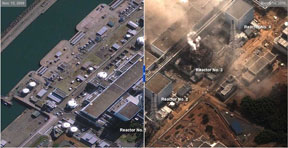
FukushimaDaiichi-BeforeAfter-288Amchitka Island, Alaska, Biological Monitoring Report 2011 Sampling Results
September 2013: To determine what [Fukushima Dai-ichi’s] direct release of radioactive materials into the atmosphere might have contributed to the background radiation on Amchitka and Adak Islands, semiquantitative gamma spectrometry measurements were made […] The results imply that Dolly Varden [a type of fish], rockweed, and to a lesser extent, Irish lord [a type of fish] appear to contain a significant cesium isotope signature from Fukushima Dai-ichi. The estimated 134Cs/137Cs activity ratios in pooled fauna samples at the time sampled ranged from <30 to about 60 percent. Observations of Fukushima-derived fallout impacting on this region are supported by findings of elevated levels of 134Cs (and 137Cs) in lichen and soil collected from both the Adak and Amchitka regions. […]

Lichen sample from mid-2011 expressed in picocuries/kilogram — Lichen on  the island had less than 70 pCi/kg of Cs-137 in 1997.

Department of Energy:
Biological Monitoring at Amchitka Appears to Show Impacts from Fukushima Dai-ichi Incident […] The U.S. Department of Energy Office Legacy Management (LM) has a long-term stewardship mission to protect human health and the environment from the legacy of underground nuclear testing conducted at Amchitka Island, Alaska, from 1965 to 1971. […] Atmospheric monitoring in the United States showed elevated cesium activities shortly after the [Fukushima] nuclear incident. LM scientists anticipated that atmospheric transport of cesium would potentially increase the cesium activities in the 2011 biological samples collected near Amchitka. Because cesium-134 has a relatively short half-life of 2 years and indicates leakage from a nuclear reactor, it is a clear indicator of a recent nuclear accident […] Because the Amchitka 2011 sampling event occurred soon after the Fukushima nuclear accident, the biota impacted by atmospheric precipitation showed the greatest impact (e.g., species that live in freshwater or shallow ocean waters) when compared to marine biota living in deeper water. This is because ocean currents are a slower transport process than wind currents. LM scientists anticipate that the marine biota will show the impacts of Fukushima during the next sampling event, currently scheduled to occur in 2016. […]

Source: ENENEWS

State of Jefferson – The 51st State

A movement to combine the unique geographical and geopolitical regions of northern California and southern Oregon to form the new state – Jefferson. Northern California and Southern Oregon. The effort to re-unite the unique geographical and geopolitical subdivisions of northern California and southern Oregon into a more sensible and equitably represented state. This effort has been on-going since the 1850’s. Read more…

Republic of Cascadia

Now is the time for the citizens of Cascadia to demand their freedom from the oppressive governments of Canada and the United States. For too long have our people put up with indifference and condescendence from distant seats of power. We have been subject to francophonic imperialism and wasteful spending of our tax money. Our entrepreneurs have been attacked by the so-called justice system for merely doing their jobs and growing our economy. When will we say enough is enough?

The former American states of Oregon and Washington and the former Canadian province of British Columbia must join together as a sovereign nation. Only then can we have self-determination and take our rightful place in the Global Community. Read more…