Memo to My Liberal/Progressive Friends | Liberty International

SABy Johnny Liberty, Author of the Global Sovereign’s Handbook

“The test of a first-rate intelligence is the ability to hold two opposing ideas in the mind at the same time.” ~ F. Scott Fitzgerald

So sorry, but my “liberal/progressive” friends who blindly hate Trump have lost their minds (and their souls in the process).

My friends are so deceived by digesting and parroting years of negative, liberal/leftist media (e.g, New York Times, CNN, MSNBC, etc) that they are no longer able to think outside the box of their own mental conditioning. 

The critical thinking skills of many of my liberty/progressive friends are impaired. They do not think for themselves. They do not read news sources from a conservative perspective. They do not read Trump’s tweets directly. Thus they are blind to what’s actually going on.

My friends have willingly given up their sovereignty and now complain daily about everything beyond their control. They believe they are victims instead of empowered individuals with the power to make a difference.

My friends place their daily angst on Trump and use him as a convenient scapegoat for all that’s wrong in our world (and there are many more powerful players than Trump). They forget  who is actually responsible for what’s wrong in our world. We the People are responsible.

My friends can believe it or not, but Trump is a freedom fighter, the first sovereign President in your lifetime who has pledged his life and honor to defend this country against its many enemies, both foreign and domestic. Other Administrations have come and gone, but they’ve all been cohorts amongst those globalists bent on destroying this country. 

Now, many of my “liberal/progressive” friends are now domestic enemies blindly and foolishly allied with these forces towards destroying this country ~ the last free country on this earth.

My friends, take a good look at where you stand!

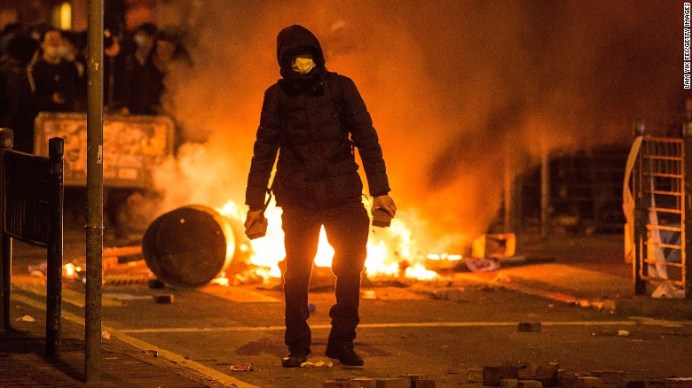
The violence ravaging the streets of America is no longer a protest about race. This is a declaration of war by forces bent on destroying the USA, a country which has blessed you with the right to freedom and liberty your entire life. 

Take notice of who is allying with these forces.

These riots are an organized attack against the people of the USA and my “liberal/progressive” friends are on the wrong side of this battle contributing en masse to America’s destruction. 

Would you prefer living in Nazi Germany or Communist China? Do you wish for your children to live in The Matrix wired to a machine like a robot without a soul?Take a good look at where you stand.

For without freedom and sovereignty in the USA there will be hell to pay for many generations beyond your life. Take a hard look at where you stand.

I stand for freedom and liberty.
I stand for sovereignty for all the people.
I stand for sovereignty for the USA and every nation of the world.

Where do you stand?

~ Johnny Liberty, Author of the Global Sovereign’s Handbook (who dedicated thirty years of his life fighting for your freedom and sovereignty)

Source: Liberty International

Three Ways Lockdowns Paved the Way for These Riots | MISES

160209115236-24-mong-kok-riot-0209-exlarge-169By Ryan McMaken

There were many reasons to oppose the COVID-19 lockdowns.

They cost human lives in terms of deferred medical treatmentThey cost human lives in terms of greater suicide and drug overdoses. Domestic abuse and child abuse have increased. There is also good reason to believe that lockdowns don’t actually work. The lockdown activists capitalized on media-stoked fear to push their authoritarian agenda based not on science, but on the whims of a handful of experts who insisted that they need not present any actual evidence that their bizarre, draconian, and extreme scheme was worth the danger posed to human rights, health, and the economic well-being of billions of human beings.

Those who lacked the obsessive and irresponsible tunnel vision of the prolockdown people warned that there were other dangers as well, in terms of social and political conflict.

[RELATED: “COVID Panic: The New War on Human Rights” by Ryan McMaken.]

It didn’t require an especially clear crystal ball to see that destroying the livelihoods of countless millions while empowering a police state to harass and arrest law-abiding citizens would create a situation that maybe—just maybe—could lead to greater social and political conflict.

Specifically, there are three ways in which the lockdowns laid the groundwork for our current state of unrest.

The Lockdowns Created an Economic Disaster

The COVID-19 stay-at-home orders, business closures, and other forms of coerced social distancing have so far led to job losses for well over 30 million Americans. The unemployment rate has risen to levels not seen since the Great Depression. Food banks are under strain as Americans line up for free food. Thanks to government moratoria on evictions in many areas, it is still unknown to what extent homeowners and renters are unable to pay mortgages and rents, but a wave of delinquencies is almost certainly coming.

To advocates of lockdowns, this is all “worth it” even though these sorts of economic stresses often lead to suicide, stress-induced disease, and death. But impoverishment, unemployment, and financial ruin are all merely “inconvenient,” as described by head lockdown advocate Anthony Fauci.

To someone who isn’t enamored of lockdowns, however, it is clear that millions of job losses are likely to worsen a variety of social ills, sometimes even resulting in violence. Moreover, the current job losses appear to be affecting the young and those who earn lower incomes most.

Lockdown advocates have attempted to avoid responsibility for all this by claiming that it is the pandemic itself that has caused the current economic disaster, and not the lockdowns. This is a baseless assertion. As has been shown, neither the pandemics of 1918 or 1958 led to the sorts of job losses and decline in economic growth that we’re now seeing.

The Lockdowns Destroyed Social Institutions

Another outcome of the lockdowns has been the destruction of American social institutions. These institutions include schools (both public and private), churches, coffee shops, bars, libraries, barbershops, and many others.

Lockdown advocates continue to claim that this is no big deal and insist that people just sit at home and “binge watch” television shows. But researchers have long pointed to the importance of these institutions in preserving peace and as a means of defusing social tensions and problems.

As much as lockdown advocates may wish that human beings could be reduced to creatures that do nothing more than work all day and watch television all night, the fact is that no society can long endure such conditions.

Human beings need what are known as “third places.” In a 2016 report, the Brookings Institution described what these places are:

the most effective ones for building real community seem to be physical places where people can easily and routinely connect with each other: churches, parks, recreation centers, hairdressers, gyms and even fast-food restaurants. A recent newspaper article on McDonald’s found that for lower-income Americans, the twin arches are becoming almost the equivalent of the English “pub,” which after all is short for “public house”: groups of retirees meeting for coffee and talk, they might hold regular Bible study meetings there, and people treat the restaurant as an inexpensive hangout.

Third places have a number of important community-building attributes. Depending on their location, social classes and backgrounds can be “leveled-out” in ways that are unfortunately rare these days, with people feeling they are treated as social equals. Informal conversation is the main activity and most important linking function. One commentator refers to third places as the “living room” of society.

The lockdown advocates, in a matter of a few days, cut people off from their third places and insisted, in many cases, that this would be the “new normal” for a year or more.

Yet, these third places cannot simply be shut down—and the public told to just forget about them indefinitely—without creating the potential for violence and other antisocial behavior.

Indeed, third places act as institutions that provide a type of social control that is key to a well-functioning society. In his trenchant book The Revolt of the Elites and the Betrayal of Democracy, historian and social critic Christopher Lasch described the importance of third places in communicating political and social values and conventions to young people, and in setting the bounds of acceptable behavior within the community. Lasch notes that these institutions are also important in defusing violent impulses among the young. Also of great importance is the fact that third places provide a means of social control that is voluntary and not a form of state coercion.

Writing in the 1990s, Lasch was lamenting the decline of third places, although he emphasized their importance even in their modern reduced form. Thanks to the lockdowns, however, these places have been crippled far beyond what Lasch might ever have imagined.

The Lockdowns Empowered the Police State

The lockdowns have created a situation in which millions of law-abiding citizens have been deemed criminals merely for seeking to make a living, leave their homes, or engage in peaceful trade.

In many areas, violations of the lockdown orders have been—or even still are, in many places—treated as criminal acts by police. This has greatly increased negative interactions between police and citizens who by no moral definition are criminals of any sort.

Many have already seen the stories: police arresting mothers for using playground equipment, police arresting business owners for using their own property, police beating people for the “crime” of standing on a sidewalk.

Complicating the issue is the apparent fact that police have not enforced social distancing edicts “uniformly.” Some have alleged, for example, that the NYPD has lopsidedly targeted nonwhites in enforcement:

Of the 40 people arrested [for social distancing violations in Brooklyn between March 17 and May 4, 35 were African American, 4 were Hispanic and 1 was white. The arrests were made in neighborhoods—Brownsville, Bedford-Stuyvesant, Cypress Hills and East New York—which have large concentrations of blacks and Latinos.

This may or may not reflect the reality of the general situation, but the fact is that the lockdowns created theperception among many that this is just yet another case of law enforcement targeting certain populations over small-time violations.

Moreover, it is quite plausible that lower-income populations have more often been on the receiving end of state harassment in the name of social distancing. After all, compliance with lockdowns is something of a luxury reserved for higher-income, white-collar residents who can work from home and remain comfortable for long periods in their roomy houses. Working-class people and those with fewer resources are far more likely to need to find income and venture outside during lockdowns. This attracts the attention of police.

Lockdown advocates, apparently in their usual state of extreme naïvete, perhaps believed that further empowering police to violently enforce government decrees against petty infractions would not lead to any unfortunate side effects down the road. Yet criminalizing millions of Americans and subjecting them to heightened police harassment is not a recipe for social tranquility.

Worsening a Volatile Situation

Of course, my comments here should not be interpreted as making excuses for rioters. Smashing up the property of innocent small business owners—or worse, physically harming innocent people—is reprehensible in all circumstances. But this isn’t about making excuses. We’re talking about avoiding extreme and immoral government policies (i.e., police-enforced lockdowns) that remove those institutions and conditions which are important in helping minimize conflict.

Some may insist that the riots would have occurred no matter what, but it’s easy to see how the lockdowns made a bad situation worse. Yes, some of the rioters are lifelong thugs who are always on the lookout for new opportunities to steal and maim. But experience suggests that the pool of people willing to engage in riots is often larger during periods of mass unemployment than during other periods. In addition, those people who exist on the margins of criminality—the sorts of people for whom third places serve an important role in moderating their more antisocial tendencies—are more likely to be swept up in these events when third places are abolished. And, as we have seen, lockdowns also create more opportunities for police abuse that ignite riots of the sort we’ve seen in recent days.

It’s true the responsibility for the riots lies primarily with the rioters. But we cannot deny that policymakers fuel the flames of conflict when they outlaw jobs and destroy people’s social support systems by cutting them off from their communities. It’s also wise to not provoke people by pushing for widespread human rights violations and additional police harassment. But this is what lockdown advocates have done, and their imprudence should not be forgotten.

Source: MISES

The Truth about Police Brutality, Riots & the New World Order Agenda by Young Pharaoh | YouTube

Source: YouTube

Mari Foreman Groff: Pushing the limits: governors’ emergency powers | Wenatchie World

5ecc03602a6b6.imageBy Mari Groff

If you find yourself scratching your head at recent Washington COVID-19 headlines, don’t worry, you are not alone.

Last week, the Attorney General of Washington sued two gym owners for remaining open, threatening severe penalties. That was the day after four more Washington casinos reopened. You still can’t get a haircut here, but you can buy pot. Crowded parking lots at Home Depot are a common occurrence, but if you participate in a religious service in a church parking lot, you cannot open your windows or get out of the car. A cashier at McDonald’s drive thru can hand you a burger, but a priest may not hand you a bag of communion bread and grape juice. You can shop for a new shirt inside Target, but small local clothing shops cannot let you in without violating the law.

Some people are confused; some are getting angry.

Looking south to Oregon, a judge last week found coronavirus restrictions “null and void” only to be halted by the Oregon Supreme Court hours later. A different result occurred in Wisconsin where their state Supreme Court struck down its stay-at-home order.

In North Carolina, a federal judge ruled the governor’s coronavirus restrictions violate religious expression. In Minnesota, the governor’s May 13 order allowed the giant Mall of America to re-open, but restricted religious gatherings to 10 or fewer.

This past weekend President Trump reentered the fray, demanding that governors allow places of faith to open right now. The next day, Minnesota’s governor changed course. U.S. Attorney General Barr says, “There is no ‘pandemic exception’ to the U.S. Constitution.”

What is going on?

Fundamentally, governors are pushing the limits of their “emergency powers.”

For the last two months, governors have wielded king-like authority, controlling our day-to-day lives in ways previously unimaginable, at times, in seeming violation of the U.S. Constitution.

They have forbid us from peaceably assembling (what about the First Amendment?), we can’t gather for religious services (First Amendment?), we can’t freely travel (Privileges and Immunities Clause, Fifth Amendment?), we can’t operate our businesses (Fifth and 14th Amendments?).

Can governors really infringe upon our civil liberties in times of trouble? What is the source of these emergency powers? And what are the limits?

First, the source: You may remember from high school civics that ours is a system of limited federal government. The federal government does not have a police power; state governments do. It’s the police power that allows states the ability to regulate in the interest of the health and safety of citizens — which of course, is what governors are doing with their proclamations, orders and directives keeping us home, closing businesses, and schools to slow the spread of COVID-19.

Specifically, here in Washington, Gov. Inslee is purporting to act under RCW 38.08, Powers and Duties of Governor, 38.52, Emergency Management, and 43.06, State of Emergency Powers (but maybe it should be RCW 70.26, Pandemic Influenza Preparedness, time will tell.)

There are several lawsuits pending against the governor, including suits by public school parents, state legislators, and small business owners. And last Friday, two more suits were filed by local folks right here in town.

The governor’s emergency powers are vast, but not without limits.

The most obvious limit is that emergency powers last only for the duration of the “emergency.”

Who decides when the “emergency” ends? Here in Washington, the governor. Are Chelan and Douglas counties in a state of emergency right now? Gov. Inslee says yes.

What criteria is he using to make that decision? Well, that’s a moving target: Most recently it was having an average of less than 10 new coronavirus cases per 100,000 in a county over 2 weeks’ time, but the governor’s spokeswoman recently said additional criteria could be announced this week.

Here is another limit: the Constitution forbids arbitrary government action. Government action — even governor “directives” issued using those broad emergency powers — must, at a bare minimum, be rationally related to a legitimate public interest.

Government action that affects First Amendment rights must meet an even higher standard, which makes sense given the importance of such rights.

Remember back in March? The “legitimate public interest” given for the shut-down was “flatten the curve!” Preventing the health care system from becoming overwhelmed was a legitimate public interest at the time, given what medical professionals were projecting about COVID-19 mortality and transmission rates.

But that was months ago. We have learned more about COVID-19 since then. Just last week the Centers for Disease Control and Prevention lowered its estimates for future coronavirus infections and deaths. Testing shows that many have had COVID-19 and produced antibodies while never experiencing symptoms. Our health care system here in Wenatchee is not overwhelmed. Our state just sent 400 more ventilators back East because we do not have the shortage we anticipated.
The rationale that initially justified shutting down our whole state is now, with more information and changed circumstances, called into question.

Yes to Target, no to local clothing shop; yes to Home Depot, no to church; yes to marijuana, no to gyms: things are starting to look arbitrary.

If governors’ directives restrict some, but not others, using changing criteria we can no longer understand, and under circumstances that no longer look like the original “emergency,” the constitutionality of those directives is called into question.

At this point, governors’ use of emergency powers is undermining the checks and balances in our federal and state government. It’s time to call our state legislature into special session. We need more local, representative voices at the table to lead us through the coming phases of COVID-19.

Source: Wenatchie World

California’s shutdown orders are totally unconstitutional | WND

FreedomJohnny Liberty, Editor’s Note: Libertarians, as you can see from the Foundation for Economic Education’s annual freedom ranking of the fifty U.S. states, California ranks near the bottom with Hawaii and New York. Perhaps this correlates with the draconian lockdown orders coming from each of these states during the COVID-19 crisis. 

By Jim Breslo

President Donald Trump is rightly talking about when we can reopen the country for business, noting that we cannot allow the cure to become worse than the disease. However, Trump does not have the keys to the shop. It is the country’s governors and mayors. Thus far they have not been expressing the same sentiment. If they do not loosen their shutdown orders within a reasonable time, we may have to turn to the courts. It turns out that many, if not all, of these orders would likely be struck down as unconstitutional.

The federal government thus far has only issued “guidelines,” not enforceable orders. Many states and cities, however, have issued enforceable orders whereby violation subjects one to fines or imprisonment.

Mark Meuser is a constitutional law attorney and former Republican nominee for California secretary of state. He reported this week on my Hidden Truth Show podcastthat the California Constitution does not permit state officials to order every resident, regardless of their individual health condition, to “self-quarantine” or “shelter in place.”

Article I of the California Constitution reads: “All people are by nature free and independent and have inalienable rights. Among these are enjoying and defending life and liberty, acquiring, possessing, and protecting property, and pursuing and obtaining safety, happiness, and privacy.” Most state constitutions contain similar language.

Neither the governor nor the mayors have the authority to suspend the state constitution, regardless of the emergency. According to Meuser, state officials may declare a state of emergency, and may quarantine individuals known to have the virus or known to have been in contact with those who had the virus pursuant to the state’s health and safety laws. But a sweeping ban prohibiting people from leaving their homes, according to Meuser, is a clear overreach. It arguably violates numerous parts of Article I, such as Californians’ “inalienable right” to be “free and independent,” enjoy “life” and “liberty,” to “acquire, possess, and protect property,” and pursue “happiness.”

California’s Appellate Court ruled on a case brought soon after the time of the Spanish Flu, stating, “A mere suspicion [that someone is infected], unsupported by facts giving rise to reasonable or probable cause, will not justify depriving a person of his liberty under an order of quarantine.” [Ex parte Arata (App. 2 Dist. 1921) 52 Cal.App. 380, 198 P. 814.]

Granted, the case involved imposing a quarantine on a single individual, not on the entire populace. But, think of it this way: If state or local officials required that just you stay home, even though you do not have the flu and have not been in contact with someone known to have the flu, your reaction would likely be, “You can’t do that!” Well, the directive is no more constitutional if it applies to everyone like you. It may seem more “fair,” and not violate the equal protection clause, but it would still equally violate individual liberty. A government violation of individual constitutional rights does not become less violative simply by applying it to more people.

Meuser argues in the interview that the orders are also a clear violation of the constitutional right to “protect property” since Californians are being prevented from tending to their property unless it happens to be deemed “essential.” If a Californian cannot visit, let alone operate, one’s business, it cannot be protected.

Mayor Eric Garcetti’s order requires “all residents of the City of Los Angeles to stay inside their residences.” The order expressly prohibits, “Travel to or from a vacation home outside the City.” In other words, Angelenos are prohibited from going to their own garage, getting in their own car and driving it to their own vacation home. Such conduct, according to the order, is punishable by “fine or imprisonment.”

The orders may also violate the United States Constitution. The First Amendment prohibits both state and federal government from “prohibiting the free exercise” of religion or “the right of the people peaceably to assemble.” Clearly, the orders prevent people from engaging in religious gatherings or joining in any group activity. Since the bans are not narrowly tailored to those with the virus or known to have been subjected to it, they likely violate the First Amendment. Further, the orders violate at least the intent of the Fifth Amendment, which provides, “nor shall private property be taken for public use, without just compensation.” Shutting down businesses for the public good arguably requires the state to provide compensation to those businesses.

It is certainly up for debate whether shutdown orders in California, New York and other states is the smart thing to do. It seems that about half of people support them, and half do not. They are wreaking economic havoc on businesses and employees, while at the same time no doubt slowing the spread of the virus. Only with time will we be able to know whether the trade-off was worth it. We make similar trade-offs between freedom and health all the time. The most obvious example being the choice to allow people to drive automobiles despite the fact that they cause about 40,000 deaths every year in the U.S. Importantly, the coronavirus has killed far less than that worldwide, yet we are restricting people to their homes, a far more restrictive measure than prohibiting people from driving.

But whether the trade-off is smart or not, it is irrelevant to the question of whether it is constitutional. The orders clearly are not. State and federal constitutions provide a vital backstop to protect the people against government overreach, which often comes at times of crisis. We saw this happen after 9/11. It is human nature to panic and to overreact out of fear. The Constitution, which we all swear an oath to by nature of being citizens, stands on guard to protect us against such overreach in times like this. This is not the time to abandon it.

Source: WND

Does Gov. Newsom Have the Power to Shut Down Private Businesses Because of Coronavirus? | California Globe

HM_JF19_Page_37_Image_0001_0Editor’s Note: Finally, a constitutional attorney studies the California Governors martial law powers distinct from emergency powers. The State of California has declared a state emergency on the heels of a national emergency so as to cash in on federal funding  available to the state, but the Governor has not declared martial law. His orders are recommendations with no force of law.

Do counties really have the authority to order everyone to stay at home? Are Shelter in Place Laws Valid?

By Katy Grimes

California Constitutional-Election Law Attorney Attorney Mark Meuser has been questioned so much about the Coronavirus shelter in place orders, and social distancing, he prepared a video and comprehensive explanation of the executive Orders issued by Gov. Gavin Newsom, and California counties public health officials’ orders.

Mark Meuser:

I have been asked by numerous people to help them understand what is going on in the state of California regarding the shutting down of businesses and shelter in place laws. Does the governor really have the power to shut down private businesses? Do counties really have the authority to order everyone to stay at home? This video is my attempt to provide some basic understanding about the difference between martial law and the governor declaring a state of emergency. In this video, we will look at California statutes, the Governors Executive Orders, and the subsequent county health orders of shelter in place. Hopefully as we go through all these documents, you will gain a better understanding of what exactly is going on in this state.

Because of all the misinformation and a lack of information regarding what is going on, if you find this video helpful, can I ask you to share this video on your social media. Tell your friends and family to watch this video so that they can be better educated on what exactly is going on legally that led to all these shelter in place laws.

Please remember that things are changing by the minute and as such, it may not necessarily reflect the most current legal developments. As such, all the information presented here is for general information purposes only and is not intended to be legal advice. You should seek the advice of legal counsel of your choice before acting upon any of the information contained in this video.

First off, let’s start off with the term Martial Law. What is Martial Law, and when can the governor declare Martial Law?

California Military and Veterans Code Section 143 is the statute that gives the Governor authority to proclaim Martial Law. This statute reads:

Whenever the Governor is satisfied that rebellion, insurrection, tumult or riot exists in any part of the state the Governor may, by proclamation, declareto be in a state of insurrection, and he or she may thereupon order into the service of the state any number and description of the active militia, or unorganized militia, as he or she deems necessary, to serve for a term and under the command of any officer as he or she directs.

As you can see, we are not currently in a state of rebellion, insurrection, tumult or riots and as such, the Governor of the State does not have the power to declare martial law. However, that being said, the Governor does have broad powers under the California Emergency Services Act. The California Emergency Services Act can be found starting in California Government Code section 8550.

There are three main types of emergencies that enable a governor to declare a state of emergency.

  1. State of War emergency.
  2. State of Emergency
  3. Local Emergency

I think we all agree that we do not currently have a state of war emergency since neither California or the United State are not under an attack or threat of attack by an enemy of the United States.

As such, that leads us to state of emergency or local emergency. A local emergency deals with disasters that are contained within the limits of a county. Since the Corona virus effects the entire state of California, we are currently dealing with the second option, a State of Emergency.

Under California Government code section 8558, a governor can call a state of emergency when there is an “existence of conditions of disaster or of extreme peril to the safety of persons and property within the state caused by conditions such as air pollution, fire, flood, storm, epidemic, riot, drought, cyberterrorism, sudden and severe energy shortage, plant or animal infestation or disease, …earthquake, or other conditions, other than conditions resulting from a labor controversy or conditions causing a state of war emergency ….”

California Government Code section 8567 states that all orders under the California Emergency Services Act must be in writing and they take effect immediately. When the governor calls a state of emergency, he may suspend any state statute, rule or regulation. (Cal. Gov. § 8571). Please notice that the governor does not have the authority to suspend the California Constitution. As such, any rights contained in the Constitution are still in force. In fact, to make sure the government understands that there are limits to their authority, Cal. Gov. § 8571.5 expressly states that nothing in the California Emergency Services Act gives the government the right to seize or confiscate any firearm or ammunition unless an officer is arresting someone pursuant to an investigation for the commission of a crime.

When a governor calls a state of emergency, this gives him the authority to commandeer or utilize any private property or personnel deemed by him necessary in carrying out the responsibilities. However, the state is liable for the reasonable value of what it uses. (Gov. Code § 8572).

Gov. Newsom’s Executive Orders

Now that we have discussed the law, let’s now talk about what the Governor of California has actually done.

On March 4, 2020, Governor Newsom Declared a State of Emergency.

On March 11, 2020, Governor Newsom’s office published the fact that it was California Department of Public Health’s policy of preventing gatherings of groups larger than 250 people “should be postponed.” This was not an executive order by the governor, instead it was a California Department of Public Health policy. This policy does not cite a single law that gives the California Department of Public Health authority to shut down events of 250 people or require social distancing of more than 6 feet. While these may be good guidelines to follow, they are simply policies, they are not the law.

To emphasize that this was just a policy and not a law, on March 12, 2020, Newsom issues his next executive order (N-25-20). This executive order states that “All residents are to heed any orders and guidance of state and local public health officials, including but not limited to the imposition of social distancing measures, to control the spread of COVID-19.”

Notice the language of this order. “All residents are to heed any orders and guidance …”. If you look up the word heed in the dictionary, you will discover that it means “to give consideration attention to.” It does not say you must obey. Gavin Newsom in his executive order utilizing his powers granted him after declaring a state of emergency told the citizens of California that Californians should takes the advice given by the California Department of Public Health into consideration when making decisions.

Thus, contrary what you may have been led to believe, Gov. Newsom did not actually issue an executive order requiring Californians to practice social distancing, nor did he actually order gatherings of over 250 people to shut down. All he did was order people to pay attention to what these organizations were saying. These were merely recommendations.

Understand, a policy is different from a regulation. While I was able to find authority that allowed the California Department of Health Services to issue emergency regulations after they jumped through a few hoops, I have been unable to find where their policies would have the full force of law. Laws are passed by the legislature, or under the state of emergency, via executive order by the governor.

Before I move on to what the counties have done with their shelter in place laws, I want to quickly let you know that Gov. Newsom has issued five other executive orders in the last several days regarding the Corona virus.

Newsom has signed an executive order on March 13 ensuring funding for schools even if the schools are closed. He has issued an executive order on March 16th on how the state must focus on protecting the health and safety of the most vulnerable. And on March 16th, his executive order dealt with suspending the laws allowing landlords and banks from removing individuals who have not been able to pay their bills until May 31st. On the 17th he signed an executive order to ensure that key commodities can be delivered to California retailers. Finally, on the 18th he issued an executive order to protect ongoing safety net services for the most vulnerable Californians.

Shelter in Place Laws

So now let’s move to the issue of shelter in place laws being issued by the counties. I have not looked at every county’s shelter in place law, but I have looked at several and they are very similar.

California law allows counties to declare a health emergency when the local health officer determines that there is a threat of the introduction of any contagious, infectious, or communicable disease. (California Health and Safety Code § 101080). It appears that this power was not given to the California Department of Health Services but instead, this power was left in the hands of local Health Officers.

Cal. Health & Safety § 101040 permits local health officers to take any preventive measures that may be necessary to protect and preserve the public health from any state of emergency declared by the governor. After a local health emergency has been declared, “The sheriff of each county .. may enforce within the county … all orders of the local health officer issued for the purpose of preventing the spread of any contagious, infectious, or communicable disease.” (Cal. Health and Safety Code 101029). Cal. Health & Safety § 101030 specifically gives the county health officer the authority to order quarantines.

However, the question arises, does a county health officer have the authority to order a quarantine of healthy people, or just those who are sick? What laws are in place in the state of California regarding the stopping of disease through quarantine?

The statutes are very broad in their wording. Cal. Health & Safety § 120175 says that the health officers “shall take measures as may be necessary to prevent the spread of the disease or occurrence of additional cases. Cal. Health & Safety § 120200 indicates that a health officer shall establish and maintain places of quarantine. But this still does not answer the question, can a health officer issue a quarantine of everyone in the county?

In 1921, Laura Culver petitioned the courts to be released from a quarantine. The Court’s held that the law permitted public health officials to quarantine individuals who have come in contact with cases and carriers of contagious diseases.

As one studies California law, it is clear that the law used to be very explicit that a quarantine was only applicable to those who had a contagious disease or those who had come in contact with someone who had a contagious disease.

While most of the laws regarding quarantine are very broad, Cal. Health & Safety § 120215 appears to have limiting language. This statute reads: Upon receiving information of the existence of contagious, infectious, or communicable disease for which the department may from time to time declare the need for strict isolation or quarantine, each health officer shall: (a) Ensure the adequate isolation of each case, and appropriate quarantine of the contacts and premises. (b) Follow the local rules and regulations, and all general and special rules, regulations, and orders of the department, in carrying out the quarantine or isolation.

Let’s look at this for a minute. I think we can all agree that the health officers have sufficient information that there is a communicable disease. However, where we disagree is that the Health Officers are ordering a county wide shelter in place law where the law only allows “adequate isolation of each case, and appropriate quarantine of the contacts.” This is where the local health official appears to have overstepped their authority. The counties are not looking at this on a case by case bases. Instead, they are issuing broad orders that affect both the healthy and the sick. They are not ordering a quarantine of those who have been in contact with someone who has the virus.

Cal. Health & Safety § 120225 also has some instructive language. This statute says that “A person subject to quarantine …”. The quarantine laws where designed to quarantine an individual or a location, not an entire community or organization.

Finally, Cal. Health & Safety § 120235 makes clear that the quarantine powers of the local health officer were never intended to be a community lock down. Cal. Health & Safety § 120235 clearly states that “no quarantine shall be raised until every exposed room, together with all personal property in the room, has been adequately treated, or, if necessary, destroyed, under the direction of the health officer, and until all persons having been under strict isolation are considered noninfectious.”

The quarantine laws are clearly intended to be applied to individuals not to the entire county. The quarantine laws are designed to stop those who might have been infected from passing the disease onto others. Absent the local health officers finding that an individual has the disease or is likely to have the disease, California law does not give them broad authority to quarantine the entire county.

As such, it appears counties such as San Francisco that have issued broad shelter in place laws may be violating California law.

If you feel like the state of emergency called by the governor or these shelter in place laws have adversely effected your business and/or violated your constitutional rights, I would encourage you to seek competent legal counsel to examine your individual case.

In conclusion, we are living in very interesting times. There are those who feel like government officials are in a contest to see who can be the most aggressive in upending the lives of its citizens over the Corona virus. The great debate of today seems to be, is the government doing too much or is the government not doing enough. Regardless of the answer to that question, there are going to be some serious financial ramifications as a result of this virus.

Regardless of whether the government has over reacted or under reacted, the threat of this virus will end. When it does, our generation will have the opportunity to show how we are able to bounce back, just like we did after the Great Depression or 9/11.

Source: California Globe
SPLC brands evangelical group that fights antisemitism as ‘hate group’ | WND

Editor’s Note: Twenty years ago I found myself (aka “Johnny Liberty” and many of our associates on the distinguished SPLC listed as a “hate group” because we were largely successful in teaching millions of people about sovereignty through our audio courses and offshore seminars. SPLC labeled us as part of their continuing “disinformation” campaign waged on behalf of deep state operatives who wish to destroy this constitutional Republic at all costs. Unfortunately, SPLC was hired to miseducate police officers all across America to harass “constitutionalists” and sovereign citizens.

The Southern Poverty Law Center (SPLC), once widely praised for fighting the KKK, has devolved into routinely slapping its “hate” label on groups that don’t align with its far-left values

With that in mind, there may be a silver lining in SPLC’s designation of Proclaiming Justice to the Nations as a hate group, said PJTN’s founder and president, Laurie Cardoza-Moore.

“If being pro-Israel and against antisemitism is now considered a hate crime, I will wear the SPLC listing as a badge of honor,” she said

But she said that placing her group “alongside bigots and Nazis minimizes the true meaning of hate.”

“In reality, PJTN is on the front lines and in the headlines of fighting against antisemitism on a daily basis.”

She vowed to continue “to fight hate through our thousands of PJTN Watchmen around the globe.”

“Our answer to this absurd listing will be to open more PJTN chapters in American and fight harder to have antisemitism defined and confronted throughout the free world,” Cardoza-Moore said.

She pointed to the irony of SPLC’s claim that PJTN is a “hate” group, since PJTN “exists to fight the world’s oldest hatred – antisemitism.”

“PJTN has gained wide international media acclaim as it encourages state legislators to act against antisemitism and BDS,” the organization’s statement said.

“However, the Southern Poverty Law Center seems to believe that being pro-Israel and against antisemitism is now a hate crime.”

Cardoza-Moore said the SPLC list “has become nothing short of a witch hunt against organizations that don’t share their extremist liberal worldview.”

“Sadly, many institutions still look to the once credible SPLC for advice on hate groups. We hope that being blacklisted will not impede upon our ability to continue defending the Jewish people and Israel against global antisemitism,” she said.

“We will not be marginalized or silenced because of our support for Israel and the Jewish people. This will only strengthen our resolve to work harder. We call upon all of our supporters to write to the SPLC and demand that they immediately remove PJTN from their nefarious list before they lose any credibility they still have as a credible watchdog.”

The organization was established to urge Christians to stand with their Jewish brethren and Israel against the global surge of anti-Semitism.

Cardoza-Moore, who serves as a special envoy to the United Nations, recently called on Christians to stand vigil outside synagogues during the Rosh Hashanah holidays for Jews.

Pointing to several acts of violence against synagogues, she said there is “no justification on earth for these heinous attacks and no American should feel unsafe in their house of worship.”

Source: WND

NYPD ‘Stoppage’ is Pushback Against Big Government | Voices of Liberty

OfficerofPeaceToday I’d like to make a few comments about their work stoppage, the slow down of the New York City Police, they are not arresting as many people. A lot of people are getting very nervous about this and trying to figure out what this all means.

This is an out growth of the conflict that became regularly apparent between the militarization of the police and their abuse of the average citizen as well as the citizens of Ferguson, and other countries reacting negatively by causing violence as well. This conflict is going on, but there is also a New York added factor that the police do not think that the mayor is treating them fairly enough and therefore they are not going to go out and arresting people.

Now ordinarily if the police were really doing something important for our safety and protecting us this would be catastrophic, something would happen, the arrests would maybe go down but the criminality would go up. So far that’s not the case. Something similar to that in Detroit in the midst of their severe crisis, they had to downsize on their police forces.

As a matter of fact, there were no signs that there was an increase in the criminality, but police have been less anxious to arrest people. There is a 94 percent decrease in the arrest of minor traffic offenses. I guess the average citizen wouldn’t care about that, that is only a gimmick to raise revenue for the city and they have quotas even though they deny it. It’s just a revenue enhancer for cities to pay policeman a lot of money. My guess is that there are way too many policeman and writing a lot of tickets is something that they do because they have the motive and incentive to raise the money.

Source: Voices of Liberty

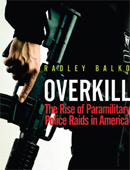
Overkill: The Rise of Paramilitary Police Raids in America | Cato Institute

By Radley Balco

Americans have long maintained that a man’s home is his castle and that he has the right to defend it from unlawful intruders. Unfortunately, that right may be disappearing.

Executive Summary

OverkillAmericans have long maintained that a man’s home is his castle and that he has the right to defend it from unlawful intruders. Unfortunately, that right may be disappearing. Over the last 25 years, America has seen a disturbing militarization of its civilian law enforcement, along with a dramatic and unsettling rise in the use of paramilitary police units (most commonly called Special Weapons and Tactics, or SWAT) for routine police work.

The most common use of SWAT teams today is to serve narcotics warrants, usually with forced, unannounced entry into the home.These increasingly frequent raids, 40,000 per year by one estimate, are needlessly subjecting nonviolent drug offenders, bystanders, and wrongly targeted civilians to the terror of having their homes invaded while they’re sleeping, usually by teams of heavily armed paramilitary units dressed not as police officers but as soldiers.

These raids bring unnecessary violence and provocation to nonviolent drug offenders, many of whom were guilty of only misdemeanors. The raids terrorize innocents when police mistakenly target the wrong residence. And they have resulted in dozens of needless deaths and injuries, not only of drug offenders, but also of police officers, children, bystanders, and innocent suspects.

This paper presents a history and overview of the issue of paramilitary drug raids, provides an extensive catalogue of abuses and mistaken raids, and offers recommendations for reform.

About the Author

Radley Balko is a policy analyst for the Cato Institute specializing in vice and civil liberties issues. He is a columnist for FoxNews.com and has been published in Time magazine, the Washington Post, the Los Angeles Times, Slate, Forbes, the National Post, Worth, Reason, and several other publications. Balko has also appeared on CNN, CNBC, Fox News Channel, NPR, and MSNBC.

Source: Cato Institute

DEA, IRS raid Denver area pot businesses | NBC News

By Colleen Slevin and Kristen Wyatt

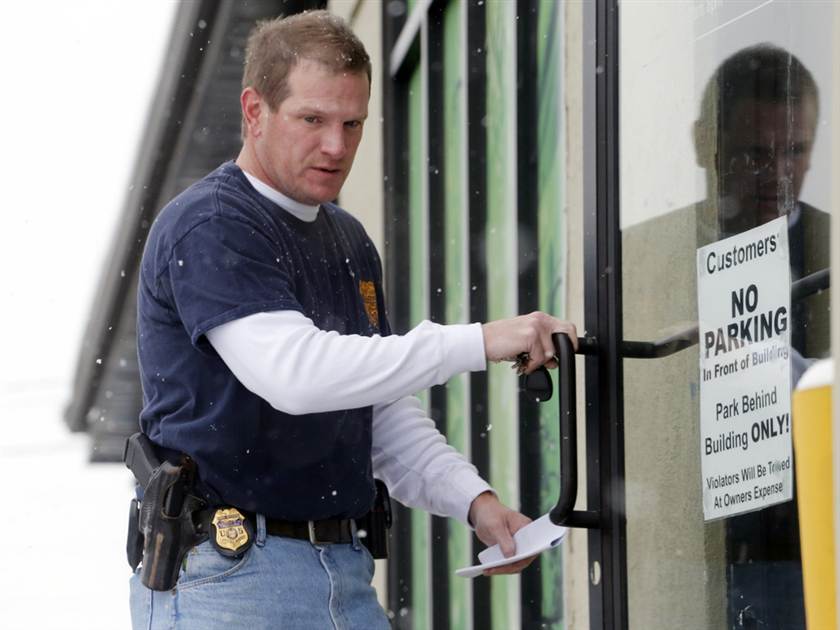
PotRaidsThe raids, conducted on a snowy morning, were the first in Colorado since the U.S. Department of Justice said in August that it wouldn’t interfere with state marijuana laws as long as the states keep the drug away from children, the black market and federal property.

The U.S. Attorney’s Office in Denver said the federal action “comports with the Department’s recent guidance” but would not elaborate. The U.S. Attorney’s Office said authorities were executing sealed search and seizure warrants and wouldn’t disclose how many businesses are being targeted or what they’re being investigated for.

Retail marijuana sales are to begin Jan. 1 in Colorado, though not all municipalities will be ready to go by then. For now, dispensaries are supposed to sell only to people with medical permission to use the drug. Many of the state’s 500 or so existing dispensaries are making plans to convert to recreational sales.

The Justice Department said in August that it wouldn’t stand in the way of votes in Colorado and Washington to legalize recreational pot but warned there needed to be effective controls to keep marijuana away from children, the black market and federal property.

At one of the raided dispensaries, VIP Cannabis, agents took boxes out of the business and loaded them into a U-Haul truck. One officer wore a surgical mask.

In Boulder, agents raided a number of marijuana-growing warehouses, leaving a chest-high pile of marijuana plants on the side of a road before loading them into trucks, The Daily Camera reported.

Colorado’s marijuana industry was quick to point out that the raids did not necessarily mean that the federal government was going back on its word or planning to interfere with Colorado’s plans to a recreational market.

Mike Elliott, a spokesman for the Medical Marijuana Industry Group, said the industry itself has pushed for “robust” regulations and expects industry compliance with lengthy state regulations on how the drug is grown and sold.

“While everyone involved in these raids should be considered innocent until proven guilty, enforcement is a sign that this program is working and maturing,” he said in a statement.

Mason Tvert of the Marijuana Policy Project said it wasn’t clear how many businesses were raided. Many dispensaries and growing warehouses were operating as usual Thursday.

“The Justice Department said it would respect states’ rights to regulate marijuana, and that it would not go after businesses as long as they are complying with state laws,” he said in a statement. “We hope they are sticking to their word and not interfering with any state-regulated, law-abiding businesses.”

Source: