If you have ever heard talk or been to a seminar about “sovereignty”, then very likely those conversations were influenced by the foundational research of the author and educator.
His research and educational journey reaching millions of people worldwide began in 1992 and culminated in 2022 with the 3-Volume book release – his final word on the subject.
At the turn of the millennium his books and audio courses facilitated in part – a sovereignty and tax-honesty movement that involved millions of Americans.
This 3 Volume series comprises the life’s work of Johnny Liberty filled with comprehensive insights into the last few hundred years of history, law, economics, money, citizenship and governance.
These books show how it is supposed to be done in a constitutional Republic.
How did We the People get to where we are today?
What can we do to reclaim our inherent sovereignty and natural rights?
Many of the answers may be found within these revolutionary pages. Available as a paperback, E-Book (PDF) or an Amazon Kindle format. Thank you for supporting the author.
Sincerely,
With Freedom For All, ~ Johnny Liberty
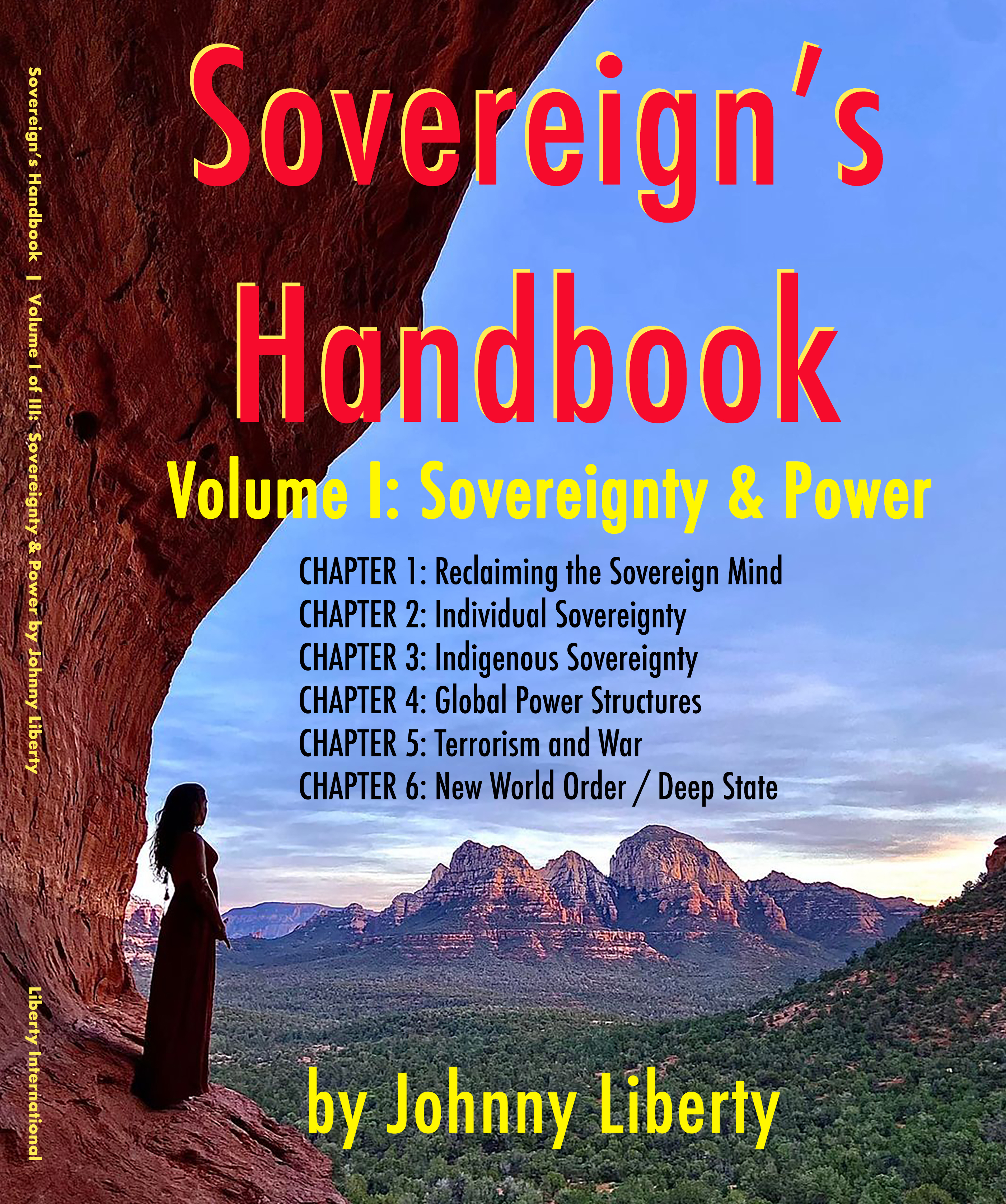
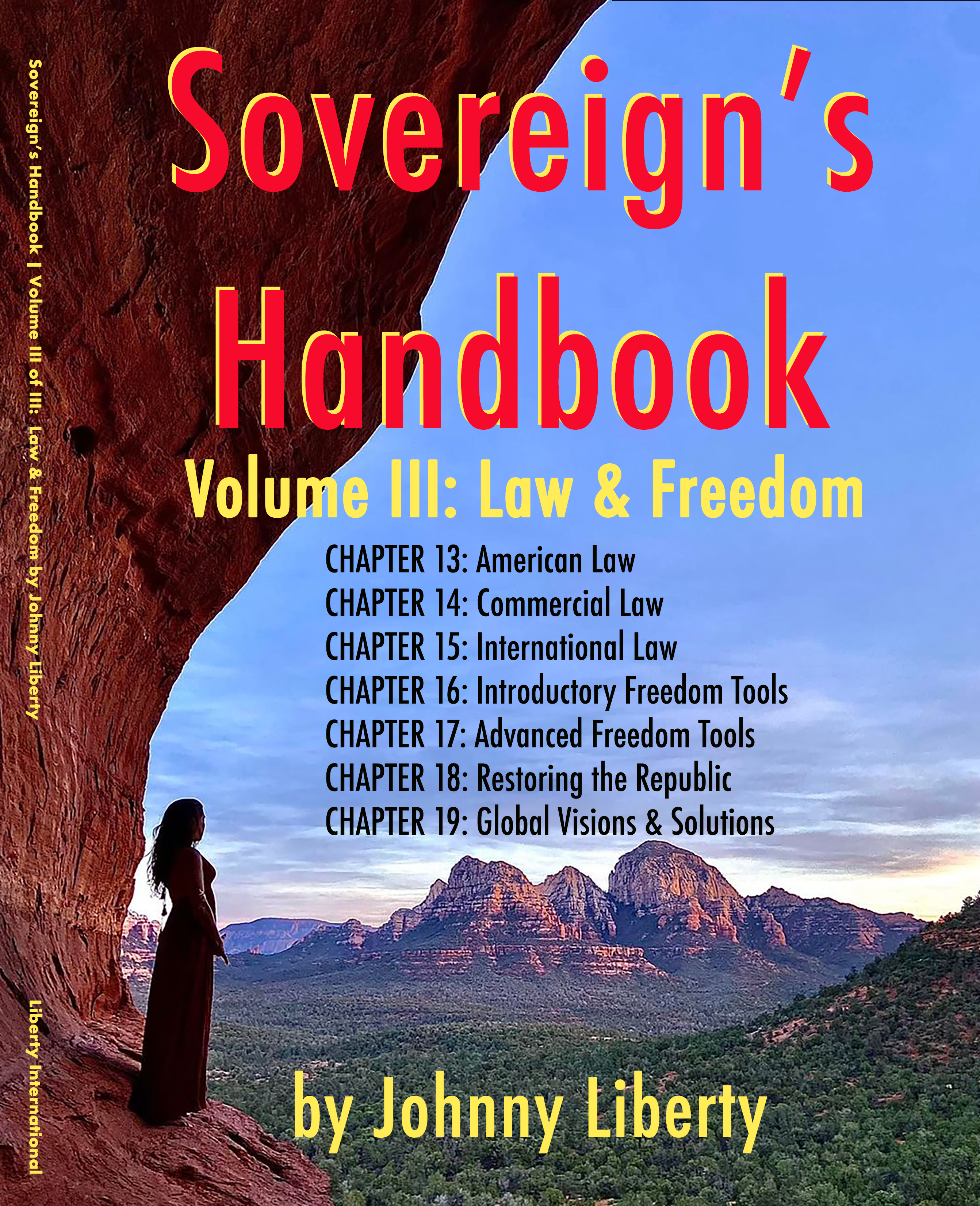
Sovereign’s Handbook by Johnny Liberty (30th Anniversary Edition)
A three-volume, 750 page tome with an extensive update of the renowned underground classic ~ the Global Sovereign’s Handbook.
Still after all these years, it is the most comprehensive book on sovereignty, economics, law, power structures and history ever written.
Served as the primary research behind the best-selling Global One Audio Course.
The 3 Volume Sovereign’s Handbook by Johnny Liberty is textbook material for everyone including educators/teachers, homeschoolers, historians, activists, leaders/politicians, attorneys/judges/law schools, police officers, and state Citizens/Nationals.
Sovereign’s Handbook by Johnny Liberty (30th Anniversary Edition) (3-Volume Printed, Bound Book or PDF)
A three-volume, 750+ page tome with an extensive update of the renowned underground classic ~ the Global Sovereign’s Handbook. Still after all these years, this is the most comprehensive book on sovereignty, economics, law, power structures and history ever written. Served as the primary research behind the best-selling Global One Audio Course. Available Now!
Dawning of the Corona Age: Navigating the Pandemic by Johnny Freedom (3rd Edition) (Printed, Bound Book or PDF)
This comprehensive book, goes far beyond the immediate impact of the “pandemic”, but, along with the reader, imagines how our human world may be altered, both positively and negatively, long into an uncertain future. Available Now!
As we exit the pandemic, expect to hear much more about The Great Reset and building back better. Far from resulting in a low-carbon dream life, though, it’s a cartoonish fantasy that will hand the global elite even more power.
‘The Great Reset’ is a term that has been bandied about quite readily by most Western neo-liberal politicians. So often, in fact, and without proper explanation, that it strikes the prudent observer as a kind of paid advertisement.
But what is it exactly? The term rose to prominence at the 50th annual meeting of the World Economic Forum (WEF) in June 2020. It was initially launched by the Prince of Wales, before being absorbed into the philosophy of the sartorially dystopian sci-fi villain Klaus Schwab, founder and executive chairman of the WEF.
The Great Reset refers to a plan to rebuild the world’s infrastructure ‘in a sustainable way’ following the economic ravages of the Covid-19 pandemic and to establish a global treaty to prevent future pandemics, or as it is described more formally, to “build a more robust international health architecture that will protect future generations.” If you ever hear people talking about “building back better,” they are referring to The Great Reset.
Probably the most disturbing part of The Great Reset is how much it strongly resembles business-as-usual, only with EXTRA globalism. Most of the plan’s outlines include a further weakening of national boundaries and individual national autonomy, in favour of a more ‘universal governance.’ As usual, it is the rapidly vanishing Western middle class which must shoulder this burden, as their freedoms are further curtailed to meet the quotas of corporate-media-fuelled activism.
Regardless, many world leaders, no doubt charmed into acquiescence by Schwab’s commandingly sinister Blofeld-esque wardrobe, agreed to the Great Reset, including Boris Johnson, Emmanuel Macron, Angela Merkel, Kyriakos Mitsotakis, Mark Rutte, Pedro Sánchez, Erna Solberg and Volodymyr Zelensky. According to John Kerry, Joe Biden’s administration is on board, too.
But the general agreement of the Western leaders is absolutely typical of any agenda which is espoused by NATO, the UN, or the WEF. If an emotionally charged, politically vague and ultimately ineffectual edict or bill is proposed by one of these entities – each resembling a shabby, globe-trotting team of insurance salesmen – our effete politicians line up to show the most fervent compliance.
As a rule, it seems their solutions to specific environmental or scientific problems mysteriously become entwined with LGBTQ+ rights, workplace equity, open borders initiatives and other unrelated social justice causes. It’s as though any goals they have are somehow unilaterally from the same source, or entail the same solution, regardless of causality or consequence. Therefore, a united response to a global pandemic mysteriously also equals trans rights activism.
In their own words, “No single government or multilateral agency can address this (pandemic) threat alone. Together, we must be better prepared to predict, prevent, detect, assess and effectively respond to pandemics in a highly co-ordinated fashion.”
There are many other sweeping sentiments expressed by Schwab and his acolytes which can seem either trite or threatening. Consider“the gulf between what markets value and what people value will close” and “we want more attention paid to scientific experts. No one can “self-isolate” from climate change so we all need to “act in advance and in solidarity.” There is much talk of the pursuit of “fairer and equitable outcomes.”
International treaties always tend to be about concentrating power. It’s one of those rules of life, for realists, as there is no escaping power dynamics in human affairs. Real problems don’t often have feel-good solutions. Often, they require ‘solutions that sound mean’, that don’t sound good on a corporate goals bulletin. Initiatives like The Great Reset all entail the gradual loss of the autonomy of individual nations, as their decision-making power is transferred to an international, disembodied rule-maker.
It has been, without a doubt, a globalist fantasy for a long time, but the key question is: do they realise what they are doing or not?
As far as their amazing coordinated pandemic response goes, this appears to be nothing more than forced world-wide vaccinations for EVERYBODY. According to Klaus Schwab himself: “As long as not everybody is vaccinated, nobody will be safe.” To which the attendant neo-liberal world leaders nodded in re-affirming unison, repeating in unison their mantra: “Global public good.”
Schwab, despite appearing like an immortal brothel-keeper at Kublai Khan’s Xanadu, is really cut from the same cloth as your typical EU technocrat. His ideas are not creative, they are quite staid and pedestrian, and research of his career shows they have been unchanged since the 1970s. He has consistently been preaching the very same thing, like a broken record.
Schwab believes we can achieve environmental solutions without altering capitalism in the slightest, by creating treaties of “mutual accountability and shared responsibility, transparency and co-operation within the international system.” His idea involves ‘ethical capitalism’ – where the excesses of capitalism will somehow be held at bay by ‘ethical stakeholders,’ to whom the corporations will be held accountable, while (conveniently) the elites and systems already in place will continue as they are. This is the master plan of the World Economic Forum, largely unchanged for 40 years.
The result? A green technocracy, one assumes, with a WEF-mandated ‘ethical stakeholder’ apparatus, a worldwide spiderweb organisation ruling by the threatened fears of pandemic and carbon doom. No section of society would be exempt from edicts of ‘the new treaty.’
The Great Reset website appears to be little more than an advertisement for modern pod-living. It seems to style itself as a low-carbon dream-life (without loss of modern convenience) to effeminate hipsters. One can see slovenly-looking neo-liberal youths, frequent references to LGBTQ+ values, and an overall urgency about carbon footprints.
There is a hint of Adbusters about the website, creator of the Occupy Wall Street movement. Despite the fact that the WEF and Davos and all associated entities are entirely elite institutions, the website styles itself on grassroots urban activism. There is much cringeworthy symbology in its white papers, such as a green and rainbow flag-combination with fey slogans like ‘we salute you, zoom queen!’
Schwab refers to the aim of The Great Reset as “the Fourth Industrial Revolution,” with the first being powered by water and steam, the second introducing mass production, and the third electronic automation. The fourth will blur the lines between “physical, digital and biological spheres.”
In this grab-bag of magical advances, he lists, “fields such as artificial intelligence, robotics, the Internet of Things, autonomous vehicles, 3-D printing, nanotechnology, biotechnology, materials science, energy storage and quantum computing.”
This sounds like cartoonish optimism, as many of these technologies are anything but clean and don’t seem to de facto relate to side-stepping out of industrialism or anything else. On top of that, fewer than 9% of companies use the machine learning, robotics, touch screens and other advanced technologies listed as somehow ‘changing everything.’ Stakeholder capitalism, as a concept, does not explain itself as foolproof, and will no doubt be freely interpreted by the likes of Silicon Valley or supply chain conglomerates.
The jewel in the crown of Great Reset optimism has to be the belief that the advent of AI will alter everything positively, again without specifics, to somehow create a low-carbon new world.
It appears at best to be all be smoke and mirrors, a childish corporate fantasy manufactured by isolated bean counters. At worst, it is an intentional power-grab by unaccountable international agencies and hidden oligarchs.
Either way, it is a fake utopia at the price of privacy and autonomy, sold to us by used-car salesmen who think they are princes.
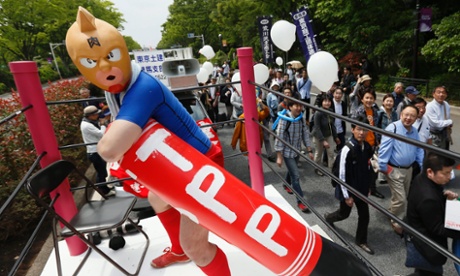
WikiLeaks has released the draft text of a chapter of the Trans-Pacific Partnership (TPP) agreement, a multilateral free-trade treaty currently being negotiated in secret by 12 Pacific Rim nations.
The full agreement covers a number of areas, but the chapter published by WikiLeaks focuses on intellectual property rights, an area of law which has effects in areas as diverse as pharmaceuticals and civil liberties.
Negotiations for the TPP have included representatives from the United States, Canada, Australia, New Zealand, Japan, Mexico, Malaysia, Chile, Singapore, Peru, Vietnam, and Brunei, but have been conducted behind closed doors. Even members of the US Congress were only allowed to view selected portions of the documents under supervision.
“We’re really worried about a process which is so difficult for those who take an interest in these agreements to deal with. We rely on leaks like these to know what people are talking about,” says Peter Bradwell, policy director of the London-based Open Rights Group.
“Lots of people in civil society have stressed that being more transparent, and talking about the text on the table, is crucial to give treaties like this any legitimacy. We shouldn’t have to rely on leaks to start a debate about what’s in then.”
The 30,000 word intellectual property chapter contains proposals to increase the term of patents, including medical patents, beyond 20 years, and lower global standards for patentability. It also pushes for aggressive measures to prevent hackers breaking copyright protection, although that comes with some exceptions: protection can be broken in the course of “lawfully authorised activities carried out by government employees, agents, or contractors for the purpose of law enforcement, intelligence, essential security, or similar governmental purposes”.
WikiLeaks claims that the text shows America attempting to enforce its highly restrictive vision of intellectual property on the world – and on itself. “The US administration is aggressively pushing the TPP through the US legislative process on the sly,” says Julian Assange, the founder and editor-in-chief of WikiLeaks, who is living in the Ecuadorean embassy in London following an extradition dispute with Sweden, where he faces allegations of rape.
“If instituted,” Assange continues, “the TPP’s intellectual property regime would trample over individual rights and free expression, as well as ride roughshod over the intellectual and creative commons. If you read, write, publish, think, listen, dance, sing or invent; if you farm or consume food; if you’re ill now or might one day be ill, the TPP has you in its crosshairs.”
Just Foreign Policy, a group dedicated to reforming US foreign policy, managed to crowdfund a $70,000 (£43,700) bounty for Wikileaks if the organisation managed to leak the TPP text. “Our pledge, as individuals, is to donate this money to WikiLeaks should it leak the document we seek.” The conditions the group set have not yet been met, however, because it required the full text, not individual chapters.
Related to the TPP is a second secret trade agreement, the Transatlantic Trade and Investment Partnership (TTIP), which ties together regulatory practices in the US and EU. George Monbiot, writing in this paper, referred to the treaty as a “monstrous assault on democracy”. Ken Clarke, the minister without portfolio, replied that it “would see our economy grow by an extra £10bn per annum”.
Campaign group Fight for the Future has already collected over 100,000 signatures in an online petition against what it calls the “extreme Internet censorship plan: contained in the TPP.
Evan Greer, campaign manager for Fight for the Future, said: “The documents revealed by WikiLeaks make it clear why the US government has worked so hard to keep the TPP negotiatons secret. While claiming to champion an open Internet, the Obama administration is quietly pushing for extreme, SOPA-like copyright policies that benefit Hollywood and giant pharmaceutical companies at the expense of our most basic rights to freedom of expression online.”
Drilling conflicts are almost always described in the context of their impacts on air, water and health. But increasingly, as the drilling boom sweeps the country, another part of the drilling story is starting to bubble up in drilling hotspots like Colorado, Pennsylvania, New York, Wyoming and Texas.
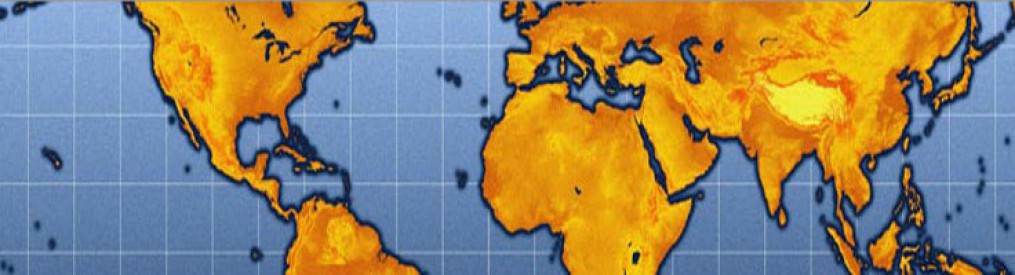
Increasingly, oil and gas development is butting up against, and often trampling, the bedrock American principles of property rights and the value of one’s home. The map below shows all the shale gas in play in North America.
Industry estimates peg the number new wells that will be drilled across the U.S. over the next decade at more than 200,000. In this rush to tap once unreachable deposits, oil and gas development is pushing the boundaries of drilling. Innovations like fracking and horizontal drilling mean nothing is out of reach. Once the province of wide open spaces, drilling rigs now regularly inch up and even into communities that never anticipated having to address problems like round-the-clock noise, storage tanks, drums of toxic chemicals, noxious fumes, and pipelines near homes, schools, playgrounds and parks.
This clash of large-scale industrial activity and communities has surfaced a deep rift in the American landscape, where the legal doctrine of split estates allows one party to own mineral rights and someone else to hold the rights to soil and surface. With the oil and gas industry showing little self-restraint in where drilling happens, and almost no regulatory or legal precedents to protect them from having industrial activity in their back yards, communities are fighting back. Increased truck traffic, chemicals, lights, noise, heavy equipment, noxious air emissions and water contamination are liabilities for landowners, to the point that communities in Colorado, New York and other states have taken matters into their own hands.
Feeling unprotected by weak state and oil and gas regulations—most of which were developed never contemplating drilling in urban and suburban landscapes—towns, cities and counties are instituting moratoria and bans on drilling within their borders. There are fracking-related ballot measures in at least four Colorado communities this year.
But it’s not just “not-in-my-back-yard”-ism driving this reactive opposition. The financial risks posed by drilling are real and substantial enough, for example, that banks and insurers are adopting guidelines that forbid mortgage loans or insurance coverage on properties affected by drilling. It’s a battle between oil and gas and the nest egg of countless Americans.
The following examples begin to piece together the ways in which the threats posed by drilling and the deep pockets of the oil and gas industry quite literally hit home. Taken together, they are a call for decision-makers to start quantifying data and asking tough questions about drilling vs. the American Dream. Read more…



 Liberty International News