California’s shutdown orders are totally unconstitutional | WND

FreedomJohnny Liberty, Editor’s Note: Libertarians, as you can see from the Foundation for Economic Education’s annual freedom ranking of the fifty U.S. states, California ranks near the bottom with Hawaii and New York. Perhaps this correlates with the draconian lockdown orders coming from each of these states during the COVID-19 crisis. 

By Jim Breslo

President Donald Trump is rightly talking about when we can reopen the country for business, noting that we cannot allow the cure to become worse than the disease. However, Trump does not have the keys to the shop. It is the country’s governors and mayors. Thus far they have not been expressing the same sentiment. If they do not loosen their shutdown orders within a reasonable time, we may have to turn to the courts. It turns out that many, if not all, of these orders would likely be struck down as unconstitutional.

The federal government thus far has only issued “guidelines,” not enforceable orders. Many states and cities, however, have issued enforceable orders whereby violation subjects one to fines or imprisonment.

Mark Meuser is a constitutional law attorney and former Republican nominee for California secretary of state. He reported this week on my Hidden Truth Show podcastthat the California Constitution does not permit state officials to order every resident, regardless of their individual health condition, to “self-quarantine” or “shelter in place.”

Article I of the California Constitution reads: “All people are by nature free and independent and have inalienable rights. Among these are enjoying and defending life and liberty, acquiring, possessing, and protecting property, and pursuing and obtaining safety, happiness, and privacy.” Most state constitutions contain similar language.

Neither the governor nor the mayors have the authority to suspend the state constitution, regardless of the emergency. According to Meuser, state officials may declare a state of emergency, and may quarantine individuals known to have the virus or known to have been in contact with those who had the virus pursuant to the state’s health and safety laws. But a sweeping ban prohibiting people from leaving their homes, according to Meuser, is a clear overreach. It arguably violates numerous parts of Article I, such as Californians’ “inalienable right” to be “free and independent,” enjoy “life” and “liberty,” to “acquire, possess, and protect property,” and pursue “happiness.”

California’s Appellate Court ruled on a case brought soon after the time of the Spanish Flu, stating, “A mere suspicion [that someone is infected], unsupported by facts giving rise to reasonable or probable cause, will not justify depriving a person of his liberty under an order of quarantine.” [Ex parte Arata (App. 2 Dist. 1921) 52 Cal.App. 380, 198 P. 814.]

Granted, the case involved imposing a quarantine on a single individual, not on the entire populace. But, think of it this way: If state or local officials required that just you stay home, even though you do not have the flu and have not been in contact with someone known to have the flu, your reaction would likely be, “You can’t do that!” Well, the directive is no more constitutional if it applies to everyone like you. It may seem more “fair,” and not violate the equal protection clause, but it would still equally violate individual liberty. A government violation of individual constitutional rights does not become less violative simply by applying it to more people.

Meuser argues in the interview that the orders are also a clear violation of the constitutional right to “protect property” since Californians are being prevented from tending to their property unless it happens to be deemed “essential.” If a Californian cannot visit, let alone operate, one’s business, it cannot be protected.

Mayor Eric Garcetti’s order requires “all residents of the City of Los Angeles to stay inside their residences.” The order expressly prohibits, “Travel to or from a vacation home outside the City.” In other words, Angelenos are prohibited from going to their own garage, getting in their own car and driving it to their own vacation home. Such conduct, according to the order, is punishable by “fine or imprisonment.”

The orders may also violate the United States Constitution. The First Amendment prohibits both state and federal government from “prohibiting the free exercise” of religion or “the right of the people peaceably to assemble.” Clearly, the orders prevent people from engaging in religious gatherings or joining in any group activity. Since the bans are not narrowly tailored to those with the virus or known to have been subjected to it, they likely violate the First Amendment. Further, the orders violate at least the intent of the Fifth Amendment, which provides, “nor shall private property be taken for public use, without just compensation.” Shutting down businesses for the public good arguably requires the state to provide compensation to those businesses.

It is certainly up for debate whether shutdown orders in California, New York and other states is the smart thing to do. It seems that about half of people support them, and half do not. They are wreaking economic havoc on businesses and employees, while at the same time no doubt slowing the spread of the virus. Only with time will we be able to know whether the trade-off was worth it. We make similar trade-offs between freedom and health all the time. The most obvious example being the choice to allow people to drive automobiles despite the fact that they cause about 40,000 deaths every year in the U.S. Importantly, the coronavirus has killed far less than that worldwide, yet we are restricting people to their homes, a far more restrictive measure than prohibiting people from driving.

But whether the trade-off is smart or not, it is irrelevant to the question of whether it is constitutional. The orders clearly are not. State and federal constitutions provide a vital backstop to protect the people against government overreach, which often comes at times of crisis. We saw this happen after 9/11. It is human nature to panic and to overreact out of fear. The Constitution, which we all swear an oath to by nature of being citizens, stands on guard to protect us against such overreach in times like this. This is not the time to abandon it.

Source: WND

Does Gov. Newsom Have the Power to Shut Down Private Businesses Because of Coronavirus? | California Globe

HM_JF19_Page_37_Image_0001_0Editor’s Note: Finally, a constitutional attorney studies the California Governors martial law powers distinct from emergency powers. The State of California has declared a state emergency on the heels of a national emergency so as to cash in on federal funding  available to the state, but the Governor has not declared martial law. His orders are recommendations with no force of law.

Do counties really have the authority to order everyone to stay at home? Are Shelter in Place Laws Valid?

By Katy Grimes

California Constitutional-Election Law Attorney Attorney Mark Meuser has been questioned so much about the Coronavirus shelter in place orders, and social distancing, he prepared a video and comprehensive explanation of the executive Orders issued by Gov. Gavin Newsom, and California counties public health officials’ orders.

Mark Meuser:

I have been asked by numerous people to help them understand what is going on in the state of California regarding the shutting down of businesses and shelter in place laws. Does the governor really have the power to shut down private businesses? Do counties really have the authority to order everyone to stay at home? This video is my attempt to provide some basic understanding about the difference between martial law and the governor declaring a state of emergency. In this video, we will look at California statutes, the Governors Executive Orders, and the subsequent county health orders of shelter in place. Hopefully as we go through all these documents, you will gain a better understanding of what exactly is going on in this state.

Because of all the misinformation and a lack of information regarding what is going on, if you find this video helpful, can I ask you to share this video on your social media. Tell your friends and family to watch this video so that they can be better educated on what exactly is going on legally that led to all these shelter in place laws.

Please remember that things are changing by the minute and as such, it may not necessarily reflect the most current legal developments. As such, all the information presented here is for general information purposes only and is not intended to be legal advice. You should seek the advice of legal counsel of your choice before acting upon any of the information contained in this video.

First off, let’s start off with the term Martial Law. What is Martial Law, and when can the governor declare Martial Law?

California Military and Veterans Code Section 143 is the statute that gives the Governor authority to proclaim Martial Law. This statute reads:

Whenever the Governor is satisfied that rebellion, insurrection, tumult or riot exists in any part of the state the Governor may, by proclamation, declareto be in a state of insurrection, and he or she may thereupon order into the service of the state any number and description of the active militia, or unorganized militia, as he or she deems necessary, to serve for a term and under the command of any officer as he or she directs.

As you can see, we are not currently in a state of rebellion, insurrection, tumult or riots and as such, the Governor of the State does not have the power to declare martial law. However, that being said, the Governor does have broad powers under the California Emergency Services Act. The California Emergency Services Act can be found starting in California Government Code section 8550.

There are three main types of emergencies that enable a governor to declare a state of emergency.

  1. State of War emergency.
  2. State of Emergency
  3. Local Emergency

I think we all agree that we do not currently have a state of war emergency since neither California or the United State are not under an attack or threat of attack by an enemy of the United States.

As such, that leads us to state of emergency or local emergency. A local emergency deals with disasters that are contained within the limits of a county. Since the Corona virus effects the entire state of California, we are currently dealing with the second option, a State of Emergency.

Under California Government code section 8558, a governor can call a state of emergency when there is an “existence of conditions of disaster or of extreme peril to the safety of persons and property within the state caused by conditions such as air pollution, fire, flood, storm, epidemic, riot, drought, cyberterrorism, sudden and severe energy shortage, plant or animal infestation or disease, …earthquake, or other conditions, other than conditions resulting from a labor controversy or conditions causing a state of war emergency ….”

California Government Code section 8567 states that all orders under the California Emergency Services Act must be in writing and they take effect immediately. When the governor calls a state of emergency, he may suspend any state statute, rule or regulation. (Cal. Gov. § 8571). Please notice that the governor does not have the authority to suspend the California Constitution. As such, any rights contained in the Constitution are still in force. In fact, to make sure the government understands that there are limits to their authority, Cal. Gov. § 8571.5 expressly states that nothing in the California Emergency Services Act gives the government the right to seize or confiscate any firearm or ammunition unless an officer is arresting someone pursuant to an investigation for the commission of a crime.

When a governor calls a state of emergency, this gives him the authority to commandeer or utilize any private property or personnel deemed by him necessary in carrying out the responsibilities. However, the state is liable for the reasonable value of what it uses. (Gov. Code § 8572).

Gov. Newsom’s Executive Orders

Now that we have discussed the law, let’s now talk about what the Governor of California has actually done.

On March 4, 2020, Governor Newsom Declared a State of Emergency.

On March 11, 2020, Governor Newsom’s office published the fact that it was California Department of Public Health’s policy of preventing gatherings of groups larger than 250 people “should be postponed.” This was not an executive order by the governor, instead it was a California Department of Public Health policy. This policy does not cite a single law that gives the California Department of Public Health authority to shut down events of 250 people or require social distancing of more than 6 feet. While these may be good guidelines to follow, they are simply policies, they are not the law.

To emphasize that this was just a policy and not a law, on March 12, 2020, Newsom issues his next executive order (N-25-20). This executive order states that “All residents are to heed any orders and guidance of state and local public health officials, including but not limited to the imposition of social distancing measures, to control the spread of COVID-19.”

Notice the language of this order. “All residents are to heed any orders and guidance …”. If you look up the word heed in the dictionary, you will discover that it means “to give consideration attention to.” It does not say you must obey. Gavin Newsom in his executive order utilizing his powers granted him after declaring a state of emergency told the citizens of California that Californians should takes the advice given by the California Department of Public Health into consideration when making decisions.

Thus, contrary what you may have been led to believe, Gov. Newsom did not actually issue an executive order requiring Californians to practice social distancing, nor did he actually order gatherings of over 250 people to shut down. All he did was order people to pay attention to what these organizations were saying. These were merely recommendations.

Understand, a policy is different from a regulation. While I was able to find authority that allowed the California Department of Health Services to issue emergency regulations after they jumped through a few hoops, I have been unable to find where their policies would have the full force of law. Laws are passed by the legislature, or under the state of emergency, via executive order by the governor.

Before I move on to what the counties have done with their shelter in place laws, I want to quickly let you know that Gov. Newsom has issued five other executive orders in the last several days regarding the Corona virus.

Newsom has signed an executive order on March 13 ensuring funding for schools even if the schools are closed. He has issued an executive order on March 16th on how the state must focus on protecting the health and safety of the most vulnerable. And on March 16th, his executive order dealt with suspending the laws allowing landlords and banks from removing individuals who have not been able to pay their bills until May 31st. On the 17th he signed an executive order to ensure that key commodities can be delivered to California retailers. Finally, on the 18th he issued an executive order to protect ongoing safety net services for the most vulnerable Californians.

Shelter in Place Laws

So now let’s move to the issue of shelter in place laws being issued by the counties. I have not looked at every county’s shelter in place law, but I have looked at several and they are very similar.

California law allows counties to declare a health emergency when the local health officer determines that there is a threat of the introduction of any contagious, infectious, or communicable disease. (California Health and Safety Code § 101080). It appears that this power was not given to the California Department of Health Services but instead, this power was left in the hands of local Health Officers.

Cal. Health & Safety § 101040 permits local health officers to take any preventive measures that may be necessary to protect and preserve the public health from any state of emergency declared by the governor. After a local health emergency has been declared, “The sheriff of each county .. may enforce within the county … all orders of the local health officer issued for the purpose of preventing the spread of any contagious, infectious, or communicable disease.” (Cal. Health and Safety Code 101029). Cal. Health & Safety § 101030 specifically gives the county health officer the authority to order quarantines.

However, the question arises, does a county health officer have the authority to order a quarantine of healthy people, or just those who are sick? What laws are in place in the state of California regarding the stopping of disease through quarantine?

The statutes are very broad in their wording. Cal. Health & Safety § 120175 says that the health officers “shall take measures as may be necessary to prevent the spread of the disease or occurrence of additional cases. Cal. Health & Safety § 120200 indicates that a health officer shall establish and maintain places of quarantine. But this still does not answer the question, can a health officer issue a quarantine of everyone in the county?

In 1921, Laura Culver petitioned the courts to be released from a quarantine. The Court’s held that the law permitted public health officials to quarantine individuals who have come in contact with cases and carriers of contagious diseases.

As one studies California law, it is clear that the law used to be very explicit that a quarantine was only applicable to those who had a contagious disease or those who had come in contact with someone who had a contagious disease.

While most of the laws regarding quarantine are very broad, Cal. Health & Safety § 120215 appears to have limiting language. This statute reads: Upon receiving information of the existence of contagious, infectious, or communicable disease for which the department may from time to time declare the need for strict isolation or quarantine, each health officer shall: (a) Ensure the adequate isolation of each case, and appropriate quarantine of the contacts and premises. (b) Follow the local rules and regulations, and all general and special rules, regulations, and orders of the department, in carrying out the quarantine or isolation.

Let’s look at this for a minute. I think we can all agree that the health officers have sufficient information that there is a communicable disease. However, where we disagree is that the Health Officers are ordering a county wide shelter in place law where the law only allows “adequate isolation of each case, and appropriate quarantine of the contacts.” This is where the local health official appears to have overstepped their authority. The counties are not looking at this on a case by case bases. Instead, they are issuing broad orders that affect both the healthy and the sick. They are not ordering a quarantine of those who have been in contact with someone who has the virus.

Cal. Health & Safety § 120225 also has some instructive language. This statute says that “A person subject to quarantine …”. The quarantine laws where designed to quarantine an individual or a location, not an entire community or organization.

Finally, Cal. Health & Safety § 120235 makes clear that the quarantine powers of the local health officer were never intended to be a community lock down. Cal. Health & Safety § 120235 clearly states that “no quarantine shall be raised until every exposed room, together with all personal property in the room, has been adequately treated, or, if necessary, destroyed, under the direction of the health officer, and until all persons having been under strict isolation are considered noninfectious.”

The quarantine laws are clearly intended to be applied to individuals not to the entire county. The quarantine laws are designed to stop those who might have been infected from passing the disease onto others. Absent the local health officers finding that an individual has the disease or is likely to have the disease, California law does not give them broad authority to quarantine the entire county.

As such, it appears counties such as San Francisco that have issued broad shelter in place laws may be violating California law.

If you feel like the state of emergency called by the governor or these shelter in place laws have adversely effected your business and/or violated your constitutional rights, I would encourage you to seek competent legal counsel to examine your individual case.

In conclusion, we are living in very interesting times. There are those who feel like government officials are in a contest to see who can be the most aggressive in upending the lives of its citizens over the Corona virus. The great debate of today seems to be, is the government doing too much or is the government not doing enough. Regardless of the answer to that question, there are going to be some serious financial ramifications as a result of this virus.

Regardless of whether the government has over reacted or under reacted, the threat of this virus will end. When it does, our generation will have the opportunity to show how we are able to bounce back, just like we did after the Great Depression or 9/11.

Source: California Globe
Supreme Court to Decide If States Can Bind Electoral College Members to Popular Vote | The Epoch Times

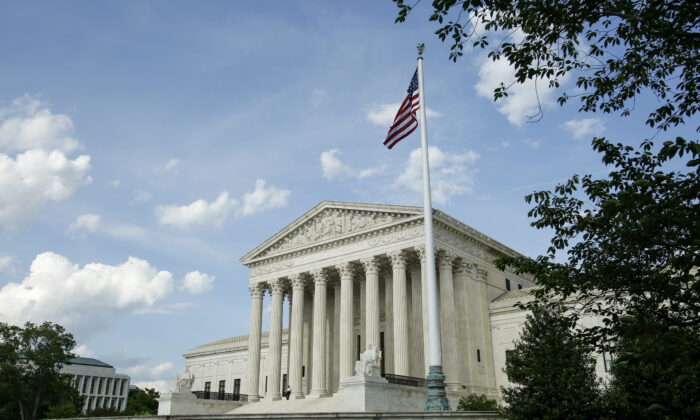
The Supreme Court of the United States in Washington on May 7, 2019. (Samira Bouaou/The Epoch Times)

The U.S. Supreme Court on Friday has agreed to take up a dispute that questions whether an electoral collegemember is bound by the state to support the presidential candidate chosen by the popular vote.

The top court granted a petition to review a pair of cases—from Washington state and Colorado—that will decide the enforceability of state laws that threatens to penalize a presidential elector if they refused to vote for the candidate they pledged to support, commonly referred to as “faithless electors.”

The Supreme Court’s decision, expected later in the year, will likely have ramifications on this year’s presidential race if the electoral college members seek to casts votes for someone who did not win the popular vote in the state.

When an elector does not vote for a candidate who was chosen by the popular vote, some states provide that the deviant vote be canceled, and the elector replaced, according to FairVote.org.

Meanwhile, some states allow the vote to stay but would impose a penalty on the elector. Some states also allow both the canceling of the vote and a penalty.

Both Washington and Colorado have laws that direct how electors perform their duties and enforce consequences for casting a vote that deviates from the will of the people.

In Washington, an elector can be fined if they vote contrary to how the law directs. Meanwhile, in Colorado, if an elector does not back the candidate with a popular vote, they would have been deemed to have “refused to act,” resulting in a vacancy in that elector’s office that needed to be immediately re-filled.

The lower courts in both cases came to the opposite conclusion about the issues, with the 10th Circuit Court of Appeals in Colorado ruling for the electoral college members. At the same time, the Washington Supreme Court found in favor of the state.

In the Colorado case, one elector Michael Baca was replaced, and his vote canceled when he sought to vote for GOP John Kasich, Ohio’s former governor, in the 2016 presidential election.

Meanwhile, the Washington case was brought by three Democratic electors who chose not to vote for Hilary Clinton during the same presidential election. Instead, all three electors opted for Colin Powell, a former U.S. Secretary of State, and were subsequently fined.

The U.S. Supreme Court did not provide any reasoning for agreeing to hear the cases (pdf). The two cases have been consolidated, and oral argument is like to be scheduled in March or April.

In 2016, 10 of the 538 presidential electors attempted to cast their votes for someone other than their party’s candidate.

The victor in a U.S. presidential election is determined by securing a majority of the electoral votes allotted to the 50 U.S. states and the District of Columbia, rather than amassing a majority of the popular vote.

The electoral college members cast the electoral votes. All states, except for Maine and Nebraska, have a winner-takes-all system awarding all electors to the presidential candidate who wins the state’s popular vote.

The number of electors in each state is the sum of its two U.S. senators and its number of members in the House of Representatives, based on population size. The District of Columbia, which is not a state, is allotted, three electors.

Source: The Epoch Times

Supreme Court rules in case watched for impact on Trump pardons | Politico

The Supreme Court ruled Monday in a closely watched “double jeopardy” case, issuing a decision that preserves states’ power to limit the impact of future pardons by President Donald Trump or his successors.

In a 7-2 ruling, the justices declined to disturb a longstanding legal principle known as dual sovereignty, which allows state governments to bring their own charges against defendants already tried or convicted in federal court, or vice versa.

Lawyers for an Alabama man facing a gun charge in federal court after pleading guilty to the same offense in state court — resulting in a nearly three-year extension of his prison sentence — failed in their effort to persuade the justices to hold that the Constitution’s prohibition on double jeopardy prevents such follow-on prosecutions.

The federal government had argued that overturning the dual-sovereignty doctrine would upend the country’s federalist system, and that the phenomenon of overcriminalization makes states’ ability to preserve their own sphere of influence and prevent federal encroachment on law enforcement more important.

Democrats and others bracing for potential pardons by Trump of individuals convicted in former special counsel Robert Mueller’s investigation were tracking the case, Terance Gamble v. U.S., because a decision overturning the dual sovereigns rule could have complicated efforts by state prosecutors to blunt the impact of any attempt Trump may make to grant clemency to those targeted by Mueller’s team.

Still, the high court case was not seen as make-or-break for state prosecutions because Mueller didn’t bring charges on every potential crime he uncovered. In addition, the federal prosecution of former Trump campaign chairman Paul Manafort resulted in a combination of jury convictions, guilty pleas, mistried charges and dismissals as part of a plea deal.

The complex result in Manafort’s case left fertile ground for New York prosecutors, who jumped into the breach in March with a 16-count indictment charging the longtime lobbyist and political consultant with mortgage fraud, falsifying business records and other crimes. The offenses seemed to partially overlap with crimes Manafort was charged with in federal court in Virginia.

Manafort’s lawyers in the state case have indicated they plan to argue that the indictment obtained by Manhattan District Attorney Cyrus Vance Jr. violates a New York law that limits state prosecutions of crimes already prosecuted at the federal level.

New York’s Democrat-controlled Legislature has been trying to alter that law to limit its application in cases where a defendant receives a presidential pardon or commutation.

A bill aimed at doing that won formal approval last month from both chambers of the state legislature but has not yet been sent to Gov. Andrew Cuomo, who has signaled he plans to sign it. The measure includes language seeking to cover individuals already convicted, tried or who pleaded guilty, but it’s unclear whether applying the law that way is constitutional.

The bulk of the opinions the justices issued Monday were focused on historical evidence about whether the founders expected that dual prosecutions would be permitted or forbidden by the Constitution.

“Gamble’s historical arguments must overcome numerous ‘major decisions of this Court’ spanning 170 years,” Justice Samuel Alito wrote on behalf of the seven-justice majority. “In light of these factors, Gamble’s historical evidence must, at a minimum, be better than middling. And it is not.”

The decision drew separate dissents from justices at opposite ends of the court’s ideological spectrum: liberal Ruth Bader Ginsburg and conservative Neil Gorsuch.

“It is the doctrine’s premise that each government has — and must be allowed to vindicate — a distinct interest in enforcing its own criminal laws,” Ginsburg wrote. “That is a peculiar way to look at the Double Jeopardy Clause, which by its terms safeguards the ‘person’ and restrains the government.” She argued that the legal precedent was weak, noting that “early American courts regarded with disfavor the prospect of successive prosecutions by the Federal and State Governments” and that, with regard to concerns about federal and state governments interfering with each other, “cooperation between authorities is the norm.”

Gorsuch, meanwhile, argued that “a free society does not allow its government to try the same individual for the same crime until it’s happy with the result. Unfortunately, the Court today endorses a colossal exception to this ancient rule against double jeopardy.”

He added that the separate sovereigns exception “finds no meaningful support in the text of the Constitution,” unlike the Constitution’s ban on double jeopardy.

Fordham University law professor Jed Shugerman told POLITICO that the Gamble decision will have “no real impact on Trump cases.” Manafort is still facing state prosecutions in New York and Virginia, which have their own jeopardy rules, he noted. And former national security adviser Michael Flynn’s guilty plea to one count of making false statements to the FBI was limited to federal law, Shugerman said. The same appears true of Roger Stone’s prosecution on false statement and witness tampering charges, he added.

“Trump and others aren’t getting prosecuted federally anyway before 2021, so they haven’t faced a single jeopardy yet,” Shugerman said. “A pardon wouldn’t create jeopardy, so they’d still face state prosecutions post-pardons.”

Some opponents of the proposed New York changes urged legislators to hold off passing them until the Supreme Court ruled in the case decided Monday. Experts said the decision might encourage more states to tinker with their double-jeopardy limits.

“The big question may be how states react to this ruling, and whether it will incentivize some states to ban trials by separate sovereigns of the same defendant for the same conduct, or, now that the Court has said the federal Constitution isn’t offended, whether states that already have such bans might relax them,” said University of Texas law professor Stephen Vladeck.

Source: Politico

Constitution under siege: The Electoral College battle | Metro Voice News

“Every vote should count.” To many that sounds fair. It sounds right. But is it? “The Electoral College is wrong. The person who gets the most votes should be president.” Does that sound right to you?

The answer varies but falls under one fundamental belief: Do you believe America to be a democracy or a republic.

From that divide, you will understand the main difference between what conservatives are trying to preserve and what liberals are trying to fundamentally transform.

During the 2000 Presidential Election, many in the media and the left believed that Al Gore would win the Electoral College and Bush would in the popular vote. This was the last time the media and the Left staunchly defended the Electoral College while lying the groundwork for the very assault on it. It was after this election that I started studying what the Electoral College is and its importance.

So what is the Electoral College? Each state is afforded a certain number of votes, the amount of senators (2) combined with the amount of representatives in the house (which varies according to population). This makes the minimum amount of votes a state gives as three. These votes are determined by the popular vote each state making the winner the President of the United States.

The emphasis on States is important. Each state in America has different needs and desires. Each state under the Electoral College gets to choose which candidate they want as president by majority vote. (That’s the democracy in the republic you hear about.) The candidate that gets the most votes (270 at this time) from these states wins the Presidency. Under this system, each state matters and therefore the people of each individual state are important.

Under a popular vote, the one with the most votes wins. It’s simpler and therefore easier to circumvent most people. That means cheating is easier. Also ignoring large sects of this country also becomes expedient.

Elections are expensive. Under the popular vote, the middle is ignored because all a candidate need win is the big cities of the east and west coast. The Midwest, the Southwest, and parts of the South will no longer matter because their votes won’t win elections. Look at the state of New York. NYC rules the state, and the Democrat Party rules NYC with an iron fist.

Under a popular, every vote counts. That sounds great, but not every vote should count. “Every four years, the dead rise and vote democrat in Chicago,” the old joke says. The truth is sadder; in that, in many big cities, the dead vote. Add to that the millions of illegal aliens that vote. Then add to that those who vote more than once. Then add to that all those miraculous ballots that appear in bags which were handily put to the side in case needed to overturn an election barely won by a Republican which was how Al Franken won his seat in the Senate and many Republicans lost elections in 2018 they won on election night. Every vote counts. In the past election, some counties had more people vote in them than actually lived there by the thousands. Obviously, they all voted Democrats.

Once you put all those numbers together, it’s easy to see popular votes are easily doctored, and elections can easily be stolen. This is especially true because of an outwardly bias media who is out to cover for those on their side of the political aisle and dreg up the basest stories from the most unreliable sources to bury their competition. Many are willing to accept this because they want their candidate to win no matter what the cost. But what happens, when it’s someone they don’t like? At that point it doesn’t matter, because the republic is dead, and the government class rules us all without any checks or balances.

Ignorance is the greatest ally to the enemies of our Constitution. The reason so many are in favor of abolishing the Electoral College is that we have and Education system controlled by the Left who purposely keep their students from learning the importance of America’s greatness and what is needed to keep her free. Our institutes of educations have become indoctrination center of leftist ideology (socialism, humanism, atheism, etc.). Generations of children have become adults with no real understanding of our Constitution, and its greatness.

The Constitution is under siege. The States lost the battle for the Senate. Now the states may lose the battle of the Electoral College. We lose this and we lose the right to choose our leaders. The Republic needs you and me to educate the ignorant and show them why our founders were all against Democracies and why they chose a Republic instead.

Source: Metro Voice News

Supreme Court clamps down on ‘excessive fines’ by states | The Hill

The Supreme Court on Wednesday ruled unanimously that states must adhere to the Constitution’s ban on excessive fines, a decision that will likely limit the ability of states to impose certain fees and seize property.

In delivering the opinion of the court, Justice Ruth Bader Ginsburg said the Eighth Amendment guards against abuses of the government’s punitive or criminal law-enforcement authority, and that it extends to fines.

“This safeguard, we hold, is ‘fundamental to our scheme of ordered liberty,’ with ‘deep roots in our history and tradition,’” she said, quoting Supreme Court precedent.

Ginsburg, who returned to the bench for oral arguments Tuesday for the first time since undergoing surgery in December, was joined in the ruling by Chief Justice John Roberts, Justices Stephen Breyer, Samuel Alito, Sonia Sotomayor, Elena Kagan, Neil Gorsuch and Brett Kavanaugh. Justice Clarence Thomas filed an opinion concurring in the judgment.

The case centered on Tyson Timbs, who pleaded guilty in Indiana state court to dealing in a controlled substance and conspiracy to commit theft. When Timbs was arrested, police seized the Land Rover he had purchased, for $42,000, from an insurance policy he received when his father died.

The state then brought a  civil forfeiture suit against Timbs for his vehicle because it had been used to transport heroin. The trial court denied the state’s forfeiture request.

Since Timbs had recently purchased the vehicle for more than four times the maximum $10,000 monetary fine he can be charged for the drug conviction, the court said the forfeiture violated the Eighth Amendment.

The Indiana Supreme Court ultimately reversed that ruling, holding that the Excessive Fines Clause constrains only federal action and is inapplicable to state impositions. Watch the video…

The high court vacated that ruling Wednesday.

Source: The Hill

5 Minute Speech that Got Judge Napolitano Fired from Fox News | YouTube

Asking questions as Judge Andrew Napolitano did in a recent broadcast on his now cancelled daily show may very well be the reason behind his recent dismissal from Fox. Though specific details are hard to come by because the Judge has yet to give any interviews on the matter, it’s believed that his refusal to bow to commonly manufactured media narratives is among one of several key reasons he is no longer with the network.

The following 5-Minute Speech that Got Napolitano Fired from Fox News is one that should not only be forwarded and shared with every single man, woman and child in this country, but taught and expounded upon in every social studies, civics and government class from first grade through college.

Source: YouTube

First Step Towards Nullification: Michigan Governor Signs Anti-NDAA Bill into Law | 10th Amendment Center

StateofMichiganWith a few pen strokes, Michigan Gov. Rick Snyder took the first step in getting the Great Lakes State out of the indefinite detention business.

On Thursday, Snyder signed bill prohibiting any state agency in Michigan from cooperating with the U.S. military if it attempts to indefinitely detain a U.S. citizen without due process.

SB094 bars any state agency, employee, agency of a political subdivision of the state and members of the Michigan National Guard from aiding “an agency of the armed forces of the United States in any investigation, prosecution, or detention of any person pursuant to section 1021 of the national defense authorization act for fiscal year 2012, if such aid would place that state agency, political subdivision, employee, or member of the Michigan national guard in violation of the United States constitution, the state constitution of 1963, or any law of this state.”

The bill unanimously passed the Senate 37-0 last March and gained House approval 109-0 earlier this month.

Sen. Rick Jones (R – 24th) sponsored the bill. Rep. Tom McMillin (R – 45th), a vocal supporter for blocking state cooperation of indefinite detention, was instrumental in getting the bill through the House.

“Pushing back against the feds is important. Michigan now joins Virginia, California and Alaska. Congrats to all who helped over the last two years to make this happen – like Dennis Marburger, Justin Amash, Shane G Trejo, David A. Dudenhoefer, Bill Sage, Mike Maharrey and Tony DeMott. Thanks also to Lt. Gov. Brian Calley for helping me get it through the legislature and working with the governor’s office to ensure he and his legal staff understood the issue and was comfortable signing it,” McMillin said in a Facebook post.

Jones said the new law fits well into Michigan’s tradition of protecting basic due process.

“Historically, Michigan first asserted 10th Amendment rights in 1855 when we passed a law to block the Fugitive Slave Act. I thought of this great history as I pushed the bill to nullify the NDAA,” he said. “No US citizen should have to fear being thrown into jail or prison without charges. I got support from both sides of the political spectrum. With the governor’s signature Michigan states no local police, state police, sheriff or Michigan National Guard will assist the feds with holding a US citizen.”

By refusing to cooperate with provisions written into the NDAA, Michigan will make it much more difficult for the feds to indefinitely detain somebody in that state. The federal government almost always depends on state and local cooperation. This bill would strip that away. As Judge Andrew Napolitano said recently, such widespread noncompliance can make a federal law “nearly impossible to enforce” (video here).

Tenth Amendment Center national communications director Mike Maharrey called the bill a great first step, but noted more work remains in Michigan to fully nullify indefinite detention.

“This is a great step forward in protecting the basic due process rights of people in Michigan and gives activists there something to build on,” he said. “Moving forward, I would love to see the Michigan legislature expand the policy in two ways. First, I would like to see it include protection for all people, not just U.S. citizens. After all, every person has a right to basic due process, no matter who they are or where they are from. Second, I would like to see a bill expanding the ban on cooperation to any future federal law or regulation that purports to allow indefinite detention. No federal act can justify kidnapping. None.”

SB094 will serve as the first step and activists in the state will need to continue pressing the issue. By including a caveat – if such aid would place that state agency, political subdivision, employee, or member of the Michigan national guard in violation of the United States constitution, the state constitution of 1963, or any law of this state”  – the bill is not an express prohibition.  Rather, since no official determination has been made on such constitutionality as of yet, it leaves the decision of constitutionality to discretion. But, the new law does provide legal backing for those sheriffs, law enforcement officers, and other agencies and employees, who refuse to assist the federal government in such activities based on their own constitutional determination.  As Sheriff Richard Mack has taught around the country for years now, this is what should be done all the time already.  (visit the Constitutional Sheriffs and Peace Officers Association for more information)

The new law will create a climate for each local community in the state – counties, cities, towns, etc – to step up and get involved. To give the bill teeth, activists will need to take action at a local level – to press their local governments to pass legally-binding ordinances to give the new state law additional force. The local legislation would do the following:

a) Express full support for the new state policy to “refuse to provide material support for or to participate in any way with the implementation within this state of any federal law that purports to authorize indefinite detention of a person within Michigan.”

b) Create an express prohibition on the use of any local government assets – funds, employees, and the like – to provide material support for or participate in any way with federal indefinite detention.

Once the state is blanketed with localities which have passed such measures, the practical effect would be even stronger than if SB94 had ordered them to do the same.  Reaching this point would mean that support for the effort would be well into the mainstream around the state, and that resolve to ensure the resistance continues to victory is likely much stronger.

ACTION AND TRACKING:

To track the status of similar legislation in states around the country, visit this link

Click on your state and follow the recommended action steps to support.

Source: 10th Amendment Center