30th Anniversary Edition ~ Sovereign’s Handbook by Johnny Liberty Now Available! | Liberty International

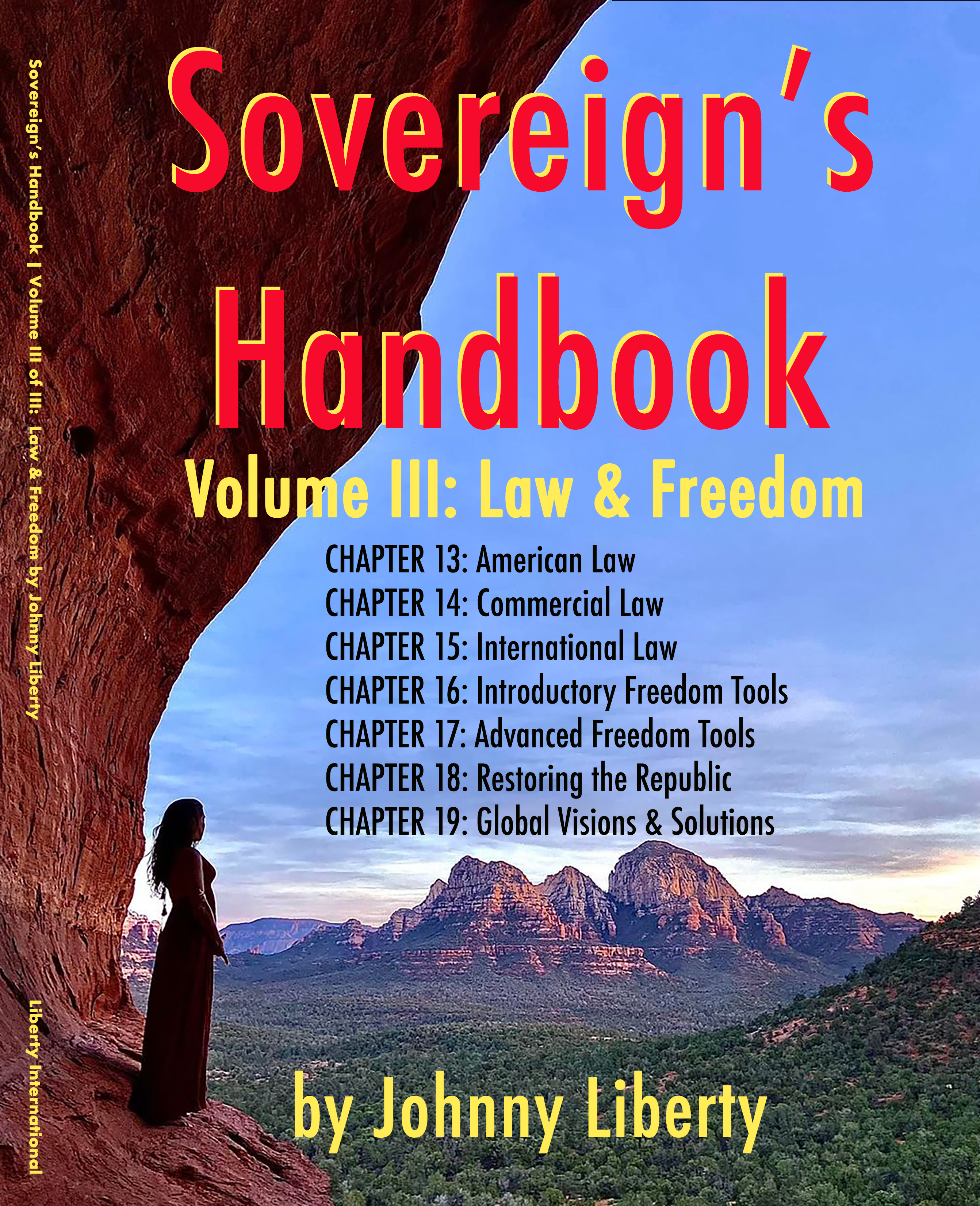
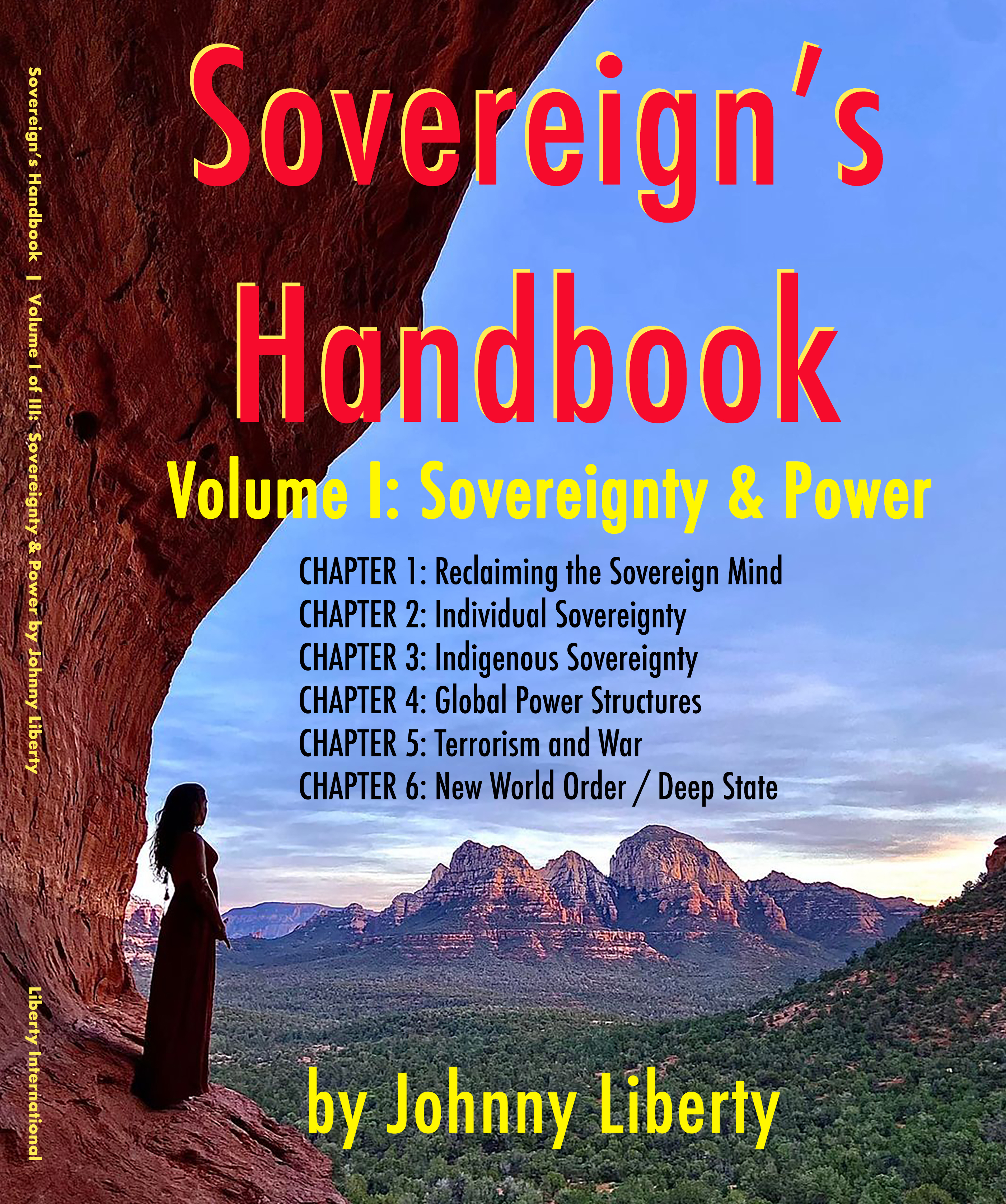
If you have ever heard talk or been to a seminar about “sovereignty”, then very likely those conversations were influenced by the foundational research of the author and educator.

His research and educational journey reaching millions of people worldwide began in 1992 and culminated in 2022 with the 3-Volume book release – his final word on the subject.

At the turn of the millennium his books and audio courses facilitated in part –  a sovereignty and tax-honesty movement that involved millions of Americans.

This 3 Volume series comprises the life’s work of Johnny Liberty filled with comprehensive insights into the last few hundred years of history, law, economics, money, citizenship and governance. 

These books show how it is supposed to be done in a constitutional Republic. 

How did We the People get to where we are today? 

What can we do to reclaim our inherent sovereignty and natural rights? 

Many of the answers may be found within these revolutionary pages. Available as a paperback, E-Book (PDF) or an Amazon Kindle format. Thank you for supporting the author. 

Sincerely, 

With Freedom For All, 
~ Johnny Liberty

Sovereign’s Handbook by Johnny Liberty (30th Anniversary Edition)

  • A three-volume, 750 page tome with an extensive update of the renowned underground classic ~ the Global Sovereign’s Handbook.
  • Still after all these years, it is the most comprehensive book on sovereignty, economics, law, power structures and history ever written.
  • Served as the primary research behind the best-selling Global One Audio Course.
  • ORDER NOW!
  • $99.99 ~ THREE VOLUME PRINT SERIES
  • $33.33 ~ THREE VOLUME E-BOOK

The 3 Volume Sovereign’s Handbook by Johnny Liberty is textbook material for everyone including educators/teachers, homeschoolers, historians, activists, leaders/politicians, attorneys/judges/law schools, police officers, and state Citizens/Nationals. 

Order Additional Books, Audios & Videos from The Freedom Catalog: LibertyInternationalBooks.com 
Sovereign’s Handbook (Website): http://SovereignsHandbook.com 
Dawning of the Corona Age (Website): DawningoftheCoronaAge.com 
Liberty International News: http://LibertyInternational.news 

ORDER YOUR LIBERTY BOOKS TODAY!

Sovereign’s Handbook by Johnny Liberty 
(30th Anniversary Edition)
(3-Volume Printed, Bound Book or PDF)

A three-volume, 750+ page tome with an extensive update of the renowned underground classic ~ the Global Sovereign’s Handbook. Still after all these years, this is the most comprehensive book on sovereignty, economics, law, power structures and history ever written. Served as the primary research behind the best-selling Global One Audio Course. Available Now!

$99.95 ~ THREE-VOLUME PRINT SERIES
$33.33 ~ THREE-VOLUME EBOOK

Dawning of the Corona Age: Navigating the Pandemic by Johnny Freedom 
(3rd Edition)
(Printed, Bound Book or PDF)

This comprehensive book, goes far beyond the immediate impact of the “pandemic”, but, along with the reader, imagines how our human world may be altered, both positively and negatively, long into an uncertain future. Available Now!

$25.00 ~ PRINT BOOK
$10.00 ~ EBOOK

Five Reasons You Don’t Owe Income Tax, Dammit! | Reason

By Brian Doherty

Here are some of the core arguments against the legality of the income tax one finds in the tax honesty movement. Devotees probably would regard them as oversimplifications. This is certainly not an all-inclusive list.

1) The IRS declares in various documents that the income tax is “voluntary.” And in Flora v. U.S. (1960), the Supreme Court announced, “Our system of taxation is based upon voluntary assessment and payment.”

2) In Brushaber v. Union Pacific (1916), the Supreme Court declared that “the conclusion that the 16th Amendment provides for a hitherto unknown power of taxation” is “erroneous,” and thus the 16th Amendment did not give Congress any taxing powers it did not already have. Hence, an unapportioned direct tax such as the income tax still cannot be legal. (Most mainstream readings of this extremely hard-to-follow decision say the Court meant Congress always had the power to levy an income tax, and that it was merely the question whether it should have to be apportioned that was at issue.)

3) Income, for the purposes of the tax code, should not be understood in any “common sense” way but only as defined by the Supreme Court. The Supreme Court, in Merchant’s Loan and Trust Company v. Smietanka (1921), defined it as having the same meaning as in the Corporation Excise Tax of 1909-and as Irwin Schiff has written, “nothing that was received by private persons was taxable as ‘income’ under that Act.” Income is defined as “gain derived…from labor” in a previous Supreme Court decision, Stratton’s Independence v. Howbert (1913).

4) Title 26 of the U.S. Code, in which tax-related statutes are found, is inherently “void for vagueness” because it lacks precise definitions of such terms as state, United States, employee, and person. Again, “common sense” definitions aren’t good enough. (Many tax honesty types interpret the use of the word includes in the tax code as properly meaning, “is limited to.”)

5) According to the tax-honesty reading of U.S. Code 26, Section 861, only income from foreigners or from overseas activity appears to actually be subject to the income tax.

6) The IRS declares in various documents that the income tax is “voluntary.” And in Flora v. U.S. (1960), the Supreme Court announced, “Our system of taxation is based upon voluntary assessment and payment.”

7) In Brushaber v. Union Pacific (1916), the Supreme Court declared that “the conclusion that the 16th Amendment provides for a hitherto unknown power of taxation” is “erroneous,” and thus the 16th Amendment did not give Congress any taxing powers it did not already have. Hence, an unapportioned direct tax such as the income tax still cannot be legal. (Most mainstream readings of this extremely hard-to-follow decision say the Court meant Congress always had the power to levy an income tax, and that it was merely the question whether it should have to be apportioned that was at issue.)

8) Income, for the purposes of the tax code, should not be understood in any “common sense” way but only as defined by the Supreme Court. The Supreme Court, in Merchant’s Loan and Trust Company v. Smietanka (1921), defined it as having the same meaning as in the Corporation Excise Tax of 1909-and as Irwin Schiff has written, “nothing that was received by private persons was taxable as ‘income’ under that Act.” Income is defined as “gain derived…from labor” in a previous Supreme Court decision, Stratton’s Independence v. Howbert (1913).

9) Title 26 of the U.S. Code, in which tax-related statutes are found, is inherently “void for vagueness” because it lacks precise definitions of such terms as state, United States, employee, and person. Again, “common sense” definitions aren’t good enough. (Many tax honesty types interpret the use of the word includes in the tax code as properly meaning, “is limited to.”)

10) According to the tax-honesty reading of U.S. Code 26, Section 861, only income from foreigners or from overseas activity appears to actually be subject to the income tax.

Source: Reason