John Pilger on ISIS: Only When We See the War Criminals In Our Midst Will the Blood Begin to Dry | Films for Action

By John Pilger

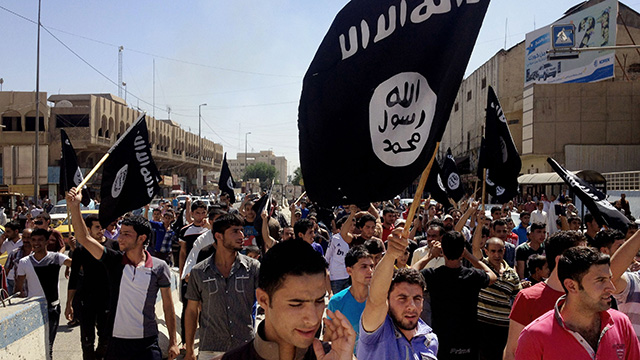
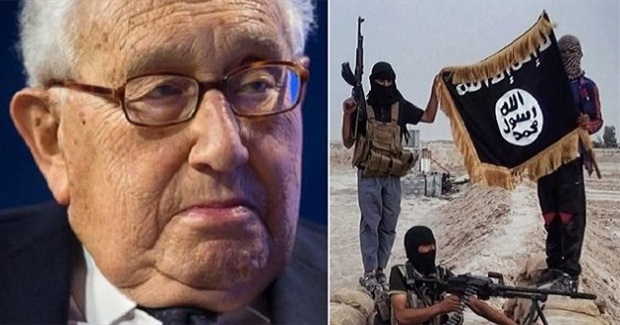
KissingerISISIn transmitting President Richard Nixon’s orders for a “massive” bombing of Cambodia in 1969, Henry Kissinger said, “Anything that flies on everything that moves”.  As Barack Obama ignites his seventh war against the Muslim world since he was awarded the Nobel Peace Prize, the orchestrated hysteria and lies make one almost nostalgic for Kissinger’s murderous honesty.

As a witness to the human consequences of aerial savagery – including the beheading of victims, their parts festooning trees and fields – I am not surprised by the disregard of memory and history, yet again. A telling example is the rise to power of Pol Pot and his Khmer Rouge, who had much in common with today’s Islamic State in Iraq and Syria (ISIS). They, too, were ruthless medievalists who began as a small sect. They, too, were the product of an American-made apocalypse, this time in Asia.

According to Pol Pot, his movement had consisted of “fewer than 5,000 poorly armed guerrillas uncertain about their strategy, tactics, loyalty and leaders”. Once Nixon’s and Kissinger’s B52 bombers had gone to work as part of “Operation Menu”, the west’s ultimate demon could not believe his luck.

The Americans dropped the equivalent of five Hiroshimas on rural Cambodia during 1969-73. They levelled village after village, returning to bomb the rubble and corpses. The craters left monstrous necklaces of carnage, still visible from the air. The terror was unimaginable. A former Khmer Rouge official described how the survivors “froze up and they would wander around mute for three or four days. Terrified and half-crazy, the people were ready to believe what they were told… That was what made it so easy for the Khmer Rouge to win the people over.”

A Finnish Government Commission of Enquiry estimated that 600,000 Cambodians died in the ensuing civil war and described the bombing as the “first stage in a decade of genocide”. What Nixon and Kissinger began, Pol Pot, their beneficiary, completed. Under their bombs, the Khmer Rouge grew to a formidable army of 200,000.

ISIS has a similar past and present. By most scholarly measure, Bush and Blair’s invasion of Iraq in 2003 led to the deaths of some 700,000 people – in a country that had no history of jihadism. The Kurds had done territorial and political deals; Sunni and Shia had class and sectarian differences, but they were at peace; intermarriage was common. Three years before the invasion, I drove the length of Iraq without fear. On the way I met people proud, above all, to be Iraqis, the heirs of a civilization that seemed, for them, a presence.

Bush and Blair blew all this to bits. Iraq is now a nest of jihadism. Al-Qaeda – like Pol Pot’s “jihadists” – seized the opportunity provided by the onslaught of Shock and Awe and the civil war that followed. “Rebel” Syria offered even greater rewards, with CIA and Gulf state ratlines of weapons, logistics and money running through Turkey. The arrival of foreign recruits was inevitable. A former British ambassador, Oliver Miles, wrote recently, “The [Cameron] government seems to be following the example of Tony Blair, who ignored consistent advice from the Foreign Office, MI5 and MI6 that our Middle East policy – and in particular our Middle East wars – had been a principal driver in the recruitment of Muslims in Britain for terrorism here.”

ISIS is the progeny of those in Washington and London who, in destroying Iraq as both a state and a society, conspired to commit an epic crime against humanity. Like Pol Pot and the Khmer Rouge, ISIS are the mutations of a western state terror dispensed by a venal imperial elite undeterred by the consequences of actions taken at great remove in distance and culture. Their culpability is unmentionable in “our” societies.

It is 23 years since this holocaust enveloped Iraq, immediately after the first Gulf War, when the US and Britain hijacked the United Nations Security Council and imposed punitive “sanctions” on the Iraqi population – ironically, reinforcing the domestic authority of Saddam Hussein. It was like a medieval siege. Almost everything that sustained a modern state was, in the jargon, “blocked” – from chlorine for making the water supply safe to school pencils, parts for X-ray machines, common painkillers and drugs to combat previously unknown cancers carried in the dust from the southern battlefields contaminated with Depleted Uranium.

Just before Christmas 1999, the Department of Trade and Industry in London restricted the export of vaccines meant to protect Iraqi children against diphtheria and yellow fever. Kim Howells, parliamentary Under-Secretary of State in the Blair government, explained why. “The children’s vaccines”, he said, “were capable of being used in weapons of mass destruction”. The British Government could get away with such an outrage because media reporting of Iraq – much of it manipulated by the Foreign Office – blamed Saddam Hussein for everything.

Under a bogus “humanitarian” Oil for Food Programme, $100 was allotted for each Iraqi to live on for a year. This figure had to pay for the entire society’s infrastructure and essential services, such as power and water. “Imagine,” the UN Assistant Secretary General, Hans Von Sponeck, told me, “setting that pittance against the lack of clean water, and the fact that the majority of sick people cannot afford treatment, and the sheer trauma of getting from day to day, and you have a glimpse of the nightmare. And make no mistake, this is deliberate. I have not in the past wanted to use the word genocide, but now it is unavoidable.”

Disgusted, Von Sponeck resigned as UN Humanitarian Co-ordinator in Iraq. His predecessor, Denis Halliday, an equally distinguished senior UN official, had also resigned. “I was instructed,” Halliday said, “to implement a policy that satisfies the definition of genocide: a deliberate policy that has effectively killed well over a million individuals, children and adults.”

A study by the United Nations Children’s Fund, Unicef, found that between 1991 and 1998, the height of the blockade, there were 500,000 “excess” deaths of Iraqi infants under the age of five. An American TV reporter put this to Madeleine Albright, US Ambassador to the United Nations, asking her, “Is the price worth it?” Albright replied, “We think the price is worth it.”

In 2007, the senior British official responsible for the sanctions, Carne Ross, known as “Mr. Iraq”, told a parliamentary selection committee, “[The US and UK governments] effectively denied the entire population a means to live.”  When I interviewed Carne Ross three years later, he was consumed by regret and contrition. “I feel ashamed,” he said. He is today a rare truth-teller of how governments deceive and how a compliant media plays a critical role in disseminating and maintaining the deception. “We would feed [journalists] factoids of sanitised intelligence,” he said, “or we’d freeze them out.”

On 25 September, a headline in the Guardian read: “Faced with the horror of Isis we must act.” The “we must act” is a ghost risen, a warning of the suppression of informed memory, facts, lessons learned and regrets or shame. The author of the article was Peter Hain, the former Foreign Office minister responsible for Iraq under Blair. In 1998, when Denis Halliday revealed the extent of the suffering in Iraq for which the Blair Government shared primary responsibility, Hain abused him on the BBC’s Newsnight as an “apologist for Saddam”. In 2003, Hain backed Blair’s invasion of stricken Iraq on the basis of transparent lies. At a subsequent Labour Party conference, he dismissed the invasion as a “fringe issue”.

Now Hain is demanding “air strikes, drones, military equipment and other support” for those “facing genocide” in Iraq and Syria. This will further “the imperative of a political solution”. Obama has the same in mind as he lifts what he calls the “restrictions” on US bombing and drone attacks. This means that missiles and 500-pound bombs can smash the homes of peasant people, as they are doing without restriction in Yemen, Pakistan, Afghanistan and Somalia – as they did in Cambodia, Vietnam and Laos. On 23 September, a Tomahawk cruise missile hit a village in Idlib Province in Syria, killing as many as a dozen civilians, including women and children. None waved a black flag.

The day Hain’s article appeared, Denis Halliday and Hans Von Sponeck happened to be in London and came to visit me. They were not shocked by the lethal hypocrisy of a politician, but lamented the enduring, almost inexplicable absence of intelligent diplomacy in negotiating a semblance of truce. Across the world, from Northern Ireland to Nepal, those regarding each other as terrorists and heretics have faced each other across a table. Why not now in Iraq and Syria.

Like Ebola from West Africa, a bacteria called “perpetual war” has crossed the Atlantic. Lord Richards, until recently head of the British military, wants “boots on the ground” now. There is a vapid, almost sociopathic verboseness from Cameron, Obama and their “coalition of the willing” – notably Australia’s aggressively weird Tony Abbott – as they prescribe more violence delivered from 30,000 feet on places where the blood of previous adventures never dried. They have never seen bombing and they apparently love it so much they want it to overthrow their one potentially valuable ally,  Syria. This is nothing new, as the following leaked UK-US intelligence file illustrates:

“In order to facilitate the action of liberative [sic] forces… a special effort should be made to eliminate certain key individuals [and] to proceed with internal disturbances in Syria. CIA is prepared, and SIS (MI6) will attempt to mount minor sabotage and coup de main [sic] incidents within Syria, working through contacts with individuals… a necessary degree of fear… frontier and [staged] border clashes [will] provide a pretext for intervention… the CIA and SIS should use… capabilities in both psychological and action fields to augment tension.”

That was written in 1957, though it could have been written yesterday. In the imperial world, nothing essentially changes. Last year, the former French Foreign Minister Roland Dumas revealed that “two years before the Arab spring”, he was told in London that a war on Syria was planned. “I am going to tell you something,” he said in an interview with the French TV channel LPC, “I was in England two years before the violence in Syria on other business. I met top British officials, who confessed to me that they were preparing something in Syria… Britain was organising an invasion of rebels into Syria. They even asked me, although I was no longer Minister for Foreign Affairs, if I would like to participate… This operation goes way back. It was prepared, preconceived and planned.”

The only effective opponents of ISIS are accredited demons of the west – Syria, Iran, Hezbollah. The obstacle is Turkey, an “ally” and a member of Nato, which has conspired with the CIA, MI6 and the Gulf medievalists to channel support to the Syrian “rebels”, including those now calling themselves ISIS. Supporting Turkey in its long-held ambition for regional dominance by overthrowing the Assad government beckons a major conventional war and the horrific dismemberment of the most ethnically diverse state in the Middle East.

A truce – however difficult to achieve – is the only way out of this imperial maze; otherwise, the beheadings will continue. That genuine negotiations with Syria should be seen as “morally questionable” (the Guardian) suggests that the assumptions of moral superiority among those who supported the war criminal Blair remain not only absurd, but dangerous.

Together with a truce, there should be an immediate cessation of all shipments of war materials to Israel and recognition of the State of Palestine. The issue of Palestine is the region’s most festering open wound, and the oft-stated justification for the rise of Islamic extremism. Osama bin Laden made that clear. Palestine also offers hope. Give justice to the Palestinians and you begin to change the world around them.

More than 40 years ago, the Nixon-Kissinger bombing of Cambodia unleashed a torrent of suffering from which that country has never recovered. The same is true of the Blair-Bush crime in Iraq. With impeccable timing, Henry Kissinger’s latest self-serving tome has just been released with its satirical title, “World Order”. In one fawning review, Kissinger is described as a “key shaper of a world order that remained stable for a quarter of a century”. Tell that to the people of Cambodia, Vietnam, Laos, Chile, East Timor and all the other victims of his “statecraft”.  Only when “we” recognise the war criminals in our midst will the blood begin to dry.


Source: John Pilger

A Primer: What is the Islamic State, and Why Are We Fighting Them? | BillMoyers.com

By Joshua Holland

Who Are These Islamic State Guys?

IS is a group of violent Islamic fundamentalists that first formed in Iraq in the aftermath of the US invasion as Jama’at al-Tawhid wal-Jihad, or “The Organization of Monotheism and Jihad.” It has gone by many names; today, it is also known as the Islamic State, The Islamic State of Iraq and Syria (ISIS) and the Islamic State of Iraq and the Levant (ISIL). As the latter name implies, they ultimately aspire to create an ultra-conservative Islamic state in Iraq, Syria, Lebanon, Israel, Jordan, Cyprus and Southern Turkey.

To simplify a complex history, the organization, which was most familiar to Americans as “Al-Qaeda in Iraq,” began in late 2004 as a home-grown Iraqi Sunni insurgency group that pledged allegiance to Osama Bin Laden. It has expanded into Syria during that country’s civil war, where it attracted extremists from around the world and grew in numbers and strength. Last October, Liz Sly reported for The Washington Post that “thousands of Arabs and other non-Syrian Muslims” had “streamed into Syria over the past two years to join in the fight.”

Experts say that IS has now become so powerful and well-organized that it’s misleading to call it a “terrorist group.” Jessica Lewis of the Washington-based Institute for the Study of War told Time Magazine that it now has “an advanced military leadership… They have incredible command and control and they have a sophisticated reporting mechanism from the field that can relay tactics and directives up and down the line,” she said. “They are well-financed, and they have big sources of manpower, not just the foreign fighters, but also prisoner escapees.”

Martin Chulov reports for The Guardian that IS has “secured massive cashflows from the oilfields of eastern Syria, and supplemented those revenues by robbing banks and looting antiquities.” According to Chulov, the network may have access to $2 billion.

Writing for The Atlantic, Aaron Zelin notes that IS has established a very severe form of Islamic law in areas it has occupied, while also employing “a soft-power governing strategy that includes social services, religious lectures, and da’wa(proselytizing) to local populations.” And at The Nation, Robert Dreyfuss suggeststhat there’s “a real danger that ISIS and its allies can set up a rump statelet in northwest Iraq and northern and eastern Syria controlled by ISIS, and its allies, including groups more closely affiliated to Al Qaeda.”

What’s the Regional Context Here?

This is both an Iraqi conflict, and also a tangled web of proxy wars fought along various regional fault lines.

This chart, by Hayes Brown and Adam Peck from ThinkProgress, is a helpful guide to all of the parties in this highly interconnected conflict:

Media accounts often focus on the discord between the Gulf states, led by Saudi Arabia, and the “Shiite crescent” — Iraq and Iran, where Shiites are the majority; Lebanon, where Hezbollah is a powerful faction; and Syria, where the Alawites (an offshoot of Shia Islam) are a dominant minority. As the chart above illustrates, this tension also affects Turkey, which has launched multiple strikes against Kurdish separatists in Iraq, and the Israeli-Palestinian conflict.

The Pew Research Center finds that throughout the region, from Tunisia to Egypt, there are “widespread fears” that the “violence in Syria would spill over into neighboring states.”

Are We Responsible for This Mess?

APTOPIX Mideast IraqThat’s an oversimplification.

It also takes a short view of history: As the birthplace of the three major Abrahamic religions — and the repository for a good chunk of the world’s oil reserves — the Middle East has long been plagued by conflict. The European colonial powers that sliced up the territory according to their own needs also deserve a lot of credit for its current instability — at GlobalPost, Charles Sennott writes that ISIS is in the process of “tearing up the map” created by France and Great Britain during World War I.

That said, it’s impossible to deny that the US invasion of Iraq in March 2003, plus a series of ideologically informed decisions by the Bush administration that followed, is the proximate cause of the bloody conflict raging there today.

The Bush administration went into Iraq with a “small footprint” — that is, insufficient forces to provide security — fired the army and police as part of its “de-baathification” program, privatized the Iraqi economy instead of investing in adequate public services and established a Shiite-dominated government that marginalized the Sunni community.

At The New Yorker, Dexter Filkins argues that the current wave of extremism in Iraq is “America’s legacy.” He writes: “When the Americans invaded they destroyed the Iraqi state—its military, its bureaucracy, its police force, and most everything else that might hold a country together.”

In 2004, The Atlantic’s James Fallows reported that “the Administration will be condemned for what it did with what was known. The problems the United States has encountered are precisely the ones its own expert agencies warned against.” Naomi Klein reported for Harper’s that the administration’s free-market ideology was the root cause of many of the problems that plagued US reconstruction efforts. In 2007, Nir Rosen wrote in The Washington Post that an “obsession with sects informed the U.S. approach to Iraq from day one of the occupation, but it was not how Iraqis saw themselves — at least, not until very recently. Iraqis were not primarily Sunnis or Shiites; they were Iraqis first, and their sectarian identities did not become politicized until the Americans occupied their country, treating Sunnis as the bad guys and Shiites as the good guys. ” That same year, Raed Jarrar and I said that US officials in Iraq had thwarted a number of plans for peace and reconciliation that had been put forth by parties that opposed the occupation.

The US also played a major role in Nouri al-Maliki’s rise to power following the handover from the Iraqi Coalition Government. Maliki has governed in a fiercely sectarian manner — Al-Monitor states that many “inhabitants of Mosul see the Iraqi army as a Shiite occupation army from Baghdad, and some civilians welcomed ISIS when they entered Mosul and removed all Iraqi army checkpoints. And while The Washington Post’s David Ignatius wrote back in 2007 that “the most important fact about Maliki’s election is that it’s a modest declaration of independence from Iran,” Maliki spent a decade in exile in Iran and, despite some ideological differences, the party he heads, Dawa, has received consistent support from Tehran.

Dexter Filkins reported for The New Yorker that a crucial deal that brought the current Iraqi government together was orchestrated by Qassem Suleimani, the head of Iran’s Quds Force and the architect of Syrian President Bashar al-Assad’s war against the Syrian insurgency.

Source: Bill Moyers


The Plan Acccording to U.S. General Wesley Clark (Ret.) | YouTube

In an interview with Amy Goodman on March 2, 2007, U.S. General Wesley Clark (Ret.), explains that the Bush Administration planned to take out 7 countries in 5 years: Iraq, Syria, Lebanon, Lybia, Somalia, Sudan, Iran.

We didn’t have to invade them, but just throw out their governments and divide the countries with the help of destabilisation.

  • Iraq – ✓[2003]
  • Afghanistan – ✓ [2001]
  • Libya – ✓ [ The fall of Gaddafi 2011 ]
  • Sudan – ✓[Divided last year in two states after US sponsored terrorism.]
  • Somalia – ✓ [US puppets in government]
  • Lebanon – [In progress right now. The Syrian war is spreading across the borders just last week]
  • Syria – [In progress right now. US financed terrorism]
  • Iran – The final stage. And it will be loud one.

Islamic charity founder Pete Seda ‘vindicated’ by ruling saying feds tried to turn tax fraud into terrorism | The Oregonian

By Bryon Denson

A federal appeals court Friday overturned the 2010 criminal conviction of Pete Seda, a key figure in an Ashland charity accused of supporting terrorism by smuggling money 10 years earlier to Chechen guerrillas at war with the Russian Federation.

The 9th U.S. Circuit Court of Appeals opinion accuses federal prosecutors of improperly influencing the outcome of Seda’s trial by concealing that they had paid a witness. The government also exceeded the scope of a search warrant and omitted facts that might have helped the defense, the court ruled.

“This is a tax fraud case that was transformed into a trial on terrorism,” Circuit Judge M. Margaret McKeown wrote in the panel’s 2-1 opinion.

The Iranian-born Seda, whose formal name is Pirouz Sedaghaty, was charged with falsifying a 2000 tax form filed on behalf of the U.S. wing of the Al-Haramain Islamic Foundation Inc., a Saudi Arabian charity. The U.S. government accused the charity of sending $150,000 through Saudi Arabia to fund terrorist activities and support the Chechen mujahideen “under the guise of humanitarian aid,” McKeown wrote.

Seda’s defense team, headed by Federal Public Defender Steven T. Wax, argued that Seda’s accountant caused the discrepancy in his client’s 2001 tax form and that Seda had a long, fruitful history as a man peacefully advancing the word of Islam.

A jury in Eugene’s U.S. District Court found Seda guilty of defrauding the U.S. government by making false statements on the tax return. He was later sentenced to 33 months in prison.

Wax told The Oregonian that he and Seda had waited nervously for the 9th Circuit opinion since arguing the case before the panel last December. When he got the news, Wax phoned Seda at a Portland halfway house — where he was serving the final day of his sentence since leaving prison in May.

“Pete was quite pleased to finally have some vindication of his position,” Wax said. “He has denied his guilt from the outset of these proceedings and is quite happy that the circuit has recognized that the trial was not a fair one.”

Amanda Marshall, the U.S. attorney for Oregon, said her office is reviewing the opinion and considering its options. Those range from dismissing the case to holding a new trial to filing appeals that might take the case all the way to the U.S. Supreme Court.

“Any decision about whether we will seek further review will have to be made in consultation with the (U.S. Department of Justice) Criminal Division and Solicitor General’s Office,” Marshall said in a prepared statement.

Government prosecutors withheld “significant impeachment evidence” by not telling the trial court that one of its key witnesses had been paid by the FBI, the appeals court found.

The panel also concluded that FBI agents, who obtained a search warrant from a U.S. magistrate for Seda’s home and the charity’s office, “went well beyond” the limitations imposed by the order when they searched Seda’s computer hard drives.

“The appeal illustrates the fine line between the government’s use of relevant evidence to document motive for a cover-up and its use of inflammatory, unrelated evidence about Osama Bin-Laden and terrorist activity that prejudices the jury,” McKeown wrote.

U.S. District Judge Michael Hogan did not properly follow the Classified Information Procedures Act as he tried the Seda case, the appellate panel found.

The law, known as CIPA, is intended to protect government secrets from disclosure at trial while ensuring that defendants are given substitute documents — typically written summaries — of classified materials. The appeals court found that the substitution approved by Hogan did not provide Seda “with substantially the same ability to make his defense as would disclosure of the specified classified information.”

Government prosecutors in Oregon have used CIPA to protect U.S. secrets in a number of national security cases. Those include the 2002 Portland Seven terrorism case, the 2009 spy case against former CIA officer Jim Nicholson and the trial of Mohamed Mohamud, the man found guilty in January of attempting to set off a bomb at Portland’s 2010 holiday tree-lighting ceremony.

The appellate ruling on CIPA won’t change the law, but it’s likely to give judges who find themselves trying national-security cases some pause, said Tung Yin, a professor at Lewis & Clark Law School who has followed the Seda case.

The ruling, he said, will serve as “a reminder to pay a little more attention to the substitutions and make sure they are crafted neutrally.”

Source: The Oregonian

Edward Snowden asylum: US ‘disappointed’ by Russian decision | The Guardian

Edward Snowden's lawyer

By in Moscow, , and in Washington

Edward Snowden’s lawyer Anatoly Kucherena shows a copy of a temporary document allowing the whistleblower to cross the border into Russia. Photograph: AP

The White House expressed anger and dismay on Thursday after Russia granted temporary asylum to the American whistleblower Edward Snowden and allowed him to leave the Moscow airport where he had been holed up for over a month.

White House spokesman Jay Carney said the US was “extremely disappointed” by the decision, almost certainly taken personally by President Vladimir Putin. He said Moscow should hand Snowden back and hinted that Barack Obama might now boycott a bilateral meeting with Putin in September, due to be held when the US president travels to Russia for a G20 summit.

Carney added that Snowden had arrived in both China and Russia carrying with him thousands of top secret US documents. He said: “Simply the possession of that kind of highly sensitive classified information outside of secure areas is both a huge risk and a violation.

“As we know he’s been in Russia now for many weeks. There is a huge risk associated with … removing that information from secure areas. You shouldn’t do it, you can’t do it, it’s wrong.”

With US-Russian relations now at a cold war-style low, Snowden slipped out of Sheremetyevo airport on Thursday afternoon. His lawyer, Anatoly Kucherena, said Russia’s federal migration service had granted him temporary asylum for one year. Snowden had left the airport to stay at an undisclosed location with expatriate Americans, he added.

Putin made no immediate comment. But having weighed Russia’s options for some weeks, he appears to have decided that Snowden’s propaganda value outweighs any possible US repercussions. Obama’s already floundering attempts to “reset”, or improve, relations with Moscow are in effect over.

In a statement released by WikiLeaks, Snowden thanked the Russian authorities and accused the US of behaving illegally. He made no explicit mention of the trial of Bradley Manning, who this week was convicted of espionage and faces 136 years in jail.

Snowden said: “Over the past eight weeks we have seen the Obama administration show no respect for international or domestic law, but in the end the law is winning.”

He added: “I thank the Russian Federation for granting me asylum in accordance with its laws and international obligations.”

Snowden has been given a temporary Russian travel document, with his name in Cyrillic and a fresh passport photo. “This gave him the right to temporary asylum on the territory of the Russian Federation, Kucherena said, holding up a copy of the document. US authorities had cancelled his American passport.

Security officials said Snowden officially crossed the border into Russia from the airport’s transit zone at about 3.30pm local time. Russia had apparently not informed the US of the move in advance. The state TV channel Rossiya 24 showed a photograph of Snowden’s departure, as he clambered into a grey unmarked car.

Despite being pictured from behind Snowden was instantly recognisable wearing his trademark grey shirt and carrying a black backpack. Next to him was Sarah Harrison, the WikiLeaks representative who accompanied him last month on his flight from Hong Kong.

Kucherena declined to provide details on where Snowden was heading, citing safety concerns. “Since he is the most hunted person in the world, he will address the question of security today,” he told journalists.

The former NSA employee will himself choose his place of residence and forms of protection, he added. Previously, some speculated that the Russian government was keeping Snowden hidden, although the whistleblower and his lawyer have denied that, adding that he has had no contact with Russian security services.

The whistleblower’s father, Lon Snowden, had reportedly been planning to visit his son. Kucherena said on Wednesday that he was sending an invitation to Snowden’s father so he could obtain a Russian visa. Kucherena told Rossiya 24 on Thursday that he would be speaking to the father later in the day to arrange his visit.

US authorities have repeatedly called on Moscow to return the fugitive to face charges in America. Last week America’s attorney general, Eric Holder, sent a letter to Russia’s justice minister promising that Snowden would not be tortured and that he would not face the death penalty if handed over to the US.

Russian officials previously said they had no jurisdiction to return Snowden, as he was not officially located on Russian territory, and that the US had not filed an official extradition request.

The Kremlin did not immediately comment on Snowden’s temporary asylum. Putin has previously said repeatedly that to remain in Russia, Snowden must stop activities harming the United States. His lawyer suggested that fresh revelations published by the Guardian on Wednesday and Thursday had come from documents that Snowden had already given the paper before Putin made his comments.

Russia’s decision has emboldened hawkish critics of the White House, who have long dubbed Obama’s attempts to improve relations with Putin as naive and inappropriate. In a statement on his website, Senator John McCain said: “Russia’s action today is a disgrace and a deliberate effort to embarrass the United States. It is a slap in the face of all Americans. Now is the time to fundamentally rethink our relationship with Putin’s Russia.”

He proposed in response to expand the Magnitsky Act list of banned Russian officials, push for Georgia’s acceptance into Nato and implement US missile defence programmes in Europe.

At the White House, Carney made it clear that President Obama was frustrated by the decision by Russia to allow Snowden to enter the country, and that a planned presidential summit was now in jeopardy.

Obama is scheduled to travel to Russia in September for at meeting of G20 leaders in St Petersburg. He also planned to meet Putin for a bilateral summit during the trip in what would have been a sign of improving relations between the two powers.

That meeting is now under review. “Obviously this is not a positive development,” Carney said. “We have a wide range of interests with the Russians. We are evaluating the utility of the summit.”

Amnesty International called for the focus to switch from Snowden’s asylum plight to the “sweeping nature and unlawfulness” of the US government’s surveillance programmes.

Widney Brown, senior director for international law and policy at Amnesty, said in a statement: “Now that Edward Snowden has left the airport and has protected status in Russia, the focus really needs to be on the US government’s surveillance programs. Snowden would not have needed temporary asylum but for revealing the sweeping nature and unlawfulness of a massive system of domestic and international surveillance by the United States government.”

A survey showed that 43% of Russians supported granting Snowden asylum and 51% approved of his whistleblowing activities. Kucherena said he had received numerous letters from Russians offering Snowden lodging, protection and money, as well as from women interested in Snowden romantically.

Pavel Durov, the founder of Russia’s most popular social network, VKontakte, invited Snowden to come work as a programmer at the network, in a post on his VKontakte page on Thursday.

Source: The Guardian

Jimmy Carter Defends Edward Snowden, Says NSA Spying Has Compromised Nation’s Democracy | The Huffington Post

jimmy carter edward snowden

Former president Jimmy Carter speaks at dedication ceremonies for the new George W. Bush Presidential Center in Dallas, Texas, Thursday, April 25, 2013. (Paul Moseley/Fort Worth Star-Telegram/MCT via Getty Images)

Former President Jimmy Carter announced support for NSA whistleblower Edward Snowden this week, saying that his uncovering of the agency’s massive surveillance programs had proven “beneficial.”

Speaking at a closed-door event in Atlanta covered by German newspaper Der Spiegel, Carter also criticized the NSA’s domestic spying as damaging to the core of the nation’s principles.

“America does not have a functioning democracy at this point in time,” Carter said, according to a translation by Inquisitr.

No American outlets covered Carter’s speech, given at an Atlantic Bridge meeting, which has reportedly led to some skepticism over Der Spiegel’s quotes. But Carter’s stance would be in line with remarks he’s made on Snowden and the issue of civil liberties in the past.

In June, while Snowden was scrambling to send out asylum requests from an airport in Russia, Carter appeared to back the former NSA contractor’s efforts to remain out of U.S. custody.

“He’s obviously violated the laws of America, for which he’s responsible, but I think the invasion of human rights and American privacy has gone too far,” he told CNN, saying that nations were within their right to offer asylum to Snowden. “I think that the secrecy that has been surrounding this invasion of privacy has been excessive, so I think that the bringing of it to the public notice has probably been, in the long term, beneficial.”

Snowden has been hard-pressed to find support among U.S. politicians. Lawmakers on both sides of the aisle have declared Snowden a traitor who deserves to be prosecuted for his leaks. The White House has also been persistent in its attempts to bring him into custody. Last week, the administration criticized Russia for facilitating a meeting between Snowden and human rights activists. Snowden has since applied for temporary asylum in the nation, following complications surrounding transit to the Latin American nations that he’d been considering.

Source: The Huffington Post

Edward Snowden is a whistleblower, not a spy – but do our leaders care? | The Guardian

Mike Rogers, CA 'Dutch' Ruppersberger

By Spencer Akerman
The Twitter account of House intelligence committee chairman Mike Rogers, left, placed Edward Snowden in the company of two infamous double agents. Photograph: J Scott Applewhite/AP

According to US legislators and journalists, the surveillance whistleblower Edward Snowden actively aided America’s enemies. They are just missing one essential element for the meme to take flight: evidence.

An op-ed by Representative Mike Pompeo (Republican, Kansas) proclaiming Snowden, who provided disclosed widespread surveillance on phone records and internet communications by the National Security Agency, “not a whistleblower” is indicative of the emerging narrative. Writing in the Wichita Eagle on 30 June Pompeo, a member of the House intelligence committee, wrote that Snowden “has provided intelligence to America’s adversaries“.

Pompeo correctly notes in his op-ed that “facts are important”. Yet when asked for the evidence justifying the claim that Snowden gave intelligence to American adversaries, his spokesman, JP Freire, cited Snowden’s leak of NSA documents. Those documents, however, were provided to the Guardian and the Washington Post, not al-Qaeda or North Korea.

It’s true that information published in the press can be read by anyone, including people who mean America harm. But to conflate that with actively handing information to foreign adversaries is to foreclose on the crucial distinction between a whistleblower and a spy, and makes journalists the handmaidens of enemies of the state.

Yet powerful legislators are eager to make that conflation about Snowden.

The Twitter account of Representative Mike Rogers (Republican, Michigan), the chairman of the House intelligence committee, on 18 June placed Snowden and accused WikiLeaks source Bradley Manning in the same company as Aldrich Ames and Robert Hanssen, two infamous CIA and FBI double-agents. (The tweet appears to have been deleted.)

When I asked about the conflation, Rogers’ Twitter account responded: “All 4 gave critical national security information to our enemies. Each did it in different ways but the result was the same.”

Never to be outdone, Peter King, a New York Republican and former chair of the House homeland security committee, proclaimed Snowden a “defector” on 10 June. Days later, Snowden left Hong Kong to seek asylum in an undetermined country – a curious move for a defector to make.

Once elected and appointed leaders casually conflate leaking and espionage, it is a matter of time before journalists take the cue. For insight into the “fear and isolation that NSA leaker Edward Snowden is living through”, CNN turned to Christopher Boyce – who sold US secrets to the USSR before becoming a bank robber.

There are understandable suspicions that Snowden may have aided foreign intelligence services in order to aid in his escape from American criminal justice. While some have speculated that the Russian or Chinese intelligence services might have snuck a look at the highly sensitive intelligence material Snowden is carrying, that material is heavily encrypted. For what it’s worth, in a Guardian webchat I asked Snowden directly if he would trade access to his documents for asylum. He said he would not.

Perhaps Snowden lied. Perhaps he might change his mind. But all of that is far off in the realm of speculation. As things stand now, there is no evidence Snowden has aided any US adversary or intelligence service, wittingly or not.

Even the Obama administration has stopped short of terming Snowden a spy, even in the course of attacking his character. (Yes, he was indicted under the Espionage Act, but the actual charges against him are theft of government property, unauthorized communication of national defense information, and willful communication of classified intelligence information to an unauthorized person.) In an email meant to discredit Snowden in the press, an anonymous “senior administration official” told reporters on 24 June that Snowden’s ostensible idealism “is belied by the protectors he has potentially chosen: China, Russia, Cuba, Venezuela and Ecuador”. That’s something to remember the next time Washington wants to talk about its commitment to human rights while cooperating with, say, China and Russia.

Edward Snowden Edward Snowden. Photograph: Reuters/The GuardianWhen asked directly if there was any evidence that Snowden had cooperated with any intelligence service or American adversary, the administration and Congress declined to provide any. The office of the director of national intelligence, James Clapper, declined to comment for this story. The Justice Department and the House intelligence committee didn’t even respond to inquiries.
By all means, consider Snowden a hero, a traitor or a complex individual with a mixture of motives and interests. Lots of opinions about Snowden are valid. He is a necessarily polarizing figure. The information he revealed speaks to some of the most basic questions about the boundaries between the citizen and the state, as well as persistent and real anxieties about terrorism.

What isn’t valid is the blithe assertion, absent evidence, that the former NSA contractor actively collaborated with America’s enemies. Snowden made classified information about widespread surveillance available to the American public. That’s a curious definition of an enemy for US legislators to adopt.

Source: The Guardian

A desperate protest by prisoners at Guantánamo has shamed Barack Obama

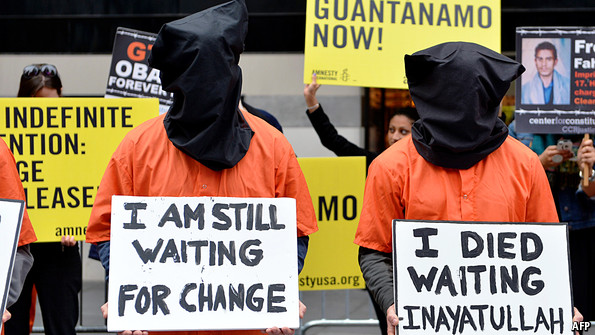
GuantanamoHungerStrike“YOU have to hand it to some of these IRA boys,” Margaret Thatcher once remarked of the republican hunger-strikers who embarrassed her in 1981. “What a terrible waste of human life!” she said of the ten who died. Since some of the hunger-strikers at Guantánamo Bay are being force-fed through nasal tubes, Barack Obama may be spared Mrs Thatcher’s grief. But he has been shamed by their desperate gambit all the same. The protest is a reminder of one of his most glaring failures in office.

Officials count 100 hunger-strikers; lawyers for the detainees say there are 130; on any reckoning, a majority of the 166 remaining inmates are starving themselves. Through their lawyers, detainees complain of a rougher regime since the army took over guard duties from the navy last autumn. In particular they allege that their Korans were mistreated during an inspection in February, when the hunger-strike began (prison authorities vigorously deny that). A cell-block raid by guards on April 13th (provoked by the covering up of security cameras), during which some prisoners were shot with rubber pellets, hardened rather than broke the strikers.

But the underlying cause is simpler, and more personal. “The reason they’re willing to die”, says Carlos Warner, a federal defender who represents 11 of the detainees, “is President Obama.”

Mr Obama said this week that Guantánamo “hurts us in terms of our international standing.” That echoed the view he espoused when, on his second day in office in January 2009, he ordered the prison to be closed within a year. Its existence since 2002, he said, had “likely created more terrorists around the world than it ever detained”—an opinion eventually shared by assorted veterans of George W. Bush’s administration. And yet the only Guantánamo-related closure so far has been the shutting, in January this year, of the diplomatic office charged with resettling the inmates.

Mr Obama blames Congress—with some justification. It thwarted his original plan to transfer the detainees to a facility in Illinois. Then, either out of concern for national security, a yen to embarrass the president, or both, in clauses inserted into successive defence-spending bills Congress made it difficult for officials to transfer anyone anywhere. Difficult, but not impossible: Mr Obama can authorise transfers using a presidential waiver. He has chosen not to. (After a bomb plot with links to Yemen at the end of 2009, he also chose to halt transfers there—and most of the remaining prisoners are Yemeni.) He evidently calculated that, given the battles he is already waging with Congress, Guantánamo was one he could do without.

That stalemate has been an especial let-down for the 86 residual prisoners who, in 2010, were slated for transfer out of Guantánamo by a presidential review; some had already been designated for transfer under the previous administration. Many of these men claim to have committed no offence except being in the wrong place—Afghanistan—at the wrong time, or to have been sold to American forces for the bounties they offered. One such, and one of the hunger-strikers, is Shaker Aamer, a British resident picked up in Jalalabad in 2001 and allegedly tortured. His lawyer, Clive Stafford Smith, points out that the British government is well-equipped to monitor Mr Aamer should he be repatriated.

According to the review, many of these men were low-level fighters rather than total innocents. But none has been charged with a crime—and most have been at Guantánamo for over a decade. In fact, only seven of the 779 prisoners who have passed through the camp have been convicted by its military tribunals (and two of those verdicts have been challenged). Of those still there, only three have been convicted and only six currently face trial, including Khalid Sheikh Mohammed, the alleged mastermind of the September 11th attacks. Subject to multiple legal challenges, beset by scandals over hidden microphones and leaked defence documents, the tribunals are now regarded as a failure even by those untroubled by their dubious legal status. As Mr Obama pointed out, federal courts have proved a much more effective forum for prosecuting terrorists.

The result, at the camp, is near-total stasis. No new prisoner has arrived since 2008; none has left for over a year. Parole-style hearings planned for the group not designated for either trial or transfer have yet to begin. Prisoners have lawyers, but there is little the lawyers can do for them. This bleak situation, says Mr Stafford Smith, is worse than being on death row.

Last chance?

Beyond the feeling of personal betrayal by Mr Obama, the detainees also sense—correctly—that the attention of the foreign leaders, human-rights watchdogs and United Nations officials who once energetically protested at their predicament has wandered. The outrage that the manacled, blindfolded, jumpsuited figures first provoked has dimmed. Drone warfare has become a much bigger human-rights preoccupation. And yet, unpropitious as it might seem, the prisoners also fear that this may be their last chance to get out.

Mr Warner says that if, with the president’s views and legal background, Mr Obama “can’t get this done, I don’t know who could.” It is hard to see a future presidential candidate matching his troublesome pledge to shut the prison. And for Mr Obama as well, time is running out. Even if he chose to use his waiver powers, and leant on other governments to accept detainees, the diplomacy, including gathering the necessary assurances on security and humane treatment, would take time.

Meanwhile the Guantánamo authorities are seeking an extra $200m for refurbishments, on top of annual running costs that wildly exceed those for ordinary prisons. They are planning new medical facilities to care for elderly detainees.

This week Mr Obama vowed to re-engage with Congress. “I’m going to go back at this,” he promised. He should hurry. Once Guantánamo was a byword for an overmighty executive and the excesses of Mr Bush’s “war on terror”. Under Mr Obama it has become a victim and a symbol of the paralysing divisiveness of American politics. “It’s going to get worse,” he said this week. “It’s going to fester.”

Source: The Economist

Lost in Translation: An Important Note for International Reckoners | The Daily Reckoning

Buenos Aires, Argentina – If you’re planning a vacation to the United States of America in the foreseeable future, you would do well to refrain from employing any confusing colloquialisms in your social media updates prior to departure.

For Australians, that means no “cracking onto” members of the opposite sex…no getting “off one’s face”…no “tearing it up”…no “little rippers” and, we would think, no “barrakking” for anyone.

Our Irish friends will likewise wish to steer clear of referring to anything as “the gas,” from declaring intentions to “eat one’s head off” and from “throwing shapes,” “sucking diesel” or otherwise “effin’ and blindin’.”

We can only imagine to what extent our English Reckoners shall have to curb their delightfully colorful lingo to ensure a stateside journey (even relatively) free of let or hindrance at the gate, though we imagine no measure of self-censorship will be sufficient to guarantee a transit experience free of at least a touch of “Ye ol’ Liberty Grope.”

What’s all this caper then, eh? What’s the apple, the score, the bleedin’ apple core?

Apologies for the loose linguistics, weary reader. But a point begs its making; a point two British (would-be) tourists, Leigh Van Bryan and Emily Bunting, discovered the hard way just last week.

Apparently rather chuffed at the upcoming prospect of a wee jaunt over the pond, Van Bryan and Bunting engaged in a bit of online banter before their big trip to the US. Mistake number one. The two were perhaps unaware that the Department of Homeland Security routinely trolls the global social media digital waves, setting up accounts to listen in on prospective threats to…um…the “Homeland.”

We can only imagine the hysterical frenzy that whipped around the DHS H.Q. when they discovered what Van Bryan, 26, had posted.

“Free this week for a quick gossip/prep before I go and destroy America x”

Not that it should matter, but “destroy” is popular English slang for “party”…an easily Googlable fact, one would think, for the highly skilled heroes manning the control tower at the Twitter and Facebook Counter Terrorism and Special Operations Unit for Liberty and Freedom of the Homeland… Patriot… Liberty… uh, never mind.

After making their way through passport control at Los Angeles International Airport (LAX) last week, the pair were promptly detained by armed guards/heroes/patriots. But the real trouble was still to come.

The two were then informed that the DHS was on to their scheme to “destroy” (read: party in) America and (Could it be? No! Sweet Mother of Mercy!) their sick and twisted plot to dig up the grave of Marilyn Monroe!

“3 weeks today, we’re totally in LA p****** people off on Hollywood Blvd and diggin’ Marilyn Monroe up!”

The pair explained that the tweet, which the DHS had considered a grave matter of national security was, actually, a reference from Family Guy, a popular television show produced in the Homeland itself…behind patriot lines!

“They asked why we wanted to destroy America and we tried to explain it meant to get trashed and party,” explained Bunting. “I almost burst out laughing when they asked me if I was going to be Leigh’s lookout while he dug up Marilyn Monroe. I couldn’t believe it because it was a quote from the comedy Family Guy which is an American show.”

Department of Homeland Security staff, brave unwavering professionals as they are, were not deterred from their mission.

“It got even more ridiculous because the officials searched our suitcases and said they were looking for spades and shovels. They did a full body search on me too” explained Bunting.

Perhaps because grave-robbing spades and shovels have little to do with (most people’s idea of) partying, the DHS were unable to find any in the pair’s luggage or, strangely enough, on their person. Nevertheless, this was no time to take chances:

“I kept saying to them they had got the wrong meaning from my tweet but they just told me ‘you’ve really f***** up with that tweet boy’.”

Van Bryan, apparently thought to be the leader of the non-existent operation, was then cuffed, thrown in a cage inside a van and whisked away to a location where he could not be of harm to Homeland citizens. Read more…

Source: The Daily Reckoning

Fresh Violence Rages in Libya | Al Jazerra

Libyan forces loyal to Muammar Gaddafi are waging a bloody operation to keep him in power, with residents reporting gunfire in parts of the capital Tripoli and other cities, while other citizens, including the country’s former ambassador to India, are saying that warplanes were used to “bomb” protesters.

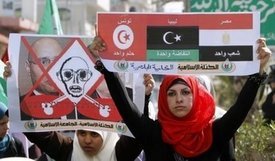
A Palestinian student holds up a placard displaying the Libyan flag flanked by the Tunisian (left) and Egyptian (right) flags during a protest against Libyan leader Moamer Kadhafi in Gaza City on Tuesday. (AFP/Mahmud Hams) Nearly 300 people are reported to have been killed in continuing violence in the capital and across the north African country as demonstrations enter their second week.

Navi Pillay, the UN high commissioner for human rights, has warned that the widespread attacks against civilians “amount to crimes against humanity”, and called for an international investigation in possible human rights violations.

Witnesses in Tripoli told Al Jazeera that fighter jets had bombed portions of the city in fresh attacks on Monday night. The bombing focused on ammunition depots and control centres around the capital.

Helicopter gunships were also used, they said, to fire on the streets in order to scare demonstrators away.

Several witnesses said that “mercenaries” were firing on civilians in the city, while pro-Gaddafi forces warned people not to leave their homes via loudspeakers mounted on cars.

Residents of the Tajura neighbourhood, east of Tripoli, said that dead bodies are still lying on the streets from earlier violence. At least 61 people were killed in the capital on Monday, witnesses told Al Jazeeera. Read more…