Assange psychologically tortured to ‘breaking point’ by ‘democratic states,’ UN rapporteur tells RT | RT.com

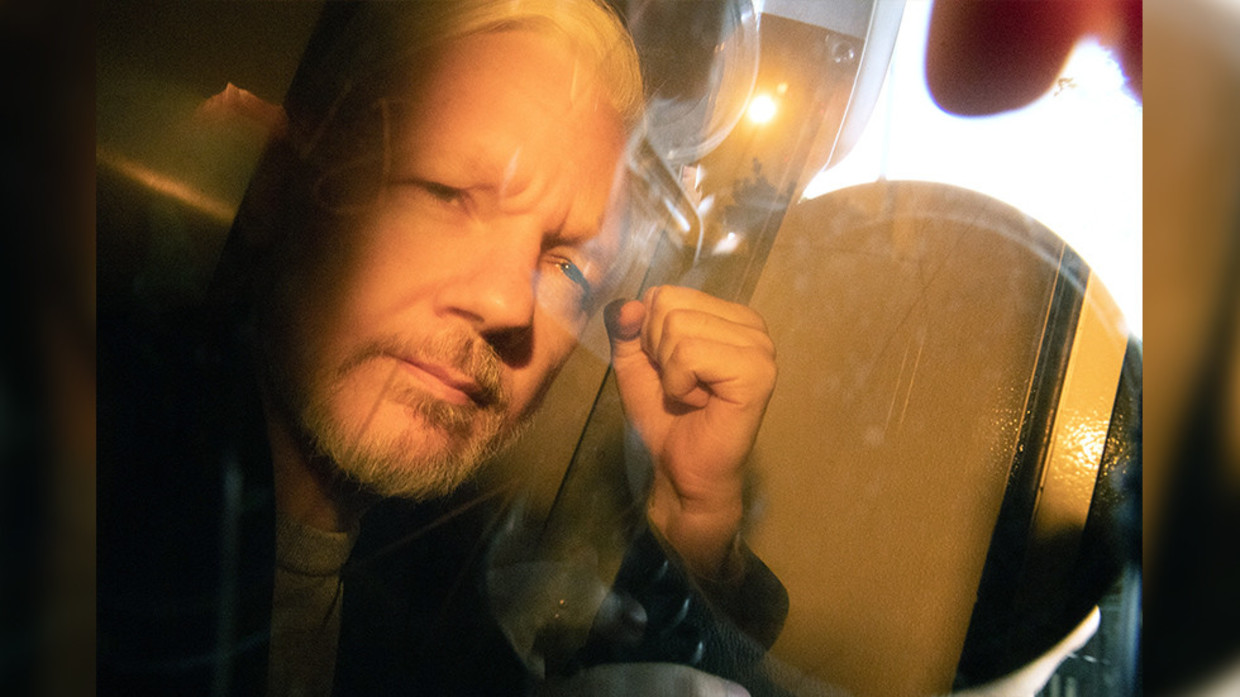
Jailed WikiLeaks co-founder Julian Assange shows clear signs of degrading and inhumane treatment which only adds to his deteriorating health, UN Special Rapporteur on Torture Nils Melzer told RT.

Assange has “all the symptoms typical for a person who has been exposed to prolonged psychological torture,” Melzer told RT’s Afshin Rattansi. This adds to the toll of his deteriorating physical state caused by a lack of adequate medical care for several years, he said.

Melzer said he was judging from two decades of experience in working with POWs and political prisoners, and only after applying “scientific” UN methods to assess Assange’s condition. But the journalist’s case still “shocked” him.

An individual has been isolated and singled out by several democratic states, and persecuted systematically… to the point of breaking him.

Earlier this month, a UK court sentenced the WikiLeaks co-founder to nearly a year in jail for skipping bail in 2012. The courts are now deciding whether to extradite Assange to the US where he is wanted for 17 charges under the Espionage Act. He can end up serving up to 175 years in prison if proven guilty.

Also in May, Sweden reopened an investigation into the allegations of rape by Assange, which he denies. The probe was originally dropped in 2017.

WikiLeaks warned that the journalist’s health had “significantly deteriorated” during the seven years he spent living in the Ecuadorian Embassy in London, and continued to worsen after he was evicted in April and placed in a British prison. According to WikiLeaks, he was recently moved to the prison’s “hospital wing.”


How 5G will change (destroy) the world | World Economic Forum

large_m297nKs9NwkwFNcZIsHG-pB8DPtURngI4QodH4rR8Rc

Editor’s Note: The unforeseen consequences of unleashing an electronic network worldwide with nowhere to hide, with a bombardment of such powerful frequencies as to disrupt every living system with proven oxygen shattering and immune suppressing technology is beginning to unfold. This article is an industry puff piece for the global leaders of industry promoting 5G as the next panacea for all our problems. My friends, this is a crisis of consciousness and will forever map the trajectory of human evolution. Only robots will survive this 5G rollout. Read it and weep!

By Don Rosenberg

It is not an easy time to be an internationalist, to seek global solutions to global problems amid what feels like one of history’s periodic inclinations toward divisiveness.

Yet, ironically, we’re on the verge of a new age of interconnectedness, when the daily lives of people across the planet will be more closely intertwined than ever. Advances in technology will usher in the age of fifth generation, or 5G, telecommunications. And, if past is prologue, this technological evolution will lead to dramatic societal changes.

The first generation of mobile communications, with brick-sized phones, brought just a handful of users expensive and often unreliable analogue voice calling. The second generation introduced digital voice service that was less likely to be dropped, available to many more people and ultimately cheaper to use. 3G ushered in the mobile internet, mobile computing, and the proliferation of apps. 4G (often called LTE) made possible all we have come to expect of mobile broadband: streaming video and audio; instantaneous ride hailing; the explosion of social media.

We take all this connectivity for granted, but the engineering inside the device in your bag or pocket today would have seemed impossible less than 20 years ago.

So, where will 5G take us?

Think about a world in which not just people but all things are connected: cars to the roads they are on; doctors to the personal medical devices of their patients; augmented reality available to help people shop and learn and explore wherever they are. This requires a massive increase in the level of connectivity.

5G is the technological answer, making possible billions of new connections, and making those connections secure and instantaneous. 5G will impact every industry – autos, healthcare, manufacturing and distribution, emergency services, just to name a few. And 5G is purposely designed so that these industries can take advantage of cellular connectivity in ways that wouldn’t have been possible before, and to scale upwards as use of 5G expands.

But generational change in mobile communications doesn’t just appear overnight. It requires significant effort in research and development and the resources necessary to support that effort. Work on 4G took nearly a decade and the challenges were not easy. Consider one of tens of thousands of problems that needed to be solved as described by an engineer at Qualcomm, where much of this technology was invented:

“When the signal leaves the base station, it can undergo a loss of up to 130 decibels before it reaches your mobile phone. To put that loss into perspective, if you consider the transmitted signal power to be roughly the size of the Earth, then the received signal power would be equivalent to the size of a tiny bacteria.”

That is a tremendous loss of power, and it requires some pretty impressive engineering to compensate for the effect of the loss on the words, pictures, and other data we send and receive across the airwaves in a transparent, seamless and instantaneous way.

But we weren’t alone. The international engineering co-operation that goes into development of a telecom standard illustrates how much can be achieved when disparate national, commercial and scientific parties work together for the common good.

Like 3G and 4G, 5G is the responsibility of the standards-setting organisation 3GPP, where the handful of companies that invent technologies come together with many, many more companies who will develop products that implement those technologies.

Think about this process for a moment: engineers from rival inventing companies, rival product makers, rival wireless network operators, all from different countries and continents, discussing, testing, striving to perfect tens of thousands of different technical solutions that ultimately make up a standard like 5G.

They judge each technical solution using a merit-based, consensus-building approach. This process has been at the foundation of a technological revolution that spawned myriad new industries, millions of new jobs and well over a $1 trillion in economic growth.

It’s the fusion of commercial self-interest with the recognition that some problems are best solved by working together. And it’s not a bad model of human behaviour if we are to meet the World Economic Forum’s goal this year to address the problems of “a fractured world”.

The benefits and advantages of 5G technology are expected to be available sometime in 2019. We believe 5G will change the world even more profoundly than 3G and 4G; that it will be as revolutionary as electricity or the automobile, benefitting entire economies and entire societies.

Developing nations have rivalled or surpassed their industrialised counterparts in benefiting from the deployment of mobile technology, and there’s every reason to think 5G will have an even bigger levelling effect than its predecessors.

Economists estimate the global economic impact of 5G in new goods and services will reach $12 trillion by 2035 as 5G moves mobile technology from connecting people to people and information, towards connecting people to everything.


Many of the benefits probably aren’t yet apparent to us. Wireless network operators initially resisted proposals to give their customers mobile access to the internet, questioning why they would want it. At the dawn of 4G’s adoption no one could have predicted the new business models that grew on the back of mobile broadband, like Uber, Spotify and Facebook.

Now, according to the European Patent Office, the number of patent applications related to “smart connected objects” has surged 54% over the last three years, suggesting new, related and as-yet unknown inventions will arrive even before 5G becomes available.

This is news that should encourage us amid glum commentaries on the state of the world. There is promise yet in what we’re capable of achieving.

Source: World Economic Forum

Sunshine Week: Transparency issues persist with Obama administration | Washington Post

By Josh Hicks

ObamaLipsSunday marked the start of Sunshine Week, a time when government-transparency advocates promote their cause and issue reports gauging the openness of federal agencies.

The findings have never been great for the current administration, which promised to be the most transparent in history on the day President Obama took office. In recent years, most agencies have not fully complied with Freedom of Information Act (FOIA) requirements.

This year’s reports show improvement in some areas, but still much to be desired by news organizations and open-government groups such as the Center for Effective Government and the National Security Archive.

An Associated Press analysis of federal data found that the Obama administration has grown more secretive over time, last year censoring or outright denying FOIA access to government files more than ever since Obama took office.

The administration has also cited more legal exceptions to justify withholding materials and refused to turn over newsworthy files quickly, and most agencies took longer to answer records requests, according to the AP study.

A separate report this week from the National Security Archives found that 54 percent of all agencies have ignored directives that Obama and Attorney General Eric Holder issued in 2009 calling for a “presumption of disclosure” with FOIA requests. The good news: That number is down from about 70 percent of agencies last year.

The National Security Archives also found that nearly half of all federal agencies have not updated their FOIA regulations to comply with 2007 amendments Congress made to the law. The changes require agencies to cooperate with a new FOIA ombudsman in the Office of Government Information Services and report specific data on FOIA output, among other provisions.

The National Security Archive, which claims to file more FOIA requests than any other group, gathers and publishes declassified U.S. government files, with a focus on U.S. foreign policy documents.

In a third analysis, the Center for Effective Government released its annual government-transparency report card on Monday, handing out failing grades to seven of the 15 agencies it reviewed. The scores are based on three metrics: processing requests for information, establishing rules for answering requests and creating user-friendly Web sites.

The White House has put forward an action plan that could help the administration improve its marks by creating one core FOIA regulation and a common set of practices to help requesters and federal agencies better understand the guidelines.

In Congress, the House has passed a bipartisan bill that would require agencies to update their regulations within 180 days.

Source: Washington Post

Fact Check: So who’s checking the fact-finders? | The Florida Times-Union & Jacksonville Times

Journalists have always been fact-checkers. Now, thanks to the Internet and social media, everyone has a soapbox, and everyone can send truths and untruths to hundreds of people with the push of a button. Spoofs and satires become gospel. Unpopular viewpoints and people are targeted.

To get at the truth, many news organizations now include fact-checking columns, like this one.

But the fact-checkers themselves are not free from criticism. More often than not, the criticism comes from the right because, with a Democrat in the White House, that’s where most of the viral criticism comes from. So most of the fact-checking is of those allegations. Fact-finding sources that appear in the Times-Union, however, pride themselves on being accurate – using original reporting, source-checking, corroborating research and well-documented reports from other fact-finding groups to get at the truth.

So how do we know if we’re getting the straight skinny?

When we use other sources, we corroborate results. If we can’t be certain about something, we say so. But we do rely on some fact-finders that repeatedly have come under fire.

SNOPES.COM

Snopes.com is at the top of that list. An email circulating since 2008 warns not to use Snopes.com because of its political leanings: “I have recently discovered that Snopes.com is owned by a flaming liberal and this man is in the tank for Obama. …”

Snopes.com is the oldest fact-finder on the Internet. It was well-respected for years when it fact-checked urban legends, such as whether more domestic abuse occurs on Super Bowl Sunday than on any other day. But when Snopes.com starting debunking rumors about candidate-then-President Barack Obama, it was roundly criticized.

Snopes.com is owned and run by David and Barbara Mikkelson of California, who have not hidden their identities as one of the viral email claims. Check out the list that shows this at www.snopes.com/info/articles.asp.

As far as being liberal, other fact-checkers, such as Truthorfiction.com; David Emery, who researches urban legends for the information website About.com; and FactCheck.org have researched Snopes.com and none has found any instance where the Mikkelsons have stated a political preference or affiliation.

Barbara Mikkelson is a Canadian citizen, so she can’t contribute to a political campaign or vote in U.S. elections. David Mikkelson provided his voter registration papers to FactCheck.org that show he registered as a Republican in 2000, and had no party affiliation in 2008.

A check of the donor list at the Center for Responsive Politics, which tracks campaign contributions (1990-2012), shows no contributions by Mikkelson to any candidate from any party. You can check yourself at www.opensecrets.org.

If there is proof that refutes this, or shows that the Mikkelsons are “flaming liberals,” no one has come up with it.

Truth be told, there are emails that present what they say is verifiable proof that Snopes.com is biased.

One viral email suggested that Elena Kagan was nominated to the Supreme Court because as solicitor general she fended off all the lawsuits challenging Obama’s eligibility to be president. Snopes.com was castigated for debunking the rumor, but all it did was look at the docket items cited by the email and found that not a single one was about Obama’s eligibility. A check of those dockets at www.supremecourt.gov confirms that.

Emery, who said he has looked at the texts about Obama forwarded to Snopes.com, states that he “has found no any evidence of advocacy for or against. To the contrary, I see a consistent effort to provide even-handed analyses. …”

FactCheck.org also fact-checked Snopes.com: “We reviewed a sampling of their political offerings, including some on rumors about George W. Bush, Sarah Palin and Barack Obama, and we found them [Snopes.com] to be utterly poker-faced.”

There have also been viral emails charging that Snopes.com is financed by business magnate and philanthropist George Soros. There have been no verifiable reports of a Soros connection, but Snopes.com’s books are not open for all to see, so we can’t say for absolutely certain.

Some of the emails disparaging Snopes.com cite that TruthorFiction.com is a much more reliable site. TruthorFiction.com lauds Snopes.com as an “excellent” and “authoritative” resource (www.truthorfiction.com/rumors/s/snopes.htm).

Although Snopes.com could do a better job of linking to sources within its stories, it does list its sources, so it is easy to confirm accuracy.

FACTCHECK.ORG

FactCheck.org is a nonpartisan fact-finding project of the Annenberg Public Policy Center at the University of Pennsylvania. It has been attacked as a leftist group in an email that says that Wallis Annenberg, president and CEO of the Annenberg Foundation, contributed $25,000 to the Democratic National Committee.

In March 2007, Wallis Annenberg did personally donate $25,000 to the Democratic Congressional Campaign Committee. This had nothing to do with FactCheck.org. And, according to the Federal Election Commission campaign contribution database (www.fec.gov), she has also given to numerous Republican campaigns.

Brooks Jackson, a journalist who launched FactCheck.org, told the Times-Union that the group’s charter stipulates nonpartisanship.

It is ironic that the viral emails charge FactCheck.org as being a leftist organization when philanthropist Walter Annenberg was a fervid Republican, as was his wife Leonore. But even so, the foundation has never influenced FactCheck.org one way or the other, Jackson said.

TRUTHORFICTION.COM

TruthorFiction.com was founded in 1999 by the late Rich Buhler, a Christian radio broadcaster, speaker, author and producer who researched and wrote about urban legends for more than 30 years, according to various media reports. Its staff researches the rumors; original sources are usually listed or linked, so it is a good site to corroborate facts.

POLITIFACT.COM

PolitiFact.com is a fact-finding project of the Tampa Bay Times (formerly The St. Petersburg Times) and has been assailed as a partisan member of the “liberal media.”

PolitiFact.com, which was awarded a Pulitzer Prize, examines statements by politicians and pundits and rates what they say on its Truth-O-Meter. The website also tracks promises by Obama and Republican leaders.

It is true that some of its reporters work for the Tampa Bay Times, a fact not lost on a website called PolitiFactbias.com, which exposes what it calls liberal bias by PolitiFact.com.

But PolitiFact.com uses strict journalistic standards, according to its mandate. Its reporters and researchers use original reports rather than news stories. When possible, PolitiFact.com uses original sources to verify the claims and interviews impartial experts.

These fact-finders all help to arrive at the truth. But we believe that confirming accuracy through multiple sources and original reporting is the best guarantee. And as Emery says:

“In the thorny search for truth, there’s no substitute for doing one’s own research and applying one’s own considered judgment before thinking oneself informed.”

Source: The Florida Times-Union & Jacksonville Times

The 28th Amendment: Fact or Fiction? | Snopes

Proposed 28th Amendment to the United States Constitution:

“Congress shall make no law that applies to the citizens of the United States that does not apply equally to the Senators and Representatives; and, Congress shall make no law that applies to the Senators and Representatives that does not apply equally to the citizens of the United States.”Q: Does this text represent the actual 28th Amendment to the U.S. Constitution?

A: No. The U.S. Constitution has only 27 amendments, the last of which (a limit on Congressional pay increases) was ratified in 1992.

Q: Does this text represent a proposed 28th Amendment?

A: This item is a “proposed 28th amendment” only in the very loose sense that any change to the U.S. Constitution suggested since the ratification of the 27th Amendment is a “proposed 28th Amendment.” However, when this piece hit the Internet back in 2009 it was just a bit of online politicking, not something that had been introduced or proposed as a potential amendment by any member of Congress.

In August 2013, nearly four years after this item began making the rounds on the Internet, two Congressmen (Ron DeSantis of Florida and Matt Salmon of Arizona) did introduce a joint resolution (H.J.RES.55) similar to one of its elements, proposing an amendment to the Constitution stating that “Congress shall make no law respecting the citizens of the United States that does not also apply to the Senators and Representatives.” That bill died in committee, and it is exceedingly unlikely that any such broadly worded amendment could ever pass muster in Congress without the underlying idea being subject to a good many qualifications.

Q: Could this amendment be passed without Congress’ voting on it?

A: Possibly, not not likely. Article 5 of the U.S. Constitution specifies two procedures for amendments. One method is for two-thirds of states legislatures to call for a constitutional convention at which new amendments may be proposed, subject to ratification by three-fourths of the states. The constitutional convention method allows for the Constitution to be amended by the actions of states alone and cuts Congress out of the equation — no Congressional vote or approval is required. However, not once in the history of the United States have the states ever called a convention for the purpose of proposing new constitutional amendments.

The other method for amending the Constitution (the one employed with every amendment so far proposed or enacted) requires that the proposed amendment be approved by both houses of Congress (i.e., the Senate and the House of Representatives) by a two-thirds majority in each, and then ratified by three-fourths of the states. It’s probably safe to speculate that the odds that a supermajority of both houses of Congress would pass an amendment which placed such restrictions upon them are very low indeed.

Q: Can members of Congress retire with full pay after serving only a single term?

A: No. This is a long-standing erroneous rumor which we have covered in detail in a separate article.

Q: Are members of Congress exempt from paying into Social Security?

A: No. As noted in our article about Congressional pensions, although Congress initially participated in the Civil Service Retirement System (CSRS) rather than Social Security, since 1984 all members of Congress have been required to pay into the Social Security fund.

Q: Are members of Congress exempt from prosecution for sexual harassment?

A: No. The passage of Public Law 104-1 (the Congressional Accountability Act of 1995, also known as CAA) made a variety of laws related to civil rights and workplace regulations applicable to the legislative branch of the federal government. Section 1311(a) of the CAA specifically prohibits sexual harassment (as well as harassment on the basis of race, color, religion, or national origin).

Q: Are members of Congress exempt from the Patient Protection and Affordable Care Act (i.e., “Obamacare”) health care legislation?

A: No. One of the provisions of the Patient Protection and Affordable Care Act passed by Congress is a requirement that lawmakers give up the insurance coverage previously provided to them through the Federal Employees Health Benefits Program and instead purchase health insurance through the online exchanges that the law created:

An August 2013 ruling by the federal Office of Personnel Management (OPM) was widely and inaccurately reported as exempting members of Congress from the requirement that they give up their Federal Employees Health Benefits Program coverage and instead purchase health insurance through online exchanges. That reporting was incorrect: Lawmakers are still required to purchase health insurance through government-created exchanges; what the OPM’s ruling actually declared was that members of Congress and their staffs did not have to give up the federal subsidies covering part of the costs of their insurance premiums which they had previously been receiving (and which are afforded to millions of other federal workers).

An October 2011 variant of this item is prefaced by a statement made by Warren Buffett: “‘I could end the deficit in 5 minutes. You just pass a law that says that anytime there is a deficit of more than 3% of GDP, all sitting members of Congress are ineligible for re-election.’” This quote came from a 7 July 2011 CNBC interview in which the Oracle of Omaha addressed the then-current issue of raising the debt limit. The rest of the message however, has nothing to do with Warren Buffett.

Some versions of this item include a statement asserting that the children and staffers of U.S. Congressmen are exempt from paying back student loan obligations. That statement is false.

Later versions of this item have been prefaced with the statement that “Governors of 35 states have filed suit against the Federal Government for imposing unlawful burdens upon them. It only takes 38 (of the 50) States to convene a Constitutional Convention.” Actually, only 34 states are required to convene such a convention.

Source: Snopes