Editor’s Note: An interesting discussion of whether to reward or punish whistleblowers such as Snowden or Assange. Gabbard suggests that we encourage truth telling by insiders. I agree with her.
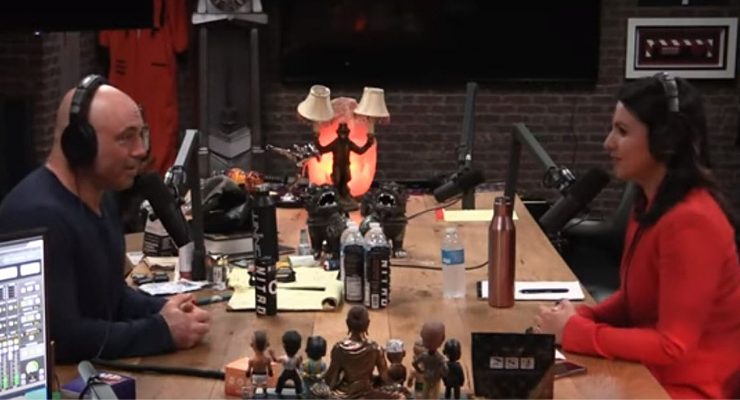
In midst of an interesting and wide-ranging discussion on the Joe Rogan Experience, Democratic congresswoman and presidential candidate Tulsi Gabbard said that if elected president she would drop all charges against NSA whistleblower Edward Snowden and WikiLeaks founder Julian Assange.
“What would you do about Julian Assange? What would you do about Edward Snowden?” Rogan asked in the latter part of the episode.
“As far as dropping the charges?” Gabbard asked.
“If you’re president of the world right now, what do you do?”
“Yeah, dropping the charges,” Gabbard replied.
Rogan noted that Sweden’s preliminary investigation of rape allegations has just been re-opened, saying the US government can’t stop that, and Gabbard said as president she’d drop the US charges leveled against Assange by the Trump administration.
“Yeah,” Gabbard said when asked to clarify if she was also saying that she’d give Edward Snowden a presidential pardon, adding, “And I think we’ve got to address why he did things the way that he did them. And you hear the same thing from Chelsea Manning, how there is not an actual channel for whistleblowers like them to bring forward information that exposes egregious abuses of our constitutional rights and liberties. Period. There was not a channel for that to happen in a real way, and that’s why they ended up taking the path that they did, and suffering the consequences.”
This came at the end of a lengthy discussion about WikiLeaks and the dangerous legal precedent that the Trump administration is setting for press freedoms by prosecuting Assange, as well as the revelations about NSA surveillance and what can be done to roll back those unchecked surveillance powers.
“What happened with [Assange’s] arrest and all the stuff that just went down I think poses a great threat to our freedom of the press and to our freedom of speech,” Gabbard said. “We look at what happened under the previous administration, under Obama. You know, they were trying to find ways to go after Assange and WikiLeaks, but ultimately they chose not to seek to extradite him or charge him, because they recognized what a slippery slope that begins when you have a government in a position to levy criminal charges and consequences against someone who’s publishing information or saying things that the government doesn’t want you to say, and sharing information the government doesn’t want you to share.
And so the fact that the Trump administration has chosen to ignore that fact, to ignore how important it is that we uphold our freedoms, freedom of the press and freedom of speech, and go after him, it has a very chilling effect on both journalists and publishers. And you can look to those in traditional media and also those in new media, and also every one of us as Americans. It was a kind of a warning call, saying Look what happened to this guy. It could happen to you. It could happen to any one of us.”
Gabbard discussed Mike Pompeo’s arbitrary designation of WikiLeaks as a hostile non-state intelligence service, the fact that James Clapper lied to Congress about NSA surveillance as Director of National Intelligence yet suffered no consequences and remains a respected TV pundit, and the opaque and unaccountable nature of FISA warrants.
Some other noteworthy parts of Gabbard’s JRE appearance for people who don’t have time to watch the whole thing, with hyperlinks to the times in the video:
Rogan gets Gabbard talking in depth about what Bashar al-Assad was actually like when she met him and what he said to her, which I don’t think I’ve ever seen anyone bother to do before.
The two discuss Eisenhower’s famous speech warning of the dangers of the military-industrial complex, and actually pause their dialogue to watch a good portion of it. Gabbard points out that in the original draft of the speech, Eisenhower had intended to call it the “congressional-military-industrial complex”.
Rogan asks Gabbard what she thinks happens to US presidents that causes them to fail to enact their campaign promises and capitulate to the will of the warmongering establishment, and what as president she’ll do to avoid the same fate. All presidential candidates should have to answer this question.
Rogan asks Gabbard how she’ll stand against the billionaires for the American people without getting assassinated. All presidential candidates should have to answer this question as well.
I honestly think the entire American political system would be better off if the phoney debate stage format were completely abandoned and presidential candidates just talked one-on-one with Joe Rogan for two and a half hours instead. Cut through all the vapid posturing and the fake questions about nonsense nobody cares about and get them to go deep with a normal human being who smokes pot and curses and does sports commentary for cage fighting. Rogan asked Gabbard a bunch of questions that real people are interested in, in a format where she was encouraged to relax out of her standard politician’s posture and discuss significant ideas sincerely and spontaneously. It was a good discussion with an interesting political figure and I’m glad it’s already racked up hundreds of thousands of views.
Documents unsealed this week lend credence to a theory about Russian election meddling that was first put forward in the Trump-Russia dossier, however they do not corroborate the more explosive claims that the Trump campaign colluded with the Kremlin in the 2016 campaign.
A report from a retired agent who worked for the FBI’s cyber division, submitted as expert testimony in a civil lawsuit, presented new evidence about how Russian intelligence might have exploited a private web hosting company when it fooled top Democratic targets into giving up their passwords. The fruits of those hacks formed the basis of the WikiLeaks email dumps that roiled the race.
The controversial dossier had accused Russian hackers of using those companies, Webzilla and its parent company XBT, as part of their scheme to meddle in the presidential election. The memos, written by a retired British spy, Christopher Steele, also claimed that Russian entrepreneur Aleksej Gubarev assisted the cyberattacks “under duress” from Russian intelligence.
Gubarev vehemently denied those allegations and sued BuzzFeed for defamation after it published the dossier. That prompted BuzzFeed to commission the expert witness report from FTI Consulting’s Anthony Ferrante, who is also a CNN contributor. A federal judge dismissed the lawsuit in December, and ordered that dozens of documents be released to the public this week. The judge ruled on First Amendment grounds and did not assess the hacking-related allegations.
Details of the report
The FTI report concluded that one of the hyperlinks the Russians designed to trick Hillary Clinton’s campaign chairman John Podesta into giving up his email password was created on an internet protocol address owned by Root S.A., an XBT subsidiary.
In his deposition, retired FBI cyber official Ferrante admitted the evidence didn’t conclusively show XBT was aware of the Russian campaign against Democrats.
“I will further state that other than the fact that XBT employees did little to nothing to detect, stop and prevent the significant malicious activity, I have no evidence of them actually sitting behind a keyboard,” he said.
Gubarev’s team argued that an internet hosting company couldn’t be held responsible for the activities of people who use its services.
A rebuttal on Gubarev’s behalf, filed by a former CIA cybersecurity expert, Eric Cole, stressed that he and his staff were frequently unaware of the specific activity conducted on its servers.
“XBT/Webzilla is not responsible for every bit of data that a bad actor passes over its infrastructure any more than a post office is responsible for the actions of the Unabomber,” Cole wrote.
“Special Counsel Robert Mueller indicted the 12 Russians responsible for the hacking. Those are the folks responsible, not us,” Evan Fray-Witzer, an attorney for Gubarev, told CNN. The 11-count indictment against those hackers, which was filed in July 2018, did not mention Webzilla or XBT.
BuzzFeed News characterized the report as vindication of its decision to publish the Trump-Russia dossier. “We knew already that publishing the dossier was in the public interest,” spokesperson Matt Mittenthal told CNN. “Now, because BuzzFeed News published the dossier, we’re learning more about the facts of foreign influence in the 2016 presidential election.”
Gubarev sued BuzzFeed in 2017 and sought damages for defamation. As part of the legal process, some of the key players in the dossier saga were deposed, including Steele.
The court unsealed one page of that deposition, which happened last year in London. Steele testified that he tried to verify the allegations against Gubarev by doing, among other things, an “open source search,” which would likely include scouring news clippings and public records.
Steele has years of experience as a British spy in Moscow and has been a trusted source for the FBI. Allies of Democratic nominee Clinton funded Steele’s investigation in 2016. But he was so concerned by his findings that he shared his memo with senior US and UK officials.
In her decision to throw out the case, the judge confirmed that BuzzFeed got the dossier from an associate of Republican Sen. John McCain in December 2016, weeks after the election.
The memos were circulating in Washington, and CNN soon broke the story that senior US intelligence officials had briefed President-elect Trump and President Barack Obama about some of the unverified allegations. Hours later, BuzzFeed published the complete dossier online.
The most salacious allegations in the dossier remain unverified to this day. But the claims that form the bulk of the memos have held up over time, or at least proved to be partially true.
This notably includes Steele’s claim that Russian President Vladimir Putin oversaw an effort to interfere in the 2016 election. It also includes allegations of secret contacts between Trump’s team and the Russians during the campaign. Steele gathered this stunning information months before the Russian meddling campaign was publicly confirmed by US intelligence agencies and in court filings from special counsel Robert Mueller.
Kevin Collier, a cybersecurity reporter for CNN, previously worked for BuzzFeed News.
“There is no such thing as absolute privacy in America: there is no place outside of judicial reach,” Comey said at a Boston College conference on cybersecurity. The remark came as he was discussing the rise of encryption since Edward Snowden’s 2013 revelations of the NSA’s mass surveillance tools, used on citizens around the world.
Both the Snowden revelations and the CIA leak highlight the variety of creative techniques intelligence agencies can use to spy on individuals, at a time when many of us are voluntarily giving up our personal data to private companies and installing so-called “smart” devices with microphones (smart TVs, Amazon Echo) in our homes.
So, where does this leave us? Is privacy really dead, as Silicon Valley luminaries such as Mark Zuckerberg have previously declared?
Not according to the Electronic Frontier Foundation’s executive director, Cindy Cohn.
“The freedom to have a private conversation – free from the worry that a hostile government, a rogue government agent or a competitor or a criminal are listening – is central to a free society,” she said.
While not as strict as privacy laws in Europe, the fourth amendment to the US constitution does guarantee the right to be free from unreasonable searches and seizures.
That doesn’t mean citizens have “absolute privacy”.
“I don’t think there’s been absolute privacy in the history of mankind,” said Albert Gidari, director of privacy at the Stanford Center for Internet and Society. “You walk out in public and it’s no longer private. You shout from one window to another and someone will hear you in conversation.”
“At the same time things are more intrusive, persistent, searchable, they never die. So our conception of what is or isn’t risk from a privacy perspective does change and evolve over time.”
The law hasn’t kept pace with digital technologies. For example, there is a legal theory called the “third-party doctrine” that holds that people who give up their information to third parties like banks, phone companies, social networks and ISPs have “no reasonable expectation of privacy”. This has allowed the US government to obtain information without legal warrants.
Unlike the NSA techniques revealed by Snowden, the CIA appears to favour a more targeted approach: less dragnet, more spearfishing.
The WikiLeaks files show that the CIA has assembled a formidable arsenal of cyberweapons designed to target individuals’ devices such as mobile phones, laptops and TVs by targeting the operating systems such as Android, iOS and Windows with malware.
It’s encouraging to note that the government has yet to crack the encryption of secure messaging apps such as WhatsApp, Signal and Confide. However, it does not need to if it can instal malware on people’s devices that can collect audio and message traffic before encryption is applied.
“People expect the government to have these magic tools,” he said.
American citizens should not be lulled into a false sense of security that the CIA only targets foreign nationals. The “Vault 7” documents show a broad exchange of tools and information between the CIA, the National Security Agency, and other US federal agencies, as well as intelligence services of close allies Australia, Canada, New Zealand and the United Kingdom.
“We can’t spy on our own citizens but we can spy on anyone else’s,” explained Neil Richards, a law professor from Washington University. “If agencies are friends with each other, they have everybody else do their work for them and they just share the data.”
“Dividing the world into American citizens and non-American citizens is a false dichotomy,” Gidari added. “We don’t have a monopoly on spy tools.”
This leaves us with a terrifying new prospect: government spies essentially deploying viruses and trojans against their own citizens.
The onus is now on the companies that make the devices to plug any holes in their operating systems – something they do regularly through bug bounty programs, where security researchers disclose vulnerabilities in return for rewards.
It’s clear from the CIA files that the US government has flouted this custom in order to stockpile “zero days” – undisclosed exploits – for its own advantage. This is a practice the US government has previously publicly denied.
“If companies aren’t aware that a vulnerability exists they can’t patch it. If it exists it can be exploited by any malicious actor – whether that’s a hacker, foreign state or criminal enterprise,” said Neema Singh Guliani, legislative counsel with the American Civil Liberties Union.
“I have a big problem with the government leaving us vulnerable to the same tools in hand so other nation states and hackers could exploit them,” Gidari said. “That isn’t protecting American citizens.”
Gidari’s view echoes Apple’s stance when the FBI demanded the company build a backdoor to the iPhone so they could access data on the San Bernardino killer’s phone.
“Apple believes deeply that people in the United States and around the world deserve data protection, security and privacy. Sacrificing one for the other only puts people and countries at greater risk,” the company said at the time. The iPhone maker was more muted in its response to the Vault 7 dump, vowing to “rapidly address” any security holes.
“There is nearly universal consensus from technologists that it’s impossible to build weaknesses or access mechanisms into technology that can only be used by the good guys and not the bad,” Cohn said.
This week’s revelations are sure to increase the strain on relations between Silicon Valley and the US government. While some of the older telephony companies such as AT&T and Verizon, which rely heavily on government contracts, have a history of compliance with government requests, tech giants Google, Facebook, Microsoft and Apple have proved to be less compliant.
It’s not possible to meaningfully participate in modern life without relationships with some or all of these technology companies processing our data, Richards added. So it’s important to know where their loyalties lie – to their customers or to government.
Since Snowden’s revelations of mass surveillance, companies such as Apple, Google and Microsoft have been working hard to rebuild trust with consumers through strengthening security, fighting government data requests and releasing transparency reports highlighting when and how many requests are made.
“It’s a very encouraging development if we care about civil liberties and the right to privacy, but at the same time it’s unsatisfying if the discretion of a company is the only real protection for our data,” Richards said.
“We need to build the digital society we want rather than the one handed to us by default,” he added.
The founder of the transparency organization WikiLeaks released a statement on 1 December upon the release of over 500,000 diplomatic cables dating back to 1979, which succinctly reveals how the CIA was essentially responsible for creating the Islamic State (ISIS) terror group.
The timing of the release coincided with the sixth anniversary of WikiLeaks “Cablegate” release, which exposed the machinations of the underbelly of the U.S. empire. The latest release, known as the “Carter Cables,” adds 531,525 new diplomatic cables to the WikiLeaks’ already voluminous Public Library of U.S. Diplomacy (PLUSD).
In a statement released in concert with the release of the “Carter Cables,” Julian Assange mapped out how the events of 1979 began a series of events that have ultimately culminated in the rise of ISIS.
“If any year could be said to be the “year zero” of our modern era, 1979 is it,” said Assange.
Assange lays bare the reality that the roots of modern Islamist terrorism began through a joint venture by the CIA and Saudi Arabian government, to the tune of billions of dollars, to create a “Mujahideen” force to fight against the Soviet Union in Afghanistan – which ultimately led to the creation of al-Qaeda.
Assange is not alone in his claims either. According to a poll by the Express, the overwhelming majority of people understand that US foreign policy created ISIS.
Assange goes on to note that the subsequent attacks of 9/11, and invasion of Afghanistan and Iraq, directly led to the rise of ISIS.
“In the Middle East, the Iranian revolution, the Saudi Islamic uprising and the Egypt-Israel Camp David Accords led not only to the present regional power dynamic but decisively changed the relationship between oil, militant Islam and the world.
“The uprising at Mecca permanently shifted Saudi Arabia towards Wahhabism, leading to the transnational spread of Islamic fundamentalism and the US-Saudi destabilisation of Afghanistan,” said Assange.
The narrative laid out by Assange exposes exactly how militant Islam was nurtured by the CIA and Saudi government as a mean of usurping the communist Afghani government, which had asked for Soviet assistance in combatting Islamic terrorism.
“The invasion of Afghanistan by the USSR would see Saudi Arabia and the CIA push billions of dollars to Mujahideen fighters as part of Operation Cyclone, fomenting the rise of al-Qaeda and the eventual collapse of the Soviet Union.
“The 1979 current of Islamification spread to Pakistan where the US embassy was burned to the ground and Pakistan Prime Minister Zulfikar Ali Bhutto was executed.
“The Iranian hostage crisis would go on to fatally undermine Jimmy Carter’s presidency and see the election of Ronald Reagan.
“The rise of al-Qaeda eventually bore the September 11, 2001 attacks in the United States, enabling the US invasion of Afghanistan and Iraq and over a decade of war, leaving, at its end, the ideological, financial and geographic basis for ISIS,” said Assange.
In addition to the rise of global militant Islam, the latest release also includes cables regarding the election of Margaret Thatcher as British Prime Minister. Three Mile Island nuclear incident is also covered as well as cables highlighting Henry Kissinger secretly working with David Rockefeller to find a place for the deposed Shah of Iran to hide.
“In 1979 it seemed as if the blood would never stop,” noted Assange. “Dozens of countries saw assassinations, coups, revolts, bombings, political kidnappings and wars of liberation.”
With the release of the “Carter Cables,” WikiLeaks’ has now published a total of 3.3 million U.S. diplomatic cables. Staying true to their motto – WikiLeaks continues to open up governments.
Below is a video interview with Assange where he highlights an email from the Podesta leak, which exposed that the governments of Saudi Arabia and Qatar are directly funding ISIS. In that email, sent on August 17, 2014, Hillary Clinton asked John Podesta to help put “pressure” on the Qatari and Saudi Arabian governments over their support of ISIS. State sponsorship of ISIS, by what is generally considered a close ally of the United States, is something that U.S. officials continue to refuse to acknowledge publicly.
Hillary Clinton’s email to Podesta reveals clearly the reality of the situation.
“We need to use our diplomatic and more traditional intelligence assets to bring pressure on the governments of Qatar and Saudi Arabia, which are providing clandestine financial and logistic support to ISIL and other radical Sunni groups in the region,” Clinton wrote in the email.
Binney, a cryptanalyst-mathematician and a Russia specialist at one point during his 30 years with the NSA, is a signatory of an open letter released Monday from six retired intelligence officials, calling themselves the “Veteran Intelligence Professionals for Sanity,” who assert that the allegations that Russia hacked the Democratic National Committee (DNC) are baseless.
“The evidence that should be there is absent; otherwise, it would surely be brought forward, since this could be done without any danger to sources and methods,” the letter stated. “Thus, we conclude that the emails were leaked by an insider – as was the case with Edward Snowden and Chelsea Manning. Such an insider could be anyone in a government department or agency with access to NSA databases, or perhaps someone within the DNC.”
In an in-depth interview on Radio Sputnik’s Loud & Clear, Binney details points clarifying that the WikiLeaks email releases are not hacks at all, but actually insider leaks.
“In order to get to the servers, they [hackers] would have to come across the network and go into the servers, penetrate them, and then extract data out of the servers and bring it back across the network,” Binney explained. “If it were the Russians, it would then go to Russia, and it would have to go from there across the network again to get to WikiLeaks.”Binney explained that “anything doing that would be picked up by the NSA’s vast surveillance system, both in terms of collecting the data as it transits the fiber optics inside the US, as well as internationally.”
The retired intelligence analyst also noted that traceroute packets are embedded in hundreds of switchers around the world, and that email messages are easily traced.
“With all the billions of dollars we spend on this collection access system that the NSA has, there’s no way that could have missed all the packets being transferred from those servers to the Russians,” Binney said. “I mean, they should know exactly how and when those packets left those servers and went to the Russians, and where specifically in Russia it went. There’s no excuse for not knowing that.”
If it was a hack, Binney reveals, the NSA would know who the sender and recipients of the data are, thanks to mass internet surveillance programs. The intelligence apparatus does not depend on “circumstantial evidence,” as has been reported.
“My point is really pretty simple. There should be no guessing here at all, they should be able to show the traceroutes of all the packets, or some of them anyways, going to the Russians and then from the Russians to WikiLeaks,” Binney explained. “There is no excuse for not being able to do that — and that would be the basic evidence to prove it. Otherwise, it could be any hacker in the world, or any other government in the world, who knows.”
Former CIA analyst Ray McGovern also signed the letter, and has been outspoken about his disbelief that the information came from a Russian hack — or that the breach was, indeed, a hack.
“Today they are talking about having ‘overwhelming circumstantial evidence.’ Now we have overwhelming technical evidence. We have the former technical director of the National Security Agency that tells us that this is really just drivel,” McGovern previously told Radio Sputnik. “This is really just an operation to blacken the Russians and to blame the defeat of Hillary Clinton on the Russians.”
On Monday, Sputnik reported that former CIA officer and current executive director of the Council for the National Interest, Philip Giraldi, has come to the same conclusion as Binney and McGovern.
“If the intelligence community is nevertheless claiming that they know enough to conclude that it was directed from the top levels of the Russian government, then they should be able to produce documentary or other evidence of officials’ ordering the operation to take place,” Giraldi wrote. “Do they have that kind of information? It is clear that they do not, in spite of their assertion of ‘high confidence,’ and there is a suggestion by Republican Rep. Devin Nunes, a persistent critic of Russian spying who is on the House Intelligence Committee, that the information they do have consists of innuendo and is largely circumstantial.”
For a director who customarily tackles subjects with the approach of a gorilla playing American football, Oliver Stone’s take on whistleblower Edward Snowden seems curiously muted. Audiences who are already familiar with Citizenfour, Laura Poitras’s exemplary documentary on the same subject, will be struck by the fact that, in dramatising Snowden’s story, Stone seems to have leached out much of the drama. The aim was clearly to create an All the President’s Men for the age of cyber-surveillance. But somehow the sense of peril is downplayed, diluted by too much inert exposition and pacing that could be tighter.
Playing Edward Snowden, Joseph Gordon-Levitt is one of the film’s main assets. His character’s ferocious intelligence is signposted with cheap details – he is forever fiddling with a Rubik’s cube and has a nerd’s enthusiasm for arcane enciphering equipment. But Snowden’s intellect is most effectively conveyed in Gordon-Levitt’s eyes – watchful, sober and clouded by doubt, they are a window into his impossible ethical quandary.
Melissa Leo is somewhat underused as Poitras. And playing Guardian reporter Glenn Greenwald, Zachary Quinto is tonally jarring. It feels as though Stone realised that some of the scenes were flagging, so got Quinto to shout angrily at random moments, to keep the audience on their toes.
There are some fun elements, many involving Rhys Ifans’s ruthlessly unprincipled CIA trainer Corbin O’Brian (the fact the character shares a surname with the villain of Orwell’s Nineteen Eighty-Four is no accident). I particularly enjoyed a scene in which O’Brian’s massive glowering face is beamed into a conference room to berate Snowden. His carnivorous snarl fills the immense screen; he looks like a malevolent version of the Wizard of Oz. There’s a playful visual flair to this moment that is sadly lacking elsewhere in the film.
Whistleblower and former NSA contractor Edward Snowden remains a fugitive at large, but that didn’t stop him from popping up and chiming in on the recent presidential election.
Snowden, who in 2013 blew the lid on the NSA’s massive covert surveillance program, recently appeared on camera via livestream to talk about privacy in an event hosted by StartPage.
Naturally the topic of Donald Trump came up a few times. At one point Snowden was asked “if the outcome [of the election] was better or worse for your case.” (I presume the question was referring to Snowden’s prospect of receiving a presidential pardon.)
Snowden deflected the part of the question that spoke to a possible pardon, saying the election was not about him. But as he continued his response got interesting.
After criticizing the authoritarian tone of the campaign, Snowden said people should stop focusing so much on presidents.
This is the thing I think we begin to forget when we focus too much on a single candidate. The current president of the United States, President Barack Obama, campaigned on a platform of ending mass surveillance in the United States. He said no more warrantless wiring tapping. He said he’d investigate and end criminal activities that had occurred under the prior administration….And we all put a lot of hope in him because of this. Not just people in [the United States]…but people in Europe and elsewhere around the world. It was a moment where we believed that because the right person got into office everything would change. But unfortunately, once he took that office we saw that he actually didn’t fulfill those campaign promises.
Snowden highlighted Obama’s failure to close Guantanamo Bay and end mass warrantless surveillance as specific broken campaign promises. Snowden said he was bringing up these points simply to drive home a larger message.
“We should be cautious about putting too much faith or fear into elected officials,” said Snowden. “At the end of the day, this is just a president.”
He said if people want to change the world, they should look to themselves instead of putting their hopes or fears in a single person. “This can only be the work of the people,” Snowden said. “If we want to have a better world we can’t hope for an Obama, and we should not fear a Donald Trump, rather we should build it ourselves.”
The crowd erupted in applause following Snowden’s monologue.
Snowden makes a great point, and I found his choice of words interesting.
He says people are putting too much “faith” in politicians. Faith. It has occurred to me on more than one occasion that people increasingly treat politics as a religion and political leaders like gods or demigods. Modern man looks to political leaders for hope and sustenance, and often blames them (in their hearts, if not in words) for their pain and misfortune.
Would America not be a better place if people more often looked inward instead of putting their hopes and fears in some distant leader? Would we not be better people if we did so?
Award-winning journalist John Pilger says that Donald Trump’s election victory “could be seen from miles away,” and has blamed a union of political, financial and media figures for standing behind a “grotesque campaign” to elect the “corrupt” Hillary Clinton.
“The only people who are surprised are those who allowed it to happen – and I am speaking about the liberal class in the US,”Pilger told RT’s Afshin Rattansi during a lengthy interview on RT UK’s Going Underground.
“They told us that only the status quo – a corrupt, war-mongering candidates will be acceptable to the majority. We will have their hyperventilating, and their frustration, and their frenzied reaction for a long time. But, they’ve created Trump…”
He added that the shock surprise is similar to that which occurred after Brexit – “how dare these people vent their frustrations at the ballot box?”
The journalist believes that the arrogance was on display as far back as when Clinton was given a straight run to the nomination during her primaries, with her only real challenger, the outsider Bernie Sanders, treated with contempt.
“They corrupted a voting system, within the Democratic Party that ensured that another populist, Bernie Sanders – though I don’t think he would have beaten Trump – could not win, and instead the embodiment of the status quo, who has declared the whole world a battlefield was made out to be the ‘candidate of sanity’ or ‘the candidate for women.’”
Pilger criticized Clinton’s entourage, noting that she was backed not only by Wall Street heavyweights, but nearly all of the major arms manufacturers in the US, creating an unappealing image for a woman those at home and abroad already saw as a “warmonger.”
“Most of the world regards that kind of behavior from the most powerful country in the world as abhorrent, and she has been the personification of that,” said Pilger.
Pilger also said that US media, in which all but one national newspaper backed Clinton, acted as “anti-journalists,” looking to catch out and “demonize” Trump, without even attempting to weigh up his message.
“One of the most revealing things about the campaign has been the exposure of journalism as the extension of the same established power. They are not independent, they are echo chambers… And the most respected are the worst. The New York Times has become a sort of Cold War propaganda sheet,”said Pilger, who also criticized the tactic of blaming Russia and Julian Assange’s Wikileaks, for exposing genuine email communications related to Clinton.
Despite praising the President Elect for “articulating the frustrations of ordinary Americans very well,”Pilger remains cautious about the next four years.
“Whether Trump will be any better is unclear. He says he is anti-establishment, but he will come with his own establishment. I don’t believe for a moment that he is against the establishment of the US in a wider sense – indeed he is a product of it,” said Pilger. “The truth is, there was no one to vote for.”
A silent war continues, led by the west, ignored by the media, writes John Pilger.
The American journalist, Edward Bernays, is often described as the man who invented modern propaganda.
The nephew of Sigmund Freud, the pioneer of psycho-analysis, it was Bernays who coined the term “public relations” as a euphemism for spin and its deceptions.
In 1929, he persuaded feminists to promote cigarettes for women by smoking in the New York Easter Parade – behaviour then considered outlandish. One feminist, Ruth Booth, declared, “Women! Light another torch of freedom! Fight another sex taboo!”
Bernays’ influence extended far beyond advertising. His greatest success was his role in convincing the American public to join the slaughter of the First World War. The secret, he said, was “engineering the consent” of people in order to “control and regiment [them]according to our will without their knowing about it”.
He described this as “the true ruling power in our society” and called it an “invisible government”.
Today, the invisible government has never been more powerful and less understood. In my career as a journalist and film-maker, I have never known propaganda to insinuate our lives as it does now, and to go unchallenged.
Imagine two cities. Both are under siege by the forces of the government of that country. Both cities are occupied by fanatics, who commit terrible atrocities, such as beheading people.
But there is a vital difference. In one siege, the government soldiers are described as liberators by Western reporters embedded with them, who enthusiastically report their battles and air strikes. There are front page pictures of these heroic soldiers giving a V-sign for victory. There is scant mention of civilian casualties.
(IMAGE: The U.S. Army, Flickr)
In the second city – in another country nearby – almost exactly the same thing is happening. Government forces are laying siege to a city controlled by the same breed of fanatics.
The difference is that these fanatics are supported, supplied and armed by “us” – by the United States and Britain. They even have a media centre that is funded by Britain and America.
Another difference is that the government soldiers laying siege to this city are the bad guys, condemned for assaulting and bombing the city – which is exactly what the good soldiers do in the first city.
Confusing? Not really. Such is the basic double standard that is the essence of propaganda. I am referring, of course, to the current siege of the city of Mosul by the government forces of Iraq, who are backed by the United States and Britain, and to the siege of Aleppo by the government forces of Syria, backed by Russia. One is good; the other is bad.
What is seldom reported is that both cities would not be occupied by fanatics and ravaged by war if Britain and the United States had not invaded Iraq in 2003. That criminal enterprise was launched on lies strikingly similar to the propaganda that now distorts our understanding of the civil war in Syria.
Without this drumbeat of propaganda dressed up as news, the monstrous ISIS and Al-Qaida and al-Nusra and the rest of the jihadist gang might not exist, and the people of Syria might not be fighting for their lives today.
Some may remember in 2003 a succession of BBC reporters turning to the camera and telling us that Blair was “vindicated” for what turned out to be the crime of the century. The US television networks produced the same validation for George W. Bush. Fox News brought on Henry Kissinger to effuse over Colin Powell’s fabrications.
Former US president George W Bush (IMAGE: Peter Stevens, Flickr).
The same year, soon after the invasion, I filmed an interview in Washington with Charles Lewis, the renowned American investigative journalist. I asked him, “What would have happened if the freest media in the world had seriously challenged what turned out to be crude propaganda?”
He replied that if journalists had done their job, “there is a very, very good chance we would not have gone to war in Iraq”.
It was a shocking statement, and one supported by other famous journalists to whom I put the same question – Dan Rather of CBS, David Rose of the Observer and journalists and producers in the BBC, who wished to remain anonymous.
In other words, had journalists done their job, had they challenged and investigated the propaganda instead of amplifying it, hundreds of thousands of men, women and children would be alive today, and there would be no ISIS and no siege of Aleppo or Mosul.
There would have been no atrocity on the London Underground on 7th July 2005. There would have been no flight of millions of refugees; there would be no miserable camps.
When the terrorist atrocity happened in Paris last November, President Francoise Hollande immediately sent planes to bomb Syria – and more terrorism followed, predictably, the product of Hollande’s bombast about France being “at war” and “showing no mercy”. That state violence and jihadist violence feed off each other is the truth that no national leader has the courage to speak.
“When the truth is replaced by silence,” said the Soviet dissident Yevtushenko, “the silence is a lie.”
The attack on Iraq, the attack on Libya, the attack on Syria happened because the leader in each of these countries was not a puppet of the West. The human rights record of a Saddam or a Gaddafi was irrelevant. They did not obey orders and surrender control of their country.
The same fate awaited Slobodan Milosevic once he had refused to sign an “agreement” that demanded the occupation of Serbia and its conversion to a market economy. His people were bombed, and he was prosecuted in The Hague. Independence of this kind is intolerable.
As WikiLeaks has revealed, it was only when the Syrian leader Bashar al-Assad in 2009 rejected an oil pipeline, running through his country from Qatar to Europe, that he was attacked.
From that moment, the CIA planned to destroy the government of Syria with jihadist fanatics – the same fanatics currently holding the people of Mosul and eastern Aleppo hostage.
Why is this not news? The former British Foreign Office official Carne Ross, who was responsible for operating sanctions against Iraq, told me: “We would feed journalists factoids of sanitised intelligence, or we would freeze them out. That is how it worked.”
The West’s medieval client, Saudi Arabia – to which the US and Britain sell billions of dollars’ worth of arms – is at present destroying Yemen, a country so poor that in the best of times, half the children are malnourished.
Look on YouTube and you will see the kind of massive bombs – “our” bombs – that the Saudis use against dirt-poor villages, and against weddings, and funerals.
The explosions look like small atomic bombs. The bomb aimers in Saudi Arabia work side-by-side with British officers. This fact is not on the evening news.
Propaganda is most effective when our consent is engineered by those with a fine education – Oxford, Cambridge, Harvard, Columbia – and with careers on the BBC, theGuardian, the New York Times, the Washington Post.
These organisations are known as the liberal media. They present themselves as enlightened, progressive tribunes of the moral zeitgeist. They are anti-racist, pro-feminist and pro-LGBT.
And they love war.
While they speak up for feminism, they support rapacious wars that deny the rights of countless women, including the right to life.
In 2011, Libya, then a modern state, was destroyed on the pretext that Muammar Gaddafi was about to commit genocide on his own people. That was the incessant news; and there was no evidence. It was a lie.
An anti-Gaddafi rally, Libya 2011. (IMAGE: mojomogwai, Flickr)
In fact, Britain, Europe and the United States wanted what they like to call “regime change” in Libya, the biggest oil producer in Africa. Gaddafi’s influence in the continent and, above all, his independence were intolerable.
So he was murdered with a knife in his rear by fanatics, backed by America, Britain and France. Hillary Clinton cheered his gruesome death for the camera, declaring,
“We came, we saw, he died!”
The destruction of Libya was a media triumph. As the war drums were beaten, Jonathan Freedland wrote in the Guardian: “Though the risks are very real, the case for intervention remains strong.”
Intervention – what a polite, benign, Guardian word, whose real meaning, for Libya, was death and destruction.
According to its own records, Nato launched 9,700 “strike sorties” against Libya, of which more than a third were aimed at civilian targets. They included missiles with uranium warheads. Look at the photographs of the rubble of Misurata and Sirte, and the mass graves identified by the Red Cross. The Unicef report on the children killed says, “most [of them]under the age of 10”.
As a direct consequence, Sirte became the capital of ISIS.
Ukraine is another media triumph. Respectable liberal newspapers such as the New York Times, the Washington Post and the Guardian, and mainstream broadcasters such as the BBC, NBC, CBS, CNN have played a critical role in conditioning their viewers to accept a new and dangerous cold war.
All have misrepresented events in Ukraine as a malign act by Russia when, in fact, the coup in Ukraine in 2014 was the work of the United States, aided by Germany and Nato.
This inversion of reality is so pervasive that Washington’s military intimidation of Russia is not news; it is suppressed behind a smear and scare campaign of the kind I grew up with during the first cold war. Once again, the Ruskies are coming to get us, led by another Stalin, whom The Economist depicts as the devil.
The suppression of the truth about Ukraine is one of the most complete news blackouts I can remember. The fascists who engineered the coup in Kiev are the same breed that backed the Nazi invasion of the Soviet Union in 1941. Of all the scares about the rise of fascist anti-Semitism in Europe, no leader ever mentions the fascists in Ukraine – except Vladimir Putin, but he does not count.
Russian president Vladimir Putin. (IMAGE: IoSonoUnaFotoCamera, Flickr).
Many in the Western media have worked hard to present the ethnic Russian-speaking population of Ukraine as outsiders in their own country, as agents of Moscow, almost never as Ukrainians seeking a federation within Ukraine and as Ukrainian citizens resisting a foreign-orchestrated coup against their elected government.
There is almost the joie d’esprit of a class reunion of warmongers. The drum-beaters of the Washington Post inciting war with Russia are the very same editorial writers who published the lie that Saddam Hussein had weapons of mass destruction.
To most of us, the American presidential campaign is a media freak show, in which Donald Trump is the arch villain.
But Trump is loathed by those with power in the United States for reasons that have little to do with his obnoxious behaviour and opinions. To the invisible government in Washington, the unpredictable Trump is an obstacle to America’s design for the 21stcentury.
This is to maintain the dominance of the United States and to subjugate Russia, and, if possible, China.
To the militarists in Washington, the real problem with Trump is that, in his lucid moments, he seems not to want a war with Russia; he wants to talk with the Russian president, not fight him; he says he wants to talk with the president of China.
In the first debate with Hillary Clinton, Trump promised not to be the first to introduce nuclear weapons into a conflict. He said, “I would certainly not do first strike. Once the nuclear alternative happens, it’s over.” That was not news.
Did he really mean it? Who knows? He often contradicts himself. But what is clear is that Trump is considered a serious threat to the status quo maintained by the vast national security machine that runs the United States, regardless of who is in the White House.
The CIA wants him beaten. The Pentagon wants him beaten. The media wants him beaten. Even his own party wants him beaten. He is a threat to the rulers of the world – unlike Clinton who has left no doubt she is prepared to go to war with nuclear-armed Russia and China.
US Republican presidential candidate, Donald Trump. (IMAGE: Gage Skidmore, Flickr)
Clinton has the form, as she often boasts. Indeed, her record is proven. As a senator, she backed the bloodbath in Iraq. When she ran against Obama in 2008, she threatened to “totally obliterate” Iran. As Secretary of State, she colluded in the destruction of governments in Libya and Honduras and set in train the baiting of China.
She has now pledged to support a No Fly Zone in Syria — a direct provocation for war with Russia. Clinton may well become the most dangerous president of the United States in my lifetime –a distinction for which the competition is fierce.
Without a shred of evidence, she has accused Russia of supporting Trump and hacking her emails. Released by WikiLeaks, these emails tell us that what Clinton says in private, in speeches to the rich and powerful, is the opposite of what she says in public.
That is why silencing and threatening Julian Assange is so important. As the editor of WikiLeaks, Assange knows the truth. And let me assure those who are concerned, he is well, and WikiLeaks is operating on all cylinders.
Today, the greatest build-up of American-led forces since World War Two is under way – in the Caucasus and eastern Europe, on the border with Russia, and in Asia and the Pacific, where China is the target.
Keep that in mind when the presidential election circus reaches its finale on November 8th, If the winner is Clinton, a Greek chorus of witless commentators will celebrate her coronation as a great step forward for women. None will mention Clinton’s victims: the women of Syria, the women of Iraq, the women of Libya. None will mention the civil defence drills being conducted in Russia. None will recall Edward Bernays’ “torches of freedom”.
George Bush’s press spokesman once called the media “complicit enablers”.
Coming from a senior official in an administration whose lies, enabled by the media, caused such suffering, that description is a warning from history.
In 1946, the Nuremberg Tribunal prosecutor said of the German media: “Before every major aggression, they initiated a press campaign calculated to weaken their victims and to prepare the German people psychologically for the attack. In the propaganda system, it was the daily press and the radio that were the most important weapons.”
When NSA whistleblower Edward Snowden leaked details of massive government surveillance programs in 2013, he ignited a raging debate over digital privacy and security. That debate came to a head this year, when Apple refused an FBI court order to access the iPhone of alleged San Bernardino Terrorist Syed Farook. Meanwhile, journalists and activists are under increasing attack from foreign agents. To find out the government’s real capabilities, and whether any of us can truly protect our sensitive information, VICE founder Shane Smith heads to Moscow to meet the man who started the conversation, Edward Snowden.
 Editor’s Note: An interesting discussion of whether to reward or punish whistleblowers such as Snowden or Assange. Gabbard suggests that we encourage truth telling by insiders. I agree with her.
 By Olivia Solon


 Liberty International News