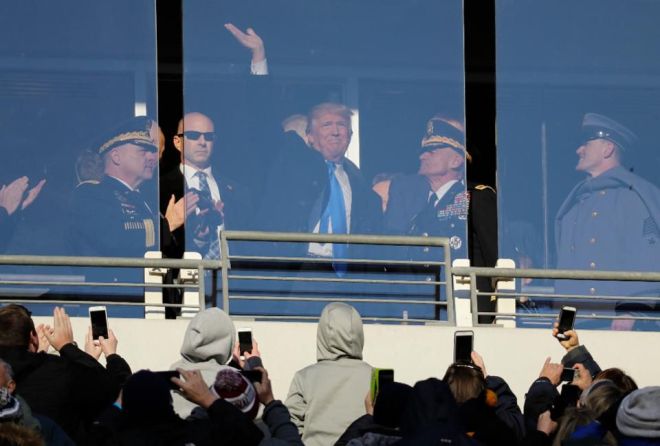
Snowden: Stop Putting So Much Faith (and Fear) in Presidents | RT

snowden

By Jon Miltimore

Whistleblower and former NSA contractor Edward Snowden remains a fugitive at large, but that didn’t stop him from popping up and chiming in on the recent presidential election.

Snowden, who in 2013 blew the lid on the NSA’s massive covert surveillance program, recently appeared on camera via livestream to talk about privacy in an event hosted by StartPage.

Naturally the topic of Donald Trump came up a few times. At one point Snowden was asked “if the outcome [of the election] was better or worse for your case.” (I presume the question was referring to Snowden’s prospect of receiving a presidential pardon.)

Snowden deflected the part of the question that spoke to a possible pardon, saying the election was not about him. But as he continued his response got interesting.

After criticizing the authoritarian tone of the campaign, Snowden said people should stop focusing so much on presidents.

This is the thing I think we begin to forget when we focus too much on a single candidate. The current president of the United States, President Barack Obama, campaigned on a platform of ending mass surveillance in the United States. He said no more warrantless wiring tapping. He said he’d investigate and end criminal activities that had occurred under the prior administration….And we all put a lot of hope in him because of this. Not just people in [the United States]…but people in Europe and elsewhere around the world. It was a moment where we believed that because the right person got into office everything would change. But unfortunately, once he took that office we saw that he actually didn’t fulfill those campaign promises.

Snowden highlighted Obama’s failure to close Guantanamo Bay and end mass warrantless surveillance as specific broken campaign promises. Snowden said he was bringing up these points simply to drive home a larger message.

“We should be cautious about putting too much faith or fear into elected officials,” said Snowden. “At the end of the day, this is just a president.”

He said if people want to change the world, they should look to themselves instead of putting their hopes or fears in a single person. “This can only be the work of the people,” Snowden said. “If we want to have a better world we can’t hope for an Obama, and we should not fear a Donald Trump, rather we should build it ourselves.”

The crowd erupted in applause following Snowden’s monologue.

Snowden makes a great point, and I found his choice of words interesting.

He says people are putting too much “faith” in politicians. Faith. It has occurred to me on more than one occasion that people increasingly treat politics as a religion and political leaders like gods or demigods. Modern man looks to political leaders for hope and sustenance, and often blames them (in their hearts, if not in words) for their pain and misfortune.

Would America not be a better place if people more often looked inward instead of putting their hopes and fears in some distant leader? Would we not be better people if we did so?

Source: RT

The Election: Of Hate, Grief, and a New Story

love

By Charles Eisenstein

Normal is coming unhinged. For the last eight years it has been possible for most people (at least in the relatively privileged classes) to believe that society is sound, that the system, though creaky, basically works, and that the progressive deterioration of everything from ecology to economy is a temporary deviation from the evolutionary imperative of progress.

A Clinton Presidency would have offered four more years of that pretense. A woman President following a black President would have meant to many that things are getting better. It would have obscured the reality of continued neoliberal economics, imperial wars, and resource extraction behind a veil of faux-progressive feminism. Now that we have, in the words of my friend Kelly Brogan, rejected a wolf in sheep’s clothing in favor of a wolf in wolf’s clothing, that illusion will be impossible to maintain.

The wolf, Donald Trump (and I’m not sure he’d be offended by that moniker) will not provide the usual sugarcoating on the poison pills the policy elites have foisted on us for the last forty years. The prison-industrial complex, the endless wars, the surveillance state, the pipelines, the nuclear weapons expansion were easier for liberals to swallow when they came with a dose, albeit grudging, of LGBTQ rights under an African-American President.

I am willing to suspend my judgement of Trump and (very skeptically) hold the possibility that he will disrupt the elite policy consensus of free trade and military confrontation – major themes of his campaign. One might always hope for miracles. However, because he apparently lacks any robust political ideology of his own, it is more likely that he will fill his cabinet with neocon war hawks, Wall Street insiders, and corporate reavers, trampling the wellbeing of the working class whites who elected him while providing them their own sugar-coating of social conservatism.

The social and environmental horrors likely to be committed under President Trump are likely to incite massive civil disobedience and possibly disorder. For Clinton supporters, many of whom were halfhearted to begin with, the Trump administration could mark the end of their loyalty to our present institutions of government. For Trump supporters, the initial celebration will collide with gritty reality when Trump proves as unable or unwilling as his predecessors to challenge the entrenched systems that continually degrade their lives: global finance capital, the deep state, and their programming ideologies. Add to this the likelihood of a major economic crisis, and the public’s frayed loyalty to the existing system could snap.

We are entering a time of great uncertainty. Institutions so enduring as to seem identical to reality itself may lose their legitimacy and dissolve. It may seem that the world is falling apart. For many, that process started on election night, when Trump’s victory provoked incredulity, shock, even vertigo. “I can’t believe this is happening!”

At such moments, it is a normal response to find someone to blame, as if identifying fault could restore the lost normality, and to lash out in anger. Hate and blame are convenient ways of making meaning out of a bewildering situation. Anyone who disputes the blame narrative may receive more hostility than the opponents themselves, as in wartime when pacifists are more reviled than the enemy.

Racism and misogyny are devastatingly real in this country, but to blame bigotry and sexism for voters’ repudiation of the Establishment is to deny the validity of their deep sense of betrayal and alienation. The vast majority of Trump voters were expressing extreme dissatisfaction with the system in the way most readily available to them. (See herehereherehere) Millions of Obama voters voted for Trump (six states who went for Obama twice switched to Trump). Did they suddenly become racists in the last four years? The blame-the-racists (the fools, the yokels…) narrative generates a clear demarcation between good (us) and evil (them), but it does violence to the truth. It also obscures an important root of racism – anger displaced away from an oppressive system and its elites and onto other victims of that system. Finally, it employs the same dehumanization of the other that is the essence of racism and the precondition for war. Such is the cost of preserving a dying story. That is one reason why paroxysms of violence so often accompany a culture-defining story’s demise.

The dissolution of the old order that is now officially in progress is going to intensify. That presents a tremendous opportunity and danger, because when normal falls apart the ensuing vacuum draws in formerly unthinkable ideas from the margins. Unthinkable ideas range from rounding up the Muslims in concentration camps, to dismantling the military-industrial complex and closing down overseas military bases. They range from nationwide stop-and-frisk to replacing criminal punishment with restorative justice. Anything becomes possible with the collapse of dominant institutions. When the animating force behind these new ideas is hate or fear, all manner of fascistic and totalitarian nightmares can ensue, whether enacted by existing powers or those that arise in revolution against them.

That is why, as we enter a period of intensifying disorder, it is important to introduce a different kind of force to animate the structures that might appear after the old ones crumble. I would call it love if it weren’t for the risk of triggering your New Age bullshit detector, and besides, how does one practically bring love into the world in the realm of politics? So let’s start with empathy. Politically, empathy is akin to solidarity, born of the understanding that we are all in this together. In what together? For starters, we are in the uncertainty together.

We are exiting an old story that explained to us the way of the world and our place in it. Some may cling to it all the more desperately as it dissolves, looking perhaps to Donald Trump to restore it, but their savior has not the power to bring back the dead. Neither would Clinton have been able to preserve America as we’d known it for too much longer. We as a society are entering a space between stories, in which everything that had seemed so real, true, right, and permanent comes into doubt. For a while, segments of society have remained insulated from this breakdown (whether by fortune, talent, or privilege), living in a bubble as the containing economic and ecological systems deteriorate. But not for much longer. Not even the elites are immune to this doubt. They grasp at straws of past glories and obsolete strategies; they create perfunctory and unconvincing shibboleths (Putin!), wandering aimlessly from “doctrine” to “doctrine” – and they have no idea what to do. Their haplessness and half-heartedness was plain to see in this election, their disbelief in their own propaganda, their cynicism. When even the custodians of the story no longer believe the story, you know its days are numbered. It is a shell with no engine, running on habit and momentum.

We are entering a space between stories. After various retrograde versions of a new story rise and fall and we enter a period of true unknowing, an authentic next story will emerge. What would it take for it to embody love, compassion, and interbeing? I see its lineaments in those marginal structures and practices that we call holistic, alternative, regenerative, and restorative. All of them source from empathy, the result of the compassionate inquiry: What is it like to be you?

It is time now to bring this question and the empathy it arouses into our political discourse as a new animating force. If you are appalled at the election outcome and feel the call of hate, perhaps try asking yourself, “What is it like to be a Trump supporter?” Ask it not with a patronizing condescension, but for real, looking underneath the caricature of misogynist and bigot to find the real person.

Even if the person you face IS a misogynist or bigot, ask, “Is this who they are, really?” Ask what confluence of circumstances, social, economic, and biographical, may have brought them there. You may still not know how to engage them, but at least you will not be on the warpath automatically. We hate what we fear, and we fear what we do not know. So let’s stop making our opponents invisible behind a caricature of evil.

We’ve got to stop acting out hate. I see no less of it in the liberal media than I do in the right-wing. It is just better disguised, hiding beneath pseudo-psychological epithets and dehumanizing ideological labels. Exercising it, we create more of it. What is beneath the hate? My acupuncturist Sarah Fields wrote to me, “Hate is just a bodyguard for grief. When people lose the hate, they are forced to deal with the pain beneath.”

I think the pain beneath is fundamentally the same pain that animates misogyny and racism – hate in a different form. Please stop thinking you are better than these people! We are all victims of the same world-dominating machine, suffering different mutations of the same wound of separation. Something hurts in there. We live in a civilization that has robbed nearly all of us of deep community, intimate connection with nature, unconditional love, freedom to explore the kingdom of childhood, and so much more. The acute trauma endured by the incarcerated, the abused, the raped, the trafficked, the starved, the murdered, and the dispossessed does not exempt the perpetrators. They feel it in mirror image, adding damage to their souls atop the damage that compels them to violence. Thus it is that suicide is the leading cause of death in the U.S. military. Thus it is that addiction is rampant among the police. Thus it is that depression is epidemic in the upper middle class. We are all in this together.

Something hurts in there. Can you feel it? We are all in this together. One earth, one tribe, one people.

We have entertained teachings like these long enough in our spiritual retreats, meditations, and prayers. Can we take them now into the political world and create an eye of compassion inside the political hate vortex? It is time to do it, time to up our game. It is time to stop feeding hate. Next time you post on line, check your words to see if they smuggle in some form of hate: dehumanization, snark, belittling, derision.., some invitation to us versus them. Notice how it feels kind of good to do that, like getting a fix. And notice what hurts underneath, and how it doesn’t feel good, not really. Maybe it is time to stop.

This does not mean to withdraw from political conversation, but to rewrite its vocabulary. It is to speak hard truths with love. It is to offer acute political analysis that doesn’t carry the implicit message of “Aren’t those people horrible?” Such analysis is rare. Usually, those evangelizing compassion do not write about politics, and sometimes they veer into passivity. We need to confront an unjust, ecocidal system. Each time we do we will receive an invitation to give in to the dark side and hate “the deplorables.” We must not shy away from those confrontations. Instead, we can engage them empowered by the inner mantra that my friend Pancho Ramos-Stierle uses in confrontations with his jailers: “Brother, your soul is too beautiful to be doing this work.” If we can stare hate in the face and never waver from that knowledge, we will access inexhaustible tools of creative engagement, and hold a compelling invitation to the haters to fulfill their beauty.

Source: Charles Eisenstein

John Pilger: Liberals created Trump by pushing corrupt Clinton, but now act surprised | RT

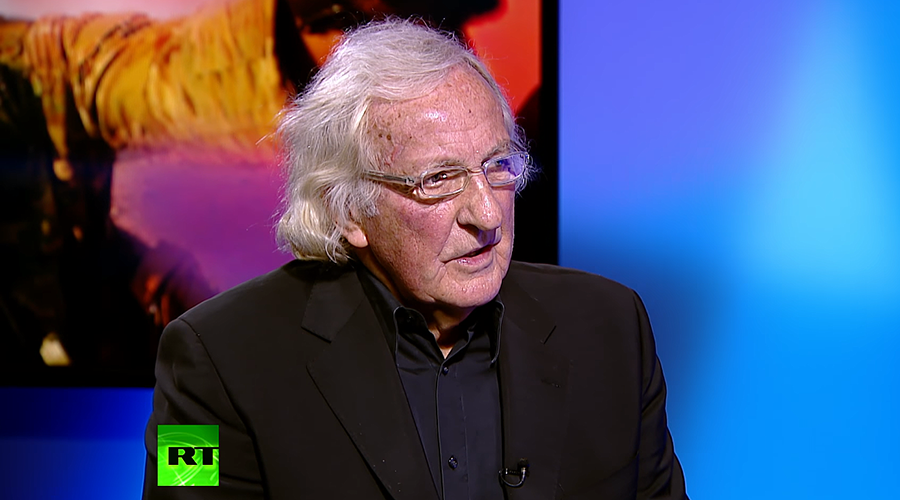
pilger
By Julian Assange
Award-winning journalist John Pilger says that Donald Trump’s election victory “could be seen from miles away,” and has blamed a union of political, financial and media figures for standing behind a “grotesque campaign” to elect the “corrupt” Hillary Clinton.

“The only people who are surprised are those who allowed it to happen – and I am speaking about the liberal class in the US,”Pilger told RT’s Afshin Rattansi during a lengthy interview on RT UK’s Going Underground.

“They told us that only the status quo – a corrupt, war-mongering candidates will be acceptable to the majority. We will have their hyperventilating, and their frustration, and their frenzied reaction for a long time. But, they’ve created Trump…”

He added that the shock surprise is similar to that which occurred after Brexit – “how dare these people vent their frustrations at the ballot box?”

The journalist believes that the arrogance was on display as far back as when Clinton was given a straight run to the nomination during her primaries, with her only real challenger, the outsider Bernie Sanders, treated with contempt.

“They corrupted a voting system, within the Democratic Party that ensured that another populist, Bernie Sanders – though I don’t think he would have beaten Trump – could not win, and instead the embodiment of the status quo, who has declared the whole world a battlefield was made out to be the ‘candidate of sanity’ or ‘the candidate for women.’”

Pilger criticized Clinton’s entourage, noting that she was backed not only by Wall Street heavyweights, but nearly all of the major arms manufacturers in the US, creating an unappealing image for a woman those at home and abroad already saw as a “warmonger.”

“Most of the world regards that kind of behavior from the most powerful country in the world as abhorrent, and she has been the personification of that,” said Pilger.

Pilger also said that US media, in which all but one national newspaper backed Clinton, acted as “anti-journalists,” looking to catch out and “demonize” Trump, without even attempting to weigh up his message.

“One of the most revealing things about the campaign has been the exposure of journalism as the extension of the same established power. They are not independent, they are echo chambers… And the most respected are the worst. The New York Times has become a sort of Cold War propaganda sheet,”said Pilger, who also criticized the tactic of blaming Russia and Julian Assange’s Wikileaks, for exposing genuine email communications related to Clinton.

Despite praising the President Elect for “articulating the frustrations of ordinary Americans very well,”Pilger remains cautious about the next four years.

“Whether Trump will be any better is unclear. He says he is anti-establishment, but he will come with his own establishment. I don’t believe for a moment that he is against the establishment of the US in a wider sense – indeed he is a product of it,” said Pilger. “The truth is, there was no one to vote for.”

Source: RT

Inside The Invisible Government: John Pilger On War, Propaganda, Clinton And Trump | New Matilda

overiraq

By John Pilger

A silent war continues, led by the west, ignored by the media, writes John Pilger.

The American journalist, Edward Bernays, is often described as the man who invented modern propaganda.

The nephew of Sigmund Freud, the pioneer of psycho-analysis, it was Bernays who coined the term “public relations” as a euphemism for spin and its deceptions.

In 1929, he persuaded feminists to promote cigarettes for women by smoking in the New York Easter Parade – behaviour then considered outlandish. One feminist, Ruth Booth, declared, “Women! Light another torch of freedom! Fight another sex taboo!”

Bernays’ influence extended far beyond advertising. His greatest success was his role in convincing the American public to join the slaughter of the First World War. The secret, he said, was “engineering the consent” of people in order to “control and regiment [them]according to our will without their knowing about it”.

He described this as “the true ruling power in our society” and called it an “invisible government”.

Today, the invisible government has never been more powerful and less understood. In my career as a journalist and film-maker, I have never known propaganda to insinuate our lives as it does now, and to go unchallenged.

Imagine two cities. Both are under siege by the forces of the government of that country. Both cities are occupied by fanatics, who commit terrible atrocities, such as beheading people.

But there is a vital difference. In one siege, the government soldiers are described as liberators by Western reporters embedded with them, who enthusiastically report their battles and air strikes. There are front page pictures of these heroic soldiers giving a V-sign for victory. There is scant mention of civilian casualties.

(IMAGE: The U.S. Army, Flickr)

In the second city – in another country nearby – almost exactly the same thing is happening. Government forces are laying siege to a city controlled by the same breed of fanatics.

The difference is that these fanatics are supported, supplied and armed by “us” – by the United States and Britain. They even have a media centre that is funded by Britain and America.

Another difference is that the government soldiers laying siege to this city are the bad guys, condemned for assaulting and bombing the city – which is exactly what the good soldiers do in the first city.

Confusing? Not really. Such is the basic double standard that is the essence of propaganda. I am referring, of course, to the current siege of the city of Mosul by the government forces of Iraq, who are backed by the United States and Britain, and to the siege of Aleppo by the government forces of Syria, backed by Russia. One is good; the other is bad.

What is seldom reported is that both cities would not be occupied by fanatics and ravaged by war if Britain and the United States had not invaded Iraq in 2003. That criminal enterprise was launched on lies strikingly similar to the propaganda that now distorts our understanding of the civil war in Syria.

Without this drumbeat of propaganda dressed up as news, the monstrous ISIS and Al-Qaida and al-Nusra and the rest of the jihadist gang might not exist, and the people of Syria might not be fighting for their lives today.

Some may remember in 2003 a succession of BBC reporters turning to the camera and telling us that Blair was “vindicated” for what turned out to be the crime of the century. The US television networks produced the same validation for George W. Bush. Fox News brought on Henry Kissinger to effuse over Colin Powell’s fabrications.

Former US president George W Bush (IMAGE: Peter Stevens, Flickr).

The same year, soon after the invasion, I filmed an interview in Washington with Charles Lewis, the renowned American investigative journalist. I asked him, “What would have happened if the freest media in the world had seriously challenged what turned out to be crude propaganda?”

He replied that if journalists had done their job, “there is a very, very good chance we would not have gone to war in Iraq”.

It was a shocking statement, and one supported by other famous journalists to whom I put the same question – Dan Rather of CBS, David Rose of the Observer and journalists and producers in the BBC, who wished to remain anonymous.

In other words, had journalists done their job, had they challenged and investigated the propaganda instead of amplifying it, hundreds of thousands of men, women and children would be alive today, and there would be no ISIS and no siege of Aleppo or Mosul.

There would have been no atrocity on the London Underground on 7th July 2005. There would have been no flight of millions of refugees; there would be no miserable camps.

When the terrorist atrocity happened in Paris last November, President Francoise Hollande immediately sent planes to bomb Syria – and more terrorism followed, predictably, the product of Hollande’s bombast about France being “at war” and “showing no mercy”. That state violence and jihadist violence feed off each other is the truth that no national leader has the courage to speak.

“When the truth is replaced by silence,” said the Soviet dissident Yevtushenko, “the silence is a lie.”

The attack on Iraq, the attack on Libya, the attack on Syria happened because the leader in each of these countries was not a puppet of the West. The human rights record of a Saddam or a Gaddafi was irrelevant. They did not obey orders and surrender control of their country.

The same fate awaited Slobodan Milosevic once he had refused to sign an “agreement” that demanded the occupation of Serbia and its conversion to a market economy. His people were bombed, and he was prosecuted in The Hague. Independence of this kind is intolerable.

Syria-Assad

As WikiLeaks has revealed, it was only when the Syrian leader Bashar al-Assad in 2009 rejected an oil pipeline, running through his country from Qatar to Europe, that he was attacked.

From that moment, the CIA planned to destroy the government of Syria with jihadist fanatics – the same fanatics currently holding the people of Mosul and eastern Aleppo hostage.

Why is this not news? The former British Foreign Office official Carne Ross, who was responsible for operating sanctions against Iraq, told me: “We would feed journalists factoids of sanitised intelligence, or we would freeze them out. That is how it worked.”

The West’s medieval client, Saudi Arabia – to which the US and Britain sell billions of dollars’ worth of arms – is at present destroying Yemen, a country so poor that in the best of times, half the children are malnourished.

Look on YouTube and you will see the kind of massive bombs – “our” bombs – that the Saudis use against dirt-poor villages, and against weddings, and funerals.

The explosions look like small atomic bombs. The bomb aimers in Saudi Arabia work side-by-side with British officers. This fact is not on the evening news.

Propaganda is most effective when our consent is engineered by those with a fine education – Oxford, Cambridge, Harvard, Columbia – and with careers on the BBC, theGuardian, the New York Times, the Washington Post.

These organisations are known as the liberal media. They present themselves as enlightened, progressive tribunes of the moral zeitgeist. They are anti-racist, pro-feminist and pro-LGBT.

And they love war.

While they speak up for feminism, they support rapacious wars that deny the rights of countless women, including the right to life.

In 2011, Libya, then a modern state, was destroyed on the pretext that Muammar Gaddafi was about to commit genocide on his own people. That was the incessant news; and there was no evidence. It was a lie.

An anti-Gaddafi rally, Libya 2011. (IMAGE: mojomogwai, Flickr)

In fact, Britain, Europe and the United States wanted what they like to call “regime change” in Libya, the biggest oil producer in Africa. Gaddafi’s influence in the continent and, above all, his independence were intolerable.

So he was murdered with a knife in his rear by fanatics, backed by America, Britain and France. Hillary Clinton cheered his gruesome death for the camera, declaring,

“We came, we saw, he died!”

The destruction of Libya was a media triumph. As the war drums were beaten, Jonathan Freedland wrote in the Guardian: “Though the risks are very real, the case for intervention remains strong.”

Intervention – what a polite, benign, Guardian word, whose real meaning, for Libya, was death and destruction.

According to its own records, Nato launched 9,700 “strike sorties” against Libya, of which more than a third were aimed at civilian targets. They included missiles with uranium warheads. Look at the photographs of the rubble of Misurata and Sirte, and the mass graves identified by the Red Cross. The Unicef report on the children killed says, “most [of them]under the age of 10”.

As a direct consequence, Sirte became the capital of ISIS.

Ukraine is another media triumph. Respectable liberal newspapers such as the New York Times, the Washington Post and the Guardian, and mainstream broadcasters such as the BBC, NBC, CBS, CNN have played a critical role in conditioning their viewers to accept a new and dangerous cold war.

All have misrepresented events in Ukraine as a malign act by Russia when, in fact, the coup in Ukraine in 2014 was the work of the United States, aided by Germany and Nato.

This inversion of reality is so pervasive that Washington’s military intimidation of Russia is not news; it is suppressed behind a smear and scare campaign of the kind I grew up with during the first cold war. Once again, the Ruskies are coming to get us, led by another Stalin, whom The Economist depicts as the devil.

The suppression of the truth about Ukraine is one of the most complete news blackouts I can remember. The fascists who engineered the coup in Kiev are the same breed that backed the Nazi invasion of the Soviet Union in 1941. Of all the scares about the rise of fascist anti-Semitism in Europe, no leader ever mentions the fascists in Ukraine – except Vladimir Putin, but he does not count.

Russian president Vladimir Putin. (IMAGE: IoSonoUnaFotoCamera, Flickr).

Many in the Western media have worked hard to present the ethnic Russian-speaking population of Ukraine as outsiders in their own country, as agents of Moscow, almost never as Ukrainians seeking a federation within Ukraine and as Ukrainian citizens resisting a foreign-orchestrated coup against their elected government.

There is almost the joie d’esprit of a class reunion of warmongers. The drum-beaters of the Washington Post inciting war with Russia are the very same editorial writers who published the lie that Saddam Hussein had weapons of mass destruction.

To most of us, the American presidential campaign is a media freak show, in which Donald Trump is the arch villain.

But Trump is loathed by those with power in the United States for reasons that have little to do with his obnoxious behaviour and opinions. To the invisible government in Washington, the unpredictable Trump is an obstacle to America’s design for the 21stcentury.

This is to maintain the dominance of the United States and to subjugate Russia, and, if possible, China.

To the militarists in Washington, the real problem with Trump is that, in his lucid moments, he seems not to want a war with Russia; he wants to talk with the Russian president, not fight him; he says he wants to talk with the president of China.

In the first debate with Hillary Clinton, Trump promised not to be the first to introduce nuclear weapons into a conflict. He said, “I would certainly not do first strike. Once the nuclear alternative happens, it’s over.” That was not news.

Did he really mean it? Who knows? He often contradicts himself. But what is clear is that Trump is considered a serious threat to the status quo maintained by the vast national security machine that runs the United States, regardless of who is in the White House.

The CIA wants him beaten. The Pentagon wants him beaten. The media wants him beaten. Even his own party wants him beaten. He is a threat to the rulers of the world – unlike Clinton who has left no doubt she is prepared to go to war with nuclear-armed Russia and China.

US Republican presidential candidate, Donald Trump. (IMAGE: Gage Skidmore, Flickr)

Clinton has the form, as she often boasts. Indeed, her record is proven. As a senator, she backed the bloodbath in Iraq. When she ran against Obama in 2008, she threatened to “totally obliterate” Iran. As Secretary of State, she colluded in the destruction of governments in Libya and Honduras and set in train the baiting of China.

She has now pledged to support a No Fly Zone in Syria — a direct provocation for war with Russia. Clinton may well become the most dangerous president of the United States in my lifetime –a distinction for which the competition is fierce.

Without a shred of evidence, she has accused Russia of supporting Trump and hacking her emails. Released by WikiLeaks, these emails tell us that what Clinton says in private, in speeches to the rich and powerful, is the opposite of what she says in public.

That is why silencing and threatening Julian Assange is so important. As the editor of WikiLeaks, Assange knows the truth. And let me assure those who are concerned, he is well, and WikiLeaks is operating on all cylinders.

Today, the greatest build-up of American-led forces since World War Two is under way – in the Caucasus and eastern Europe, on the border with Russia, and in Asia and the Pacific, where China is the target.

Keep that in mind when the presidential election circus reaches its finale on November 8th, If the winner is Clinton, a Greek chorus of witless commentators will celebrate her coronation as a great step forward for women. None will mention Clinton’s victims: the women of Syria, the women of Iraq, the women of Libya. None will mention the civil defence drills being conducted in Russia. None will recall Edward Bernays’ “torches of freedom”.

Democratic presidential candidate, Hillary Clinton. (IMAGE: iprimages, Flickr)

George Bush’s press spokesman once called the media “complicit enablers”.

Coming from a senior official in an administration whose lies, enabled by the media, caused such suffering, that description is a warning from history.

In 1946, the Nuremberg Tribunal prosecutor said of the German media: “Before every major aggression, they initiated a press campaign calculated to weaken their victims and to prepare the German people psychologically for the attack. In the propaganda system, it was the daily press and the radio that were the most important weapons.”

Source: New Matilda

President Assad of Syria is Not An Evil Dictator Killing His People – The Establishment Has Lied | The Marshall Report

media-blackout-as-france-and-russia-both-announce-monsanto-gmo-bansWhat do evil dictators look like? What do they talk like? Just how wicked is an evil dictator’s wife ? Should she be toppled along with her husband? Who am I talking about? President Assad of Syria and his wife, Asmas Al Assad.
These are the same ones boy Rubio, McCain, Lyndsay Graham, Ryan, the Bush’s, Obama, Kerry and Hillary all want to topple down to bring peace to Syria. That is THE LIE they are and have been shouting. What they really want to do is take over Syria in order to hurry along their New World Order agenda. The media whores push the establishment narrative that president Assad of Syria is evil and a corrupt dictator. They fear that when you realize who these people really are, you will be sorry you ever believed any lies told about them, let alone what they have conspired to do against them and all the citizens of Syria.

The real truth is – President Assad and his wife Asmas Al Assad, care about their people. Syria has been invaded with Islamic radicals that have terrorized their nation. We should be helping Assad, not the radical rebels who have infiltrated in the same manner the US manufactured ISIS has infiltrated throughout the entire region. President Assad is fighting terrorists.

Meanwhile before Obama’s push to topple Assad and take over Syria, the media wrote wonderful stories about President Assad and his wife Asmas. Vogue magazine issued a wonderful story calling Asmas the “Rose of The Desert”. After Obama’s regime targeted Syria, the media buried any good stories and began a cut throat propaganda campaign to match their new narrative of Assad as an evil dictator. (You know the drill). They have taken great lengths to rewrite wonderful stories where they once called Asmas Al Assad wonderful things and were amazed at the good will being done by Asmas to people of all faiths. Now they want you to believe that she was faking her lifetime of caring and sided with her so-called evil husband dictator.

The establishment media, in support of Obama’s regime have pushed a propaganda arsenal of civil war crisis and chaos, meanwhile they hired moderate Muslims, trained them and sent them in to fight a sovereign nation. Read more…

Source: The Marshall Report

Top 9 ethical issues in artificial intelligence | World Economic Forum

HM_JF19_Page_37_Image_0001_0By Julie Bossmann

Optimizing logistics, detecting fraud, composing art, conducting research, providing translations: intelligent machine systems are transforming our lives for the better. As these systems become more capable, our world becomes more efficient and consequently richer.

Tech giants such as Alphabet, Amazon, Facebook, IBM and Microsoft – as well as individuals like Stephen Hawking and Elon Musk – believe that now is the right time to talk about the nearly boundless landscape of artificial intelligence. In many ways, this is just as much a new frontier for ethics and risk assessment as it is for emerging technology. So which issues and conversations keep AI experts up at night?


1. Unemployment. What happens after the end of jobs?

The hierarchy of labour is concerned primarily with automation. As we’ve invented ways to automate jobs, we could create room for people to assume more complex roles, moving from the physical work that dominated the pre-industrial globe to the cognitive labour that characterizes strategic and administrative work in our globalized society.

Look at trucking: it currently employs millions of individuals in the United States alone. What will happen to them if the self-driving trucks promised by Tesla’s Elon Musk become widely available in the next decade? But on the other hand, if we consider the lower risk of accidents, self-driving trucks seem like an ethical choice. The same scenario could happen to office workers, as well as to the majority of the workforce in developed countries.

This is where we come to the question of how we are going to spend our time. Most people still rely on selling their time to have enough income to sustain themselves and their families. We can only hope that this opportunity will enable people to find meaning in non-labour activities, such as caring for their families, engaging with their communities and learning new ways to contribute to human society.

If we succeed with the transition, one day we might look back and think that it was barbaric that human beings were required to sell the majority of their waking time just to be able to live.

2. Inequality. How do we distribute the wealth created by machines?

Our economic system is based on compensation for contribution to the economy, often assessed using an hourly wage. The majority of companies are still dependent on hourly work when it comes to products and services. But by using artificial intelligence, a company can drastically cut down on relying on the human workforce, and this means that revenues will go to fewer people. Consequently, individuals who have ownership in AI-driven companies will make all the money.

We are already seeing a widening wealth gap, where start-up founders take home a large portion of the economic surplus they create. In 2014, roughly the same revenues were generated by the three biggest companies in Detroit and the three biggest companies in Silicon Valley … only in Silicon Valley there were 10 times fewer employees.

If we’re truly imagining a post-work society, how do we structure a fair post-labour economy?

3. Humanity. How do machines affect our behaviour and interaction?

Artificially intelligent bots are becoming better and better at modelling human conversation and relationships. In 2015, a bot named Eugene Goostman won the Turing Challenge for the first time. In this challenge, human raters used text input to chat with an unknown entity, then guessed whether they had been chatting with a human or a machine. Eugene Goostman fooled more than half of the human raters into thinking they had been talking to a human being.

This milestone is only the start of an age where we will frequently interact with machines as if they are humans; whether in customer service or sales. While humans are limited in the attention and kindness that they can expend on another person, artificial bots can channel virtually unlimited resources into building relationships.

Even though not many of us are aware of this, we are already witnesses to how machines can trigger the reward centres in the human brain. Just look at click-bait headlines and video games. These headlines are often optimized with A/B testing, a rudimentary form of algorithmic optimization for content to capture our attention. This and other methods are used to make numerous video and mobile games become addictive. Tech addiction is the new frontier of human dependency.

On the other hand, maybe we can think of a different use for software, which has already become effective at directing human attention and triggering certain actions. When used right, this could evolve into an opportunity to nudge society towards more beneficial behavior. However, in the wrong hands it could prove detrimental.

4. Artificial stupidity. How can we guard against mistakes?

Intelligence comes from learning, whether you’re human or machine. Systems usually have a training phase in which they “learn” to detect the right patterns and act according to their input. Once a system is fully trained, it can then go into test phase, where it is hit with more examples and we see how it performs.

Obviously, the training phase cannot cover all possible examples that a system may deal with in the real world. These systems can be fooled in ways that humans wouldn’t be. For example, random dot patterns can lead a machine to “see” things that aren’t there. If we rely on AI to bring us into a new world of labour, security and efficiency, we need to ensure that the machine performs as planned, and that people can’t overpower it to use it for their own ends.

5. Racist robots. How do we eliminate AI bias?

Though artificial intelligence is capable of a speed and capacity of processing that’s far beyond that of humans, it cannot always be trusted to be fair and neutral. Google and its parent company Alphabet are one of the leaders when it comes to artificial intelligence, as seen in Google’s Photos service, where AI is used to identify people, objects and scenes. But it can go wrong, such as when a camera missed the mark on racial sensitivity, or when asoftware used to predict future criminals showed bias against black people.

We shouldn’t forget that AI systems are created by humans, who can be biased and judgemental. Once again, if used right, or if used by those who strive for social progress, artificial intelligence can become a catalyst for positive change.

6. Security. How do we keep AI safe from adversaries?

The more powerful a technology becomes, the more can it be used for nefarious reasons as well as good. This applies not only to robots produced to replace human soldiers, or autonomous weapons, but to AI systems that can cause damage if used maliciously. Because these fights won’t be fought on the battleground only, cybersecurity will become even more important. After all, we’re dealing with a system that is faster and more capable than us by orders of magnitude.

Proliferation of Armed Drones

7. Evil genies. How do we protect against unintended consequences?

It’s not just adversaries we have to worry about. What if artificial intelligence itself turned against us? This doesn’t mean by turning “evil” in the way a human might, or the way AI disasters are depicted in Hollywood movies. Rather, we can imagine an advanced AI system as a “genie in a bottle” that can fulfill wishes, but with terrible unforeseen consequences.

In the case of a machine, there is unlikely to be malice at play, only a lack of understanding of the full context in which the wish was made. Imagine an AI system that is asked to eradicate cancer in the world. After a lot of computing, it spits out a formula that does, in fact, bring about the end of cancer – by killing everyone on the planet. The computer would have achieved its goal of “no more cancer” very efficiently, but not in the way humans intended it.

8. Singularity. How do we stay in control of a complex intelligent system?

The reason humans are on top of the food chain is not down to sharp teeth or strong muscles. Human dominance is almost entirely due to our ingenuity and intelligence. We can get the better of bigger, faster, stronger animals because we can create and use tools to control them: both physical tools such as cages and weapons, and cognitive tools like training and conditioning.

This poses a serious question about artificial intelligence: will it, one day, have the same advantage over us? We can’t rely on just “pulling the plug” either, because a sufficiently advanced machine may anticipate this move and defend itself. This is what some call the “singularity”: the point in time when human beings are no longer the most intelligent beings on earth.

9. Robot rights. How do we define the humane treatment of AI?

While neuroscientists are still working on unlocking the secrets of conscious experience, we understand more about the basic mechanisms of reward and aversion. We share these mechanisms with even simple animals. In a way, we are building similar mechanisms of reward and aversion in systems of artificial intelligence. For example, reinforcement learning is similar to training a dog: improved performance is reinforced with a virtual reward.

Right now, these systems are fairly superficial, but they are becoming more complex and life-like. Could we consider a system to be suffering when its reward functions give it negative input? What’s more, so-called genetic algorithms work by creating many instances of a system at once, of which only the most successful “survive” and combine to form the next generation of instances. This happens over many generations and is a way of improving a system. The unsuccessful instances are deleted. At what point might we consider genetic algorithms a form of mass murder?

Once we consider machines as entities that can perceive, feel and act, it’s not a huge leap to ponder their legal status. Should they be treated like animals of comparable intelligence? Will we consider the suffering of “feeling” machines?

Some ethical questions are about mitigating suffering, some about risking negative outcomes. While we consider these risks, we should also keep in mind that, on the whole, this technological progress means better lives for everyone. Artificial intelligence has vast potential, and its responsible implementation is up to us.

Source: World Economic Forum

Renowned Scientists and Engineers Conclude in New Report: All 3 WTC Towers Collapsed Due to Controlled Demolition | Physics Magazine

journalJohnny Liberty, Editor’s Note: Even though this is old news it’s pertinent today as so many people are unwilling to remove the blindfolds and see what’s happening behind the scenes of current events. Turns out this “conspiracy theory” is “conspiracy fact”. 

Over the past 15 years many highly respected academics and experts have come forward to challenge the official narrative on the collapse of the WTC towers forwarded by the U.S. government. The official government position holds that the collapse of all three towers was due to intense heat inside of the buildings.

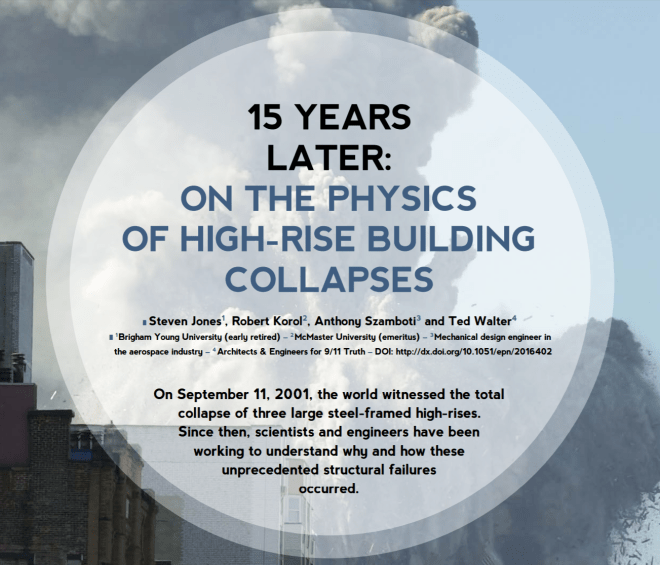
But a new forensic investigation into the collapse of the three World Trade Center towers on 9/11, published in Europhysics News – a highly respected European physics magazine – claims that “the evidence points overwhelmingly to the conclusion that all three buildings were destroyed by controlled demolition.”

While many in the mainstream have attempted to label anyone questioning the official narrative as “tin foil hat” conspiracy theorist, many highly respected experts have come forward to lampoon the idea that the buildings collapsed due to the intense heat and fires following two terrorist-directed plane crashes.

“Given the far-reaching implications, it is morally imperative that this hypothesis be the subject of a truly scientific and impartial investigation by responsible authorities,” the four physicists conclude in the damning report.

The new report is the work of Steven Jones, former full professor of physics at Brigham Young University, Robert Korol, a professor emeritus of civil engineering at McMaster University in Ontario, Canada, Anthony Szamboti, a mechanical design engineer with over 25 years of structural design experience in the aerospace and communications industries and Ted Walter, the director of strategy and development for Architects & Engineers for 9/11 Truth, a nonprofit organization that today represents more than 2,500 architects and engineers.

The comprehensive report in Europhysics Magazine directly challenges the official narrative and lends to a growing body of evidence that seriously questions the veracity of the government narrative.

In 2002, the National Institute of Standards and Technology remarked that the case was exceptionally bizarre. There were no other known cases of total structural collapses in high-rise buildings caused by fires and so it is deeply unusual that it should have happened three times in the space of one day, noted NIST.

Official investigations have never been able to thoroughly and coherently explain how this might have happened and various teams tasked with examining the collapse have raised difficult questions about the veracity of the government’s story.

Perhaps most damning of all, the experts claimed that after a thorough forensic analysis of video footage of the building’s collapse, it revealed signs of a controlled implosion. Additionally, Jones has co-authored a number of papers documenting evidence of unreacted nano-thermitic material in the WTC dust.

The authors of the report note that the buildings fell with such speed and symmetry that they there was no other feasible explanation for the sudden collapse at free fall speeds – directly refuting studies that attempted to debunk the idea that the building fell without resistance. These respected experts’ new forensic analysis only adds to the growing movement of people calling for a new and impartial investigation into the collapse of the World Trade Center.

Revealing the scope and breadth of public disbelief in the official government narrative surrounding the events of 9/11, even presidential candidate Jill Stein has recently called for a new investigation.

Pentagon At War With CIA In Syria | ZeroHedge

whatamess

By Tyler Durden

What a mess! In the crazy Syrian war, US-backed and armed groups are fighting other US-backed rebel groups. How can this be?

It is so because the Obama White House had stirred up war in Syria but then lost control of the process. When the US has a strong president, he can usually keep the military and intelligence agencies on a tight leash.

But the Obama administration has had a weak secretary of defense and a bunch of lady strategists who are the worst military commanders since Louis XV, who put his mistress, Madame de Pompadour, in charge of French military forces during the Seven Year’s War. The French were routed by the Prussians. France’s foe, Frederick the Great of Prussia, named one of his dogs, ‘la Pompadour.’

As a result, the two arms of offensive US strategic power, the Pentagon and CIA, went separate ways in Syria. Growing competition between the US military and militarized CIA broke into the open in Syria.

Fed up with the astounding incompetence of the White House, the US military launched and supported its own rebel groups in Syria, while CIA did the same.

Fighting soon after erupted in Syria and Iraq between the US-backed groups. US Special Forces joined the fighting in Syria, Iraq and most lately, Libya.

The well-publicized atrocities, like mass murders and decapitations, greatly embarrassed Washington, making it harder to portray their jihadi wildmen as liberators. The only thing exceptional about US policy in Syria was its astounding incompetence.

Few can keep track of the 1,000 groups of jihadis that keep changing their names and shifting alliances. Throw in Turkomans, Yzidis, Armenians, Nestorians, Druze, Circassians, Alawis, Assyrians and Palestinians. Oh yes, and the Alevis.

Meanwhile, ISIS was inflicting mayhem on Syria and Iraq. But who really is ISIS? A few thousand twenty-something hooligans with little knowledge of Islam but a burning desire to dynamite the existing order and a sharp media sense. The leadership of these turbaned anarchists appears to have formed in US prison camps in Afghanistan.

The US, Saudi Arabia, and Turkey armed and financed ISIS as a weapon to unleash on Syria, which was an ally of Iran that refused to take orders from the Western powers. The west bears heavy responsibility for the deaths of 450,000 Syrians, at least half the nation of 23 million becoming refugees, and destruction of this once lovely country.

At some point, ISIS shook off its western tutors and literally ran amok. But the US has not yet made a concerted attempt to crush ISIS because of its continuing usefulness in Syria and in the US, where ISIS has become the favorite whipping boy of politicians.

Next come the Kurds, an ancient Indo-European stateless people spread across Turkey, Iraq, Iran and Syria. They have been denied a national state by the western powers since WWI. Kurdish rebels in Iraq have been armed and financed by Israel since the 1970’s.

When America’s Arab jihadists proved militarily feeble, the US turned to the Kurds, who are renowned fighters, arming and financing the Kurdish Syrian YPG which is part of the well-known PKK rebel group that fights Turkey.

I covered the Turkish-Kurdish conflict in eastern Anatolia in the 1980’s in which some 40,000 died.

Turkey is now again battling a rising wave of Kurdish attacks that caused the Turks to probe into northern Syria to prevent a link-up of advancing Kurdish rebel forces.

So, Turkey, a key American ally, is now battling CIA-backed Kurdish groups in Syria. Eighty percent of Turks believe the recent failed coup in Turkey was mounted by the US – not the White House, but by the Pentagon which has always been joined at the hip to Turkey’s military.

This major Turkish-Kurdish crisis was perfectly predictable, but the obtuse junior warriors of the Obama administration failed to grasp this point.

Now the Russians have entered the fray in an effort to prevent their ally, Bashar Assad, from being overthrow by western powers. Also perfectly predictable. Russia claimed to be bombing ISIS but in fact is targeting US-backed groups. Washington is outraged that the wicked Russians are doing in the Mideast what the US has done for decades.

The US and Russia now both claim to have killed a senior ISIS commander in an air strike. Their warplanes are dodging one another, creating a perfect scenario for a head-on clash at a time when neocons in the US are agitating for war with Russia.

Does anyone think poor, demolished Syria is worth the price? Hatred for the US is now seething in Turkey and across the Mideast. Hundreds of millions of US tax dollars have been wasted in this cruel, pointless war.

Time for the US to stop stirring this witch’s brew.

Source: Zero Hedge

Dangerous chemicals hiding in everyday products | CNN

It was long believed that you could acquire “better living through chemistry.” But that may really not be the case. In a landmark alliance, known as Project TENDR, leaders of various disciplines have come together in a consensus statement to say that many of the chemicals found in everyday products can result in neurodevelopmental disorders, including autism and attention-deficit disorders.

“Ten years ago, this consensus wouldn’t have been possible, but the research is abundantly clear,” said Irva Hertz-Picciotto, an environmental epidemiologist at the University of California, Davis and co-chairwoman of Project TENDR.

BPA-free plastic alternatives may not be safe as you think

“At some point, we say we know enough to take preventative action,” said Frederica Perera, a professor of environmental health sciences at Columbia University. Perera is also a signatory on the statement.

Last year, the International Federation of Gynecology and Obstetrics (PDF) stated that “Widespread exposure to toxic environmental chemicals threatens healthy human reproduction.” Other medical groups such as the Endocrine Society (PDF), the world’s oldest and largest organization devoted to researching hormones, have expressed similar concerns.

But this is the first time that leading scientists, doctors and policy advocates across various disciplines have come together to say that the science on toxic chemicals is clear: They can harm brain development.

Everyday chemicals carry toxic burden

These everyday chemicals, including organophosphates, flame retardants and phthalates, can be found in food, plastics, furniture, food wrap, cookware, cans, carpets, shower curtains, electronics and even shampoo. They are pretty much everywhere around us.

Scientists and researchers are concerned that many of these chemicals may be carcinogenic or wreak havoc with our hormones, our body’s regulating system. But the impact of these chemicals may be most severe on the developing brain, Perera said.

Brain development is the “most complete and most rapid during the first nine months, prenatally,” she said. During that time, neural connections and pathways are being developed.

“Any interference by a physical stress like a toxic chemical or other stressor can disrupt this natural progression that is so very delicate and complex,” explained Perera.

Though the group hopes to come up with regulatory recommendations to reduce this toxic burden, there are some simple things that inpiduals can do to reduce their exposure.

Chemicals to watch for

Organophosphate pesticides

Organophosphate pesticides (PDF) are a class of neurotoxic chemicals used as warfare agentsin the 1930s. However, today, they account for about half of all pesticide use in the United States. And they can make their way onto crops that we use as food sources. Areas that spray pesticides heavily, such as farms, may find higher rates of exposure.

Children exposed to higher levels of these pesticides have been found to have higher rates of attention-deficit hyperactivity disorder.

You can reduce your exposure to them by eating organic and using alternative pest control methods.

Phthalates

These chemicals soften plastics and help scents and chemicals bind together.

Exposure to phthalates has been associated with lower IQ levels.

They can be found in shampoos, conditioners, body sprays, hair sprays, perfumes, colognes, soap, nail polish, shower curtains, medical tubing, IV bags, vinyl flooring and wall coverings, food packaging and coatings on time-release pharmaceuticals.

You can reduce your exposure to phthalates by using unscented lotions and laundry detergents, microwaving food in glass containers rather than plastic, using cleaning supplies without scents, and avoiding air fresheners and plastics labeled as No. 3, No. 6 and No 7.

Polybrominated diphenyl ethers

These chemicals are used as flame retardants, chemicals that can slow the speed of a flame. They can be found in televisions, computers, insulation and foam products, including children’s toys and baby pillows.

Products can shed ethers that can accumulate in dust. Exposure to these ethers have been associated with thyroid issues.

There isn’t a directory that lists which products have these ethers, but consumers may still be able to reduce exposure by looking for products that advertise themselves as free of flame retardant. These chemicals were found in a lot of older foams, so replace products such sofas and pillows that have exposed foam. And use a high-efficiency HEPA filter vacuum to clean up dust.

Air pollutants

Air pollution from burning fossil fuels such as coal, oil or gas is usually associated with respiratory issues. However, these pollutants can also include nitrogen dioxide, formaldehyde and benzene.

Higher exposure to air pollutants has been associated with lower birth weights, preterm deliveries and congenital heart defects. The World Health Organization (PDF) considers exposure to benzene a major public health concern.

Aside from trying to avoid polluted areas, you can make sure to buy furniture and products that advertise themselves as formaldehyde-free. Try to avoid buying furniture made with particleboard, plywood or pressed wood. Many of these products use glues containing formaldehyde.

Lead

Lead is a naturally occurring metal. It was banned from gasoline in the 1970s but can still be found in older homes that used leaded paint. Lead can also make its way into water, because of corrosion from old water pipes. Lead is also used in a variety of products like industrial paints, car batteries and wheel weights.

Lead exposure has been associated with ADHD, lower IQs and developmental delay.

Infants and toddlers are at greatest risk for lead exposure because they frequently put their hands and toys in their mouths after they may be exposed to lead in dust.

Why lead is so dangerous for children

Find out if you have lead in your water by reaching out to your local water supplier or even getting an at-home test kit from a home improvement store. If your home was built before 1978, test your paint. If the paint is chipping or peeling, it will need to be stripped or covered.

Homeowners may want to consider using a professional who is lead-safe certified to help you. Parents can also talk to your doctor about having your children tested for lead if there is reason for concern.

Mercury

Mercury is a naturally occurring element, but it can also be released into the environment from the burning of coal and oil. Mercury can also be found in some household items such as thermometers, light bulbs and older-model clothes dryers and washing machines. Mercury in the environment can make its way into fish and shellfish. Some fish, such as some kinds of tuna, may have higher concentrations of mercury.

According to the Environmental Protection Agency, exposure to mercury in utero may impact memory, attention and cognitive skills.

While you can’t completely eliminate mercury from your environment, you can reduce your exposure to mercury by avoiding fish high in mercury. Try to use mercury-free thermometers. When getting rid of household items with mercury, reach out to your state or local household hazardous waste collection center for advice.

Polychlorinated biphenyls

Between 1929 and 1977, thousands of tons of polychlorinated biphenyls were used worldwide. Production of the chemical in the U.S. was banned by the EPA in 1977, but they can linger (PDF) in the environment for a long time and make their way into the food chain. These chemicals have been used as coolants and lubricants in electrical equipment because they are good insulators.

According to the Centers for Disease Control and Prevention, polychlorinated biphenyls are associated with cancer in occupational settings and has been associated with issues with motor skills and short term memory in children.

Much like mercury, they have made their way into our food sources, particularly fish and some meat. To avoid polychlorinated biphenyls in your food, the Environmental Defense Fund suggests, before cooking, removing the parts where toxic chemicals are likely to accumulate, such as the skin, fat and internal organs. When cooking, make sure to drain away fat and avoid drippings.

Source: CNN

State of Surveillance with Edward Snowden | VICE News

When NSA whistleblower Edward Snowden leaked details of massive government surveillance programs in 2013, he ignited a raging debate over digital privacy and security. That debate came to a head this year, when Apple refused an FBI court order to access the iPhone of alleged San Bernardino Terrorist Syed Farook. Meanwhile, journalists and activists are under increasing attack from foreign agents. To find out the government’s real capabilities, and whether any of us can truly protect our sensitive information, VICE founder Shane Smith heads to Moscow to meet the man who started the conversation, Edward Snowden.

Source: VICE News