
Top US Government Insider: Bin Laden Died In 2001, 9/11 A False Flag | Prison Planet
Top US government insider Dr. Steve R. Pieczenik, a man who held numerous different influential positions under three different Presidents and still works with the Defense Department, shockingly told The Alex Jones Show yesterday that Osama Bin Laden died in 2001 and that he was prepared to testify in front of a grand jury how a top general told him directly that 9/11 was a false flag inside job.
Pieczenik cannot be dismissed as a “conspiracy theorist”. He served as the Deputy Assistant Secretary of State under three different administrations, Nixon, Ford and Carter, while also working under Reagan and Bush senior, and still works as a consultant for the Department of Defense. A former US Navy Captain, Pieczenik achieved two prestigious Harry C. Solomon Awards at the Harvard Medical School as he simultaneously completed a PhD at MIT.
Recruited by Lawrence Eagleburger as Deputy Assistant Secretary of State for Management, Pieczenik went on to develop, “the basic tenets for psychological warfare, counter terrorism, strategy and tactics for transcultural negotiations for the US State Department, military and intelligence communities and other agencies of the US Government,” while also developing foundational strategies for hostage rescue that were later employed around the world.
Pieczenik also served as a senior policy planner under Secretaries Henry Kissinger, Cyrus Vance, George Schultz and James Baker and worked on George W. Bush’s election campaign against Al Gore. His record underscores the fact that he is one of the most deeply connected men in intelligence circles over the past three decades plus.
The character of Jack Ryan, who appears in many Tom Clancy novels and was also played by Harrison Ford in the popular 1992 movie Patriot Games, is also based on Steve Pieczenik.
Back in April 2002, over nine years ago, Pieczenik told the Alex Jones Show that Bin Laden had already been “dead for months,” and that the government was waiting for the most politically expedient time to roll out his corpse. Pieczenik would be in a position to know, having personally met Bin Laden and worked with him during the proxy war against the Soviets in Afghanistan back in the early 80′s.
Pieczenik said that Osama Bin Laden died in 2001, “Not because special forces had killed him, but because as a physician I had known that the CIA physicians had treated him and it was on the intelligence roster that he had marfan syndrome,” adding that the US government knew Bin Laden was dead before they invaded Afghanistan.
Marfan syndrome is a degenerative genetic disease for which there is no permanent cure. The illness severely shortens the life span of the sufferer.
“He died of marfan syndrome, Bush junior knew about it, the intelligence community knew about it,” said Pieczenik, noting how CIA physicians had visited Bin Laden in July 2001 at the American Hospital in Dubai.
“He was already very sick from marfan syndrome and he was already dying, so nobody had to kill him,” added Pieczenik, stating that Bin Laden died shortly after 9/11 in his Tora Bora cave complex.
“Did the intelligence community or the CIA doctor up this situation, the answer is yes, categorically yes,” said Pieczenik, referring to Sunday’s claim that Bin Laden was killed at his compound in Pakistan, adding, “This whole scenario where you see a bunch of people sitting there looking at a screen and they look as if they’re intense, that’s nonsense,” referring to the images released by the White House which claim to show Biden, Obama and Hillary Clinton watching the operation to kill Bin Laden live on a television screen.
“It’s a total make-up, make believe, we’re in an American theater of the absurd….why are we doing this again….nine years ago this man was already dead….why does the government repeatedly have to lie to the American people,” asked Pieczenik.
“Osama Bin Laden was totally dead, so there’s no way they could have attacked or confronted or killed Osama Bin laden,” said Pieczenik, joking that the only way it could have happened was if special forces had attacked a mortuary. Read more…
TSA lies about the Constitution | Tenth Amendment Center
Round two of the battle for travel freedom is well underway.
The first round, which garnered national attention in the fall of 2010, focused primarily on the TSA implementing new procedures…pat downs, body scanners….and the public outcry against it….boycotts, protests, calling congress to demand change.
But, as the public response failed to stop the scanners and searches, round two has moved to state legislatures around the country. Most prominently, Texas, where the state house just passed a bill banning TSA searches without probable cause. Click here to read the Tenth Amendment Center’s report on the bill.
This time, the TSA is on the defensive, and published an official statement about the Texas bill on their blog:
What’s our take on the Texas House of Representatives voting to ban the current TSA pat-down? Well, the Supremacy Clause of the U.S. Constitution (Article. VI. Clause 2) prevents states from regulating the federal government.
The problem here? The statement is false. Ignorance from the TSA is unlikely, so I’ll call a spade a spade. They’re lying.
The supremacy clause says nothing of the sort. Here’s the full text:
This Constitution, and the Laws of the United States which shall be made in pursuance thereof; and all treaties made, or which shall be made, under the authority of the United States, shall be the supreme law of the land; and the judges in every state shall be bound thereby, anything in the constitution or laws of any state to the contrary notwithstanding.
So, in simple terms, what does the supremacy clause mean? Just what it says. The constitution is supreme. And any federal laws made in line with the constitution is supreme. Nothing more, nothing less.
Notice there’s not one single word in the actual text that says anything about states regulating the federal government as the TSA claims. They’re just making things up as they go. Read more…
Johnny Liberty’s “Allodial Titles & Land Patents” Presentation | Ashland, Oregon
Sherry Jackson To Be Released from Prison
First and foremost, I would like to thank you for all your prayers, love, and support. Your prayers kept me strong in the midst of the storm. Your financial support helped restore my health and keep our house from foreclosure. Thank you!
It’s almost over. I was released from Coleman Prison Camp on February 15, 2011. I was released to a transitional facility (halfway house) up until April 1st and then allowed to go home on “home confinement”. Officially, I will be in the Bureau of Prisons custody until August 8, 2011. At that time, I will begin a one-year probation period, answering to a probation officer once a week. Then I will be able to travel and have more freedom of speech. The time between now and August 8th will be spent restoring relationships and re-familiarizing myself with the world around me (especially technology).
I wrote 5 books in prison, one of which I would like to become a movie. (No, I didn’t waste my time playing cards and watching television.) I will have to do a little more research on two of the books, type all of the books into Microsoft Word and get them copyrighted and published. I plan to continue public speaking. I also plan to attend Bible College this fall and start a women’s ministry. (Any tuition or publication gifts will be greatly appreciated. In addition, I will be speaking out on social issues, like PRISONS.
I solicit your prayers in these areas.
I plan to produce a monthly e-mail to anyone who is interested in hearing what is going on, where I will be speaking, if I will be on radio, when a book is released…. I will not bombard you with e-mails. Any additional e-mails will be sent only if I will be in your area. I will not sell or otherwise give out your information to anyone else. I invite you to let me know if you want to be on my list and I will only be contacting those who request it. If you don’t have an e-mail address, I will snail-mail you the same information that is sent out by e-mail. I don’t plan on doing the Facebook or Twitter thing at this point, so this e-mail newsletter will be my main method of contact. If you want to be in contact with me, please let me know by mailing your name, e-mail, home phone, cell phone, and mailing address to me at 1560 Fieldgreen Overlook, Stone Mountain, GA 30088. Otherwise, I will not bother you. I know how overwhelming electronic media can be.
I plan to release the first newsletter in August, so please respond as soon as possible so I can get your information keyed into the database before then. If you know of others who would like the newsletter and didn’t receive this letter, please feel free to invite them on my behalf to respond also. Again, thank you so much for your support and prayers. I never felt unloved.
– Sherry Jackson
Income Tax Propaganda Cartoon
US Government propaganda cartoon from WWII era.
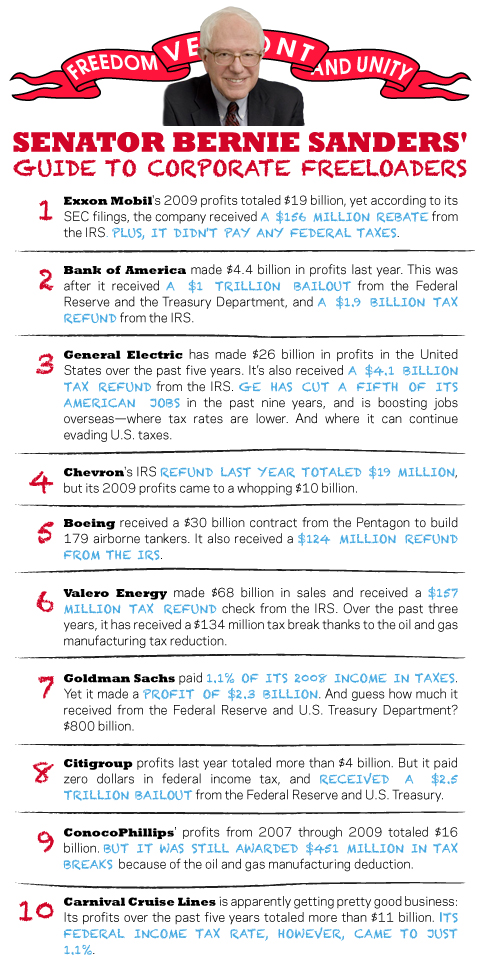
Guide to Corporate Freeloaders
Criminal Charges Loom For Goldman Sachs After Scathing Senate Report | Forbes
By Halah Touryalai
A Senate panel released a damning report accusing the likes of Goldman Sachs of engaging in massive conflicts of interest, contaminating the U.S. financial system with toxic mortgages and undermining public trust in U.S. markets in the months leading up to the financial crisis.
Just when you thought Washington lawmakers were over that whole financial crisis thing, Senator Carl Levin, D-Mich., and Senator Tom Coburn M.D., R-Okla, blast Wall Street in a 635-page report stemming from a 2-year bipartisan investigation on the key causes of the crisis.
The report comes at a time when much of the feeling from lawmakers in Washington is that Wall Street is being over-regulated by the new Dodd-Frank rules.
The report from the Senate’s Permanent Subcommittee on Investigations however takes an opposite view by citing internal documents and private communications of bank executives, regulators, credit ratings agencies and investors to depict an industry that was rife with conflicts of interest and reckless during the mortgage surge.
Senator Levin said in the release yesterday:
“Using emails, memos and other internal documents, this report tells the inside story of an economic assault that cost millions of Americans their jobs and homes, while wiping out investors, good businesses, and markets,” said Levin. “High risk lending, regulatory failures, inflated credit ratings, and Wall Street firms engaging in massive conflicts of interest, contaminated the U.S. financial system with toxic mortgages and undermined public trust in U.S. markets. Using their own words in documents subpoenaed by the Subcommittee, the report discloses how financial firms deliberately took advantage of their clients and investors, how credit rating agencies assigned AAA ratings to high risk securities, and how regulators sat on their hands instead of reining in the unsafe and unsound practices all around them. Rampant conflicts of interest are the threads that run through every chapter of this sordid story.”
The report takes specific issue with the way Goldman Sachs touted investments to clients on one end but bet against them on the other. A similar accusation against Goldman by the SEC lead to a $550 settlement last year, but Levin and his team don’t think that punishment fits the crime. From the report:
When Goldman Sachs realized the mortgage market was in decline, it took actions to profit from that decline at the expense of its clients. New documents detail how, in 2007, Goldman’s Structured Products Group twice amassed and profited from large net short positions in mortgage related securities. At the same time the firm was betting against the mortgage market as a whole, Goldman assembled and aggressively marketed to its clients poor quality CDOs that it actively bet against by taking large short positions in those transactions.
New documents and information detail how Goldman recommended four CDOs, Hudson, Anderson, Timberwolf, and Abacus, to its clients without fully disclosing key information about those products, Goldman’s own market views, or its adverse economic interests. For example, in Hudson, Goldman told investors that its interests were “aligned” with theirs when, in fact, Goldman held 100% of the short side of the CDO and had adverse interests to the investors, and described Hudson’s assets were “sourced from the Street,” when in fact, Goldman had selected and priced the assets without any third party involvement.
New documents also reveal that, at one point in May 2007, Goldman Sachs unsuccessfully tried to execute a “short squeeze” in the mortgage market so that Goldman could scoop up short positions at artificially depressed prices and profit as the mortgage market declined.
This isn’t the first time Levin is gunning for Goldman. Back in April 2010, the Senator had a memorable back-and-forth with a Goldman executive during a testimony where the two discussed a “shitty deal” the firm was selling to clients.
In fact, Levin is referred to that very testimony yesterday saying he doesn’t think Goldman executives were being truthful about its activity, and that he would refer the testimony to the Department of Justice and the Securities and Exchange Commission for possible criminal investigations.
“In my judgment, Goldman clearly misled their clients and they misled the Congress,” he said.
Goldman isn’t alone in feeling Levin’s wrath though. The report also points to Deutsche Bank AG (DB) saying the Frankfurt-based company created a $1.1 billion CDO with assets that its traders referred to as “crap” and “pigs” but then attempted to sell “before the market falls off a cliff.”
Not even credit rating agencies are spared in this report which concluded that “the most immediate cause of the financial crisis was the July 2007 mass ratings downgrades by Moody’s and Standard & Poor’s that exposed the risky nature of mortgage-related investments that, just months before, the same firms had deemed to be as safe as Treasury bills.”
Here’s more:
Internal emails show that credit rating agency personnel knew their ratings would not “hold” and delayed imposing tougher ratings criteria to “massage the … numbers to preserve market share.” Even after they finally adjusted their risk models to reflect the higher risk mortgages being issued, the firms often failed to apply the revised models to existing securities, and helped investment banks rush risky investments to market before tougher rating criteria took effect.
They also continued to pull in lucrative fees of up to $135,000 to rate a mortgage backed security and up to $750,000 to rate a collateralized debt obligation (CDO) – fees that might have been lost if they angered issuers by providing lower ratings. The mass rating downgrades they finally initiated were not an effort to come clean, but were necessitated by skyrocketing mortgage delinquencies and securities plummeting in value. In the end, over 90% of the AAA ratings given to mortgage-backed securities in 2006 and 2007 were downgraded to junk status, including 75 out of 75 AAA-rated Long Beach securities issued in 2006.
When sound credit ratings conflicted with collecting profitable fees, credit rating agencies chose the fees.
Among the 19 recommendations from the panel on how to handle the problems is one suggestion that asks the SEC to rank credit rating agencies according to the accuracy of their ratings.
At this stage, do we think the SEC can handle that?
Source: Forbes
Report: Big Profits Drove Faulty Ratings at Moody’s, S&P | McClatchy Newspapers
By Kevin G. Hall
Credit rating agencies are supposed to provide independent assessments on the quality of debt being issued by companies or governments. Traditionally, investments rated AAA had a probability of failure of less than 1 percent.
But in collusion with Wall Street investment banks, the Senate report concludes, the top two ratings agencies — Moody’s Investors Service and Standard & Poor’s — effectively cashed in on the housing boom by ignoring mounting evidence of problems in the housing market.
“Instead of using this information to temper their ratings, the firms continued to issue a high volume of investment-grade ratings for mortgage backed securities,” the report said.
Profits at both companies soared, with revenues at market leader Moody’s more than tripling in five years. Then the bottom fell out of the housing market, and Moody’s stock lost 70 percent of its value; it has yet to fully recover. More than 90 percent of AAA ratings given in 2006 and 2007 to pools of mortgage-backed securities were downgraded to junk status.
Wednesday’s report provided greater detail about the behavior of Brian Clarkson, the president of Moody’s at the time of his departure in mid-2008, when the financial crisis was in full bloom.
Clarkson rose from the head of Structured Finance, which rated complex bonds backed by U.S. mortgages, to president of the company. His rise paralleled the decline in ratings quality. He has refused to talk to McClatchy or other news organizations, and was scheduled to testify last year before the Financial Crisis Inquiry Commission but was rushed to the hospital with a kidney stone.
Analysts had confided to McClatchy that Clarkson bullied and threatened them as he rose up the ranks, and the Senate report details that in numerous emails. One email dating to 2003 shows Clarkson suggesting the need to “refine our approach” to keep pace with competitors “easing their standards to capture (market) share.”
Similarly, an S&P employee in an August 2006 email described his company’s cozy relationship with Wall Street banks this way: “They’ve become so beholden to their top issuers for revenue they have all developed a kind of Stockholm syndrome…”
Stockholm syndrome is the bond a kidnapping victim feels with captors.
Source: McClatchy Newspapers
Guerrilla Hoarding | Ludwig von Mises Institute
focuses upon people whose “inability to part with their belongings is so out of control that they are on the verge of a personal crisis”; like drug addicts, they require an intervention. The vilification of hoarders as mentally ill, child-endangering animal abusers is in full swing.
What is this vile and dangerous thing called hoarding? The noun “hoard” is defined as “a store of money or valued objects, typically one that is secret or carefully guarded.” The verb means to “save up as for future use.” In common usage, anyone who stores more of a good than their neighbors do is often viewed as a “hoarder.”
A common example of hoarding is stocking up on durable grocery items — such as canned goods, rice, or pasta — when they are on sale, so that your family has a year’s supply of staples in the house. In rural areas, this is known as “keeping a good pantry.”
Historically, governments have frowned upon hoarding. Especially in bad economic times, stigmatizing the hoarder for “causing” high prices or shortages because he buys more than his “share” serves a useful political purpose. They divert attention away from government policies, such as tariffs, that are the true cause of empty shelves and high prices. By stirring up resentment toward neighbors who own one more can of peas than you do, politicians avoid the full and just brunt of public anger.
In times of economic crisis, when governments flirt with rationing and price controls, the frown can turn into a scowl; laws against hoarding are then passed and goods are sometimes confiscated. The most notorious confiscation in America came in 1933 when President Franklin D. Roosevelt signed Executive Order 6102, ostensibly as a measure to combat the Great Depression. The order commanded the American people (with a few exceptions) to relinquish all but a still-permitted $100 worth of gold coins, bullion, and certificates to the Federal Reserve in exchange for a payment of $20.67 per troy ounce. Less than a year later, the government raised the trade rate to $35 per troy ounce. Thus, the government reaped huge profits at the expense of private investors and savers — a.k.a. hoarders of gold.
Hoarding, like any other human activity, can become obsessive. But in its common form, hoarding is nothing more than preparing for the future by laying aside a store of items you and your family may need. This is an especially valuable practice during economic instability, when necessary supplies can become scarce or suddenly double in price.
The Austrian investment counselor Jack Pugsley once explained another perspective on hoarding: it is an investment. A low-income family may not be able to afford precious metals, but they can afford to invest in dry or canned consumables. Last year, with some frequency, my grocery store sold a 900-gram package of pasta for 99¢. With wheat shortages, and with the American government diverting almost 30 percent of corn crops into producing ethanol, food products dependent on grain have skyrocketed. The same package of pasta now regularly costs $2.99. If a struggling family bought 60 packages of the 99¢ pasta for a future consumption of one package a week, then their hoarding would have knocked perhaps $100 off their grocery bill. By consistently buying more than they immediately need of bargain items, the family can build a solid pantry to sustain them through unemployment, inflation or scarcity.
Unfortunately, during economic crises, the government also acquires an interest in hoarding — specifically, in punishing the hoarder as unpatriotic. A historical example is the Food and Fuel Control Act, which became law in 1917, during World War I; the acts official name was “An Act to Provide Further for the National Security and Defense by Encouraging the Production, Conserving the Supply, and Controlling the Distribution of Food Products and Fuel.” In short, the government became a food dictator, and anyone possessing more than a 30-day supply of food (which was considered reasonable by food administrator Herbert Hoover) could be arrested.
The May 30, 1918, New York Times carried the headline, “Navy Man Indicted for Food Hoarding.” It reported on a man who had invested his wife’s inheritance in a year’s food for storage; and so they were held on a $3,000 bail each. The food was confiscated.
The navy man’s fate is a cautionary tale in more than one way. The store of food for his family was discovered because a grocer and neighbors informed upon him. Thus, a sad corollary to the wisdom of hoarding food for your family is the need to do so with discretion. This is sad, because the natural impulse of people in a community is to assist those in need. Measures like the Food and Fuel Control Act mean that sharing food with a neighbor who has hungry children is no longer simply a gesture of compassion and generosity; such government acts make sharing into a danger to your safety and your own children’s well-being.
There is still time to hoard the items upon which your family depends. Prices are rising, to be sure, but the full force of inflation and shortages is probably several months in the future. Hoard now; hoard quietly.
Source: Ludwig von Mises Institute