Source: YouTube
Source: YouTube
 Source: U.S. Debt Clock
Source: YouTube
 Editor’s Note: Protests, rioting and looting across the USA occurred primarily in the following cities: Minneapolis, MN, Los Angeles, CA, New York, NY, Philadelphia, PA, Nashville, TN, San Francisco, CA, Detroit. MI, Portland, OR, Memphis, TN, Chicago, IL, Atlanta, GA, Washington, DC, Madison WI, Denver, CO, Santa Monica, CA, San Diego, CA (Republican), Boston, MA, Miami, FL (Republican), Oklahoma City, OK (Republican), Scottsdale, AZ (Republican), Windemere, FL, Albuquerque, NM, Sioux City, SD (Republican), Fontana, CA (Republican), Columbus, OH, Houston, TX, Phoenix, AZ, Louisville, KY, Davenport, IA, Jacksonville, FL (Republican), St. Louis, MO, Las Vegas, NV, and Oakland, CA. All but the seven noted had Democrat Mayors.
The death of George Floyd, an unarmed black man who died in police custody after a white officer kneeled on his neck for more than 8 minutes, has sparked widespread violent protests in dozens of American cities.
Floyd, 46, was pronounced dead Monday night after he was pinned to the ground under the knee of Minneapolis police officer Derek Chauvin, who is white. In a video recorded by a bystander, Floyd is heard saying he could not breathe.
Four police officers – Chauvin, Tomas Lane, Tou Thao, and J. Alexander Kueng – were fired from the force Tuesday. Chauvin was arrested Friday and charged with murder in the third degree.
In the days since his death, unrest in every corner of the country left charred and shattered landscapes in dozens of American cities. Here is a list of some of the cities where protests have erupted:
Minneapolis, Minn.
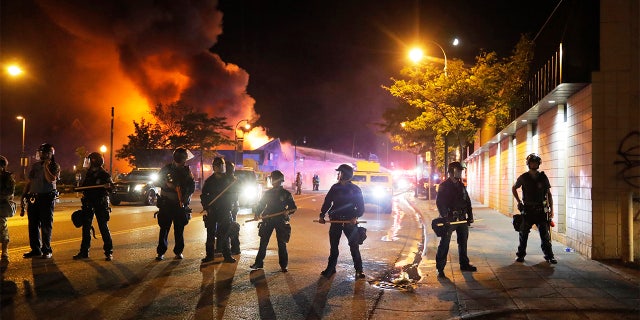
Police stand watch as a firefighters put out a blaze Saturday, May 30, 2020, in Minneapolis. AP Photo/Julio Cortez (AP Photo/Julio Cortez)
Minneapolis has been the epicenter of protests since the death on Memorial Day of Floyd after a police officer pressed his knee on Floyd’s neck for several minutes. The protests have spread to cities across the United States.
Peaceful protests broke out a day after Floyd’s death. The demonstrations quickly escalated to outright violence and looting. For several days after, city residents woke up to fires still burning from the violent protests.
The building of the Minneapolis Police’s 3rd Precinct was overtaken by protesters and burned down by the end of the week.
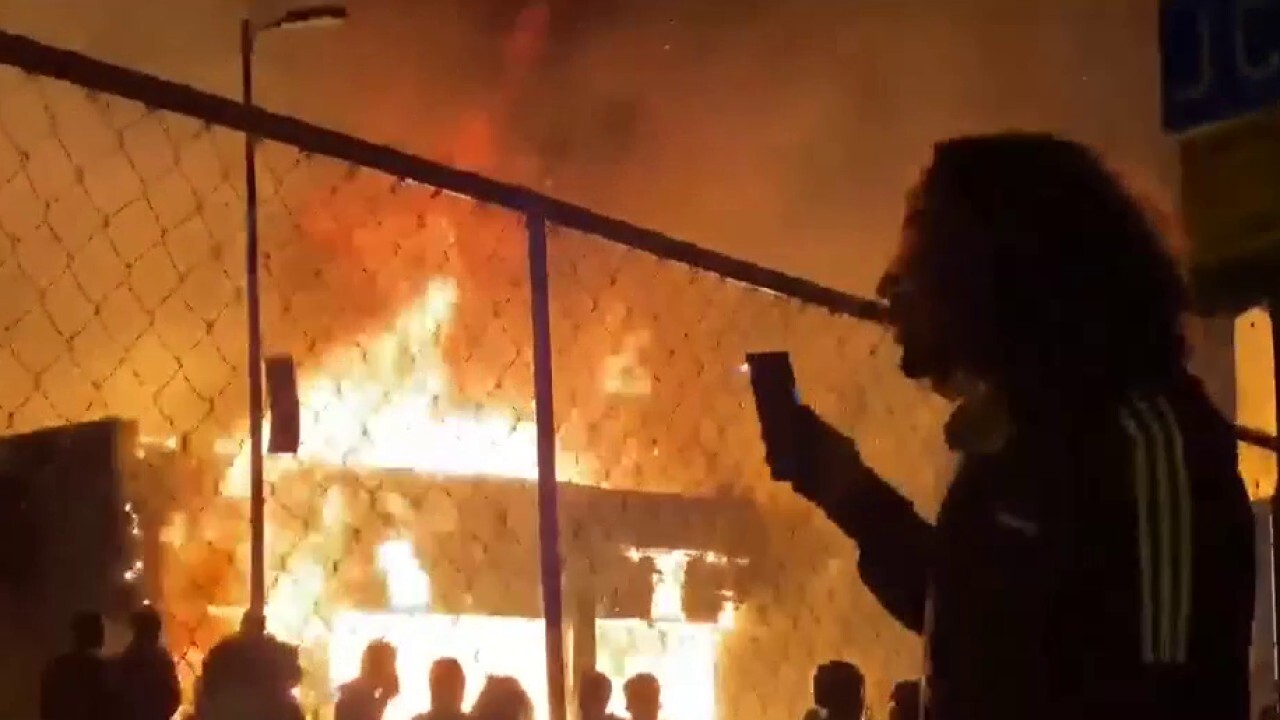
Be Saturday, protesters were seen defying curfew orders issued by Frey as firefighters sought to put out several business fires after the fourth night of unrest. The curfew lasts from 8 p.m. until 6 a.m. and any violation of it could lead to a misdemeanor charge, which entails 90 days in jail and a $1,000 fine.
Gov. Tim Walz, who authorized the “full mobilization” of the state’s National Guard, said it’s the largest civilian deployment in the state’s history. He said it was three times the size of what was in place during the race riots of the 1960s.
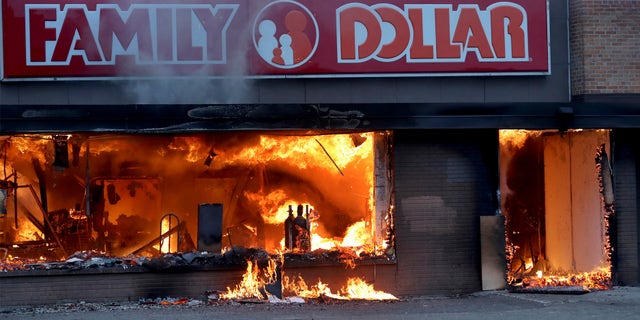
Fire burns inside The Family Dollar Store after a night of unrest and protests in the death of George Floyd early Friday, May 29, 2020 in Minneapolis. (David Joles/Star Tribune via AP)
The Pentagon has been ordered to prepare troops to be sent to the Twin Cities, a move said to be rare in nature.
“This is no longer about protesting,” Frey said Saturday. “This is about violence and we need to make sure that it stops.”
After the fifth day of protests, police said early Sunday they succeeded in stopping violent protests that ravaged parts of the city for several days
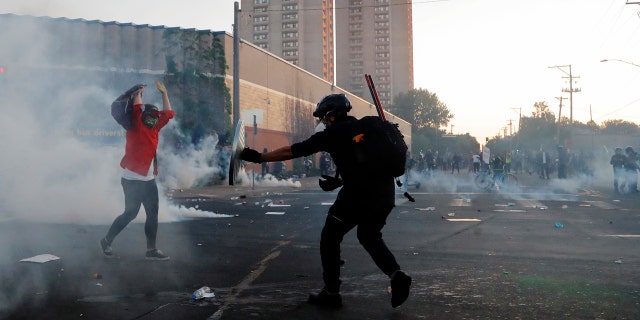
People clear the area after curfew Saturday, May 30, 2020, in Minneapolis.
(AP Photo/Julio Cortez)
Police, state troopers and National Guard members moved in to break up protests after an 8 p.m. curfew took effect, firing tear gas and rubber bullets to clear streets outside the city police’s 5th Precinct and elsewhere. The show of force came after three days where police mostly declined to engage with protesters.
The tougher tactics also came after the state poured in more than 4,000 National Guard members and said the number would soon rise to nearly 11,000. Dozens of people were arrested as of Sunday morning, FOX9 reported.
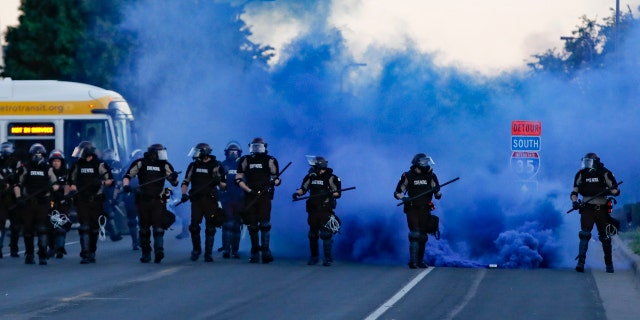
Police in riot gear prepares to advance on protesters, Saturday, May 30, 2020, in Minneapolis. (AP Photo/John Minchillo)
As Minneapolis streets appeared largely quiet, Corrections Commissioner Paul Schnell said the heavy response would remain as long as it takes to “quell this situation.”
The tougher tactics came after city and state leaders were criticized for not more strongly confronting violent and damaging protests.
Authorities made a new round of arrests on Sunday night as they worked to enforce the curfew, FOX9 reported.
Hours earlier, a semitrailer sped toward a crowd of people protesting on an interstate bridge in a harrowing series of events, forcing the protesters to run for safety.
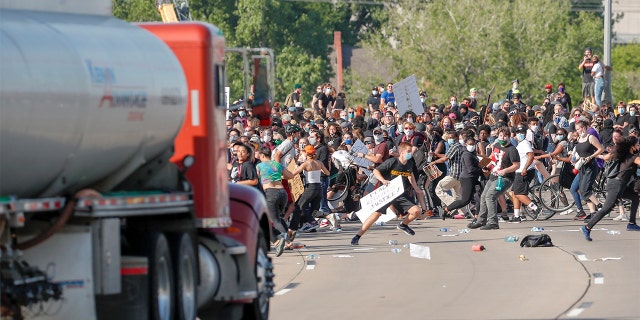
A tanker truck drives into thousands of protesters marching on 35W north bound highway during a protest against the death in Minneapolis police custody of George Floyd, in Minneapolis, Minnesota, U.S. May 31, 2020. (REUTERS/Eric Miller)
The driver was later identified by the Hennepin County Sheriff’s Office as Bogdan Vechirko, according to Fox 9. Police said he’s being held on suspicion of assault.
Los Angeles, Calif.
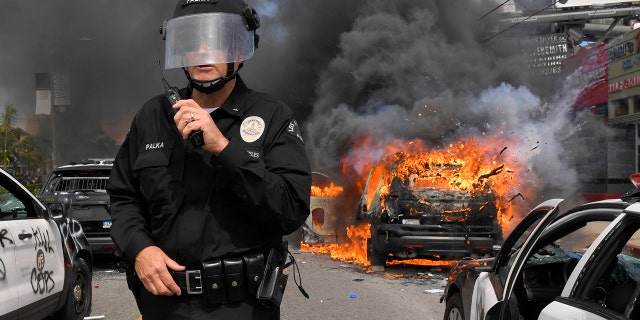
Los Angeles Police Department commander Cory Palka stands among several destroyed police cars as one explodes while on fire during a protest over the death of George Floyd, Saturday, May 30, 2020, in Los Angeles. (AP Photo/Mark J. Terrill)
Protests in Los Angeles began two days after Floyd’s death, with dozens temporarily blocking Highway 101. The demonstrations turned violent in the days after and lasted through the weekend.
On Saturday morning, police worked to disperse crowds in downtown Los Angeles as multiple businesses were looted. Hundreds were reportedly arrested, and at least five police officers were injured, multiple media outlets reported.
By later in the day, Los Angeles Mayor Eric Garcetti imposed a rare citywide curfew and called in the National Guard after demonstrators clashed repeatedly with officers, torched police vehicles, and pillaged businesses in a popular shopping district.
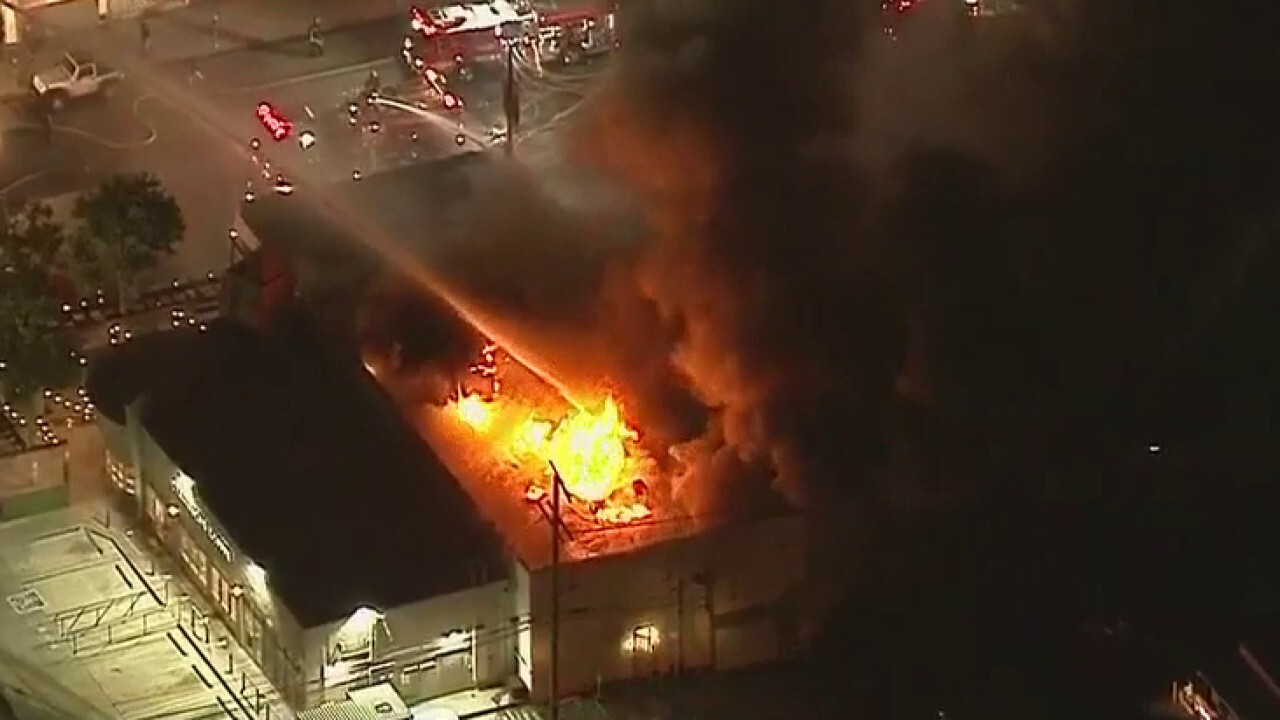
Garcetti said Saturday he asked Gov. Gavin Newsom for 500 to 700 members of the Guard to assist the 10,000 Los Angeles Police Department officers.
Garcetti said the soldiers would be deployed “to support our local response to maintain peace and safety on the streets of our city.”
Firefighters responded to dozens of fires, and scores of businesses were damaged.
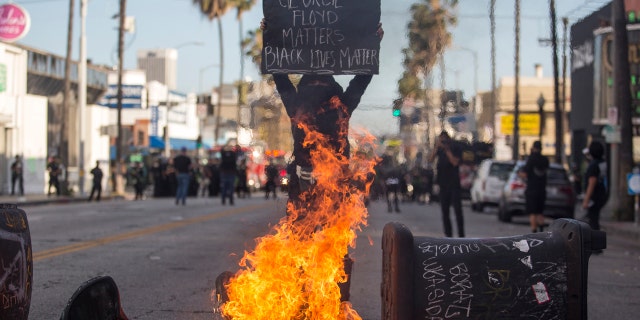
A protester holding a sign stands behind the burning trash cans during a protest over the death of George Floyd, a handcuffed black man in police custody in Minneapolis, in Los Angeles, Saturday, May 30, 2020. (AP Photo/Ringo H.W. Chiu)
“If you’re in pain, I feel that pain. If you’re angry, I get it. But this has moved from a being a protest, to vandalism to destruction, and nobody should be out there making a mistake,” Garcetti told FOX11.
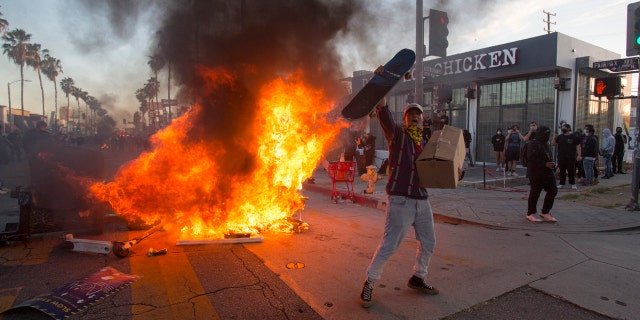
A protester shouts in front of a fire during a protest over the death of George Floyd, a handcuffed black man in police custody in Minneapolis, in Los Angeles, Saturday, May 30, 2020. (AP Photo/Ringo H.W. Chiu)
One of the hardest-hit areas was the area around the Grove, a popular high-end outdoor mall west of downtown where hundreds of protesters swarmed the area, showering police with rocks and other objects and vandalizing shops.
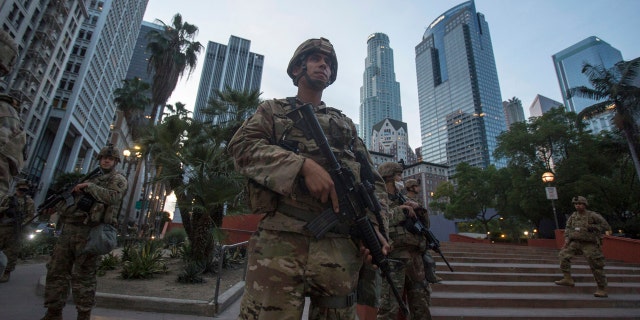
Members of California National Guard stand guard in Pershing Square, Sunday, May 31, 2020, in Los Angeles. (AP Photo/Ringo H.W. Chiu)
A countywide curfew was in effect Sunday night into Monday morning after another day of violence and destruction throughout parts of Los Angeles city and county, FOX11 reported.
The Los Angeles Police Department estimated there were 398 arrests on Saturday night and Sunday morning related to the police protests.
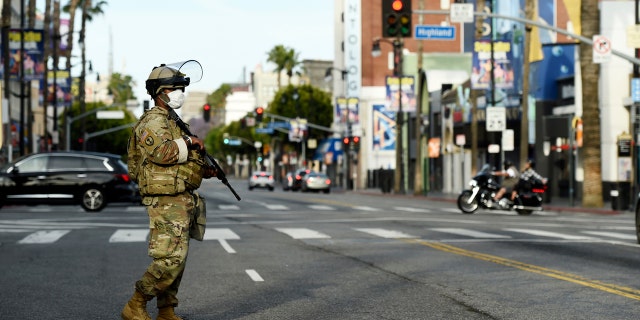
A U.S. National Guard soldier watches over Hollywood Blvd., Sunday, May 31, 2020, in Los Angeles. (AP Photo/Chris Pizzello)
During a press conference Sunday afternoon, LAPD Chief Michel Moore said at least five officers were injured with two being hospitalized. One officer was hit on the head with a brick and suffered a fractured skull but is expected to recover, according to Moore.
The scale of the destruction in Los Angeles was being compared to the 1992 riots when there was more than $1 billion in property damage. There was no estimate of how many businesses suffered damage since protests began Wednesday, but it was clearly extensive.
New York, N.Y.
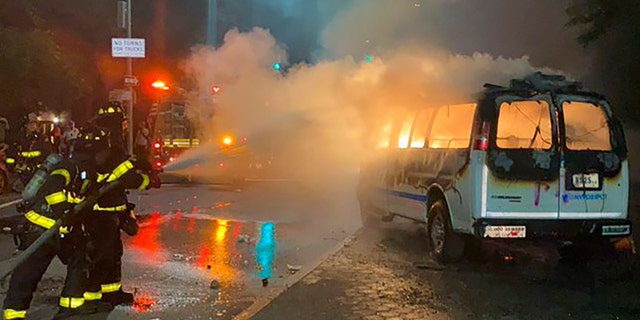
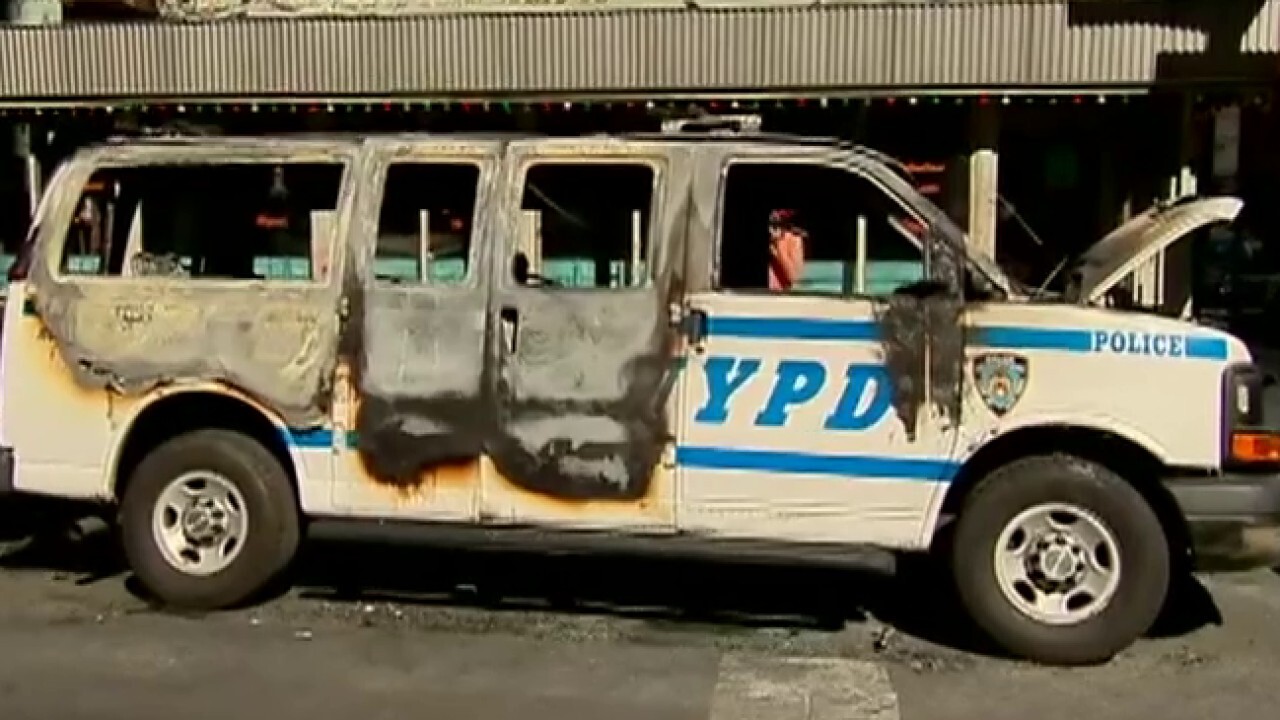
In this photo provided by Khadijah, firefighters work to contain the flames from a New York City Police Department van ablaze, Friday, May 29, 2020, in the Brooklyn borough of New York, amid a protest of the death of George Floyd in police custody on Memorial Day in Minneapolis. (Khadijah via AP)
Demonstrators took to New York City streets in protest of Floyd’s death and invoked the names of other black people who died at police hands. Street protests have spiraledinto some of the worst unrest the nation’s largest city has seen in decades.
Fires burned, windows got smashed and dangerous confrontations between demonstrators and officers flared Friday and Saturday amid crowds of thousands decrying police killings.
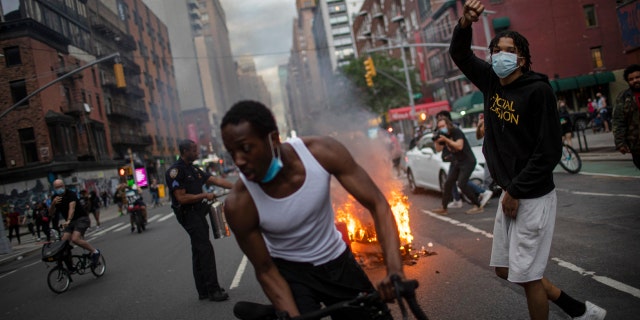
Protesters march down the street as trash burns in the background during a solidarity rally for George Floyd, Saturday, May 30, 2020, in New York. (AP Photo/Wong Maye-E)
The names of black people killed by police, including Floyd and Eric Garner, killed on Staten Island in 2014, were on signs carried by those in the crowd, and in their chants.
But as day turned into night, a handful of stores in Manhattan had their windows broken and merchandise stolen.
Officers sprayed crowds with chemicals, and video showed two police cruisers lurching into a crowd of demonstrators on a Brooklyn street, knocking several to the ground, after people attacked it with thrown objects, including something on fire. It was unclear whether anyone was hurt.
Since the protests began days ago, at least 790 people have been arrested, 33 officers have been injured and 27 police vehicles have been damaged or destroyed, police said.
New York City Mayor Bill de Blasio, a Democrat, blamed the destruction on a small number of agitators who he said “do not represent this city” and were purposely trying to incite violence against police.
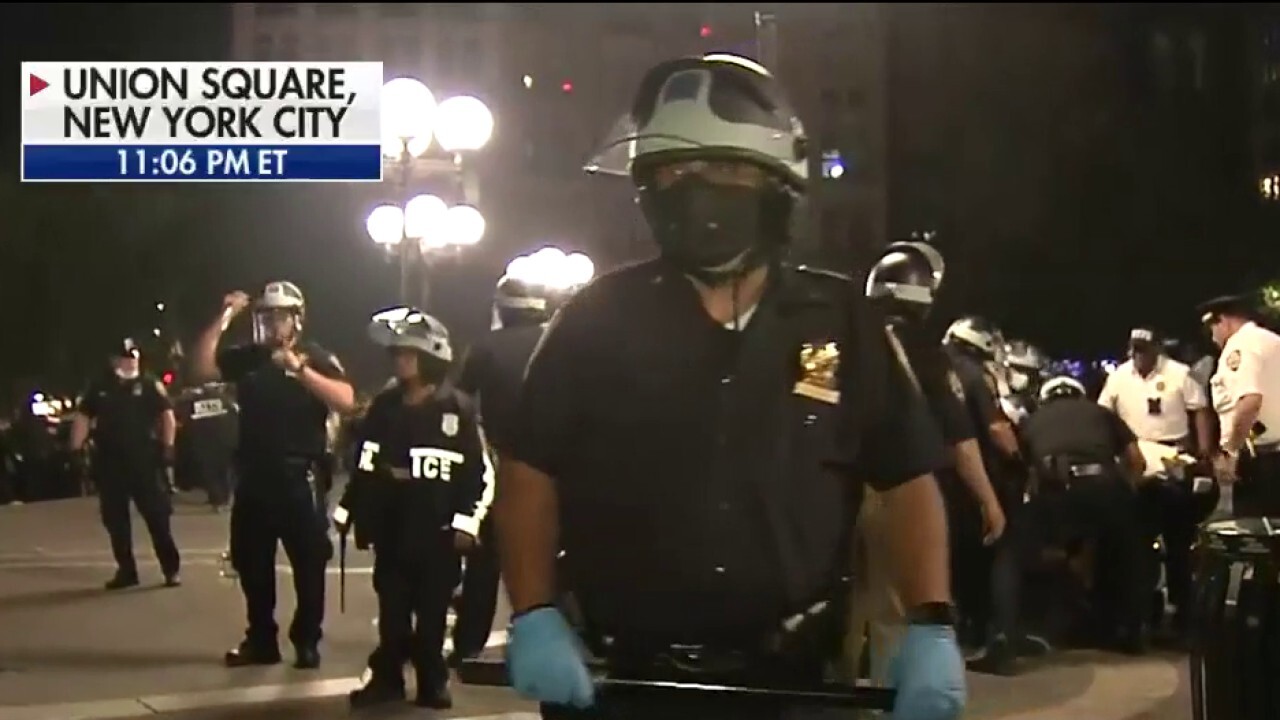
“We appreciate and respect all peaceful protest, but now it is time for people to go home,” de Blasio told reporters outside the city’s emergency management headquarters just after 11:30 p.m.
“What we’re seeing is people coming in from outside, a lot of them are purporting to speak about the issues of communities of color, but a lot of them are not from communities of color,” de Blasio said on NY1.
The mayor said he was upset by videos of confrontations “where protesters were handled very violently” by police, including one that showed a woman being needlessly thrown to the ground.
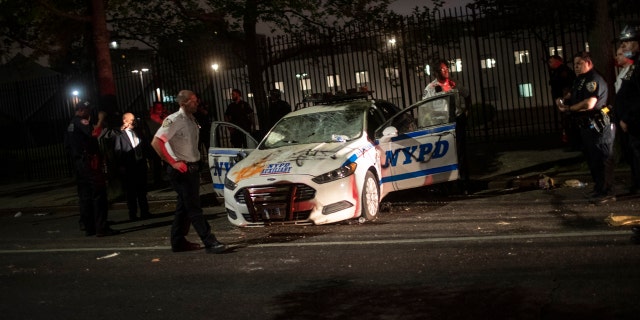
Policemen surround a NYPD vehicle after it was vandalized by protestors over the death of George Floyd, a black man who was in police custody in Minneapolis, on Saturday, May 30, 2020, in the Brooklyn borough of New York. Floyd died after being restrained by Minneapolis police officers on Memorial Day. ((AP Photo/Wong Maye-E)
But he defended officers in the streets, saying they were being subjected “to horrible, vile things.”
Of the video of officers driving into a crowd Saturday, de Blasio said it would be investigated, but that the officers acted because they were being attacked.
The mayor’s daughter, Chiara de Blasio, 25, was among those arrested Saturday night, a law enforcement official told the New York Post.
The arrest report, obtained by the New York Post, said she refused to leave a Manhattan street cleared by officers because people were throwing things. Chiara de Blasio, who is black, was later given a court summons and released.
Gov. Andrew Cuomo said Saturday he stood with the Minnesota protesters.
“Nobody is sanctioning the arson, and the thuggery and the burglaries, but the protesters and the anger and the fear and the frustration? Yes. Yes. And the demand is for justice,” Cuomo said.
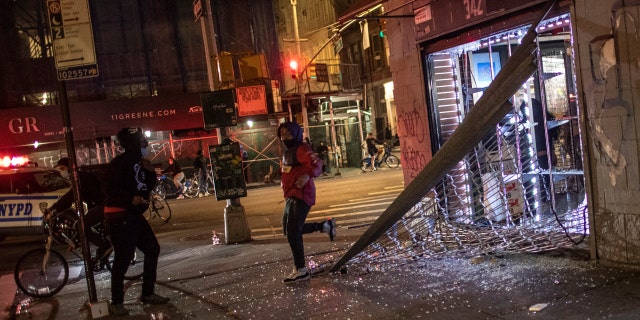
People run out of a smoke shop that they broke into as police arrive on the scene on Monday, June 1, 2020, in New York.(AP Photo/Wong Maye-E)
By Sunday, a fourth day of protests against police brutality saw thousands mass through multiple neighborhoods. During the day the demonstrations remained peaceful, but after dark ugly confrontations once again appeared.
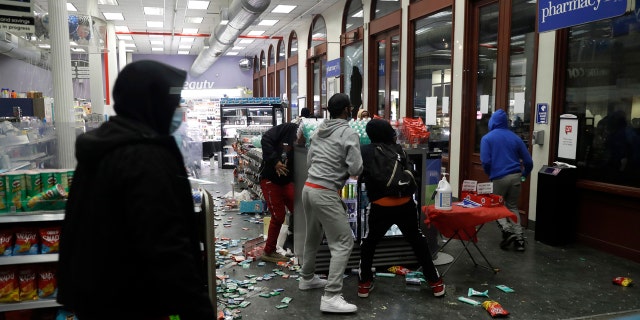
People grab items inside a pharmacy that had its windows broken in New York, Monday, June 1, 2020. (AP Photo/Seth Wenig)
Demonstrators in downtown Brooklyn and parts of Manhattan pelted officers with objects and set fires. Officers charged into crowds to clear streets, sending people sprawling and battering bystanders who couldn’t get out of the way.
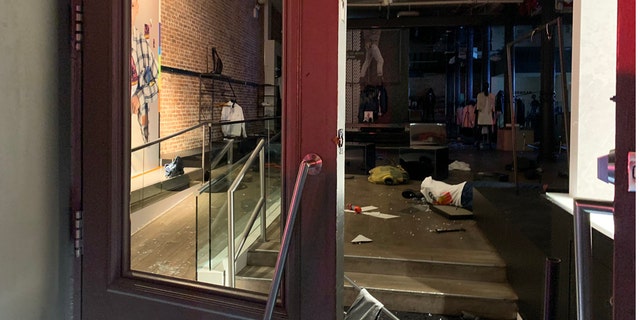
Damage to store in New York City’s SoHo neighborhood after looting in the early hours of Monday, June 1, 2020. (Bryan Llenas/FOX News)
Early Monday morning in Manhattan’s Soho neighborhood, mobs of people rampaged down the sidewalks, smashing into numerous luxury shops to steal merchandise.
Hundreds of people marauded through the area, breaking into Rolex, Chanel and Prada boutiques as well as clothing and electronics stores.
Philadelphia, Pa.
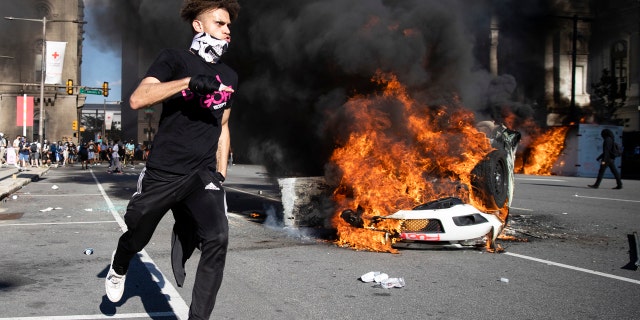
Smoke rises from a fire on a police cruiser in Center City during the Justice for George Floyd Philadelphia Protest on Saturday, May 30, 2020, in Philadelphia. (AP Photo/Matt Rourke)
Authorities in Philadelphia said a peaceful demonstration on Saturday protesting the death of George Floyd later turned violent, and at least 13 police officers have been injured amid incidents of arson and store break-ins in the city’s downtown.
Police Commissioner Danielle Outlaw said at least four police vehicles were set ablazeand other fires were set throughout downtown Saturday afternoon.
Protesters smashed windows and stole merchandise from stores as police tried to worked to corral the crowd, which Outlaw estimated numbered about 3,000.
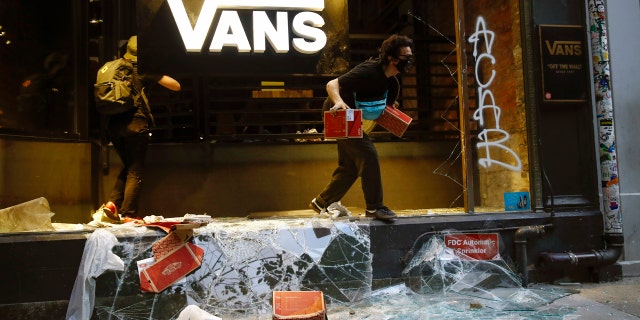
A person jumps from a storefront that had its window broken during the Justice for George Floyd Philadelphia Protest on Saturday, May 30, 2020. (AP Photo/Matt Rourke)
Philadelphia Mayor Jim Kenney has implemented a mandatory city-wide curfew that went into effect at 8 p.m. Saturday and will continue on Sunday evening.
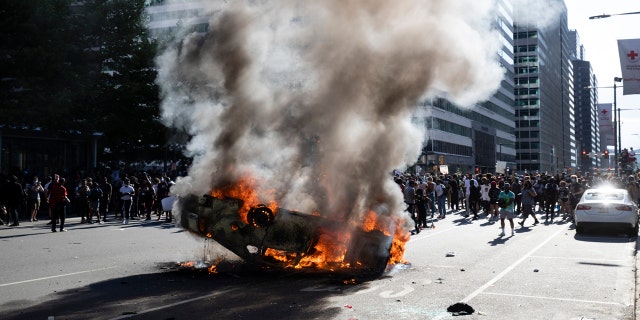
Smoke rises from a fire on a police cruiser in Center City during the Justice for George Floyd Philadelphia Protest on Saturday, May 30, 2020, in Philadelphia. (AP Photo/Matt Rourke)
“The peaceful protests earlier were touching showings of our collective grief. The anger being displayed now cannot continue. Please have respect and dignity for each other and return home,” the mayor tweeted Saturday night.
Protesters also sprayed graffiti on a statue of former Philadelphia Mayor Frank Rizzo, tried to topple it, and set a fire at its base.
One officer who was was riding a bike toward a group of suspected looters was injured after being struck by a vehicle that later drove off, FOX29 reported.
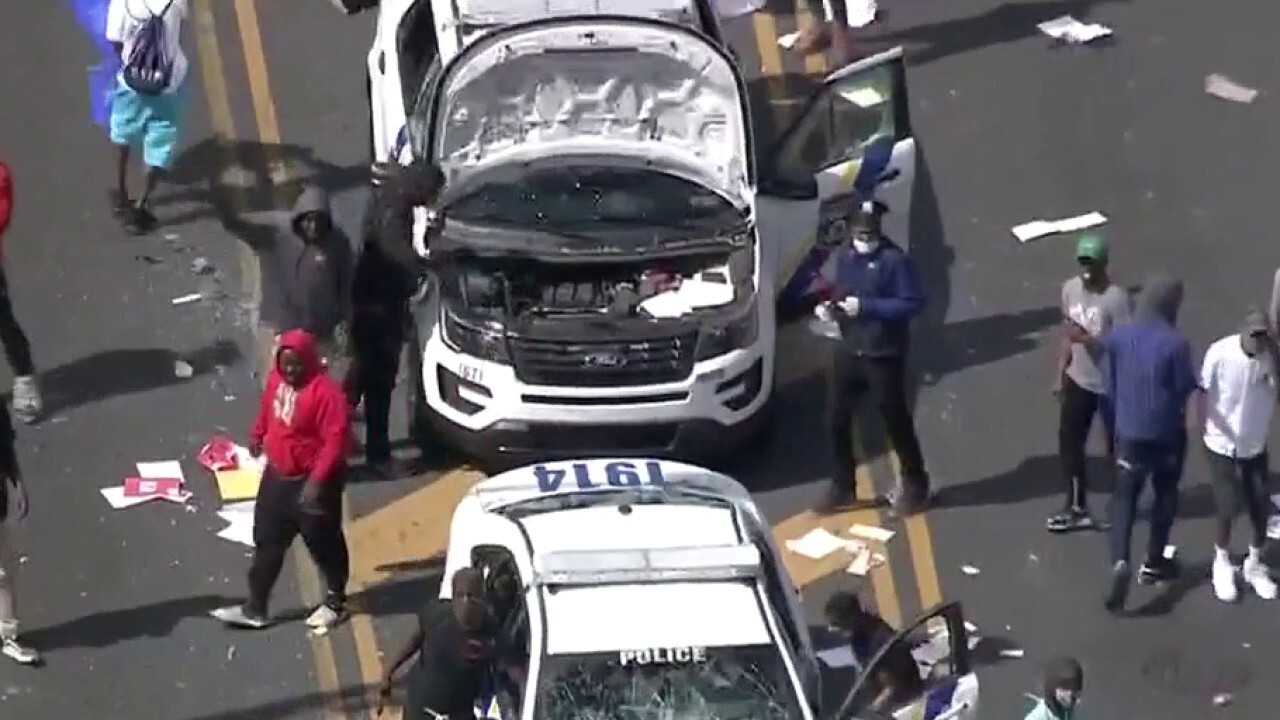
Looters were back out ransacking parts of Philadelphia on Sunday afternoon.
Video captured by Fox 29 showed what appeared to a hijacked police car crashing into another vehicle. Other protesters could be seen ransacking another police car, smashing its windshield, and emptying its contents out onto the street.
The lingering unrest prompted city officials to order retail businesses closed and issue a curfew from 6 p.m. Sunday to 6 a.m. Monday.
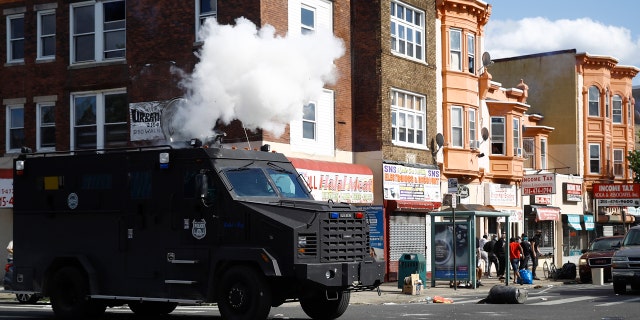
Police deploy tear gas to disperse a crowd during a protest Sunday, May 31, 2020, in Philadelphia over the death of George Floyd. (AP Photo/Matt Rourke)
The National Guard has since arrived in the city, according to FOX29.
“The Pennsylvania National Guard is ready to provide safety and protection to our communities,” said Maj. Gen. Anthony Carrelli, Adjutant General of Pennsylvania. “Our troops are trained to protect life, preserve property and ensure people’s right to peacefully demonstrate.”
Nashville, Tenn.
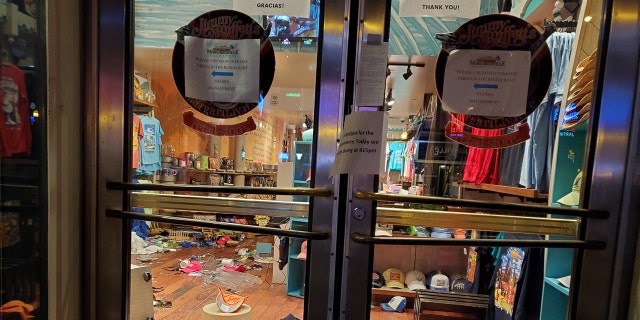
Damage after riots on Saturday in Nashville, Tenn. (Metro Nashville Police Department)
A state of civil emergency was declared Saturday in Nashville, Tenn., after protesters set a fire inside the Metro Courthouse in the state’s capital city.
Thousands had rallied near the Capitol building Saturday afternoon to peacefully protest police brutality and racism but things turned violent after darkness fell.
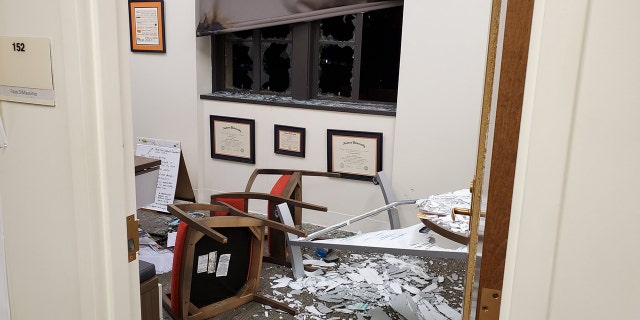
Damage after riots on Saturday in Nashville, Tenn. (Metro Nashville Police Department)
Protesters broke windows in government buildings and caused other property damage, FOX17 reported.
Police deployed tear gas and began warning demonstrators that the protest was unlawful.
The Metro Nashville Police Department said that more than 30 businesses and buildings were damaged in Saturday’s riots, and 28 people were arrested downtown. Of those arrested, all but three were Tennessee residents, according to police.
Mayor John Cooper said the courthouse was the site of “reprehensible vandalism.”
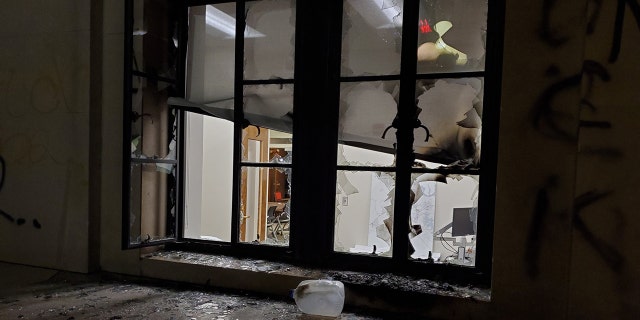
Damage after riots on Saturday in Nashville, Tenn. (Metro Nashville Police Department)
Gov. Bill Lee issued an order Saturday night for the National Guard to mobilize “in response to protests that have now taken a violent, unlawful turn in Nashville.”
A curfew was put into place started at 8 p.m. on Sunday.
The MNPD said Sunday that 25-year-old Wesley Somers was arrested on charges of felony arson, vandalism, and disorderly conduct for setting fire to Nashville’s Historic Courthouse Saturday night.
San Francisco, Calif.
San Francisco’s iconic Union Square saw people stealing leather bags from the Coach store and shoes from the Salvatore Ferragamo location as protests erupted across the Bay Area on Saturday.
Streets were littered with bras from Victoria’s Secret and cushioned jewelry boxes from Swarovski. Police fired tear gas to disperse protesters, the Mercury News reported.
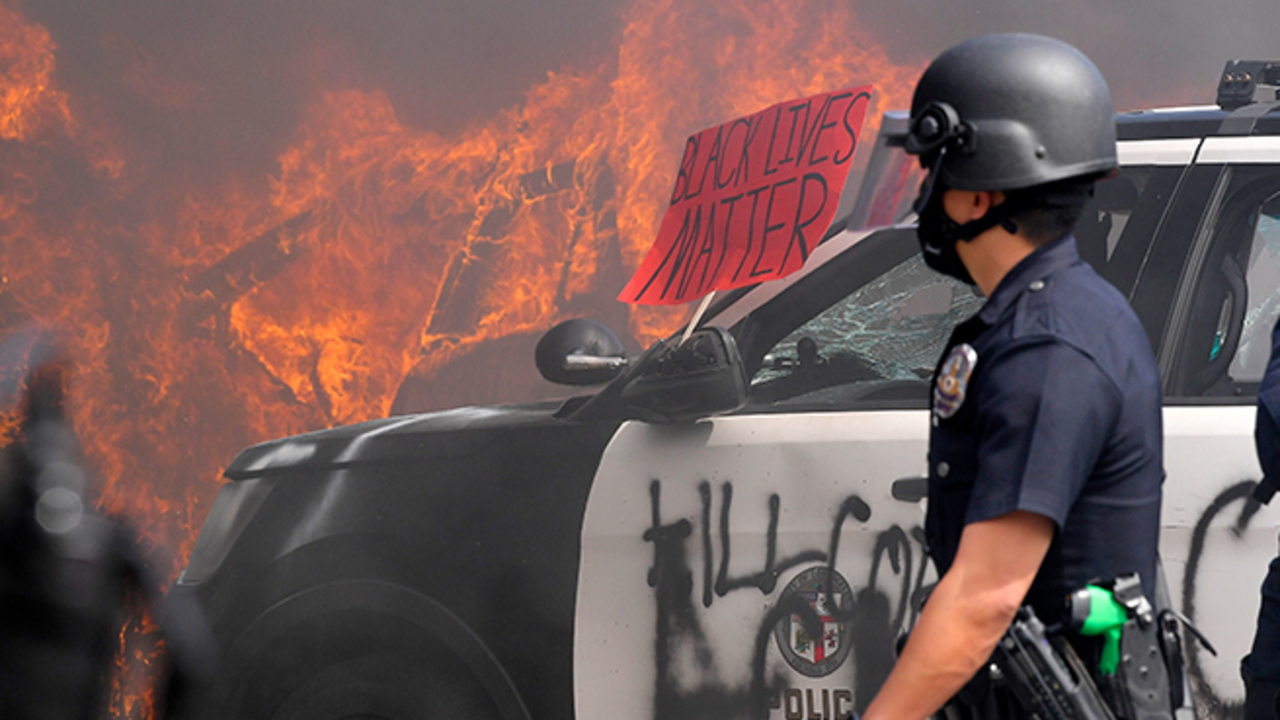
Jeff Paul reports on aftermath of skirmish between police officers and protesters.
San Francisco Mayor London Breed said a citywide curfew would go into effect from 8 p.m. Sunday to 5 a.m. Monday. She also asked the governor to put the National Guard on standby.
“People are hurting right now. They’re angry. I’m angry,” Breed tweeted. “We can’t tolerate violence and vandalism.”
San Francisco Police Chief Bill Scott said he understood why protesters are angry at police. But he warned that if anyone assaulted officers, “we will not tolerate that.”
San Francisco police officers seized firearms and explosives and arrested at least 80 people Sunday night on violating a curfew and looting charges.
Scott said demonstrations that drew about 1,000 people carrying signs and chanting “George Floyd” and “Black lives matter” were overwhelmingly peaceful Sunday and the vast majority of demonstrators dispersed without incident before the 8 p.m. curfew.
But a relatively small number of “defiant individuals” who had gathered in the Civic Center area refused to disperse, threw bottles at officers and started trash fires, Scott said.
In response, officers and deputies with the sheriff’s office began making arrests, he said.
Detroit, Mich.
Some 1,500 people demonstrated peacefully Friday in Detroit as part of the nationwide protests.
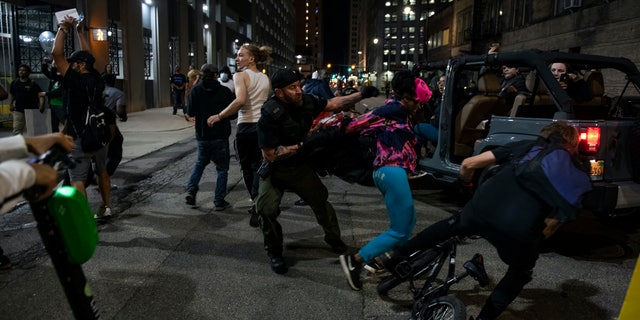
Detroit police officer grabs a protester during a rally calling for an end to police violence and justice for George Floyd Friday May 29, 2020. Nicole Hester/Mlive.com
Police Chief James Craig said one person was killed and more than 40 people were arrested. He said at least three-fourths of the demonstrators were from outside of the city.
A DPD spokesperson said a grey Dodge Durango pulled up and fired into the crowd, striking a 19-year-old man. The shooting did not involve the police.
Tear gas was deployed Sunday night after protesters refused to obey a new curfew in Detroit, FOX2 reported.
“We advised them of the curfew,” said Detroit Police Chief James Craig. “The officers took rocks, bottles and railroad ties at some point.”
Portland, Ore.
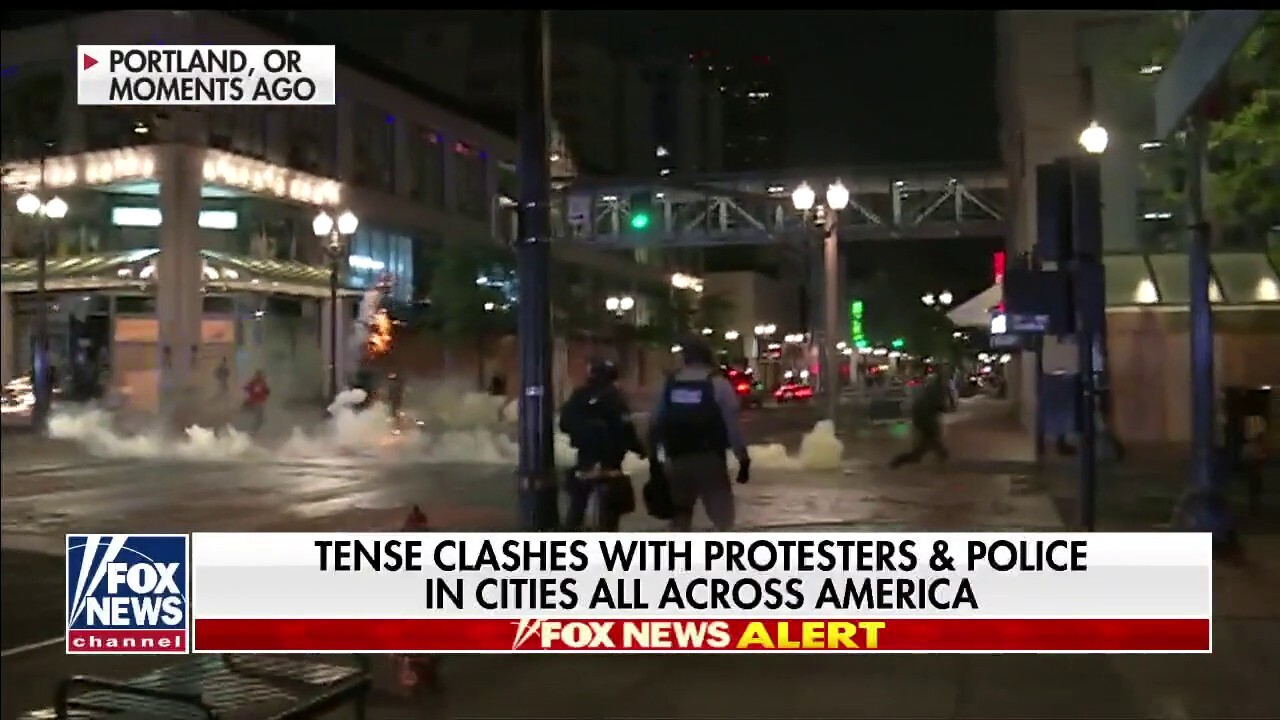
Police in Portland, Ore., declared a riot after demonstrators on Friday smashed store windows and broke into the Multnomah County Justice Center, where office cubicles were set ablaze. “ENOUGH!” Mayor Ted Wheeler wrote on Twitter before declaring a state of emergency and instituting an overnight curfew.
Portland’s mayor declared a state of emergency for Portlandafter riots damaged numerous businesses and public buildings Friday night. A curfew has been enacted, starting at 8 p.m. and continuing until 6 a.m.
Dozens were arrested on Saturday as hundreds took to city streets again.
Over the course of five hours, police told FOX12 that businesses were vandalized in downtown and the Lloyd District. The vandalism included fires, smashed windows, looting and illegal use of construction site materials for blocking streets and traffic.
Confrontations continued on Sunday as police deployed tear gas to disperse a large crowd downtown after authorities said projectiles were thrown at officers.
Earlier, police said protesters smashed windows at the federal courthouse, and authorities on loudspeakers declared the gathering a civil disturbance.
Thousands of people marched throughout Oregon’s largest city on Sunday, the third day of George Floyd protests in Portland. For much of the afternoon and evening protesters were largely peaceful, but there were reports of increased violence directed at police into the night.
Memphis, Tenn.
Protesters took to the streets of Memphis Friday night to speak out against police brutality and the recent deaths of three African-Americans at the hands of police.
The first demonstrators arrived just before 6:30 p.m. Within an hour, the crowd had grown to about 300, the largest of the protests so far.
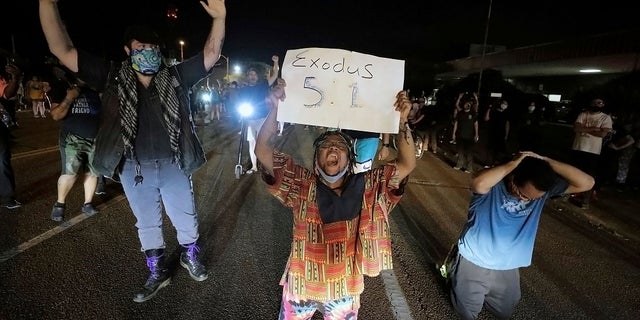
Protesters kneel in front of the Union Avenue police station in Memphis, Tenn., during a protest over the death of George Floyd, Thursday, May 28, 2020, in Memphis, Tenn. (Patrick Lantrip/Daily Memphian via AP)
That was despite a series of road closures set up by the Memphis Police Department at every entrance into the area. While Wednesday, the overarching emotion seemed to be anger, Friday night’s protest seemed to be about unity and healing.
During protests on Sunday night, some stores were damaged after rioters smashed several building storefronts, FOX13 reported.
Chicago, Ill.
Dozens of protesters wearing face masks — many with the communist group Revolution Club Chicago and the organization Refuse Fascism Now, which is calling for President Donald Trump’s removal — gathered in downtown Chicago and marched through the streets for hours Friday evening.
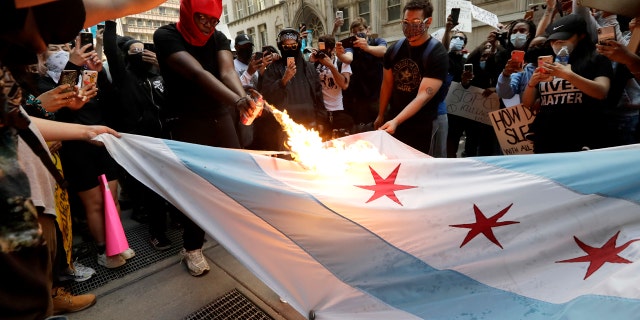
A person burns a Chicago flag during a protest over the death of George Floyd in Chicago, Saturday, May 30, 2020. (AP Photo/Nam Y. Huh)
The group chanted “say his name, George Floyd” and “black lives matter.” Some held signs that said “Justice 4 George” and “I can’t breathe.”
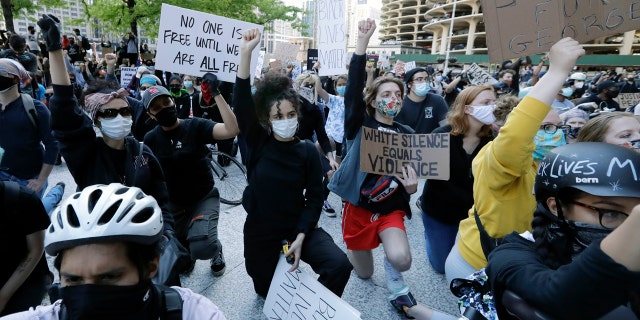
People get down on their knee during a protest over the death of George Floyd in Chicago, Saturday, May 30, 2020. (AP Photo/Nam Y. Huh)
At one point, the group blocked a major highway, stopping traffic as police created a barricade with their bicycles. Later on, the group stopped outside the Metropolitan Correctional Center and chanted “we love you,” according to videos posted to social media.
The peaceful protest took a turn early Saturday morning, with demonstrators breaking the windows of several downtown storefronts. Multiple people were arrested, police said.
Another protest in Chicago on Saturday evening took a more violent turn.
A video posted to Twitter on Saturday evening showed protesters in Chicago physically clashing with police as a bystander filmed the confrontation. The crowd surrounds one police officer and begins to hurl objects in his direction after pushing him repeatedly. It then becomes a free-for-all of plainclothes citizens and uniformed officers hitting one another.
Chicago Mayor Lori Lightfoot announced an overnight curfew in the city running from 9 p.m. Saturday until 6 a.m. Sunday, and she said police would crack down on any violence.
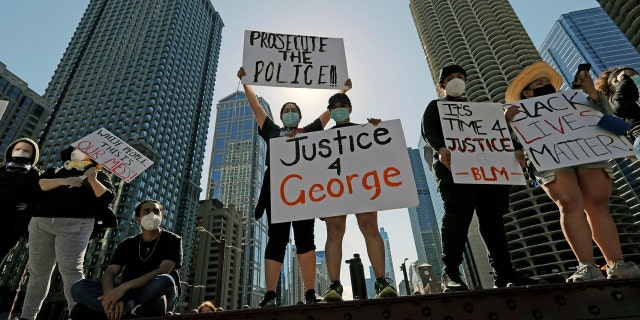
People hold signs during a protest over the death of George Floyd in Chicago, Saturday, May 30, 2020. (AP Photo/Nam Y. Huh)
Lightfoot said that peaceful protesting “devolved into criminal conduct.”
The mayor added that police will be aggressive with arrests for anyone caught damaging property.
“We can have zero tolerance for people who came prepared for a fight and tried to initiate and provoke our police department,” she said.
Officials in Chicago have taken to such tactics as raising bridges along the Chicago River in order to limit access to downtown on Sunday morning.
At least six people were shot downtown, one of them fatally, during the protests Saturday in Chicago, FOX32 reported.
Widespread looting was reported Sunday throughout the South and West sides of Chicago and some suburbs after authorities blocked access to the city’s downtown, according to FOX32.
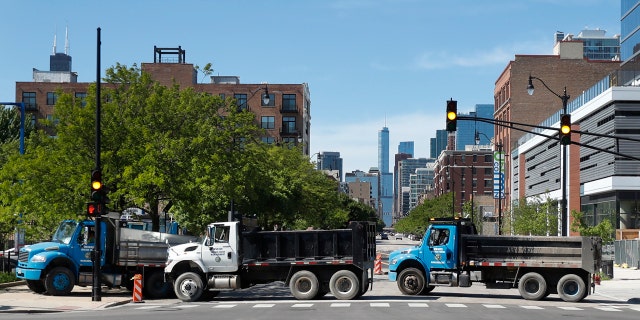
Department of Water Management trucks are used to block the northbound lanes of South Wabash Avenue, Sunday, May 31, 2020, as part of a security perimeter around downtown Chicago. (AP Photo/Charles Rex Arbogast)
Illinois Gov. J.B. Pritzker ordered the National Guard to support Chicago police following the violent protests.
Atlanta, Ga.
A state of emergency was declared in Atlanta hours after hundreds of protests converged outside CNN’s downtown headquarters late Friday. Activists spray-painted over a large CNN logo outside the building, broke a window and tagged doors.
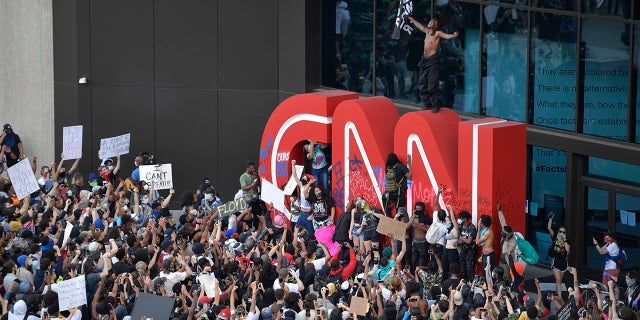
Demonstrators paint on the CNN logo during a protest, Friday, May 29, 2020, in Atlanta, in response to the death of George Floyd in police custody on Memorial Day in Minneapolis. The protest started peacefully earlier in the day before demonstrators clashed with police. (AP Photo/Mike Stewart)
Protesters pelted officers who came over with bottles, striking some of them. Other bottles thrown at authorities exploded behind the police line, but no officers appeared to get hit. Protesters chanted, “Quit your jobs.”
The officers backed their line away from the group of protesters who were throwing objects at them. Police ordered demonstrators to leave the street and threatened to arrest them if they did not leave quickly.
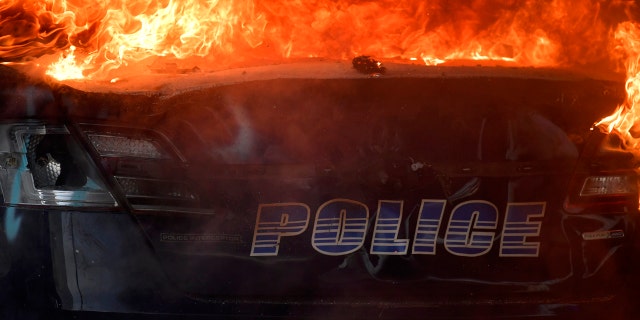
An Atlanta Police Department vehicle burns during a demonstration against police violence, Friday, May 29, 2020 in Atlanta. (AP Photo/Mike Stewart)
Protesters used an accelerant to burn an American flag. People were watching the scene from rooftops, some laughing at skirmishes that broke out and vandalism by the protesters.
Mayor Keisha Lance Bottoms said: “This is not a protest … this is chaos.”
Georgia Gov. Brian Kemp said Saturday he is expanding a state of emergency to authorize the deployment of up to 3,000 National Guard troops to protests in cities across the state.
Kemp said he was prepared to send Guard soldiers to Athens, Savannah and any other Georgia cities where demonstrations were planned Sunday.
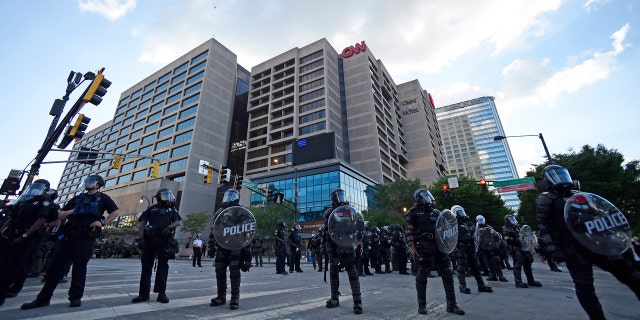
Atlanta Police, monitor demonstrators protesting, Saturday, May 30, 2020 in Atlanta.
(AP Photo/Mike Stewart)
“Hopefully, we don’t have to,” the Republican governor told WSB-TV late Saturday.
Kemp had already approved up to 1,500 Guardsmen to help enforce a 9 p.m. Saturday curfew in Atlanta.
Atlanta police said in a statement late Saturday they had made more than 50 arrests as protesters threw rocks at officers and broke windows in the downtown area. The curfew was imposed after demonstrations Friday night turned violent with people setting fires and smashing windows at businesses and restaurants.
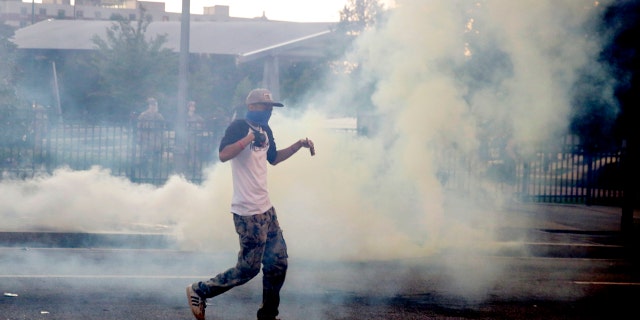
Demonstrators protest in a fog of gas that the Atlanta Police launched at a crowd, Saturday, May 30, 2020 in Atlanta. (AP Photo/Brynn Anderson)
“The protesters need to know we’re going to support their efforts in a peaceful, nonviolent protest,” Kemp said. “The agitators need to know that we’ll be there … to take them to jail if they’re destroying lives and property.”
In downtown Atlanta, authorities fired tear gas on Sunday night to disperse hundreds of demonstrators.
Bottoms said two officers had been fired and three placed on desk duty after a video showed police surrounding a car Saturday, then pulling a woman out of the passenger seat and appearing to use a stun gun on a man who was driving. Police Chief Erika Shields called it “really shocking to watch.”
Washington, D.C.
Angry protesters arrived at Pennsylvania Avenue, sparking a lockdown at the White House Friday night.
Videos showed a large group of protesters gathering, with some burning flags and knocking over barricades. The protesters then moved from the White House to another part of the city.
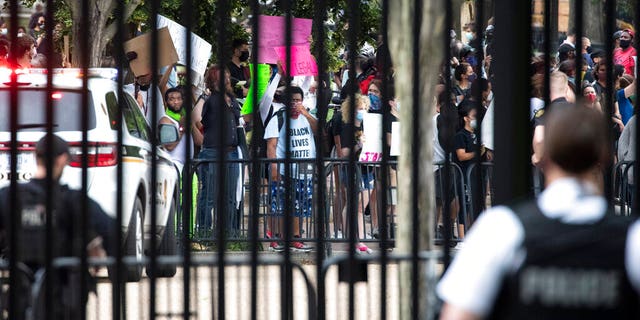
A U.S. Secret Service officer stands inside the fence at the White House as demonstrators protest the death of George Floyd, a black man who died in police custody in Minneapolis, Friday, May 29, 2020, in Washington. (AP Photo/Alex Brandon)
Multiple reporters posted that they were inside the White House and that the Secret Service was not letting them leave the grounds during the lockdown.
In Lafayette Park, the angry group of protests appeared to turn its rage on a Fox News crew early Saturday, chasing and pummeling reporter Leland Vittert and his crew. They were punched and hit by projectiles as they fled.
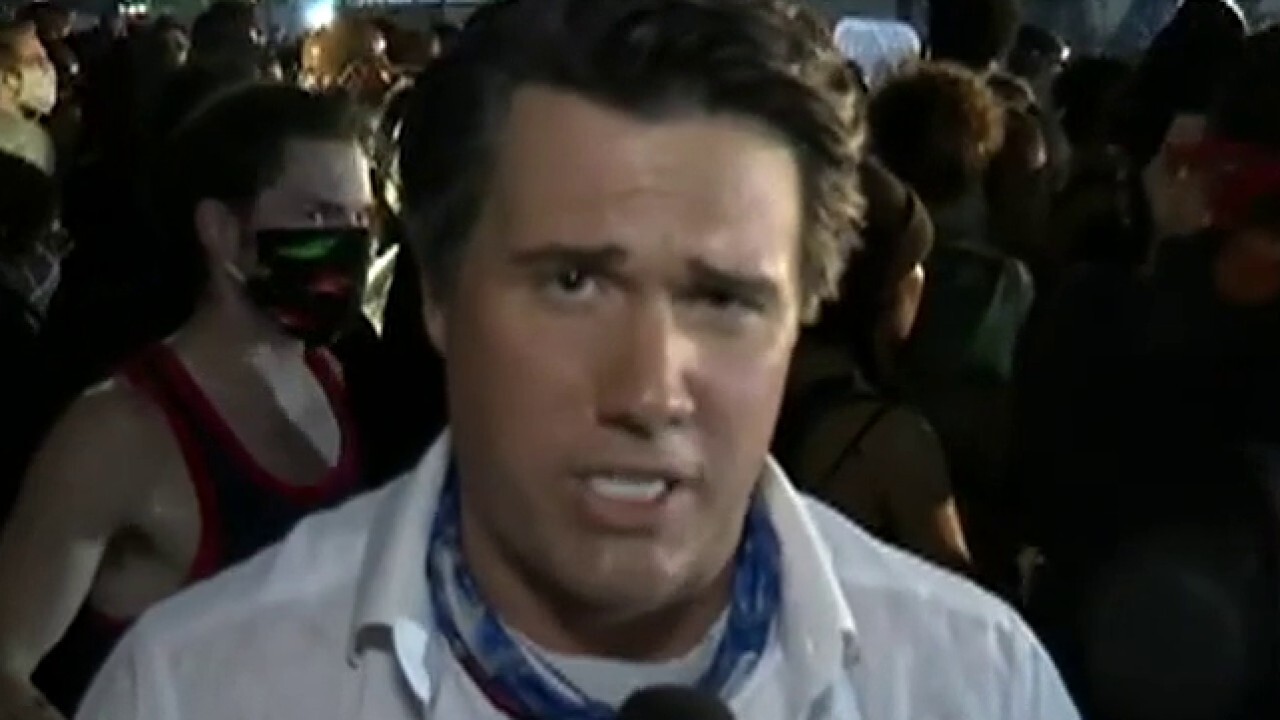
President Trump on Saturday praised the Secret Service for its protection of the White House on Friday night, calling them “very cool & very professional” – and warned that any protesters who breached the fence would have met by “vicious dogs” and “ominous weapons.”
On Sunday, it was revealed that more 60 Secret Service officers and special agents sustained multiple injuries in three days worth of violent clashes. Famed monuments in the nation’s capital have also been damaged.
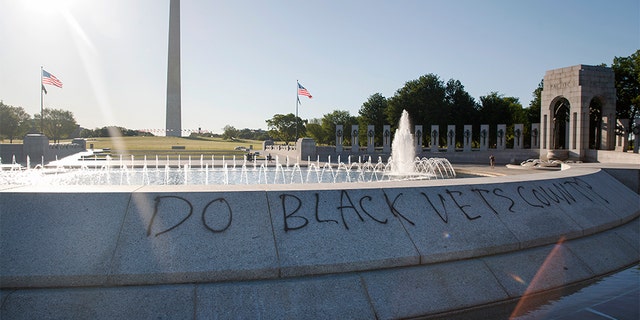
Spray paint that reads “Do Black Vets Count?” is seen World War II Memorial on the National Mall in Washington, Sunday, May 31, 2020, the morning after protests over the death of George Floyd. Floyd died after being restrained by Minneapolis police officers on Memorial Day. (AP Photo/Carolyn Kaster)
The violence escalated on Sunday night as fires set by rioters blazed near the White Houseas the entire Washington, D.C. National Guard was being called in to help with the response to protests, according to two Defense Department officials
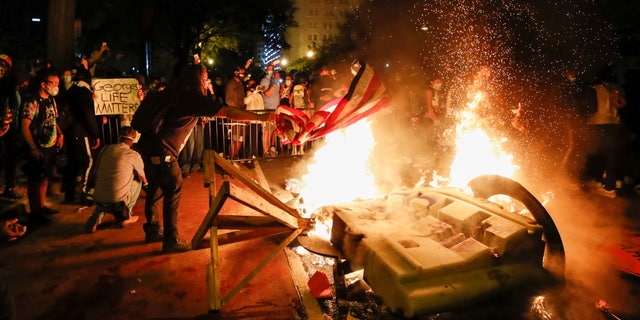
Demonstrators start a fire as they protest the death of George Floyd, Sunday, May 31, 2020, near the White House in Washington. (AP Photo/Alex Brandon)
Washington Mayor Muriel Bowser said Sunday that she had requested 500 DC Guardsman to assist local law enforcement. Later on Sunday, as the protests escalated, Army Secretary Ryan McCarthy ordered the rest of the Guardsman — roughly 1,200 soldiers — to report.
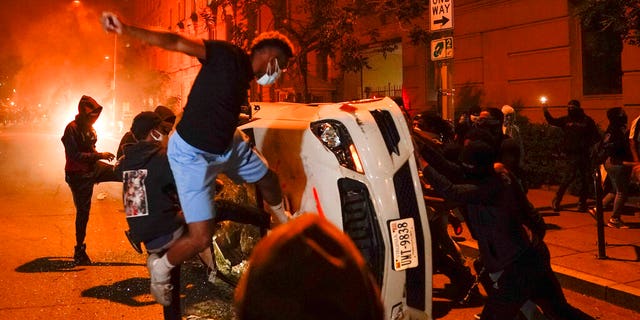
Demonstrators protest the death of George Floyd, Sunday, May 31, 2020, near the White House in Washington. (AP Photo/Evan Vucci)
As authorities clashed with demonstrators for the third straight night, the parish house connected to the historic St. John’s Episcopal Church across the street from the White House was set on fire late Sunday.
Madison, Wis.
A total of 75 businesses on State Street in Maidson, Wis., were damaged or looted after a protest on Saturday in the Wisconsin capital turned violent.
The Madison Police Department said in a news release that after a demonstration ended at 4:30 p.m. on Saturday, a group of 150 people remained and “began damaging property.”
One MPD squad care was broken into, driven a short distance, and set on fire. Police said two rifles were stolen from the vehicle. Video posted to Twitter showed the vehicle being driven away.
One officer was injured, and many were pelted with rocks and bottles throughout the night.
Officials said so far, three arrests have been made in connection with the violence in Madison.
Fifteen people were arrested after a second night of violence erupted Sunday night in Madison, Wisconsin, with police firing tear gas as protesters again threw rocks and damaged store downtown stores following an afternoon peaceful protest. Madison police reported Monday that multiple stores were looted in the State Street area.
Denver, Colo.
Denver Mayor Michael Hancock called for calm and unity Friday after the first of several planned city protests over Floyd’s death turned violent, declaring, “Let not the story be about the riots and protests. Let’s keep the focus on the life that was lost.”
“I can tell you not to go out and demonstrate but the reality is it’s going to happen,” Hancock said at a news briefing, stressing he shared outrage over what he’s called the “senseless and tragic murder” of Floyd in Minneapolis.
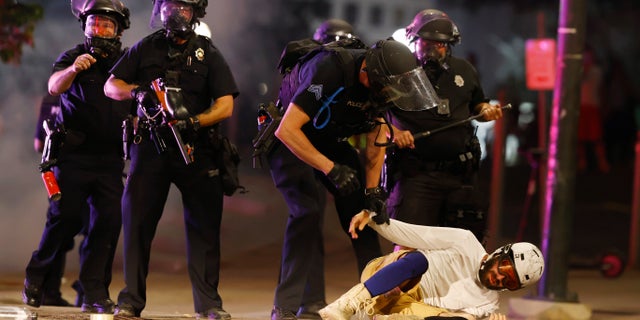
Denver Police Department officers clear a man who fell to the street after they used tear gas and rubber bullets to disperse a protest outside the State Capitol over the death of George Floyd, a handcuffed black man who died in police custody in Minneapolis, late Thursday, May 28, 2020, in Denver. (AP Photo/David Zalubowski)
Hancock and Police Chief Paul Pazen blamed what they called a minority of agitators among peaceful protesters for inciting violence throughout downtown on Thursday.
That violence included throwing rocks at police officers, setting small fires, and breaking windows and damaging cars at the state Capitol and at businesses. Pazen said three officers were injured and that 13 people were arrested for burglary, criminal mischief, and assault.
A curfew was implemented at night after violence and looting continued.
Santa Monica, Calif.
A peaceful protest in Santa Monica, Calif., on Sunday over the death of George Floyd descended into chaos after some of the protesters started looting local businesses, with the ransacking caught on video.
Not far from a peaceful demonstration, a group broke into a Gap and a Vans sneaker store, where people walked out with boxes of shoes.
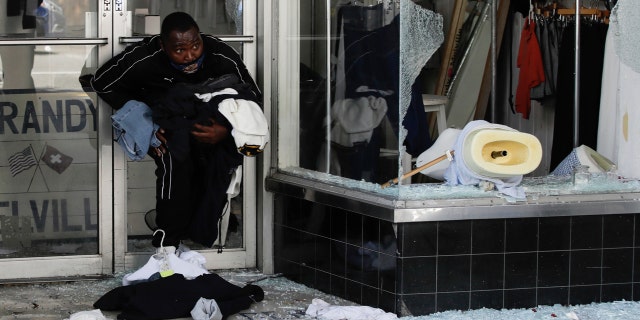
A man exits with clothing from a store Sunday, May 31, 2020, in Santa Monica, Calif., during unrest and protests over the death of George Floyd, who died after being restrained by Minneapolis police officers on May 25. (AP Photo/Marcio Jose Sanchez)
Others shattered the windows of an REI outdoor supply store and snatched folding chairs, a bike, and backpacks. A fire broke out at a restaurant across the street.
San Diego, Calif.
The violent unrest gripping the nation spread Saturday night to a suburb of San Diego, where rioters burned two banks to the ground and looted and destroyed many other businesses.
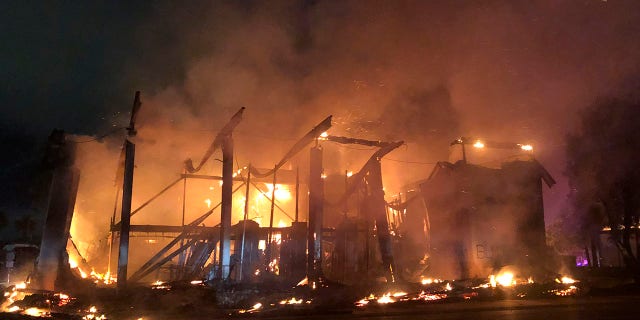
A bank burns during a protest over the death of George Floyd, Sunday, May 31, 2020, in La Mesa, Calif. (AP Photo/Elliot Spagat)
Images showed the fire engulfing one bank, leaving behind a gutted skeleton of lumber and twisted metal by morning in La Mesa.
Demonstrations continued Sunday in San Diego, with officials later ordering people to disperse after an “escalation of violence and vandalism” downtown.
Highways and bridges were closed as the city and nearby suburbs issued curfews, FOX5 reported.
Boston, Mass.
A Sunday afternoon of mostly peaceful protests in Boston broke at nightfall when protesters clashed with officers, throwing rocks, breaking into several stores and lighting a police vehicle on fire.
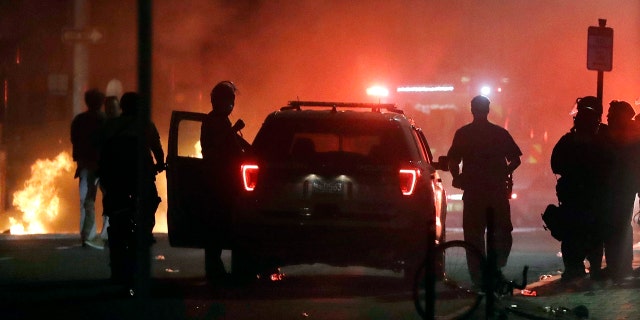
A police car burns, left rear, after being set on fire in Boston, Sunday, May 31, 2020.
(AP Photo/Steven Senne)
Boston police tweeted that at least 40 people had been arrested as of 3 a.m. Monday. Police said seven police officers had been hospitalized and 21 police cruisers were damaged.
A National Guard unit had been called in to help quell the clashes.
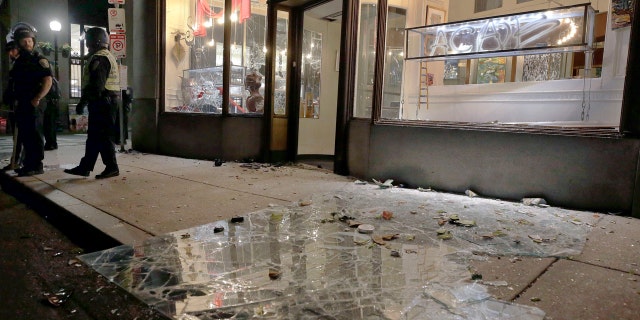
Police officers stand in front of a business with a demolished window in Boston, Sunday, May 31, 2020. (AP Photo/Steven Senne)
Republican Gov. Charlie Baker called the violence “criminal and cowardly” in a tweet. The nighttime destruction was a stark contrast to the several protests earlier Sunday that featured thousands of demonstrations marching peacefully.
Miami, Fla.
City of Miami Police enforced a curfew on Sunday night after peaceful protests give way to tense confrontations with police and vandalism at area businesses.
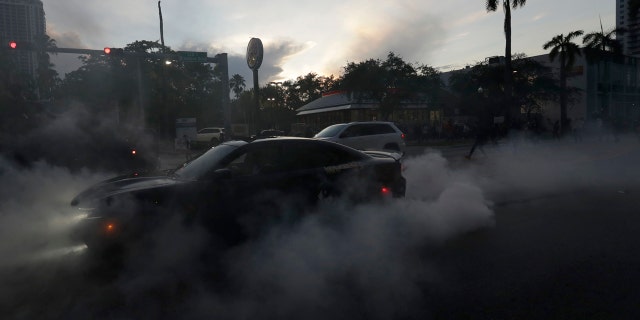
A protester does a burnout as he and others demonstrate over the death of George Floyd, Sunday, May 31, 2020, in Miami.(AP Photo/Wilfredo Lee)
Various videos show people vandalizing shops across the city over the weekend. Looters targeted stores at shopping centers in Midtown Miami and downtown, according to WSVN.
Protestors also shut down portions of interstates in the city as they marched throughout the day.
Oklahoma City, Okla.
Peaceful protests in Oklahoma City on Sunday turned violent, as officials declared a state of emergency due to violence downtown.
Mayor David Holt ordered a curfew overnight for downtown after violence was reported, according to FOX25.
On Saturday, over a dozen were arrested and tear gas was used after vandalism and assault on officers was reported after nightfall, FOX 25 reported.
Scottsdale, Ariz.
YouTuber Jake Paul issued a response after sparking outrage by filming inside an Arizona mall as it was being looted by protesters during Saturday night’s unrest at Scottsdale Fashion Square.
Video showed Jake Paul outside of the mall while people are seen stealing clothes and tennis shoes.
Jake Paul, who resides in Los Angeles, is not an Arizona native and has more than 20 million subscribers on YouTube.
Paul posted a statement on Twitter stating he did not participate in looting or vandalism.
“We were gassed and forced to keep moving,” Paul said.
Hundreds came to the mall under “the guise of protesting police violence,” officials told FOX10.
“While some may have indeed come to join what they believed would be a peaceful protest, what occurred was neither peaceful, nor a protest,” wrote Scottsdale Police. “It was a riot that saw several dozens of individuals collectively damaging property at and near the mall, breaking into businesses and looting the interiors.”
Windermere, Fla.
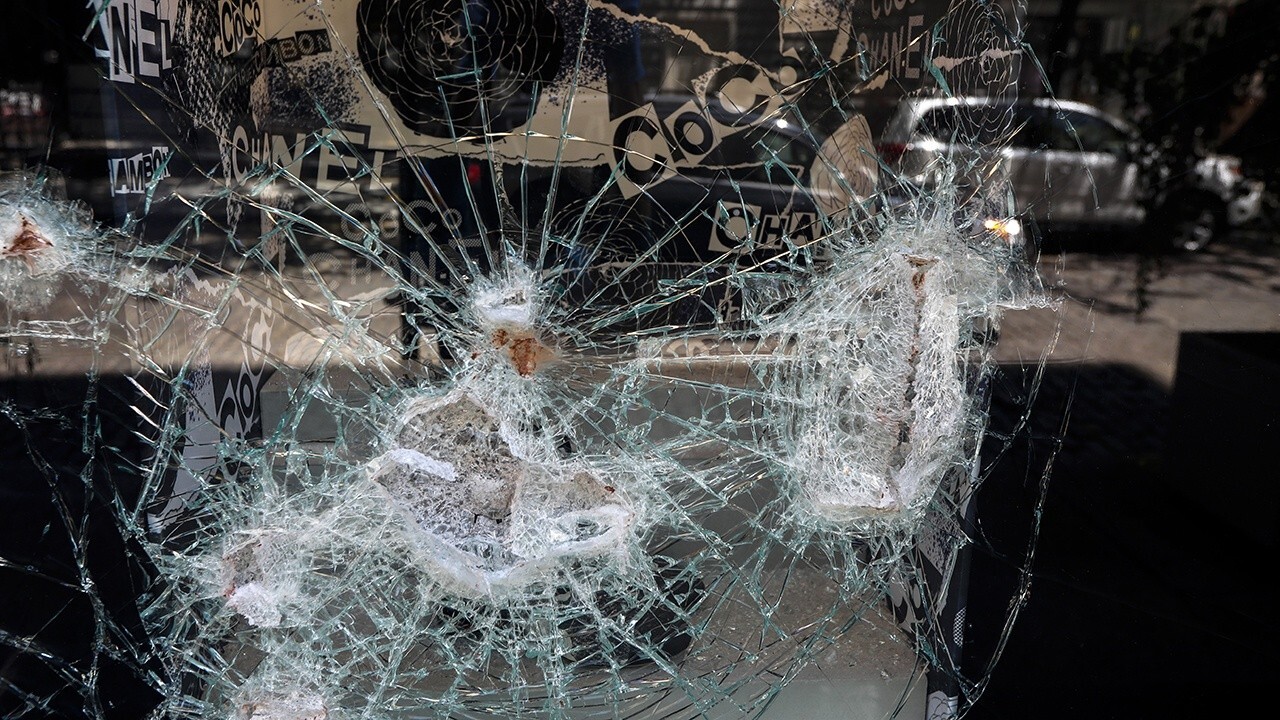
A group of about 10 protesters gathered Friday near a home that belongs to Chauvin, the police officer charged with killing Floyd, after social media postings listed an address in the community of Windermere outside Orlando.
They carried signs that said, “He said I can’t breathe. Justice for George,” and “We see you, we hear you … we love you! #Justice for George.”
The Orange County Sheriff’s Office tweeted from its official account that Chauvin is not at the residence and is not expected there. The office says it’s confirmed he has no plans to be in the area.
Albuquerque, N.M.
Albuquerque police used a helicopter and tear gas Friday as they retreated from a crowd of people after a confrontation that followed a protest on the start of a violent weekend across the country.
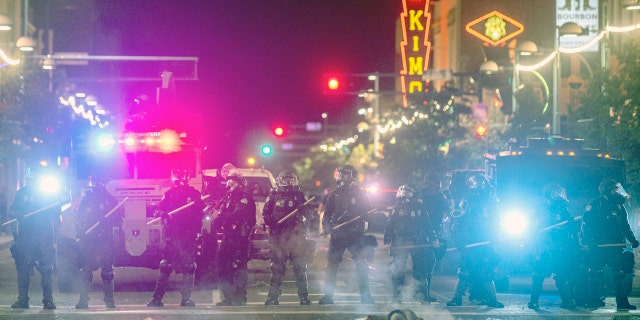
Police in riot gear prepare to clear downtown Albuquerque, N.M., early Monday, June 1, 2020. (Anthony Jackson/ Albuquerque Journal via AP)
Another protest along the historic Route 66 into downtown Albuquerque turned violent early Monday after police reported demonstrators setting small fires and officers say they were fired upon.
Albuquerque police spokesman Gilbert Gallegos told the AP officers reported shots fired at them in front of the historic Kimo Theater early Monday after a mostly peaceful demonstration disbanded.
Gallego said there was damage to several properties in the area, including broken windows and some stealing from stores. No injuries were reported.
Before the chaos, hundreds of people on Sunday marched down historic Route 66, protesting the death of George Floyd.
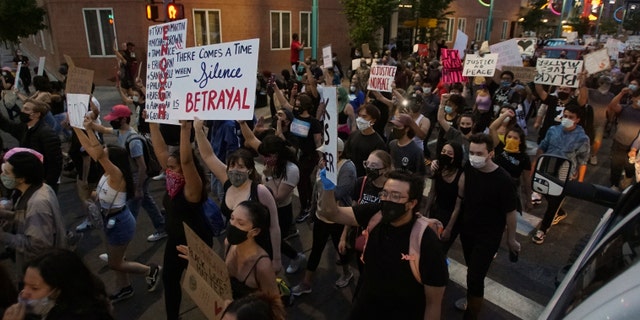
Protesters holding signs block a street Sunday, May 31, 2020, in downtown Albuquerque, N.M. (Adolphe Pierre-Louis/Albuquerque Journal via AP)
Protesters in New Mexico’s largest city held signs, wore masks and chanted, “Say his name: George Floyd” and “Hands up, don’t shoot.”
Sioux Falls, S.D.
South Dakota Gov. Governor Kristi Noem activated the National Guard after protests in Sioux Falls turned violent.
The protest in South Dakota’s largest city started Sunday afternoon with a march downtown. Police said dozens of protesters later congregated at the Empire Mall and began throwing rocks at officers and breaking windows.
Police said protesters had dispersed by 11 p.m. Noem said about 70 Guard members are in Sioux Falls and will remain until they are no longer needed.
Fontana, Calif.
Nine people were arrested after rocks were thrown at businesses, vehicles and officers during a Southern California protest stemming from the death of George Floyd.
The violence erupted Thursday night in Fontana as about 100 people moved up and down a thoroughfare and blocked traffic. Police say an unlawful assembly was declared and the crowd was ordered to disperse but some persisted.
Elsewhere in the region, demonstrators gathered outside Los Angeles police headquarters but there was no repeat of Wednesday evening’s action in which protesters blocked freeway traffic and attacked two Highway Patrol cruisers.
Columbus, Ohio
Five people were arrested and two police officers were injured by protesters throwing rocks and bricks at them on the second straight night of protests in Ohio’s capital city.
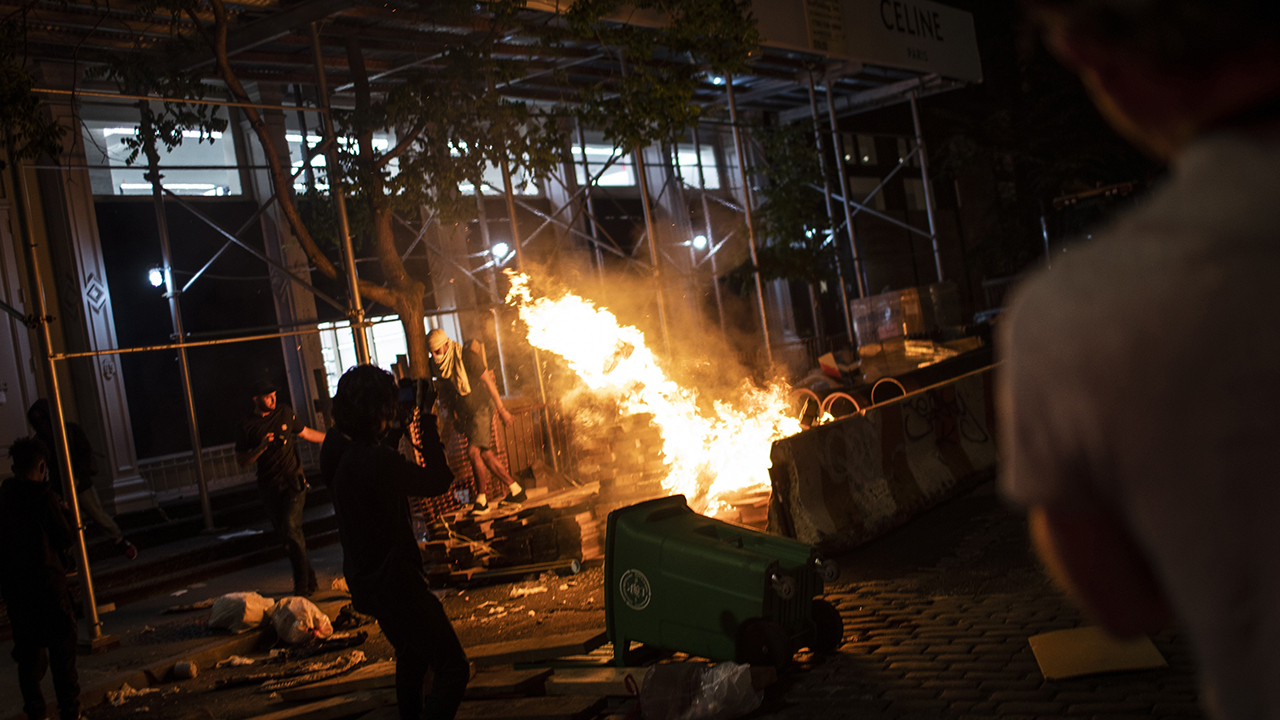
Police also reported broken windows and spray-paint graffiti in the Short North. Business owners boarded up their buildings, and a couple stood outside well after midnight, with guns, to protect their properties.
Protesters converged earlier in the night on Columbus police headquarters, where they staged a peaceful protest.
Houston, Texas
On Friday, several thousand people attended a rally in front of city hall in Houston, where Floyd grew up.
The rally was mostly peaceful but police had apparently taken into custody a woman who had a rifle and had tried to use it to incite the crowd.
The crowd marched through downtown Houston to get to city hall, blocking traffic and at times chanting “No justice, no peace” and “Say his name. George Floyd.” Many held up signs that said, “I Can’t Breathe” and “Justice For George.”
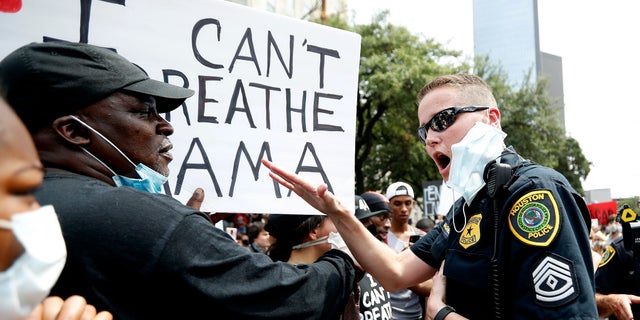
Protesters clash with Houston Police officers, angry about the death of George Floyd, as they took to Bagby Street near City Hall, in Houston, Friday, May 29, 2020. Floyd the man originally from Houston, who died while he was in the custody of Minneapolis police earlier this week, which has sparked protests throughout the country. (Karen Warren/Houston Chronicle)
Eventually, the protesters ended up alongside U.S. Highway 59, one of the major thoroughfares in Houston. A group of about 60 to 70 shut down the freeway for at least half an hour. Houston police accompanied the protesters as they marched for less than half a mile along the freeway before they walked off of it. No arrests were made.
Houston Police Chief Art Acevedo said he welcomed the rally.
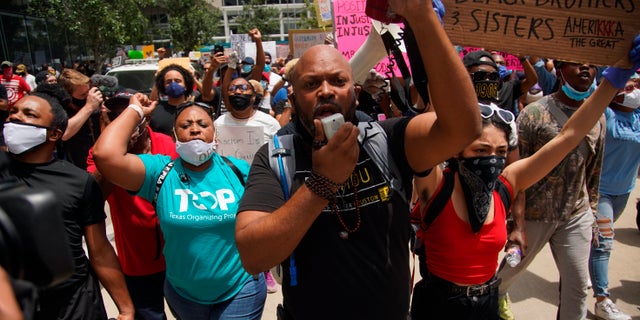
Black Lives Matter protesters rally in honor of George Floyd at Discovery Green in Houston, Friday, May 29, 2020. Floyd died Memorial Day while in the custody of the Minneapolis police. (Elizabeth Conley/Houston Chronicle via AP)
“We stand with them protesting what happened in Minnesota,” said Acevedo. “I’m happy that they’re here today because people need to be heard, voices need to be heard.”
One of those protesting Floyd’s death was 19-year-old Jimmy Ohaz, who came from the nearby city of Richmond, Texas.
“My question is how many more, how many more? I just want to live in a future where we all live in harmony and we’re not oppressed.”
Phoenix, Ariz.
Hundreds rallied in downtown Phoenix, marching from Phoenix City Hall to the state Capitol on Thursday night into Friday morning. They carried signs reading, “Silence is violence” and “Being black should not be a death sentence,” The Arizona Republic reported.
Around 11 p.m. Friday, Phoenix police declared an unlawful assembly around the Capitol building. Protesters refused to leave the area, news outlets reported.
The newspaper reported that rocks and water bottles were thrown at police. Video from local TV stations showed protesters hammering on the window of a police car, and the newspaper reported at least one police car window was broken. The Arizona Department of Public Safety and Phoenix police responded by firing pepper spray and rubber bullets at the crowd.
Phoenix police fired tear gas on Sunday night at protesters who marched downtown after the city’s curfew, witnesses told FOX10.
Arizona Gov. Doug Ducey declared a state of emergency Sunday and announced a statewide, weeklong curfew to go into effect each night from 8 p.m. to 5 a.m. after several nights of protests turned destructive and violent.
Louisville, Ky.
Looking to defuse tensions in Louisville, Floyd’s mother on Friday called on protesters to continue demanding justice but to do it in “the right way without hurting each other.”
Kentucky Gov. Andy Beshear read the statement from Breonna Taylor’s mother hours after gunshots erupted, wounding at least seven people, during protests late Thursday outside City Hall. At least one person was in critical condition, Louisville Metro Police said early Friday.
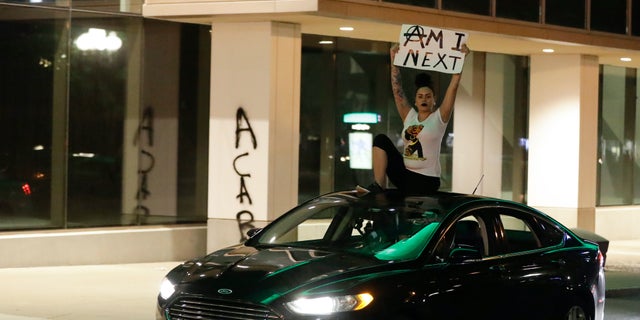
A protester rides on the top of a car during a protest over the deaths of George Floyd and Breonna Taylor, Friday, May 29, 2020, in Louisville, Ky. Breonna Taylor, a black woman, was fatally shot by police in her home in March. (AP Photo/Darron Cummings)
“No officers discharged their service weapons,” and all seven people shot were civilians, police spokesman Sgt. Lamont Washington wrote in an email to The Associated Press.
In her statement, Tamika Palmer said her daughter — an emergency medical technician — devoted her life to others, and the “last thing she’d want right now is any more violence.”
Demonstrations continued over the weekend.
ST LOUIS, MO – MAY 29: Protesters rally as they march through the streets on May 29, 2020 in St Louis, Missouri. Demonstrations are being held across the US after George Floyd died in police custody on May 25th in Minneapolis, Minnesota. (Photo by Michael B. Thomas/Getty Images)
A man reportedly was dragged and killed by a FedEx truck early Saturday after protesters blocked off a downtown street with their cars. They were seen setting something in the road on fire when the truck approached.
Las Vegas, Nev.
More than 400 people demonstrated on the Las Vegas Strip on Friday afternoon calling for policing reforms.
Oakland, Calif.
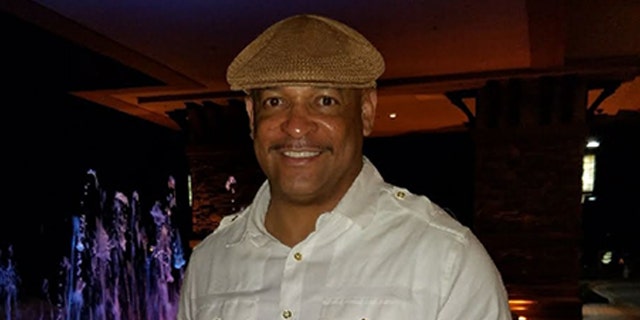
A Federal Protective Service (FPS) Officer was killed and another injured Friday in a shooting at a federal building in Oakland, Calif., amid protests and violence in the city over the death of Minneapolis man George Floyd.
“We have witnessed an outright assault on our law enforcement community last night in Oakland, California,” Acting Homeland Security Secretary Chad Wolf said at a Saturday news conference. “An assassin cowardly shot two Federal Protective Service contractors as they stood watch over a protest.”
According to the FBI’s San Francisco branch, the shooting occurred at the Ronald V. Dellums Federal Building when a vehicle approached the building and opened fire at the security officers.
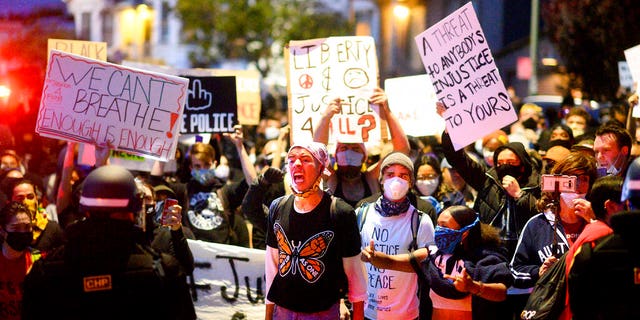
In this May 29, 2020, photo, demonstrators face off against police officers in Oakland, Calif. while protesting the Monday death of George Floyd, a handcuffed black man in police custody in Minneapolis. (AP Photo/Noah Berger)
Family members identified the officer on Sunday as 53-year-old Patrick Underwood.
Underwood’s sister, Lancaster City Councilwoman Angela Underwood Jacobs — who briefly ran for Congress — confirmed the death of her brother in a short post on Facebook.
Underwood was killed while the second officer was wounded and remains in critical condition. His identity has not yet been released.
Protests in California raged on overnight into Sunday, while some riots saw buildings damaged with smashed windows, graffiti on the walls, and fires lit.
About 60 people were arrested in Oakland, including three detained Monday on suspicion of assault with a deadly weapon on officers. The three allegedly shot at the department’s headquarters from a car just after midnight. No officers were injured, authorities said.
The Oakland Police Department said the trio was arrested about a mile north from police headquarters but gave no other information.
The city of 430,000 people across the bay from San Francisco has not imposed a curfew.
Fox News’ Brooke Singman, Bradford Betz, David Aaro, Stephen Sorace, Adam Shaw, Vandana Rambaran, Tyler Olson, Tyler McCarthy, Gregg Re, Charlie Creitz, Nick Givas, Gregg Re, Caitlin McFall, Dom Calicchio, and the Associated Press contributed to this report.
Source: Fox News
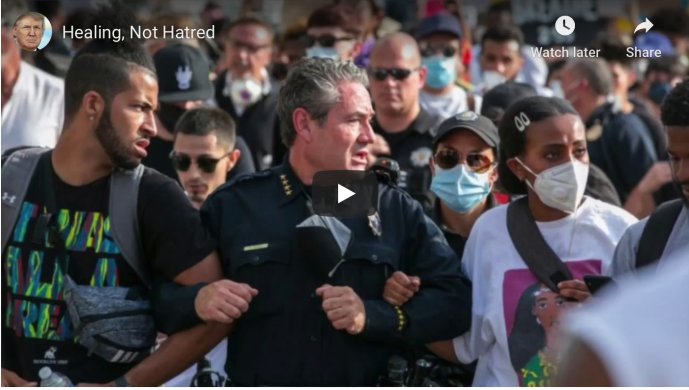 On Saturday, President Trump gave an incredibly touching and unifying speech to the nation concerning the death of George Floyd. If you’re wondering why you missed it, the answer is simple:
The media refused to give it much attention. Instead, they decided to focus on the violent riots in the streets.
As a result, the liberal media and celebrities everywhere have accused President Trump of being ‘divisive’ and ‘weak’. Dwayne ‘The Rock’ Johnson even made a viral video this week asking Trump ‘Where are you? Where is our compassionate leader?’
Turns out, President Trump has been incredibly unifying and compassionate, but the social media giants are censoring that content.
On Wednesday, the Trump campaign released a video called ‘Healing, not hatred’ which highlighted President Trump’s unifying remarks about George Floyd on Saturday, but it was promptly removed from the left wing platform.
Their excuse for taking the video down was due to ‘copyright’ reasons, but we all know the real reason it was taken down. In our humble opinion, this video displayed perfect messaging on the part of President Trump, and Twitter couldn’t stand to see it go viral.
“Twitter and Jack are censoring this uplifting and unifying message from President Trump after the George Floyd tragedy. The same speech the media refused to cover. Here is the YouTube link.”
As of right now, the video is still up on YouTube. Watch below and share it with EVERYONE YOU KNOW:
“The death of George Floyd in the streets of Minneapolis was a grave tragedy. It should never have happened. It has filled Americans all over the country with horror, anger, and grief,” Trump says in the video.
“We support the right of peaceful protesters, and we hear their pleas,” added Trump. “I stand before you as a friend and ally to every American seeking justice and peace.”
As you can see, President Trump stood with the PEACEFUL protesters, vowed justice for George Floyd, AND supported our law enforcement!
However, the liberal media has spent all week acting like this speech never happened. They swept it under the rug and they are shielding the truth from the American people.
Source: Trending Politics
 By David J. Lynch & Emily Rauhala
President Trump on Friday leveled an extraordinary broadside at the Chinese government, accusing it of a comprehensive “pattern of misconduct” and ordering U.S. officials to begin the process of revoking Hong Kong’s special status under U.S. law.
The president did not outline a deadline for the historic action. But if carried out, it would mean that the United States would no longer treat Hong Kong and China as separate entities for the purposes of extradition, customs, trade and visa issues, he said. And the announcement could include sanctions on Hong Kong or Chinese officials.
In Rose Garden remarks, Trump alleged that the Chinese government covered up the coronavirus outbreak and instigated “a global pandemic that has cost more than 100,000 American lives and over 1 million lives worldwide.” The president also attacked the World Health Organization as effectively controlled by Beijing.
“We will today be terminating our relationship” with the WHO, the president said, adding that the organization’s more than $400 million annual U.S. contribution will be diverted to other health groups.
The president later issued a proclamation to protect sensitive American university research from Chinese spying and to bar an unspecified number of Chinese nationals from entering the United States for graduate study. He also directed an administration working group headed by Treasury Secretary Steven Mnuchin to evaluate Chinese corporations listed on U.S. financial markets as potential targets of future restrictions.
The moves seemed certain to intensify growing U.S.-China tensions , though investors on Friday took them in stride.
The president’s comments were as notable for what he did not say. There was no mention of his irritation with China’s failure to quickly increase purchases of American goods as required by the trade deal he signed in January. He also made no direct reference to Chinese President Xi Jinping, even as he said “the world is now suffering as a result of the malfeasance of the Chinese government.”
In one sign of Trump’s increased fury with the world’s second-largest economy, on Friday morning he tweeted simply: “CHINA!”
His formal Friday announcement — while long on harsh rhetoric — was short on details. The president reiterated some familiar grievances, blaming the Chinese for stealing American trade secrets and jobs and assailing his predecessors for allegedly letting them get away with it.
He expanded his indictment of the Chinese government to include its program of island construction in the South China Sea, a national security concern he rarely addresses.
“The Chinese government has continually violated its promises to us and so many nations,” he said.
Trump also stopped short of taking concrete action against the U.S.-listed Chinese companies he said posed “hidden and undue risks” for American investors. The Securities and Exchange Commission and other regulators have complained for years about China’s refusal to grant access to their companies’ audit records.
As of last year, 156 Chinese companies — including 11 with significant government ownership — traded on U.S. markets, according to the U.S.-China Economic and Security Review Commission, a nonpartisan congressional body.
After Trump’s remarks, Senate Minority Leader Charles E. Schumer (D-N.Y.) suggested the president was trying to use China to distract from the pandemic and battered economy.
“President Trump’s Rose Garden event just now was pathetic,” he said. “It perfectly encapsulates his inability to lead when our nation needs it most. The only question is whether President Trump is afraid to lead or just doesn’t know how.”
Trump’s announcement followed Secretary of State Mike Pompeo’s statement earlier this week that Hong Kong was no longer sufficiently autonomous from mainland China to deserve separate treatment. Under the 1997 handover agreement with the United Kingdom, China agreed to preserve the former British colony’s democratic system for 50 years. Xi’s decision to impose security legislation on Hong Kong directly rather than by working through the territory’s local legislature may mark the collapse of that “one country, two systems” approach.
Some advocates of a tougher U.S. approach to China were disappointed by the president’s 10-minute statement.
“They didn’t do anything with regard to Hong Kong. His Hong Kong comments could have been issued as a statement a week ago,” said Derek Scissors, a China specialist at the American Enterprise Institute. “The administration has absolutely considered specific actions since the NPC proposal was made public but decided not to announce a single one.”
Receive the most important pandemic developments in your inbox every day. All stories linked in the newsletter are free to access.
Caught in the middle of the deepening U.S.-China dispute are more than 1,350 U.S. corporations with offices in Hong Kong. The erosion of the city’s freedoms, including an independent judiciary, threatens to turn one of the global economy’s financial centers into just another Chinese city and calls into question the rationale for such a sizable commercial presence there.
The Chinese National People’s Congress, the country’s rubber-stamp legislature, on Thursday approved a plan to impose national security legislation in Hong Kong. The move was denounced in a joint statement by the United States, Canada, Australia and United Kingdom as in “direct conflict” with China’s promises in 1997 when it regained sovereignty over the former British colony.
“The United States may well have to do something the market doesn’t like in light of its longer-term interests,” said Patrick Chovanec, economic adviser for Silvercrest Asset Management in New York. “But there is concern about whether the U.S. is in a spiral of escalation with China on several fronts.”
The president’s visa move targets Chinese graduate students in the United States who have worked, studied, or been employed by entities linked to China’s efforts to “acquire or divert” technology for the People’s Liberation Army.
It is not immediately clear how many of the 350,000 Chinese students in the United States will be affected. And the announcement is expected to draw strong pushback from U.S. universities; some are heavily reliant on the full-fee tuition payments from Chinese students.
Over a 10-year period, the People’s Liberation Army dispatched 2,500 scientists and engineers to study overseas, focusing on democracies like the United States, according to a 2018 report by the Australian Strategic Policy Institute, a nonpartisan think tank.
In January, the FBI arrested a 29-year-old Boston University student, accusing her of failing to disclose on her visa application that she was a lieutenant in the PLA.
Friday’s action represents only the administration’s latest slap at Beijing. The president earlier this month pushed a federal retirement pension board to abandon plans to invest in Chinese securities. And the Commerce Department tightened limits on Chinese telecom giant Huawei’s ability to purchase American computer chips.
Just four months after Trump celebrated a partial trade deal with China, marking an apparent truce in a two-year diplomatic conflict, relations between the two countries have plummeted. The president has been openly displeased with China’s failure to quickly fulfill the trade deal’s terms, including massive additional purchases of American crops, energy products and manufactured goods.
“Frankly the U.S. government is — I’ll use the word furious with what China has done in recent days, weeks and months. They have not behaved well and they have lost the trust I think of the whole Western world,” Larry Kudlow, director of the National Economic Council, said Friday on Fox News.
Lawmakers in both parties also are increasingly impatient with Beijing, and the president failed to address some issues of concern on Capitol Hill. He made no reference, for example, to new legislation that requires him to impose sanctions on Chinese officials implicated in human rights violations in the Muslim-majority province of Xinjiang.
Trump’s decision to “terminate” the United States’ relationship with the World Health Organization comes after repeated threats to act.
Of the $893 million the United States sent in the 2018 and 2019 funding period, $237 million was an “assessed contribution” — a type of membership fee that may prove hard to cut without congressional approval.
At greater risk is what’s known as the “voluntary contribution,” that is money provided to U.S. agencies for health efforts and then given to WHO programs. The largest share of this money goes to polio eradication, with large chunks to fight vaccine preventable disease, malaria, tuberculosis, HIV/AIDS and the provision of basic health care.
The prospect of cutting U.S. funding for public health issues like polio in the middle of the pandemic drew immediate fire. Patrice Harris, president of the American Medical Association, said the action “serves no logical purpose and makes finding a way out of this public health crisis dramatically more challenging.”
Source: Washington Post
 Editor’s Note: An Associated Press article by Michael Biesecker and Jason Dearen that includes a description of the 600-physician letter is headlined “GOP fronts ‘pro-Trump’ doctors to prescribe rapid reopening,” which has led to criticism of Gold and her colleagues on social media. However, as the article acknowledges in the text, “Gold denied she was coordinating her efforts with Trump’s reelection campaign.” Gold echoed those comments to us, saying, “This was 100% physician grassroots. There was 0% GOP.”
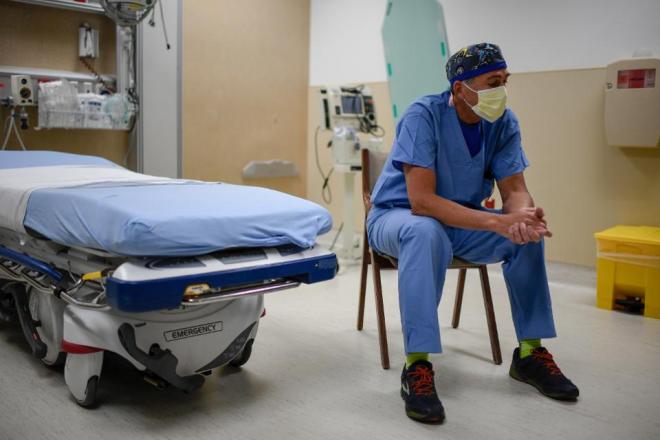
More than 600 of the nation’s physicians sent a letter to President Trump this week calling the coronavirus shutdowns a “mass casualty incident” with “exponentially growing negative health consequences” to millions of non COVID patients.
“The downstream health effects…are being massively under-estimated and under-reported. This is an order of magnitude error,” according to the letter initiated by Simone Gold, M.D., an emergency medicine specialist in Los Angeles.
“Suicide hotline phone calls have increased 600%,” the letter said. Other silent casualties: “150,000 Americans per month who would have had new cancer detected through routine screening.”
From missed cancer diagnoses to untreated heart attacks and strokes to increased risks of suicides, “We are alarmed at what appears to be a lack of consideration for the future health of our patients.”
Patients fearful of visiting hospitals and doctors’ offices are dying because COVID-phobia is keeping them from seeking care. One patient died at home of a heart attack rather than go to an emergency room. The number of severe heart attacks being treated in nine U.S hospitals surveyed dropped by nearly 40% since March. Cardiologists are worried “a second wave of deaths” indirectly caused by the virus is likely.
The physicians’ letter focuses on the impact on Americans’ physical and mental health. “The millions of casualties of a continued shutdown will be hiding in plain sight, but they will be called alcoholism, homelessness, suicide, heart attack, stroke, or kidney failure. In youths it will be called financial instability, unemployment, despair, drug addiction, unplanned pregnancies, poverty, and abuse.
“It is impossible to overstate the short, medium, and long-term harm to people’s health with a continued shutdown,” the letter says. “Losing a job is one of life’s most stressful events, and the effect on a person’s health is not lessened because it also has happened to 30 million [now 38 million] other people. Keeping schools and universities closed is incalculably detrimental for children, teenagers, and young adults for decades to come.”
While all 50 states are relaxing lockdowns to some extent, some local officials are threatening to keep stay-at-home orders in place until August. Many schools and universities say they may remain closed for the remainder of 2020.
“Ending the lockdowns are not about Wall Street or disregard for people’s lives; it about saving lives,” said Dr. Marilyn Singleton, a California anesthesiologist and one of the signers of the letter. “We cannot let this disease change the U.S. from a free, energetic society to a society of broken souls dependent on government handouts.” She blogs about the huge damage the virus reaction is doing to the fabric of society.
Dr. Jane Orient, executive director of the Association of American Physicians and Surgeons, also warns that restrictions are having a huge negative impact on non-COVID patients.
“Even patients who do get admitted to hospital, say for a heart problem, are prisoners. No one can be with them. Visitation at a rare single-story hospital was through closed outside window, talking via telephone,” she wrote us. “To get permission to go to the window you have to make an appointment (only one group of two per day!), put on a mask, get your temperature taken, and get a visitor’s badge of the proper color of the day.”
How many cases of COVID-19 are prevented by these practices? “Zero,” Dr. Orient says. But the “ loss of patient morale, loss of oversight of care, especially at night are incalculable.”
Virtually all hospitals halted “elective” procedures to make beds available for what was expected to be a flood of COVID-19 patients. Beds stayed empty, causing harm to patients and resulting in enormous financial distress to hospitals, especially those with limited reserves.
Even states like New York that have had tough lockdowns are starting to allow elective hospital procedures in some regions. But it’s more like turning up a dimmer switch. In Pennsylvania, the chair of the Geisinger Heart Institute, Dr. Alfred Casale, said the opening will be slow while the facility is reconfigured for COVID-19 social distancing and enhanced hygiene.
Will patients come back? COVID-phobia is deathly real.
Patients still are fearful about going to hospitals for heart attacks and even for broken bones and deep lacerations. Despite heroic efforts by physicians to deeply sanitize their offices, millions have cancelled appointments and are missing infusion therapies and even chemotherapy treatments. This deferred care is expected to lead to patients who are sicker when they do come in for care and more deaths from patients not receiving care for stroke, heart attacks, etc.
She waited almost a week before going to the hospital where doctors discovered she had a brain bleed that had gone untreated. She had multiple strokes and died. “This is something that most of the time we’re able to prevent,” said her neurosurgeon, Dr. Abhineet Chowdhary, director of the Overlake Neuroscience Institute in Bellevue, Wash.
As the number of deaths from the virus begin to decline, we are likely to awaken to this new wave of casualties the 600 physicians are warning about. We should be listening to the doctors, and heed their advice immediately.
Source: Forbes & Associated Press
 By Spiro Skouras
This report is a follow-up to one where I cover how Michael Ryan of the WHO stated in a press briefing how the WHO (which is of course in the pocket of Bill Gates) now believes it is time to start removing people from their homes.
I know many people, especially those of you who are in the US, think that could never happen here … well, those are probably the same people who thought just a couple months ago that it would be impossible to lockdown the entire country because people would never put up with it and because we have rights… right? This is being said even as we are ON lockdown.
For those of you who can’t wait for the government to lift the lockdowns, as many states are preparing to do, remember that we were told things will not go back to normal until there is a vaccine and the entire planet has largely received it… we have also been told about how we must embrace the new normal.
By Michael Tellinger
U.S. President Donald Trump breaks a 250-year long stranglehold of the Royal Political Elite and their central banks. Since the 1760s and the rise of the Rothschild banking empire, the world has been held hostage by the global banking elite families, led by the Rothschilds – creating the largest organised crime syndicate on Earth – larger than all other crime syndicates combined – more brutal, more bloodthirsty and yet completely visible to all. They have abducted, tortured, bribed, extorted and murdered all their opponents to stay in control. They launched most of the wars in history, invaded countries and removed any threat with brutal force over and over again.
They have more blood on their hands than all other crime syndicates combined. Many honest leaders, presidents and prime ministers have tried to free their countries from the banksters’ stranglehold over this period, but so far, in over 250 years, no one has succeeded. Until NOW President Donald J Trump has quietly taken over the Federal Reserve Bank of the USA, in the last 2 weeks of March 2020 – without any fanfare or massive media exposure.
In a cunning move, Trump is now in complete control of the largest Reserve Bank on Earth – without any violence or bloodshed – by simply absorbing the FED into the Treasury Department. It may take some time for this to sink in – But this is a pivotal moment in more that 250 years – will other leaders follow the USA president, or are they too fearful? At least the USA will not invade your country, as they have done before – to topple the “rogue” leadership in order to retain control of the central bank – because the USA is now leading this historic break-away moment.
If only 10 countries of the world do this – take control of their central banks – and in essence rename them the “Peoples Banks” – we will rapidly break the Rothschild stranglehold over humanity and usher in a new era of freedom from economic slavery – prosperity and abundance for all.
Source: YouTube & Michael Tellinger’s Ubuntu Planet
 Liberty International News