The truth is out: money is just an IOU, and the banks are rolling in it | The Guardian

By David Graeber

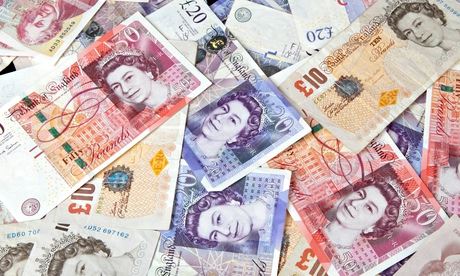
British banknotes – moneyBack in the 1930s, Henry Ford is supposed to have remarked that it was a good thing that most Americans didn’t know how banking really works, because if they did, “there’d be a revolution before tomorrow morning”.

Last week, something remarkable happened. The Bank of England let the cat out of the bag. In a paper called “Money Creation in the Modern Economy“, co-authored by three economists from the Bank’s Monetary Analysis Directorate, they stated outright that most common assumptions of how banking works are simply wrong, and that the kind of populist, heterodox positions more ordinarily associated with groups such as Occupy Wall Street are correct. In doing so, they have effectively thrown the entire theoretical basis for austerity out of the window.

To get a sense of how radical the Bank’s new position is, consider the conventional view, which continues to be the basis of all respectable debate on public policy. People put their money in banks. Banks then lend that money out at interest – either to consumers, or to entrepreneurs willing to invest it in some profitable enterprise. True, the fractional reserve system does allow banks to lend out considerably more than they hold in reserve, and true, if savings don’t suffice, private banks can seek to borrow more from the central bank.

The central bank can print as much money as it wishes. But it is also careful not to print too much. In fact, we are often told this is why independent central banks exist in the first place. If governments could print money themselves, they would surely put out too much of it, and the resulting inflation would throw the economy into chaos. Institutions such as the Bank of England or US Federal Reserve were created to carefully regulate the money supply to prevent inflation. This is why they are forbidden to directly fund the government, say, by buying treasury bonds, but instead fund private economic activity that the government merely taxes.

It’s this understanding that allows us to continue to talk about money as if it were a limited resource like bauxite or petroleum, to say “there’s just not enough money” to fund social programmes, to speak of the immorality of government debt or of public spending “crowding out” the private sector. What the Bank of England admitted this week is that none of this is really true. To quote from its own initial summary: “Rather than banks receiving deposits when households save and then lending them out, bank lending creates deposits” … “In normal times, the central bank does not fix the amount of money in circulation, nor is central bank money ‘multiplied up’ into more loans and deposits.”

In other words, everything we know is not just wrong – it’s backwards. When banks make loans, they create money. This is because money is really just an IOU. The role of the central bank is to preside over a legal order that effectively grants banks the exclusive right to create IOUs of a certain kind, ones that the government will recognise as legal tender by its willingness to accept them in payment of taxes. There’s really no limit on how much banks could create, provided they can find someone willing to borrow it. They will never get caught short, for the simple reason that borrowers do not, generally speaking, take the cash and put it under their mattresses; ultimately, any money a bank loans out will just end up back in some bank again. So for the banking system as a whole, every loan just becomes another deposit. What’s more, insofar as banks do need to acquire funds from the central bank, they can borrow as much as they like; all the latter really does is set the rate of interest, the cost of money, not its quantity. Since the beginning of the recession, the US and British central banks have reduced that cost to almost nothing. In fact, with “quantitative easing” they’ve been effectively pumping as much money as they can into the banks, without producing any inflationary effects.

What this means is that the real limit on the amount of money in circulation is not how much the central bank is willing to lend, but how much government, firms, and ordinary citizens, are willing to borrow. Government spending is the main driver in all this (and the paper does admit, if you read it carefully, that the central bank does fund the government after all). So there’s no question of public spending “crowding out” private investment. It’s exactly the opposite.

Why did the Bank of England suddenly admit all this? Well, one reason is because it’s obviously true. The Bank’s job is to actually run the system, and of late, the system has not been running especially well. It’s possible that it decided that maintaining the fantasy-land version of economics that has proved so convenient to the rich is simply a luxury it can no longer afford.

But politically, this is taking an enormous risk. Just consider what might happen if mortgage holders realised the money the bank lent them is not, really, the life savings of some thrifty pensioner, but something the bank just whisked into existence through its possession of a magic wand which we, the public, handed over to it.

Historically, the Bank of England has tended to be a bellwether, staking out seeming radical positions that ultimately become new orthodoxies. If that’s what’s happening here, we might soon be in a position to learn if Henry Ford was right.

Source: The Guardian

Federal Reserve: 100 years of US dollar | Hang the Bankers

FED USD manipulation

Monday 23 December marks the 100th Anniversary of the creation of the Federal Reserve System – the Central Bank of the United States of America.

The mainstream media are keeping remarkably quiet about this key milestone.

No doubt, they know only too well that growing millions of workers inside and outside the US are realizing that a century of central banking monopoly in the hands of a private clique of usurer banksters is enough. More than enough!

‘Twas the night before Christmas…

…when all through the house, not a creature was stirring, not even a mouse”. These words written by 19th Century American poet, Clement Clarke Moore, aptly describe the scene a hundred years ago when the Federal Reserve Act was discretely rubberstamped in the US Congress: true, hardly a mouse was stirring either in the House or in the Senate… But the big rats were definitely there to vote in their act!

1913: Woodrow Wilson was President of the United States; World War One was but eight months away; and three years earlier a very hush-hush meeting had taken place at mega-banker, John Pierpont Morgan’s, private estate on Jekyll Island off the coast of Georgia.

Bloomberg News described this in a February-15, 2012 article as “a secret meeting that launched the Federal Reserve Bank. In November 1910, a group of government and business leaders fashioned a powerful new financial system that has survived a century, two world wars, a Great Depression and many recessions.”

That’s the Bloomberg Version. The ugly truth is probably exactly the opposite: in November 1910 a group of government, banking and business leaders fashioned a powerful new financial system that triggered, promoted and imposed a century of conflict and genocide, including two world wars, a Great Depression, many recessions and systematic mega-banker bailouts using taxpayer’s money.

In 1995, American investigator and author, G. Edward Griffin, published what is clearly the most authoritative book on the “FED” – as it is colloquially called in banking circles and by the mainstream media – “The Creature from Jekyll Island”.

Printing dollars

Griffin’s book describes how a top secret conspiracy – sorry, can’t think of a better phrase – of very high-powered bankers, government officials and foreign agents met to plan the take-over of the American economy, finance and national currency, the US Dollar, to then wage global wars of conquest.

Bloomberg went on to describe how Rhode Island Senator, Nelson Aldrich, whose daughter married John D. Rockefeller Jr, “invited men he knew and trusted, or at least men of influence who he felt could work together: Abram Piatt Andrew, assistant secretary of the Treasury; Henry P. Davison, a business partner of JP Morgan’s; Charles D. Norton, president of the First National Bank of New York; Benjamin Strong, another Morgan friend and the head of the Bankers Trust; Frank A. Vanderlip, president of the National City Bank; and Paul M. Warburg, a partner in Kuhn, Loeb & Co. and a German citizen.”

Paul Warburg was the actual mastermind behind the FED. Interestingly, his main partner at Kühn, Loeb & Co, Jakob Shiff, had just financed the Japanese war against the Russian Tsar; he would later channel 20,000,000 US dollars via a Russian exile living in Brooklyn by the name of Lev Davidovich Bronstein (better known as Leon Trotsky) to ensure the 1917 victory of the Bolshevik Revolution.

Neither ‘Federal’, nor ‘Reserve’, nor a ‘Bank’

Actually, it’s a “system”. Officially, the “Federal Reserve System” wields full control over the US Dollar, not to serve the American people but on the contrary the interests of private bankers, who hold its very special type of stocks and shares.

In practice, the FED is over 95 percent privately-owned, is not integrated into the US Government, nor accountable to any branch of government. There is nothing “Federal” about it as it lies fully outside the government system of checks-and-balances.

Nor does it “Reserve” anything. Rather it arbitrarily prints all the money the mega-bankers and power elites need to keep the “globalized” world rolling in the direction that they wish and need. This includes such things as multi-trillion dollar “quantitative easings” to keep Goldman Sachs, Bank of America, CityCorp, Wachovia and JPMorgan Chase happy and “healthy”; financing clandestine and terror operations to overthrow the governments of Iran, Nicaragua, Argentina, Cuba, Chile, Syria, Libya, Vietnam and many others; waging decades-long wars against Afghanistan, Pakistan, Iraq, Africa and Latin America; unflinchingly supporting “little Israel’s” genocide in Palestine and its “democratic” 400-bomb strong nuclear program; and keeping Wall Street on permanent life-support.

Finally, it is definitely no “Bank” in the sense of a financial institution promoting the credit needs of the real economy for the benefit of the vast majority of the working population’s needs.

Rather, the FED supports the financial needs of the global war system, covert operations, usury, drug dealers, and the global banksters.

Federal reserve

The FED answers to no one. It clearly does not serve “We the People” of the US or anywhere else. Its purpose is to serve the global power elites, regularly meeting to plan world government through entities like the Council of Foreign Relations, Trilateral Commission, Bilderberg, World Economic Forum and others forming part of todays’ intricate planetary web of global money power.

Straight from the horse’s mouth

In a Public Broadcast System (PBS) interview on “News Hour” aired on September 18, 2007, US journalist Jim Lehrer had this Q&A session with former decades-long Fed Chairman (and JP Morgan bank officer) Alan Greenspan:

Jim Lehrer: “What is the proper relationship between a chairman of the Fed and a president of the United States?”

Alan Greenspan: “Well, first of all, the Federal Reserve is an independent agency, and that means, basically, that there is no other agency of government which can overrule actions that we take. So long as that is in place and there is no evidence that the administration or the Congress or anybody else is requesting that we do things other than what we think is the appropriate thing, then what the relationships are don’t frankly matter.”

Huh? If you’re a US citizen, you should re-read the above once or twice.

The FED System lies at the root of US “superpower” status. Allow me to explain how the FED scam really works from the point of view of someone living in Argentina – a very down-trodden country repeatedly made to bite the dust by the global power elites through their local agents imposed upon us through money-power “democracy”.

This means that every time Argentina needs to buy 100 dollars-worth of, say, oil, medicines or technological components, the Argentine people must work to earn those 100 dollars through exports and genuine work.

By comparison, every time the US Government needs to buy 100 dollars-worth of oil, medicines or whatever, all they need to do is tell the Fed to print 100 dollars and that’s that. Let’s just say that this makes it much easier to be a “superpower”.

OK, the mechanism’s not that simple, but this certainly explains schematically how the whole US-Dollar power system really works. It also explains why the elites won’t tolerate anybody challenging the dollar.

Oh, when the Fed… comes marchin’ in…

Look at the world’s oil market. It is a monopoly run by three global trading centers located in New York, London and Dubai. The idea is to ensure that “petro-dollars” flow around the world 24/7, and only incidental small amounts should flow back into the US financial system.

This explains why when in late 2002 Saddam Hussein decided he would do his UN-sanctions authorized “One Billion Dollars Iraqi Oil for Food” trade with the West in euros instead of dollars, he was quickly visited by the Fed’s military branch in March 2003.

Or take Muammar Kaddafi who in 2011 was about to launch a program to trade Libyan and North African oil using a new gold-backed currency – the gold dinar. He too got a little visit from Peace Prize Barack and Babylon Hillary. Do you begin to see the pattern?

But don’t think that the FED’s global financial enslavement system is simply aimed outside the US; it kicked off a century ago by first silently enslaving the very people of the United States it is supposed to serve.

Here’s how that works: every time the US Government decides to put money into circulation – those 1, 5, 10, 20, 50, 100 dollar bills we’re all so familiar with – instead of asking the government mint to print them at a penny’s cost in paper and ink, the government instead asks the private banksters at the Fed to print those bills for the Treasury, in exchange delivering to the Fed interest-bearing US Treasury Bills and Bonds, which translates into trillions of dollars’ in profits funneled to the private banking elite though the Fed.

It was all so well planned a hundred years ago, that just before the Federal Reserve Act was passed on December 23, 1913, they also maneuvered to close this parasitic circle, for if the US Government was to begin making gigantic interest payments to the Fed just for printing its own money, they first needed to have a revenue scheme in place to milk the American taxpayer: the Income Tax Act!

Capitol

Actually, it was the 16th Amendment to the US Constitution passed by Congress in July 1909, and enacted as law in February 1913. Thus international banksters have been ripping off Americans and getting America to fight their wars as proxies for a full century, whilst most of the population haven’t got a clue of what’s going on.

Clearly, the FED lies so far above the US White House, Congress and Supreme Court, that over the past five decades no one has been able to have a proper audit done on its books and numbers. Oh, you Homer Simpsons!

Not that you haven’t been warned. In 1923, Minnesota representative, Charles Lindbergh, father of the famous aviator, sent an early warning: “The financial system has been turned over to the Federal Reserve Board which administers the finance system by authority of a purely profiteering group. The system is private, conducted for the sole purpose of obtaining the greatest possible profits from the use of other people’s money.”

In the 60’s, republican senator and presidential candidate, Barry Goldwater, said “most Americans have no real understanding of the operation of international moneylenders; the accounts of the Federal Reserve system have never been audited; it operates outside the control of Congress and manipulates the credit of the United States.” Today, former representative, Ron Paul, has been sending the same message.

Even president John Kennedy understood this when he issued Executive Order No. 11110 on June 4, 1963, ordering the US Treasury to print zero-interest public money to the tune of 4.3 billion dollars, fully bypassing the Fed. But he too ran into some trouble in Dallas barely five months later on 22 November.

Epilogue: Fed Up?

One would have thought that something as important as whether to continue to allow a private FED to operate in its present format, or revamping it, or even doing away with it after a whole century, would be something that should be squarely on the American and global public agenda… big time!

And yet all we have is silence from the US Government, Congress and politicians; silence from world leaders; total silence from the mainstream media, and from the academic world.

And so you little parasitic mega-bankers running planet Earth: come Monday 23 December you can uncork all the champagne you like and celebrate your “One Hundredth Masters of the Universe Slave Drivers Anniversary”, partying on straight into Christmas Day.

Then, come Thursday 26th, just carry on crucifying the entire world. For you it will be business as usual.

SEE ALSO:
– Federal Reserve: $75 billion a month in bond purchases
– Former head of Israel’s central bank to be Vice Chairman of Federal Reserve
– Former Federal Reserve employee: “I’m sorry America, QE was a Wall Street bailout”
– CNBC admits central banks rule the world
– The Federal Reserve cartel: The Eight Families
– The history of the Federal Reserve system
– Cui Bono: who benefits from the Federal Reserve?
– Federal Reserve hacked by Anonymous, 4000 bankers details published

Source: http://rt.com/op-edge/fed-us-dollar-manipulate-049/

Federal Reserve: 100 years of US dollar

FED USD manipulationBy Clark Kent

Monday 23 December marks the 100th Anniversary of the creation of the Federal Reserve System – the Central Bank of the United States of America.

The mainstream media are keeping remarkably quiet about this key milestone.

No doubt, they know only too well that growing millions of workers inside and outside the US are realizing that a century of central banking monopoly in the hands of a private clique of usurer banksters is enough. More than enough!

‘Twas the night before Christmas…

…when all through the house, not a creature was stirring, not even a mouse”. These words written by 19th Century American poet, Clement Clarke Moore, aptly describe the scene a hundred years ago when the Federal Reserve Act was discretely rubberstamped in the US Congress: true, hardly a mouse was stirring either in the House or in the Senate… But the big rats were definitely there to vote in their act!

1913: Woodrow Wilson was President of the United States; World War One was but eight months away; and three years earlier a very hush-hush meeting had taken place at mega-banker, John Pierpont Morgan’s, private estate on Jekyll Island off the coast of Georgia.

Bloomberg News described this in a February-15, 2012 article as “a secret meeting that launched the Federal Reserve Bank. In November 1910, a group of government and business leaders fashioned a powerful new financial system that has survived a century, two world wars, a Great Depression and many recessions.”

That’s the Bloomberg Version. The ugly truth is probably exactly the opposite: in November 1910 a group of government, banking and business leaders fashioned a powerful new financial system that triggered, promoted and imposed a century of conflict and genocide, including two world wars, a Great Depression, many recessions and systematic mega-banker bailouts using taxpayer’s money.

In 1995, American investigator and author, G. Edward Griffin, published what is clearly the most authoritative book on the “FED” – as it is colloquially called in banking circles and by the mainstream media – “The Creature from Jekyll Island”.

Printing dollars

Griffin’s book describes how a top secret conspiracy – sorry, can’t think of a better phrase – of very high-powered bankers, government officials and foreign agents met to plan the take-over of the American economy, finance and national currency, the US Dollar, to then wage global wars of conquest.

Bloomberg went on to describe how Rhode Island Senator, Nelson Aldrich, whose daughter married John D. Rockefeller Jr, “invited men he knew and trusted, or at least men of influence who he felt could work together: Abram Piatt Andrew, assistant secretary of the Treasury; Henry P. Davison, a business partner of JP Morgan’s; Charles D. Norton, president of the First National Bank of New York; Benjamin Strong, another Morgan friend and the head of the Bankers Trust; Frank A. Vanderlip, president of the National City Bank; and Paul M. Warburg, a partner in Kuhn, Loeb & Co. and a German citizen.”

Paul Warburg was the actual mastermind behind the FED. Interestingly, his main partner at Kühn, Loeb & Co, Jakob Shiff, had just financed the Japanese war against the Russian Tsar; he would later channel 20,000,000 US dollars via a Russian exile living in Brooklyn by the name of Lev Davidovich Bronstein (better known as Leon Trotsky) to ensure the 1917 victory of the Bolshevik Revolution.

Neither ‘Federal’, nor ‘Reserve’, nor a ‘Bank’

Actually, it’s a “system”. Officially, the “Federal Reserve System” wields full control over the US Dollar, not to serve the American people but on the contrary the interests of private bankers, who hold its very special type of stocks and shares.

In practice, the FED is over 95 percent privately-owned, is not integrated into the US Government, nor accountable to any branch of government. There is nothing “Federal” about it as it lies fully outside the government system of checks-and-balances.

Nor does it “Reserve” anything. Rather it arbitrarily prints all the money the mega-bankers and power elites need to keep the “globalized” world rolling in the direction that they wish and need. This includes such things as multi-trillion dollar “quantitative easings” to keep Goldman Sachs, Bank of America, CityCorp, Wachovia and JPMorgan Chase happy and “healthy”; financing clandestine and terror operations to overthrow the governments of Iran, Nicaragua, Argentina, Cuba, Chile, Syria, Libya, Vietnam and many others; waging decades-long wars against Afghanistan, Pakistan, Iraq, Africa and Latin America; unflinchingly supporting “little Israel’s” genocide in Palestine and its “democratic” 400-bomb strong nuclear program; and keeping Wall Street on permanent life-support.

Finally, it is definitely no “Bank” in the sense of a financial institution promoting the credit needs of the real economy for the benefit of the vast majority of the working population’s needs.

Rather, the FED supports the financial needs of the global war system, covert operations, usury, drug dealers, and the global banksters.

Federal reserve

The FED answers to no one. It clearly does not serve “We the People” of the US or anywhere else. Its purpose is to serve the global power elites, regularly meeting to plan world government through entities like the Council of Foreign Relations, Trilateral Commission, Bilderberg, World Economic Forum and others forming part of todays’ intricate planetary web of global money power.

Straight from the horse’s mouth

In a Public Broadcast System (PBS) interview on “News Hour” aired on September 18, 2007, US journalist Jim Lehrer had this Q&A session with former decades-long Fed Chairman (and JP Morgan bank officer) Alan Greenspan:

Jim Lehrer: “What is the proper relationship between a chairman of the Fed and a president of the United States?”

Alan Greenspan: “Well, first of all, the Federal Reserve is an independent agency, and that means, basically, that there is no other agency of government which can overrule actions that we take. So long as that is in place and there is no evidence that the administration or the Congress or anybody else is requesting that we do things other than what we think is the appropriate thing, then what the relationships are don’t frankly matter.”

Huh? If you’re a US citizen, you should re-read the above once or twice.

The FED System lies at the root of US “superpower” status. Allow me to explain how the FED scam really works from the point of view of someone living in Argentina – a very down-trodden country repeatedly made to bite the dust by the global power elites through their local agents imposed upon us through money-power “democracy”.

This means that every time Argentina needs to buy 100 dollars-worth of, say, oil, medicines or technological components, the Argentine people must work to earn those 100 dollars through exports and genuine work.

By comparison, every time the US Government needs to buy 100 dollars-worth of oil, medicines or whatever, all they need to do is tell the Fed to print 100 dollars and that’s that. Let’s just say that this makes it much easier to be a “superpower”.

OK, the mechanism’s not that simple, but this certainly explains schematically how the whole US-Dollar power system really works. It also explains why the elites won’t tolerate anybody challenging the dollar.

Oh, when the Fed… comes marchin’ in…

Look at the world’s oil market. It is a monopoly run by three global trading centers located in New York, London and Dubai. The idea is to ensure that “petro-dollars” flow around the world 24/7, and only incidental small amounts should flow back into the US financial system.

This explains why when in late 2002 Saddam Hussein decided he would do his UN-sanctions authorized “One Billion Dollars Iraqi Oil for Food” trade with the West in euros instead of dollars, he was quickly visited by the Fed’s military branch in March 2003.

Or take Muammar Kaddafi who in 2011 was about to launch a program to trade Libyan and North African oil using a new gold-backed currency – the gold dinar. He too got a little visit from Peace Prize Barack and Babylon Hillary. Do you begin to see the pattern?

But don’t think that the FED’s global financial enslavement system is simply aimed outside the US; it kicked off a century ago by first silently enslaving the very people of the United States it is supposed to serve.

Here’s how that works: every time the US Government decides to put money into circulation – those 1, 5, 10, 20, 50, 100 dollar bills we’re all so familiar with – instead of asking the government mint to print them at a penny’s cost in paper and ink, the government instead asks the private banksters at the Fed to print those bills for the Treasury, in exchange delivering to the Fed interest-bearing US Treasury Bills and Bonds, which translates into trillions of dollars’ in profits funneled to the private banking elite though the Fed.

It was all so well planned a hundred years ago, that just before the Federal Reserve Act was passed on December 23, 1913, they also maneuvered to close this parasitic circle, for if the US Government was to begin making gigantic interest payments to the Fed just for printing its own money, they first needed to have a revenue scheme in place to milk the American taxpayer: the Income Tax Act!

Capitol

Actually, it was the 16th Amendment to the US Constitution passed by Congress in July 1909, and enacted as law in February 1913. Thus international banksters have been ripping off Americans and getting America to fight their wars as proxies for a full century, whilst most of the population haven’t got a clue of what’s going on.

Clearly, the FED lies so far above the US White House, Congress and Supreme Court, that over the past five decades no one has been able to have a proper audit done on its books and numbers. Oh, you Homer Simpsons!

Not that you haven’t been warned. In 1923, Minnesota representative, Charles Lindbergh, father of the famous aviator, sent an early warning: “The financial system has been turned over to the Federal Reserve Board which administers the finance system by authority of a purely profiteering group. The system is private, conducted for the sole purpose of obtaining the greatest possible profits from the use of other people’s money.”

In the 60’s, republican senator and presidential candidate, Barry Goldwater, said “most Americans have no real understanding of the operation of international moneylenders; the accounts of the Federal Reserve system have never been audited; it operates outside the control of Congress and manipulates the credit of the United States.” Today, former representative, Ron Paul, has been sending the same message.

Even president John Kennedy understood this when he issued Executive Order No. 11110 on June 4, 1963, ordering the US Treasury to print zero-interest public money to the tune of 4.3 billion dollars, fully bypassing the Fed. But he too ran into some trouble in Dallas barely five months later on 22 November.

Epilogue: Fed Up?

One would have thought that something as important as whether to continue to allow a private FED to operate in its present format, or revamping it, or even doing away with it after a whole century, would be something that should be squarely on the American and global public agenda… big time!

And yet all we have is silence from the US Government, Congress and politicians; silence from world leaders; total silence from the mainstream media, and from the academic world.

And so you little parasitic mega-bankers running planet Earth: come Monday 23 December you can uncork all the champagne you like and celebrate your “One Hundredth Masters of the Universe Slave Drivers Anniversary”, partying on straight into Christmas Day.

Then, come Thursday 26th, just carry on crucifying the entire world. For you it will be business as usual.

Source: Hang the Bankers
Mexican Congress passes bill opening oil industry to U.S., others | CBS News

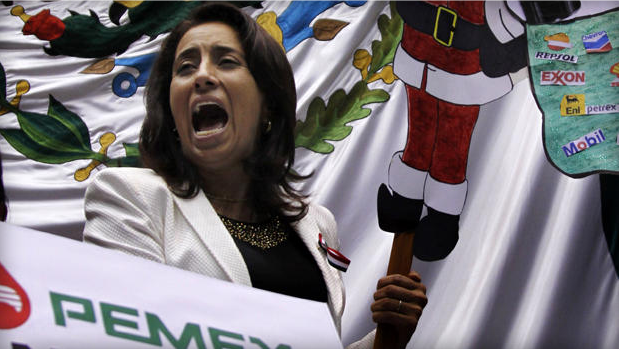
MexicoProtestsMexico’s Congress voted Thursday to open the country’s moribund state-run oil industry to foreign and domestic investors, casting aside nationalist opposition to approve the most dramatic energy reform in seven decades.

The 353-134 vote will allow the government to give private companies contracts and licenses to explore and drill for oil and gas, deals now prohibited under Mexico’s constitution.

The final step, approval by 17 of Mexico’s 31 states, is widely seen as assured.

The state-run oil company, Petroleos Mexicanos, or Pemex, has had a monopoly since the government took over operations of foreign oil companies in 1938, a move that has been revered ever since as a symbol of national sovereignty.

Opponents say they fear that multinationals, especially from the U.S., will once again regain the sort of domination they had over Mexico’s oil before 1938. Mexico remains one of the top five crude exporters to the U.S., shipping more than 1 million barrels a day.

Leftist lawmakers tried to block discussion of the measure on Wednesday by seizing the main chamber of the House of Deputies, blocking access with chairs and tables.

When the debate was moved to another room, they dragged out discussion for 20 hours before the measure was finally approved.

“The homeland is not for sale! The homeland is to be defended!” they shouted while holding protest signs and Mexican flags.

One congressman of the leftist Democratic Revolution Party, Antonio Garcia Conejo, undressed during a speech Wednesday to dramatize his assertion the bill is a “plunder of the nation.”

But most oil analysts had a positive view of the bill hashed out by President Enrique Pena Nieto’s Institutional Revolutionary Party and the conservative National Action Party.

They say major change is needed to rescue Mexico’s oil industry, where production has declined, and where Pemex hasn’t had the finances or expertise needed to tap the country’s vast deep-water and shale reserves.

While oil output has been rising in the U.S. and Canada, Mexico’s production has fallen 25 percent since 2004 despite increased investment.

According to Pemex statistics, the company has nearly 14 billion barrels in proven reserves and up to 115 billion barrels in prospective reserves, about half of which are in deep water or shale oil and gas.

“The opening of Mexico’s markets to put it bluntly, we believe is very good for the people of Mexico and the people everywhere in the world that uses energy,” William Colton, Exxon Mobil’s vice president of corporate strategic planning, said in a webcast before the vote Thursday. “It’s win-win if there ever was one.”

Supporters say a better energy sector could add at least a full percentage point to Mexico’s annual growth rate, which was scaled back dramatically this year from a projected 3.5 percent to 1.3 percent. Backers also say it will be a boon to all three countries, the U.S., Canada and Mexico, in the North American Free Trade Agreement.

“We are going to be able to develop services and competencies in dealing with energy that are transferrable from one country to another,” Thomas Donohue, president of the U.S. Chamber of Commerce, told The Associated Press. “They all have some differences in commodities and have their own regulatory systems, but all of it will be in the context of a lot oil, a lot of gas, a lot of coal and a fundamental ability to attract manufacturing, to improve supply chain and to drive the creation of jobs and economic growth.”

Barclays Research, part of the Corporate and Investment Banking division of Barclays Bank, says the process of boosting production will be slow. Pemex estimates it needs more than $60 billion a year in investment to explore reserves, and currently gets about $24 billion.

“We have to recognize that this is an important effort in a historic sense. However, the challenges are huge because of the amount that has to be done to implement the reform as it is designed,” said Michelle Michot Foss, head of the University of Texas’ Center for Energy Economics.

The measure would allow contracts for profit- and production-sharing as well as licenses under which companies would pay royalties and taxes to the Mexican government for the right to explore and drill.

Private companies could post reserves as long as they specify in contracts that all oil and gas belongs to Mexico. The constitution would continue to prohibit oil concessions, considered the most liberal kind of access for private oil companies.

The bill also calls for mechanisms to prevent, detect and punish corruption in all new contracts, though the specifics must be worked out in what’s known as the secondary laws.

It also appears to reduce the influence of the powerful oil union run by Carlos Romero Deschamps, whose family is famous for its ostentatious lifestyle.

Pemex has an estimated 155,000 employees, of which about 101,000 are unionized, according to Mexico’s Center for Economic Investigation and Education.

Romero Deschamps, who is also a senator for Pena Nieto’s Institutional Revolutionary Party, was initially in favor of the reform proposal, which barely touched Pemex or the union. But in a last-minute change approved by both houses, the bill effectively removed the union’s representation on the Pemex board of directors.

Romero Deschamps walked out of the Senate and didn’t vote.

Source: CBS News

Iceland thumbs nose at international opposition to advance $1.2bn debt relief plan | Russia Times

IcelandHousesIceland’s government has announced that it will be writing off up to 24,000 euros ($32,600) of every household’s mortgage, fulfilling its election promise, despite overwhelming criticism from international financial institutions.

The measure was introduced by the country’s prime minister, Sigmundur David Gunnlaugsson, the leader of the Progressive Party which won the late-April elections on a promise of household debt relief.

According to the government’s website the household debt will be reduced by 13 percent on average.

Citizens of Iceland have been suffering from debt since the 2008 financial crisis, which led to high borrowing costs after the collapse of the krona against other currencies.

“Currently, household debt is equivalent to 108 percent of GDP, which is high by international comparison,” highlighted a government statement, according to AFP. “The action will boost household disposable income and encourage savings.”

The government said that the debt relief will begin by mid-2014 and according to estimates the measure is set to cost $1.2 billion in total. It will be spread out over four years.

The financing plan for the program has not yet been laid out. However, Gunnlaugsson has promised that public finances will not be put at risk. It was initially proposed that the foreign creditors of Icelandic banks would pay for the measure.

International organizations have confronted the idea with criticism. The International Monetary Fund (IMF) and the Organization for Economic Cooperation and Development (OECD) have advised against it, citing economic concerns.

Iceland has “little fiscal space for additional household debt relief” according to the IMF, while the OECD stated that Iceland should limit its mortgage relief to low-income households.

In the meantime, ratings service, Standard & Poor’s, cut back on its outlook for Iceland’s long-term credit rating to negative from stable, stating that the economic measure could affect the confidence of foreign investors if it ends up being paid for by the existing creditors of Icelandic banks.

Source: Russia Times

Documents in JPMorgan settlement reveal how every large bank in U.S. has committed mortgage fraud | The Real News Network

This’ll be the first installment in what can we learn from the statement of facts that constitutes JPMorgan’s admissions. This in that settlement that the Department of Justice is billing as the $13 billion settlement. As I’ve explained in the past, it’s not that big, but it’s still quite large in dollar terms. And we owe a debt of gratitude to Judge Rakoff, who’s been giving the Securities and Exchange Commission a hard time about settling cases and getting absolutely no useful admissions from the people that perpetrated the frauds.

Source: The Real News Network

DOJ Sues Bank Of America Over Mortgage-Backed Securities | Reuters

BankofAmericaBy David Ingram

The U.S. government on Tuesday filed two civil lawsuits against Bank of America for what the Justice Department and securities regulators said was a fraud on investors involving $850 million of residential mortgage-backed securities.

The Justice Department and the U.S. Securities and Exchange Commission filed the parallel suits in U.S. District Court in Charlotte, according to the court filings.

The securities date to about January 2008, the government said, putting them just at the beginning of the global financial crisis.

Bank of America responded to the lawsuits with a statement: “These were prime mortgages sold to sophisticated investors who had ample access to the underlying data, and we will demonstrate that.

“The loans in this pool performed better than loans with similar characteristics originated and securitized at the same time by other financial institutions. We are not responsible for the housing market collapse that caused mortgage loans to default at unprecedented rates and these securities to lose value as a result.”

Bank of America had warned in a securities filing on Thursday about possible new civil charges linked to a sale of one or two mortgage bonds.

The two suits accuse Bank of America of making misleading statements and failing to disclose important facts about the mortgages underlying a securitization named BOAMS 2008-A.

“These misstatements and omissions concerned the quality and safety of the mortgages collateralizing the BOAMS 2008-A securitization, how it originated those mortgages and the likelihood that the ‘prime’ loans would perform as expected,” the Justice Department said in its statement.

A “material number” of mortgages in the pool “failed to materially adhere to Bank of America’s underwriting standards,” the statement said.

Bank of America has announced a series of settlements with investors and the U.S. government, including an $8.5 billion settlement with investors in mortgage-backed securities and a $1.6 billion deal with bond insurer MBIA Inc.

Source: Reuters

Holder: Big Banks’ Clout “Has an Inhibiting Impact” on Prosecutions | Frontline

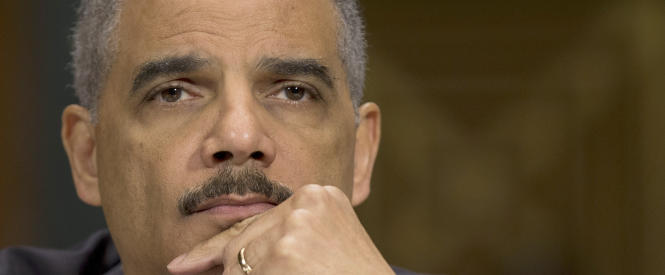
Eric HolderAttorney General Eric Holder said that the Justice Department had considered the economic fallout that could result from prosecuting major banks for their role in the financial crisis, in Senate testimony on Tuesday.

Holder’s comments underscored remarks his deputy, Lanny Breuer, gave in an interview for FRONTLINE’s film The Untouchables that raised concerns among some in government that the Justice Department hasn’t been sufficiently aggressive in prosecuting major banks for the fiscal crisis.

“I am concerned that the size of some of these institutions becomes so large that it does become difficult to prosecute them,” Holder told the Senate Judiciary Committee. “When we are hit with indications that if you do prosecute, if you do bring a criminal charge it will have a negative impact on the national economy, perhaps world economy, that is a function of the fact that some of these institutions have become too large. It has an inhibiting impact on our ability to bring resolutions that I think would be more appropriate. That is something that you all need to consider.”

Holder added that he felt the department had been “appropriately aggressive,” in pursuing and bringing cases where it could prove companies or individuals had broken the law. “These are not easy cases to make,” he said. “Things were done wrong, but the question is whether they’re illegal.”

So far, no Wall Street executives have been prosecuted for fraud in connection with the financial crisis.

Breuer’s interview, which you can read in full here, sparked a Jan. 29 letter from Sens. Charles Grassley (R-Iowa) and Sherrod Brown (D-Ohio) asking for more information on how the Justice Department determined which cases to prosecute. It also asked for the names of any outside experts Justice consulted, and what they were paid.

The Justice Department responded (pdf) one month later, defending its record. But the senators said the letter was “aggressively evasive” and didn’t answer their questions.

On Tuesday, Holder told Grassley that the DOJ would “endeavor to answer” the senators’ letter.

Holder’s full testimony is embedded below. (The exchange on financial fraud prosecutions begins around the 2:17:22 mark.)

Source: Frontline

Ron Paul’s Farewell Address to Congress

Ron Paul: This may well be the last time I speak on the House Floor.  At the end of the year I’ll leave Congress after 23 years in office over a 36 year period.  My goals in 1976 were the same as they are today:  promote peace and prosperity by a strict adherence to the principles of individual liberty.

It was my opinion, that the course the U.S. embarked on in the latter part of the 20th Century would bring us a major financial crisis and engulf us in a foreign policy that would overextend us and undermine our national security.

To achieve the goals I sought, government would have had to shrink in size and scope, reduce spending, change the monetary system, and reject the unsustainable costs of policing the world and expanding the American Empire.

The problems seemed to be overwhelming and impossible to solve, yet from my view point, just following the constraints placed on the federal government by the Constitution would have been a good place to start.

How Much Did I Accomplish?

In many ways, according to conventional wisdom, my off-and-on career in Congress, from 1976 to 2012, accomplished very little.  No named legislation, no named federal buildings or highways—thank goodness.  In spite of my efforts, the government has grown exponentially, taxes remain excessive, and the prolific increase of incomprehensible regulations continues.  Wars are constant and pursued without Congressional declaration, deficits rise to the sky, poverty is rampant and dependency on the federal government is now worse than any time in our history.

All this with minimal concerns for the deficits and unfunded liabilities that common sense tells us cannot go on much longer.  A grand, but never mentioned, bipartisan agreement allows for the well-kept secret that keeps the spending going.  One side doesn’t give up one penny on military spending, the other side doesn’t give up one penny on welfare spending, while both sides support the bailouts and subsidies for the banking and  corporate elite.  And the spending continues as the economy weakens and the downward spiral continues.   As the government continues fiddling around, our liberties and our wealth burn in the flames of a foreign policy that makes us less safe.

The major stumbling block to real change in Washington is the total resistance to admitting that the country is broke. This has made compromising, just to agree to increase spending, inevitable since neither side has any intention of cutting spending.

The country and the Congress will remain divisive since there’s no “loot left to divvy up.”

Without this recognition the spenders in Washington will continue the march toward a fiscal cliff much bigger than the one anticipated this coming January.

I have thought a lot about why those of us who believe in liberty, as a solution, have done so poorly in convincing others of its benefits.  If liberty is what we claim it is- the principle that protects all personal, social and economic decisions necessary for maximum prosperity and the best chance for peace- it should be an easy sell.  Yet, history has shown that the masses have been quite receptive to the promises of authoritarians which are rarely if ever fulfilled. Read more…

Source: Ron Paul

The man who changed Iceland – The message for Greece | Knowledge of Today

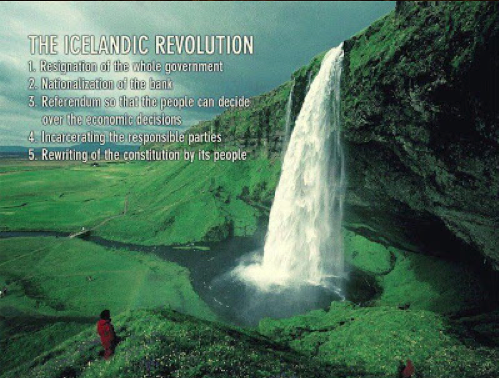
The man who forced the government of Iceland to resign and kicked out the IMF representatives from his country, Hordur Torfarson, is now teaching meta-modern democracy throughout Europe. The rest of the world would benefit from following the example set by Iceland: Arresting the corrupt bankers who are responsible for the current economic turmoil.

The true measure of the leader is not how many follower he has, but how many leaders he creates. Too many people hold the idea that psychopaths are essentially killers or convicts. The general public hasn’t been educated to see beyond the social stereotypes to understand that psychopaths can be entrepreneurs, politicians, CEOs and other successful individuals who may never see the inside of a prison. The difference between bankers and the mafia is becoming increasingly indistinguishable.

Control Your Money or Your Money Will Control You Change your attitude toward debt. Every time you use credit for a purchase think,“Debt is slavery; I am making myself a slave.”

“Manipulators rarely advise you to seek new and diverse information or to ‘learn and research for yourself,’ it tends to be safer for exploitative and irresponsible leaders to keep their citizens in the dark; in their view less independent thought is better. Independent thought leads to an inquiring mind, a mindset that eventually leads to the questioning of authority figures, and that is the one thing that inadequate leaders do not want.”

Governments have never existed to solve problems domestic or international. Governments and their institutions exist merely to further and secure the interests of favored groups, but We the People are never the favored group.

Source: Knowledge of Today