What were the results of the experimentation and practice of social engineering and mind-control during the Cold War? When Project Paperclip was ushered into the United States, coinciding with the inception of the CIA and the National Security Act, Nazi research and trauma based mind-control experiments were brought to the US, initiating Project MK ULTRA. These secret projects were funded through arms deals, drug operations, human trafficking and human slavery.
The ultimate goal behind this hidden agenda was to implement mind-control deeply within our government, education, healthcare and media to create compliance in the new world regime. TRANCE weaves Cathy O’Brien’s experience as one of the last surviving victims of MK Ultra and Project Monarch, into the macrocosm of past world events, and the agenda currently unfolding. An eye opening view of our world today and how we got here.
As we exit the pandemic, expect to hear much more about The Great Reset and building back better. Far from resulting in a low-carbon dream life, though, it’s a cartoonish fantasy that will hand the global elite even more power.
‘The Great Reset’ is a term that has been bandied about quite readily by most Western neo-liberal politicians. So often, in fact, and without proper explanation, that it strikes the prudent observer as a kind of paid advertisement.
But what is it exactly? The term rose to prominence at the 50th annual meeting of the World Economic Forum (WEF) in June 2020. It was initially launched by the Prince of Wales, before being absorbed into the philosophy of the sartorially dystopian sci-fi villain Klaus Schwab, founder and executive chairman of the WEF.
The Great Reset refers to a plan to rebuild the world’s infrastructure ‘in a sustainable way’ following the economic ravages of the Covid-19 pandemic and to establish a global treaty to prevent future pandemics, or as it is described more formally, to “build a more robust international health architecture that will protect future generations.” If you ever hear people talking about “building back better,” they are referring to The Great Reset.
Probably the most disturbing part of The Great Reset is how much it strongly resembles business-as-usual, only with EXTRA globalism. Most of the plan’s outlines include a further weakening of national boundaries and individual national autonomy, in favour of a more ‘universal governance.’ As usual, it is the rapidly vanishing Western middle class which must shoulder this burden, as their freedoms are further curtailed to meet the quotas of corporate-media-fuelled activism.
Regardless, many world leaders, no doubt charmed into acquiescence by Schwab’s commandingly sinister Blofeld-esque wardrobe, agreed to the Great Reset, including Boris Johnson, Emmanuel Macron, Angela Merkel, Kyriakos Mitsotakis, Mark Rutte, Pedro Sánchez, Erna Solberg and Volodymyr Zelensky. According to John Kerry, Joe Biden’s administration is on board, too.
But the general agreement of the Western leaders is absolutely typical of any agenda which is espoused by NATO, the UN, or the WEF. If an emotionally charged, politically vague and ultimately ineffectual edict or bill is proposed by one of these entities – each resembling a shabby, globe-trotting team of insurance salesmen – our effete politicians line up to show the most fervent compliance.
As a rule, it seems their solutions to specific environmental or scientific problems mysteriously become entwined with LGBTQ+ rights, workplace equity, open borders initiatives and other unrelated social justice causes. It’s as though any goals they have are somehow unilaterally from the same source, or entail the same solution, regardless of causality or consequence. Therefore, a united response to a global pandemic mysteriously also equals trans rights activism.
In their own words, “No single government or multilateral agency can address this (pandemic) threat alone. Together, we must be better prepared to predict, prevent, detect, assess and effectively respond to pandemics in a highly co-ordinated fashion.”
There are many other sweeping sentiments expressed by Schwab and his acolytes which can seem either trite or threatening. Consider“the gulf between what markets value and what people value will close” and “we want more attention paid to scientific experts. No one can “self-isolate” from climate change so we all need to “act in advance and in solidarity.” There is much talk of the pursuit of “fairer and equitable outcomes.”
International treaties always tend to be about concentrating power. It’s one of those rules of life, for realists, as there is no escaping power dynamics in human affairs. Real problems don’t often have feel-good solutions. Often, they require ‘solutions that sound mean’, that don’t sound good on a corporate goals bulletin. Initiatives like The Great Reset all entail the gradual loss of the autonomy of individual nations, as their decision-making power is transferred to an international, disembodied rule-maker.
It has been, without a doubt, a globalist fantasy for a long time, but the key question is: do they realise what they are doing or not?
As far as their amazing coordinated pandemic response goes, this appears to be nothing more than forced world-wide vaccinations for EVERYBODY. According to Klaus Schwab himself: “As long as not everybody is vaccinated, nobody will be safe.” To which the attendant neo-liberal world leaders nodded in re-affirming unison, repeating in unison their mantra: “Global public good.”
Schwab, despite appearing like an immortal brothel-keeper at Kublai Khan’s Xanadu, is really cut from the same cloth as your typical EU technocrat. His ideas are not creative, they are quite staid and pedestrian, and research of his career shows they have been unchanged since the 1970s. He has consistently been preaching the very same thing, like a broken record.
Schwab believes we can achieve environmental solutions without altering capitalism in the slightest, by creating treaties of “mutual accountability and shared responsibility, transparency and co-operation within the international system.” His idea involves ‘ethical capitalism’ – where the excesses of capitalism will somehow be held at bay by ‘ethical stakeholders,’ to whom the corporations will be held accountable, while (conveniently) the elites and systems already in place will continue as they are. This is the master plan of the World Economic Forum, largely unchanged for 40 years.
The result? A green technocracy, one assumes, with a WEF-mandated ‘ethical stakeholder’ apparatus, a worldwide spiderweb organisation ruling by the threatened fears of pandemic and carbon doom. No section of society would be exempt from edicts of ‘the new treaty.’
The Great Reset website appears to be little more than an advertisement for modern pod-living. It seems to style itself as a low-carbon dream-life (without loss of modern convenience) to effeminate hipsters. One can see slovenly-looking neo-liberal youths, frequent references to LGBTQ+ values, and an overall urgency about carbon footprints.
There is a hint of Adbusters about the website, creator of the Occupy Wall Street movement. Despite the fact that the WEF and Davos and all associated entities are entirely elite institutions, the website styles itself on grassroots urban activism. There is much cringeworthy symbology in its white papers, such as a green and rainbow flag-combination with fey slogans like ‘we salute you, zoom queen!’
Schwab refers to the aim of The Great Reset as “the Fourth Industrial Revolution,” with the first being powered by water and steam, the second introducing mass production, and the third electronic automation. The fourth will blur the lines between “physical, digital and biological spheres.”
In this grab-bag of magical advances, he lists, “fields such as artificial intelligence, robotics, the Internet of Things, autonomous vehicles, 3-D printing, nanotechnology, biotechnology, materials science, energy storage and quantum computing.”
This sounds like cartoonish optimism, as many of these technologies are anything but clean and don’t seem to de facto relate to side-stepping out of industrialism or anything else. On top of that, fewer than 9% of companies use the machine learning, robotics, touch screens and other advanced technologies listed as somehow ‘changing everything.’ Stakeholder capitalism, as a concept, does not explain itself as foolproof, and will no doubt be freely interpreted by the likes of Silicon Valley or supply chain conglomerates.
The jewel in the crown of Great Reset optimism has to be the belief that the advent of AI will alter everything positively, again without specifics, to somehow create a low-carbon new world.
It appears at best to be all be smoke and mirrors, a childish corporate fantasy manufactured by isolated bean counters. At worst, it is an intentional power-grab by unaccountable international agencies and hidden oligarchs.
Either way, it is a fake utopia at the price of privacy and autonomy, sold to us by used-car salesmen who think they are princes.
Far from being a war against “white supremacy,” the Biden administration’s new “domestic terror” strategy clearly targets primarily those who oppose US government overreach and those who oppose capitalism and/or globalization.
In the latest sign that the US government’s War on Domestic Terror is growing in scope and scale, the White House on Tuesday revealed the nation’s first ever government-wide strategy for confronting domestic terrorism. While cloaked in language about stemming racially motivated violence, the strategy places those deemed “anti-government” or “anti-authority” on a par with racist extremists and charts out policies that could easily be abused to silence or even criminalize online criticism of the government.
Even more disturbing is the call to essentially fuse intelligence agencies, law enforcement, Silicon Valley, and “community” and “faith-based” organizations such as the Anti-Defamation League, as well as unspecified foreign governments, as partners in this “war,” which the strategy makes clear will rely heavily on a pre-crime orientation focused largely on what is said on social media and encrypted platforms. Though the strategy claims that the government will “shield free speech and civil liberties” in implementing this policy, its contents reveal that it is poised to gut both.
Indeed, while framed publicly as chiefly targeting “right-wing white supremacists,” the strategy itself makes it clear that the government does not plan to focus on the Right but instead will pursue “domestic terrorists” in “an ideologically neutral, threat-driven manner,” as the law “makes no distinction based on political view—left, right or center.” It also states that a key goal of this strategic framework is to ensure “that there is simply no governmental tolerance . . . of violence as an acceptable mode of seeking political or social change,” regardless of a perpetrator’s political affiliation.
Considering that the main cheerleaders for the War on Domestic Terror exist mainly in establishment left circles, such individuals should rethink their support for this new policy given that the above statements could easily come to encompass Black Lives Matter–related protests, such as those that transpired last summer, depending on which political party is in power.
Once the new infrastructure is in place, it will remain there and will be open to the same abuses perpetrated by both political parties in the US during the lengthy War on Terror following September 11, 2001. The history of this new “domestic terror” policy, including its origins in the Trump administration, makes this clear.
It’s Never Been Easier to Be a “Terrorist”
In introducing the strategy, the Biden administration cites “racially or ethnically motivated violent extremists” as a key reason for the new policy and a main justification for the War on Domestic Terror in general. This was most recently demonstrated Tuesday in Attorney General Merrick Garland’s statement announcing this new strategy. However, the document itself puts “anti-government” or “anti-authority” “extremists” in the same category as violent white supremacists in terms of being a threat to the homeland. The strategy’s characterization of such individuals is unsettling.
For instance, those who “violently oppose” “all forms of capitalism” or “corporate globalization” are listed under this less-discussed category of “domestic terrorist.” This highlights how people on the left, many of whom have called for capitalism to be dismantled or replaced in the US in recent years, could easily be targeted in this new “war” that many self-proclaimed leftists are currently supporting. Similarly, “environmentally-motivated extremists,” a category in which groups such as Extinction Rebellion could easily fall, are also included.
In addition, the phrasing indicates that it could easily include as “terrorists” those who oppose the World Economic Forum’s vision for global “stakeholder capitalism,” as that form of “capitalism” involves corporations and their main “stakeholders” creating a new global economic and governance system. The WEF’s stakeholder capitalism thus involves both “capitalism” and “corporate globalization.”
The strategy also includes those who “take steps to violently resist government authority . . . based on perceived overreach.” This, of course, creates a dangerous situation in which the government could, purposely or otherwise, implement a policy that is an obvious overreach and/or blatantly unconstitutional and then label those who resist it “domestic terrorists” and deal with them as such—well before the overreach can be challenged in court.
Another telling addition to this group of potential “terrorists” is “any other individual or group who engages in violence—or incites imminent violence—in opposition to legislative, regulatory or other actions taken by the government.” Thus, if the government implements a policy that a large swath of the population finds abhorrent, such as launching a new, unpopular war abroad, those deemed to be “inciting” resistance to the action online could be considered domestic terrorists.
Such scenarios are not unrealistic, given the loose way in which the government and the media have defined things like “incitement” and even “violence” (e. g., “hate speech” is a form of violence) in the recent past. The situation is ripe for manipulation and abuse. To think the federal government (including the Biden administration and subsequent administrations) would not abuse such power reflects an ignorance of US political history, particularly when the main forces behind most terrorist incidents in the nation are actually US government institutions like the FBI (more FBI examples here, here, here, and here).
Furthermore, the original plans for the detention of American dissidents in the event of a national emergency, drawn up during the Reagan era as part of its “continuity of government” contingency, cited popular nonviolent opposition to US intervention in Latin America as a potential “emergency” that could trigger the activation of those plans. Many of those “continuity of government” protocols remain on the books today and can be triggered, depending on the whims of those in power. It is unlikely that this new domestic terror framework will be any different regarding nonviolent protest and demonstrations.
Yet another passage in this section of the strategy states that “domestic terrorists” can, “in some instances, connect and intersect with conspiracy theories and other forms of disinformation and misinformation.” It adds that the proliferation of such “dangerous” information “on Internet-based communications platforms such as social media, file-upload sites and end-to-end encrypted platforms, all of these elements can combine and amplify threats to public safety.”
Thus, the presence of “conspiracy theories” and information deemed by the government to be “misinformation” online is itself framed as threatening public safety, a claim made more than once in this policy document. Given that a major “pillar” of the strategy involves eliminating online material that promotes “domestic terrorist” ideologies, it seems inevitable that such efforts will also “connect and intersect” with the censorship of “conspiracy theories” and narratives that the establishment finds inconvenient or threatening for any reason.
Pillars of Tyranny
The strategy notes in several places that this new domestic-terror policy will involve a variety of public-private partnerships in order to “build a community to address domestic terrorism that extends not only across the Federal Government but also to critical partners.” It adds, “That includes state, local, tribal and territorial governments, as well as foreign allies and partners, civil society, the technology sector, academic, and more.”
The mention of foreign allies and partners is important as it suggests a multinational approach to what is supposedly a US “domestic” issue and is yet another step toward a transnational security-state apparatus. A similar multinational approach was used to devastating effect during the CIA-developed Operation Condor, which was used to target and “disappear” domestic dissidents in South America in the 1970s and 1980s. The foreign allies mentioned in the Biden administration’s strategy are left unspecified, but it seems likely that such allies would include the rest of the Five Eyes alliance (the UK, Australia, Canada, New Zealand) and Israel, all of which already have well-established information-sharing agreements with the US for signals intelligence.
The new domestic-terror strategy has four main “pillars,” which can be summarized as (1) understanding and sharing domestic terrorism-related information, including with foreign governments and private tech companies; (2) preventing domestic terrorism recruitment and mobilization to violence; (3) disrupting and deterring domestic terrorism activity; and (4) confronting long-term contributors to domestic terrorism.
The first pillar involves the mass accumulation of data through new information-sharing partnerships and the deepening of existing ones. Much of this information sharing will involve increased data mining and analysis of statements made openly on the internet, particularly on social media, something already done by US intelligence contractors such as Palantir. While the gathering of such information has been ongoing for years, this policy allows even more to be shared and legally used to make cases against individuals deemed to have made threats or expressed “dangerous” opinions online.
Included in the first pillar is the need to increase engagement with financial institutions concerning the financing of “domestic terrorists.” US banks, such as Bank of America, have already gone quite far in this regard, leading to accusations that it has begun acting like an intelligence agency. Such claims were made after it was revealed that the BofA had passed to the government the private banking information of over two hundred people that the bank deemed as pointing to involvement in the events of January 6, 2021. It seems likely, given this passage in the strategy, that such behavior by banks will soon become the norm, rather than an outlier, in the United States.
The second pillar is ostensibly focused on preventing the online recruitment of domestic terrorists and online content that leads to the “mobilization of violence.” The strategy notes that this pillar “means reducing both supply and demand of recruitment materials by limiting widespread availability online and bolstering resilience to it by those who nonetheless encounter it.“ The strategy states that such government efforts in the past have a “mixed record,” but it goes on to claim that trampling on civil liberties will be avoided because the government is “consulting extensively” with unspecified “stakeholders” nationwide.
Regarding recruitment, the strategy states that “these activities are increasingly happening on Internet-based communications platforms, including social media, online gaming platforms, file-upload sites and end-to-end encrypted platforms, even as those products and services frequently offer other important benefits.” It adds that “the widespread availability of domestic terrorist recruitment material online is a national security threat whose front lines are overwhelmingly private-sector online platforms.”
The US government plans to provide “information to assist online platforms with their own initiatives to enforce their own terms of service that prohibits the use of their platforms for domestic terrorist activities” as well as to “facilitate more robust efforts outside the government to counter terrorists’ abuse of Internet-based communications platforms.”
Given the wider definition of “domestic terrorist” that now includes those who oppose capitalism and corporate globalization as well as those who resist government overreach, online content discussing these and other “anti-government” and “anti-authority” ideas could soon be treated in the same way as online Al Qaeda or ISIS propaganda. Efforts, however, are unlikely to remain focused on these topics. As Unlimited Hangoutreported last November, both UK intelligence and the US national-security state were developing plans to treat critical reporting on the COVID-19 vaccines as “extremist” propaganda.
Another key part of this pillar is the need to “increase digital literacy” among the American public, while censoring “harmful content” disseminated by “terrorists” as well as by “hostile foreign powers seeking to undermine American democracy.” The latter is a clear reference to the claim that critical reporting of US government policy, particularly its military and intelligence activities abroad, was the product of “Russian disinformation,” a now discredited claim that was used to heavily censor independent media. This new government strategy appears to promise more of this sort of thing.
It also notes that “digital literacy” education for a domestic audience is being developed by the Department of Homeland Security (DHS). Such a policy would have previously violated US law until the Obama administration worked with Congress to repeal the Smith-Mundt Act, thus lifting the ban on the government directing propaganda at domestic audiences.
The third pillar of the strategy seeks to increase the number of federal prosecutors investigating and trying domestic-terror cases. Their numbers are likely to jump as the definition of “domestic terrorist” is expanded. It also seeks to explore whether “legislative reforms could meaningfully and materially increase our ability to protect Americans from acts of domestic terrorism while simultaneously guarding against potential abuse of overreach.” In contrast to past public statements on police reform by those in the Biden administration, the strategy calls to “empower” state and local law enforcement to tackle domestic terrorism, including with increased access to “intelligence” on citizens deemed dangerous or subversive for any number of reasons.
To that effect, the strategy states the following (p. 24):“The Department of Justice, Federal Bureau of Investigation, and Department of Homeland Security, with support from the National Counterterrorism Center [part of the intelligence community], are incorporating an increased focus on domestic terrorism into current intelligence products and leveraging current mechanisms of information and intelligence sharing to improve the sharing of domestic terrorism-related content and indicators with non-Federal partners. These agencies are also improving the usability of their existing information-sharing platforms, including through the development of mobile applications designed to provide a broader reach to non-Federal law enforcement partners, while simultaneously refining that support based on partner feedback.”
Such an intelligence tool could easily be, for example, Palantir, which is already used by the intelligence agencies, the DHS, and several US police departments for “predictive policing,” that is, pre-crime actions. Notably, Palantir has long included a “subversive” label for individuals included on government and law enforcement databases, a parallel with the controversial and highly secretive Main Core database of US dissidents.
DHS Secretary Alejandro Mayorkas made the “pre-crime” element of the new domestic terror strategy explicit on Tuesday when he said in a statement that DHS would continue “developing key partnerships with local stakeholders through the Center for Prevention Programs and Partnerships (CP3) to identify potential threats and prevent terrorism.” CP3, which replaced DHS’ Office for Targeted Violence and Terrorism Prevention this past May, officially “supports communities across the United States to prevent individuals from radicalizing to violence and intervene when individuals have already radicalized to violence.”
The fourth pillar of the strategy is by far the most opaque and cryptic, while also the most far-reaching. It aims to address the sources that cause “terrorists” to mobilize “towards violence.” This requires “tackling racism in America,” a lofty goal for an administration headed by the man who controversially eulogized Congress’ most ardent segregationist and who was a key architect of the 1994 crime bill. As well, it provides for “early intervention and appropriate care for those who pose a danger to themselves or others.”
In regard to the latter proposal, the Trump administration, in a bid to “stop mass shootings before they occur,” considered a proposal to create a “health DARPA” or “HARPA” that would monitor the online communications of everyday Americans for “neuropsychiatric” warning signs that someone might be “mobilizing towards violence.” While the Trump administration did not create HARPA or adopt this policy, the Biden administration has recently announced plans to do so.
Finally, the strategy indicates that this fourth pillar is part of a “broader priority”: “enhancing faith in government and addressing the extreme polarization, fueled by a crisis of disinformation and misinformation often channeled through social media platforms, which can tear Americans apart and lead some to violence.” In other words, fostering trust in government while simultaneously censoring “polarizing” voices who distrust or criticize the government is a key policy goal behind the Biden administration’s new domestic-terror strategy.
Calling Their Shots?
While this is a new strategy, its origins lie in the Trump administration. In October 2019, Trump’s attorney general William Barr formally announced in a memorandum that a new “national disruption and early engagement program” aimed at detecting those “mobilizing towards violence” before they commit any crime would launch in the coming months. That program, known as DEEP (Disruption and Early Engagement Program), is now active and has involved the Department of Justice, the FBI, and “private sector partners” since its creation.
Barr’s announcement of DEEP followed his unsettling “prediction” in July 2019 that “a major incident may occur at any time that will galvanize public opinion on these issues.” Not long after that speech, a spate of mass shootings occurred, including the El Paso Walmart shooting, which killed twenty-three and about which many questions remain unanswered regarding the FBI’s apparent foreknowledge of the event. After these events took place in 2019, Trump called for the creation of a government backdoor into encryption and the very pre-crime system that Barr announced shortly thereafter in October 2019. The Biden administration, in publishing this strategy, is merely finishing what Barr started.
Indeed, a “prediction” like Barr’s in 2019 was offered by the DHS’ Elizabeth Neumann during a Congressional hearing in late February 2020. That hearing was largely ignored by the media as it coincided with an international rise of concern regarding COVID-19. At the hearing, Neumann, who previously coordinated the development of the government’s post-9/11 terrorism information sharing strategies and policies and worked closely with the intelligence community, gave the following warning about an imminent “domestic terror” event in the United States:“And every counterterrorism professional I speak to in the federal government and overseas feels like we are at the doorstep of another 9/11, maybe not something that catastrophic in terms of the visual or the numbers, but that we can see it building and we don’t quite know how to stop it.”
This “another 9/11” emerged on January 6, 2021, as the events of that day in the Capitol were quickly labeled as such by both the media and prominent politicians, while also inspiring calls from the White House and the Democrats for a “9/11-style commission” to investigate the incident. This event, of course, figures prominently in the justification for the new domestic-terror strategy, despite the considerable video and other evidence that shows that Capitol law enforcement, and potentially the FBI, were directly involved in facilitating the breach of the Capitol. In addition, when one considers that the QAnon movement, which had a clear role in the events of January 6, was itself likely a government-orchestratedpsyop, the government hand in creating this situation seems clear.
It goes without saying that the official reasons offered for these militaristic “domestic terror” policies, which the US has already implemented abroad—causing much more terror than it has prevented—does not justify the creation of a massive new national-security infrastructure that aims to criminalize and censor online speech. Yet the admission that this new strategy, as part of a broader effort to “enhance faith in government,” combines domestic propaganda campaigns with the censorship and pursuit of those who distrust government heralds the end of even the illusion of democracy in the United States.
The US and some other Western nations held up as “models of liberal democracy” are rapidly turning into totalitarian regimes reminiscent of the Soviet Union, the head of Russia’s Foreign Intelligence Service has claimed.
Speaking on Thursday at the Moscow Conference on International Security, Sergey Naryshkin claimed that there are “almost all signs of a totalitarian dictatorship” in some Western countries, including a “monopoly on the media,” the “police nature of the state,” and the “irremovability of oligarchic elites.”
“It is astonishing to see how the West is trying to divide our diverse world into two completely artificial camps – a supposedly democratic one and a supposedly authoritarian one,” Naryshkin said, noting Russia, China, and Iran have been placed into the second camp, along with NATO ally Turkey and, on some issues, EU member state Poland.
“The US and other so-called models of liberal democracy seem not to notice that they themselves are rapidly turning into a liberal-totalitarian regime,” the chief spook said.
According to Naryshkin, the West’s imposition of ideological attitudes is somewhat reminiscent of the history of the late Soviet Union, in that it doesn’t even believe the values it tries to project abroad.
However, the head spy pointed to the US-Russia summit in Switzerland earlier this month as a potential turning point, noting that he hopes the West will be able to use “the spirit of Geneva to try to build a safer and fairer world.”
Naryshkin’s belief that the West is attempting to split the world into ‘democratic’ and ‘authoritarian’ echoes a statement made by Defense Minister Sergey Shoygu at the same conference on Wednesday.
“Today, a new trend is coming to the fore,” Shoygu said. “The formation of global coalitions, the division of the world into ‘friends’ and ‘strangers.’”
I once thought the internet would have the same effect on corporate media gatekeepers as the AK-47 had on colonial empires in Africa. That was before Big Tech turned that promise of freedom into the second coming of feudalism.
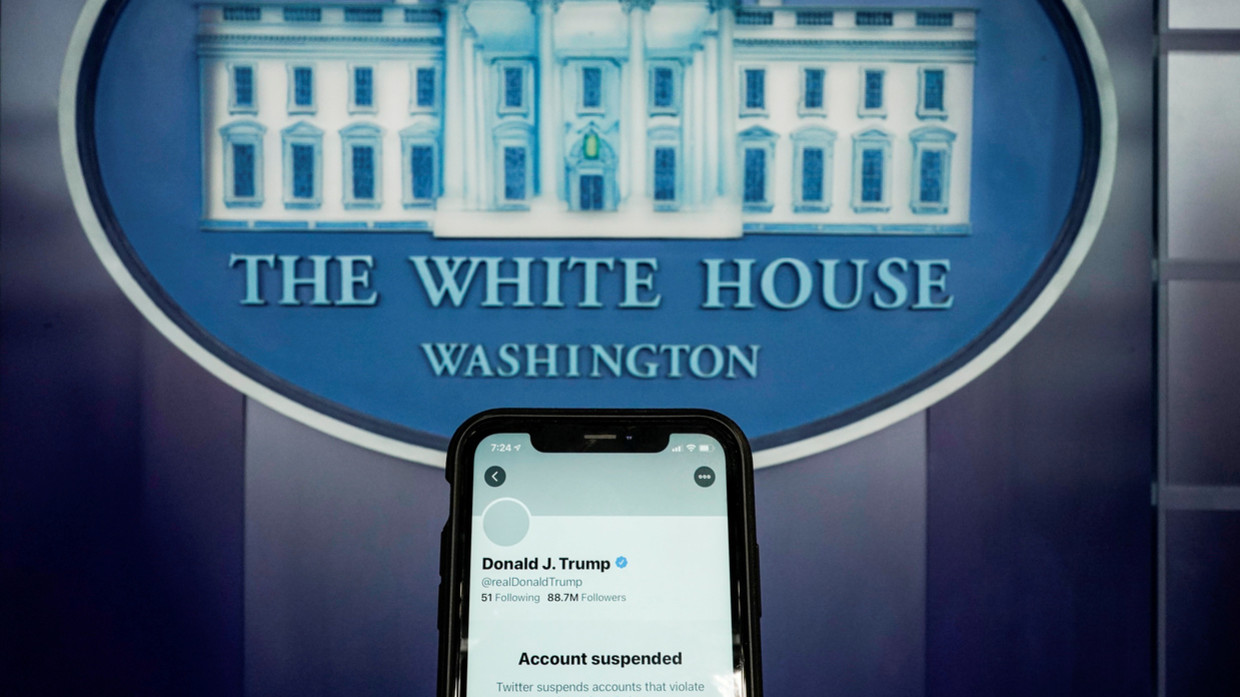
Wednesday’s decision by Facebook’s “oversight board” – a transparent attempt to outsource responsibility for censorship to an international committee – to extend the ban on 45th US President Donald Trump is just the latest example, but by no means the most egregious. Earlier this week, the banhammer descended on RT’s digital project Redfish over posts criticizing… Italian fascist leader Benito Mussolini and the Holocaust, of all things.
How did it come to this? Years ago, in an argument over media censorship, I had brought up the internet as the modern version of the AK-47. While the European colonial armies were able to conquer Africa in the 19th century, using machine guns and repeating rifles, they became unable to hold it once the Kalashnikov automatic rifle put the peasants in places like Congo, Angola and Vietnam on equal footing with Western armies seeking to keep them down.
Or, if you want a more peaceful metaphor, it was the promise of open pasture extended to people who had previously been treated like cattle, penned up in factory barns and fed slop from a trough.
That was in March 2011. Facebook, YouTube and Twitter were already around, but they were challenging the gatekeepers and offering their platforms to the common people like myself. In 2016, everything changed. That was the year Trump was able to bypass the corporate gatekeepers, using those platforms to speak to the American people directly.
Having consolidated the internet between them, and under pressure from politicians they already supported, the corporations running these platforms began censoring content and users – first gradually, then suddenly. The pretext for this was “Russiagate,” the conspiracy theory pushed by Democrats and their corporate media allies to explain Hillary Clinton’s 2016 fiasco, delegitimize Trump’s presidency, and – as it turns out – justify censorship.
As demonstrated by the recent example of Twitter’s clash with Russia over illegal content, or Facebook’s standoff with Australia over paying for news, these mega-corporations aren’t opposed to censorship or committed to property on principle. Rather, their only “principle” is the Who-Whom reductionism, a world in which they and those they agree with can do no wrong, while anyone else can do no right.
The long march from banning Alex Jones in 2018 to banning the sitting president of the United States in 2021 was completed with surprising alacrity. The collusion within Silicon Valley to ban Trump on the blatantly false pretext of “inciting insurrection” on January 6 may have been the political Rubicon, but Big Tech had begun putting their finger, fist and even elbow on the political scales long before.
Does banning the New York Post over Hunter Biden ring any bells? How about the “pre-bunking” of the 2020 election outcome, arranged by Democrat activists more than a year prior? It’s in the infamous February TIME article, the one about the heroic “fortifiers” of the “proper” election outcome, buried among other bombshells and easy to miss. There was also Facebook CEO Mark Zuckerberg literally donating millions to Democrats in certain key cities and counties, to help collect and count mail-in ballots. The list goes on.
We have this thing called the government that is accountable to everyone. We pass laws outlawing child labor, making sure our food is safe to eat, ensuring airplanes don’t fall out of the sky or Wall Street doesn’t crash the economy. For some reason Facebook is above all this?— Zaid Jilani (@ZaidJilani) May 5, 2021
“But my private company!” facetiously proclaims the brigade that literally cheered Barack Obama’s “you didn’t build that” speech just a few short years before. Corporations shouldn’t be people, no one is above the law, Citizens United is bad – except when it helps us get into power, in which case it’s just fine, carry on.
These are the same “experts” on the US Constitution who believe the Second Amendment applies only to muskets, the First only to the government, the Fourth is optional, the Fourteenth trumps all of them, and the Tenth is vestigial and doesn’t apply to anything.
Believing that “American values” ought to apply to businesses incorporated in the US, under protection of US laws – Section 230, looking at you here – and benefiting from US power when muscling governments abroad is downright quaint, considering these companies don’t actually care about that constitutional republic, but back Our Democracy that has replaced it instead.
America gave Facebook everything. The platform exists because of our laws, economy, & innovative minds. How does Facebook respond? By flipping the bird to the American system.The First Amendment doesn’t literally apply to Facebook. But as an American company, its values should. https://t.co/3nbkg77be1— Rachel Bovard (@rachelbovard) May 5, 2021
I still think I was correct in 2011, arguing that the internet had broken the information monopoly of cable channels and newspapers. The plummeting ratings and newspaper revenues have borne that out. Unfortunately, Big Tech figured it out as well – and succumbed to the temptation to turn the promise of open pastures into the very factory farms it was supposed to replace.
Now we’re not just back to eating slop from the corporate trough, but everything we’ve said while believing in freedom has been harvested and can and will be weaponized to “cancel” us at any time. One might call this called techno-feudalism, except the overlords have no obligations and the serfs have no rights.
Way back in 2019, Trump had tweeted a meme: “In reality, they’re not after me, they’re after you. I’m just in the way.” Can you honestly say now that he was wrong?
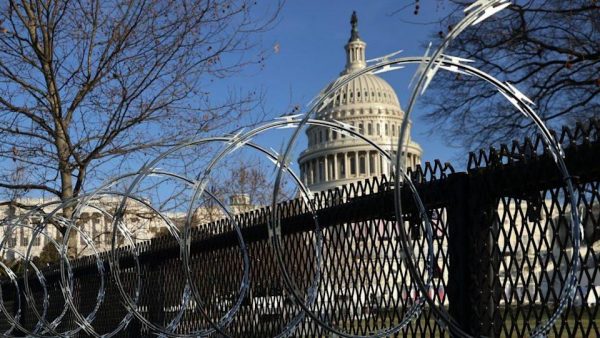
US National Guard troops patrol the vicinity of the US Capitol hours before the Inauguration of US President-Elect Joe Biden in Washington, DC, on January 20, 2021. (Photo by ROBERTO SCHMIDT / AFP) (Photo by ROBERTO SCHMIDT/AFP via Getty Images)
By Lee Smith
On Saturday, Peoples’ Republic of China planes flew into Taiwan’s airspace. Incursions are a normal occurrence but the most recent one represented an escalation. Typically one or two planes will probe Taiwan’s air defenses but in this case it was reportedly eight bombers and four fighter jets. It appears Beijing is eager to test Joe Biden early. It’s likely China won’t be the only one. The more than 20,000 National Guard troops in Washington to last week protect the new president’s nearly unattended inauguration is evidence that the United States is broken.
Observers widely misunderstood the National Guard deployment as a show of force asserting the Biden team’s legitimacy as the elected government of the United States. But the most salient fact of the troop presence is that some who were found to have supported Donald Trump were sent home. And thus the reason for the deployment, which may now continue into March, is that the Biden White House is keen to use the sporadically violent but mostly peaceful Jan. 6 march on the Capitol building as a political pretext to further target Trump supporters.
From the perspective of the administration and its media surrogates, Trump supporters were already deplorable, but now that they have attempted an insurrection, the gloves will come off. The nearly 75 million people who voted for Biden’s opponent deserve whatever is coming to them next—further impoverishment, further collective punishment in the guise of public health (i.e., coronavirus) measures, designation as domestic terrorists, imprisonment, and even death.
Let’s try to imagine how foreigners see our circumstances: Neither traditional U.S. allies nor adversaries can share the new administration’s assessment that the United States government faced an insurrection Jan. 6. In comparison to their own domestic challenges, those protests were plainly mild.
In France, for instance, the Yellow Vests movement has been engaged in protests for more than two years that have frequently devolved into street violence, leaving 11 dead and more than 4000 wounded. From the perspective of the nation that produced the French Revolution, Jan. 6 was nothing like an insurrection. Same for Israel, which has been fighting terrorist attacks plotted by some of the state’s Arab citizens since the country’s founding.
Consider how authoritarian states must see it. Does the Islamic Republic of Iran, periodically engaged in low-level violent conflict with its growing opposition movement, believe that Jan. 6 was an attack on America’s domestic peace? What about Russia, where over the weekend authorities arrested more than 2000 who marched nationwide to demand the release of Vladimir Putin critic Alexander Navalny? Does the Chinese Communist Party, which uses mass detentions and forced sterilizations to eradicate the Muslim minority Uyghur population, believe that American families and seniors marching in the winter cold amounted to an existential threat to the American regime? No, they all see through it—the American political, corporate, cultural, and media elite is waging war on the Americans it despises.
What can foreign powers be thinking when journalists, think-tank experts, and current and former law enforcement officials recommend that the Biden administration deploy the same counterterrorism tactics against Americans that U.S. forces have used to kill Islamic extremists around the globe since the 9/11 attacks on the World Trade Center and the Pentagon? Or how can they interpret the heavily guarded inauguration attended by faded pop-stars celebrating a man in a black mask who prophesied a “dark winter,” who for months had been hidden underground by his handlers, and who is unlikely to finish his four-year term under his own power except as a drum circle of celebrity necromancers? If our allies and adversaries see us at all clearly, they are thinking America’s leaders have lost their minds.
It can hardly surprise anyone to see the country gone mad since Biden’s inauguration represented the culmination of the U.S. elite’s four-year-long insurrection against reality.
It began in December 2016 when Barack Obama instructed his director of the Central Intelligence Agency John Brennan to delegitimize his successor by assessing he was helped to the presidency by a foreign power, Russia. Subsequently, with the robust support of prestige media organizations and the rest of the elite’s ideological apparatus—the academy, think tanks, Hollywood, and so on—half the country invested its political convictions and mental health in a conspiracy theory.
It does not require much imagination to see America the way outsiders have for the last several years. The U.S. agency singly responsible for discovering and stopping the efforts of foreign agents to sabotage the American political system, the Federal Bureau of Investigation, was focused instead on sabotaging the American president. Because top officials were not held accountable for their illegal political operation, others were emboldened to join the effort. An official from the Pentagon and another from the CIA led a government-wide campaign that included senior American diplomats to impeach Trump.
With the arrival of COVID-19, the U.S. elite’s increasing use of the phrase “the new normal” to rationalize unconstitutional edicts targeting the businesses, homes, and liberties of Trump supporters was evidence that the country was split not between political parties but between those who saw the light slipping away and those who had willfully migrated to a dark dreamworld.
We will be fortunate if adversaries like the Chinese Communist Party choose to simply stand aside and watch while America’s leadership class consumes itself in madness. But we shouldn’t count on it.
What we found was that all of the 1500 samples were mostly Influenza A and some were influenza B, but not a single case of Covid, and we did not use the B.S. PCR test. We then sent the remainder of the samples to Stanford, Cornell, and a few of the University of California labs and they found the same results as we did, NO COVID. They found influenza A and B. All of us then spoke to the CDC and asked for viable samples of COVID, which CDC said they could not provide as they did not have any samples. We have now come to the firm conclusion through all our research and lab work, that the COVID 19 was imaginary and fictitious.
The flu was called Covid and most of the 225,000 dead were dead through co-morbidities such as heart disease, cancer, diabetes, emphysema etc. and they then got the flu which further weakened their immune system and they died. I have yet to find a single viable sample of Covid 19 to work with. We at the 7 universities that did the lab tests on these 1500 samples are now suing the CDC for Covid 19 fraud. the CDC has yet to send us a single viable, isolated and purifed sample of Covid 19. If they can’t or won’t send us a viable sample, I say there is no Covid 19, it is fictitious. The four research papers that do describe the genomic extracts of the Covid 19 virus never were successful in isolating and purifying the samples. All the four papers written on Covid 19 only describe small bits of RNA which were only 37 to 40 base pairs long which is NOT A VIRUS. A viral genome is typically 30,000 to 40,000 base pairs.
With as bad as Covid is supposed to be all over the place, how come no one in any lab world wide has ever isolated and purified this virus in its entirety? That’s because they’ve never really found the virus, all they’ve ever found was small pieces of RNA which were never identified as the virus anyway.
So what we’re dealing with is just another flu strain like every year, COVID 19 does not exist and is fictitious. I believe China and the globalists orchestrated this COVID hoax (the flu disguised as a novel virus) to bring in global tyranny and a worldwide police totalitarian surveillance state, and this plot included massive election fraud to overthrow Trump.
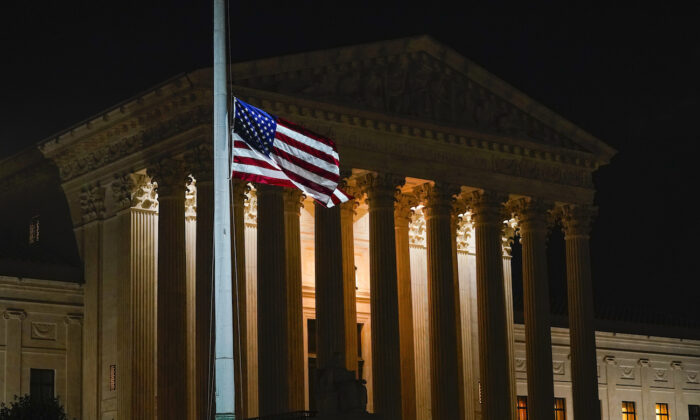
The American flag blows in the wind after it was lowered to half-staff Friday, Sept. 18, 2020, in Washington, after the Supreme Court announced that Supreme Court Justice Ruth Bader Ginsburg has died of metastatic pancreatic cancer at age 87. (AP Photo/Alex Brandon)
By Peter Svab
The formation of a totalitarian state is just about complete in America as the most powerful public and private sector actors unify behind the idea that actions to stamp out dissent can be justified, according to several experts on modern totalitarian ideologies.
While many have warned about the rise of fascism or socialism in “the land of the free,” the ideas have largely been vague or fragmented, focusing on individual events or actors. Recent events, however, indicate that seemingly unconnected pieces of the oppression puzzle are fitting together to form a comprehensive system, according to Michael Rectenwald, a retired liberal arts professor at New York University.
But many Americans, it appears, have been caught off guard or aren’t even aware of the newly forming regime, as the idea of elected officials, government bureaucrats, large corporations, the establishment academia, think tanks and nonprofits, the legacy media, and even seemingly grassroot movements all working in concert toward some evil purpose seems preposterous. Is a large portion of the country in on a conspiracy?
The reality now emerges that no massive conspiracy was in fact needed—merely an ideological alignment and some informal coordination, Rectenwald argues.
Despite the lack of formal overarching organization, the American socialist regime is indeed totalitarian, as the root of its ideology requires politically motivated coercion, he told The Epoch Times. The power of the regime is not yet absolute but it’s becoming increasingly effective as it erodes the values, checks, and balances against tyranny established by traditional beliefs and enshrined in the American founding.
The effects can be seen throughout society. Americans, regardless of their income, demographics, or social stature are being fired from jobs, getting stripped of access to basic services such as banking and social media, or having their businesses crippled for voicing political opinions and belonging to a designated political underclass. Access to sources of information unsanctioned by the regime is becoming increasingly difficult. Some figures of power and influence are sketching the next step, labelling large segments of society as “extremists” and potential terrorists who need to be “deprogrammed.”
While the onset of the regime appears tied to events of recent years—the presidency of Donald Trump, the CCP (Chinese Communist Party) viruspandemic, the Capitol intrusion of Jan. 6—its roots go back decades.
Is It Really Totalitarian?
Totalitarian regimes are commonly understood as constituting a government headed by a dictator that regiments the economy, censors the media, and quells dissent by force. That is not the case in America but it’s also a misunderstanding of how such regimes function, literature on totalitarianism indicates.
To claim power, the regimes don’t initially need to control every aspect of society through government.
Adolf Hitler, leader of the National Socialist Workers Party in Nazi Germany, used various means to control the economy, including gaining compliance of industry leaders voluntarily, through intimidation, or through replacing the executives with party loyalists.
Similarly, the regime rearing its head in America relies on corporate executives to implement its agenda voluntarily but also through intimidation by online brigades of activists and journalists who take initiative to launch negative PR campaigns and boycotts to progress their preferred societal structure.
Also, Hitler initially didn’t control the spread of information via government censorship but rather through his brigades of street thugs, the “brown shirts,” who would intimidate and physically prevent his opponents from speaking publicly.
The tactic parallels the often successful efforts to “cancel” and “shut down” public speakers by activists and violent actors, such as Antifa.
Dissenting media in America haven’t been silenced by the government directly as of yet. But they are stymied in other ways.
In the digital age, media largely rely on reaching and growing their audience through social media and web search engines, which are dominated by Facebook and Google. Both companies have in place mechanisms to crack down on dissenting media.
Google gives preference in its search results to sources it deems “authoritative.” Search results indicate the company tends to consider media ideologically close to it to be more authoritative. Such media can then produce hit pieces on their competitors, giving Google justification to slash the “authoritativeness” of the dissenters.
Facebook employs third-party fact checkers who have the discretion to label content as “false” and thus reduce the audience on its platform. Virtually all the fact checkers focused on American content are ideologically aligned with Facebook.
Attempts to set up alternative social media have run into yet more fundamental obstacles, as demonstrated by Parler, whose mobile app was terminated by Google and Apple, while the company was kicked off Amazon’s servers.
To the degree that a totalitarian regime requires a police state, there’s no law in America targeting dissenters explicitly. But there are troubling signs of selective, politically motivated enforcement. Signs go back to the IRS’s targeting of Tea Party groups or the difference in treatment received by former Trump adviser Lt. Gen Michael Flynn and former FBI deputy Director Andrew McCabe—both allegedly lying to investigators but only one getting prosecuted. The situation may get still worse as the restrictions tied to the CCP virus see broad swaths of ordinary human behavior being considered “illegal,” opening the door to nearly universal political targeting.
“I think the means by which a police state is being set up is the demonization of Trump supporters and the likely use of medical passports to institute the effective equivalent of social credit scores,” Rectenwald said.
While loyalty to the government and to a specific political party plays a major role, it’s the allegiance to the ideological root of totalitarianism that gives it its foot soldiers, literature on the subject indicates.
Totalitarian Ideology
The element “that holds totalitarianism together as a composite of intellectual elements” is the ambition of fundamentally reimagining society—“the intention to create a ‘New Man,’” explained author Richard Shorten in “Modernism and Totalitarianism: Rethinking the Intellectual Sources of Nazism and Stalinism, 1945 to the Present.”
Various ideologies have framed the ambition differently, based on what they posited as the key to the transformation.
Karl Marx, co-author of the Communist Manifesto, viewed the control of the economy as primary, describing socialism as “socialized man, the associated producers, rationally regulating their interchange with Nature, bringing it under their common control, instead of being ruled by it as by the blind forces of Nature,” in his Das Kapital.
Adolf Hitler, leader of the National Socialist Workers Party in Nazi Germany, viewed race as primary. People would become “socialized”—that is transformed and perfected—by removing Jews and other supposedly “lesser” races from society, he claimed.
The most dominant among the current ideologies stem from the so-called “critical theories,” where the perfected society is defined by “equity,” meaning elimination of differences in outcomes for people in demographic categories deemed historically marginalized. The goal is to be achieved by eliminating the ever-present “white supremacy,” however the ideologues currently define it.
While such ideologies commonly prescribe collectivism, calling for national or even international unification behind their agenda, they are elitist and dictatorial in practice as they find mankind never “woke” enough to follow their agenda voluntarily.
In Marx’s prophecies, the revolution was supposed to occur spontaneously. Yet it never did, leading Vladimir Lenin, the first head of the Soviet Union, to conclude that the revolution will need leadership after all.
“The idea is that you have some enlightened party … who understand the problem of the proletariat better than the proletariat does and is going to shepherd them through the revolution that they need to have for the greater good,” explained James Lindsay, author of “Cynical Theories: How Activist Scholarship Made Everything about Race, Gender, and Identity—and Why This Harms Everybody.”
Elements of this intellectual foundation can be found in ideologies of many current political forces, from neo-nazis and anarcho-communists, through to progressives and to some extent even neoliberals and neoconservatives, Lindsay acknowledged.
“This is why you see so many people today saying that the only possible answers are a full return to classical liberalism or a complete rejection of liberalism entirely as fatally disposed to create progressivism, neoliberalism, etc.,” he said.
That’s not to say these ideologies are openly advocating totalitarianism but rather that they inevitably lead to it.
The roadmap could be summarized as follows:
There’s something fundamentally and intolerably wrong with current reality
There’s a plan to fix it requiring a whole society buy-in
People opposing the plan need to be educated about the plan so they accept it
People who resist the persuasion need to be reeducated, even against their will
People who won’t accept the plan no matter what need to be removed from society.
“I think that’s the general thrust,” Lindsay said. “We can make the world the way we want it to be if we all just get on the same page and same project. It’s a disaster, frankly.”
Points four and five now appear to be in progress.
Former Facebook executive Alex Stamos recently labeled the widespread questioning of the 2020 election results as “violent extremism,” which social media companies should eradicate the same way they countered online recruitment content from the ISIS terrorist group.
The “core issue,” he said, is that “we have given a lot of leeway, both in traditional media and on social media, to people to have a very broad range of political views” and this has led to the emergence of “more and more radical” alternative media like OAN and Newsmax.
Stamos then mused about how to reform Americans who’ve tuned in to the dissenters.
“How do you bring those people back into the mainstream of fact-based reporting and try to get us all back into the same consensus reality?” he asked in a CNN interview.
“And can you? Is that possible?” CNN host Brian Stelter added.
The logic goes as follows: Trump claimed the election was stolen through fraud and other illegalities. That has not been proven in court and is thus false. People who stormed the U.S. Capitol on Jan. 6 and managed to break inside and disrupt the electoral vote counting did so because they believed the election was stolen. Therefore, anybody who questions the legitimacy of the election results is an extremist and potentially a terrorist.
With tens of thousands of troops assembled to guard the inauguration of President-elect Joe Biden, Rep. Steve Cohen (D-Tenn.) recently told CNNthat all guard members who voted for Trump belong to a “suspect group” that “might want to do something,” alluding to past leaders of other countries who were “killed by their own people.”
Former FBI Director James Comey recently said the Republican party needs to be “burned down or changed.”
“They want a one party state,” commented conservative filmmaker Dinesh D’Souza in a recent podcast. “That is not to say they don’t want an opposition. They want a token opposition. They want Republicans where they get to say what kind of Republican is ok.”
Just as Marx blamed the ills of the world on capitalists and Hitler on Jews, the current regime tends to blame various permutations of “white supremacy.”
“Expel the Republican members of Congress who incited the white supremacist attempted coup,” said Rep. Cori Bush (D-Mo.) in a recent tweet, garnering some 300,000 likes.
She was referring to the Republican lawmakers who raised objections on Jan. 6 to election results in Arizona and Pennsylvania. Their objections were voted down.
“Can U.S. Spy Agencies Stop White Terror?” Daily Beast’s Jeff Stein asked in a recent headline, concluding that a call for “secret police” to sniff out “extremist” Americans “may well get renewed attention.”
Under the regime, allegations of election fraud—de facto questioning the legitimacy of the leader—have become incitement of terrorism. YouTube (owned by Google), Facebook, and Twitter have either banned content that claims the election was rigged or are furnishing it with warning labels. Twitter chief executive Jack Dorsey was recently recorded as saying that banning the president’s account was just the beginning.
The approach closely mirrors that of the Chinese communist regime, which commonly targets dissidents for “subverting” the state or “spreading rumors.”
What’s the Alternative?
If calls for radically reorganizing the world are inherently totalitarian, how is the world to avoid them? The question appears to be its own answer. If totalitarianism inherently requires allegiance to its ideology, it can’t exist in a society with a lack of such allegiance.
The United States was founded on the idea that individual rights are God-given and unalienable. The idea, rooted in traditional beliefs that human morality is of divine origin, stands a bulwark against any attempt to assail people’s rights even for their own good.
“If you’re not a believer in actual God, you can posit a God’s ideal on the matter … We have to posit some arbiter who’s above and beyond our own prejudices and biases in order to ensure these kinds of rights. … Because otherwise you have this infinitely malleable situation in which people with power and coercive potential can eliminate and rationalize the elimination of rights willy-nilly,” Rectenwald said.
Editor’s Note: Here’s another level of censorship by Google/YouTube whereby they decide what’s appropriate for viewers to watch or not, then label it as such (especially political content they choose not to agree with). Welcome to 1984 today!.
Attorney L. Lin Wood sits down for an exclusive interview with Joshua Philipp on the 2020 US presidential elections, the possibility of martial law, the Georgia Senate runoff, China’s infiltration of America, and why he fights for the truth.





 Liberty International News