We Have No Reason to Believe 5G is Safe | Scientific American

By Joel Moskovitz

Editor’s Note: Science is allegedly the foundation for sound reasoning when it comes to evaluating the short and long-term benefits (and drawbacks) of any new technology, but in the case of 5G there is no reliable science to assure us of its safety. Quite the contrary, it’s being deployed globally without concern for the safety of those exposed.

The telecommunications industry and their experts have accused many scientists who have researched the effects of cell phone radiation of “fear mongering” over the advent of wireless technology’s 5G. Since much of our research is publicly-funded, we believe it is our ethical responsibility to inform the public about what the peer-reviewed scientific literature tells us about the health risks from wireless radiation.

The chairman of the Federal Communications Commission (FCC) recently announced through a press release that the commission will soon reaffirm the radio frequency radiation (RFR) exposure limits that the FCC adopted in the late 1990s. These limits are based upon a behavioral change in rats exposed to microwave radiation and were designed to protect us from short-term heating risks due to RFR exposure.

Yet, since the FCC adopted these limits based largely on research from the 1980s, the preponderance of peer-reviewed research, more than 500 studies, have found harmful biologic or health effects from exposure to RFR at intensities too low to cause significant heating.

Citing this large body of research, more than 240 scientists who have published peer-reviewed research on the biologic and health effects of nonionizing electromagnetic fields (EMF) signed the International EMF Scientist Appeal, which calls for stronger exposure limits. The appeal makes the following assertions:

“Numerous recent scientific publications have shown that EMF affects living organisms at levels well below most international and national guidelines. Effects include increased cancer risk, cellular stress, increase in harmful free radicals, genetic damages, structural and functional changes of the reproductive system, learning and memory deficits, neurological disorders, and negative impacts on general well-being in humans. Damage goes well beyond the human race, as there is growing evidence of harmful effects to both plant and animal life.”

The scientists who signed this appeal arguably constitute the majority of experts on the effects of nonionizing radiation. They have published more than 2,000 papers and letters on EMF in professional journals.

The FCC’s RFR exposure limits regulate the intensity of exposure, taking into account the frequency of the carrier waves, but ignore the signaling properties of the RFR. Along with the patterning and duration of exposures, certain characteristics of the signal (e.g., pulsing, polarization)increase the biologic and health impacts of the exposure. New exposure limits are needed which account for these differential effects. Moreover, these limits should be based on a biological effect, not a change in a laboratory rat’s behavior.

The World Health Organization’s International Agency for Research on Cancer (IARC) classified RFR as “possibly carcinogenic to humans” in 2011. Last year, a $30 million study conducted by the U.S. National Toxicology Program (NTP) found “clear evidence” that two years of exposure to cell phone RFR increased cancer in male rats and damaged DNA in rats and mice of both sexes. The Ramazzini Institute in Italy replicated the key finding of the NTP using a different carrier frequency and much weaker exposure to cell phone radiation over the life of the rats.

Based upon the research published since 2011, including human and animal studies and mechanistic data, the IARC has recently prioritized RFR to be reviewed again in the next five years. Since many EMF scientists believe we now have sufficient evidence to consider RFR as either a probable or known human carcinogen, the IARC will likely upgrade the carcinogenic potential of RFR in the near future.

Nonetheless, without conducting a formal risk assessment or a systematic review of the research on RFR health effects, the FDA recently reaffirmed the FCC’s 1996 exposure limits in a letter to the FCC, stating that the agency had “concluded that no changes to the current standards are warranted at this time,” and that “NTP’s experimental findings should not be applied to human cell phone usage.” The letter stated that “the available scientific evidence to date does not support adverse health effects in humans due to exposures at or under the current limits.”

The latest cellular technology, 5G, will employ millimeter waves for the first time in addition to microwaves that have been in use for older cellular technologies, 2G through 4G. Given limited reach, 5G will require cell antennas every 100 to 200 meters, exposing many people to millimeter wave radiation. 5G also employs new technologies (e.g., active antennas capable of beam-forming; phased arrays; massive multiple inputs and outputs, known as massive MIMO) which pose unique challenges for measuring exposures.

Millimeter waves are mostly absorbed within a few millimeters of human skin and in the surface layers of the cornea. Short-term exposure can have adverse physiological effects in the peripheral nervous system, the immune system and the cardiovascular system. The research suggests that long-term exposure may pose health risks to the skin (e.g., melanoma), the eyes (e.g., ocular melanoma) and the testes (e.g., sterility).

Since 5G is a new technology, there is no research on health effects, so we are “flying blind” to quote a U.S. senator. However, we have considerable evidence about the harmful effects of 2G and 3G. Little is known the effects of exposure to 4G, a 10-year-old technology, because governments have been remiss in funding this research. Meanwhile, we are seeing increases in certain types of head and neck tumors in tumor registries, which may be at least partially attributable to the proliferation of cell phone radiation. These increases are consistent with results from case-control studies of tumor risk in heavy cell phone users.

5G will not replace 4G; it will accompany 4G for the near future and possibly over the long term. If there are synergistic effects from simultaneous exposures to multiple types of RFR, our overall risk of harm from RFR may increase substantially. Cancer is not the only risk as there is considerable evidence that RFR causes neurological disorders and reproductive harm, likely due to oxidative stress.

As a society, should we invest hundreds of billions of dollars deploying 5G, a cellular technology that requires the installation of 800,000 or more new cell antenna sites in the U.S. close to where we live, work and play?

Instead, we should support the recommendations of the 250 scientists and medical doctors who signed the 5G Appeal that calls for an immediate moratorium on the deployment of 5G and demand that our government fund the research needed to adopt biologically based exposure limits that protect our health and safety.

Source: Scientific American

5G drones to blanket the nation, beaming down cancer-causing radiation from the skies… and there’s nowhere they can’t find you | Natural News

Editor’s Note: 5G technology is being rapidly deployed in the next few years without any concern for the short or long-term health effects upon human beings (and other living creatures as well). It’s being touted as a “technological boon” (certainly for the companies who’ll profit from it), but for the rest of us? The jury is out, because no trial about “benefits vs. dangers” has been set.

Whether we like it or not, 5G (fifth generation) wireless internet technology is slowly but surely being rolled out across the globe. Promising faster speeds, better connectivity and virtually instant data transfers, 5G is being hailed as a technological boon.

Service providers promise that 5G will enable downloads at 100 times greater speeds than 4G technology. This would translate to the ability to download a full HD movie in less than 10 seconds. 5G also promises more stable connections and greater capacity, enabling networks to handle multiple high-demand applications simultaneously.

However, while the media continues to sing its praises, very little has been said about its potential dangers – of which there are many. Studies have found that 5G technology will emit radiation at levels never before experienced by human beings, which could have devastating – and irreversible – effects.

Despite the potentially serious dangers, however, Waking Times reported recently that a collaboration of tech giants and defense contractors will soon be launching huge, football-sized drones into the stratosphere above Hawaii, from where they will beam massive amounts of 5G radiation down to the Earth below. (Related: Experts WARN — 5G technology will blanket the Earth with ultra-high microwave frequencies.)

“Airborne overhead 5G communication”

According to the Use Determination Application compiled for the Research Corporation of the University of Hawaii, the purpose of the HAWK30 program “is to develop new airborne overhead 5G communication, which would provide strong wireless service over a large area, including deep valleys, remote lands, and over the ocean.”

The Federal Aviation Administration (FAA) has granted the project a COA2 certificate of authorization, which will allow the drones to operate in a 150 square mile radius for up to two years. The area which will be covered by the drones includes the Molokini crater, a popular tourist spot that boasts 300,000 visitors annually, as well as beautiful tropical waters that are home to tropical fish and a special humpback whale national marine sanctuary.

Experts warn, however, that these drones pose significant risks. Waking Times reported:

Radiation harm is a concern as one HAWK30 drone broadcasts the equivalent of 1800 cell towers, albeit at a much lower power level, however, power is irrelevant to health effects except for tissue heating. Thousands of peer reviewed research studies document the non-thermal effects of wireless radiation on humans and other living things. In some experiments the lowest power levels caused the most leakage in the blood-brain barrier. An inverse relationship between power and health effects has even been shown. Wireless technology is not made safe by reducing the power.

The HAPS drones which will be used in the project will fly at 70 miles per hour and have a 260-foot wingspan and 10 propellers each. Each drone will boast cell site coverage of 124 miles in diameter, creating a blanket of radiation over the entire area.

There are other issues in addition to radiation concerns. Waking Times warns:

In addition to irradiating all life forms within range, this type of massive flying wing has a bad safety record. Two high altitude drones have been built by AeroVironment and they both fell from the sky and crashed. In fact, the drone is so experimental that almost no regulations exist to govern it. Project officials appear ready to take full advantage of this, having boasted about schooling the FAA and writing their own rules.

But a 1.5 ton HAWK30 falling from the stratosphere could have devastating effects. Only 2300 Newtons of force crush a human skull wearing a helmet. Falling from a height of 70,000 feet, a 1.5 ton object would impact with 266,756,000 Newtons of force!

Eventually the project leaders plan to turn the island of L?na’I into a manufacturing plant and launch pad for thousands of drones which will be sent across the globe, blanketing the planet in cancer-causing radiation. Learn more about the dangers of 5G technology at Radiation.news.

Source: Natural News

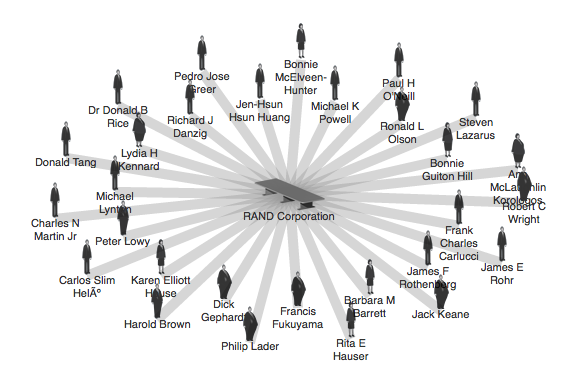
TheyRule.net

Check out the interconnections between Boards of Directors, Corporations, Institutions, etc. with this interesting website.

Source: TheyRule.net

How 5G will change (destroy) the world | World Economic Forum

large_m297nKs9NwkwFNcZIsHG-pB8DPtURngI4QodH4rR8Rc

Editor’s Note: The unforeseen consequences of unleashing an electronic network worldwide with nowhere to hide, with a bombardment of such powerful frequencies as to disrupt every living system with proven oxygen shattering and immune suppressing technology is beginning to unfold. This article is an industry puff piece for the global leaders of industry promoting 5G as the next panacea for all our problems. My friends, this is a crisis of consciousness and will forever map the trajectory of human evolution. Only robots will survive this 5G rollout. Read it and weep!

By Don Rosenberg

It is not an easy time to be an internationalist, to seek global solutions to global problems amid what feels like one of history’s periodic inclinations toward divisiveness.

Yet, ironically, we’re on the verge of a new age of interconnectedness, when the daily lives of people across the planet will be more closely intertwined than ever. Advances in technology will usher in the age of fifth generation, or 5G, telecommunications. And, if past is prologue, this technological evolution will lead to dramatic societal changes.

The first generation of mobile communications, with brick-sized phones, brought just a handful of users expensive and often unreliable analogue voice calling. The second generation introduced digital voice service that was less likely to be dropped, available to many more people and ultimately cheaper to use. 3G ushered in the mobile internet, mobile computing, and the proliferation of apps. 4G (often called LTE) made possible all we have come to expect of mobile broadband: streaming video and audio; instantaneous ride hailing; the explosion of social media.

We take all this connectivity for granted, but the engineering inside the device in your bag or pocket today would have seemed impossible less than 20 years ago.

So, where will 5G take us?

Think about a world in which not just people but all things are connected: cars to the roads they are on; doctors to the personal medical devices of their patients; augmented reality available to help people shop and learn and explore wherever they are. This requires a massive increase in the level of connectivity.

5G is the technological answer, making possible billions of new connections, and making those connections secure and instantaneous. 5G will impact every industry – autos, healthcare, manufacturing and distribution, emergency services, just to name a few. And 5G is purposely designed so that these industries can take advantage of cellular connectivity in ways that wouldn’t have been possible before, and to scale upwards as use of 5G expands.

But generational change in mobile communications doesn’t just appear overnight. It requires significant effort in research and development and the resources necessary to support that effort. Work on 4G took nearly a decade and the challenges were not easy. Consider one of tens of thousands of problems that needed to be solved as described by an engineer at Qualcomm, where much of this technology was invented:

“When the signal leaves the base station, it can undergo a loss of up to 130 decibels before it reaches your mobile phone. To put that loss into perspective, if you consider the transmitted signal power to be roughly the size of the Earth, then the received signal power would be equivalent to the size of a tiny bacteria.”

That is a tremendous loss of power, and it requires some pretty impressive engineering to compensate for the effect of the loss on the words, pictures, and other data we send and receive across the airwaves in a transparent, seamless and instantaneous way.

But we weren’t alone. The international engineering co-operation that goes into development of a telecom standard illustrates how much can be achieved when disparate national, commercial and scientific parties work together for the common good.

Like 3G and 4G, 5G is the responsibility of the standards-setting organisation 3GPP, where the handful of companies that invent technologies come together with many, many more companies who will develop products that implement those technologies.

Think about this process for a moment: engineers from rival inventing companies, rival product makers, rival wireless network operators, all from different countries and continents, discussing, testing, striving to perfect tens of thousands of different technical solutions that ultimately make up a standard like 5G.

They judge each technical solution using a merit-based, consensus-building approach. This process has been at the foundation of a technological revolution that spawned myriad new industries, millions of new jobs and well over a $1 trillion in economic growth.

It’s the fusion of commercial self-interest with the recognition that some problems are best solved by working together. And it’s not a bad model of human behaviour if we are to meet the World Economic Forum’s goal this year to address the problems of “a fractured world”.

The benefits and advantages of 5G technology are expected to be available sometime in 2019. We believe 5G will change the world even more profoundly than 3G and 4G; that it will be as revolutionary as electricity or the automobile, benefitting entire economies and entire societies.

Developing nations have rivalled or surpassed their industrialised counterparts in benefiting from the deployment of mobile technology, and there’s every reason to think 5G will have an even bigger levelling effect than its predecessors.

Economists estimate the global economic impact of 5G in new goods and services will reach $12 trillion by 2035 as 5G moves mobile technology from connecting people to people and information, towards connecting people to everything.


Many of the benefits probably aren’t yet apparent to us. Wireless network operators initially resisted proposals to give their customers mobile access to the internet, questioning why they would want it. At the dawn of 4G’s adoption no one could have predicted the new business models that grew on the back of mobile broadband, like Uber, Spotify and Facebook.

Now, according to the European Patent Office, the number of patent applications related to “smart connected objects” has surged 54% over the last three years, suggesting new, related and as-yet unknown inventions will arrive even before 5G becomes available.

This is news that should encourage us amid glum commentaries on the state of the world. There is promise yet in what we’re capable of achieving.

Source: World Economic Forum

Plans To Release Entire Fukushima Waste Into Ocean Confirmed By Tepco | Social Consciousness

Editor’s Note: The dumping of highly radioactive material in the Pacific Ocean from Japan’s Fukushima has been occurring for years with no plans to stop dumping or bio-remediate this massive problem for all life in our oceans. This is yet another by-product of civilization which has been ignored by government, scientists and climate-change activists.  

Tepco has confirmed it plans to release the radioactive material from the Fukushima plant into the ocean saying that the “decision has already been made”. The decision has an upset local fisherman who says the decision will kill their industry as a result of a massive loss of sea life.

Under the controversial plan, which could be a massive environmental disaster, the radioactive material tritium, which is being used to cool reactors whose cooling systems were damaged in 2011 tsunami, will now be released into the ocean.

rt.com reports: “I’m very sorry that Tepco has been prolonging making a decision,” the new chairman of Tokyo Electric Power Company Holdings (TEPCO) Takashi Kawamura told reporters on Thursday, reported Reuters. “We could have decided much earlier, and that is Tepco’s responsibility.”

The plan still requires the approval of the Japanese government before TEPCO can proceed. Some 770,000 tons (metric) of tritium-containing water is currently stored in 580 tanks at the plant, reported the Japan Times. Toxic water at the plant is currently being treated through a processing system that can remove 62 different types of radioactive material, except tritium.

The local fishermen cooperative has hit out at the plan, saying it had not been discussed with local residents. “Releasing (tritium) into the sea will create a new wave of unfounded rumors, making our efforts all for naught,” Kanji Tachiya, head of a local fishermen cooperative, told the Japan Times.

Situated 10 meters above sea-level, three of the nuclear power plant’s six reactors’ cooling systems were crippled by flooding caused by the tsunami, making the disaster the worst since the Chernobyl catastrophe in the USSR in 1986.

The plan still requires the approval of the Japanese government before TEPCO can proceed. Related: Fukushima Radiation: The Entire Pacific Ocean Has Been Contaminated, And It’s Going To Get Worse Fukushima Radiation: Your Days of Eating Pacific Ocean Fish Are Over, Or Worse Officials Warn: Fukushima Has Now Contaminated 1/3 Of The World’s Oceans

Source: Social Consciousness

Big Pharma Owns The Corporate Media, But Americans Are Waking Up And Fighting Back | Ring of Fire

am_law_0432By Gary Bentley

When you tune in to MSNBC, Fox News, or any of the other corporate media machines, you’re probably not going to hear much about the methods in which big pharma is taking advantage of consumers either through price gouging or medical mishaps. The reason for this is because talking about those stories creates a major conflict of interest for the people behind the scenes. Mike Papantonio discusses this with journalist and author Martha Rosenberg.

Transcript of the above video:

Mike:
According to a 2009 study by Fairness and Accuracy in Reporting, with the exception of CBS every major media outlet in the United States shares at least one board member with at least one drug company. Let me put it in perspective for you, these board members wake up, they go to a meeting at Merck or Pfizer, and then they have their driver take them over to a meeting with NBC to decide what kind of programming that network is going to air. For those board members who aren’t pulling double duty with a media conglomerate and a big drug company, they still understand that they can’t be honest and objective about big pharma because big pharma pays their bills.

Drug companies spend about $5 billion a year on advertising with these corporate media outlets, so when Pfizer or Merck or Eli Lilly, or any of the drug companies, kill or cripple Americans with defective drugs, do you really think these board members are going to allow their story to be told on the air? It can take anywhere from three days to a full week before the media reports on a drug or a medical device recall, if they report at all.

In the case of Invokana it took 32 days before television outlets reported a single story involving an FDA warning about the potential problems with the product. The FDA began warning about the extreme dangers of Cook IVC filters as early as 2010 and it took about five years, five years, before television media started reporting that to the public. It’s worth pointing out that in these instances it was only through non-corporate independent media outlets that these stories were told at all. It was the outlets who weren’t being forced, they weren’t being forced to remain silent about the drug industry.

You can replace IVC or Invokana with any other drug or product and the story is all the same. Stryker hip implants, C8, Vioxx, RoundUp, Xarelto, talcum powder, they’re all the same thing. The corporate media doesn’t care about these stories because they either share board members with these companies, or because they want those companies to keep throwing dollars their way in big advertising dollars. These gigantic media corporations aren’t going to do anything to threaten their relationship with big advertisers.

Drugs are cash cow advertising bonanza for corporate media. Fortunately an increase in number of Americans who are starting to wake up and realize that the mainstream media shouldn’t be trusted on issues like this. In recent years we’ve seen the alternative media experience rapid growth and mainstream media has been losing credibility at a staggering rate. Americans are starting to look elsewhere for the truth about what’s really going on out there. As a result of that advertising money kicking around the corporate media isn’t permitted to report complex drug stories anymore.

It’s as if they don’t understand things like the link between crony capitalism and the revolving door between the FDA and the drug industry, but the media is only one side of the story here. Big pharma knows that if it wants to continue manipulating the public it has to start with our elected officials in Washington DC. According to OpenSecrets, big pharma spent more than $58 million on politicians just in 2016, the most amount they’ve spend on a direct contribution in the last quarter century.

When it comes to lobbying, few industry spend more than big pharma did last year. They spent a staggering $244 million dollars to influence our elected leaders in Washington DC. It looks like things are about to get much worse, you see, big pharma understands that the ridiculous … their price gouging is starting to draw negative attention from the American public, and no matter how much they spend advertising or buying our politicians, they can’t keep the public anger down forever.

According to a new report by ProPublica, drug companies are offering huge money to any scientist, any professor or academic willing to author studies that are going to show that these drug markups are necessary, that they’re just fine. Their goal is to spread around enough money at universities to develop scientists and doctors who are going to create this fantasy story about how price gouging is just great for the American public, and then that story will be run by corporate media, dominated by the drug industry.

Joining me now to talk about big pharma’s influence over our daily lives and their quest for even more power is Martha Rosenberg, an investigative health reporter and the author of the book, Born With A Junk Food Deficiency. Martha, is it an overstatement to say that big pharma, they have a firmer grip on our daily lives than most people realize, where it comes to the drugs that we take?

Martha:
No. No Mike, I don’t think it’s an overstatement at all. I think this is the year that we celebrate 20 years of direct-to-consumer ads. Any time people are watching TV, they’re seeing the drug ads, and then on top of that there’s PR campaigns going on. One of which on the Sunday news shows that were trying to objectively talk about Obamacare, they were financed by a PR campaign called Go Boldly, which is trying to defend the high prices. In addition to the direct-

Mike:
Martha, all you have to do is watch the nightly news. You’re liable to see eight advertisements for Merck and Pfizer, Johnson & Johnson. How can that not be influencing the reporters or the executive producers of that programming? They know where their money is coming from, they know where they’re getting this money, that some cat on the 50th floor makes this decision that says, “You know, we can’t tell these stories where drugs are killing people. We can’t tell it because we’re going to lose advertising dollars.” Can’t you basically already see that just by watching the nightly news and seeing those advertisements?

Martha:
Of course you can. They won’t report on the dangers which of course you and I know about, and also they plant the idea in many people’s minds that they are sick and they need the drugs. That disease mongering is a big part of it. The screening, when they’re always saying, “Ask your doctor, you might have this or that disease,” the screening causes over-diagnosis, over-treatment and over-medication, which pharma loves.

Mike:
Most people who handle cases in this industry, they look to you first on a lot of this reporting because you catch the stories certainly before corporate media does, or if corporate media gets it before you, corporate media doesn’t tell the stories because they’re ordered not to by their advertisers. But it’s not just corporate media that’s the problem, don’t we also have a problem with, they’ve put so much money into the political schemes taking place in DC. They bought politicians, there’s no other way to put it. The money is staggering, $244 million just for lobbying, endless money to individual campaigns. Don’t you see that happening as you follow these stories?

Martha:
Definitely. I think that it’s one of the most expensive lobbying machines there is, the big pharma. What they’re doing now, big pharma and bio pharma are trying to defend their price, so we see a lot of that. Yeah, there’s no question. Up until the Affordable Care Act there was no hiding all the perks that doctors got, and there were examples in China, GSK, which is a big pharmaceutical company, was buying sex bribery to sell their drugs. Here in the US according to charges, Victory Pharma was buying lap dances for doctors to prescribe its opiates.

Mike:
There’s worst stories than that, some of the stories we can’t even tell on the air. Let’s talk about this new ProPublica report about big pharma trying to pay scientists, I call them biostitutes. They’re doctors and scientists who will write anything the industry asks them to write for a check of $100,000. They’ll write anything.

Right now we have the industry going around trying to find these biostitutes that will say, “It’s just fine that the industry has these huge markups, even though sometimes it’s 6,000% markup on a drug, 10,000% markup.” They actually are going to find scientists and doctors who say, “That’s absolutely appropriate. The industry needs to do it.” You and I know that’s a lie because most of the money that they spend goes to advertising, it doesn’t go to R&D. What’s your take on that?

Martha:
Yeah, right now what pharma has done Mike is, it’s replaced its blockbusters like Viagra and Lipitor with what we call biologics. That would be your vaccines and your liquid injectable drugs. That enables them to charge what they’re now charging. Now they’re in the process of trying to defend those charges. Now, the ProPublica report, it reveals the machinery between academia and big pharma, which is not really new.

The ghostwriting and what we used to call conflicts of interests, they now call private-public partnerships and it’s our tax dollars going on. But yeah, the academics are now writing the papers and not only are, pardon my French but not only are the journals pimping for big pharma but pharma will create its own journals to make sure its message gets out there. These academics are part of the whole thing.

Mike:
Okay, so let me put these parts together. The industry goes out and finds these biostitutes, who will say anything for the right amount of money. I see them in court every single day, up on the witness stand, testifying, lying, knowing they’re lying, absolutely misrepresenting the truth about everything, because they’re getting paid a lot of money. Now what you have is you have them, they find the biostitute, the biostitute writes the story and the next thing you know, mainstream corporate media, like NBC, MSNBC, ABC is reporting that story that was created by the biostitute. Did I get that right?

Martha:
Absolutely, absolutely. It’s stenography. It’s not reporting, it’s stenography.

Mike:
As I follow this, of course, this story is going to continue to build because we’re going to start seeing a lot more of these stories coming out, they’re horrendous stories. Last week we saw Bernie Sanders pushing back, the Democrats won’t get behind him because the Democrats are as much part of this as the Republicans are. The pharmaceutical industry, they’re just spreading around a lot of money. I have to tell you something, I appreciate you joining me tonight, okay?

Martha:
Thank you so much. Thank you for your good work Mike.

Source: Ring of Fire

Top 9 ethical issues in artificial intelligence | World Economic Forum

HM_JF19_Page_37_Image_0001_0By Julie Bossmann

Optimizing logistics, detecting fraud, composing art, conducting research, providing translations: intelligent machine systems are transforming our lives for the better. As these systems become more capable, our world becomes more efficient and consequently richer.

Tech giants such as Alphabet, Amazon, Facebook, IBM and Microsoft – as well as individuals like Stephen Hawking and Elon Musk – believe that now is the right time to talk about the nearly boundless landscape of artificial intelligence. In many ways, this is just as much a new frontier for ethics and risk assessment as it is for emerging technology. So which issues and conversations keep AI experts up at night?


1. Unemployment. What happens after the end of jobs?

The hierarchy of labour is concerned primarily with automation. As we’ve invented ways to automate jobs, we could create room for people to assume more complex roles, moving from the physical work that dominated the pre-industrial globe to the cognitive labour that characterizes strategic and administrative work in our globalized society.

Look at trucking: it currently employs millions of individuals in the United States alone. What will happen to them if the self-driving trucks promised by Tesla’s Elon Musk become widely available in the next decade? But on the other hand, if we consider the lower risk of accidents, self-driving trucks seem like an ethical choice. The same scenario could happen to office workers, as well as to the majority of the workforce in developed countries.

This is where we come to the question of how we are going to spend our time. Most people still rely on selling their time to have enough income to sustain themselves and their families. We can only hope that this opportunity will enable people to find meaning in non-labour activities, such as caring for their families, engaging with their communities and learning new ways to contribute to human society.

If we succeed with the transition, one day we might look back and think that it was barbaric that human beings were required to sell the majority of their waking time just to be able to live.

2. Inequality. How do we distribute the wealth created by machines?

Our economic system is based on compensation for contribution to the economy, often assessed using an hourly wage. The majority of companies are still dependent on hourly work when it comes to products and services. But by using artificial intelligence, a company can drastically cut down on relying on the human workforce, and this means that revenues will go to fewer people. Consequently, individuals who have ownership in AI-driven companies will make all the money.

We are already seeing a widening wealth gap, where start-up founders take home a large portion of the economic surplus they create. In 2014, roughly the same revenues were generated by the three biggest companies in Detroit and the three biggest companies in Silicon Valley … only in Silicon Valley there were 10 times fewer employees.

If we’re truly imagining a post-work society, how do we structure a fair post-labour economy?

3. Humanity. How do machines affect our behaviour and interaction?

Artificially intelligent bots are becoming better and better at modelling human conversation and relationships. In 2015, a bot named Eugene Goostman won the Turing Challenge for the first time. In this challenge, human raters used text input to chat with an unknown entity, then guessed whether they had been chatting with a human or a machine. Eugene Goostman fooled more than half of the human raters into thinking they had been talking to a human being.

This milestone is only the start of an age where we will frequently interact with machines as if they are humans; whether in customer service or sales. While humans are limited in the attention and kindness that they can expend on another person, artificial bots can channel virtually unlimited resources into building relationships.

Even though not many of us are aware of this, we are already witnesses to how machines can trigger the reward centres in the human brain. Just look at click-bait headlines and video games. These headlines are often optimized with A/B testing, a rudimentary form of algorithmic optimization for content to capture our attention. This and other methods are used to make numerous video and mobile games become addictive. Tech addiction is the new frontier of human dependency.

On the other hand, maybe we can think of a different use for software, which has already become effective at directing human attention and triggering certain actions. When used right, this could evolve into an opportunity to nudge society towards more beneficial behavior. However, in the wrong hands it could prove detrimental.

4. Artificial stupidity. How can we guard against mistakes?

Intelligence comes from learning, whether you’re human or machine. Systems usually have a training phase in which they “learn” to detect the right patterns and act according to their input. Once a system is fully trained, it can then go into test phase, where it is hit with more examples and we see how it performs.

Obviously, the training phase cannot cover all possible examples that a system may deal with in the real world. These systems can be fooled in ways that humans wouldn’t be. For example, random dot patterns can lead a machine to “see” things that aren’t there. If we rely on AI to bring us into a new world of labour, security and efficiency, we need to ensure that the machine performs as planned, and that people can’t overpower it to use it for their own ends.

5. Racist robots. How do we eliminate AI bias?

Though artificial intelligence is capable of a speed and capacity of processing that’s far beyond that of humans, it cannot always be trusted to be fair and neutral. Google and its parent company Alphabet are one of the leaders when it comes to artificial intelligence, as seen in Google’s Photos service, where AI is used to identify people, objects and scenes. But it can go wrong, such as when a camera missed the mark on racial sensitivity, or when asoftware used to predict future criminals showed bias against black people.

We shouldn’t forget that AI systems are created by humans, who can be biased and judgemental. Once again, if used right, or if used by those who strive for social progress, artificial intelligence can become a catalyst for positive change.

6. Security. How do we keep AI safe from adversaries?

The more powerful a technology becomes, the more can it be used for nefarious reasons as well as good. This applies not only to robots produced to replace human soldiers, or autonomous weapons, but to AI systems that can cause damage if used maliciously. Because these fights won’t be fought on the battleground only, cybersecurity will become even more important. After all, we’re dealing with a system that is faster and more capable than us by orders of magnitude.

Proliferation of Armed Drones

7. Evil genies. How do we protect against unintended consequences?

It’s not just adversaries we have to worry about. What if artificial intelligence itself turned against us? This doesn’t mean by turning “evil” in the way a human might, or the way AI disasters are depicted in Hollywood movies. Rather, we can imagine an advanced AI system as a “genie in a bottle” that can fulfill wishes, but with terrible unforeseen consequences.

In the case of a machine, there is unlikely to be malice at play, only a lack of understanding of the full context in which the wish was made. Imagine an AI system that is asked to eradicate cancer in the world. After a lot of computing, it spits out a formula that does, in fact, bring about the end of cancer – by killing everyone on the planet. The computer would have achieved its goal of “no more cancer” very efficiently, but not in the way humans intended it.

8. Singularity. How do we stay in control of a complex intelligent system?

The reason humans are on top of the food chain is not down to sharp teeth or strong muscles. Human dominance is almost entirely due to our ingenuity and intelligence. We can get the better of bigger, faster, stronger animals because we can create and use tools to control them: both physical tools such as cages and weapons, and cognitive tools like training and conditioning.

This poses a serious question about artificial intelligence: will it, one day, have the same advantage over us? We can’t rely on just “pulling the plug” either, because a sufficiently advanced machine may anticipate this move and defend itself. This is what some call the “singularity”: the point in time when human beings are no longer the most intelligent beings on earth.

9. Robot rights. How do we define the humane treatment of AI?

While neuroscientists are still working on unlocking the secrets of conscious experience, we understand more about the basic mechanisms of reward and aversion. We share these mechanisms with even simple animals. In a way, we are building similar mechanisms of reward and aversion in systems of artificial intelligence. For example, reinforcement learning is similar to training a dog: improved performance is reinforced with a virtual reward.

Right now, these systems are fairly superficial, but they are becoming more complex and life-like. Could we consider a system to be suffering when its reward functions give it negative input? What’s more, so-called genetic algorithms work by creating many instances of a system at once, of which only the most successful “survive” and combine to form the next generation of instances. This happens over many generations and is a way of improving a system. The unsuccessful instances are deleted. At what point might we consider genetic algorithms a form of mass murder?

Once we consider machines as entities that can perceive, feel and act, it’s not a huge leap to ponder their legal status. Should they be treated like animals of comparable intelligence? Will we consider the suffering of “feeling” machines?

Some ethical questions are about mitigating suffering, some about risking negative outcomes. While we consider these risks, we should also keep in mind that, on the whole, this technological progress means better lives for everyone. Artificial intelligence has vast potential, and its responsible implementation is up to us.

Source: World Economic Forum

Twenty Years of Media Consolidation Has Not Been Good For Our Democracy | Bill Moyers & Truthout

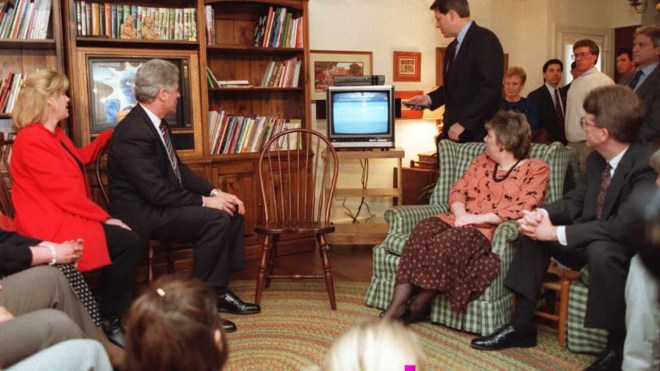
GettyImages-51584279-1280x720The media has become controlled by a handful of corporations thanks to the Telecommunications Act of 1996.
By Michael Corcoran

Wall Street’s sinister influence on the political process has, rightly, been a major topic during this presidential campaign. But history has taught us that the role that the media industry plays in Washington poses a comparable threat to our democracy. Yet this is a topic rarely discussed by the dominant media, or on the campaign trail.

But now is a good time to discuss our growing media crises. Twenty years ago last month, President Bill Clinton signed the Telecommunications Act of 1996. The act, signed into law on February 8, 1996, was “essentially bought and paid for by corporate media lobbies,” as Fairness and Accuracy in Reporting (FAIR) described it, and radically “opened the floodgates on mergers.”

The negative impact of the law cannot be overstated. The law, which was the first major reform of telecommunications policy since 1934, according to media scholar Robert McChesney, “is widely considered to be one of the three or four most important federal laws of this generation.” The act dramatically reduced important Federal Communications Commission (FCC) regulations on cross ownership, and allowed giant corporations to buy up thousands of media outlets across the country, increasing their monopoly on the flow of information in the United States and around the world.

“Never have so many been held incommunicado by so few,” said Eduardo Galeano, the Latin-American journalist, in response to the act.

Twenty years later the devastating impact of the legislation is undeniable: About 90 percent of the country’s major media companies are owned by six corporations. Bill Clinton’s legacy in empowering the consolidation of corporate media is right up there with the North American Free Trade Agreement (NAFTA) and welfare reform, as being among the most tragic and destructive policies of his administration.

The Telecommunications Act of 1996 is not merely a regrettable part of history. It serves as a stern warning about what is at stake in the future. In a media world that is going through a massive transformation, media companies have dramatically increased efforts to wield influence in Washington, with a massive lobbying presence and a steady dose of campaign donations to politicians in both parties — with the goal of allowing more consolidation, and privatizing and commodifying the internet.

This issue has not been central in the 2016 presidential election. But it is deeply concerning that, of all the presidential candidates running in 2016, the Big Media lobby has chosen to back Hillary Clinton. Media industry giants have donated way more to her than any other candidate in the race, according to data from the Center for Responsive Politics. In light of this, we must be mindful of the media reform challenges we face in the present, as we try to prevent the type of damage to our democracy that was caused by the passing of this unfortunate law.

A Threat to Democracy: The Telecommunications Act and Media Consolidation

When President Bill Clinton signed the Telecommunications Act into law, he did so with great fanfare. The bill, which was lobbied for in great numbers by the communications and media industry, was sadly a bipartisan misadventure — only 3 percent of Congress voted against the bill: five senators and 16 members of the House, including then-Rep. Bernie Sanders.

At the time, President Clinton touted the law as “truly revolutionary legislation … that really embodies what we ought to be about as a country.” House Speaker Newt Gingrich boasted ofprojected consumer savings and private job growth. Rep. John Dingell (D-Michigan) “thanked God” for the bill that would “make this country the best served, the best educated and the most successful country … in all areas of communications.”

Despite all of these glowing words, the consequences of the bill were disastrous. The act “fueled a consolidation so profound that even insiders are surprised by its magnitude,” said one trade publication, according to Robert McChesney, in his book, Rich Media, Poor Democracy: Communication Politics in Dubious Times.

“Before the ink was even dry on the 1996 Act,” wrote S. Derek Turner, research director of Free Press, in a 2009 report proposing a national broadband strategy, “the powerful media and telecommunications giants and their army of overpaid lobbyists went straight to work obstructing and undermining the competition the new law was intended to create.”

Media consolidation was already an extremely pressing concern long before 1996. In 1983, Ben Bagdikian published his groundbreaking book, The Media Monopoly, which revealed that just 50 corporations owned 90 percent of the media. That number gradually dwindled over the coming 13 years and was accelerated by the Telecommunications Act. This has led us to the aforementioned crisis where more than 90 percent of the media is owned by just six companies: Viacom, News Corporation, Comcast, CBS, Time Warner and Disney.

Radio has seen an equally appalling consolidation, which has been horrendous for both news media and music. In 1995, before the Telecommunications Act was passed, companies were not allowed to own more than 40 radio stations. “Since passage of the 1996 Telecommunications Act, Clear Channel [now called iHeartMedia] has grown from 40 stations to 1,240 stations — 30 times more than congressional regulation previously allowed,” according to a report from the Future of Music Coalition.

Local newspapers, too, have been stung by these deregulations. Gannett, for instance, owns more than 1,000 newspapers and 600 print periodicals. Layoffs have been the norm for the company, including at USA Today, the paper with the largest circulation in the country, where layoffs were described as a “total bloodbath” in the American Journalism Review.

Save the Internet: The Next Big Media Battle

There was a lot at stake when media companies lobbied for reform in 1996. There is just as much at stake today in the battle for a free and open press. Not only have big media companies continued to push for more consolidation and mergers, but they are also seeking to commodify and privatize the internet. This has become a major concern for advocates of “net neutrality,” who want to “save the internet,” and ensure it is protected as a public utility with equal access for everybody. An FCC ruling in February 2015 has protected the internet for now, but as Free Press warns, the internet is still “in danger.”

“Net neutrality has made the internet an unrivaled space for free speech, civic participation, innovation and opportunity. Net neutrality prohibits online discrimination and gives any individual, organization or company the same chance to share their ideas and find an audience,” explains Free Press’s website, Save the Internet. “Companies like Comcast and Verizon aren’t used to losing in Washington, and they’ll do everything they can to knock down the Title II protections the FCC approved on Feb. 26, 2015.”

The organization is right to be concerned. One reason for the passage of the Telecommunications Act of 1996, as McChesney wrote in 1997, was the sheer power that the media and communications industry has in Washington. “Both the Democratic and Republican parties have strong ties to the large communication firms and industries, and the communication lobbies are among the most feared, respected and well-endowed of all that seek favors on Capitol Hill.”

Today that power and influence has only increased. “From 2002-2008, the industry increased its spending on lobbying efforts every year,” reports the Center for Responsive Politics. “The streak snapped when the Great Recession set in and most clients cut back on their DC efforts, and then reversed again in 2013. In 2014, cable and satellite providers spent nearly $8.1 [million] on lobbying.”

Big Media’s Relationship With Hillary Clinton

What is most revealing when analyzing the donation patterns of these industries in the data from the Center for Responsive Politics — be it cable television, print and periodicals, radioor telecom services — is that Hillary Clinton is, by far, the largest recipient of donations of any candidate in the 2016 election in either party. In fact, of all the top industries that have donated to Clinton, the TV/movies/music category ranks behind only the securities and investments category. (This data is from reports filed on January 31, 2016, according to the Center for Responsive Politics.)

More troubling is that these filings come on the heels of a report from Politico that the Clinton Foundation has received donations, some of them very large, from most of all the major media companies directly: Viacom, News Corporation, Reuters, NBCUniversal, Newsmax, Time Warner, Mort Zuckerman (owner of US News &World Report and the New York Daily News), Comcast, AOL Huffington Post Media and Robert Allbritton (owner of Politico). George Stephanopoulos, one of ABC News’ most visible journalist and a former staffer for President Clinton, has also been under scrutiny for not disclosing a $75,000 donation to the foundation.

Of course, the Clinton Foundation is not a political campaign and does some philanthropic work. So while this all might be legal, it is extremely unsettling, especially in tandem with all the campaign donations Hillary Clinton has received from the major players in this industry.

In March 2015, for instance, a Comcast executive held a $50,000 per plate fundraiser for Clinton’s super PAC. “Comcast NBCUniversal operates in 39 states and has 130,000 employees across the country,” said company spokeswoman Sena Fitzmaurice at the time. “It is important for our customers, our employees and our shareholders that we participate in the political process.”

Of course, media companies don’t just donate to Clinton, but also to members of Congressfrom both parties. Further, as the Center for Responsive Politics reports, the FCC is filled with “revolving-door” employees, who have been switching back and forth between government work and lobbying for Comcast.

Their aggressiveness in Washington makes them a dangerous enemy in the fight for free and democratic media. In this environment, it should come as no surprise that the position of FCC chairman is typically held by a former lobbyist for the cable industry, such as Tom Wheeler, the current chairman, who was once president of the National Cable and Telecommunications Association, a major opponent of net neutrality.

And while it is good news that Clinton has come out in favor of net neutrality, it is a reasonable fear that she could change her views once elected, especially given her relationship with Big Media. It would not be the first time a president has changed a view after being elected, as we learned when Barack Obama embraced a mandate in health care, or when George H.W. Bush raised taxes, despite his infamous promisethat he never would.

It is important to note that, whatever her relationship with the telecommunications industry, it is not fair to blame Hillary Clinton for the Telecommunications Act of 1996. As first lady, Clinton was not in charge of telecommunications policy and there doesn’t appear to be evidence she played a role in constructing or fighting for the law in the White House. In fact, 20 years later, it is difficult to find any public statements from Hillary Clinton expressing her opinion about the law or its impacts. She did address a question at the 2012 YearlyKos convention about the Telecommunications Act. Her response, however, did little to clarify her views on the subject. She said:

You’ll have to ask [then-Vice President] Al Gore. We’ve had a lot of media consolidation. We’ve had some good competition. We have a lot that we need to do to begin to create a more competitive framework. Al was very involved in designing and pushing that through — he is an expert; I am not … We’ve got to take a hard look at this and I don’t want to say something I may not really support. So I have to look at that proposal.

Clinton is now, however, deep into a presidential run and could well be responsible for appointing the head of the FCC. She owes it to voters to describe her views on the Telecommunications Act, and on media consolidation more broadly, in a way that goes beyond advising Americans to “go ask Al Gore.”

Why Media Reform Matters

When McChesney observed that the communications lobby was “among the most feared, respected and well-endowed of all” groups in Washington, he also pointed out one of the great challenges about trying to fight Big Media.

“[The] only grounds for political independence in this case,” he wrote about the debate over the Telecommunications Act, “would be if there were an informed and mobilized citizenry ready to do battle for alternative policies. But where would citizens get informed?”

In other words, how can we have a real debate about media issues, when we depend on that very media to provide a platform for this debate? It is no surprise, for instance, that the media largely ignored the impact of Citizens United after the Supreme Court decision helped media companies generate record profits due to a new mass of political ads. “Super PACs may be bad for America, but they’re very good for CBS,” said CBS president Les Moonves, in a rare moment of candor at an entertainment conference in 2012.

This catch-22 is indeed one of the great difficulties about fighting for a vibrant media and a healthy democracy. But it is a challenge advocates of free media must embrace. Supporting independent media is one important way to help bring light to issues the corporate media ignores.

Media reform is the issue that affects all other issues. As the impact of the Telecommunications Act of 1996 has shown, democracy suffers when almost all media in the nation is owned by massive conglomerates. In this reality, no issue the left cares about — the environment, criminal legal reform or health care — will get a fair shake in the national debate.

Source: This post originally appeared at Truthout.

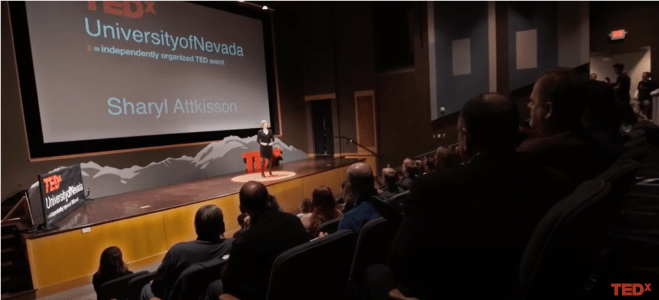
Astroturf and the Manipulation of Media Messages | Sharyl Attkisson | YouTube & TEDx~University of Nevada [click image]

Screen Shot 2020-06-15 at 7.39.52 PMIn this eye-opening talk, veteran investigative journalist Sharyl Attkisson shows how astroturf, or fake grassroots movements funded by political, corporate, or other special interests very effectively manipulate and distort media messages. Sharyl Attkisson is an investigative journalist based in Washington D.C. She is currently writing a book entitled Stonewalled (Harper Collins), which addresses the unseen influences of corporations and special interests on the information and images the public receives every day in the news and elsewhere.

For twenty years (through March 2014), Attkisson was a correspondent for CBS News. In 2013, she received an Emmy Award for Outstanding Investigative Journalism for her reporting on “The Business of Congress,” which included an undercover investigation into fundraising by Republican freshmen. She also received Emmy nominations in 2013 for Benghazi: Dying for Security and Green Energy Going Red. Additionally, Attkisson received a 2013 Daytime Emmy Award as part of the CBS Sunday Morning team’s entry for Outstanding Morning Program for her report: “Washington Lobbying: K-Street Behind Closed Doors.” In September 2012, Attkisson also received an Emmy for Oustanding Investigative Journalism for the “Gunwalker: Fast and Furious” story. She received the RTNDA Edward R. Murrow Award for Excellence in Investigative Reporting for the same story. Attkisson received an Investigative Emmy Award in 2009 for her exclusive investigations into TARP and the bank bailout.

She received an Investigative Emmy Award in 2002 for her series of exclusive reports about mismanagement at the Red Cross.

This talk was given at a TEDx event using the TED conference format but independently organized by a local community. Learn more at http://ted.com/tedx

Source: YouTube