Inaccurate Virus Models Are Panicking Officials Into Ill-Advised Lockdowns | The Federalist

InaccurateBy Madeline Osburn

Editor’s Note: Just when we thought it couldn’t get any worse, as it turns out this COVID-19 crisis has been manufactured in part (not the disease mind you, but the rapid response) by a few behind the scenes organizations which just happen to have Democrat activists at the forefront. Impeachment didn’t work to eradicate Trump, so let’s take advantage of an alleged pandemic to drive down the economy and put the blame on him (so he won’t get reelected). Read this article and weep.

How a handful of Democratic activists created alarming, but bogus data sets to scare local and state officials into making rash, economy-killing mandates.

As U.S. state and local officials halt the economy and quarantine their communities over the Wuhan virus crisis, one would hope our leaders were making such major decisions based on well-sourced data and statistical analysis. That is not the case.

A scan of statements made by media, state governors, local leaders, county judges, and more show many relying on the same source, an online mapping tool called COVID Act Now. The website says it is “built to enable political leaders to quickly make decisions in their Coronavirus response informed by best available data and modeling.”

An interactive map provides users a catastrophic forecast for each state, should they wait to implement COVID Act Now’s suggested strict measures to “flatten the curve.” But a closer look at how many of COVID Act Now’s predictions have already fallen short, and how they became a ubiquitous resource across the country overnight, suggests something more sinister.

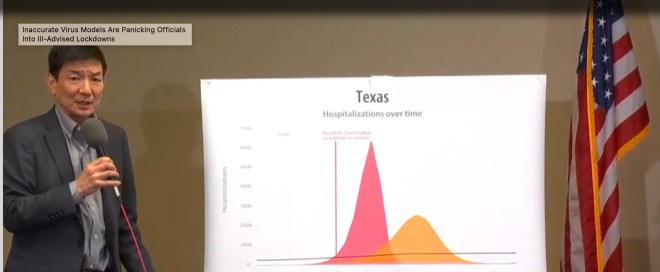
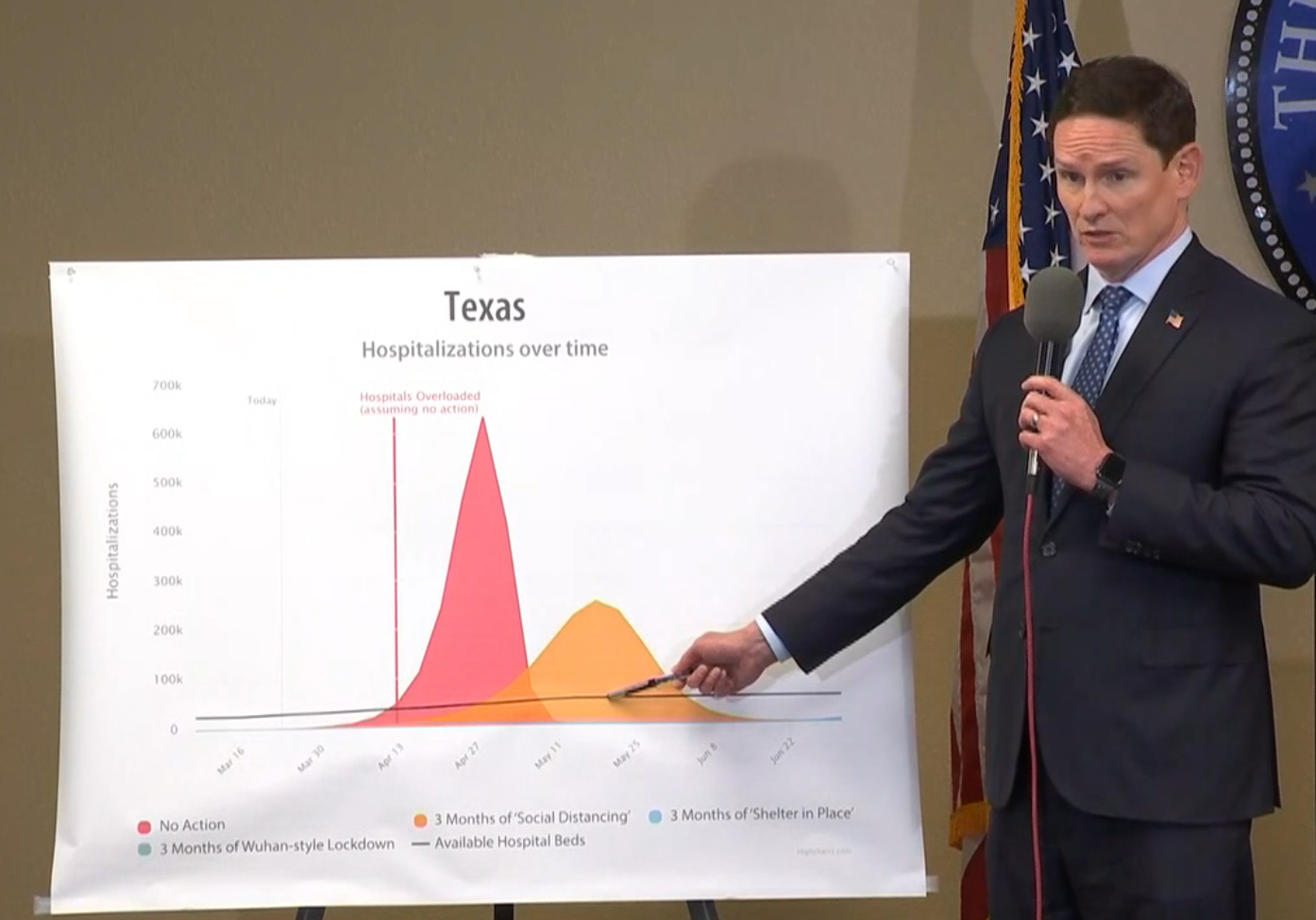
When Dallas County Judge Clay Jenkins announced a shelter-in-place order on Dallas County Sunday, he displayed COVID Act Now graphs with predictive outcomes after three months if certain drastic measures are taken. The NBC Dallas affiliate also embedded the COVID Act Now models in their story on the mandate.
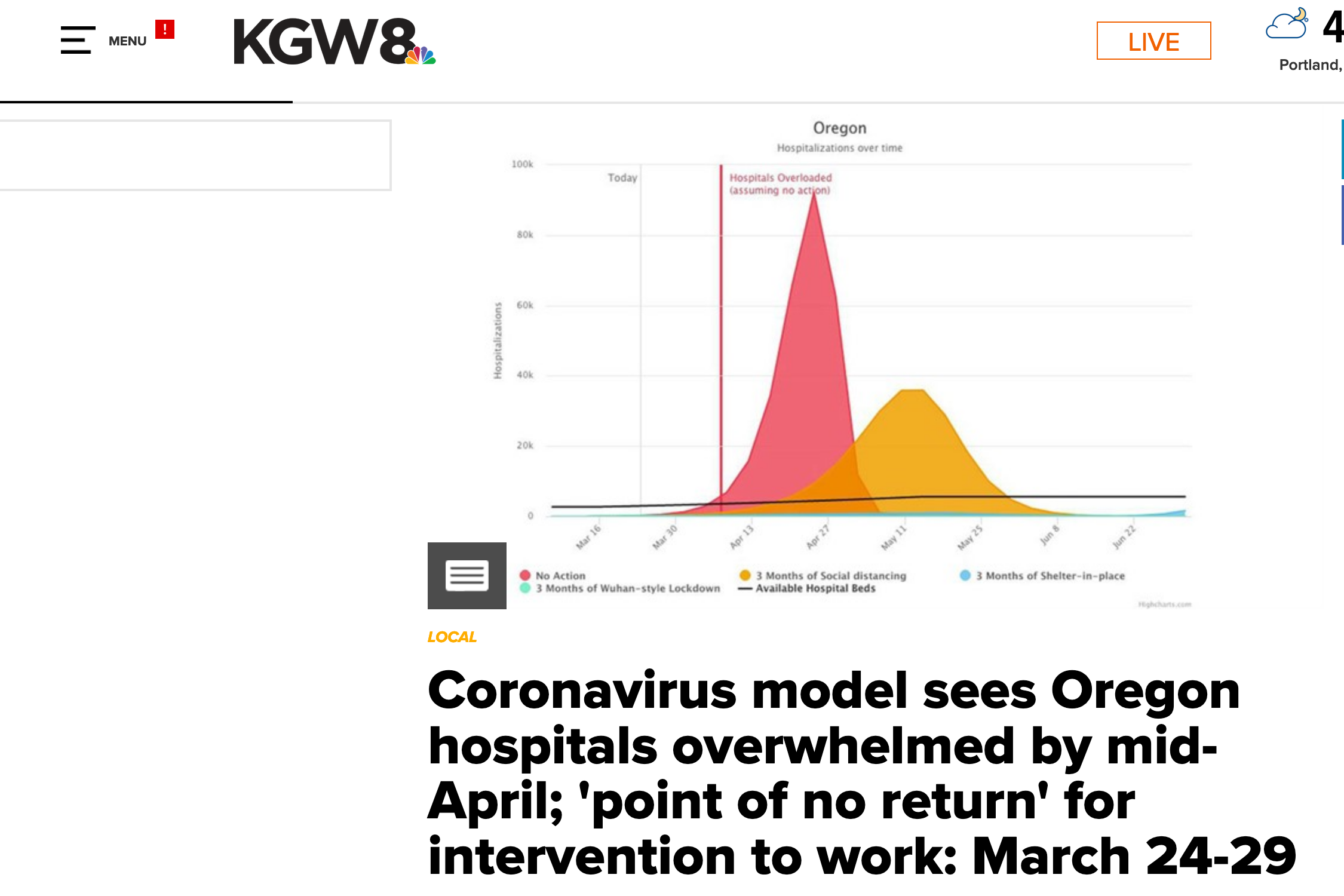
The headline of an NBC Oregon affiliate featured COVID Act Now data, and a headline blaring, “Coronavirus model sees Oregon hospitals overwhelmed by mid-April.” Both The Oregonian and The East Oregonian also published stories featuring the widely shared data predicting a “point of no return.”
Michigan Gov. Gretchen Whitmer cited COVID Act Now when telling her state they would exceed 7 million cases in Michigan, with 1 million hospitalized and 460,000 deaths if the state did nothing.

A local CBS report in Georgia featured an Emory University professor urging Gov. Brian Kemp with the same “point of no return” language and COVID Act Now models.

Carlos del Rio

@CarlosdelRio7

We need ⁦@GovKemp⁩ to act now, the point of “no return” for GA is rapidly closing. To prevent a catastrophe in the healthcare system due to we need for him to shut down GA now. ⁦@drmt⁩ ⁦⁦@Armstrws⁩ ⁦@colleenkraftmdhttps://covidactnow.org/state/GA 

This model predicts the last day each state can act before the point of no return

The only thing that matters right now is the speed of your response

covidactnow.org

The models are being shared across social media, news reports, and finding their way into officials’ daily decisions, which is concerning because COVID Act Now’s predictions have already been proven to be wildly wrong.

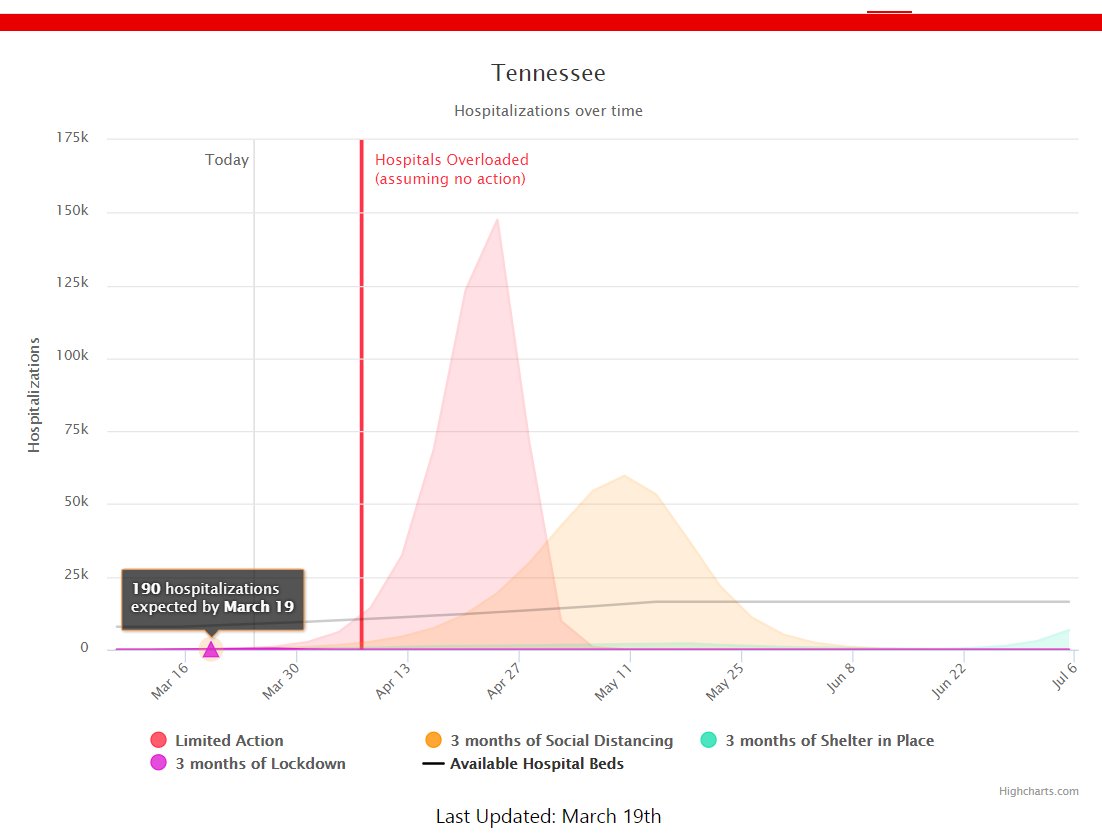
COVID Act Now predicted that by March 19 the state of Tennessee could expect 190 hospitalizations of patients with confirmed Wuhan virus. By March 19, they only had 15 patients hospitalized.
In New York, Covid Act Now claimed nearly 5,400 New Yorkers would’ve been hospitalized by March 19. The actual number of hospitalizations is around 750. The site also claimed nearly 13,000 New York hospitalizations by March 23. The actual number was around 2,500.
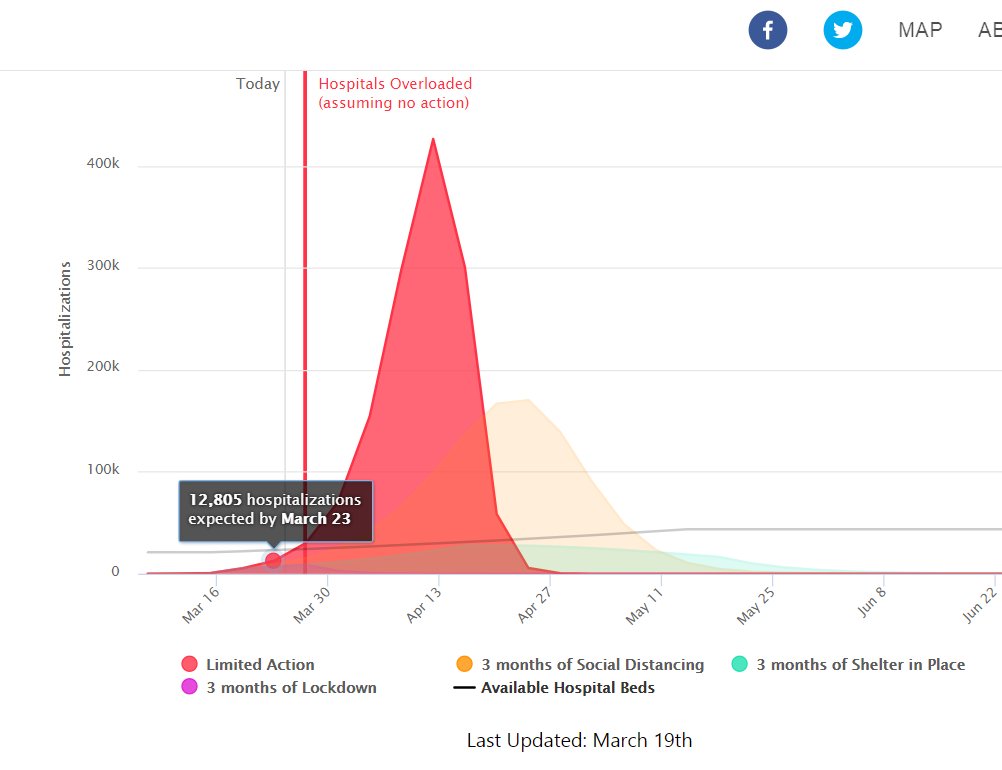
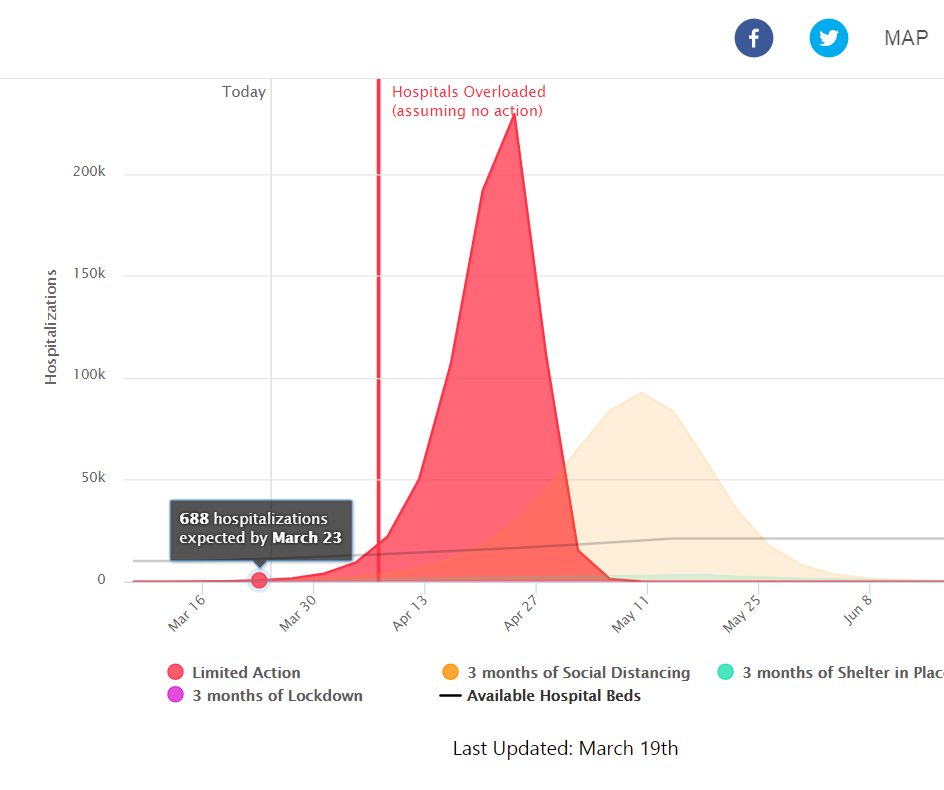
In Georgia, COVID Act Now predicted 688 hospitalizations by March 23. By that date, they had around 800 confirmed cases in the whole state, and fewer than 300 hospitalized.
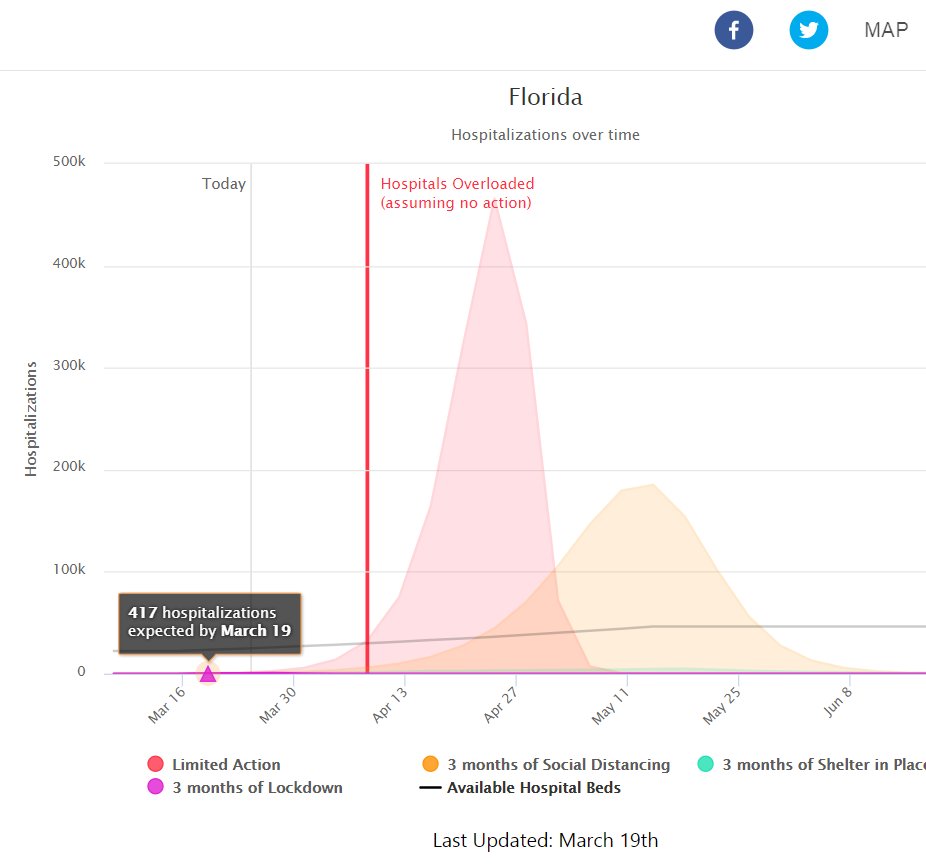
In Florida, Covid Act Now predicted that by March 19, the state would face 400 hospitalizations. On March 19, Gov. Ron DeSantis said 90 people in Florida had been hospitalized.
COVID Act Now’s models in other states, including Oklahoma and Virginia, were also far off in their predictions. Jordan Schachtel, a national security writer, said COVID Act Now’s modeling comes from one team based at Imperial College London that is not only highly scrutinized, but has a track record of bad predictions.

Jordan Schachtel

@JordanSchachtel

4) Their models come 100% from Imperial College UK projection that is coming under *heavy* scrutiny from scientific community. IC UK produced the famed doomsday scenario that guaranteed 2MM dead Americans. The man behind the projections is refusing to make his code public.

Jessica Hamzelou at New Scientist notes the systematic errors researchers and scientists have found with the modeling COVID Act Now relies on:

Chen Shen at the New England Complex Systems Institute, a research group in Cambridge, Massachusetts, and his colleagues argue that the Imperial team’s model is flawed, and contains ‘incorrect assumptions’. They point out that the Imperial team’s model doesn’t account for the availability of tests, or the possibility of ‘super-spreader events’ at gatherings, and has other issues.

Among other issues, COVID Act Now lists the “Known Limitations” of their model. Here are a few that seem especially alarming, considering they generate a model for each individual state:

Many of the inputs into this model (hospitalization rate, hospitalization rate) are based on early estimates that are likely to be wrong.

Demographics, populations, and hospital bed counts are outdated. Demographics for the USA as a whole are used, rather than specific to each state.

The model does not adjust for the population density, culturally-determined interaction frequency and closeness, humidity, temperature, etc in calculating R0.

This is not a node-based analysis, and thus assumes everyone spreads the disease at the same rate. In practice, there are some folks who are ‘super-spreaders,’ and others who are almost isolated.

So why is the organization or seemingly innocent online mapping tool using inaccurate algorithms to scaremonger leaders into tanking the economy? Politics, of course.

Founders of the site include Democratic Rep. Jonathan Kreiss-Tomkins and three Silicon Valley tech workers and Democratic activists — Zachary Rosen, Max Henderson, and Igor Kofman — who are all also donors to various Democratic campaigns and political organizations since 2016. Henderson and Kofman donated to the Hillary Clinton campaign in 2016, while Rosen donated to the Democratic National Committee, recently resigned Democratic Rep. Katie Hill, and other Democratic candidates. Prior to building the COVID Act Now website, Kofman created an online game designed to raise $1 million for the eventual 2020 Democratic candidate and defeat President Trump. The game’s website is now defunct.

Perhaps the goal of COVID Act Now was never to provide accurate information, but to scare citizens and government officials into to implementing rash and draconian measures. The creators even admit as much with the caveat that “this model is designed to drive fast action, not predict the future.”

They generated this model under the guise of protecting communities from overrun hospitals, a trend that is not on track to happen as they predicted. Not only is the data false, and looking more incorrect with each passing day, but the website is optimized for a disinformation campaign.

A social media share button prompts users to share their models and alarming graphs on Facebook and Twitter with the auto-fill text, “This is the point of no return for intervention to prevent X’s hospital system from being overloaded by Coronavirus.

The daunting phrase, the “point of no return,” is the same talking point being repeated by government officials justifying their shelter-in-place orders and filling local news headlines.

Democrats are not going to waste such a rich political opportunity as a global pandemic. Americans already witnessed Speaker of the House Nancy Pelosi and House Democrats attempt to take advantage of an economic recession with a pipe-dream relief bill this week. Projects like COVID Act Now are another attempt to play the same political games, but with help from unknown, behind-the-scenes Democratic activists instead.

Our community leaders, the mayors and the city councils, deserve better than to be swindled by a handful Silicon Valley tech bros. Our governors and state officials deserve better data and analysis than a Democratic activists’ model that doesn’t adjust for important geographical factors like population density or temperature. Americans and their families deserve better than to be jobless, hopeless, and quarantined because of a single website’s inaccurate and hyperbolic hospitalization models.
Madeline Osburn is a staff editor at the Federalist and the producer of The Federalist Radio Hour. Follow her on Twitter.

The Truth Behind Coronavirus Pandemic: COVID-19 Lockdown & The Economic Crash | London Real


https://youtu.be/gMTZu6_TjU8

Johnny Liberty, Editor’s Notes: Why Destroy the Global Economic System During the Coronavirus Crisis (and replace it with another that better serves the Global Power Structure)?

  • Global Bankers will pull trillions of dollars of equity out of the economic system (stocks, real estate values, business values) to rollback the debt obligations of the international bankers (because of the nature of the debt-based monetary system)
  • Total Economic Shutdown will destroy millions of family businesses, small businesses and medium sized businesses leaving a larger share to the big, corporate players.
  • Total Economic Shutdown will drop millions of people in countries around the world to the very bottom of the economic ladder. This is economic suicide for We the People and a few thousand dollars of government subsidies will not restore even a fraction of the losses.
  • Don’t believe what you’re being told because somebody in a suit said so. Question authority and do your own independent research.
  • The Coronavirus crisis is not about public health or caring for the elderly.
  • The Global Power Structure doesn’t care one iota about the health and welfare of the elderly. Protecting the elderly is a convenient excuse to destroy the existing economic order and impose a New World Order run by an elite few at the top of the pyramid.
  • Who benefits? The Global Power Structure, or 1%, will be the one who will benefit.
  • What is the result? To impose a Global Technocracy run by experts, scientists, technocrats, politicians and artificial intelligence under their total control. Your every move will be watched and tracked. You will be plugged into “The Matrix”.
  • For this you can thank the Coronavirus panic and overreaction.

Source: London Real & YouTube

What the Dow’s 28% Crash Tells Us About the Economy | Bloomberg

2400x-1Johnny Liberty, Editor’s Note: This is exactly why we stayed out of the markets due to the possibility of extreme fluctuation due to events beyond our control (e.g., coronavirus). This market adjustment was long overdue and the Power Structure took advantage of the “panic” in partnership with Big Media to remove trillions of dollars of value.

By Dave Merrill and Esha Dey

It is hard to follow the stomach–turning plunge across financial markets without hearing a reference to the Dow.

Professional money managers, as well as casual investors, often look at the Dow—or the Dow Jones Industrial Average—to get a 30-thousand feet view of the markets. Referred to as simply the Dow, it is a price–weighted average of 30 blue–chip U.S. stocks that are generally the leaders in their industry.

Amid the current carnage, observing the index can help in gauging the damage the coronavirus is inflicting on portfolios, and whether the downturn is a short-turn consequence of disrupted supply chains and skittish consumer demand or a broader symptom of a bull market that has run its course.

To better understand the differing aspects of the economy and the signals they are flashing, we have grouped the 30 Dow stocks into nine broad economic sectors—health care, energy, consumer staples, communication services, information technology, consumer discretionary, financials, industrials and basic materials. Here is an overview of the U.S. stock market through the lens of the Dow.

Graphic1

Components of a 8,300-Point Drop

Critics of the Dow say that it inaccurately portrays the general market as stocks with a higher price, such as Apple and Boeing, are over represented. Boeing is a relevant example as its current decline does not only reflect troubles related to the coronavirus outbreak, but also its ongoing crisis that was triggered by two fatal crashes of its 737 Max jet within a span of five months early last year. However, it is now the most significant contributor to the Dow’s drop since its peak on Feb. 12.

Graphic2

Percentage Drop by Industry Sectors, Best to Worst Performing

As shown in the chart above, certain stocks, such as Walmart, have been fairly resilient, with consumer staples as a group faring better than the rest overall. On average, stocks in four other sectors, health care, communications services, information technology and consumer discretionary are performing better than the overall drop of 28% in the Dow.

Consumer Staples

-7.7%
These consumer products are those that remain in family budgets regardless of financial problems in the larger economy, and are expectedly doing relatively better than the rest of the index. Walmart’s stock is seen as a “place to hide” amid the looming threat of a recession, while grocery sales overall are surging as consumers stock up and get ready to wait out the pandemic.

Health Care

-13.6%
Shares of pharmaceutical and biotechnology drug developers have done well amid the widespread panic, as several companies unveiled plans to combat Covid-19. At the same time, investors soured on the nation’s hospitals, which already saddled with debt, may feel an increased pressure as elective surgeries are delayed. Also, if the economy slides into a recession, it might mean the hospitals would get more patients that are covered by Medicare and Medicaid, which are less profitable, as well as see an increase in unpaid bills.

Communication Services

-20.4%
While the Dow includes just two companies from this group—Walt Disney and Verizon—overall, the sector’s stocks have done better than the broader market given a mixed exposure to the virus spread. The crisis has led to a drastic drop in ticket sales at movie theaters, yet, another part of the sector—like wireless service provider Verizon—remains largely insulated from any coronavirus impact, though equipment sales could see some declines due to supply constraints and store closings.

Information Technology

-25.5%
Technology companies—be it IBM, Apple or Microsoft—are being seen as reasonably defensive as patient investors look ahead to key tailwinds in 5G technologies, cloud computing products and artificial intelligence, even though strained global supply chains may have put a dent in near-term optimism.

Consumer Discretionary

-30.8%
Discretionary spends, such as buying new shoes, clothes, furnitures or cars, or even eating out, are expected to go down, reflected in the sharp decline seen in the stocks of Nike and McDonald’s. Restaurant stocks have continued to slide, as more companies shifted to takeout only, either by choice or state/city mandate, while cruise-line operators’ stocks are in a freefall.

Financials

-32.4%
Financial companies have been among the hardest hit as the virus threatened to tip the economy into a recession, with the KBW index of top U.S. banks falling nearly 40% since mid-February when the broader virus-fueled selloff began. With the Federal Reserve slashing its benchmark rate to near zero over the weekend, banks’ profits are expected to feel the squeeze, along with rising concern that borrowers may not be able to pay back loans in a faltering economy.

Industrials

-37.6%
With the virus outbreak forcing social distancing, and keeping people from buying cars or taking flights, the impact is rippling through the manufacturing industry and its supply chain. Factories and plants across the globe are being forced to shut down. Boeing, which was already struggling to sort out its troubles related to the 737 Max aircraft that was grounded last year after two fatal crashes, is now facing a double whammy as the airline industry sees an unprecedented drop in demand. That may, in turn, force airlines to defer their aircraft orders, or even cancel some if the situation does not improve in a few more months. The overall investor nervousness is also reflected in the shares of Caterpillar and United Technologies, two stocks that can be seen as bellwethers of the global industrial economy.

Energy

-38.4%
Energy stocks are taking a beating as the sector faces demand headwinds from coronavirus, while the ongoing price war between Saudi Arabia and Russia isn’t helping anyone’s cause. Energy is the worst-performing group in the S&P 500 this year, down 54%. Meanwhile, U.S. shale drillers are responding by slashing their capital budgets and dividends in a bid to weather the downturn.

Materials

-46.1%
The S&P 500 Materials index has lost about 28% since the rout started on Feb. 21. The worst hit sectors were chemical, fertilizer and industrial metals, all of which depend on the global economy for the demand of their products. The pullback led to fertilizer maker Mosaic Co. and plastic producer LyondellBasell Industries N.V. to lose about 50% of their stock value since the sell-off began. Meanwhile, gold miner Newmont Corp. was the least affected stock within the materials, as gold prices held up relatively well amid global panic selling.

Recoveries from Collapse

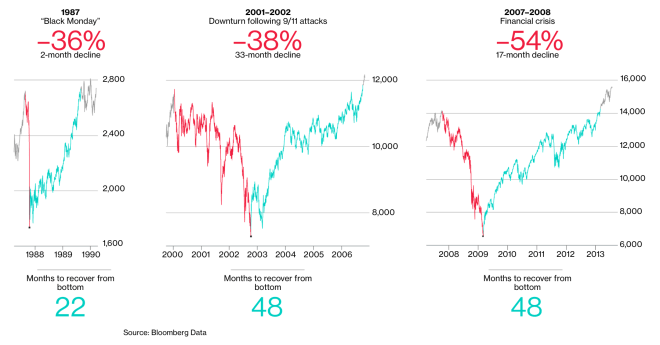
Since the 1980s, the Dow has recorded three other losses of more than 25% from previous highs. Historically, recoveries from these lows have taken many months.
Graphic3
Source: Bloomberg

Coronavirus will bankrupt more people than it kills — and that’s the real global emergency | MSN

BB115Vng.img
By Omar Hassan

Coronavirus’s economic danger is exponentially greater than its health risks to the public. If the virus does directly affect your life, it is most likely to be through stopping you going to work, forcing your employer to make you redundant, or bankrupting your business.

The trillions of dollars wiped from financial markets this week will be just the beginning, if our governments do not step in. And if President Trump continues to stumble in his handling of the situation, it may well affect his chances of re-election. Joe Biden in particular has identified Covid-19 as a weakness for Trump, promising “steady, reassuring” leadership during America’s hour of need.

Provided by The IndependentWorldwide, Covid-19 has killed 4,389 with 31 US deaths as of today. But it will economically cripple millions, especially since the epidemic has formed a perfect storm with stock market crashes, an oil war between Russia and Saudi Arabia, and the spilling over of an actual war in Syria into another potential migrant crisis.

We may look back on coronavirus as the moment when the threads that hold the global economy together came unstuck; and startups and growing businesses like mine could end up paying the price.

Just as important as fighting the virus — if not more important — is vaccinating our economies against the incoming pandemic of panic. Human suffering can come in the form of illness and death. But it can also be experienced as not being able to pay the bills or losing your home.

Small businesses in particular are struggling as supply chains dry up, leaving them without products or essential materials. Factory closures in China have led to a record low in the country’s Purchasing Manager’s Index which measures manufacturing output. China is the world’s largest exporter and is responsible for a third of global manufacturing, so China’s problem is everyone’s problem — even in the midst of a trade war between the White House and Beijing.

All this makes it even more worrying that governments continue to see this as a health crisis, not an economic one. It is time the economists took over from the doctors, before the real pandemic spreads.

It is difficult to imagine Italy not entering a recession (the world’s ninth-largest economy is now on lockdown). It is also difficult to imagine that failing to affect Europe and its largest trading partner, the United States. And it is impossible to see how any of this will not add up to a global downturn, unless governments step in faster and harder than they did 12 years ago during the last financial crisis.

The stakes are higher this time, because there seems to be a coordinated effort to economically hurt many Western countries, and warn them away from the aggressive trade policies that Trump has so enthusiastically adopted.

Although China bore the brunt of the virus’s economic and human cost, many in Beijing will see a silver lining in the weakening of the US economy, and a distraction from Trump’s trade wars that appeared to be escalating with no end in sight.

Almost perfectly synchronized with the coronavirus, a Russia-Saudi oil war has erupted. In the short-term, both Moscow and Riyadh can afford the 30 per cent overnight drop in the oil price. But America’s shale gas business cannot: The more expensive process of fracking means that much of the US oil sector will simply not exist if oil prices stay at historic lows, leading to shut downs, job losses and perhaps even state-level recessions.

President Trump has pushed through overdue payroll tax cuts and help for hourly workers — measures that will help both employers and employees survive. In the UK, Chancellor Rishi Sunak yesterday unveiled a ‘Coronavirus Budget’. But everyone needs to think bigger if they want to properly deal with how this new factor changes the status quo.

This is about much more than coronavirus, oil prices, or even the global economy. This is about the balance of power between East and West. The epicenter of this has been, for the last 10 years, Syria. After a decade of conflict on the ground, the face-off seems to have now escalated from proxy war to economic conflict.The emerging superpowers of Russia and China witnessed what many saw as American irrelevance in Syria. And they are now trying to cement their vision of a truly multi-polar world. Rather than allowing US ally Saudi Arabia to lead the oil markets through the OPEC cartel, Russia and China want to reshape global markets — and power balances — to their advantage.

To survive these shifts, the US, UK and others will need to protect the future of their businesses, large and small, and look for opportunities to benefit from the new economic world order, not deny it. Ignoring these changes will be even more damaging than any flu pandemic.

Source: MSN

To Tame Coronavirus, Mao-Style Social Control Blankets China | Economic Times/India Times

wuhan-11-ap

Johnny Liberty, Editor’s Note: This pandemic was likely created from a bioweapons lab in Wuhan and the Chinese Communist Party is showing their true colors in dealing with this humanitarian crisis. The entire world will suffer consequences from this debacle and a global economic slowdown and economic reset is inevitable.

The nation is battling the coronavirus outbreak with a grassroots mobilization reminiscent of former Communist Chairman Mao Zedong’s mass crusades, not seen in China in decades.

China has flooded cities and villages with battalions of neighborhood busybodies, uniformed volunteers and Communist Party representatives to carry out one of the biggest social control campaigns in history.

The goal: to keep hundreds of millions of people away from everyone but their closest kin.

The nation is battling the coronavirus outbreak with a grassroots mobilization reminiscent of former Communist Chairman Mao Zedong’s mass crusades, not seen in China in decades — esse ..

Housing complexes in some cities have issued the equivalents of paper hall passes to regulate how often residents leave their homes. Apartment buildings have turned away their own tenants if they have come from out of town. Train stations block people from entering cities if they cannot prove they live or work there. In the countryside, villages have been gated off with vehicles, tents and other improvised barriers.

Despite China’s arsenal of high-tech surveillance tools, the controls are mainly enforced by hundreds of thousands of workers and volunteers, who check residents’ temperature, log their movements, oversee quarantines and — most important — keep away outsiders who might carry the virus.

Residential lockdowns of varying strictness — from checkpoints at building entrances to hard limits on going outdoors — now cover at least 760 million people in China, or more than half the country’s population, according to a New York Times analysis of government announcements in provinces and major cities. Many of these people live far from the city of Wuhan, where the virus was first reported and which the government sealed off last month.

Throughout China, neighborhoods and localities have issued their own rules about residents’ comings and goings, which means the total number of affected people may be even higher. Policies vary widely, leaving some places in a virtual freeze and others with few strictures.

China’s top leader, Xi Jinping, has called for an all-out “people’s war” to tame the outbreak. But the restrictions have prevented workers from returning to factories and businesses, straining China’s giant economy. And with local officials exercising such direct authority over people’s movements, it is no surprise that some have taken enforcement to extremes.

Li Jing, 40, an associate professor of sociology at Zhejiang University in the eastern city of Hangzhou, was almost barred from taking her husband to a hospital recently after he choked on a fish bone during dinner. The reason? Her neighborhood allows only one person per family to leave the house, every other day.

“Once the epidemic was disclosed, the central government put huge pressure on local officials,” Li said. “That triggered competition between regions, and local governments turned from overly conservative to radical.

“Even when the situation is relieved or if the mortality rate turns out not to be high, the government machine is unable to change direction or tune down,” she added.

China’s prevention efforts are being led by its myriad neighborhood committees, which typically serve as a go-between for residents and local authorities. Supporting them is the government’s “grid management” system, which divides the country into tiny sections and assigns people to watch over each, ensuring a tight grip over a large population.

Zhejiang province, on China’s southeastern seaboard, has a population of nearly 60 million and has enlisted 330,000 “grid workers.” Hubei province, whose capital is Wuhan, has deployed 170,000. The southern province of Guangdong has called upon 177,000, landlocked Sichuan has 308,000, and the megacity of Chongqing has 118,000.

Authorities are also combining enormous manpower with mobile technology to track people who may have been exposed to the virus. China’s state-run cellular providers allow subscribers to send text messages to a hotline that generates a list of provinces they have recently visited.

At a high-speed rail station in the eastern city of Yiwu this past week, workers in hazmat suits demanded that passengers send the text messages that show their location data before being allowed to leave.

n app developed by a state-run maker of military electronics lets Chinese citizens enter their name and national ID number and be told whether they may have come in contact, on a plane, train or bus, with a carrier of the virus.

It is too early to say whether China’s strategy has contained the outbreak. With large numbers of new infections being reported every day, the government has clear reasons for minimizing human contact and domestic travel. But experts said that in epidemics, overbearing measures can backfire, scaring infected people into hiding and making the outbreak harder to control.

“Public health relies on public trust,” said Alexandra Phelan, a specialist in global health law at Georgetown University. “These community-level quarantines and the arbitrary nature in which they’re being imposed and tied up with the police and other officials is essentially making them into punitive actions — a coercive action rather than a public health action.”

In Zhejiang, one of China’s most developed provinces and home to Alibaba and other technology companies, people have written on social media about being denied entry to their own apartments in Hangzhou, the provincial capital. Coming home from out of town, they said, they were asked to produce documents from landlords and employers or be left on the street.

For Nada Sun, who was visiting family in Wenzhou, a coastal city in Zhejiang, a health scare turned into a mandatory quarantine.

When Sun, 29, complained of tightness in her chest this month, her mother told her to go to the hospital. She did not have a high fever, yet the hospital gave her a battery of checks. All came back negative for the virus.

Even so, when she returned to her apartment, she was told that she would be quarantined for two weeks. She was also added to a group on the WeChat messaging app with a local Communist Party secretary and other volunteers in which she has to submit her temperature and location twice a day.

“I’m worried they have too much information,” Sun said.

The lockdowns are not necessarily oppressive. Many people in China have been happy to wall themselves off, ordering groceries online and working from home if they can. Some neighborhood officials act with a humane touch.

Bob Huang, a Chinese-born American living in northern Zhejiang, said the volunteers at his complex had helped chase down a man who stayed out overnight to drink, in violation of rules about how often people can step outside. Yet they also delivered food from McDonald’s to a quarantined family.

Huang, 50, has been able to dodge the restrictions by using a special pass from the property manager, and he has been driving around delivering protective face masks to friends. Some building complexes don’t let him in. Others take down his information.

A nearby village took a less orthodox approach.

“They always start asking questions in the local dialect, and if you can respond in the local dialect, you are allowed to go in,” Huang said. Unable to speak the dialect, he had to wait, though the villagers were friendly. They gave him a folding chair, offered him a cigarette and didn’t ask for an ID.

Some parts of China have imposed other, often severe policies for fending off the epidemic.

Hangzhou has barred pharmacies from selling analgesics to force people with symptoms to seek treatment at hospitals. The eastern city of Nanjing requires anybody who takes a cab to show ID and leave contact information. Yunnan province wants all public places to display QR codes that people must scan with their phones whenever they enter or exit.

Many places have banned large gatherings. Police in Hunan province this month destroyed a mahjong parlor where they found more than 20 people playing the tile game.

With local governments deciding such policies largely on their own, China has become a vast patchwork of fiefs.

“It can be quite haphazard,” said Zhou Xun, a historian of modern China at the University of Essex in England. “A perfect plan on paper often turns into makeshift solutions locally.”

Officials seem to recognize that some local authorities have gone too far. This month, Chen Guangsheng, the deputy secretary-general of Zhejiang’s provincial government, called it “inappropriate” that some places had employed “simple and crude practices,” like locking people into their homes, to enforce quarantines.

National officials on Saturday urged towns and villages to remove unnecessary roadblocks and ensure the smooth transport of food and supplies.

Zhang Yingzi’s apartment complex in Hangzhou initially forbade anybody who had been out of town from entering. Later, the ban was adjusted to cover only people coming from Hubei province and the Zhejiang cities of Wenzhou and Taizhou, both of which have had many cases of the new virus.

“Banning everyone from out of town wasn’t realistic,” said Zhang, 29, an accountant. “There are so many of them, after all. Some needed to come back for work.”

Still, many in China are uneasy about loosening up virus controls too quickly.

Zhang Shu, 27, worries that her parents and neighbors are becoming cavalier about the virus, even as workers drive around her village near Wenzhou with loudspeakers telling people to stay home.

“Ordinary people are slowly starting to feel that the situation isn’t so horrible anymore,” she said. “They are restless.”

Nearly 6 in 10 Americans Say They’re Financially Better Off Now Than a Year Ago | Gallup Poll

shoppers-700x420Americans’ levels of optimism about their current and future personal financial situation have reached or are near record highs, according to a recent Gallup poll.
Nearly 6 in 10, or 59 percent, Americans say they are financially better off now than they were a year ago, which is up from 50 percent last year, according to polling data released on Wednesday. The highest prior record for the same question was in January 1999, at 58 percent, during the dot-com boom where economic conditions were similar. Meanwhile, 20 percent of Americans say they are financially worse off now than a year ago, with 21 percent saying they are financially the same.

The pollster also noted that at least half of Americans rated their personal finances better than a year ago from 1998 to 2000 but this number fell under 50 percent from 2001 to 2018, with a low of 23 percent in May 2009, during the Great Recession.

The data also found that Americans have expressed optimism about their future financial situation, with nearly 3 in 4, or 74 percent, of Americans predicting that they will be better off financially a year from now. Gallup noted this is the highest reading for the question since the question has been asked since 1977. The highest previous record was in 1998 at 71 percent.

The findings align with many of President Donald Trump’s assertion that Americans are doing better under his presidency, Gallup notes. During his State of the Union address on Thursday, Trump touted the burgeoning U.S. economy, tax cuts, low unemployment rates for African Americans, Hispanic Americans, and Asian Americans, growing wages, and job creation through a focus on manufacturing.

“Three years ago, we launched the great American comeback. Tonight, I stand before you to share the incredible results,” Trump said. “In just three short years, we have shattered the mentality of American decline and we have rejected the downsizing of America’s destiny” and the United States is “moving forward at a pace that was unimaginable just a short time ago, and we are never going back,” he added.

The polling data also found that there was a partisan divide in the way Republicans and Democrats see their financial situations, with 76 percent of Republicans reporting that they are financially better off now than a year ago, while only 43 percent of Democrats reported the same. Meanwhile, 83 percent of Republicans expressed optimism about their future financial situation, compared to 60 percent of Democrats who said the same. The pollster found that Independents fell in between with 58 percent expressing optimism about their current personal finances, and 76 percent predicting they will be better off next year.

The data came from the recent Mood of the Nation poll, which was conducted by telephone between Jan. 2 and Jan. 15, with a random sample of 1,014 Americans over the age of 18 across the country. The margin of error for the poll is plus or minus 4 percentage points.

Source: The Epoch Times

Four lessons from the biggest riots in decades | Sovereign Man

Editor’s Note: When stupid people take to the streets and cause reckless destruction everybody pays the price. Don’t let these radical fools destroy well-being for the rest of us because they’re angry, because they don’t like something, because they are do-nothing complainers. It’s everybody’s responsibility to cool down the flames of discontent and find meaningful ways to solve social, economic and political problems without resorting to violence. Martin Luther King would be ashamed of such violence!

If you’re been following the news, you might have seen reports about civil unrest in Chile– the worst in decades.

I lived in Chile for more than seven years before moving to Puerto Rico; I still have business interests there, along with hundreds of employees (both foreign and local), many of whom I’ve been speaking to over the last few days.

First things first, Chile is ordinarily a quiet, stable, peaceful country.

The last time Chile went to war was 140 years ago back in 1879. They even skipped both world wars.

And while there are occasional protests, Chile is quite tame by Latin American standards.

It’s also the most modern and advanced nation in the region– this is not a destitute, impoverished country.

Chile has thriving industries and a large middle class that’s in better shape than just about anywhere else in the region.

But just like every other country in the world, there are countless imperfections.

Inflation has eaten away at the purchasing power of workers’ incomes, and a lot of people are struggling to make ends meet.

The proverbial straw that broke the camel’s back was a 3% increase in metro fares.

It’s nothing. But it was enough to make thousands of people become completely unglued, resulting in riots, looting, arson, and all-out mayhem.

Let’s talk about some of the key lessons from this:

1) It can happen anywhere.

It’s not just Chile. Looking around the world right now we can see major demonstrations and even violence in places like Hong Kong, Spain, Haiti, Lebanon, etc.

The ‘yellow vest’ movement in France in late 2018/early 2019 brought hundreds of thousands of people out into the streets to torch cars and destroy property, all apparently in protest of rising fuel prices.

Political tensions, social tensions, economic tensions… they exist everywhere, in rich countries and poor countries alike.

People everywhere are tightly wound, and it doesn’t take much for them to become unhinged. If you think this can’t happen where you live, think again.

2) It can happen faster than anyone realizes.

The weather in central Chile is one of the great benefits of living there; it’s warm, sunny, and dry… southern California climate.

And this past Friday was a particularly beautiful day. By lunchtime, people were out in the parks enjoying the weather. It was calm, peaceful, and joyful.

Within a matter of hours the city had turned into a war zone. Hours.

One of my team members told me on the phone yesterday, “If you had said on Friday afternoon that Santiago would be in chaos by nightfall, I would have laughed… And then it happened.”

3) It only takes a few idiots.

There are roughly 18 million people living in Chile. And there may even be a few million people nationwide who are deeply frustrated about the rising cost of living.

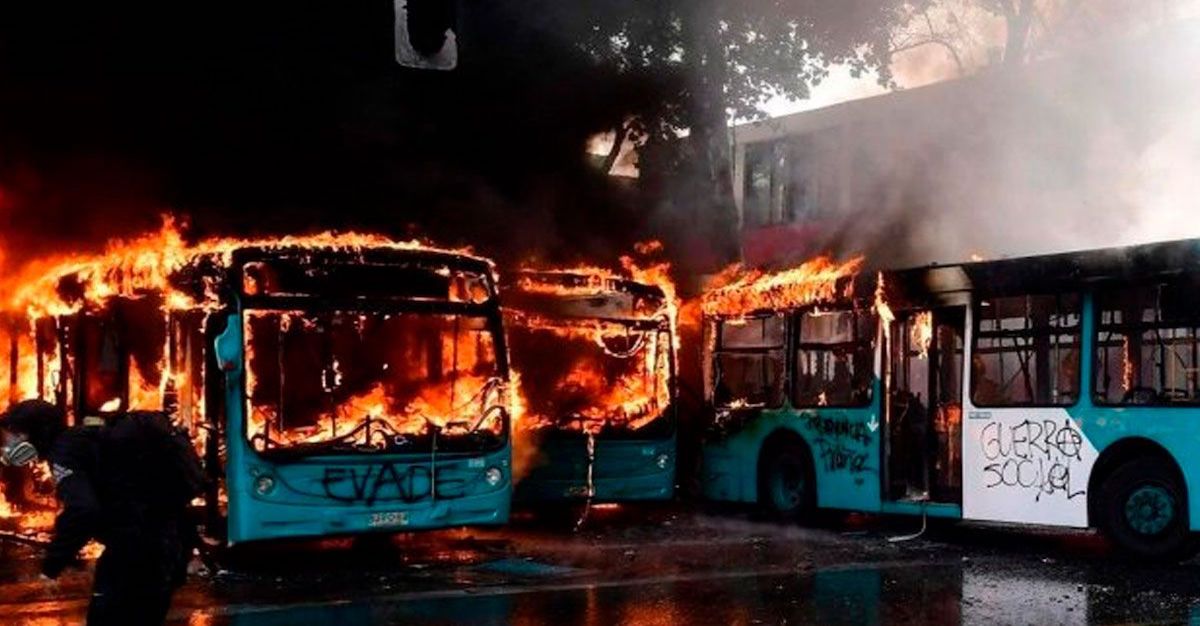
But only a few thousand have been stupid enough to cause such chaos and devastation; they’ve destroyed dozens of metro stations, buses, and even lit office buildings and grocery stores on fire.

Innocent people have died. And almost everyone else has had their lives heavily disrupted.

They can’t get to work. Schools are closed. Grocery store lines are crazy. There’s a curfew. Tanks are in the streets.

Most people are rational and peaceful. They might be angry about certain issues, but they know that torching property and killing innocents won’t solve anything.
Only a trivial fraction of a percent of the population are acting like cowards– the ones who steal a bunch of flat-screen televisions from the neighborhood electronics store before setting it on fire.

And they’re selfish and delusional enough to believe in their own righteousness– that their actions are justified as payback because of some economic injustice.

Yeah. Because nothing proves your moral superiority more than looting flat-screen TVs.

4) They often think Socialism is the answer.

Human beings seem hardwired to think that they can solve any economic injustice with Socialism.

More often than not, people don’t even think through the issues. They feel symptoms– difficulty making ends meet, difficulty getting ahead in life, etc. and they get angry.

And that’s where the analysis stops. There is no analysis actually. It’s just anger.

A rational person thinks things through– why is my cost of living increasing? Why aren’t I getting ahead? What’s the root cause of these problems? How can I fix it?

Again, Chile isn’t perfect. Not by a long shot.

But think about the 18-year old kid taking selfie videos while lighting a grocery store on fire because he’s angry… angry that his education was sub-par, angry that he can’t find a good paying job.

And he’s partially right. Public education in Chile is pretty bad, and he doesn’t have the skills for a high-paying career.

But I wonder how many books he’s read this year? How many free online courses has he taken? What has he done to solve his own problem?

Instead of torching buildings, he could have been at home watching countless videos on YouTube learning how to code in Python. For free.

And in developing real, marketable skills, he would become much more valuable and able to command a substantial wage and work remotely for prospective clients and employers worldwide.

But the Socialist mentality is not about solving your own problems.

Socialism means that you don’t have to lift a finger (except to light a match).

You just have to throw a temper tantrum until someone else solves your problems… even if you can’t even define your problem or present a reasonable solution.

I don’t want to make light of the issues; there are several problems that protesters have bought up which I agree with. But neither Socialism nor burning buildings ever solved any problems.

It may take time, but Chile is undoubtedly going to recover from this nightmare and move on. The ‘sane’ population (i.e. the vast majority) is already fighting back and defending their neighborhoods.

Source: Sovereign Man

Democrats and Republicans Aren’t just Divided. They Live in Different Worlds | The Wall Street Journal


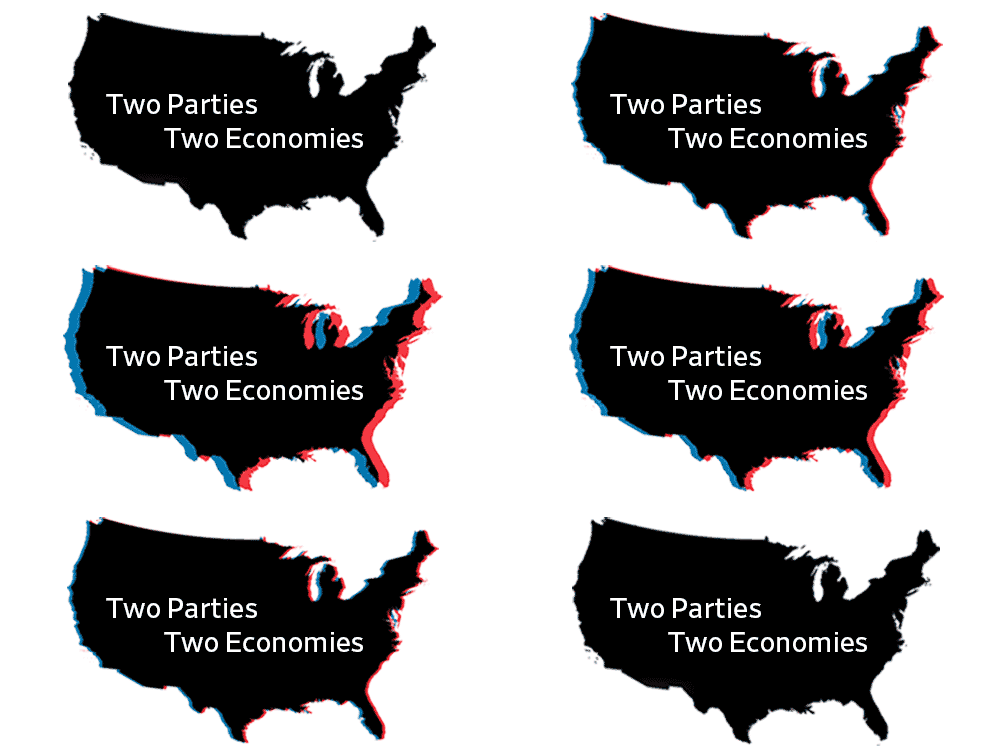
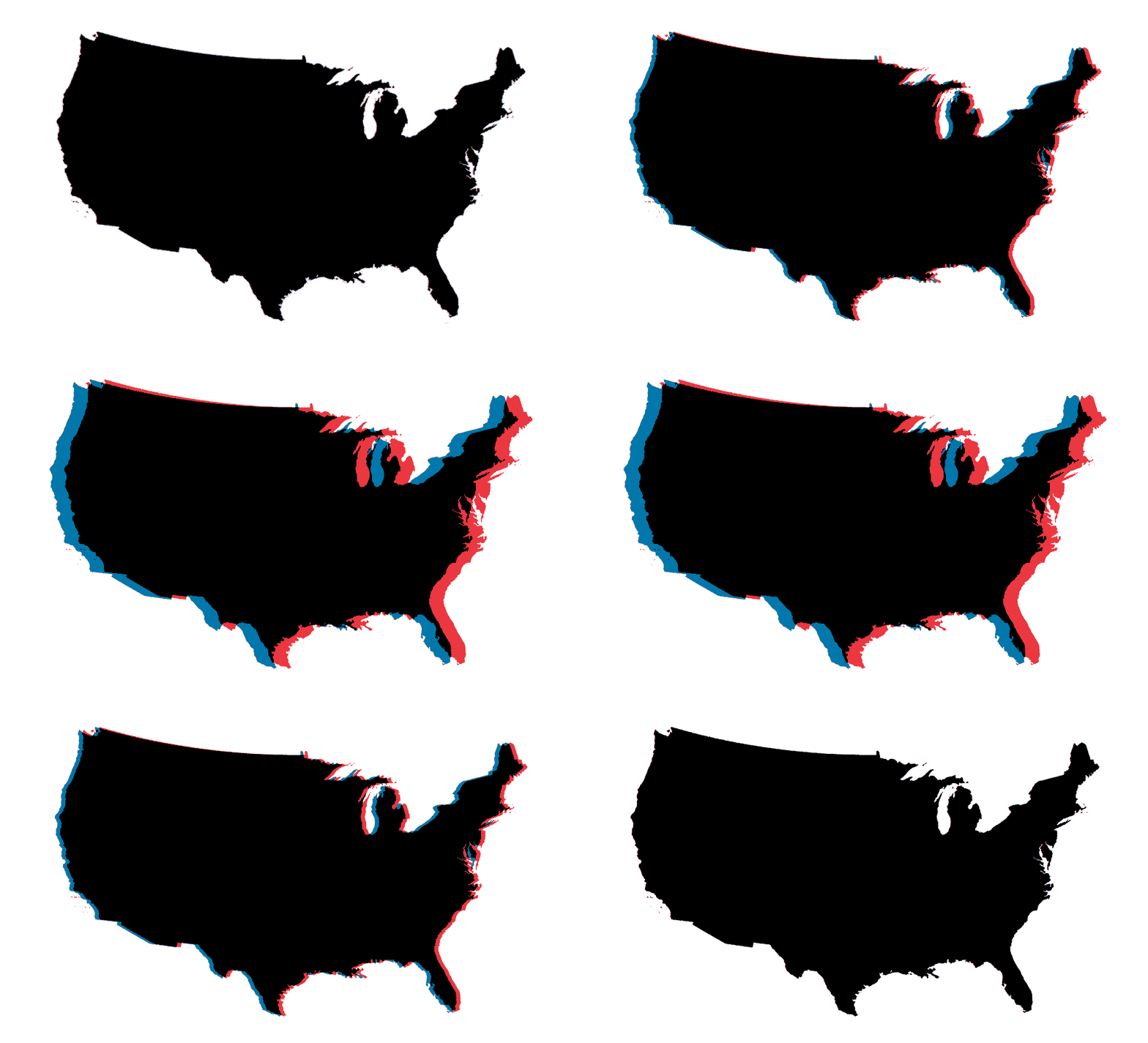
Click on Image or Source to View Visual Analysis…

Thom Tillis calls for Senate to investigate Fed independence | Politico

Editor’s Note: As a sovereignty educator for over twenty years I taught millions of people about the Federal Reserve, how it was created, the nature of money, banking, etc., and how this forever altered our constitutional Republic. That anybody in the Senate, except Former Congressmen Ron Paul and President Trump, is talking about Federal Reserve independence is good news for the Republic.

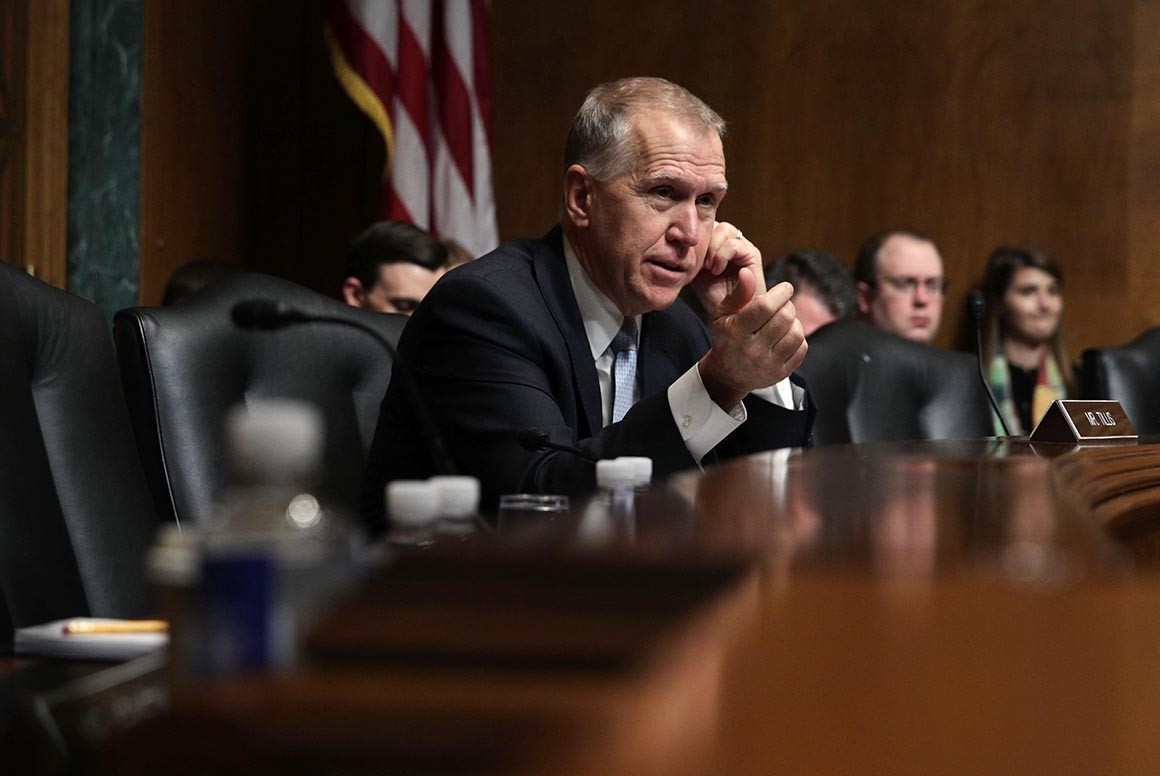
Republican Sen. Thom Tillis is calling for the Senate Banking Committee to probe the Federal Reserve’s independence after a former agency official suggested the upcoming presidential election “falls within the Fed’s purview” as it considers whether to cut interest rates.

Tillis, who is up for reelection next fall in swing state North Carolina, is siding with President Donald Trump in his ongoing feud with Federal Reserve Chairman Jay Powell. Bill Dudley, a former president of the Federal Reserve Bank of New York, wrote in a Bloomberg op-ed that the Fed should consider refusing to offer new economic stimuli because doing so could encourage Trump to plunge further into a trade war with China and would “reassert the Fed’s independence by distancing it from the administration’s policies.”

Tillis said he plans to ask the Banking Committee’s chairman, Sen. Mike Crapo (R-Idaho), about convening a hearing “regarding Fed independence and the danger of this institution taking unprecedented and inappropriate steps to meddle in the presidential election.”

“I am very disappointed that former Fed monetary Vice Chairman Bill Dudley is lobbying the Fed to use its authority as a political weapon against President Trump,” Tillis said in a statement. “The President is standing up for America against China after 30 years of our country and our workers being ripped off and there is now an effort to get the Fed to try to sabotage the President’s efforts.”

Senate Republicans generally stay out of Federal Reserve politics, but Tillis is aligning himself closely with Trump as he faces a primary challenge and a potentially difficult general election. The first-term senator previously supported a bill protecting special counsels, including Robert Mueller, and initially opposed Trump’s declaration of a national emergency on the southern border. He later supported it and has generally not deviated from Trump since.

The president has berated Powell, whom he appointed, for declining to further slash interest rates.

“The only problem we have is Jay Powell and the Fed,” Trump tweeted last week. “He’s like a golfer who can’t putt, has no touch. Big U.S. growth if he does the right thing, BIG CUT — but don’t count on him! So far he has called it wrong, and only let us down.”

The repeated attacks motivated Dudley to wade into the dispute and implore Powell to consider standing firm. He argued that the Federal Reserve’s desire to stay out of politics was admirable “but Trump’s ongoing attacks on Powell and on the institution have made that untenable.”

“Central bank officials face a choice: enable the Trump administration to continue down a disastrous path of trade war escalation, or send a clear signal that if the administration does so, the president, not the Fed, will bear the risks — including the risk of losing the next election,” Dudley wrote. “Trump’s reelection arguably presents a threat to the U.S. and global economy, to the Fed’s independence and its ability to achieve its employment and inflation objectives.”

Source: Politico