When Laws and Liberties Test Each Other’s Limits | NY Times

By Stephen Holden

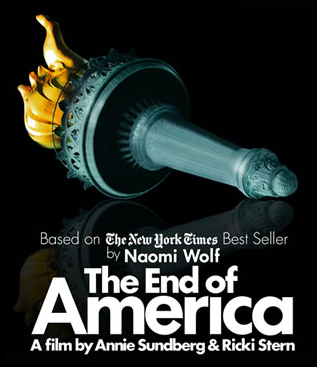
“The End of America,” an unsettling documentary polemic about the erosion of civil liberties in the wake of 9/11, brings up matters many of us would rather not contemplate in the middle of a financial crisis and on the eve of a new administration. Federal laws enacted during the last seven years that threaten our constitutional rights, it reminds us, remain in effect.

The pointedly inflammatory film, adapted from Naomi Wolf’s book “The End of America: A Letter of Warning to a Young Patriot,” compares the Bush administration’s attempts to discourage dissent and to wield increasingly unchecked power to the events preceding the establishment of 20th-century dictatorships in Germany, Italy, Chile and elsewhere. Without explicitly invoking the word, it implies that since 2001 the United States has drifted toward fascism in the name of fighting terror.

Tightly constructed and fiercely one-sided, “The End of America,” directed by Annie Sundberg and Ricki Stern (“The Devil Came on Horseback”), interweaves excerpts from a lecture in New York given by Ms. Wolf with film clips and interviews illustrating her contention that the rise of those dictatorships created a “blueprint” that the Bush administration, consciously or not, has followed.

According to Ms. Wolf, the first and fundamental tool for acquiring power is the manipulation of fear. In the shell-shocked post-

9/11 climate, the overwhelming public reaction to the Patriot Act of 2001, which gave law enforcement agencies expanded powers of surveillance, was mute acceptance of whatever was deemed necessary to keep us safe. Since then, she says, a color-coded system of terror alerts has been effectively wielded to keep us on edge.

From here, Ms. Wolf describes a 10-step program toward authoritarian rule that includes the creation of secret prisons where torture takes place; the deployment of a paramilitary force (Blackwater, which the film calls a contemporary American variation on Mussolini’s private army of “black shirts”); the development of an internal surveillance system; the harassment of citizens’ groups; and the arbitrary detention and release of ordinary civilians.

The film’s most disturbing moments are its accounts of James Yee, a United States Army chaplain at Guantánamo, who was accused of espionage and held in solitary confinement for 76 days before being released, and Maher Arar, a Syrian-born Canadian telecommunications engineer, who was detained at Kennedy International Airport, then later deported to Syria, where he was imprisoned for a year and tortured. He was eventually cleared of charges of terrorism.

The seventh step, selecting key individuals for harassment, cites the Dixie Chicks and Dan Rather as prominent cases. The eighth step, the restriction of the press, focuses on the case of Josh Wolf, a journalist jailed for 226 days for refusing to turn over videotapes he made of police brutality at a July 2005 demonstration in San Francisco.

The ninth step, the equating of political dissidents with traitors, fleetingly examines the Bush administration’s floating of the word “treason” to describe The New York Times’s publication of classified information about the government’s monitoring of overseas telephone calls. All these middle steps might be described as examples of selective intimidation intended to inhibit dissent. The case histories are glossed over.

The final step in Ms. Wolf’s Top 10 is the suspension of the rule of law. She cites the refusal of Bush administration insiders subpoenaed to appear before Congress to testify in the United States attorneys scandal. The film ends on a note of stern warning: the 11th step might be the imposing of martial law.

If the film’s vision of the steps leading toward a homegrown fascist state qualifies as paranoid, there is still enough here to make you shiver. Could it happen here? Maybe. A little fear — not the collective panic that followed 9/11 — can be a useful thing.

Source: New York Times/Movies

Fiji: “Draconian Prosecution” of press

FijiBy John Liebhardt

For the second time this month, Fiji’s military government has threatened to send a newspaper editor and its publisher to prison for publishing a letter to the editor alleged to be in contempt of court.

In mid-October, the Fiji Times and Fiji Daily Post printed a letter from a certain Vili Navukitu of Queensland, Australia complaining about a recent high court ruling that legitimized the actions of the country’s president in dissolving the Parliament, and the elected government of Laisenia Qarase, immediately following the December 2006 coup that brought into power Commodore Frank Bainamairama.

The letter (which has been reprinted in this post) pointed out that Bainimarama had undue influence on the jurors because he had previously removed the court’s chief justice.

After the letter was published, Fiji’s Attorney General Aiyaz Sayed-Khaiyum accused the Fiji Times of being in contempt according to Fiji’s laws because it casted doubts on the integrity and independence of the courts. The Fiji Times printed a front-page apology admitting contempt and offering to pay all court costs.

The Attorney General, unimpressed with the apology, has asked the court to jail the editor and publisher of the paper and apply stiff fines to the paper. The case is in recess until December.  The editor and publisher of the Fiji Daily Post, where the letter also appeared, could meet the same fate, the Attorney General declared this week. Both newspapers have been asked to provide full details of the letter writer.

The scandal comes at the heels of the announcement that press freedom group Reporters Without Borders ranked Fiji 79th for press freedom out of 173 countries, a large leap from the previous year, where it was 107.

Fiji’s bloggers have largely expressed outrage at the case against the two newspapers.

Source: Global Voices Online

Remembering the fallen: To those who paid the ultimate price for their journalism

Frontline Club logo

By Robert Fox, 22 Jun 2008

The dedication of Jaume Plensa’s giant glass vase ‘Breathing’ on the roof of the BBC at Portland Place as a memorial to all who have fallen in the cause of news and reporting  was moving, fitting and strangely remote.

It is fitting and timely because reporting is an increasingly dangerous business. The grim numbers of the killed and wounded and disappeared among reporters and news people of all kinds in conflicts from Iraq, Afghanistan, to Darfur, Zimbabwe and the Caucasus are testimony enough to this.

The sense of remoteness of the BBC memorial ceremony was encouraged by the fact that the giant sculpture is way up on a roof. The public can’t see it close-up to read the names and James Fenton’s verses on the fallen of  the ranks of journalism.

In some ways this is a metaphor. We all see the fruits of journalism in increasing volume and intensity, through TV and radio, print, the blogosphere, telephone text and video, Youtube and MySpace. But the essence of what is going on in, say, remoter Zabul, Bulawayo, the water wars of the Fergama valley and Darfur is perennially baffling. As Gordon Burn writes in his wonderful fable ‘Born Yesterday’ (last year’s news a novel) of “the feeling we all increasingly have of seeing everything but of being able to do nothing.”

Remembering the fallen and the wounded in body and spirit of the craft and calling of news reporting touches the core of  Frontline. Prominent in our memory are our fallen friends and comrades, Rory Peck, intrepid cameraman and Kurt Schork, king of the agency correspondents, Nick della Casa, who with his wife Rosanna and Charles Maxwell were murdered by their guide in northern Iraq in 1991, Carlos Mavroleon died in his Peshawar hotel in 1998, Roddy  Scott, ambushed and killed by Russians in  Chechnya (2002), James Miller cut down by the IDF in Gaza in 2003, and Richard Wild, murdered in Baghdad in 2003.

Most of these were not salaried, insured and protected correspondents of a large news organisation, but worked by the piece and day, freelance or on short contract. They did what they did because they believed in what they were doing, and telling a story that was vital.

They were prepared to go to the dark and dangerous places, on the map of the world, and into the darker inner map of human minds. So much of the news coverage in the most difficult but crucial zones of conflict depend on the freelance going the extra mile, or in most cases extra hundreds of miles, to get to the story.

In this motley crew of the non-staffers the vital links, the turn-keys of the whole enterprise, are the fixers, drivers, interpreters and helpers. They have no insurance policies, or regular income to support them when one of theirs is killed or wounded – and of course there is no safety in hazardous environments procedure, or health and safety regulation to protect them. Nearly all of us owe our lives, and our stories, to this strangely uplifting band – who do not seem  to know the meaning of the word ‘whinge’.

Some 21 years ago I was wandering the shores of the Mediterranean for a book when I went down to Tyre, to look, among other things, at the remains of the Roman circus (which was used in the Charlton Heston movie of Ben Hur). Under one of the arches of the auditorium I interviewed a bunch of ‘soeurs Islamiques’ supporters of Amal, when my companion and driver Abed spotted some Hezbollah gunmen going down for a spot of target practice. Realising they hadn’t seen me, he neatly diverted them with a torrent of  aimless conversation. Abed and his family worked for the BBC for decades, particularly for Jeremy Bowen. He was killed when Israeli gunners deliberately targeted his car in southern Lebanon a couple of years ago.

The Frontline Club’s Fixers Fund is a vital line to the families, often pretty extended, of those stringers and fixers  who are killed and injured – or simply never come back.  I would hope something can be done for educational facilities, just things as simple as books and DVDs are welcome, both for the young interpreters and their families.

As the news world becomes an ever expanding and fragmenting universe, we should remember the pioneers and bold spirits who did, and said something new – though their bosses didn’t want it. Ernie Pyle lived the life of a soldier on the frontline in Normandy, Belgium and the Pacific, telling the story through the words of his archetypal hero, GI Joe. He was killed in Okinawa in the last weeks of the Pacific war in 1945 – when the Japanese took back the island recently, his was one of only three American memorials they allowed to stay.

We should remember other bold spirits who showed courage in a different way in bringing us the news deemed unfit by the bosses  to print or broadcast, yet they believed it should – people like I. F. Stone and Ed Murrow.

From the roof opposite Jaume Plensa’s memorial sculpture Murrow made live broadcasts in the Blitz to a reluctant audience in America.

Source: Frontline Club