PepsiCo’s Naked Juices to Drop ‘All Natural’ Label After $9 Million Class Action Lawsuit| NaturalSociety

pepso_naked_juice-263x159While government agencies like the FDA keep stalling on demanding rigorous scientific testing of numerous questionable ingredients, GMO foods, and the correct labeling of such foods, PepsiCo has recently agreed to settle out of court for $9 million over a class action lawsuit that claimed ‘natural’ and ‘non-GMO’ on their bottles was misleading since they are made with GMO ingredients, as well as synthetic and ‘unnatural’ items.

The plaintiffs in the suit claimed that PepsiCo gave the “the false impression that the beverages vitamin content is due to the nutritious fruits and juices, rather than the added synthetic compounds such as calcium pantothenate (synthetically produced from formaldehyde)” and “Fibersol-2 (a proprietary synthetic digestion-resistant fiber produced by Archer Daniels Midland and developed by a Japanese chemical company), fructooligosaccharides (a synthetic fiber and sweetener), and inulin (an artificial and invisible fiber added to foods to … increase fiber content without the typical fiber mouth-feel).”

The amount of synthetic additives in Naked juices are quite possibly more than anything ‘natural’ at all. It certainly isn’t a ‘100% juice” smoothie as the labeling on the bottle currently states. Naked juices contain up to 11 different chemicals including: niacinamide, d-alpha tocopherol acetate, cyanocobalamin, and pyridoxine hydrochloride, just to name a few.

And as you may have expected, of course Pepsi Co donated more than $2.5 million dollars to help defeat Proposition 37 in California that would have required companies like Pepsi to label all products that contain GMOs in any form. The ‘Right to Know” ballot was defeated due to special interest groups like Syngenta, Dow, Monsanto, Pepsi Co, and others who helped finance its demise.

If you would like to avoid PepsiCo altogether since they are actively trying to push GMO foods and chemical laden drinks on the public while trying to pass them off as ‘health’ food, you might have a hard time ignoring the company – they are in almost every country and make everything from Pepsi Cola to Frito Lay Chips, Tropicana Juices, Quaker Oates and Gatorade. But learn of what they create, and you can steer clear.

You can also email PepsiCo’s Senior Director with your opinion about their GMO and unnatural products. The Organic Consumers Association has created a simple way to do send a message to the senior director of Communications, Mike Torres.

If you want real juice, try putting some organic apples, lemons and kale in a juicer. No corporate lies need to be added to the recipe.

Cincinnati judge orders all speed cameras confiscated, manufacturer held in contempt | NaturalNews

By J.D. Heyes

Traffic-Security-CamerasChalk one up for privacy, at least in one part of the country.

Traffic cameras have been a part of the urban scenery for years now, but in Elmwood Place – a suburb of Cincinnati – they are history. Finally.

In a recent court hearing, Judge Robert Ruehlman ordered them not only to be shut off but to be impounded – taken off the streets for good.

The ruling comes as a result of a contentious legal battle over the speed cameras. Both sides of the case were back before Ruehlman during a contempt hearing June 27, “where the judge ruled that Elmwood Place and the speed camera contractor Optotraffic were in contempt of court,” WLWT reported.

Ruehlman found in March that the speed cameras were unconstitutional, essentially then ordering them shut down, along with the speed ticket program. He also ruled that outstanding tickets issued as a result of the system did not have to be paid.

During the June 27 hearing, Ruehlman found that his order had been violated in a number of ways. First off, the cameras had been turned back on, though Elmwood Place Police Chief Bill Peskin said during the hearing that they were only used to collect traffic and speed data, not to collect license plate information or to issue new traffic tickets.

He also testified that people who had come to the station to pay tickets they had been issued were told that they didn’t have to. “Many people did show up, trying to pay their citation to us,” Peskin said, “and we told them that the program was to be suspended and they didn’t have to pay the citation.”

The thing is, tickets were never meant to be paid to the suburb – though some monies apparently were collected, with some going back to Elmwood Place, according to court testimony.

“The traffic camera company collected the citations, and apparently continued to collect money sent in after the judge’s March order,” WLWT reported. “There was testimony in court that some $48,000 was collected, with a percentage of that money passed on to the village per the speed camera contract.” Optotraffic did not have a representative in court Thursday.

Mike Allen, an attorney who is part of a legal team fighting against the speed cameras, called them a “money grab.”

“This offends me as a citizen, it offends me as a lawyer, it offends me on behalf of my clients,” Allen said, according to reports.

In order to ensure no further violations of his order occurred, the judge ordered the Hamilton County sheriff to impound the traffic cameras and all of the equipment that is part of the traffic program, and store it at the expense of Elmwood Place. The equipment is to be released when the $48,000 in improperly collected ticket fees is returned. Per WLWT:

Another victory in court for the lawyers fighting the cameras came when the topic moved to a class action lawsuit. The judge allowed the lawyers to move forward with a class action suit that Mike Allen says would involve anyone who was given a ticket by the speed cameras back to the first day of operations in Elmwood Place.

“We’re going to do everything in our power to get some money back in those people’s pockets because it’s just not right,” said Allen.

The report said the class-action suit may take some time to get through the courts. Hearings for it have already been set up, but they won’t happen for months. However, the Ohio House approved a ban on speed cameras earlier in the week, meaning the end is near for all speed cameras in the state.

“I think the days of speed cameras in the village of Elmwood and in the state of Ohio are numbered,” Allen said.

Sources: NaturalNews & WLLT

Carbon Offsets Could Create Loophole for Industry to Pollute as Usual | EcoWatch

LoggingBy Maureen Nandini Mitra and Michael Stoll

One hot day this spring John Buckley scrambled up a dusty slope of a patch of deforested land in the middle of California’s Stanislaus National Forest in the Sierra Nevada, five miles west of Yosemite National Park, and surveyed the bleak landscape: 20 acres of blackened tree stumps and the shriveled remains of undergrowth. On neighboring ridges, similar brown expanses dotted the green forest canopy. “This,” he said, spreading his arms wide, “is resource management.”

The denuded clearing is on a tract of private forestland owned by timber giant Sierra Pacific Industries that is close to being approved as a sort of carbon bank under California’s new cap-and-trade scheme. It will soon grow into a plantation of mostly Douglas fir, ponderosa pine and cedar.

Based on calculations of how much carbon the new and old trees in this forest area will remove from the atmosphere, the timber giant will soon be able to sell carbon credits, which regulators call “offsets,” to the largest California polluters so they can compensate for their greenhouse gas emissions. Looking to make a profit from their environmental practices, companies in forestry and other industries are rushing to meet the demand.

Buckley, an environmental activist from Tuolumne County, is dismayed that projects like these—that involve clearing out old, diverse forests and replanting the area with a handful of quick-growing timber varieties—are being considered as a means to enable California industries to emit more pollutants into the air.

Many environmentalists say that because it is notoriously difficult to prove that such projects actually reduce the state’s overall carbon footprint, California should proceed slowly in approving a vast expansion of the cap-and-trade market.

The plan is to start the Compliance Offset Program this summer. Sellers include some of the largest forestland owners in the U.S., dairy farms and companies that neutralize greenhouse effect-producing refrigerants. The program might also expand to other activities, such as methane capture from mining and rice farming.

Proponents say that by providing incentives to voluntarily reduce emissions and use new technology, the offset program could help California meet its legal requirement, set in 2006, to reduce its carbon footprint from all sources by about 16 percent by 2020, and even more in later years.

But critics call offsets a loophole that could undermine an effective cap-and-trade system. They say pledges of reductions that are not required by law often cannot be considered real, since companies might have made them anyway without the extra money from selling offsets. Left unchecked, the critics warn, poorly measured offsets could lead to an overall increase in California’s emissions. Read more…

Source: Earth Island Journal & EcoWatch

Monsanto wins Supreme Court fight over its genetically engineered soybeans | Washington Post

GoHomeMonsantoThe Supreme Court said Monday that an Indiana farmer violated Monsanto Co.’s patents on soybean seeds resistant to its weed-killer by growing the beans without buying new seeds from the corporation.

The justices unanimously rejected the farmer’s argument that cheap soybeans he bought from a grain elevator are not covered by the Monsanto patents, even though most of them also were genetically modified to resist the company’s Roundup herbicide.

While Monsanto won this case, the court refused to make a sweeping decision that would cover other self-replicating technologies like DNA molecules and nanotechnologies, leaving that for another day. Businesses and researchers had been closely watching this case in hopes of getting guidance on patents, but Justice Elena Kagan said the court’s holding Monday only “addresses the situation before us.”

In a statement, Monsanto officials said they were pleased with the court’s ruling.

“The court’s ruling today ensures that longstanding principles of patent law apply to breakthrough 21st century technologies that are central to meeting the growing demands of our planet and its people,” said David F. Snively, Monsanto’s top lawyer. “The ruling also provides assurance to all inventors throughout the public and private sectors that they can and should continue to invest in innovation that feeds people, improves lives, creates jobs, and allows America to keep its competitive edge.”

In the case decided by the court, farmer Vernon Hugh Bowman bought expensive, patented Monsanto’s “Roundup Ready” seeds for his main crop of soybeans, but decided to look for something cheaper for a risky, late-season soybean planting. He went to a grain elevator that held soybeans it typically sells for feed, milling and other uses, but not as seed.

Bowman reasoned that most of those soybeans also would be resistant to weed killers, as they initially came from herbicide-resistant seeds too. He was right, and he bought soybeans from the grain elevator and planted them over eight years. In 2007, Monsanto sued and won an $84,456 judgment.

Monsanto has a policy to protect its investment in seed development that prohibits farmers from saving or reusing the seeds once the crop is grown. Farmers must buy new seeds every year. More than 90 percent of American soybean farms use Monsanto’s seeds, which first came on the market in 1996.

Bowman’s lawyers argued that Monsanto’s patent rights stopped with the sale of the first crop of beans instead of extending to each new crop soybean farmers grow that has the gene modification that allows it to withstand the application of weed-killer.

But Kagan disagreed. “Bowman planted Monsanto’s patented soybeans solely to make and market replicas of them, thus depriving the company of the reward patent law provides for the sale of each article,” she said. “Patent exhaustion provides no haven for such conduct.”

Bowman also said he should not be liable, in part, because soybeans naturally sprout when planted.

Kagan said the court also did not buy that argument. “We think the blame-the-bean defense tough to credit,” she said.

Andrew Kimbrell, executive director of Center for Food Safety, said the ruling was wrong. “The court chose to protect Monsanto over farmers,” Kimbrell said. “The court’s ruling is contrary to logic and to agronomics, because it improperly attributes seeds’ reproduction to farmers, rather than nature.”

But a soybean growers’ association said it was the correct decision. “The Supreme Court has ensured that America’s soybean farmers, of which Mr. Bowman is one, can continue to rely on the technological innovation that has pushed American agriculture to the forefront of the effort to feed a global population projected to pass 9 billion by 2050,” said Danny Murphy, president of the American Soybean Association.

Calls to Bowman by The Associated Press were unanswered.

The soybean case is Bowman v. Monsanto Co., 11-796.

Source: Washington Post

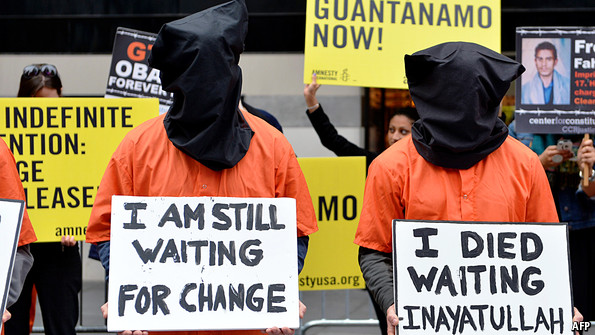
A desperate protest by prisoners at Guantánamo has shamed Barack Obama

GuantanamoHungerStrike“YOU have to hand it to some of these IRA boys,” Margaret Thatcher once remarked of the republican hunger-strikers who embarrassed her in 1981. “What a terrible waste of human life!” she said of the ten who died. Since some of the hunger-strikers at Guantánamo Bay are being force-fed through nasal tubes, Barack Obama may be spared Mrs Thatcher’s grief. But he has been shamed by their desperate gambit all the same. The protest is a reminder of one of his most glaring failures in office.

Officials count 100 hunger-strikers; lawyers for the detainees say there are 130; on any reckoning, a majority of the 166 remaining inmates are starving themselves. Through their lawyers, detainees complain of a rougher regime since the army took over guard duties from the navy last autumn. In particular they allege that their Korans were mistreated during an inspection in February, when the hunger-strike began (prison authorities vigorously deny that). A cell-block raid by guards on April 13th (provoked by the covering up of security cameras), during which some prisoners were shot with rubber pellets, hardened rather than broke the strikers.

But the underlying cause is simpler, and more personal. “The reason they’re willing to die”, says Carlos Warner, a federal defender who represents 11 of the detainees, “is President Obama.”

Mr Obama said this week that Guantánamo “hurts us in terms of our international standing.” That echoed the view he espoused when, on his second day in office in January 2009, he ordered the prison to be closed within a year. Its existence since 2002, he said, had “likely created more terrorists around the world than it ever detained”—an opinion eventually shared by assorted veterans of George W. Bush’s administration. And yet the only Guantánamo-related closure so far has been the shutting, in January this year, of the diplomatic office charged with resettling the inmates.

Mr Obama blames Congress—with some justification. It thwarted his original plan to transfer the detainees to a facility in Illinois. Then, either out of concern for national security, a yen to embarrass the president, or both, in clauses inserted into successive defence-spending bills Congress made it difficult for officials to transfer anyone anywhere. Difficult, but not impossible: Mr Obama can authorise transfers using a presidential waiver. He has chosen not to. (After a bomb plot with links to Yemen at the end of 2009, he also chose to halt transfers there—and most of the remaining prisoners are Yemeni.) He evidently calculated that, given the battles he is already waging with Congress, Guantánamo was one he could do without.

That stalemate has been an especial let-down for the 86 residual prisoners who, in 2010, were slated for transfer out of Guantánamo by a presidential review; some had already been designated for transfer under the previous administration. Many of these men claim to have committed no offence except being in the wrong place—Afghanistan—at the wrong time, or to have been sold to American forces for the bounties they offered. One such, and one of the hunger-strikers, is Shaker Aamer, a British resident picked up in Jalalabad in 2001 and allegedly tortured. His lawyer, Clive Stafford Smith, points out that the British government is well-equipped to monitor Mr Aamer should he be repatriated.

According to the review, many of these men were low-level fighters rather than total innocents. But none has been charged with a crime—and most have been at Guantánamo for over a decade. In fact, only seven of the 779 prisoners who have passed through the camp have been convicted by its military tribunals (and two of those verdicts have been challenged). Of those still there, only three have been convicted and only six currently face trial, including Khalid Sheikh Mohammed, the alleged mastermind of the September 11th attacks. Subject to multiple legal challenges, beset by scandals over hidden microphones and leaked defence documents, the tribunals are now regarded as a failure even by those untroubled by their dubious legal status. As Mr Obama pointed out, federal courts have proved a much more effective forum for prosecuting terrorists.

The result, at the camp, is near-total stasis. No new prisoner has arrived since 2008; none has left for over a year. Parole-style hearings planned for the group not designated for either trial or transfer have yet to begin. Prisoners have lawyers, but there is little the lawyers can do for them. This bleak situation, says Mr Stafford Smith, is worse than being on death row.

Last chance?

Beyond the feeling of personal betrayal by Mr Obama, the detainees also sense—correctly—that the attention of the foreign leaders, human-rights watchdogs and United Nations officials who once energetically protested at their predicament has wandered. The outrage that the manacled, blindfolded, jumpsuited figures first provoked has dimmed. Drone warfare has become a much bigger human-rights preoccupation. And yet, unpropitious as it might seem, the prisoners also fear that this may be their last chance to get out.

Mr Warner says that if, with the president’s views and legal background, Mr Obama “can’t get this done, I don’t know who could.” It is hard to see a future presidential candidate matching his troublesome pledge to shut the prison. And for Mr Obama as well, time is running out. Even if he chose to use his waiver powers, and leant on other governments to accept detainees, the diplomacy, including gathering the necessary assurances on security and humane treatment, would take time.

Meanwhile the Guantánamo authorities are seeking an extra $200m for refurbishments, on top of annual running costs that wildly exceed those for ordinary prisons. They are planning new medical facilities to care for elderly detainees.

This week Mr Obama vowed to re-engage with Congress. “I’m going to go back at this,” he promised. He should hurry. Once Guantánamo was a byword for an overmighty executive and the excesses of Mr Bush’s “war on terror”. Under Mr Obama it has become a victim and a symbol of the paralysing divisiveness of American politics. “It’s going to get worse,” he said this week. “It’s going to fester.”

Source: The Economist
Portugal Decriminalized All Drugs Eleven Years Ago And The Results Are Staggering | Business Insider

By Samuel Blackstone

PortugalDrugsOn July 1st, 2001, Portugal decriminalized every imaginable drug, from marijuana, to cocaine, to heroin. Some thought Lisbon would become a drug tourist haven, others predicted usage rates among youths to surge.Eleven years later, it turns out they were both wrong.

Over a decade has passed since Portugal changed its philosophy from labelling drug users as criminals to labelling them as people affected by a disease. This time lapse has allowed statistics to develop and in time, has made Portugal an example to follow.

First, some clarification.

Portugal’s move to decriminalize does not mean people can carry around, use, and sell drugs free from police interference. That would be legalization. Rather, all drugs are “decriminalized,” meaning drug possession, distribution, and use is still illegal. While distribution and trafficking is still a criminal offence, possession and use is moved out of criminal courts and into a special court where each offender’s unique  situation is judged by legal experts, psychologists, and social workers. Treatment and further action is decided in these courts, where addicts and drug use is treated as a public health service rather than referring it to the justice system (like the U.S.), reports Fox News.

The resulting effect: a drastic reduction in addicts, with Portuguese officials and reports highlighting that this number, at 100,000 before the new policy was enacted, has been halved in the following 10 years. Portugal’s drug usage rates are now among the lowest of EU member states, according to the same report.

One more outcome: a lot less sick people. Drug related diseases including STDs and overdoses have been reduced even more than usage rates, which experts believe is the result of the government offering treatment with no threat of legal ramifications to addicts.

While this policy is by no means news, the statistics and figures, which take years to develop and subsequently depict the effects of the change, seem to be worth noting. In a country like America, which may take the philosophy of criminalization a bit far (more than half of America’s federal inmates are in prison on drug convictions), other alternatives must, and to a small degree, are being discussed.

For policymakers or people simply interested in this topic, cases like Portugal are a great place to start.

Source: Business Insider

A Lesson for the Wall Street Journal on the NDAA | Tenth Amendment Center

Section 1021 of the 2012 National Defense Authorization Act (NDAA) purports to authorize the President to designate all persons — including U.S. Citizens found within the U.S — as enemy combatants, subject to the Law of War, including; Indefinite detention without trial or charge, transfer to foreign jurisdictions or entities (commonly known as extraordinary rendition), and military tribunals. Essentially, the NDAA seeks to designate the United States as an active war zone in regards to allegations of terrorism, or support of terrorism, wherein our most cherished and basic Constitutional Rights are subject to the President’s discretion.

The fundamental issues raised by the NDAA deserve better from the Wall Street Journal’s editorial board than that which appeared on April 30, 2012, entitled; “The Tea Party’s Inner ACLU.”  The editorial conducts a cursory and incomplete statutory and Constitutional analysis, and improperly blurs the lines between the rights of persons captured outside the U.S. and citizens within the U.S., to incorrectly conclude that: 1) the NDAA only applies to “terrorists,” 2) the president has the Constitutional authority to designate U.S. citizens within the U.S. as enemy combatants subject to the Law of War, 3) detainees have sufficient Habeas Corpus rights, 4) that the new Virginia law directs all state officials to not cooperate with Federal detainments of citizen terrorism suspects, and 5) that the Virginia law is unconstitutional.

Unfortunately, the Journal’s hasty analysis endorsing the Constitutionality of the NDAA’s enemy combatant status for U.S. citizens captured within the U.S., and objecting to state refusal to cooperate with Federal detainments pursuant to the NDAA, leaves readers with a misunderstanding the U.S. Constitution, the NDAA, and the current nation-wide NDAA nullification movement spearheaded by our organizations; the Tenth Amendment Center and the Rhode Island Liberty Coalition. Read more…

Health Care Reform and the Supreme Court (Affordable Care Act) | The New York Times

By Adam Liptak

On March 26, the Supreme Court began three days of hearings on challenges to the constitutionality of the Affordable Care Act, the health care reform bill pushed by President Obama and passed by Congress in March 2010 over bitter Republican opposition.

It is one of the most significant cases heard by the court in decades, with implications for the presidential race as well as the future of health care coverage. The decision, due in late June, is also likely to be a major factor in shaping the legacy of Chief Justice John G. Roberts Jr., as well as Mr. Obama, whose signature domestic initiative is on the line.

Day Three

On the third day of health care arguments, the justices shifted their attention to a question with enormous practical implications: If they strike down a key provision of the sprawling law, what other provisions would have to fall along with it?

Justice Antonin Scalia said the whole law would have to go. “My approach would be to say that if you take the heart out of this statute,” he said, “the statute’s gone.”

Other justices considered a variety of possible approaches.

The issue took on practical urgency after some of the questioning the day before had suggested that the law’s core provision, often called the individual mandate, may be in peril. It requires most Americans to obtain insurance or pay a penalty.

Last year, the United States Court of Appeals for the 11th Circuit, in Atlanta, ruled that the mandate was unconstitutional, but it said the balance of the law survived.

The Obama administration argued for a middle ground: that if the mandate falls, two politically popular provisions must die with it — those that prohibit insurers from declining coverage or charging higher premiums because of pre-existing medical conditions.

The challengers to the law argued that the entire act must fall along with the what one lawyer called “its heart.’’ The court appointed an outside lawyer, H. Bartow Farr III, to argue the 11th Circuit’s position, that the mandate could fall alone.

The court separated the day’s arguments into two sessions. After the morning session, which focused on the effect of overturning the mandate, the afternoon’s hearing dealt with the law’s expansion of Medicaid, part of its attempt to reduce the number of Americans without health insurance.

In the second argument, the court’s more conservative justices expressed concern that the law’s Medicaid expansion was unduly coercive to states. The law would give states additional money to expand Medicaid – which covers largely lower-income households – and also add new rules about that coverage.

Justice Anthony M. Kennedy, often the swing vote on the court, wondered whether Medicaid created accountability problems because the federal government set the rules but the states operated it.

The court’s more liberal justices expressed surprise that the expanded program, financed largely with federal money, was at all questionable on constitutional grounds. Read more…

Oregon’s SB 1552 Analyzed – Mandatory Mediation Law (For Trust Deed Foreclosures) | Querin Law

By Phil Querin, Attorney

On March 5, 2012, the Oregon Legislature passed a sweeping series of changes to its trust deed foreclosure law, SB 1552.  Once signed by the Governor it will become effective 91 days hence.  What follows is a summary of (a) the new mandatory mediation law that, after the effective date, will apply to the non-judicial foreclosure of all residential trust deeds; and (b) some important changes to the existing laws governing judicial and non-judicial foreclosures.  Between now and the effective date, the Oregon Attorney General’s office will promulgate rules to implement the mediation program.  Until then, all we have for guidance is SB 1552 itself. This summary is for informational purposes only and should not be viewed as “legal advice”.  Those interested in seeing if the new law may apply to their particular situation should consult with their own legal counsel. Read more…
New York’s U.S. Bankruptcy Court Rules MERS’s Business Model Is Illegal | Huffington Post

By L Randall Wray

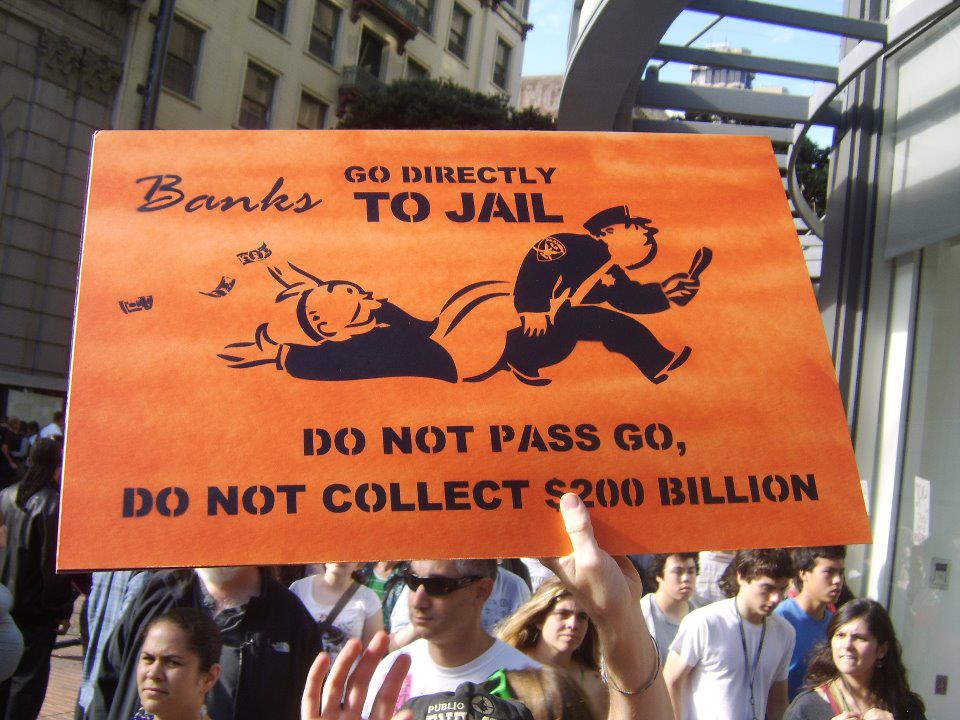
United States Bankruptcy Judge Robert Grossman has ruled that MERS’s business practices are unlawful. He explicitly acknowledged that this ruling sets a precedent that has far-reaching implications for half of the mortgages in this country. MERS is dead. The banks are in big trouble. And all foreclosures should be stopped immediately while the legislative branch comes up with a solution.

For some weeks I have been arguing that MERS is perpetrating foreclosure fraud all across the nation. Its business model makes it impossible to legally foreclose on any mortgaged property registered within its system — which includes half of the outstanding mortgages in the US. MERS was a fraud from day one, whose purpose was to evade property recording fees and to subvert five centuries of property law. Its chickens have come home to roost.

Wall Street wanted to transform America’s housing sector into the world’s biggest casino and needed to undermine property rights to make it easier to run the scam. The payoffs were bigger for lenders who could induce homeowners to take mortgages they could not possibly afford. The mortgages were packaged into securities sold-on to patsy investors who were defrauded by the “reps and warranties” falsely certifying the securities as backed by top grade loans. In fact the securities were not backed by mortgages, and in any case the mortgages were sure to go bad. Given that homeowners would default, the Wall Street banks that serviced the mortgages needed a foreclosure steamroller to quickly and cheaply throw families out of the homes so that they could be resold to serve as purported collateral for yet more gambling bets. MERS — the industry’s creation — stepped up to the plate to facilitate the fraud. The judge has ruled that its practices are illegal. MERS and the banks lose; investors and homeowners win.

Here’s MERS’s business model in brief. Real estate property sales and mortgages are supposed to be recorded in local recording offices, with fees paid. With the rise of securitization, each mortgage might be sold a dozen times before it came to rest as the collateral behind a mortgage backed security (MBS), and each of those sales would need to be recorded. MERS was created to bypass public recording; it would be listed in the county records as the “mortgagee of record” and the “nominee” of the holder of mortgage. Members of MERS could then transfer the mortgage from one to another without all the trouble of changing the local records, simply by (voluntarily) recording transactions on MERS’s registry.

A mortgage has two parts, the “note” and the “security” (not to be confused with the MBS) or “deed of trust” that is usually just called the “mortgage”. The idea behind MERS was that the “note” would be transferred from seller to purchaser, but the “mortgage” would be held by MERS. In fact, MERS recommended that the “note” be held by the mortgage servicer to facilitate foreclosures, but in practice it seems that the notes were often lost or destroyed (which is why all those Burger King Kids were hired to Robo-sign “lost note affidavits”).

At each transfer, the note and mortgage are supposed to be “assigned” to the new owner; MERS claimed that because it was the “mortgagee of record” and the “nominee” of both parties to every transaction, there was no need to assign the “mortgage” until foreclosure. And it argued that since the old adage is that the “mortgage follows the note” and that both parties intended to assign the notes (even if they did not get around to doing it), then the Bankruptcy Court should rule that the assignments did take place in some sort of “virtual reality” so that there is a clear chain of title that allows the servicers to foreclose.

The Judge rejected every aspect of MERS’s argument. The Court rejected the claim that MERS could be both holder of the mortgage as well as nominee of the “true” owner. It also found that “mortgagee of record” is a vague term that does not give one legal standing as mortgagee. Hence, at best, MERS is only a nominee. It rejected MERS’s claim that as nominee it can assign notes or mortgages — a nominee has limited rights and those most certainly do not include the right to transfer ownership unless there is specific written instruction to do so. In scarcely veiled anger, the Judge wrote:

“According to MERS, the principal/agent relationship among itself and its members is created by the MERS rules of membership and terms and conditions, as well as the Mortgage itself. However, none of the documents expressly creates an agency relationship or even mentions the word “agency.” MERS would have this Court cobble together the documents and draw inferences from the words contained in those documents.” Read more…