New Email Reveals Answer to Establishment’s Efforts to Oust Trump | The Epoch Times

By Jeff Carlson

New detail in Danchenko trial exhibits suggests that FBI intentionally targeted Trump on false Russia collusion charges.

An FBI email previously not known to the public has revealed that the bureau planned to make Igor Danchenko—the primary source for British former spy Christopher Steele’s Trump dossier—a confidential human source (CHS) before it had even interviewed him.

The revelation, which was discovered as a result of special counsel John Durham’s case against Danchenko, indicates that the FBI deliberately targeted 2016 presidential candidate and later President Donald Trump with claims it already knew at the time to be false.

The email—of which only the subject line has been made public—was first uncovered by an internet sleuth who goes by the moniker “Walkafyre” and was included in hundreds of unused exhibits from Danchenko’s trial.

The FBI used Danchenko—who was acquitted last week on all charges of lying to the FBI—in its investigation of Trump, despite knowing that Danchenko had helped fabricate the dossier.

With the benefit of this new information, a renewed examination of the timeline between the Nov. 8, 2016, presidential election and the appointment of special counsel Robert Mueller on May 17, 2017, reveals that the FBI—with the help of the Obama administration and Washington establishment figures—executed a concerted campaign to oust a sitting president.

Email Reveals FBI’s Plan for Danchenko

The newly discovered email was sent by FBI agent Kevin Helson to unknown recipients on Jan. 12, 2017. The email’s heading reads “Plan to Convert Danchenko into CHS.”

This email is critical for several reasons. It shows that the FBI intended to hide Steele’s main source behind CHS status after they had previously discovered Steele couldn’t back up the claims in his dossier despite their offer of $1 million to him for any corroboration. As a CHS, Danchenko also would be shielded from any external investigations—including those of Congress.

Of equal importance, Helson’s email also proves that the FBI planned to convert Danchenko into a CHS before the FBI had even interviewed Danchenko. Had they thought the dossier was real, there would have been no reason to hide Danchenko. Instead, the FBI would’ve been touting the existence of a crucial source.

The FBI proceeded to make him a CHS despite interviewing him several weeks later, in late January 2017, when Danchenko disavowed the claims in the dossier, saying during his interview that it was based on rumors and bar talk made in jest.

It had previously been assumed that the FBI only decided to make Danchenko a CHS after he had been interviewed.

This move by the FBI also directly coincided with President Barack Obama’s wishes expressed during a Jan. 5 White House intelligence briefing on the dossier that he wanted to withhold information from the incoming Trump administration.
Epoch Times Photo
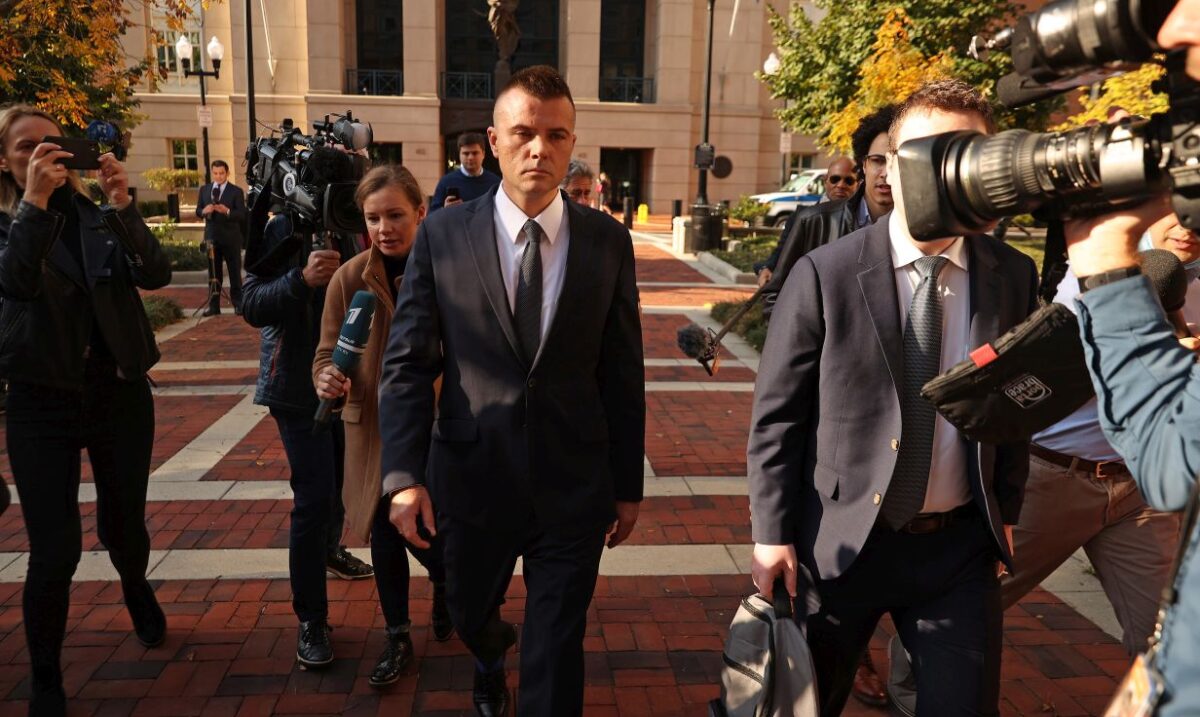
Russian analyst Igor Danchenko is pursued by journalists as he departs the Albert V. Bryan U.S. Courthouse after being arraigned, in Alexandria, Va., on Nov. 10, 2021. (Chip Somodevilla/Getty Images)

That the efforts to effectively hide Danchenko started even before Danchenko had disavowed the dossier is critical evidence of the early commencement of the FBI’s efforts against Trump. Had the FBI not done everything it could to conceal Danchenko’s existence by bestowing him with CHS status, the truth about the dossier would have likely been revealed and the effort to oust Trump would have collapsed.

Lastly, the plan to grant CHS status to Danchenko coincides with a remarkable sequence of events that took place on the same day Helson’s email was sent.

Establishing Trump–Russia Collusion Narrative

To fully understand the significance of the FBI granting CHS status to a person the agency hadn’t yet spoken to, we need to go back to Election Day.

The unexpected election of Trump on Nov. 8, 2016, prompted an unprecedented response from the intelligence community and Washington establishment. The effort to undermine Trump and his administration began almost immediately after his victory.

On Nov. 9, 2016, FBI agent Peter Strzok and FBI lawyer Lisa Page exchanged textsthat referred to a “secret society” the day after Trump’s victory. Page texted Strzoksaying, “Maybe this should be the first meeting of the Secret Society.”

Strzok responded to Page saying, “Too hard to explain here. Election related.” The next day, Strzok texted Page saying, “Bill [Priestap, head of FBI Counterintelligence] just sent a two hour invite to talk strategy.”

In early December 2016, the CIA told congressional leaders that “Russia intervened in the 2016 election to help Donald Trump win the presidency,” a claim that was a crucial convergence point between the FBI’s and CIA’s narratives. Although then-CIA Director John Brennan had been working behind the scenes by pushing information to the FBI, up to that point, it had been primarily the FBI driving the collusion narrative—for instance, by spying on Trump campaign aide Carter Page through a Foreign Intelligence Surveillance Act (FISA) warrant.

The CIA’s congressional briefings prompted Obama to direct the CIA, the FBI, and the National Security Agency (NSA) to draft an intelligence community assessment (ICA) on Russian interference in the election. While the reported date of Obama’s order was Dec. 9, 2016, the actual order may have been given much earlier, as both the CIA and FBI had been in the process of preparing reports on Russian interference.
Epoch Times Photo
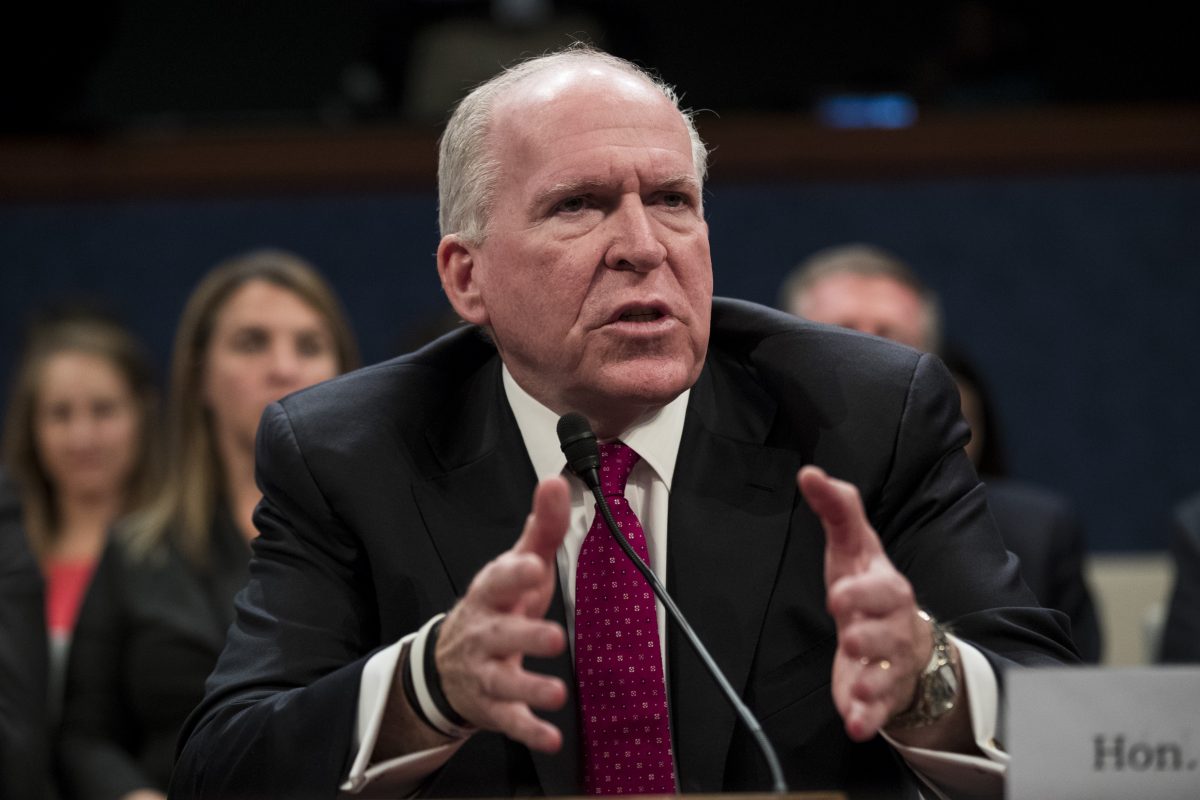
Former Director of the U.S. Central Intelligence Agency (CIA) John Brennan testifies before the House Permanent Select Committee on Intelligence on Capitol Hill in Washington on May 23, 2017. (Drew Angerer/Getty Images)

The FBI quickly jumped on board with Obama’s ICA plan. Priestap and special agent Jonathan Moffa were assigned to the ICA project on behalf of the FBI. However, the FBI didn’t appear to be interested in presenting an analytical work product. Their real goal appeared to be the inclusion of the Steele dossier in the ICA, which would give the dossier much-needed credibility. Up to that point, no media organization had published the dossier or any of its lurid allegations. If Trump was to be unseated, the dossier’s breathless claims needed to be made public.

Notably, as Durham revealed during Danchenko’s trial, by that time, the FBI already knew that the dossier was completely uncorroborated. On Oct. 3, 2016, the FBI offered dossier author Christopher Steele up to $1 million to provide any evidence that would substantiate his allegations against Trump. Steele wasn’t able to do so.

However, instead of ending its investigation, the FBI escalated efforts to tie Trump to the Russia collusion narrative. The FBI’s offer of $1 million to Steele for corroboration would later be hidden from Congress, congressional inquiries, Trump officials, and the courts.

According to a 2019 Department of Justice (DOJ) Inspector General report on the FBI’s abuses in the Carter Page FISA warrant case, FBI Deputy Director Andrew McCabe personally pushed his agents on Dec. 16 to include the dossier in the ICA. McCabe’s demand preceded the identification of Steele’s primary sub-source. As Durham reported last week, that sub-source, Danchenko, who, by his own account, was responsible for at least 80 percent of the dossier, was identified by the FBI a few days later on Dec. 20.

When FBI agent Moffa asked McCabe whether to limit what was included to “information concerning Russian election interference or to also include allegations against candidate Trump,” McCabe told him to include the allegations, “due to concerns over possible Russian attempts to blackmail Trump.”

That was an early indication that, contrary to what FBI Director James Comeywould later repeatedly claim, the FBI was already targeting Trump personally in December 2016.

On Dec. 19, lead counterespionage agent Peter Strzok texted Lisa Page, who was McCabe’s personal legal counsel, that he needed to talk to someone “about using his [expletive]” in the ICA. The name of the person that Strzok wanted to talk to is redacted and remains unknown.

After Danchenko was identified on Dec. 20, the FBI for the first time told the CIA that it wanted to include the dossier in the ICA.

On Dec. 28, according to records published by the Senate Intelligence Committee, Comey personally made a push with both the CIA and the NSA for the dossier to be included in the ICA. Comey vouched that Steele was a “credible person with a source and sub-source network in position to report on such things.”

Comey didn’t mention that Steele had failed to back up his information, even after being offered $1 million.

With Comey’s push, the other two agencies tasked with producing the ICA—the CIA and NSA—agreed to include a two-page summary of the dossier at the back of the official report from the three agencies. This had the effect that Comey and McCabe had sought—to legitimize the dossier.

On Jan. 5, 2017, top intelligence officials, including Comey, Brennan, Director of National Intelligence James Clapper, and NSA Director Michael Rogers briefed Obama on the ICA report.
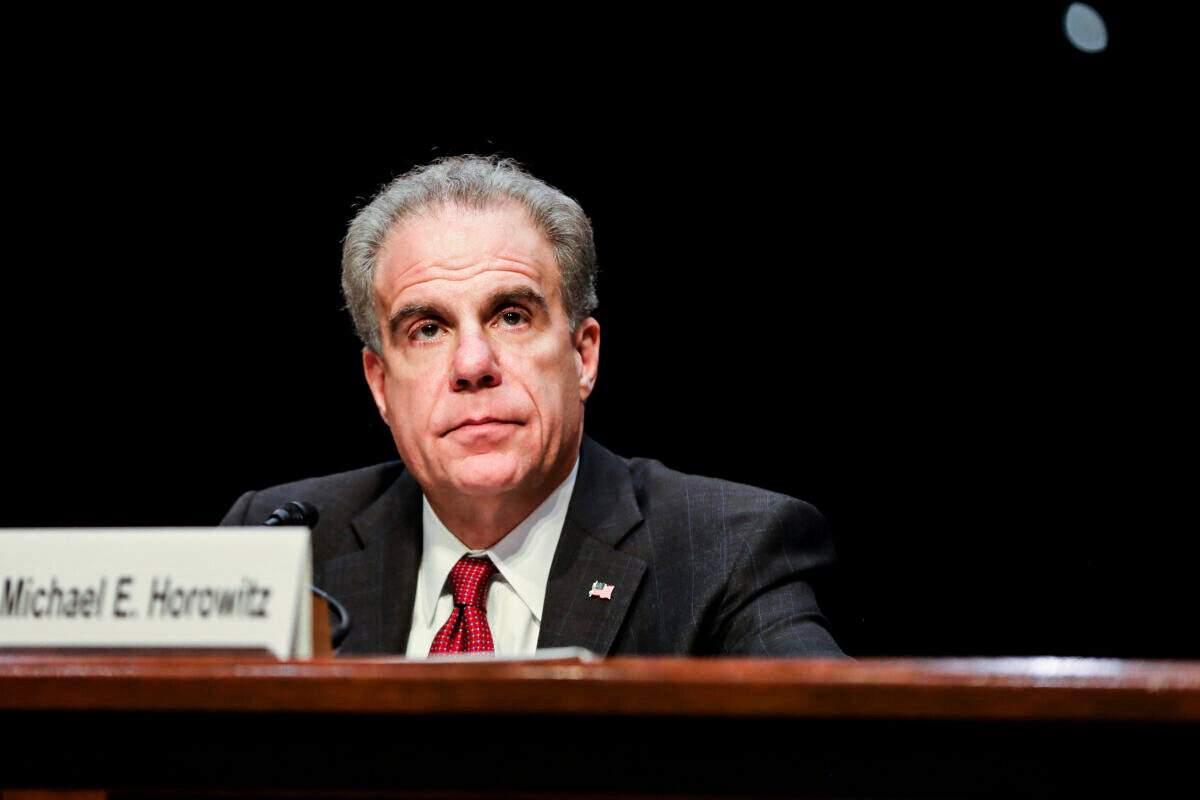
Department of Justice Inspector General Michael Horowitz
Department of Justice Inspector General Michael Horowitz testifies before the Senate Judiciary Committee in Washington on Dec. 11, 2019. (Charlotte Cuthbertson/The Epoch Times)

Following the official meeting, Comey stayed behind to brief Obama on the dossier. It was at this meeting that Obama stated that he wanted his team to be “mindful to ascertain if there is any reason that we cannot share information fully as it relates to Russia” with the incoming Trump administration.

The next day, Comey and other officials including Clapper briefed President-elect Trump and his national security team on the ICA. During this portion of the meeting, the Steele dossier was mentioned in passing.

A member of Trump’s team—reported to have been Lt. Gen. Michael Flynn—asked whether the FBI had dug into Steele’s sub-sources. If the questions were indeed posed by Flynn, it may have precipitated his subsequent demise at the hands of Comey. Once again, Comey would stay behind to brief Trump more fully on the dossier.

Comey would later tell CNN’s Jake Tapper that he only briefed Trump on the “salacious” parts of the dossier because “that was the part that the leaders of the intelligence community agreed he needed to be told about.” News of the intelligence briefing to Trump was leaked hours later to the media.

Efforts Begin in Earnest After January 2017 Briefings

On Jan. 3, 2017, Attorney General Loretta Lynch signed Section 2.3 of Executive Order 12333 into effect. This unprecedented new order significantly relaxed longstanding limits on dissemination of information gathered by the NSA’s powerful surveillance operations, granting broad latitude to the Intelligence Community with regard to interagency sharing of information.

On Jan. 10, 2017, following his Jan. 5 briefing to Obama and his abbreviated briefing to Trump on Jan. 6, Comey testified before the Senate Intelligence Committee. During the hearing, Comey was asked by Sen. Ron Wyden (D-Ore.) if the FBI was investigating relationships between associates of Trump and the Russian government. Comey stated that he could neither confirm nor deny an active investigation, thereby setting the media frenzy of Trump–Russia collusion into motion. The Steele dossier would be released by BuzzFeed on the same day.

The day after Comey’s testimony, the Senate Intelligence Committee opened an investigation into Russian interference and the Trump campaign. Its report proved to be politically driven and much of it has been discredited.

Concerned over increasing leaks to the media, Trump had actually conducted a sting of sorts during his briefing from top intelligence officials on the ICA and the Steele dossier on Jan. 6, 2017. In order to identify the people leaking classified information to the press, Trump did not tell his staff that IC officials, including Clapper and Comey, were about to brief him.

As noted earlier, after the briefing, information from the meeting was leaked almost immediately to the press—leading Trump to conclude the leaks were coming directly from officials within the Intelligence Community. Trump disclosed this sequence of events during a Jan. 11, 2017, press conference. After receiving a call from Trump regarding the leaks, Clapper was forced to issue a statement condemning intelligence community leaks following Trump’s unexpected press conference.
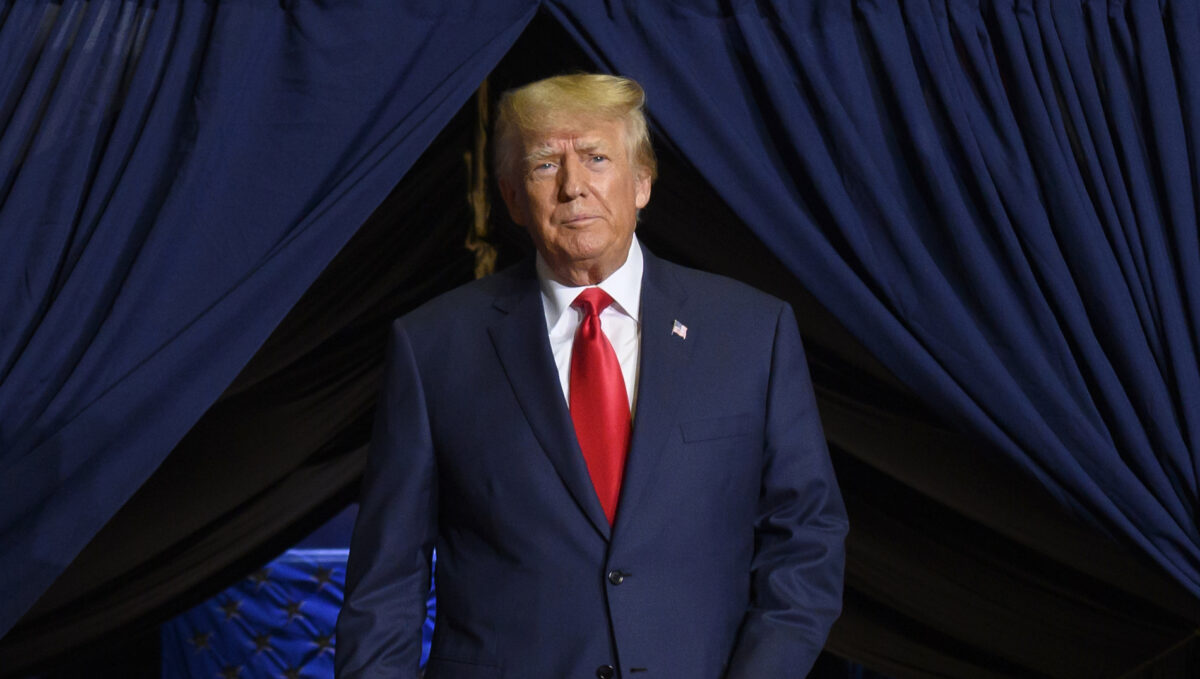
Trump rally
Former President Donald Trump enters the stage at a “Save America Rally” to support Republican candidates running for state and federal offices in the state of Ohio at the Covelli Centre in Youngstown, Ohio, on Sept. 17, 2022. (Jeff Swensen/Getty Images)

Despite Clapper’s official condemnation of leaks, according to a March 22, 2018, House intelligence report, Clapper later admitted “that he confirmed the existence of the dossier to the media,” acknowledged discussing the “dossier with CNN journalist Jake Tapper,” and conceded that he might have spoken with other journalists about the same topic. Crucially, the report noted that “Clapper’s discussion with Tapper took place in early January 2017,” following the briefing by leaders of the Intelligence Community to Obama and Trump on the Steele dossier.

Leaks from the Intelligence Community would remain prevalent throughout Trump’s term.

Events on Day Danchenko Was to Be Made CHS

On Jan. 12, 2017, the same day that Helson sent his email regarding Danchenko, and just a day after Trump’s surprise press conference, DOJ Inspector General Michael Horowitz announced his initiation of a review of actions taken by the FBI in the leadup to the 2016 presidential election.

It isn’t known whether Horowitz was ever briefed about Danchenko’s CHS status or the million-dollar bounty. His report mentions neither. By design or by accident, Horowitz’s investigation effectively tied up any outside probes into the FBI’s actions for two years.

It was on the same day, Jan. 12, that Flynn’s Dec. 29, 2016, call with Russian ambassador Sergey Kislyak was leaked to David Ignatius at The Washington Post. The leaker was never found, possibly because the leak came from within the FBI itself. Ignatius’s article, which further pushed the Trump–Russia collusion narrative, portrayed Flynn as undermining Obama’s fresh Russian sanctions during his call with Kislyak.

The article also raised the possibility that Flynn had violated the Logan Act, an obscure, 200-year-old law. Interestingly, it was Vice President Joe Biden who first suggested using the Logan Act against Flynn at the Jan. 5 White House meeting with Comey.

Flynn, who is believed to have been the person who asked Comey probing questions about the dossier’s sources, appears to have been the Intelligence Community’s first target in its effort to oust Trump. On Jan. 19, 2017, the day before Trump’s inauguration, Obama’s top intelligence and law-enforcement deputies met to talk about Flynn’s conversation with Kislyak. Flynn would be sworn in as Trump’s national security adviser on Jan. 22, 2017, and was subjected to an ambush interview by Strzok at the behest of Comey two days later.

Comey later bragged about the Flynn ambush having been his brainchild.
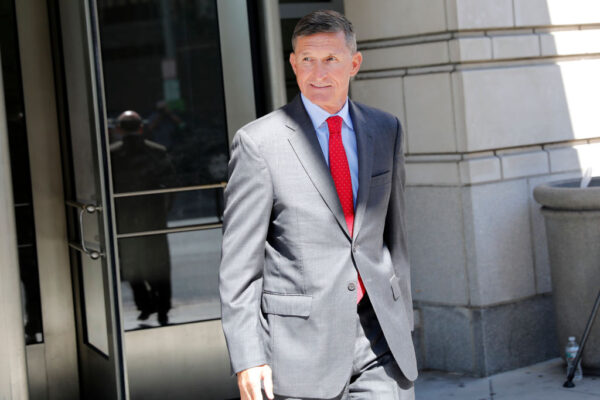
Epoch Times Photo
Retired Lt. Gen.Michael Flynn, a former national security adviser to President Donald Trump, departs the E. Barrett Prettyman U.S. Courthouse following a pre-sentencing hearing, in Washington, on July 10, 2018. (Aaron P. Bernstein/Getty Images)

Acting Attorney General Sally Yates increased the pressure on the Trump administration regarding Flynn through a series of conversations with White House counsel Don McGahn. Yates told McGahn that she believed that “Flynn was compromised with respect to the Russians.”

Flynn resigned on Feb. 13, 2017, the same day that Yates’s claim was published by The Washington Post. In 2020, declassified transcripts of Flynn’s call with Kislyak revealed that Flynn never once talked about sanctions. Just like the dossier, the charges against Flynn had been fabricated.

One other event transpired on Jan. 12, the first renewal of the Carter Page FISA warrant, which had been based on the fabricated Steele dossier and claimed that Steele’s source was Russia-based when, in reality, he was a former Brookings Institution employee living in Washington.

FBI Escalates Probe Despite Dossier Disavowal

During a three-day period at the end of January 2017, Danchenko was eventually interviewed by the FBI. Danchenko said there were major inconsistencies between what he told Steele and what was in the dossier. Danchenko told the FBI that he had passed on bar talk and rumors to Steele and never intended for completely unverified information to be used in a dossier. He also admitted that he had never met the dossier’s key source who was alleged to be responsible for every major allegation against Trump, including the “well-developed conspiracy of cooperation” between Trump and the Kremlin, that Russia passed hacked DNC emails to Wikileaks, and the infamous pee tape story.

Because Danchenko was given CHS status by the FBI, proof that the Steele dossier was fabricated was completely shielded from congressional and other investigations. We know with certainty that Danchenko formally received official CHS status no later than March 2017, but we now also know from the newly discovered unused trial exhibit that the FBI had planned to extend CHS status to Danchenko well before he was even interviewed by the FBI.
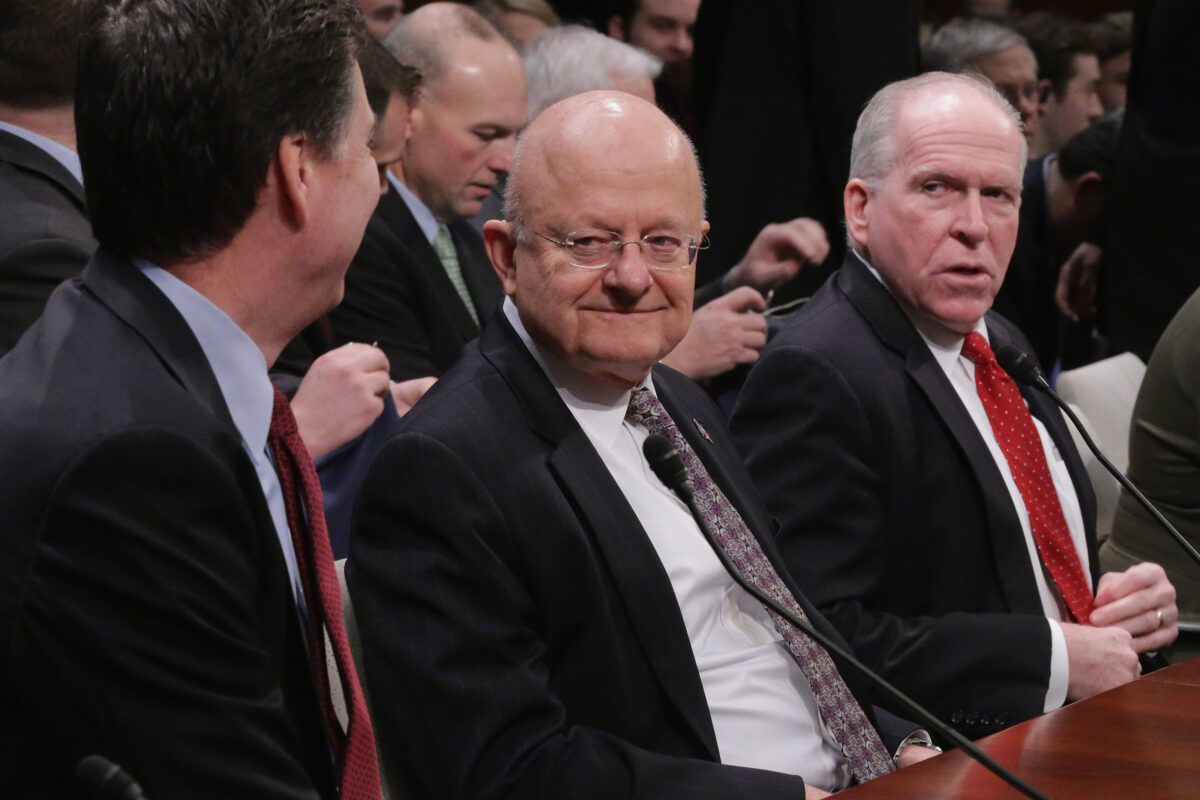
Epoch Times Photo
(L–R) FBI Director James Comey, Director of National Intelligence James Clapper, and CIA Director John Brennan prepare to testify before the House Permanent Select Committee on Intelligence on Feb. 25, 2016. (Chip Somodevilla/Getty Images)

Efforts to ensnare Trump in a Russia collusion narrative received a major boost on Feb. 27, when former President George W. Bush proclaimed “we all need answers” on the Russia collusion allegations. Bush added that he trusted Senate Intelligence Committee Chairman Richard Burr (R-N.C.) to decide whether a special counsel should be appointed.

Then, on March 2, Trump-appointed Attorney General Jeff Sessions recused himself from the Russia inquiry, dealing Trump a huge blow. Sessions inexplicably failed to assess, or even ask for evidence indicating whether the inquiry was legitimate. Sessions recused himself without ever finding out about Danchenko, that he had disavowed the dossier, or that Steele had failed to provide any evidence despite being offered $1 million for doing so.

Trump hit back on March 4, when he famously wrote on Twitter that he knew that the Obama administration had spied on his campaign. Not knowing how much Trump knew, FBI leadership panicked. In direct response to the tweet, on March 6, the FBI sent three of its most senior officials—McCabe, Priestap, and Strzok—to brief the DOJ on the FBI’s Trump investigation.

Notes of the briefing, which included incoming Trump administration officials, were disclosed by Durham earlier this year revealing that the FBI failed to mention Danchenko, Danchenko’s disavowal of the dossier, or the million-dollar reward to their DOJ counterparts. Instead, they made it appear as if the dossier, which they referred to as “Crown reporting,” had checked out and that the Russia collusion investigation was therefore going full steam ahead.

Additional briefing notes from March 8, which were also exposed by Durham, show that Comey himself subsequently lied to the so-called Gang of Eight congressional leaders. Similar to the DOJ briefing, Congress wasn’t told that Steele couldn’t back up his dossier despite the huge reward offer, and also wasn’t told about Danchenko.

The FBI’s efforts culminated in Comey’s March 20 public announcement that the Trump campaign was being investigated for Russia collusion. It was that announcement that opened the door to Mueller’s appointment as special counsel. As with his previous, non-public announcements, Comey concealed that the dossier—and with it the predicate for his investigation—had collapsed.

Case Against Trump Based on Fabrications

While it’s been claimed by some media outlets that the dossier wasn’t central to the allegations against Trump, the Intelligence Community’s efforts to ensnare Trump, the Carter Page FISA application, as well as the March 6 and 8 briefing notes, all rely almost entirely on the dossier. Additionally, we know that Comey insisted that a summary of the dossier be attached to the ICA that was presented to Obama. These actions prove beyond any doubt that the case against Trump was based on a fabricated document.

The day after Comey’s testimony, on March 21, then-House Intelligence Committee Chairman Devin Nunes (R-Calif.) met with a source. Following this meeting, Nunes informed Trump that he believed Trump and his staff were illegally surveilled and “unmasked,” a process of revealing redacted names of U.S. citizens that are incidentally collected during surveillance or intelligence gathering on foreigners. Nunes demanded that the CIA, FBI, and NSA disclose the nature of the unlawful surveillance he had uncovered.

For his efforts, an ethics investigation of Nunes was opened and he was forced to recuse himself from the Russia collusion investigation on April 6. The next day, the Carter Page FISA warrant was secretly renewed, proving that Nunes’s claim was correct. During his entire tenure as House Intelligence Committee chairman, Nunes was never told about Danchenko, his CHS status, or the million-dollar bounty.
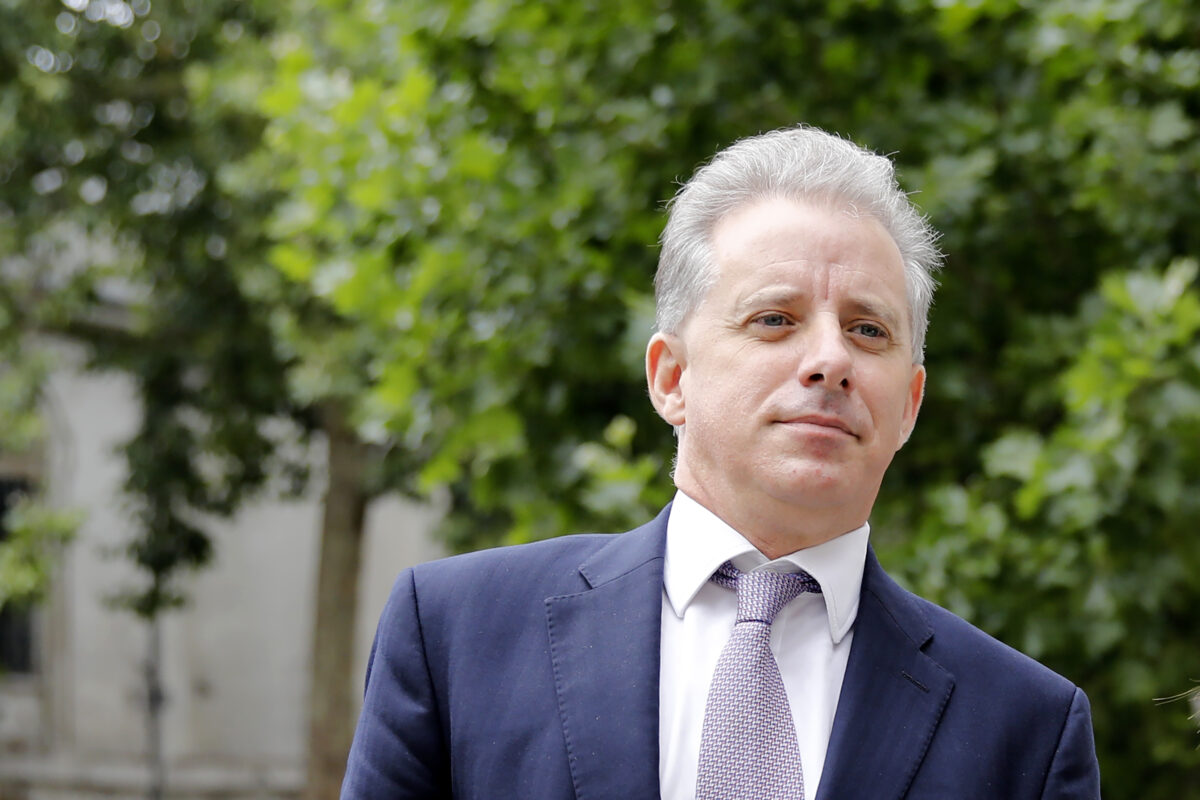
Epoch Times Photo
Former UK intelligence officer Christopher Steele in London on July 24, 2020. Steele refused an offer of $1 million from the FBI to corroborate the allegations in the 2016 dossier he produced with funding by Hillary Clinton’s campaign and the Democratic National Committee. (Tolga Akmen/AFP via Getty Images)

On May 9, 2017, Trump fired Comey from his position as FBI director and McCabe became acting director. Following Comey’s firing, DOJ official Bruce Ohr had a phone call with Steele, during which Steele expressed concern that “they will be exposed” because of Comey’s firing. Steele was undoubtedly worried that without Comey covering for him, his dossier lies would be exposed. It isn’t known whether Steele was aware that the FBI had already successfully concealed Steele’s collaborator, Danchenko, from any scrutiny or investigation.

Several days later, on May 12, Ohr and Steele began a series of exchanges via text message, with Ohr conveying a request from McCabe that Steele be reengaged by the FBI.

On May 16, Comey leaked memos about Trump to The New York Times through his friend, Columbia Law School professor Daniel Richman. Comey would later acknowledge that he did so to spur the appointment of a special counsel.

The next day, Deputy Attorney General Rod Rosenstein appointed Mueller, a former FBI director, as special counsel. As we can now see with hindsight, the FBI covered up Danchenko in early 2017. In doing so they ensured that they could continue using the fabricated Steele dossier to justify their investigation of Trump and his associates while also ensuring that no one would find out about Danchenko. In turn, the appointment of Mueller ensured that the FBI’s misdeeds were covered up.

Significantly, the many efforts to ensnare Trump, from the framing of Flynn to the media’s relentless airing of dossier smears and the Washington establishment’s push for a special counsel, couldn’t have happened unless Danchenko was kept hidden by the FBI. It was perhaps the most critical part of the effort and, as we have now learned, it happened much earlier than had been known.

Source: The Epoch Times

ORDER YOUR LIBERTY BOOKS TODAY!

Sovereign’s Handbook by Johnny Liberty 
(30th Anniversary Edition)
(3-Volume Printed, Bound Book or PDF)

A three-volume, 750+ page tome with an extensive update of the renowned underground classic ~ the Global Sovereign’s Handbook. Still after all these years, this is the most comprehensive book on sovereignty, economics, law, power structures and history ever written. Served as the primary research behind the best-selling Global One Audio Course. Available Now!

$99.95 ~ THREE-VOLUME PRINT SERIES
$33.33 ~ THREE-VOLUME EBOOK

Dawning of the Corona Age: Navigating the Pandemic by Johnny Freedom 
(3rd Edition)
(Printed, Bound Book or PDF)

This comprehensive book, goes far beyond the immediate impact of the “pandemic”, but, along with the reader, imagines how our human world may be altered, both positively and negatively, long into an uncertain future. Available Now!

$25.00 ~ PRINT BOOK
$10.00 ~ EBOOK
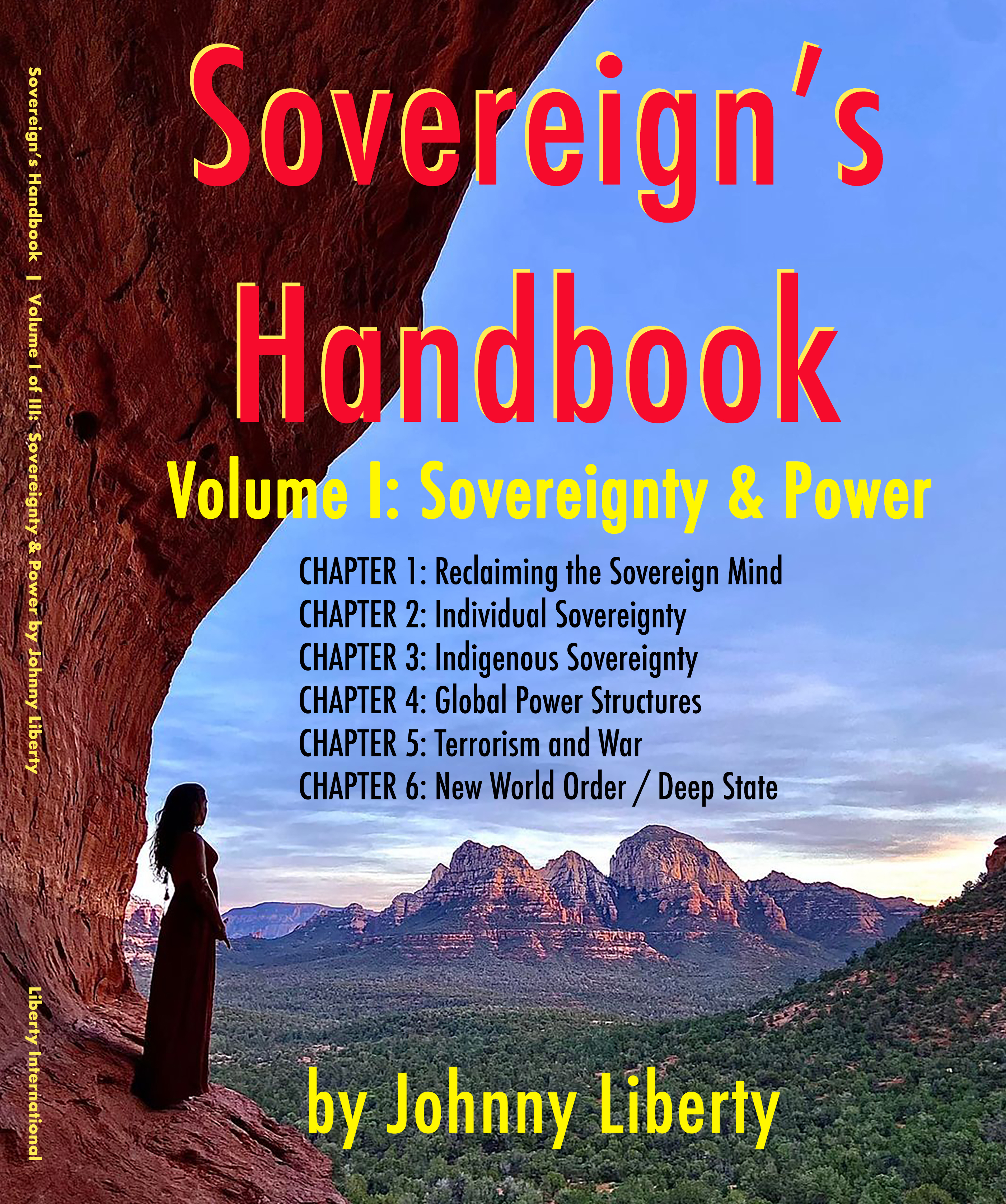
30th Anniversary Edition ~ Sovereign’s Handbook by Johnny Liberty Now Available! | Liberty International

If you have ever heard talk or been to a seminar about “sovereignty”, then very likely those conversations were influenced by the foundational research of the author and educator.

His research and educational journey reaching millions of people worldwide began in 1992 and culminated in 2022 with the 3-Volume book release – his final word on the subject.

At the turn of the millennium his books and audio courses facilitated in part –  a sovereignty and tax-honesty movement that involved millions of Americans.

This 3 Volume series comprises the life’s work of Johnny Liberty filled with comprehensive insights into the last few hundred years of history, law, economics, money, citizenship and governance. 

These books show how it is supposed to be done in a constitutional Republic. 

How did We the People get to where we are today? 

What can we do to reclaim our inherent sovereignty and natural rights? 

Many of the answers may be found within these revolutionary pages. Available as a paperback, E-Book (PDF) or an Amazon Kindle format. Thank you for supporting the author. 

Sincerely, 

With Freedom For All, 
~ Johnny Liberty

Sovereign’s Handbook by Johnny Liberty (30th Anniversary Edition)

  • A three-volume, 750 page tome with an extensive update of the renowned underground classic ~ the Global Sovereign’s Handbook.
  • Still after all these years, it is the most comprehensive book on sovereignty, economics, law, power structures and history ever written.
  • Served as the primary research behind the best-selling Global One Audio Course.
  • ORDER NOW!
  • $99.99 ~ THREE VOLUME PRINT SERIES
  • $33.33 ~ THREE VOLUME E-BOOK

The 3 Volume Sovereign’s Handbook by Johnny Liberty is textbook material for everyone including educators/teachers, homeschoolers, historians, activists, leaders/politicians, attorneys/judges/law schools, police officers, and state Citizens/Nationals. 

Order Additional Books, Audios & Videos from The Freedom Catalog: LibertyInternationalBooks.com 
Sovereign’s Handbook (Website): http://SovereignsHandbook.com 
Dawning of the Corona Age (Website): DawningoftheCoronaAge.com 
Liberty International News: http://LibertyInternational.news 

ORDER YOUR LIBERTY BOOKS TODAY!

Sovereign’s Handbook by Johnny Liberty 
(30th Anniversary Edition)
(3-Volume Printed, Bound Book or PDF)

A three-volume, 750+ page tome with an extensive update of the renowned underground classic ~ the Global Sovereign’s Handbook. Still after all these years, this is the most comprehensive book on sovereignty, economics, law, power structures and history ever written. Served as the primary research behind the best-selling Global One Audio Course. Available Now!

$99.95 ~ THREE-VOLUME PRINT SERIES
$33.33 ~ THREE-VOLUME EBOOK

Dawning of the Corona Age: Navigating the Pandemic by Johnny Freedom 
(3rd Edition)
(Printed, Bound Book or PDF)

This comprehensive book, goes far beyond the immediate impact of the “pandemic”, but, along with the reader, imagines how our human world may be altered, both positively and negatively, long into an uncertain future. Available Now!

$25.00 ~ PRINT BOOK
$10.00 ~ EBOOK

Who Is A “Terrorist” In Biden’s America? | Greanville Post

Far from being a war against “white supremacy,” the Biden administration’s new “domestic terror” strategy clearly targets primarily those who oppose US government overreach and those who oppose capitalism and/or globalization.

In the latest sign that the US government’s War on Domestic Terror is growing in scope and scale, the White House on Tuesday revealed the nation’s first ever government-wide strategy for confronting domestic terrorism. While cloaked in language about stemming racially motivated violence, the strategy places those deemed “anti-government” or “anti-authority” on a par with racist extremists and charts out policies that could easily be abused to silence or even criminalize online criticism of the government.

Even more disturbing is the call to essentially fuse intelligence agencies, law enforcement, Silicon Valley, and “community” and “faith-based” organizations such as the Anti-Defamation League, as well as unspecified foreign governments, as partners in this “war,” which the strategy makes clear will rely heavily on a pre-crime orientation focused largely on what is said on social media and encrypted platforms. Though the strategy claims that the government will “shield free speech and civil liberties” in implementing this policy, its contents reveal that it is poised to gut both.

Indeed, while framed publicly as chiefly targeting “right-wing white supremacists,” the strategy itself makes it clear that the government does not plan to focus on the Right but instead will pursue “domestic terrorists” in “an ideologically neutral, threat-driven manner,” as the law “makes no distinction based on political view—left, right or center.” It also states that a key goal of this strategic framework is to ensure “that there is simply no governmental tolerance . . . of violence as an acceptable mode of seeking political or social change,” regardless of a perpetrator’s political affiliation.

Considering that the main cheerleaders for the War on Domestic Terror exist mainly in establishment left circles, such individuals should rethink their support for this new policy given that the above statements could easily come to encompass Black Lives Matter–related protests, such as those that transpired last summer, depending on which political party is in power.

Once the new infrastructure is in place, it will remain there and will be open to the same abuses perpetrated by both political parties in the US during the lengthy War on Terror following September 11, 2001. The history of this new “domestic terror” policy, including its origins in the Trump administration, makes this clear.

It’s Never Been Easier to Be a “Terrorist”

In introducing the strategy, the Biden administration cites “racially or ethnically motivated violent extremists” as a key reason for the new policy and a main justification for the War on Domestic Terror in general. This was most recently demonstrated Tuesday in Attorney General Merrick Garland’s statement announcing this new strategy. However, the document itself puts “anti-government” or “anti-authority” “extremists” in the same category as violent white supremacists in terms of being a threat to the homeland. The strategy’s characterization of such individuals is unsettling.

For instance, those who “violently oppose” “all forms of capitalism” or “corporate globalization” are listed under this less-discussed category of “domestic terrorist.” This highlights how people on the left, many of whom have called for capitalism to be dismantled or replaced in the US in recent years, could easily be targeted in this new “war” that many self-proclaimed leftists are currently supporting. Similarly, “environmentally-motivated extremists,” a category in which groups such as Extinction Rebellion could easily fall, are also included.

In addition, the phrasing indicates that it could easily include as “terrorists” those who oppose the World Economic Forum’s vision for global “stakeholder capitalism,” as that form of “capitalism” involves corporations and their main “stakeholders” creating a new global economic and governance system. The WEF’s stakeholder capitalism thus involves both “capitalism” and “corporate globalization.”

The strategy also includes those who “take steps to violently resist government authority . . . based on perceived overreach.” This, of course, creates a dangerous situation in which the government could, purposely or otherwise, implement a policy that is an obvious overreach and/or blatantly unconstitutional and then label those who resist it “domestic terrorists” and deal with them as such—well before the overreach can be challenged in court.

Another telling addition to this group of potential “terrorists” is “any other individual or group who engages in violence—or incites imminent violence—in opposition to legislative, regulatory or other actions taken by the government.” Thus, if the government implements a policy that a large swath of the population finds abhorrent, such as launching a new, unpopular war abroad, those deemed to be “inciting” resistance to the action online could be considered domestic terrorists.

Such scenarios are not unrealistic, given the loose way in which the government and the media have defined things like “incitement” and even “violence” (e. g., hate speech” is a form of violence) in the recent past. The situation is ripe for manipulation and abuse. To think the federal government (including the Biden administration and subsequent administrations) would not abuse such power reflects an ignorance of US political history, particularly when the main forces behind most terrorist incidents in the nation are actually US government institutions like the FBI (more FBI examples hereherehere, and here).

Furthermore, the original plans for the detention of American dissidents in the event of a national emergency, drawn up during the Reagan era as part of its “continuity of government” contingency, cited popular nonviolent opposition to US intervention in Latin America as a potential “emergency” that could trigger the activation of those plans. Many of those “continuity of government” protocols remain on the books today and can be triggered, depending on the whims of those in power. It is unlikely that this new domestic terror framework will be any different regarding nonviolent protest and demonstrations.

Yet another passage in this section of the strategy states that “domestic terrorists” can, “in some instances, connect and intersect with conspiracy theories and other forms of disinformation and misinformation.” It adds that the proliferation of such “dangerous” information “on Internet-based communications platforms such as social media, file-upload sites and end-to-end encrypted platforms, all of these elements can combine and amplify threats to public safety.”

Thus, the presence of “conspiracy theories” and information deemed by the government to be “misinformation” online is itself framed as threatening public safety, a claim made more than once in this policy document. Given that a major “pillar” of the strategy involves eliminating online material that promotes “domestic terrorist” ideologies, it seems inevitable that such efforts will also “connect and intersect” with the censorship of “conspiracy theories” and narratives that the establishment finds inconvenient or threatening for any reason.

Pillars of Tyranny

The strategy notes in several places that this new domestic-terror policy will involve a variety of public-private partnerships in order to “build a community to address domestic terrorism that extends not only across the Federal Government but also to critical partners.” It adds, “That includes state, local, tribal and territorial governments, as well as foreign allies and partners, civil society, the technology sector, academic, and more.”

The mention of foreign allies and partners is important as it suggests a multinational approach to what is supposedly a US “domestic” issue and is yet another step toward a transnational security-state apparatus. A similar multinational approach was used to devastating effect during the CIA-developed Operation Condor, which was used to target and “disappear” domestic dissidents in South America in the 1970s and 1980s. The foreign allies mentioned in the Biden administration’s strategy are left unspecified, but it seems likely that such allies would include the rest of the Five Eyes alliance (the UK, Australia, Canada, New Zealand) and Israel, all of which already have well-established information-sharing agreements with the US for signals intelligence.

The new domestic-terror strategy has four main “pillars,” which can be summarized as (1) understanding and sharing domestic terrorism-related information, including with foreign governments and private tech companies; (2) preventing domestic terrorism recruitment and mobilization to violence; (3) disrupting and deterring domestic terrorism activity; and (4) confronting long-term contributors to domestic terrorism.

The first pillar involves the mass accumulation of data through new information-sharing partnerships and the deepening of existing ones. Much of this information sharing will involve increased data mining and analysis of statements made openly on the internet, particularly on social media, something already done by US intelligence contractors such as Palantir. While the gathering of such information has been ongoing for years, this policy allows even more to be shared and legally used to make cases against individuals deemed to have made threats or expressed “dangerous” opinions online.

Included in the first pillar is the need to increase engagement with financial institutions concerning the financing of “domestic terrorists.” US banks, such as Bank of America, have already gone quite far in this regard, leading to accusations that it has begun acting like an intelligence agency. Such claims were made after it was revealed that the BofA had passed to the government the private banking information of over two hundred people that the bank deemed as pointing to involvement in the events of January 6, 2021. It seems likely, given this passage in the strategy, that such behavior by banks will soon become the norm, rather than an outlier, in the United States.

The second pillar is ostensibly focused on preventing the online recruitment of domestic terrorists and online content that leads to the “mobilization of violence.” The strategy notes that this pillar “means reducing both supply and demand of recruitment materials by limiting widespread availability online and bolstering resilience to it by those who nonetheless encounter it.“ The strategy states that such government efforts in the past have a “mixed record,” but it goes on to claim that trampling on civil liberties will be avoided because the government is “consulting extensively” with unspecified “stakeholders” nationwide.

Regarding recruitment, the strategy states that “these activities are increasingly happening on Internet-based communications platforms, including social media, online gaming platforms, file-upload sites and end-to-end encrypted platforms, even as those products and services frequently offer other important benefits.” It adds that “the widespread availability of domestic terrorist recruitment material online is a national security threat whose front lines are overwhelmingly private-sector online platforms.”

The US government plans to provide “information to assist online platforms with their own initiatives to enforce their own terms of service that prohibits the use of their platforms for domestic terrorist activities” as well as to “facilitate more robust efforts outside the government to counter terrorists’ abuse of Internet-based communications platforms.”

Given the wider definition of “domestic terrorist” that now includes those who oppose capitalism and corporate globalization as well as those who resist government overreach, online content discussing these and other “anti-government” and “anti-authority” ideas could soon be treated in the same way as online Al Qaeda or ISIS propaganda. Efforts, however, are unlikely to remain focused on these topics. As Unlimited Hangoutreported last November, both UK intelligence and the US national-security state were developing plans to treat critical reporting on the COVID-19 vaccines as “extremist” propaganda.

Another key part of this pillar is the need to “increase digital literacy” among the American public, while censoring “harmful content” disseminated by “terrorists” as well as by “hostile foreign powers seeking to undermine American democracy.” The latter is a clear reference to the claim that critical reporting of US government policy, particularly its military and intelligence activities abroad, was the product of “Russian disinformation,” a now discredited claim that was used to heavily censor independent media. This new government strategy appears to promise more of this sort of thing.

It also notes that “digital literacy” education for a domestic audience is being developed by the Department of Homeland Security (DHS). Such a policy would have previously violated US law until the Obama administration worked with Congress to repeal the Smith-Mundt Act, thus lifting the ban on the government directing propaganda at domestic audiences.

The third pillar of the strategy seeks to increase the number of federal prosecutors investigating and trying domestic-terror cases. Their numbers are likely to jump as the definition of “domestic terrorist” is expanded. It also seeks to explore whether “legislative reforms could meaningfully and materially increase our ability to protect Americans from acts of domestic terrorism while simultaneously guarding against potential abuse of overreach.” In contrast to past public statements on police reform by those in the Biden administration, the strategy calls to “empower” state and local law enforcement to tackle domestic terrorism, including with increased access to “intelligence” on citizens deemed dangerous or subversive for any number of reasons.

To that effect, the strategy states the following (p. 24):“The Department of Justice, Federal Bureau of Investigation, and Department of Homeland Security, with support from the National Counterterrorism Center [part of the intelligence community], are incorporating an increased focus on domestic terrorism into current intelligence products and leveraging current mechanisms of information and intelligence sharing to improve the sharing of domestic terrorism-related content and indicators with non-Federal partners. These agencies are also improving the usability of their existing information-sharing platforms, including through the development of mobile applications designed to provide a broader reach to non-Federal law enforcement partners, while simultaneously refining that support based on partner feedback.”

Such an intelligence tool could easily be, for example, Palantir, which is already used by the intelligence agencies, the DHS, and several US police departments for “predictive policing,” that is, pre-crime actions. Notably, Palantir has long included a “subversive” label for individuals included on government and law enforcement databases, a parallel with the controversial and highly secretive Main Core database of US dissidents.

DHS Secretary Alejandro Mayorkas made the “pre-crime” element of the new domestic terror strategy explicit on Tuesday when he said in a statement that DHS would continue “developing key partnerships with local stakeholders through the Center for Prevention Programs and Partnerships (CP3) to identify potential threats and prevent terrorism.” CP3, which replaced DHS’ Office for Targeted Violence and Terrorism Prevention this past May, officially “supports communities across the United States to prevent individuals from radicalizing to violence and intervene when individuals have already radicalized to violence.”

The fourth pillar of the strategy is by far the most opaque and cryptic, while also the most far-reaching. It aims to address the sources that cause “terrorists” to mobilize “towards violence.” This requires “tackling racism in America,” a lofty goal for an administration headed by the man who controversially eulogized Congress’ most ardent segregationist and who was a key architect of the 1994 crime bill. As well, it provides for “early intervention and appropriate care for those who pose a danger to themselves or others.”

In regard to the latter proposal, the Trump administration, in a bid to “stop mass shootings before they occur,” considered a proposal to create a health DARPA” or “HARPA” that would monitor the online communications of everyday Americans for “neuropsychiatric” warning signs that someone might be “mobilizing towards violence.” While the Trump administration did not create HARPA or adopt this policy, the Biden administration has recently announced plans to do so.

Finally, the strategy indicates that this fourth pillar is part of a “broader priority”: “enhancing faith in government and addressing the extreme polarization, fueled by a crisis of disinformation and misinformation often channeled through social media platforms, which can tear Americans apart and lead some to violence.” In other words, fostering trust in government while simultaneously censoring “polarizing” voices who distrust or criticize the government is a key policy goal behind the Biden administration’s new domestic-terror strategy.

Calling Their Shots?

While this is a new strategy, its origins lie in the Trump administration. In October 2019, Trump’s attorney general William Barr formally announced in a memorandum that a new “national disruption and early engagement program” aimed at detecting those “mobilizing towards violence” before they commit any crime would launch in the coming months. That program, known as DEEP (Disruption and Early Engagement Program), is now active and has involved the Department of Justice, the FBI, and “private sector partners” since its creation.

Barr’s announcement of DEEP followed his unsettling “prediction” in July 2019 that “a major incident may occur at any time that will galvanize public opinion on these issues.” Not long after that speech, a spate of mass shootings occurred, including the El Paso Walmart shooting, which killed twenty-three and about which many questions remain unanswered regarding the FBI’s apparent foreknowledge of the event. After these events took place in 2019, Trump called for the creation of a government backdoor into encryption and the very pre-crime system that Barr announced shortly thereafter in October 2019. The Biden administration, in publishing this strategy, is merely finishing what Barr started.

Indeed, a “prediction” like Barr’s in 2019 was offered by the DHS’ Elizabeth Neumann during a Congressional hearing in late February 2020. That hearing was largely ignored by the media as it coincided with an international rise of concern regarding COVID-19. At the hearing, Neumann, who previously coordinated the development of the government’s post-9/11 terrorism information sharing strategies and policies and worked closely with the intelligence community, gave the following warning about an imminent “domestic terror” event in the United States:“And every counterterrorism professional I speak to in the federal government and overseas feels like we are at the doorstep of another 9/11, maybe not something that catastrophic in terms of the visual or the numbers, but that we can see it building and we don’t quite know how to stop it.”

This “another 9/11” emerged on January 6, 2021, as the events of that day in the Capitol were quickly labeled as such by both the media and prominent politicians, while also inspiring calls from the White House and the Democrats for a “9/11-style commission” to investigate the incident. This event, of course, figures prominently in the justification for the new domestic-terror strategy, despite the considerable video and other evidence that shows that Capitol law enforcement, and potentially the FBI, were directly involved in facilitating the breach of the Capitol. In addition, when one considers that the QAnon movement, which had a clear role in the events of January 6, was itself likely a government-orchestrated psyop, the government hand in creating this situation seems clear.

It goes without saying that the official reasons offered for these militaristic “domestic terror” policies, which the US has already implemented abroad—causing much more terror than it has prevented—does not justify the creation of a massive new national-security infrastructure that aims to criminalize and censor online speech. Yet the admission that this new strategy, as part of a broader effort to “enhance faith in government,” combines domestic propaganda campaigns with the censorship and pursuit of those who distrust government heralds the end of even the illusion of democracy in the United States.

Source: Greanville Post

The World Watches While the US Elite Wages War on America | The Epoch Times

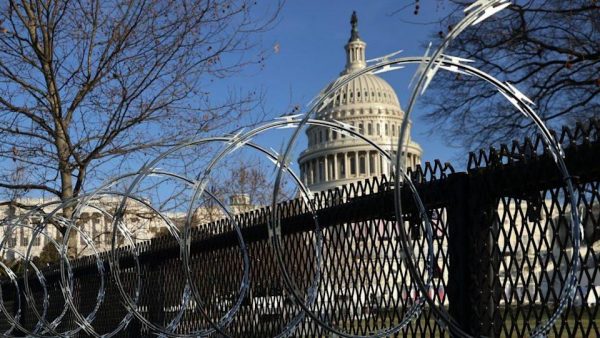
US National Guard troops patrol the vicinity of the US Capitol hours before the Inauguration of US President-Elect Joe Biden in Washington, DC, on January 20, 2021. (Photo by ROBERTO SCHMIDT / AFP) (Photo by ROBERTO SCHMIDT/AFP via Getty Images)

By Lee Smith

On Saturday, Peoples’ Republic of China planes flew into Taiwan’s airspace. Incursions are a normal occurrence but the most recent one represented an escalation. Typically one or two planes will probe Taiwan’s air defenses but in this case it was reportedly eight bombers and four fighter jets. It appears Beijing is eager to test Joe Biden early. It’s likely China won’t be the only one. The more than 20,000 National Guard troops in Washington to last week protect the new president’s nearly unattended inauguration is evidence that the United States is broken.

Observers widely misunderstood the National Guard deployment as a show of force asserting the Biden team’s legitimacy as the elected government of the United States. But the most salient fact of the troop presence is that some who were found to have supported Donald Trump were sent home. And thus the reason for the deployment, which may now continue into March, is that the Biden White House is keen to use the sporadically violent but mostly peaceful Jan. 6 march on the Capitol building as a political pretext to further target Trump supporters.

From the perspective of the administration and its media surrogates, Trump supporters were already deplorable, but now that they have attempted an insurrection, the gloves will come off. The nearly 75 million people who voted for Biden’s opponent deserve whatever is coming to them next—further impoverishment, further collective punishment in the guise of public health (i.e., coronavirus) measures, designation as domestic terrorists, imprisonment, and even death.

Let’s try to imagine how foreigners see our circumstances: Neither traditional U.S. allies nor adversaries can share the new administration’s assessment that the United States government faced an insurrection Jan. 6. In comparison to their own domestic challenges, those protests were plainly mild.

In France, for instance, the Yellow Vests movement has been engaged in protests for more than two years that have frequently devolved into street violence, leaving 11 dead and more than 4000 wounded. From the perspective of the nation that produced the French Revolution, Jan. 6 was nothing like an insurrection. Same for Israel, which has been fighting terrorist attacks plotted by some of the state’s Arab citizens since the country’s founding.

Consider how authoritarian states must see it. Does the Islamic Republic of Iran, periodically engaged in low-level violent conflict with its growing opposition movement, believe that Jan. 6 was an attack on America’s domestic peace? What about Russia, where over the weekend authorities arrested more than 2000 who marched nationwide to demand the release of Vladimir Putin critic Alexander Navalny? Does the Chinese Communist Party, which uses mass detentions and forced sterilizations to eradicate the Muslim minority Uyghur population, believe that American families and seniors marching in the winter cold amounted to an existential threat to the American regime? No, they all see through it—the American political, corporate, cultural, and media elite is waging war on the Americans it despises.

What can foreign powers be thinking when journalists, think-tank experts, and current and former law enforcement officials recommend that the Biden administration deploy the same counterterrorism tactics against Americans that U.S. forces have used to kill Islamic extremists around the globe since the 9/11 attacks on the World Trade Center and the Pentagon? Or how can they interpret the heavily guarded inauguration attended by faded pop-stars celebrating a man in a black mask who prophesied a “dark winter,” who for months had been hidden underground by his handlers, and who is unlikely to finish his four-year term under his own power except as a drum circle of celebrity necromancers? If our allies and adversaries see us at all clearly, they are thinking America’s leaders have lost their minds.

It can hardly surprise anyone to see the country gone mad since Biden’s inauguration represented the culmination of the U.S. elite’s four-year-long insurrection against reality.

It began in December 2016 when Barack Obama instructed his director of the Central Intelligence Agency John Brennan to delegitimize his successor by assessing he was helped to the presidency by a foreign power, Russia. Subsequently, with the robust support of prestige media organizations and the rest of the elite’s ideological apparatus—the academy, think tanks, Hollywood, and so on—half the country invested its political convictions and mental health in a conspiracy theory.

It does not require much imagination to see America the way outsiders have for the last several years. The U.S. agency singly responsible for discovering and stopping the efforts of foreign agents to sabotage the American political system, the Federal Bureau of Investigation, was focused instead on sabotaging the American president. Because top officials were not held accountable for their illegal political operation, others were emboldened to join the effort. An official from the Pentagon and another from the CIA led a government-wide campaign that included senior American diplomats to impeach Trump.

With the arrival of COVID-19, the U.S. elite’s increasing use of the phrase “the new normal” to rationalize unconstitutional edicts targeting the businesses, homes, and liberties of Trump supporters was evidence that the country was split not between political parties but between those who saw the light slipping away and those who had willfully migrated to a dark dreamworld.

We will be fortunate if adversaries like the Chinese Communist Party choose to simply stand aside and watch while America’s leadership class consumes itself in madness. But we shouldn’t count on it.

Source:

Ideological Alignment Pushing America Toward Totalitarianism, Experts Warn: Concerns over the nexus of big tech, big media, and big government | The Epoch Times

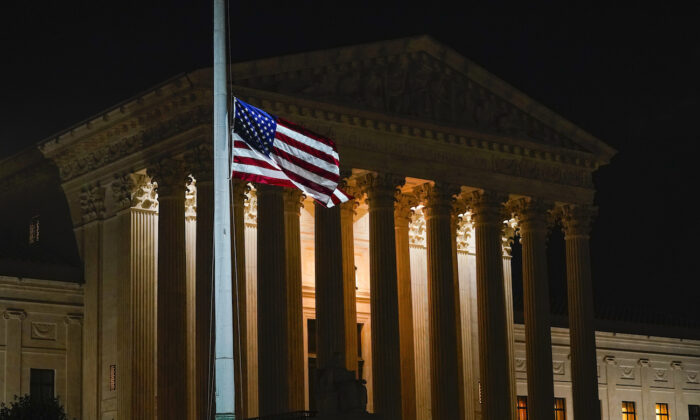
The American flag blows in the wind after it was lowered to half-staff Friday, Sept. 18, 2020, in Washington, after the Supreme Court announced that Supreme Court Justice Ruth Bader Ginsburg has died of metastatic pancreatic cancer at age 87. (AP Photo/Alex Brandon)

By Peter Svab

The formation of a totalitarian state is just about complete in America as the most powerful public and private sector actors unify behind the idea that actions to stamp out dissent can be justified, according to several experts on modern totalitarian ideologies.

While many have warned about the rise of fascism or socialism in “the land of the free,” the ideas have largely been vague or fragmented, focusing on individual events or actors. Recent events, however, indicate that seemingly unconnected pieces of the oppression puzzle are fitting together to form a comprehensive system, according to Michael Rectenwald, a retired liberal arts professor at New York University.

But many Americans, it appears, have been caught off guard or aren’t even aware of the newly forming regime, as the idea of elected officials, government bureaucrats, large corporations, the establishment academia, think tanks and nonprofits, the legacy media, and even seemingly grassroot movements all working in concert toward some evil purpose seems preposterous. Is a large portion of the country in on a conspiracy?

The reality now emerges that no massive conspiracy was in fact needed—merely an ideological alignment and some informal coordination, Rectenwald argues.

Despite the lack of formal overarching organization, the American socialist regime is indeed totalitarian, as the root of its ideology requires politically motivated coercion, he told The Epoch Times. The power of the regime is not yet absolute but it’s becoming increasingly effective as it erodes the values, checks, and balances against tyranny established by traditional beliefs and enshrined in the American founding.

The effects can be seen throughout society. Americans, regardless of their income, demographics, or social stature are being fired from jobs, getting stripped of access to basic services such as banking and social media, or having their businesses crippled for voicing political opinions and belonging to a designated political underclass. Access to sources of information unsanctioned by the regime is becoming increasingly difficult. Some figures of power and influence are sketching the next step, labelling large segments of society as “extremists” and potential terrorists who need to be “deprogrammed.”

While the onset of the regime appears tied to events of recent years—the presidency of Donald Trump, the CCP (Chinese Communist Party) viruspandemic, the Capitol intrusion of Jan. 6—its roots go back decades.

Is It Really Totalitarian?

Totalitarian regimes are commonly understood as constituting a government headed by a dictator that regiments the economy, censors the media, and quells dissent by force. That is not the case in America but it’s also a misunderstanding of how such regimes function, literature on totalitarianism indicates.

To claim power, the regimes don’t initially need to control every aspect of society through government.

Adolf Hitler, leader of the National Socialist Workers Party in Nazi Germany, used various means to control the economy, including gaining compliance of industry leaders voluntarily, through intimidation, or through replacing the executives with party loyalists.

Similarly, the regime rearing its head in America relies on corporate executives to implement its agenda voluntarily but also through intimidation by online brigades of activists and journalists who take initiative to launch negative PR campaigns and boycotts to progress their preferred societal structure.

Also, Hitler initially didn’t control the spread of information via government censorship but rather through his brigades of street thugs, the “brown shirts,” who would intimidate and physically prevent his opponents from speaking publicly.

The tactic parallels the often successful efforts to “cancel” and “shut down” public speakers by activists and violent actors, such as Antifa.

Dissenting media in America haven’t been silenced by the government directly as of yet. But they are stymied in other ways.

In the digital age, media largely rely on reaching and growing their audience through social media and web search engines, which are dominated by Facebook and Google. Both companies have in place mechanisms to crack down on dissenting media.

Google gives preference in its search results to sources it deems “authoritative.” Search results indicate the company tends to consider media ideologically close to it to be more authoritative. Such media can then produce hit pieces on their competitors, giving Google justification to slash the “authoritativeness” of the dissenters.

Facebook employs third-party fact checkers who have the discretion to label content as “false” and thus reduce the audience on its platform. Virtually all the fact checkers focused on American content are ideologically aligned with Facebook.

Attempts to set up alternative social media have run into yet more fundamental obstacles, as demonstrated by Parler, whose mobile app was terminated by Google and Apple, while the company was kicked off Amazon’s servers.

To the degree that a totalitarian regime requires a police state, there’s no law in America targeting dissenters explicitly. But there are troubling signs of selective, politically motivated enforcement. Signs go back to the IRS’s targeting of Tea Party groups or the difference in treatment received by former Trump adviser Lt. Gen Michael Flynn and former FBI deputy Director Andrew McCabe—both allegedly lying to investigators but only one getting prosecuted. The situation may get still worse as the restrictions tied to the CCP virus see broad swaths of ordinary human behavior being considered “illegal,” opening the door to nearly universal political targeting.

“I think the means by which a police state is being set up is the demonization of Trump supporters and the likely use of medical passports to institute the effective equivalent of social credit scores,” Rectenwald said.

While loyalty to the government and to a specific political party plays a major role, it’s the allegiance to the ideological root of totalitarianism that gives it its foot soldiers, literature on the subject indicates.

Totalitarian Ideology

The element “that holds totalitarianism together as a composite of intellectual elements” is the ambition of fundamentally reimagining society—“the intention to create a ‘New Man,’” explained author Richard Shorten in “Modernism and Totalitarianism: Rethinking the Intellectual Sources of Nazism and Stalinism, 1945 to the Present.”

Various ideologies have framed the ambition differently, based on what they posited as the key to the transformation.

Karl Marx, co-author of the Communist Manifesto, viewed the control of the economy as primary, describing socialism as “socialized man, the associated producers, rationally regulating their interchange with Nature, bringing it under their common control, instead of being ruled by it as by the blind forces of Nature,” in his Das Kapital.

Adolf Hitler, leader of the National Socialist Workers Party in Nazi Germany, viewed race as primary. People would become “socialized”—that is transformed and perfected—by removing Jews and other supposedly “lesser” races from society, he claimed.

The most dominant among the current ideologies stem from the so-called “critical theories,” where the perfected society is defined by “equity,” meaning elimination of differences in outcomes for people in demographic categories deemed historically marginalized. The goal is to be achieved by eliminating the ever-present “white supremacy,” however the ideologues currently define it.

While such ideologies commonly prescribe collectivism, calling for national or even international unification behind their agenda, they are elitist and dictatorial in practice as they find mankind never “woke” enough to follow their agenda voluntarily.

In Marx’s prophecies, the revolution was supposed to occur spontaneously. Yet it never did, leading Vladimir Lenin, the first head of the Soviet Union, to conclude that the revolution will need leadership after all.

“The idea is that you have some enlightened party … who understand the problem of the proletariat better than the proletariat does and is going to shepherd them through the revolution that they need to have for the greater good,” explained James Lindsay, author of “Cynical Theories: How Activist Scholarship Made Everything about Race, Gender, and Identity—and Why This Harms Everybody.”

Elements of this intellectual foundation can be found in ideologies of many current political forces, from neo-nazis and anarcho-communists, through to progressives and to some extent even neoliberals and neoconservatives, Lindsay acknowledged.

“This is why you see so many people today saying that the only possible answers are a full return to classical liberalism or a complete rejection of liberalism entirely as fatally disposed to create progressivism, neoliberalism, etc.,” he said.

That’s not to say these ideologies are openly advocating totalitarianism but rather that they inevitably lead to it.

The roadmap could be summarized as follows:

  1. There’s something fundamentally and intolerably wrong with current reality
  2. There’s a plan to fix it requiring a whole society buy-in
  3. People opposing the plan need to be educated about the plan so they accept it
  4. People who resist the persuasion need to be reeducated, even against their will
  5. People who won’t accept the plan no matter what need to be removed from society.

“I think that’s the general thrust,” Lindsay said. “We can make the world the way we want it to be if we all just get on the same page and same project. It’s a disaster, frankly.”

Points four and five now appear to be in progress.

Former Facebook executive Alex Stamos recently labeled the widespread questioning of the 2020 election results as “violent extremism,” which social media companies should eradicate the same way they countered online recruitment content from the ISIS terrorist group.

The “core issue,” he said, is that “we have given a lot of leeway, both in traditional media and on social media, to people to have a very broad range of political views” and this has led to the emergence of “more and more radical” alternative media like OAN and Newsmax.

Stamos then mused about how to reform Americans who’ve tuned in to the dissenters.

“How do you bring those people back into the mainstream of fact-based reporting and try to get us all back into the same consensus reality?” he asked in a CNN interview.

“And can you? Is that possible?” CNN host Brian Stelter added.

The logic goes as follows: Trump claimed the election was stolen through fraud and other illegalities. That has not been proven in court and is thus false. People who stormed the U.S. Capitol on Jan. 6 and managed to break inside and disrupt the electoral vote counting did so because they believed the election was stolen. Therefore, anybody who questions the legitimacy of the election results is an extremist and potentially a terrorist.

With tens of thousands of troops assembled to guard the inauguration of President-elect Joe Biden, Rep. Steve Cohen (D-Tenn.) recently told CNNthat all guard members who voted for Trump belong to a “suspect group” that “might want to do something,” alluding to past leaders of other countries who were “killed by their own people.”

Former FBI Director James Comey recently said the Republican party needs to be “burned down or changed.”

“They want a one party state,” commented conservative filmmaker Dinesh D’Souza in a recent podcast. “That is not to say they don’t want an opposition. They want a token opposition. They want Republicans where they get to say what kind of Republican is ok.”

Just as Marx blamed the ills of the world on capitalists and Hitler on Jews, the current regime tends to blame various permutations of “white supremacy.”

“Expel the Republican members of Congress who incited the white supremacist attempted coup,” said Rep. Cori Bush (D-Mo.) in a recent tweet, garnering some 300,000 likes.

She was referring to the Republican lawmakers who raised objections on Jan. 6 to election results in Arizona and Pennsylvania. Their objections were voted down.

“Can U.S. Spy Agencies Stop White Terror?” Daily Beast’s Jeff Stein asked in a recent headline, concluding that a call for “secret police” to sniff out “extremist” Americans “may well get renewed attention.”

Under the regime, allegations of election fraud—de facto questioning the legitimacy of the leader—have become incitement of terrorism. YouTube (owned by Google), Facebook, and Twitter have either banned content that claims the election was rigged or are furnishing it with warning labels. Twitter chief executive Jack Dorsey was recently recorded as saying that banning the president’s account was just the beginning.

The approach closely mirrors that of the Chinese communist regime, which commonly targets dissidents for “subverting” the state or “spreading rumors.”

What’s the Alternative?

If calls for radically reorganizing the world are inherently totalitarian, how is the world to avoid them? The question appears to be its own answer. If totalitarianism inherently requires allegiance to its ideology, it can’t exist in a society with a lack of such allegiance.

The United States was founded on the idea that individual rights are God-given and unalienable. The idea, rooted in traditional beliefs that human morality is of divine origin, stands a bulwark against any attempt to assail people’s rights even for their own good.

“If you’re not a believer in actual God, you can posit a God’s ideal on the matter … We have to posit some arbiter who’s above and beyond our own prejudices and biases in order to ensure these kinds of rights. … Because otherwise you have this infinitely malleable situation in which people with power and coercive potential can eliminate and rationalize the elimination of rights willy-nilly,” Rectenwald said.

Source: The Epoch Times

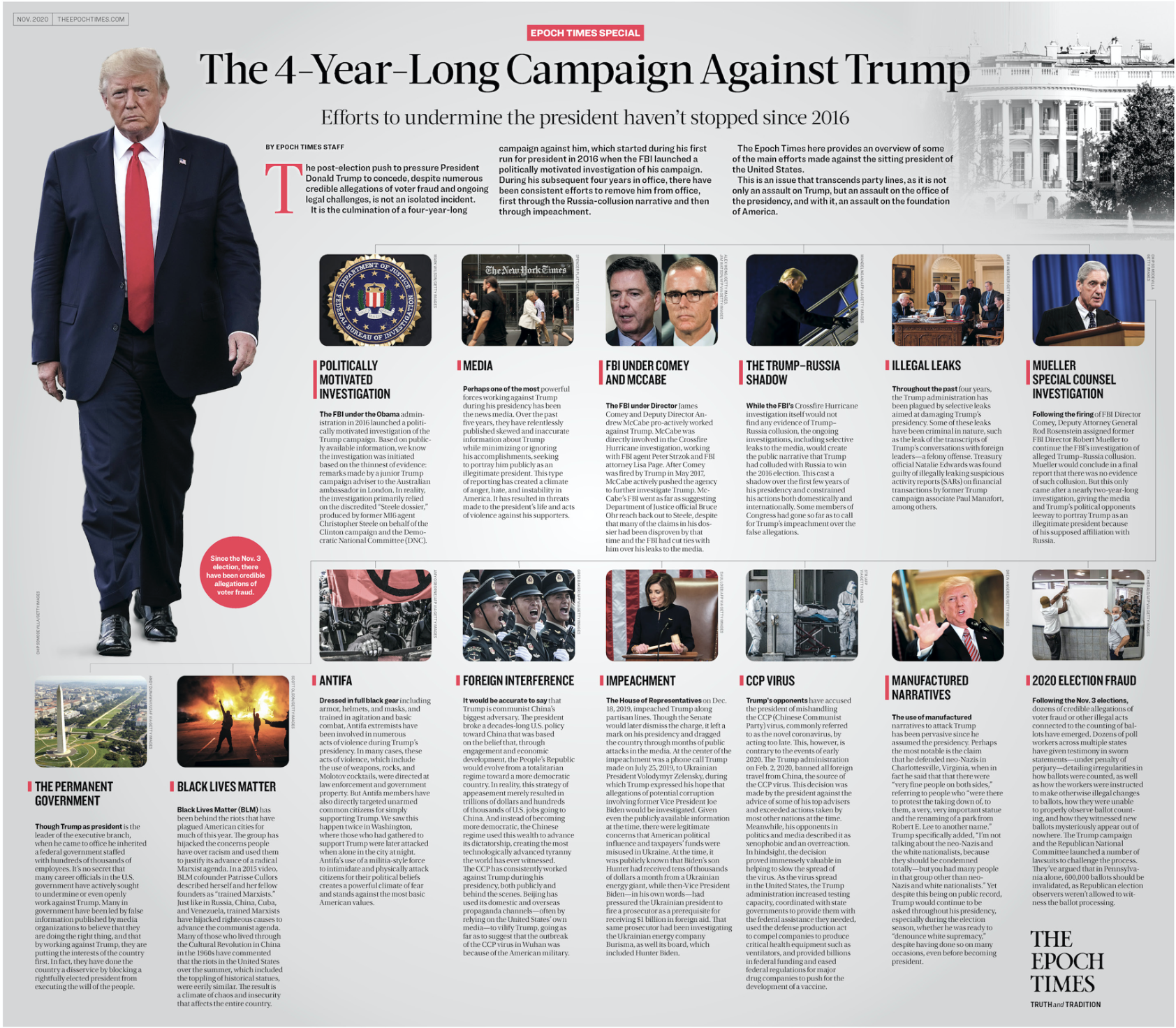
The 4-Year-Long Campaign Against Trump: Efforts to undermine the president haven’t stopped since 2016 | The Epoch Times

It is the culmination of a four-year-long campaign against him, which started during his first run for president in 2016 when the FBI launched a politically motivated investigation of his campaign. During his subsequent four years in office, there have been consistent efforts to remove him from office, first through the Russia-collusion narrative and then through impeachment.

The Epoch Times here provides an overview of some of the main efforts made against the sitting president of the United States.

This is an issue that transcends party lines, as it is not only an assault on Trump, but an assault on the office of the presidency, and with it, an assault on the foundation of America.

Politically Motivated Investigation

The FBI under the Obama administration in 2016 launched a politically motivated investigation of the Trump campaign. Based on publicly available information, we know the investigation was initiated based on the thinnest of evidence: remarks made by a junior Trump campaign adviser to the Australian ambassador in London. In reality, the investigation primarily relied on the discredited “Steele dossier,” produced by former MI6 agent Christopher Steele on behalf of the Clinton campaign and the Democratic National Committee (DNC).

The Trump–Russia Shadow

While the FBI’s Crossfire Hurricane investigation itself would not find any evidence of Trump–Russia collusion, the ongoing investigations, including selective leaks to the media, would create the public narrative that Trump had colluded with Russia to win the 2016 election. This cast a shadow over the first few years of his presidency and constrained his actions both domestically and internationally. Some members of Congress had gone so far as to call for Trump’s impeachment over the false allegations.

FBI Under Comey and McCabe

The FBI under Director James Comey and Deputy Director Andrew McCabe pro-actively worked against Trump. McCabe was directly involved in the Crossfire Hurricane investigation, working with FBI agent Peter Strzok and FBI attorney Lisa Page. After Comey was fired by Trump in May 2017, McCabe actively pushed the agency to further investigate Trump. McCabe’s FBI went as far as suggesting Department of Justice official Bruce Ohr reach back out to Steele, despite that many of the claims in his dossier had been disproven by that time and the FBI had cut ties with him over his leaks to the media.

Media

Perhaps one of the most powerful forces working against Trump during his presidency has been the news media. Over the past five years, they have relentlessly published skewed and inaccurate information about Trump while minimizing or ignoring his accomplishments, seeking to portray him publicly as an illegitimate president. This type of reporting has created a climate of anger, hate, and instability in America. It has resulted in threats made to the president’s life and acts of violence against his supporters.

Impeachment

The House of Representatives on Dec. 18, 2019, impeached Trump along partisan lines. Though the Senate would later dismiss the charge, it left a mark on his presidency and dragged the country through months of public attacks in the media. At the center of the impeachment was a phone call Trump made on July 25, 2019, to Ukrainian President Volodymyr Zelensky, during which Trump expressed his hope that allegations of potential corruption involving former Vice President Joe Biden would be investigated. Given even the publicly available information at the time, there were legitimate concerns that American political influence and taxpayers’ funds were misused in Ukraine. At the time, it was publicly known that Biden’s son Hunter had received tens of thousands of dollars a month from a Ukrainian energy giant, while then-Vice President Biden—in his own words—had pressured the Ukrainian president to fire a prosecutor as a prerequisite for receiving $1 billion in foreign aid. That same prosecutor had been investigating the Ukrainian energy company Burisma, as well its board, which included Hunter Biden.

CCP Virus

Trump’s opponents have accused the president of mishandling the CCP (Chinese Communist Party) virus, commonly referred to as the novel coronavirus, by acting too late. This, however, is contrary to the events of early 2020. The Trump administration on Feb. 2, 2020, banned all foreign travel from China, the source of the CCP virus. This decision was made by the president against the advice of some of his top advisers and exceeded actions taken by most other nations at the time. Meanwhile, his opponents in politics and media described it as xenophobic and an overreaction. In hindsight, the decision proved immensely valuable in helping to slow the spread of the virus. As the virus spread in the United States, the Trump administration increased testing capacity, coordinated with state governments to provide them with the federal assistance they needed, used the defense production act to compel companies to produce critical health equipment such as ventilators, and provided billions in federal funding and eased federal regulations for major drug companies to push for the development of a vaccine.

Foreign Interference

It would be accurate to say that Trump is communist China’s biggest adversary. The president broke a decades-long U.S. policy toward China that was based on the belief that, through engagement and economic development, the People’s Republic would evolve from a totalitarian regime toward a more democratic country. In reality, this strategy of appeasement merely resulted in trillions of dollars and hundreds of thousands of U.S. jobs going to China. And instead of becoming more democratic, the Chinese regime used this wealth to advance its dictatorship, creating the most technologically advanced tyranny the world has ever witnessed. The CCP has consistently worked against Trump during his presidency, both publicly and behind the scenes. Beijing has used its domestic and overseas propaganda channels—often by relying on the United States’ own media—to vilify Trump, going as far as to suggest that the outbreak of the CCP virus in Wuhan was because of the American military.

Black Lives Matter

Black Lives Matter (BLM) has been behind the riots that have plagued American cities for much of this year. The group has hijacked the concerns people have over racism and used them to justify its advance of a Marxist agenda. In a 2015 video, BLM co-founder Patrisse Cullors described herself and her fellow founders as “trained Marxists.” Just like in Russia, China, Cuba, and Venezuela, trained Marxists have hijacked righteous causes to advance the communist agenda. Many of those who lived through the Cultural Revolution in China in the 1960s have commented that the riots in the United States over the summer, which included the toppling of historical statues, were eerily similar. The result is a climate of chaos and insecurity that affects the entire country.

Antifa

Dressed in full black gear including armor, helmets, and masks, and trained in agitation and basic combat, Antifa extremists have been involved in numerous acts of violence during Trump’s presidency. In many cases, these acts of violence, which include the use of weapons, rocks, and Molotov cocktails, were directed at law enforcement and government property. But Antifa members have also directly targeted unarmed common citizens for simply supporting Trump. We saw this happen twice in Washington, where those who had gathered to support Trump were later attacked when alone in the city at night. Antifa’s use of a militia-style force to intimidate and physically attack citizens for their political beliefs creates a powerful climate of fear and stands against the most basic American values.

The Permanent Government

Though Trump as president is the leader of the executive branch, when he came to office he inherited a federal government staffed with hundreds of thousands of employees. It’s no secret that many career officials in the U.S. government have actively sought to undermine or even openly work against Trump. Many in government have been led by false information published by media organizations to believe that they are doing the right thing, and that by working against Trump, they are putting the interests of the country first. In fact, they have done the country a disservice by blocking a rightfully elected president from executing the will of the people.

Mueller Special Counsel Investigation

Following the firing of FBI Director Comey, Deputy Attorney General Rod Rosenstein assigned former FBI Director Robert Mueller to continue the FBI’s investigation of alleged Trump–Russia collusion. Mueller would conclude in a final report that there was no evidence of such collusion. But this only came after a nearly two-year-long investigation, giving the media and Trump’s political opponents leeway to portray Trump as an illegitimate president because of his supposed affiliation with Russia.

Illegal Leaks

Throughout the past four years, the Trump administration has been plagued by selective leaks aimed at damaging Trump’s presidency. Some of these leaks have been criminal in nature, such as the leak of the transcripts of Trump’s conversations with foreign leaders—a felony offense. Treasury official Natalie Edwards was found guilty of illegally leaking suspicious activity reports (SARs) on financial transactions by former Trump campaign associate Paul Manafort, among others.

2020 Election Fraud

Following the Nov. 3 elections, dozens of credible allegations of voter fraud or other illegal acts connected to the counting of ballots have emerged. Dozens of poll workers across multiple states have given testimony in sworn statements—under penalty of perjury—detailing irregularities in how ballots were counted, as well as how the workers were instructed to make otherwise illegal changes to ballots, how they were unable to properly observe ballot counting, and how they witnessed new ballots mysteriously appear out of nowhere. The Trump campaign and the Republican National Committee launched a number of lawsuits to challenge the process. They’ve argued that in Pennsylvania alone, 600,000 ballots should be invalidated, as Republican election observers weren’t allowed to witness the ballot processing.

Manufactured Narratives

The use of manufactured narratives to attack Trump has been pervasive since he assumed the presidency. Perhaps the most notable is the claim that he defended neo-Nazis in Charlottesville, Virginia, when in fact he said that that there were “very fine people on both sides,” referring to people who “were there to protest the taking down of, to them, a very, very important statue and the renaming of a park from Robert E. Lee to another name.” Trump specifically added, “I’m not talking about the neo-Nazis and the white nationalists, because they should be condemned totally—but you had many people in that group other than neo-Nazis and white nationalists.” Yet despite this being on public record, Trump would continue to be asked throughout his presidency, especially during the election season, whether he was ready to “denounce white supremacy,” despite having done so on many occasions, even before becoming president.

Source: The Epoch Times

Hunter Biden Took Hundreds of Trips to Foreign Countries with Secret Service | Judicial Watch

Judicial Watch received records from the U.S. Secret Service showing that, for the first five and a half years of the Obama administration, Hunter Biden traveled extensively while receiving a Secret Service protective detail. During the time period of the records provided, Hunter Biden, son of then-Vice President Joe Biden, took 411 separate domestic and international flights, including to 29 different foreign countries. He visited China five times.

The records produced with the incomplete response shows that, for the first five and a half years of the Obama administration, Hunter Biden traveled extensively while receiving a Secret Service protective detail. The records show that, between January 31, 2011 and July 8, 2014, Hunter Biden received Secret Service protection for 411 separate domestic and international trips, including to 29 different foreign countries. He received protection while visiting China five times.

Source: Judicial Watch

Covid-911 – Insurgency | YouTube

Editor’s Note: What’s happening in America today is a clear and present danger to the Constitutional Republic of the United States of America. Wake Up or lose your freedoms forever.

You’re being scammed by enemies of America who occupy powerful positions in government and the media. November 2020 is the way we, the people, can fight back. Know your enemy. Ditch the masks. Rise.

Source: YouTube

Nunes: ‘As Many As 10’ Criminal Referrals Related To Russia Probe Are Headed To DOJ | Trending Politics

5ee3634c566b5imageFormer Special Counsel Robert Mueller’s entire Russia investigation was nothing more than a two-long scam that failed to give Democrats their chance to remove President Donald Trump from office.

We have learned over time that top officials in the Obama administration played a big role in anti-Trump probe — and one lawmaker is vowing that justice will be served.

House Intelligence Committee ranking Republican Rep. Devin Nunes said he and his Republican colleagues will be sending more criminal referrals to Attorney General William Barr and the Department of Justice, the Washington Examiner reported.

Nunes made the announcement during an interview on Fox Business, where he said Republicans have gathered enough evidence for “at least another five, possibly as many as 10” referrals to the DOJ in addition to the eight referrals made last spring.

“We now are looking at the overall Gen. Flynn investigation and how that was conducted and the rest of the Mueller team,” he said, according to the Examiner. “And then, of course, as new information has come to light from the information that was declassified by acting Director of National Intelligence [Richard] Grenell, that information has also shown that there are other people who have lied or misled Congress or have, I think in some cases, maybe, lied by omission, documents that were kept from Congress.”

Nunes said that he expects to send the referrals within days.

Last month, Nunes said criminal referrals are coming for members of Mueller’s team who investigated Russian interference in the 2016 election.

“We’re looking at doing criminal referrals on the Mueller team, the Mueller dossier team, the Mueller witch hunt, whatever you want to call it. That’s where we are now in our investigation,” Nunes said.

Now, in the wake of the Justice Department’s decision to drop charges against former National Security Adviser General Michael Flynn, Nunes is turning his attention to the conduct of Mueller and his team.

“We’ve also expanded our investigation into the Mueller team and everything that happened with Mueller and the people at DOJ and FBI that were above Mueller. And so, we will be making criminal referrals in the coming weeks against the Mueller team. We’re just now putting that together and, of course, as always, waiting on more documents that we really need to come out,” Nunes said.

Having examined witness reports and other new documents released by the FBI, Republicans now claim to have evidence that Mueller’s team misled the courts during their investigation.

This comes as the recently released FISA spy report found that FBI officials had falsified documents for the FISA court so they had a better chance of securing warrants to spy on members of the Trump campaign, such as aide Carter Page.

In part, the IG report found that there was extreme bias against then-candidate Trump and that the FBI deliberately doctored evidence they presented to the nation’s top spy court in order to gain authority to spy on a key Trump affiliate.

Source: Trending Politics