Reprinted from Bracing Views with the author’s permission.
Omer Bartov is a historian who specializes in German military history and genocide studies. I have three of his books: “The Eastern Front, 1941-45, German Troops and the Barbarisation of Warfare”; “Hitler’s Army: Soldiers, Nazis, and War in the Third Reich”; and “Germany’s War and the Holocaust: Disputed Histories.” He has studied the Holocaust closely; as a young man, he served in the Israeli Defense Forces and now teaches at Brown University. He is uniquely placed to judge what’s happening in Gaza and he’s quite clear about his conclusion. It’s a genocide.
I highly recommend watching this entire interview of Omer Bartov by LTC Danny Davis.
A few points from the interview:
The IDF in Gaza is showing the effects of brutalization similar to that of the Wehrmacht in World War II. IDF soldiers are looting, killing, and showing similar manifestations of barbaric indiscipline, and they are almost never held accountable for their war crimes.
The Israeli people are being encouraged to show no empathy toward Palestinian suffering. Zionism has increasingly morphed into a racist form of Jewish supremacism in which Palestinian lives and suffering simply don’t matter.
U.S. politicians are enabling genocide in Gaza.
What Bibi Netanyahu wants is a “Greater Israel” that is largely free of Palestinians. U.S. talk of a “two-state solution” is nonsensical in the face of Bibi’s ruthless goal.
Israel is obviously pursuing a military solution to the Palestinian question. That “solution” involves mass killing, massive destruction of infrastructure, and deliberate efforts to promote starvation while doing little to prevent the spread of disease. The goal of forcing Palestinians to flee from their land, or to die if they choose to remain and fight, marks this as a genocide under international law, ironically law that was enacted in the aftermath of the Holocaust by Germany against European Jews during World War II.
The U.S. is playing Bibi’s game. Bibi will keep going with this genocide because to stop it with a ceasefire would likely mean that he will be called to account for October 7th (failing to prevent the attacks) as well as crimes he’s previously been indicted for.
Instead of the U.S. being the “best friend” of Israel, it is encouraging the worst impulses within Israel, setting the stage for further Middle East conflict and a possible war with Iran. It is also, let’s always remember, enabling the mass slaughter of innocent Palestinians.
Bartov suggests Netanyahu would prefer Donald Trump to be reelected as president, but he notes a Kamala Harris presidency would likely change little, since Netanyahu will bring all pressure to bear against Democrats to continue the current policy. Harris has already stated she supports Israel’s right to defend itself and is against any weapons embargo. If she wins, it’s likely she’ll continue current practices.
Bartov sees this as a disaster not only for the Palestinians but also ultimately for Israel in the long term.
William J. Astore is a retired lieutenant colonel (USAF). He taught history for fifteen years at military and civilian schools. He writes at Bracing Views.
The year 2023 was a banner year for change, underscoring the reality of a world transforming away from American hegemony toward the uncertainty of a yet-to-be-defined multilateral reality. This transformation was marked by many events – here are the five most important ones.
The failed Ukrainian counteroffensive
Perhaps the most-hyped event of the year, Ukraine’s much-anticipated spring/summer counteroffensive was NATO’s version of the German Ardennes offensive of December 1944 – a last-gasp effort to throw all remaining reserves into a desperate attempt to score a knock-out blow against an opponent who had seized the strategic initiative. Any sound military analyst could have predicted the inevitability of a Ukrainian defeat – one cannot responsibly speak of launching a frontal assault on a heavily defended, well-prepared defensive position using forces who are neither equipped, organized, or trained for the task.
The amount of delusion surrounding Ukrainian and NATO expectations only underscores the desperation that underpinned their cause – the West’s support of Ukraine was always of a superficial nature, where domestic politics trumped global reality. The ignorance of those who believed Ukraine could pierce the Russian defenses was easily matched by those who thought that a Moscow Maidan movement could be created through the combined impact of economic sanctions and a forever war against Ukraine.
The counteroffensive is the manifestation of the Russophobia that has gripped the collective West, where ignorance trumps fact, and delusion supersedes reality. The failed NATO/Ukrainian counteroffensive, far from weakening Russia, proved to be the incubator for the birth of a more powerful, confident, and resilient Russia that will no longer allow itself to be classified as a second-class citizen in the world community.
On October 6, 2023, Israel was sitting on top of the world. It had cowed the administration of US President Joe Biden into forgetting about a two-state solution to the Palestinian problem. Instead, it embraced the vision of a greater Israel, which glossed over the continued theft of Palestinian land through unchecked support for illegal Israeli settlements by focusing on the broader geopolitical benefits of normalized relations between Israel and the Gulf Arab states. The Israel Defense Forces were the best military in the region, backed by an intelligence and security establishment possessing a legendary reputation for knowing everything about all potential enemies.
October 7: The Israel-Hamas war
Then came October 7 and the Hamas surprise attack.
All talk of Israeli-Arab normalization is finished. The IDF is being embarrassed by Hamas and defeated by Hezbollah. The Israeli intelligence service has been exposed as an empty shell whose greatest accomplishment is an AI-assisted targeting system that facilitates the killing of Palestinian civilians.
The new reality of the Middle East is now shaped by two related issues – the necessity of a Palestinian state and the inevitability of a strategic Israeli defeat. The paths toward resolving each of these issues will not be easy ones to follow, and they may unfold over the span of years rather than months, but one thing is certain – this new geopolitical reality would not have been possible without the events of October 7.
Africa: The Sahel revolt
In the span of three years, Françafrique, or the post-colonial French-dominated sphere of influence in the Sahel region of Africa, has gone from serving as the springboard for the projection of French-led American and EU efforts to project military power in an attempt to defeat the forces of Islamic insurgency, to being humiliated and defeated at the hands of nationalists who overthrew traditional pro-French governments and replacing them with anti-French military juntas. Starting with Mali in 2021, then Burkina Faso in 2022, and finally Niger in 2023, the collapse of the Sahel component of Françafrique has been as dramatic as it has been decisive. There was seemingly nothing France nor its supporters could do to reverse the tide of anti-French sentiment in the region. In the end, the threat of outside military intervention to change the July 2023 coup in Niger collapsed in the face of a unified collective defense posture taken by the three former French colonies.
The dramatic eviction of France from the region was matched by the emergence of a new regional power – Russia. The rise of the new tripartite regional alliance between Mali, Burkina Faso, and Niger coincided with a more assertive Russian foreign policy, which looked to form common cause with an Africa still straining from the bonds of post-colonial existence manifested in geopolitical relationships like those formed under Françafrique. The Russian approach was borne out in the success of last summer’s Russian-African Summit, held in St. Petersburg, and the growing economic and security relationships between Russia and many African states – including Mali, Burkina Faso, and Niger, that have emerged since. The Russian tricolor flag, it seems, has replaced that of France as the most influential symbol of foreign involvement in that region.
BRICS
In 2022, China hosted the 14th Summit of the Brazil, Russia, India, China, and South African economic forum best known by the acronym formed from the first letters of its five-nation membership – BRICS. At that summit, BRICS aspired to greatness but was unable to accomplish anything more than talk about the creation of a so-called “currency basket” designed to challenge the global supremacy of the US dollar and speak wistfully about the possibility of opening its membership to other nations.
Then came the 15th BRICS Summit, held in South Africa. From a forum possessing unrealized potential, BRICS exploded upon the international scene as a multi-lateral competitor to the American singularity, a viable challenger to the US-imposed “rules-based international order” that had dominated global geopolitical discourse since the end of the Second World War. The events that helped propel BRICS front and center on the stage of global relevance represented a perfect storm, so to speak, of geopolitical calamity – the defeat of the collective West at the hands of Russia in Ukraine, the collapse of Françafrique in the Sahel, and the increasing dominance of China on the global economic reality.
The South African-hosted BRICS Summit proved to be the perfect counterpoint to the combined pathos of the G-7 Summit in Hiroshima, Japan, and the NATO Summit in Vilnius, Lithuania. In Japan and Lithuania, western impotence was on full display for the world to see. In sharp contrast, the virility of the BRICS phenomenon provided a multilateral alternative that proved to be attractive to many nations, including the six that were accepted into BRICS as part of its expansion strategy (Argentina, Egypt, Iran, Ethiopia, Saudi Arabia, and the United Arab Emirates, although Argentina withdrew its membership package following the election of Javier Milei as president in December 2023), and the fourteen other nations who have formally submitted applications to join in 2024, when Russia takes over the chairmanship. BRICS has surpassed the G7 in terms of collective economic clout, and the geopolitical influence of its collective membership is such that it will exceed both the G7 and NATO forums in terms of overall international relevance in the years to come.
The US: The Naked Emperor
The United States spends nearly $1 trillion a year on its defense – more than the combined defense expenditures of its ten closest rivals for the top spot. This money funds the strategic nuclear deterrence force and the conventional military power projection potential of the US. Given the enormous sums involved, one would anticipate that the dominance of US military power worldwide would be unmatched. Curiously, this is not the case.
By spending a fraction of what the US does for similar services, Russia has overtaken the United States when it comes to strategic nuclear forces. The US needs a major upgrade to its nuclear triad – the land-based and submarine-launched ballistic missiles and manned bombers – that comprise its nuclear strike capabilities. While replacement systems are in the works, it will take more than a decade to get these systems online, and the cost of doing this will run into the hundreds of billions of dollars – or more, given the history of US defense industry inefficiencies and cost overruns.
Russia, meanwhile, has begun putting advanced missiles into service – missiles designed to defeat US missile defenses, along with new submarines and manned bombers. Traditional venues used by the US to offset Russian strategic advances, such as arms control, are no longer available due to short-sighted US policies that rejected arms control for the potential of achieving a strategic nuclear advantage. The script, so to speak, has been flipped, and it’s now the US that finds itself on the short end of the atomic power equation. This disadvantageous position will be even further exacerbated by the growth of China’s strategic nuclear force, which is in the process of expanding from possessing some 400 nuclear weapons to matching the US and Russia’s 1,500 deployed warheads.
The US used to maintain a conventional military force structure capable of fighting two-and-one-half wars simultaneously – one in Europe, one in Asia, and a holding action in the Middle East until victory was achieved in one of the first two theaters, and forces could be redeployed. Today, the US, by trying to maintain a global presence that mirrors that of the Cold War, is unable to fight and win a single major conflict. It has maxed out its conventional potential in Europe, deploying some 100,000 troops in support of NATO, which has allowed its combined military combat potential to atrophy to the point that no NATO nation has a viable military capability. The collective impotence of NATO is on display in Ukraine, where a Russian army is in the process of defeating a NATO-trained and equipped Ukrainian military.
In the Pacific, the US is facing the fact that it lacks sufficient military power to defend Taiwan in the face of any potential Chinese military operation. There have been advances in the accuracy and lethality of Chinese stand-off weapons, including new advanced hypersonic missiles, which, in theory at least, could overcome US air defense systems that protect the centerpiece of American power projection – the aircraft carrier battlegroup. This weakness is not just limited to any potential conflict with China—the US Navy has deployed carrier battlegroups off the coast of Lebanon, in the Persian Gulf, and to the Red Sea, where they have been prevented from engaging in any decisive military intervention out of fear that missiles fired by Hezbollah, Iran, and the Houthi of Yemen could damage or sink the most visible symbol of American military power today.
With a budget of nearly $1 trillion, one would expect the US to be parading itself worldwide via a military second to none in terms of capabilities and lethality. Instead, the US has been exposed as an emperor with no clothes whose nakedness is a source of embarrassment on a global stage that had grown accustomed to the finery and pageantry of American military power. The humiliation of the US Navy at the hands of the Houthi is but the most recent manifestation of a trend exposing US military weakness. This trend will only expand in 2024.
Several widely held assumptions, including that the occupation is temporary, that the “peace process” will soon bring an end to Israeli abuses, that Palestinians have meaningful control over their lives in the West Bank and Gaza, and that Israel is an egalitarian democracy inside its borders, have obscured the reality of Israel’s entrenched discriminatory rule over Palestinians. Israel has maintained military rule over some portion of the Palestinian population for all but six months of its 73-year history. It did so over the vast majority of Palestinians inside Israel from 1948 and until 1966. From 1967 until the present, it has militarily ruled over Palestinians in the OPT, excluding East Jerusalem. By contrast, it has since its founding governed all Jewish Israelis, including settlers in the OPT since the beginning of the occupation in 1967, under its more rights-respecting civil law.
For the past 54 years, Israeli authorities have facilitated the transfer of Jewish Israelis to the OPT and granted them a superior status under the law as compared to Palestinians living in the same territory when it comes to civil rights, access to land, and freedom to move, build, and confer residency rights to close relatives. While Palestinians have a limited degree of self-rule in parts of the OPT, Israel retains primary control over borders, airspace, the movement of people and goods, security, and the registry of the entire population, which in turn dictates such matters as legal status and eligibility to receive identity cards.
A number of Israeli officials have stated clearly their intent to maintain this control in perpetuity and backed it up through their actions, including continued settlement expansion over the course of the decades-long “peace process.” Unilateral annexation of additional parts of the West Bank, which the government of Prime Minister Benjamin Netanyahu has vowed to carry out, would formalize the reality of systematic Israeli domination and oppression that has long prevailed without changing the reality that the entire West Bank is occupied territory under the international law of occupation, including East Jerusalem, which Israel unilaterally annexed in 1967.
International criminal law has developed two crimes against humanity for situations of systematic discrimination and repression: apartheid and persecution. Crimes against humanity stand among the most odious crimes in international law.
The international community has over the years detached the term apartheid from its original South African context, developed a universal legal prohibition against its practice, and recognized it as a crime against humanity with definitions provided in the 1973 International Convention on the Suppression and Punishment of the Crime of Apartheid (“Apartheid Convention”) and the 1998 Rome Statute of the International Criminal Court (ICC).
The crime against humanity of persecution, also set out in the Rome Statute, the intentional and severe deprivation of fundamental rights on racial, ethnic, and other grounds, grew out of the post-World War II trials and constitutes one of the most serious international crimes, of the same gravity as apartheid.
The State of Palestine is a state party to both the Rome Statute and the Apartheid Convention. In February 2021, the ICC ruled that it has jurisdiction over serious international crimes committed in the entirety of the OPT, including East Jerusalem, which would include the crimes against humanity of apartheid or persecution committed in that territory. In March 2021, the ICC Office of Prosecutor announced the opening of a formal investigation into the situation in Palestine.
The term apartheid has increasingly been used in relation to Israel and the OPT, but usually in a descriptive or comparative, non-legal sense, and often to warn that the situation is heading in the wrong direction. In particular, Israeli, Palestinian, US, and European officials, prominent media commentators, and others have asserted that, if Israel’s policies and practices towards Palestinians continued along the same trajectory, the situation, at least in the West Bank, would become tantamount to apartheid.[1] Some have claimed that the current reality amounts to apartheid.[2] Few, however, have conducted a detailed legal analysis based on the international crimes of apartheid or persecution.[3]
In this report, Human Rights Watch examines the extent to which that threshold has already been crossed in certain of the areas where Israeli authorities exercise control.
Definitions of Apartheid and Persecution
The prohibition of institutionalized discrimination, especially on grounds of race or ethnicity, constitutes one of the fundamental elements of international law. Most states have agreed to treat the worst forms of such discrimination, that is, persecution and apartheid, as crimes against humanity, and have given the ICC the power to prosecute these crimes when national authorities are unable or unwilling to pursue them. Crimes against humanity consist of specific criminal acts committed as part of a widespread or systematic attack, or acts committed pursuant to a state or organizational policy, directed against a civilian population.
The Apartheid Convention defines the crime against humanity of apartheid as “inhuman acts committed for the purpose of establishing and maintaining domination by one racial group of persons over any other racial group of persons and systematically oppressing them.” The Rome Statute of the ICC adopts a similar definition: “inhumane acts… committed in the context of an institutionalized regime of systematic oppression and domination by one racial group over any other racial group or groups and committed with the intention of maintaining that regime.” The Rome Statute does not further define what constitutes an “institutionalized regime.”
The crime of apartheid under the Apartheid Convention and Rome Statute consists of three primary elements: an intent to maintain a system of domination by one racial group over another; systematic oppression by one racial group over another; and one or more inhumane acts, as defined, carried out on a widespread or systematic basis pursuant to those policies.
Among the inhumane acts identified in either the Convention or the Rome Statute are “forcible transfer,” “expropriation of landed property,” “creation of separate reserves and ghettos,” and denial of the “the right to leave and to return to their country, [and] the right to a nationality.”
The Rome Statute identifies the crime against humanity of persecution as “the intentional and severe deprivation of fundamental rights contrary to international law by reason of the identity of the group or collectivity,” including on racial, national, or ethnic grounds. Customary international law identifies the crime of persecution as consisting of two primary elements: (1) severe abuses of fundamental rights committed on a widespread or systematic basis, and (2) with discriminatory intent.
Few courts have heard cases involving the crime of persecution and none the crime of apartheid, resulting in a lack of case law around the meanings of key terms in their definitions. As described in the report, international criminal courts have over the last two decades evaluated group identity based on the context and construction by local actors, as opposed to earlier approaches focused on hereditary physical traits. In international human rights law, including the International Convention on the Elimination of All Forms of Racial Discrimination (ICERD), race and racial discrimination have been broadly interpreted to include distinctions based on descent, and national or ethnic origin, among other categories.
Application to Israel’s Policies towards Palestinians
Two primary groups live today in Israel and the OPT: Jewish Israelis and Palestinians. One primary sovereign, the Israeli government, rules over them.
Intent to Maintain Domination
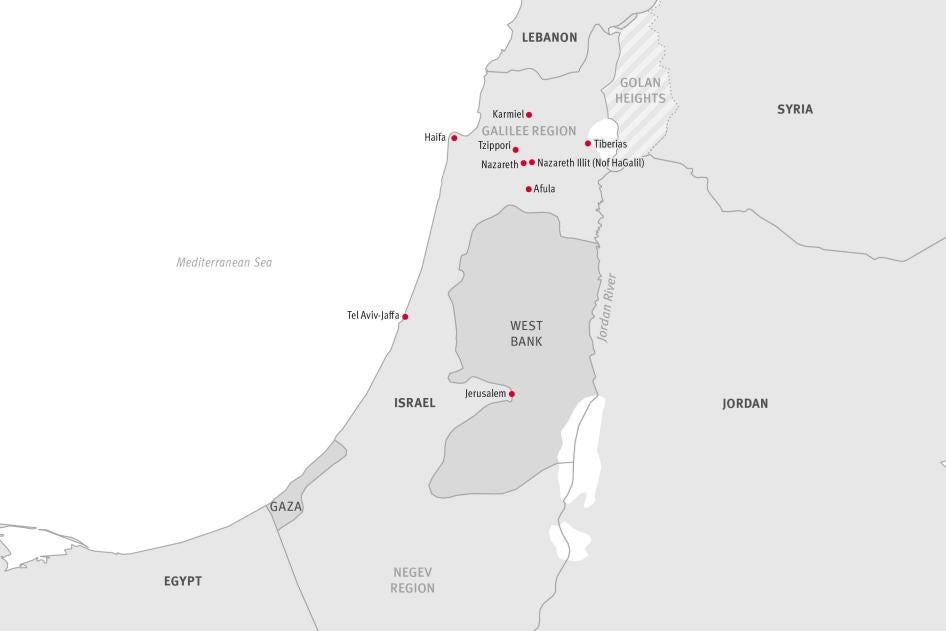
A stated aim of the Israeli government is to ensure that Jewish Israelis maintain domination across Israel and the OPT. The Knesset in 2018 passed a law with constitutional status affirming Israel as the “nation-state of the Jewish people,” declaring that within that territory, the right to self-determination “is unique to the Jewish people,” and establishing “Jewish settlement” as a national value. To sustain Jewish Israeli control, Israeli authorities have adopted policies aimed at mitigating what they have openly described as a demographic “threat” that Palestinians pose. Those policies include limiting the population and political power of Palestinians, granting the right to vote only to Palestinians who live within the borders of Israel as they existed from 1948 to June 1967, and limiting the ability of Palestinians to move to Israel from the OPT and from anywhere else to Israel or the OPT. Other steps are taken to ensure Jewish domination, including a state policy of “separation” of Palestinians between the West Bank and Gaza, which prevents the movement of people and goods within the OPT, and “Judaization” of areas with significant Palestinian populations, including Jerusalem as well as the Galilee and the Negev in Israel. This policy, which aims to maximize Jewish Israeli control over land, concentrates the majority of Palestinians who live outside Israel’s major, predominantly Jewish cities into dense, under-served enclaves and restricts their access to land and housing, while nurturing the growth of nearby Jewish communities.
Systematic Oppression and Institutional Discrimination
To implement the goal of domination, the Israeli government institutionally discriminates against Palestinians. The intensity of that discrimination varies according to different rules established by the Israeli government in Israel, on the one hand, and different parts of the OPT, on the other, where the most severe form takes place.
In the OPT, which Israel has recognized as a single territory encompassing the West Bank and Gaza, Israeli authorities treat Palestinians separately and unequally as compared to Jewish Israeli settlers. In the occupied West Bank, Israel subjects Palestinians to draconian military law and enforces segregation, largely prohibiting Palestinians from entering settlements. In the besieged Gaza Strip, Israel imposes a generalized closure, sharply restricting the movement of people and goods—policies that Gaza’s other neighbor, Egypt, often does little to alleviate. In annexed East Jerusalem, which Israel considers part of its sovereign territory but remains occupied territory under international law, Israel provides the vast majority of the hundreds of thousands of Palestinians living there with a legal status that weakens their residency rights by conditioning them on the individual’s connections to the city, among other factors. This level of discrimination amounts to systematic oppression.
In Israel, which the vast majority of nations consider being the area defined by its pre-1967 borders, the two tiered-citizenship structure and bifurcation of nationality and citizenship result in Palestinian citizens having a status inferior to Jewish citizens by law. While Palestinians in Israel, unlike those in the OPT, have the right to vote and stand for Israeli elections, these rights do not empower them to overcome the institutional discrimination they face from the same Israeli government, including widespread restrictions on accessing land confiscated from them, home demolitions, and effective prohibitions on family reunification.
The fragmentation of the Palestinian population, in part deliberately engineered through Israeli restrictions on movement and residency, furthers the goal of domination and helps obscure the reality of the same Israeli government repressing the same Palestinian population group, to varying degrees in different areas, for the benefit of the same Jewish Israeli dominant group.
Inhumane Acts and Other Abuses of Fundamental Rights
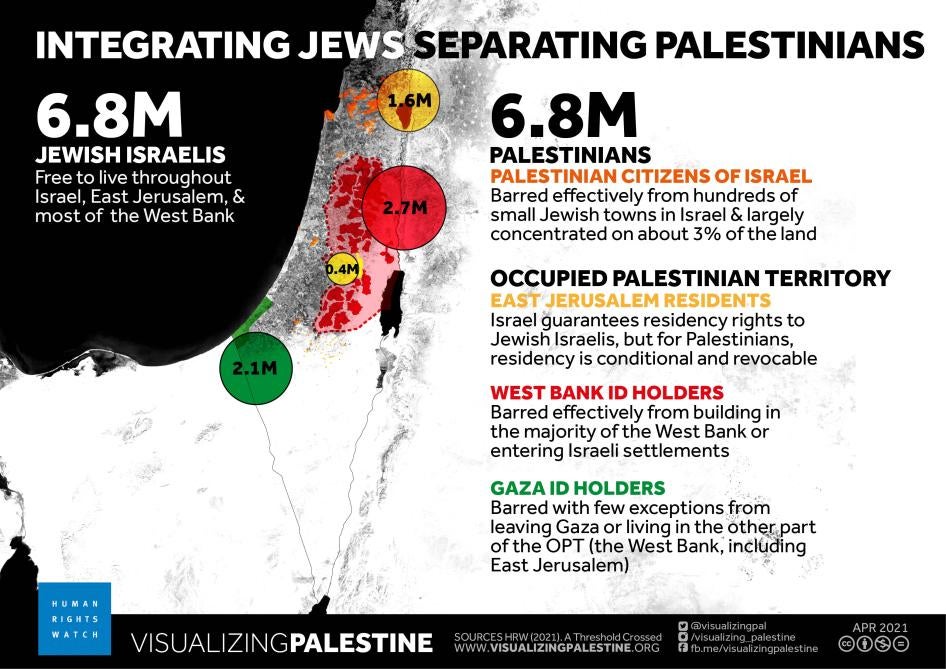
Pursuant to these policies, Israeli authorities have carried out a range of inhumane acts in the OPT. Those include sweeping restrictions on the movement of 4.7 million Palestinians there; the confiscation of much of their land; the imposition of harsh conditions, including categorical denial of building permits in large parts of the West Bank, which has led thousands of Palestinians to leave their homes under conditions that amount to forcible transfer; the denial of residency rights to hundreds of thousands of Palestinians and their relatives, largely for being abroad when the occupation began in 1967, or for long periods during the first few decades of the occupation, or as a result of the effective freeze on family reunification over the last two decades; and the suspension of basic civil rights, such as freedom of assembly and association, depriving Palestinians of the opportunity to have a voice in a wide range of affairs that most affect their daily lives and futures. Many of these abuses, including categorical denials of building permits, mass residency revocations or restrictions, and large-scale land confiscations, have no legitimate security justifications; others, such as the extent of restrictions on movement and civil rights, fail any reasonable balancing test between security concerns and the severity of the underlying rights abuse.
Since the founding of the state of Israel, the government also has systematically discriminated against and violated the rights of Palestinians inside the state’s pre-1967 borders, including by refusing to allow Palestinians access to the millions of dunams of land (1000 dunams equals 100 hectares, about 250 acres or 1 square kilometer) that were confiscated from them. In one region—the Negev—these policies make it virtually impossible for tens of thousands of Palestinians to live lawfully in the communities they have lived in for decades. In addition, Israeli authorities refuse to permit the more than 700,000 Palestinians who fled or were expelled in 1948, and their descendants, to return to Israel or the OPT, and impose blanket restrictions on legal residency, which block many Palestinian spouses and families from living together in Israel.
Report Findings
This report examines Israeli policies and practices towards Palestinians in the OPT and Israel and compares them to the treatment of Jewish Israelis living in the same territories. It is not an exhaustive evaluation of all types of international human rights and humanitarian law violations. Rather, it surveys consequential Israeli government practices and policies that violate the basic rights of Palestinians and whose purpose is to ensure the domination of Jewish Israelis, and assesses them against the definitions of the crimes against humanity of apartheid and persecution.
The report draws on years of research and documentation by Human Rights Watch and other rights organizations, including fieldwork conducted for this report. Human Rights Watch also reviewed Israeli laws, government planning documents, statements by officials, and land records. This evidentiary record was then analyzed under the legal standards for the crimes of apartheid and persecution. Human Rights Watch also wrote in July 2020 to Israeli Prime Minister Benjamin Netanyahu, soliciting the government’s perspectives on the issues covered, but, as of publication, had not received a response.
The report does not set out to compare Israel with South Africa under apartheid or to determine whether Israel is an “apartheid state”—a concept that is not defined in international law. Rather, the report assesses whether specific acts and policies carried out by Israeli authorities today amount in particular areas to the crimes of apartheid and persecution as defined under international law.
Each of the report’s three main substantive chapters explores Israel’s rule over Palestinians: the dynamics of its rule and discrimination, looking in turn at Israel and the OPT, the particular rights abuses that it commits there, and some of the objectives that motivate these policies. It does so in terms of the primary elements of the crimes of apartheid and persecution, as outlined above. Human Rights Watch evaluates the dynamics of Israeli rule in each of these areas, keeping in mind the different legal frameworks that apply in the OPT and Israel, which are the two legally recognized territorial entities, each with a different status under international law. While noting significant factual differences among subregions in each of these two territories, the report does not make separate subregional determinations.
On the basis of its research, Human Rights Watch concludes that the Israeli government has demonstrated an intent to maintain the domination of Jewish Israelis over Palestinians across Israel and the OPT. In the OPT, including East Jerusalem, that intent has been coupled with systematic oppression of Palestinians and inhumane acts committed against them. When these three elements occur together, they amount to the crime of apartheid.
Israeli officials have also committed the crime against humanity of persecution. This finding is based on the discriminatory intent behind Israel’s treatment of Palestinians and the grave abuses carried out in the OPT that include the widespread confiscation of privately owned land, the effective prohibition on building or living in many areas, the mass denial of residency rights, and sweeping, decades-long restrictions on the freedom of movement and basic civil rights. Such policies and practices intentionally and severely deprive millions of Palestinians of key fundamental rights, including to residency, private property, and access to land, services, and resources, on a widespread and systematic basis by virtue of their identity as Palestinians.
Seeking Maximal Land with Minimal Palestinians
Israeli policy has sought to engineer and maximize the number of Jews, as well as the land available to them, in Israel and the portions of the OPT coveted by the Israeli government for Jewish settlement. At the same time, by restricting the residency rights of Palestinians, Israeli policy seeks to minimize the number of Palestinians and the land available to them in those areas. The level of repression is most severe in the OPT, although often less severe aspects of similar policies can be found within Israel.
In the West Bank, authorities have confiscated more than 2 million dunams of land from Palestinians, making up more than one-third of the West Bank, including tens of thousands of dunams that they acknowledge are privately owned by Palestinians. One common tactic they have used is to declare territory, including privately-owned Palestinian land, as “state land.” The Israeli group Peace Now estimates that the Israeli government has designated about 1.4 million dunams of land, or about a quarter of the West Bank, as state land. The group has also found that more than 30 percent of the land used for settlements is acknowledged by the Israeli government as having been privately owned by Palestinians. Of the more than 675,000 dunams of state land that Israeli authorities have allocated for use by third parties in the West Bank, they have earmarked more than 99 percent for use by Israeli civilians, according to government data. Land grabs for settlements and the infrastructure that primarily serves settlers effectively concentrate Palestinians in the West Bank, according to B’Tselem, into “165 non-contiguous ‘territorial islands.’”
Israeli authorities have also made it virtually impossible in practice for Palestinians in Area C, the roughly 60 percent of the West Bank that the Oslo Accords placed under full Israeli control, as well as those in East Jerusalem, to obtain building permits. In Area C, for example, authorities approved less than 1.5 percent of applications by Palestinians to build between 2016 and 2018—21 in total—a figure 100 times smaller than the number of demolition orders it issued in the same period, according to official data. Israeli authorities have razed thousands of Palestinian properties in these areas for lacking a permit, leaving thousands of families displaced. By contrast, according to Peace Now, Israeli authorities began construction on more than 23,696 housing units between 2009 and 2020 in Israeli settlements in Area C. Transfer of an occupying power’s civilian population to an occupied territory violates the Fourth Geneva Convention.
These policies grow out of longstanding Israeli government plans. For example, the 1980 Drobles Plan, which guided the government’s settlement policy in the West Bank at the time and built on prior plans, called for authorities to “settle the land between the [Arab] minority population centers and their surroundings,” noting that doing so would make it “hard for Palestinians to create territorial contiguity and political unity” and “remove any trace of doubt about our intention to control Judea and Samaria forever.”
In Jerusalem, the government’s plan for the municipality, including both the west and occupied east of the city, sets the goal of “maintaining a solid Jewish majority in the city” and a target demographic “ratio of 70% Jews and 30% Arabs”—later adjusted to a 60:40 ratio after authorities acknowledged that “this goal is not attainable” in light of “the demographic trend.”
The Israeli government has also carried out discriminatory seizures of land inside Israel. Authorities have seized through different mechanisms at least 4.5 million dunams of land from Palestinians, according to historians, constituting 65 to 75 percent of all land owned by Palestinians before 1948 and 40 to 60 percent of the land that belonged to Palestinians who remained after 1948 and became citizens of Israel. Authorities in the early years of the state declared land belonging to displaced Palestinians as “absentee property” or “closed military zones,” then took it over, converted it to state land, and built Jewish communities there. Authorities continue to block Palestinian citizen landowners from accessing land that was confiscated from them. A 2003 government-commissioned report found that “the expropriation activities were clearly and explicitly harnessed to the interests of the Jewish majority” and that state lands, which constitute 93 percent of all land in Israel, effectively serve the objective of “Jewish settlement.” Since 1948, the government has authorized the creation of more than 900 “Jewish localities” in Israel, but it has allowed only a handful of government-planned townships and villages for Palestinians, created largely to concentrate previously displaced Bedouin communities living in the Negev.
Land confiscations and other discriminatory land policies in Israel hem in Palestinian municipalities inside Israel, denying them opportunities for natural expansion enjoyed by Jewish municipalities. The vast majority of Palestinian citizens, who make up around 19 percent of the Israeli population, live in these municipalities, which have an estimated jurisdiction over less than 3 percent of all land in Israel. While Palestinians in Israel can move freely, and some live in “mixed cities,” such as Haifa, Tel Aviv-Jaffa, and Acre, Israeli law permits small towns to exclude prospective residents based on their asserted incompatibility with the town’s “social-cultural fabric.” According to a study by a professor at Technion-Israel Institute of Technology in Haifa, there are more than 900 small Jewish towns, including kibbutzim, across Israel that can restrict who lives there. None of them have any Palestinians living among them.
In the Negev in Israel, Israeli authorities have refused to legally recognize 35 Palestinian Bedouin communities, making it impossible for their 90,000 or so residents to live lawfully in the communities they have lived in for decades. Instead, authorities have sought to concentrate Bedouin communities in larger recognized townships in order, as expressed in governmental plans and statements by officials, to maximize the land available for Jewish communities. Israeli law considers all buildings in these unrecognized villages to be illegal, and authorities have refused to connect most to the national electricity or water grids or to provide even basic infrastructure such as paved roads or sewage systems. The communities do not appear on official maps, most have no educational facilities, and residents live under constant threat of having their homes demolished. Israeli authorities demolished more than 10,000 Bedouin homes in the Negev between 2013 and 2019, according to government data. They razed one unrecognized village that challenged the expropriation of its lands, al-Araqib, 185 times.
Authorities have implemented these policies pursuant to government plans since the early years of the state that called for restricting Bedouin communities in order to secure land suitable for settling Jews. Several months before becoming prime minister in December 2000, Ariel Sharon declared that Bedouins in the Negev “are gnawing at the country’s land reserves,” which he described as “a demographic phenomenon.” As prime minister, Sharon went on to pursue a multi-billion-dollar plan that transparently sought to boost the Jewish population in the Negev and Galilee regions of Israel, areas that have significant Palestinian populations. His deputy prime minister, Shimon Peres, later described the plan as a “battle for the future for the Jewish people.”
Sharon’s push to Judaize the Negev, as well as the Galilee, developed against the backdrop of the government’s decision to withdraw Jewish settlers from Gaza. After ending Jewish settlement there, Israel began to treat Gaza effectively as a territorial jurisdiction whose population it could consider as outside the demographic calculus of Jews and Palestinians who live in Israel and in the vast majority of the OPT—the West Bank including East Jerusalem—that Israel intends to retain. Israeli officials at the time acknowledged the demographic objectives behind the move. Amid the push to withdraw settlers from Gaza, Sharon said in an August 2005 address to Israelis, “Gaza cannot be held onto forever. Over one million Palestinians live there and they double their numbers with every generation.” Peres said the same month, “We are disengaging from Gaza because of demography.”
Despite withdrawing its settlers and ground troops, Israel has remained in critical ways the supreme power in Gaza, dominating through other means and hence maintaining its legal obligations as an occupying power, as the International Committee of the Red Cross (ICRC) and the United Nations (UN), among others, have determined. Most significantly, Israel bans Palestinians living there (with only narrow exceptions) from leaving through the Erez Passenger Crossing it controls and instituted a formal “policy of separation” between Gaza and the West Bank, despite Israel having recognized within the framework of the Oslo Accords these two parts of the OPT as collectively forming a “single territorial unit.” The generalized travel ban, which has remained in place since 2007 and reduced travel out of Gaza to a fraction of what it was two decades ago, is not based on an individualized security assessment and fails any reasonable test of balancing security concerns against the right to freedom of movement for over two million people.
Authorities have also sharply restricted the entry and exit of goods to and from Gaza, which, alongside Egypt often shutting its border, effectively seals it off from the outside world. These restrictions have contributed to limiting access to basic services, devastating the economy, and making 80 percent of the population reliant on humanitarian aid. Families in Gaza in recent years have had to make do without centrally provided electricity for between 12 and 20 hours per day, depending on the period. Water is also critically scarce; the UN considers more than 96 percent of the water supply in Gaza “unfit for human consumption.”
Within the West Bank as well, Israeli authorities prohibit Palestinian ID holders from entering areas such as East Jerusalem, lands beyond the separation barrier, and areas controlled by settlements and the army, unless they secure difficult-to-obtain permits. They have also erected nearly 600 permanent obstacles, many between Palestinian communities, that disrupt daily life for Palestinians. In sharp contrast, Israeli authorities allow Jewish settlers in the West Bank to move freely within the majority of the West Bank under its exclusive control, as well as to and from Israel, on roads built to facilitate their commutes and integrate them into every facet of Israeli life.
Demographic considerations factor centrally in Israel’s separation policy between Gaza and the West Bank. In particular, in the rare cases when they allow movement between the two parts of the OPT, Israeli authorities permit it predominantly in the direction of Gaza, thereby facilitating population flow away from the area where Israel actively promotes Jewish settlement. The Israeli army’s official policy states that while a West Bank resident can apply “for permanent resettlement in the Gaza Strip for any purpose that is considered humanitarian (usually family reunification),” Gaza residents can settle in the West Bank only “in the rarest cases,” usually related to family reunification. In these cases, authorities are mandated to aim to resettle the couple in Gaza. Official data shows that Israel did not approve a single Gaza resident to resettle in the West Bank, outside of a handful who filed Supreme Court petitions between 2009 and March 2017, while permitting several dozen West Bank residents to relocate to Gaza on the condition that they sign a pledge not to return to the West Bank.
Beyond the closure policy, Israeli authorities have often used oppressive and indiscriminate means during hostilities and protests in Gaza. Since 2008, the Israeli army has launched three large-scale military offensives in Gaza in the context of hostilities with armed Palestinian groups. As described in the report, those offensives have included apparently deliberate attacks on civilians and civilian infrastructure and killed well over 2,000 civilians. In addition, Israeli forces have regularly fired on Palestinian demonstrators and others who have approached fences separating Gaza and Israel in circumstances when they did not pose an imminent threat to life, killing 214 demonstrators in 2018 and 2019 alone and maiming thousands. These practices stem from a decades-long pattern of using excessive and vastly disproportionate force to quell protests and disturbances, at great cost to civilians. Despite the frequency of such incidents over the years, Israeli authorities have failed to develop law enforcement tactics that comport with international human rights norms.
Discriminatory Restrictions on Residency and Nationality
Palestinians face discriminatory restrictions on their rights to residency and nationality to varying degrees in the OPT and Israel. Israeli authorities have used their control over the population registry in the West Bank and Gaza—the list of Palestinians they consider lawful residents for purposes of issuing legal status and identity cards—to deny residency to hundreds of thousands of Palestinians. Israeli authorities refused to register at least 270,000 Palestinians who were outside the West Bank and Gaza when the occupation began in 1967 and revoked the residency of nearly 250,000, mostly for being abroad for too long between 1967 and 1994. Since 2000, Israeli authorities have largely refused to process family reunification applications or requests for address changes by Palestinians in the West Bank and Gaza. The freeze effectively bars Palestinians from acquiring legal status for spouses or relatives not already registered and makes illegal, according to the Israeli army, the presence in the West Bank of thousands of Gaza residents who arrived on temporary permits and now live there, since they effectively cannot change their address to one in the West Bank. These restrictions have the effect of limiting the Palestinian population in the West Bank.
Authorities regularly deny entry into the West Bank to non-registered Palestinians who had lived in the West Bank but left temporarily (to study, work, marry, or for other reasons) and to their non-registered spouses and other family members.
When Israel annexed East Jerusalem in 1967, it applied its 1952 Law of Entry to Palestinians who lived there and designated them as “permanent residents,” the same status afforded to a non-Jewish foreigner who moves to Israel. The Interior Ministry has revoked this status from at least 14,701 Palestinians since 1967, mostly for failing to prove a “center of life” in the city. A path to Israeli citizenship exists, but few apply and most who did in recent years were not granted citizenship. By contrast, Jewish Israelis in Jerusalem, including settlers in East Jerusalem, are citizens who do not have to prove connections to the city to maintain their status.
Inside Israel, Israel’s Proclamation of Independence affirms the “complete equality” of all residents, but a two-track citizenship structure contradicts that vow and effectively regards Jews and Palestinians separately and unequally. Israel’s 1952 Citizenship Law contains a separate track exclusively for Jews to obtain automatic citizenship. That law grows out of the 1950 Law of Return which guarantees Jewish citizens of other countries the right to settle in Israel. By contrast, the track for Palestinians conditions citizenship on proving residency before 1948 in the territory that became Israel, inclusion in the population registry as of 1952, and a continuous presence in Israel or legal entry in the period between 1948 and 1952. Authorities have used this language to deny residency rights to the more than 700,000 Palestinians who fled or were expelled in 1948 and their descendants, who today number more than 5.7 million. This law creates a reality where a Jewish citizen of any other country who has never been to Israel can move there and automatically gain citizenship, while a Palestinian expelled from his home and languishing for more than 70 years in a refugee camp in a nearby country, cannot.
The 1952 Citizenship Law also authorizes granting citizenship based on naturalization. However, in 2003, the Knesset passed the Citizenship and Entry into Israel Law (Temporary Order), which bars granting Israeli citizenship or long-term legal status to Palestinians from the West Bank and Gaza who marry Israeli citizens or residents. With few exceptions, this law, renewed every year since and upheld by the Israeli Supreme Court, denies both Jewish and Palestinian citizens and residents of Israel who choose to marry Palestinians the right to live with their partner in Israel. This restriction, based solely on the spouse’s identity as a Palestinian from the West Bank or Gaza, notably does not apply when Israelis marry non-Jewish spouses of most other foreign nationalities. They can receive immediate status and, after several years, apply for citizenship.
Commenting on a 2005 renewal of the law, the prime minister at the time, Ariel Sharon, said: “There’s no need to hide behind security arguments. There’s a need for the existence of a Jewish state.” Benjamin Netanyahu, who was then the finance minister, said during discussions at the time: “Instead of making it easier for Palestinians who want to get citizenship, we should make the process much more difficult, in order to guarantee Israel’s security and a Jewish majority in Israel.” In March 2019, this time as prime minister, Netanyahu declared, “Israel is not a state of all its citizens,” but rather “the nation-state of the Jewish people and only them.”
International human rights law gives broad latitude to governments in setting their immigration policies. There is nothing in international law to bar Israel from promoting Jewish immigration. Jewish Israelis, many of whom historically migrated to Mandatory Palestine or later to Israel to escape anti-Semitic persecution in different parts of the world, are entitled to protection of their safety and fundamental rights. However, that latitude does not give a state the prerogative to discriminate against people who already live in that country, including with respect to rights concerning family reunification, and against people who have a right to return to the country. Palestinians are also entitled to protection of their safety and fundamental rights.
Israeli Justifications of Policies and Practices
Israeli authorities justify many of the policies documented in this report as responses to Palestinian anti-Israeli violence. Many policies, though, like the denial of building permits in Area C, East Jerusalem, and the Negev in Israel, residency revocations for Jerusalemites, or expropriation of privately owned land and discriminatory allocation of state lands, have no legitimate security justification. Others, including the Citizenship and Entry into Israel Law and freeze of the OPT population registry, use security as a pretext to advance demographic objectives.
Israeli authorities do face legitimate security challenges in Israel and the OPT. However, restrictions that do not seek to balance human rights such as freedom of movement against legitimate security concerns by, for example, conducting individualized security assessments rather than barring the entire population of Gaza from leaving with only rare exceptions, go far beyond what international law permits. Even where security forms part of the motivation behind a particular policy, that does not give Israel a carte blanche to violate human rights en masse. Legitimate security concerns can be present among policies that amount to apartheid, just as they can be present in a policy that sanctions the use of excessive force or torture.
Officials sometimes claim that measures taken in the OPT are temporary and would be rescinded in the context of a peace agreement. From former Prime Minister Levi Eshkol, of the Labor Party, declaring in July 1967 that “I see only a quasi-independent region [for Palestinians], because the security and land are in Israeli hands,” to Netanyahu of the Likud in July 2019 stating that “Israeli military and security forces will continue to rule the entire territory, up to the Jordan [River],” a range of officials have made clear their intent to maintain overriding control over the West Bank in perpetuity, regardless of what arrangements are in place to govern Palestinians. Their actions and policies further dispel the notion that Israeli authorities consider the occupation temporary, including the continuing of land confiscation, the building of the separation barrier in a way that accommodated anticipated growth of settlements, the seamless integration of the settlements’ sewage system, communication networks, electrical grids, water infrastructure and a matrix of roads with Israel proper, as well as a growing body of laws applicable to West Bank Israeli settlers but not Palestinians. The possibility that a future Israeli leader might forge a deal with Palestinians that dismantles the discriminatory system and ends systematic repression does not negate the intent of current officials to maintain the current system, nor the current reality of apartheid and persecution.
Recommendations
The Israeli government should dismantle all forms of systematic domination and oppression that privilege Jewish Israelis and systematically repress Palestinians, and end the persecution of Palestinians. In particular, authorities should end discriminatory policies and practices with regards to citizenship and residency rights, civil rights, freedom of movement, allocation of land and resources, access to water, electricity, and other services, and granting of building permits.
The findings that the crimes of apartheid and persecution are being committed do not deny the reality of Israeli occupation or erase Israel’s obligations under the law of occupation, any more than would a finding that other crimes against humanity or war crimes have been carried out. As such, Israeli authorities should cease building settlements and dismantle existing ones and otherwise provide Palestinians in the West Bank and Gaza with full respect of their human rights, using as a benchmark the rights that it grants Israeli citizens, as well as the protections that international humanitarian law grants them.
The Palestinian Authority (PA) should end forms of security coordination with the Israeli army that contribute to facilitating the crimes against humanity of apartheid and persecution.
The finding of crimes against humanity should prompt the international community to reevaluate its approach to Israel and Palestine. The US, which for decades has largely failed to press the Israeli government to end its systematic repression of Palestinians, has in some instances in recent years signaled its support for serious abuses such as the building of settlements in the occupied West Bank. Many European and other states have built close ties with Israel, while supporting the “peace process,” building the capacity of the PA, and distancing themselves from and sometimes criticizing specific abusive Israeli practices in the OPT. This approach, which overlooks the deeply entrenched nature of Israeli discrimination and repression of Palestinians there, minimizes serious human rights abuses by treating them as temporary symptoms of the occupation that the “peace process” will soon cure. It has enabled states to resist the sort of accountability that a situation of this gravity warrants, allowing apartheid to metastasize and consolidate. After 54 years, states should stop assessing the situation through the prism of what might happen should the languishing peace process one day be revived and focus instead on the longstanding reality on the ground that shows no signs of abating.
Crimes against humanity can serve as the basis for individual criminal liability in international fora, as well as in domestic courts outside of Israel and the OPT under the principle of universal jurisdiction.
In light of the decades-long failure by Israeli authorities to rein in serious abuses, the International Criminal Court’s Office of the Prosecutor should investigate and prosecute individuals credibly implicated in the crimes against humanity of apartheid or persecution. The ICC has jurisdiction over, and the prosecutor has opened an investigation into, serious crimes committed in the OPT. In addition, all governments should investigate and prosecute those credibly implicated in these crimes, under the principle of universal jurisdiction and in accordance with national laws.
Beyond criminality, Human Rights Watch calls on states to establish through the UN an international commission of inquiry to investigate systematic discrimination and repression based on group identity in the OPT and Israel. The inquiry should be mandated to establish and analyze the facts; identify those responsible for serious crimes, including apartheid and persecution, with a view to ensuring that the perpetrators are held accountable; as well as collect and preserve evidence related to abuses for future use by credible judicial institutions.
States should also establish through the UN a position of UN global envoy for the crimes of persecution and apartheid with a mandate to mobilize international action to end persecution and apartheid worldwide.
States should issue statements expressing concern about Israel’s practice of apartheid and persecution. They should vet agreements, cooperation schemes, and all forms of trade and dealing with Israel to screen for those directly contributing to the commission of the crimes of apartheid and persecution against Palestinians, mitigate the human rights impacts, and, where not possible, end the activities and funding found to facilitate these serious crimes.
The implications of the findings of this report for businesses are complex and beyond the scope of this report. At a minimum, businesses should cease activities that directly contribute to the commission of the crimes of apartheid and persecution. Companies should assess whether their goods or services contribute to the commission of the crimes of apartheid and persecution, such as equipment used in the unlawful demolition of Palestinian homes, and cease providing goods and services that will likely be used for such purposes, in accordance with the UN Guiding Principles on Business and Human Rights.
States should impose individual sanctions, including travel bans and asset freezes, against officials and individuals responsible for the continued commission of these serious crimes and condition arms sales and military and security assistance to Israel on Israeli authorities taking concrete and verifiable steps towards ending their commission of the crimes of apartheid and persecution.
The international community has for too long explained away and turned a blind eye to the increasingly transparent reality on the ground. Every day a person is born in Gaza into an open-air prison, in the West Bank without civil rights, in Israel with an inferior status by law, and in neighboring countries effectively condemned to lifelong refugee status, like their parents and grandparents before them, solely because they are Palestinian and not Jewish. A future rooted in the freedom, equality, and dignity of all people living in Israel and the OPT will remain elusive so long as Israel’s abusive practices against Palestinians persist.
“In a globally internetworked world, we are all going to learn to work together because there’s no viable alternative.”
Consider this: The “enemies paradigm” and the perspective it represents are obsolete. We humans on this Earth are in the process of moving onward, beyond that worldview, into a different era. In the new era, there will still be groups of people we may see as our adversaries, but they will not be enemies. There will still be bad problems, but we will solve them more ably, working together with the people we used to think of as our enemies. In a globally internetworked world, we are all going to learn to do this because there’s no viable alternative. It begins with adopting a different mental map.
The organizing principle of the new mental map is the idea of No More Enemies. It belongs to everyone on the planet. It’s a simple idea, really. The concept of “enemies” is no longer serving humanity. It has, demonstrably, become very destructive and is overdue for retirement. The old enemies-oriented worldview is being displaced by emergent new paradigms of partnership, shared responsibility, and co-evolving. Humanity is struggling to redesign itself, using new tools. New technologies of medical imaging, for instance, give us a crucial biofeedback loop to evaluate the impact of our own thoughts and cultural habits on our health, our behavior, our society, our planet. That gives us new information to help us co-redesign our way of understanding and interacting with our world. The evidence is there in plain sight…we just have to connect the dots.
“We, the people, are not the problem. The problem is the paradigm: the enemies paradigm.”
As a Jewish American Israeli woman who has spent years living and working with Muslim and Christian Arabs in Israel/Palestine, I know what I’m talking about. We, the people, are not the problem. The problem is the paradigm: the enemies paradigm.
Many of us have already discarded the enemies-based map of reality. We know that we have like-minded partners elsewhere in the Middle East, and far beyond. Our shared mantra, from Rela Mazali: We refuse to be enemies. We are trying to swing the regional momentum away from violence and fear and toward pluralism and equality. But history, the educational system, industry, army, religious extremism and government are all against us (so far). What we mainly have is our vision of a different way: No More Enemies.
“In Israel, successive governments have built a gigantic wall of brutality in the vain hope of protecting the folks on one side from the aspirations on the other side: never a sustainable strategy.”
In Israel, successive governments have built a gigantic wall of brutality in the vain hope of protecting the folks on one side from the aspirations on the other side: never a sustainable strategy. Our wall is like all such walls: constructed and funded by successive regimes, meant to keep at bay those whom the authorities wish to exclude, and to intimidate those who dissent. This wall is made of cement and electronic sensors and barbed wire, but the mortar binding it is made of powerful existential anxieties, of memories of historical suffering and injustice, and of continuing bloodshed mixed with fear, fear, fear.
And now—inevitably—there is this global picket line that has sprung up around Israel in response. BDS (boycott, divestment, sanctions), the Palestinian-led boycott movement is a call for equal rights for every person in this land and is supported worldwide by hundreds of thousands of people across a broad political spectrum. Most of them can agree on little else; oppression often makes strange bedfellows. Although not a boycott enthusiast, I have publicly supported this one as a nonviolent way of leveraging policy change here—because the alternative (business as usual) will be much worse for everyone concerned, long-term.
Clearly, things in Israel and Palestine have gone horribly wrong over the years. There has been heroism, and barbarism, on every side (all exhaustively documented). A vast river of self-righteous rhetoric has flowed under the bridge. None of that has mended what’s wrong here, and the situation is surely not going to fix itself. By rejecting Wallmania and working together, however, we can transform this scenario and get a life for us and our neighbors. The dissidents next door are equally committed. Maybe you’ve seen some of them on TV recently. This is deep change coming, which is why it evokes a backlash. We say: No fear. No more enemies.
“Palestinian nonviolence is not new.”
Did you know that the nonviolent Palestinian independence movement is not new? It is not new but it has been successfully smothered for decades, both by the somewhat discredited romance with “armed struggle” and by Israeli government repression. No longer. As its leaders are jailed, harassed, and even killed, this movement only grows stronger. In recent years, significant segments of Palestinian civil society, including young people, have indeed renounced violence. They have renounced it in English, Hebrew, and Arabic. They have done so sincerely, authentically, publicly, and repeatedly until, right now, there may be more Palestinians than Israelis deeply committed to nonviolent change. And—despite the militants who get all the headlines—the Palestinian people’s commitment to nonviolence seems to be increasing, week by week, while the trend in Israel, sadly, seems to be going the other way.
“The world finally seems to be waking up to the fact that justice for Palestinians is an urgent existential necessity—for Palestinians, for Israelis, maybe for the planet.”
The Israeli elite (like other entrenched elites hereabouts) is frightened, and that is dangerous. It’s important for people abroad not to demonize ordinary Israelis now, now that the world finally seems to be waking up to the fact that justice for Palestinians is an urgent existential necessity—for Palestinians, for Israelis, maybe for the planet. The Israeli people need your tough love, not your condemnation. The Israeli legislature, seemingly lacking any imaginative scheme for a different and more constructive shared future with the neighbors, is working hard to criminalize domestic dissent here. And the harder it works to do that, the more unequivocally we who dissent are obliged to declare where we stand.
We stand with all our Palestinian and Israeli sisters and brothers who refuse to be enemies. We stand with the Jewish, Christian and Muslim traditions of compassion. We stand with the peaceful protestors and nonviolent demonstrators and former combatants who have laid down their guns and are risking their lives for a different future, unarmed. We stand with Palestinians in refugee camps and in the diaspora who have waited for two or three generations now, for a chance to come back home. They are people, people like us, and they are homesick. Why do so many Israelis and Jews abroad insist on seeing them as a threat? They are a huge, untapped resource of vibrant human energy waiting to be allowed the chance to contribute to a more beautiful, more egalitarian, and more sustainable community in Israel/Palestine.
The song humanity needs to be singing now, in our region and elsewhere, is called No More Enemies. The history it will celebrate has only just begun to unfold. This is the new Exodus. As it moves us out of the old landscape of enemies and into new and unknown territory, maybe the right troubadour will appear who can find the words and melody for this song, and help us sing it. In harmony.
I am in Cairo, as of December 24th, and will return on January 18, 2010 (see below).
During the “Reign of the Goddess”, the compassionate nurturer, and the procreator of life—there was peace. When the Hebrews converted to the male God image (the warrior) we have had wars for thousands of years. Throughout history women have promoted peace and at times refused conjugal favors until their men put down their weapons. Unfortunately, modern women (especially American) have been conscripted and have bought into the male macho slogans: “might makes right” and “the end justifies the means”.
Fortunately, some women have remained true to the Goddess image and have maintained a vigil for Peace. An example of this is the women who established Code Pink and are sponsoring the Gaza Freedom March. For more information see www.gazafreedommarch.org.
There have been many men who have championed the Goddess concept as well and have promoted peace, such as, Mahatma Gandhi and Dr. Martin Luther King, Jr. One such person that I know personally is Father Peter Dougherty, who just won the International Gandhi Award. I met Father Dougherty 20 years ago when I first got arrested for civil disobedience while protesting nuclear weapons at Williams International.
Father Dougherty is the founder of the Michigan Peace Team (formerly known as the Michigan Faith & Resistance Peace Team). I served 10 years on the MPT Board and remain a trainer for their training in non-violent resistance in areas of conflict. I am proud to be on a delegation from the Michigan Peace Team, along with 5 women to participate in the Gaza Freedom March.
Attached are two press releases, one from the national Code Pink and one from Michigan Peace Team. We must break the death grip that Israel has on the Gaza Strip and all of Palestine! View this 5 minute You-Tube video by Marice Jacobsen to see for yourself what is going on in Gaza and the Gaza Freedom March plans: www.vimeo.com/7956625.
Our intention is to raise awareness amongst the international community and inform Americans, who spend billions of dollars supporting the Israeli genocide of Palestinians.
Please forward this e-mail to your friends and participate in any way you can to create a moral awareness around the death grip Israel has on Palestine!
Hubb Wa Salaam
Yusif
P.S. I’m also attaching an article about me, titled “Jogger”, which will give you an idea of my dedication & passion for peace, along with the 2 press releases. Please excuse any duplication of this message that you may receive as a result of my amateur attempt at computer communication.



 By Deb Reich
 “In Israel, successive governments have built a gigantic wall of brutality in the vain hope of protecting the folks on one side from the aspirations on the other side: never a sustainable strategy.”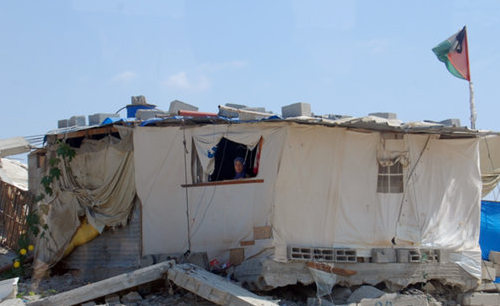
 Liberty International News