As one of the world’s pre-eminent professional conspiracy theorists, David Icke has been a regular guest on London Real, discussing topics as diverse as 5G, 9/11 and censorship.
Often described as a maverick or a renegade, David is a unique voice in the space, propounding a number of predictions around his post-Orwellian vision of society and the future.
An introduction to David Icke
“Today’s mighty oak is just yesterday’s nut that held its ground.”
Since his spiritual awakening in 1990, David enjoys a sizable global following, regularly speaking for up to 10 hours at venues such as Wembley Arena to audiences of thousands of people.
As well as public speaking, David is an acclaimed author having written over 21 books including The Robots’ Rebellion (1994), And The Truth Shall Set You Free (1995), The Biggest Secret (1999) and Children of the Matrix (2001), in which he developed his worldview of New Age thinking.
With a mission to wake up society and free our minds from what governments and mainstream media are trying to make us do, his credentials make him one of the most influential thinkers and catalysts for change.
The episode they didn’t want you to see
We knew the world would be watching when David returned to the studio, but it seems some very powerful people indeed were also watching…
…and they didn’t like what they saw…
…and they didn’t want you to see it either!
In this interview which was reported heavily by the BBC and others and subsequently BANNED, David joined us to talk about the CORONAVIRUS PANDEMIC, the worldwide COVID-19 LOCKDOWN, how governments have manipulated their citizens and the wider agenda behind social control and a Surveillance Society.
We go deeper into the global crisis, the looming economic recession and the impact of 5G technology and the violation of our rights and freedom of speech.
While we don’t always agree with everything David says, London Real will defend his right to be able to say it. So with that in mind sit back and enjoy this incredible and informative episode with David Icke.
Join us as we discuss:
George Orwell, the U.S. First Amendment, and the RT-PCR test
Dr. Andrew Kaufman, 5G technology, and the COVID-19 hoax
The WHO, Eddie Large, and Lombardy air pollution
Wuhan reporting, Dr. Neil Ferguson, and Imperial College
Boris Johnson, the climate change scam, and Bill Gates
The Freemasons, global fascism and Trump
The Rockefeller family, Bill Gates and Elon Musk
Offering more than meets the eye on first glance, David Icke is a man with serious credentials and a challenging perspective on our species and planet.
According to a new breaking news report from Politico, China is once again implementing mass quarantines to combat the coronavirus outbreak after their initial quarantine failed.
“Henan province in central China has taken the drastic measure of putting a mid-sized county in total lockdown as authorities try to fend off a second coronavirus wave in the midst of a push to revive the economy,” Politico reported. “Curfew-like measures came into effect on Tuesday in Jia county, near the city of Pingdingshan, with the area’s roughly 600,000 residents told to stay home, according to a notice on the country’s official microblog account.”
This breaking news comes at the same time as a new report from Washington Post Beijing bureau chief Anna Fifield stated that the real death toll from the coronavirus in Wuhan, China may be over 40,000, more than 16 times the amount of deaths currently reported by China.
The coronavirus pandemic ravaging the globe officially claimed 2,563 lives in Wuhan, where it began in a market that sold exotic animals for consumption. But evidence emerging from the city as it stirs from its two-month hibernation suggests the real death toll is exponentially higher. …
Using photos posted online, social media sleuths have estimated that Wuhan funeral homes had returned 3,500 urns a day since March 23. That would imply a death toll in Wuhan of about 42,000 — or 16 times the official number. Another widely shared calculation, based on Wuhan’s 84 furnaces running nonstop and each cremation taking an hour, put the death toll at 46,800.
This bombshell report comes not much after Bloomberg News reported that U.S. intelligence officials shared a classified report with President Donald Trump stating that China had lied about how bad the coronavirus was in their country.
“China’s public reporting on cases and deaths is intentionally incomplete,” Bloomberg News reported. “Two of the officials said the report concludes that China’s numbers are fake.”
Vice President Mike Pence also spoke out on the matter: “The reality is that we could have been better off if China had been more forthcoming. What appears evident now is that long before the world learned in December that China was dealing with this, and maybe as much as a month earlier than that, that the outbreak was real in China.”
Dr Deborah Birx, the head of the White House Coronavirus Response also spoke out, indicating that China may have lied about their coronavirus numbers.
“When you talk about could we have known something different, you know, I think all of us, I was overseas when this happened in Africa and I think when you look at the China data originally, and you said, there’s 80 million people, or 20 million people in Wuhan and 80 million people in Hubei, and they come up with the number of 50,000, you start thinking of this more like SARS than you do this kind of global pandemic,” Birx said.
Based on the information that China provided, Birx stated that she did not think that the coronavirus would escalate into a global pandemic.
“So, I think the medical community interpreted the Chinese data as this was serious, but smaller than anyone expected because I think probably we were missing a significant amount of the data” from China, Birx said.
Johnny Liberty, Editor’s Note: While it’s true both Russia and China have their own agendas so does the Unites States. The coronavirus has taken the world by storm, with nation states unprepared for the consequences of such a globally disruptive event. Whether the coronavirus was engineered in a bioweapons laboratory and accidentally released is of less consequence than the social and economic blowback which will be felt worldwide. If the truth ever be told (which unlikely it ever will be), unscrupulous propaganda agents from any country are not serving the best interests of humanity to protect themselves against the onslaught of this lethal virus.
By Eva Fu
U.S. adversaries such as Russia and China are propagating false information about the novel coronavirus outbreak amid a global public health crisis, according to a top State Department official tasked with countering foreign propaganda threats.
“The coronavirus is an example of where we’ve seen adversaries take advantage of a health crisis where people are terrified worldwide—to try to advance their priorities,” Lea Gabrielle, who leads the Global Engagement Center at the State Department, said during a Senate hearing on March 5.
While both countries’ propaganda malign and undermine free societies, the intent and the style of their state-directed campaigns differ greatly, according to Gabrielle.
“One of the best practices in countering propaganda and disinformation is exposing it,” she said.
Moscow
The Kremlin has put “the entire ecosystem of Russia disinformation at play,” including state proxy websites, state media, and “swarms of online false personas pushing out false narratives,” she explained.
While the aim of restoring its image as a global superpower, Moscow “seeks to weaken its adversaries by manipulating the information environment in nefarious ways, polarizing domestic political conversations, and attempting to destroy the public’s faith in good governance, independent media, and democratic principles,” Gabrielle said.
In February, senior State Department official Philip Reeker accused Russia of engaging thousands of social media accounts to promote unfounded conspiracy theories, such as the claim that the United States developed the virus as a biological weapon to “wage economic war” on China.
“By spreading disinformation about coronavirus, Russian malign actors are once again choosing to threaten public safety by distracting from the global health response,” Reeker told Agence France Presse at the time.
The lies, Gabrielle said, are a convenient tool for the Kremlin to distract the public. By creating and discrediting a fictitious “enemy”—the West—the Russian government could justify its existing political system and shift its internal troubles away from the international spotlight. In doing so, the Kremlin also “seeks to nurture the most extreme or divisive elements of society,” she said.
Beijing
Unlike Russia, which “seeks to chaotically disrupt the current world order to accomplish its goals, the CCP [Chinese Communist Party] seeks to deliberately shape it to Beijing’s advantage,” according to Gabrielle.
Beijing’s attempts to censor “the sheer extent of this global public health crisis” have brought such CCP goals into full display: from downplaying death toll numbers, stifling critics, to silencing whistleblowers who raised red flags about the virus during the outbreak’s early stages, she said.
Chinese doctor Li Wenliang, among the first to raise attention about a “SARS-like” outbreak on social media, was accused of rumor-mongering. He later died of the virus, after contracting it from a patient he was treating. Three citizen journalists, Fang Bin, Chen Qiushi, and Li Zehua, were recently arrested while documenting the outbreak in Wuhan.
Chinese messaging app WeChat and video streaming app YY have been using keywords to censor social media posts with virus-related terms—likely due to “official guidance,” according to a new report by Canadian cyber research group Citizen Lab.
Such state-sanctioned efforts “underscore Beijing’s sensitivity to being portrayed as anything other than a responsible actor at home and abroad,” Gabrielle said.
On March 5, the U.S. Senate unanimously passed a resolution to honor Li. Sen. Tom Cotton (R-Ark.) said the doctor was “victimized by his own government, the Chinese Communist Party.”
‘Whole-of-Government’ Campaign
Beijing’s propaganda operatives are comprehensive, deploying a “whole-of-government approach”: political, economic, military, and information tools are used to push the regime’s narrative domestically and globally, Gabrielle said.
More recently, the Chinese regime has walked back its initial claims that the virus came from a live animal and seafood market in Wuhan. Zhao Lijian, a spokesperson for the country’s foreign ministry, said on March 5 that “it is yet undetermined where the virus originated,” stressing that Beijing has been “widely acclaimed” for its “signature strength, efficiency, and speed.”
State outlets also published a series of articles bolstering China’s response to the outbreak. One March 5 article in China Daily, for example, said the government’s fight against the virus was “a story of pride.”
Pushing back on Beijing’s claims about the virus’s country of origin, U.S. State Secretary Mike Pompeo noted that the CCP itself had said “it came from Wuhan.”
“We have pretty high confidence that we know where this began [i.e. China], and we have high confidence too that there was information that could have been made available more quickly and data that could have been provided and shared among health professionals across the world,” he told CNBC on March 6.
Editor’s Note: Twenty years ago I found myself (aka “Johnny Liberty” and many of our associates on the distinguished SPLC listed as a “hate group” because we were largely successful in teaching millions of people about sovereignty through our audio courses and offshore seminars. SPLC labeled us as part of their continuing “disinformation” campaign waged on behalf of deep state operatives who wish to destroy this constitutional Republic at all costs. Unfortunately, SPLC was hired to miseducate police officers all across America to harass “constitutionalists” and sovereign citizens.
The Southern Poverty Law Center (SPLC), once widely praised for fighting the KKK, has devolved into routinely slapping its “hate” label on groups that don’t align with its far-left values
“If being pro-Israel and against antisemitism is now considered a hate crime, I will wear the SPLC listing as a badge of honor,” she said
But she said that placing her group “alongside bigots and Nazis minimizes the true meaning of hate.”
“In reality, PJTN is on the front lines and in the headlines of fighting against antisemitism on a daily basis.”
She vowed to continue “to fight hate through our thousands of PJTN Watchmen around the globe.”
“Our answer to this absurd listing will be to open more PJTN chapters in American and fight harder to have antisemitism defined and confronted throughout the free world,” Cardoza-Moore said.
She pointed to the irony of SPLC’s claim that PJTN is a “hate” group, since PJTN “exists to fight the world’s oldest hatred – antisemitism.”
“PJTN has gained wide international media acclaim as it encourages state legislators to act against antisemitism and BDS,” the organization’s statement said.
“However, the Southern Poverty Law Center seems to believe that being pro-Israel and against antisemitism is now a hate crime.”
Cardoza-Moore said the SPLC list “has become nothing short of a witch hunt against organizations that don’t share their extremist liberal worldview.”
“Sadly, many institutions still look to the once credible SPLC for advice on hate groups. We hope that being blacklisted will not impede upon our ability to continue defending the Jewish people and Israel against global antisemitism,” she said.
“We will not be marginalized or silenced because of our support for Israel and the Jewish people. This will only strengthen our resolve to work harder. We call upon all of our supporters to write to the SPLC and demand that they immediately remove PJTN from their nefarious list before they lose any credibility they still have as a credible watchdog.”
The organization was established to urge Christians to stand with their Jewish brethren and Israel against the global surge of anti-Semitism.
Cardoza-Moore, who serves as a special envoy to the United Nations, recently called on Christians to stand vigil outside synagogues during the Rosh Hashanah holidays for Jews.
Pointing to several acts of violence against synagogues, she said there is “no justification on earth for these heinous attacks and no American should feel unsafe in their house of worship.”
Editor’s Note: We’ve long understood the entanglement between the mainstream press and the national security system. This article gives us some deeper insight.
The New York Times has publicly acknowledged that it sends some of its stories to the US government for approval from “national security officials” before publication.
This confirms what veteran New York Times correspondents like James Risen have said: The American newspaper of record regularly collaborates with the US government, suppressing reporting that top officials don’t want made public.
On June 15, the Times reported that the US government is escalating its cyber attacks on Russia’s power grid. According to the article, “the Trump administration is using new authorities to deploy cybertools more aggressively,” as part of a larger “digital Cold War between Washington and Moscow.”
In response to the report, Donald Trump attacked the Times on Twitter, calling the article “a virtual act of Treason.”
The New York Times PR office replied to Trump from its official Twitter account, defending the story and noting that it had, in fact, been cleared with the US government before being printed.
“Accusing the press of treason is dangerous,” the Times communications team said. “We described the article to the government before publication.”
“As our story notes, President Trump’s own national security officials said there were no concerns,” the Times added.
Indeed, the Times report on the escalating American cyber attacks against Russia is attributed to “current and former [US] government officials.” The scoop in fact came from these apparatchiks, not from a leak or the dogged investigation of an intrepid reporter.
‘Real’ journalists get approval from ‘national security’ officials
The neoliberal self-declared “Resistance” jumped on Trump’s reckless accusation of treason (the Democratic Coalition, which boasts, “We help run #TheResistance,” responded by calling Trump “Putin’s puppet”). The rest of the corporatemedia went wild.
But what was entirely overlooked was the most revealing thing in the New York Times’ statement: The newspaper of record was essentially admitting that it has a symbiotic relationship with the US government.
In fact, some prominent American pundits have gone so far as to insist that this symbiotic relationship is precisely what makes someone a journalist.
In May, neoconservative Washington Post columnist Marc Thiessen — a former speechwriter for President George W. Bush — declared that WikiLeaks publisher and political prisoner Julian Assange is “not a journalist”; rather, he is a “spy” who “deserves prison.” (Thiessen also once called Assange “the devil.”)
What was the Post columnist’s rationale for revoking Assange’s journalistic credentials?
Unlike “reputable news organizations, Assange did not give the U.S. government an opportunity to review the classified information WikiLeaks was planning to release so they could raise national security objections,” Thiessen wrote. “So responsible journalists have nothing to fear.”
In other words, this former US government speechwriter turned corporate media pundit insists that collaborating with the government, and censoring your reporting to protect so-called “national security,” is definitionally what makes you a journalist.
This is the express ideology of the American commentariat.
NY Times editors ‘quite willing to cooperate with the government’
The symbiotic relationship between the US corporate media and the government has been known for some time. American intelligence agencies play the press like a musical instrument, using it it to selectively leak information at opportune moments to push US soft power and advance Washington’s interests.
But rarely is this symbiotic relationship so casually and publicly acknowledged.
In 2018, former New York Times reporter James Risen published a 15,000-word article in The Intercept providing further insight into how this unspoken alliance operates.
Risen detailed how his editors had been “quite willing to cooperate with the government.” In fact, a top CIA official even told Risen that his rule of thumb for approving a covert operation was, “How will this look on the front page of the New York Times?”
There is an “informal arrangement” between the state and the press, Risen explained, where US government officials “regularly engaged in quiet negotiations with the press to try to stop the publication of sensitive national security stories.”
“At the time, I usually went along with these negotiations,” the former New York Times reported said. He recalled an example of a story he was writing on Afghanistan just prior to the September 11, 2001 attacks. Then-CIA Director George Tenet called Risen personally and asked him to kill the story.
“He told me the disclosure would threaten the safety of the CIA officers in Afghanistan,” Risen said. “I agreed.”
Risen said he later questioned whether or not this was the right decision. “If I had reported the story before 9/11, the CIA would have been angry, but it might have led to a public debate about whether the United States was doing enough to capture or kill bin Laden,” he wrote. “That public debate might have forced the CIA to take the effort to get bin Laden more seriously.”
This dilemma led Risen to reconsider responding to US government requests to censor stories. “And that ultimately set me on a collision course with the editors at the New York Times,” he said.
“After the 9/11 attacks, the Bush administration began asking the press to kill stories more frequently,” Risen continued. “They did it so often that I became convinced the administration was invoking national security to quash stories that were merely politically embarrassing.”
In the lead-up to the Iraq War, Risen frequently “clashed” with Times editors because he raised questions about the US government’s lies. But his stories “stories raising questions about the intelligence, particularly the administration’s claims of a link between Iraq and Al Qaeda, were being cut, buried, or held out of the paper altogether.”
The Times’ executive editor Howell Raines “was believed by many at the paper to prefer stories that supported the case for war,” Risen said.
In another anecdote, the former Times journalist recalled a scoop he had uncovered on a botched CIA plot. The Bush administration got wind of it and called him to the White House, where then-National Security Adviser Condoleezza Rice ordered the Times to bury the story.
Risen said Rice told him “to forget about the story, destroy my notes, and never make another phone call to discuss the matter with anyone.”
“The Bush administration was successfully convincing the press to hold or kill national security stories,” Risen wrote. And the Barack Obama administration subsequently accelerated the “war on the press.”
CIA media infiltration and manufacturing consent
In their renowned study of US media, “Manufacturing Consent: The Political Economy of the Mass Media,” Edward S. Herman and Chomsky articulated a “propaganda model,” showing how “the media serve, and propagandize on behalf of, the powerful societal interests that control and finance them,” through “the selection of right-thinking personnel and by the editors’ and working journalists’ internalization of priorities and definitions of newsworthiness that conform to the institution’s policy.”
But in some cases, the relationship between US intelligence agencies and the corporate media is not just one of mere ideological policing, indirect pressure, or friendship, but rather one of employment.
In the 1950s, the CIA launched a covert operation called Project Mockingbird, in which it surveilled, influenced, and manipulated American journalists and media coverage, explicitly in order to direct public opinion against the Soviet Union, China, and the growing international communist movement.
Legendary journalist Carl Bernstein, a former Washington Post reporter who helped uncover the Watergate scandal, published a major cover story for Rolling Stone in 1977 titled “The CIA and the Media: How America’s Most Powerful News Media Worked Hand in Glove with the Central Intelligence Agency and Why the Church Committee Covered It Up.”
Bernstein obtained CIA documents that revealed that more than 400 American journalists in the previous 25 years had “secretly carried out assignments for the Central Intelligence Agency.”
Bernstein wrote:
“Some of these journalists’ relationships with the Agency were tacit; some were explicit. There was cooperation, accommodation and overlap. Journalists provided a full range of clandestine services—from simple intelligence gathering to serving as go‑betweens with spies in Communist countries. Reporters shared their notebooks with the CIA. Editors shared their staffs. Some of the journalists were Pulitzer Prize winners, distinguished reporters who considered themselves ambassadors without‑portfolio for their country. Most were less exalted: foreign correspondents who found that their association with the Agency helped their work; stringers and freelancers who were as interested in the derring‑do of the spy business as in filing articles; and, the smallest category, full‑time CIA employees masquerading as journalists abroad. In many instances, CIA documents show, journalists were engaged to perform tasks for the CIA with the consent of the managements of America’s leading news organizations.”
Virtually all major US media outlets cooperated with the CIA, Bernstein revealed, including ABC, NBC, the AP, UPI, Reuters, Newsweek, Hearst newspapers, the Miami Herald, the Saturday Evening Post, and the New York Herald‑Tribune.
However, he added, “By far the most valuable of these associations, according to CIA officials, have been with the New York Times, CBS and Time Inc.”
These layers of state manipulation, censorship, and even direct crafting of the news media show that, as much as they claim to be independent, The New York Times and other outlets effectively serve as de facto spokespeople for the government — or at least for the US national security state.
Authoritatively written and narrated by Francis Richard Conolly, the film begins its labyrinthine tale during the era of World War I, when the wealthiest and most powerful figures of industry discovered the immense profits to be had from a landscape of ongoing military conflict. The film presents a persuasive and exhaustively researched argument that these towering figures formed a secret society by which they could orchestrate or manipulate war-mongering policies to their advantage on a global scale, and maintain complete anonymity in their actions from an unsuspecting public. Conolly contends that these sinister puppet masters have functioned and thrived throughout history – from the formation of Nazism to the build-up and aftermath of September 11.
By criminalizing alleged “contacts with the Kremlin” – and by demonizing Russia itself – today’s Democrats are becoming the party of the new and more perilous Cold War.
Stephen F. Cohen, professor emeritus of Russian Studies and Politics (at NYU and Princeton), and John Batchelor hold their (usually) weekly discussions of the new US-Russian Cold War. (Previous installments, now in their fourth year, are at TheNation.com.)
In light of recent events, from Washington to the false alerts in Hawaii and Japan, Cohen returns to a theme he has explored previously: the ways in which the still-unproven Russiagate allegations, promoted primarily by the Democratic Party, have become the number-one threat to American national security. Historical context is needed, which returns Cohen briefly to related subjects he has also previously discussed with Batchelor.
This year marks the 70th anniversary of what is usually said to have been the full onset of the long Cold War, in 1948. In fact, 2018 marks the 100th anniversary of US-Russian cold wars, which began with the Russian Civil War when, for the next 15 years, Washington refused to formally recognize the victorious Soviet government – surely a very cold relationship, though one without an arms race. The first of several détente policies – attempts to reduce the dangers inherent in cold war by introducing important elements of cooperation – was initiated by President Franklin D. Roosevelt in 1933, when he formally extended diplomatic recognition to the Soviet Union, then ruled by Stalin. That is, FDR was the father of détente, a circumstance forgotten or disregarded by many Democrats, especially today.
Three major détentes were pursued later in the 20th century, all by Republican presidents: Eisenhower in the 1950s, Nixon in the 1970s, and by Reagan in the second half of the 1980s, which was so fulsome and successful that he and his Soviet counterpart, Mikhail Gorbachev, thought they had ended the Cold War altogether.
And yet today, post–Soviet Russia and the United States are in a new and even more dangerous Cold War, one provoked in no small measure by the Democratic Party, from President Clinton’s winner-take-all policies toward Russia in the 1990s to President Obama’s refusal to cooperate significantly with Moscow against international terrorism, particularly in Syria; the role of his administration in the illegal overthrow of Ukrainian President Yanukovych in 2014 (a coup by any other name); and the still-shadowy role of Obama’s intelligence chiefs, not only those at the FBI, in instigating Russiagate allegations against Donald Trump early in 2016.
(Obama’s so-called “reset” of Russia policy was a kind of pseudo-détente and doomed from the outset. It asked of Moscow, and got, far more than the Obama administration offered; was predicated on the assumption that Vladimir Putin, then prime minister, would not return to the presidency; and was terminated by Obama himself when he broke his promise to his reset partner, then-Russian President Dmitry Medvedev, by overthrowing Libyan leader Gaddafi.)
It should also be remembered that the current plan to “modernize” US nuclear weapons by making them smaller, more precise, and thus more “usable” was launched by the Obama administration.
Which brings Cohen to President Trump, who, whether Trump fully understood it or not, sought to be the fourth Republican president to initiate a policy of détente – or “cooperate with Russia” – in times of perilous Cold War. In the past, a “dovish” wing of the Democratic Party supported détente, but not this time. Russiagate allegations, still mostly a Democratic project, have been leveled by leading Democrats and their mainstream media against Trump every time he has tried to develop necessary cooperative agreements with President Putin, characterizing those initiatives as disloyal to America, even “treasonous.”
Still more, the same Democratic actors have increasingly suggested that normal “contacts” with Russia at various levels – a practice traditionally encouraged by pro-détente US leaders – are evidence of “collusion with the Kremlin.” (A particularly egregious example is General Michael Flynn’s “contacts” with a Russian ambassador on behalf of President-elect Trump, a long-standing tradition now being criminalized.) Still worse, criticism of US policy toward Russia since the 1990s, which Cohen and a few other Russia specialists have often expressed, is being equated with “colluding” with Putin’s views, as in the case of a few words by Carter Page – that is, also as disloyal.
Until recently, Democratic Russiagate allegations were motivated primarily by a need to explain away and take revenge for Hillary Clinton’s defeat in the 2016 presidential election. Now, however, they are being codified into a Democratic Party program for escalated and indefinite Cold War against Russia, presumably to be a major plank in the party’s appeal to voters in 2018 and 2020, as evidenced by two recent publications: a flagrantly cold-warfare article coauthored by former Vice President Joseph Biden, who is clearly already campaigning for the party’s 2020 presidential nomination, in the current issue of Foreign Affairs; and an even more expansive “report” produced by Democratic Senator Ben Cardin purporting to show that Putin is attacking not only America, as he purportedly did in 2016, but democracies everywhere in the world and that America must respond accordingly.
Both are recapitulations of primitive American (and Soviet) “propaganda” that characterized the onset of the early stage of the post-1948 Cold War: full of unbalanced prosecutorial narratives, selective and questionable “facts,” Manichean accounts of Moscow’s behavior, and laden with ideological, not analytical, declarations.
Indeed, both suggest that “Putin’s Russia” is an even more fearsome threat than was Soviet Communist Russia. Tellingly, both implicitly deny that Russia has any legitimate national interests abroad and, with strong Russophobic undertones, that it is a nation worthy in any way. Both preclude, of course, any rethinking of US policy toward Russia except for making it more aggressive.
These latter approaches to Soviet Russia were eventually tempered or abandoned during the era of détente for the sake of diplomacy, relegated mainly to fringe groups. Now they are becoming the proposed policies of the Democratic Party.
Leave aside, Cohen continues, the consequences of another prolonged Cold War for a “progressive agenda” at home. Consider instead the supremely existential and real danger of nuclear war, which as Reagan wisely concluded, “cannot be won and therefore must never be fought.” And consider the false alarms of incoming nuclear missiles recently experienced in Hawaii and Japan. These episodes alone should compel any Democratic Party worthy of the name to support Trump’s pro-détente instincts, however inadequate they may be, and urge him to pursue with Putin agreements that would take all nuclear weapons off high alert, which gives both leaders only a few minutes to decide whether such alarms are authentic or false before launching massive retaliation; adopt a reassuring mutual doctrine of no-first-use of nuclear weapons; and move quickly toward radical reductions of those weapons on both sides.
But for that to happen, the Democratic Party would need to give American national security a higher priority than its obsession with Russiagate, which is currently very far from the case.
Some Democratic members of Congress seem to understand this imperative, at least privately, but evidently lack the civic courage to speak out. And, to be ecumenical, so do those Republican members and their media who now allege that Russiagate is somehow a function of “Russian propaganda” having been smuggled into American politics.
Hegel liked to say, “The Owl of Minerva spreads its wings only with the falling of dusk” — that wisdom comes too late. A Hegel-like historical irony may also be unfolding. FDR was the first pro-détente president. Due primarily to today’s Democrats, Trump might be the last.
Stephen F. Cohen is a professor emeritus of Russian studies and politics at New York University and Princeton University and a contributing editor of The Nation.
Over the past two years, many thousands of broadcast hours and probably millions of words have been devoted to Donald Trump’s relationship with the truth. Equally, the President has made accusations of dishonesty and bias against the media and his political opponents a central part of his persona and presidency.
What lies are told about the President? Is he lying when he makes these allegations? In a feverish atmosphere of claim and counterclaim, when everyone seems to reflexively accuse everyone else of “fake news”, it can be difficult to know what’s what.
There are many articles that exist detailing lies and misleading claims made by the Trump administration. This article is intended as a neutral, reliable analysis of the lies, false allegations and misleading claims made about and against Donald Trump since his inauguration in January 2017. We’ve attempted to strip away the hyperbole, name-calling and generalizations, and examine the patterns and trends at work: what characterizes these lies and exaggerations, the effect they have, what might explain them.
We pay particular attention to selected examples — claims that have gained prominence among the mainstream opposition to Trump, revealing much about the methods, priorities, and tone of that opposition, and illustrating how this movement both cultivates and plays off a number of caricatures of the 45th President and at times falls prey to a handful of identifiable and repeated errors of thought.
This is nothing new. Supporters and opponents of every high-profile politician in American history have done exactly the same, but in the current cultural atmosphere, where “the truth” is universally, even manically, exalted as an abstract concept but then widely degraded in practice, it’s essential to confront, correct, and analyze patterns of falsehoods like these.
This is not an exhaustive list. For that, and a litany of fact checks of claims made by the President, you can browse the Snope archive on him.
The focus here is on attacks against Trump. So for the purpose of this article, we’re not interested in false claims that are intended to reflect favorably on him. Nor does this analysis address claims made against his family members, of which there have been many. It’s also limited to the period following the inauguration on 20 January. This analysis was primarily based on an in-depth search of our own archives.
The Many Donald Trumps
Broadly speaking, most of the falsehoods levelled against Trump fall into one or more of five categories, each of them drawing from and feeding into five public personas inhabited by the President.
They are:
Donald Trump: International Embarrassment
Trump the Tyrant
Donald Trump: Bully Baby
Trump the Buffoon
Trump the Cruel Bigot
Some of these claims are downright fake, entirely fabricated by unreliable or dubious web sites and presented as satire, or otherwise blatantly false. But the rest — some of which have gained significant traction and credibility from otherwise serious people and organizations — provide a fascinating insight into the tactics and preoccupations of the broad anti-Trump movement known as “the Resistance,” whether they were created by critics of the President or merely shared by them.
Generally speaking, we discovered that they are characterized and driven by four types of errors of thought:
Alarmism
A lack of historical context or awareness
Cherry-picking of evidence (especially visual evidence)
A failure to adhere to Occam’s Razor — the common-sense understanding that the simplest explanation for an event or behavior is the most likely.
Infused throughout almost all these claims, behind their successful dissemination, is confirmation bias: the fuel that drives the spread of all propaganda and false or misleading claims among otherwise sensible and skeptical people. Confirmation bias is the tendency to look for, find, remember and share information that confirms the beliefs we already have, and the tendency to dismiss, ignore and forget information that contradicts those beliefs. It is one of the keys to why clever people, on all sides of every disagreement, sometimes believe stupid things that aren’t true.
We’re going to take a look at the four major types of falsehood we found, which correspond with Donald Trump’s five public personas, and point out along the way how various errors in thought have played a role in their origins and their spread.
Donald Trump: International Embarrassment
What’s remarkable is the extent to which false claims about the President revolve around body language, nonverbal gestures and symbolism, all phenomena that are notoriously open to interpretation. These lies and misrepresentations are also often based on snapshots — visual evidence presented without proper context.
Take, for example, the claim that Trump was the only world leader at a G7 summit in May not to take notes, based on a photograph posted to Twitter by French President Emannuel Macron. Here Trump was portrayed as unprepared and out of his depth on the world stage, with a “ten-second attention span”. However, the claim was entirely untrue, with other images and video of the meeting showing that Trump did indeed have notes and a pen. Not only that, but the very image used to make the false claim clearly shows two other world leaders sitting with no note-taking paraphernalia. In this case, even the cherry-picked evidence chosen to make the point undermines it.
Or, from the same G7 summit, the claim that Trump was caught on video raising his middle fingerto Italian PM Paolo Gentiloni. Here we have Trump, contemptuous of other world leaders, once again risking international incident with his short temper and foul manners.
Except that he didn’t. The original source of the claim is revealing — the Twitter account of GiveHimTheFinger.com, an anti-Trump website that encourages his opponents to send the White House postcards designed as a middle finger. A longer video of the discussion shows that Trump and Gentiloni spoke cordially before the incident, which undermines the implicit logic behind the claim — that Trump was expressing anger or distain for Gentiloni. Indeed, no one has ever explained why Trump supposedly flipped him the bird, and so Occam’s Razor comes into play here.
While it is possible, of course, that Trump had such a mercurial change of heart about Gentiloni that he went from sharing warm words with him to publicly insulting him in a matter of minutes, is it not far more likely that the US President just had an itchy head?
And then there’s Newsweek’s claim that Indian Prime Minister Narendra Modi “evaded” Trump’s “notorious… bone-crunching power handshake”, about which there has been a seemingly endless supply of every imaginable kind of analysis.
“In his visit to the White House Monday,” wrote Tom Porter in June, “Indian Prime Minister Narendra Modi neatly sidestepped the challenge, swooping in for two bear hugs with the president during a joint press conference in the Rose Garden.” What’s missing from this account, in a theme repeated throughout this collection, is historical context, either by deliberate omission or due to the author’s lack of awareness.
Modi, as has long been noted, is famous for hugging world leaders, a gesture he bestowed upon Trump’s predecessor Barack Obama, as well as the last two presidents of France, among others. Rather than being an example of yet another world leader “fighting back” (as the Guardian’s Jonathan Freedland has described what are essentially firm handshakes), this was an example of India’s prime minister continuing to greet another world leader in the way he always has.
Lack of historical context and cherry-picked evidence also played a role in another particularly egregious episode, in which Occupy Democrats placed a photograph of Pope Francis frowning beside Trump, next to one of the Pontiff grinning beside Barack Obama.
“See the difference?” the caption asked. Of course: Pope happy, Pope sad. But proper context (and basic common sense) would make it clear that no meaning whatsoever can be gleaned from these two snapshots.
People in the company of someone they like don’t keep a smile constantly plastered on their faces while devoutly maintaining a scowl when forced to hang out with someone who is not their favorite. And our facial expressions often have nothing to do with the people in our immediate vicinity (think: trapped gas, or checking your phone at the dinner table). A photograph of Francis frowning next to Obama was not hard to come by. Nor was one of him grinning next to Trump.
See the difference?
Trump the Tyrant
The second major strand of falsehood we have observed is one that portrays Trump as a would-be dictator, straying beyond his constitutional powers and imposing his will on whatever and whomever he chooses.
It has to be said that these claims have primarily come in the form of blatantly fabricated posts and stories from disreputable sources. Like a satirical News Werthy article that reported that Trump was looking into an executive order to abolish impeachment, or an artist’s “Future Internment Camp” signs in various vacant lots, which were mistaken for genuine by some readers and observers.
Then there was the satirical article that reported Trump had signed an executive order declaring himself the popular vote winner in 2016’s presidential election, or the claim that he had imposed martial law in Chicago, using a video of a police tank which has been in use since 2010. However, there have been more serious claims made about Trump’s supposedly authoritarian tendencies; a story published by the website Learn Progress offers a good illustration of this:“Trump Says Americans Have “No Right” to Protest Him. TYRANNY” reads the headline. In reality, three protesters thrown out of a Trump rally in March 2016 later sued him, alleging incitement to violence. As part of that case, lawyers for the President filed a motion arguing, in part, that protesters did not have a right to disrupt a campaign rally to the extent that they effectively denied the event organizers their own freedom of expression.
This is far more specific and limited than the absolutist way the motion was misrepresented in the article’s headline. Once again, a clue as to the falsehood of the claim is to be found in the very evidence used as its basis. The motion itself is prefaced by the disclaimer: “Of course, protestors have their own First Amendment right to express dissenting views…” So not only did the evidence not support the claim that Trump thinks that Americans have “no right” to protest him, it actually supported the opposite.
A final example of how rushed and alarmist conclusions, a lack of context, and a pre-existing caricature of Trump as an incipient dictator have played a role in false claims made against him came early on in his presidency. In the days following Trump’s inauguration, claims emerged that his administration had literally rewritten the Bill of Rights, changing all mention of “people” to “citizens”.
The story horrified readers. “Not a joke,” read one widely-shared tweet, “not a drill.” But also, not true. The administration had changed WhiteHouse.gov’s summary of the Constitution, but not the Constitution itself. What’s more, the change from “people” to “citizens” in this summary had already been made during the tenure of President Barack Obama.
Donald Trump: Bully Baby
Closely linked to the “dictator” trope are several false claims based on Trump’s persona as a thin-skinned, narcissistic baby, lashing out at perceived insults and bullying much less powerful people. So when, in May, Stephen Colbert made a controversial joke about Trump performing fellatio on Vladimir Putin, it was almost inevitable that a fake story would follow, claiming that the President had forced CBS to fire Colbert, in a single phone call. Similarly, Alec Baldwin’s popular portrayal of Trump on Saturday Night Live prompted this fake story, which reported that the President had signed an executive order cancelling the show.
In the same vein, Crayola’s decision to drop the “dandelion” crayon was falsely attributed to pressure from an image-obsessed Trump administration, worried that children were using that particular color to create unflattering pictures of the President.
Sometimes these claims seem plausible enough to gain even more credibility and traction. In April, Trump met the public at the traditional White House Easter Egg Roll. A teenaged boy asked him to sign his “Make America Great Again” hat, and the President obliged, but appeared to toss the hat in the air.
This was presented as a callous act from a bullying, villainous Donald Trump by observers such as the Resistance Report web site, which wrote ” Trump Just Ruined This Kid’s Day at the Easter Egg Roll.” However, another camera angle clearly shows that Trump was playfully tossing the hat back to the boy, who happily receives the hat and walks away.
But even without the second camera angle, Occam’s Razor comes into play once again. Does it make sense that Donald Trump, asked by an enthusiastic young man to sign a hat bearing his iconic slogan, would sign the hat and then, smiling, deliberately throw it away from the boy? Or is it more likely that Trump was being playful with someone who acted admiringly towards him, and tossed the hat in the air with the intention of giving it back to the boy?
Trump’s “thin-skinned” persona has also been the source of falsehoods, like the one shared by writer Dana Schwartz in January, who claimed the President had doctored a photograph to make his hands look bigger. She attempted to prove this by comparing two pictures of the same embrace between Donald Trump and Barack Obama. The claim was based entirely on the fact that Trump’s left hand appeared bigger in one image than the other, but otherwise provided no evidence that the picture had been doctored.
This also ignored the fact that the two images were taken from slightly different angles and distances, enough to organically make one hand appear bigger than the other.
Trump the Buffoon
Another major strand of falsehood about the President is the one that feeds into his persona as a bumbling fool, prone to accidents and devoid of any cultural sophistication.
Here, one claim stands out. In March, Ireland’s Taoiseach (Prime Minister) Enda Kenny came to the White House for a traditional St Patrick’s Day visit with the sitting President. During a speech, Trump recited a verse (the relevant section starts at 9:21):
As we stand together with our Irish friends, I’m reminded of that proverb — and this is a good one, this is one I like, I’ve heard it for many, many years and I love it:
“Always remember to forget the friends that proved untrue, but never forget to remember those that have stuck by you.”
The response was huge. Almost instantly, Trump was mocked for citing as an Irish proverb a poem written by a Nigerian man. The Daily Kos web site wrote:
[Trump] took his moment to read the following, which he described as an old “Irish proverb”…Within minutes, the true origins of the “Irish proverb” were known and surprise! Not Irish. In fact, the words were from Nigerian poet Albashir Adam Alhassan.
Alhassan was born to Nigerian parents in the Kano State of Nigeria, which, coincidentally, is not Ireland. But according to Trump, it doesn’t matter if a proverb isn’t Irish; he can make it Irish.
It’s actually strange. I’m wondering what must have made him relate it to Ireland even if he loves the lines.
Stephen Colbert devoted this three-minute segment to eviscerating what he presented as Trump’s cultural deafness and downright ignorance:
“That’s very nice, that’s very sweet,” Colbert said of Trump’s recitation:
Very sweet thought. Only problem — Trump’s “favorite Irish proverb” is not a proverb, it’s a poem, and it’s not from Ireland, it’s written by a Nigerian poet… Irish, Nigerian — it’s an honest mistake.
Only problem, as Colbert might say, Trump never once claimed the proverb was Irish.
The video of Trump’s remarks has been played countless times, embedded into mocking reports, and retweeted by thousands of people, aghast at his tone-deafness. The clip would have been edited by staff at Late Night for use, and Colbert himself would have heard the President’s words immediately before launching into the segment (which is frankly difficult to watch) in the knowledge that it is based on an entirely fabricated characterization. Not once, apparently, did anyone hear what Trump actually said — “a proverb”, not “an Irish proverb”.
Why would Trump relate the words to the Irish? The answer to the question posed by Albashir Alhassan is once again so simple that it appears to have eluded almost everyone.
“As we stand together with our Irish friends,” is how Trump prefaced his recitation. Now remember what those words were. “Always remember to forget the friends that proved untrue, but never forget to remember those that have stuck by you.” Standing next to the leader of a country with a long-standing friendly relationship with the United States, accompanied by “Irish friends”, Trump recited a verse about the loyalty of true friends. It makes complete sense for him to have read these words, and not once did he ever describe them as “Irish”.
Set aside the fact that, far from being written in 2013, those words date back at least 80 years; set aside, even, the fact that they appear online in several places, described as an “Irish proverb“. Trump never said they were Irish anyway.
The entire episode is a remarkable example of something bordering on collective hallucination, most likely brought on by confirmation bias. Here hundreds of thousands of people — including professional journalists working for influential news organizations, and a chat show host with more than three million nightly viewers — literally heard Trump say something he never said, in most cases probably because it confirmed a pre-existing image of the President as a poorly read, culturally ignorant buffoon.
Other fake stories have simply been designed to make him look ridiculous, like the widely-shared photographs doctored to show Trump with fake diarrhea stains on his golf pants, wearing a diaperor balloon breasts, or posing with a stripper.
Trump the Cruel Bigot
The final strand of false claims we are examining are those that have contributed to, and fed off, an image of the President and his administration as racist, homophobic, anti-immigrant, and cruel toward poor people.
Some are entirely fabricated or intended as satire, like the claim that Trump was planning to deport American Indians to India, and another that he had made English the official language of the U.S., or stories claiming that the President had banned the full-face Muslim veil or Sharia law.
Others, however, have gained more mainstream traction. The predominant theme, here, has been alarmism, particularly at the beginning of Trump’s tenure. On Inauguration Day, the actor and activist George Takei warned his Twitter followers that the new White House had removed references to climate change, healthcare, civil rights and LGBT rights from its web site. While that was true, content of all kinds was temporarily removed from WhiteHouse.gov and archived during a routine transition between the Obama and Trump administrations.
Similarly, there were claims that Trump’s administration had removed LGBT categories from the 2020 Census. In reality, such categories have never been included in the U.S. Census, reports that the Census Bureau had dropped plans to introduce them stemmed from a clerical error, and there is no evidence the Trump was involved in the Census Bureau’s decision-making anyway.
Trump has also been accused of various cruel cuts and attacks on funding and services, particularly around the time he proposed the 2018 Budget to Congress. In March, the Occupy Democrats web site claimed in a headline “Trump Just Announced Plan to End ‘Meals on Wheels’”. In this case, Trump proposed eliminating the Community Development Block Grant, which provides funding to several programs, including Meals on Wheels. However, only 3 percent of Meals on Wheels’ funding comes from federal sources like the Community Development Block Grant.
So not only did Trump not announce a plan to end Meals on Wheels, as such, but it would be an enormous exaggeration even to say that the effect of his proposals would be to end the program. We do not wish to downplay the fact that Meals on Wheels is a tremendously important program for many, and that any cuts at all might affect them; however, it is important to keep a sense of perspective in an environment increasingly fueled by outrage.
The president’s persona as callous and cruel also fed into, and was supported by fabricated stories such as the Satira Tribune’s claim that he had cut funding for the veteran suicide hotline, because he didn’t want the U.S. military to appear “weak”, or a fake Donald Trump tweet declaring that drug-testing would be a prerequisite for benefits recipients.
Conclusion
It has to be acknowledged that since January, many of Trump’s opponents, and even lukewarm supporters, have found considerable fault with his policies and behavior, based on accurate facts. There have been many occasions when Trump himself, undistorted and unfiltered, contributed mightily to the five personas we have outlined.
Indeed, in many instances the false claims against him carry a grain of truth. The president’s plan to scrap the Community Development Block Grant was real, and could very reasonably be expected to have significant consequences across a number of services and programs, including Meals on Wheels. All this is true, but it makes it no less false and no more acceptable to claim, on this basis, that he had singled out Meals on Wheels for elimination. He had not.
In some ways, these sorts of massive exaggerations and gross distortions are even more corrosive and destructive than fake news about diarrhea on the golf course, because they bear some distant relationship with the truth.
Sometimes conspiracy theories turn out to be true. Therefore, it’s worth assessing them, even if their claims appear wholly outlandish. Especially if their claims appear wholly outlandish.
Generally speaking, conspiracy theories form where there is a vacuum of verifiable facts associated with a controversial, usually tragic event. The concept has evolved over the years and is a part of our popular culture.
There are legions of conspiracy theorists and “truthers” who have devoted their lives to certain theories, and there are legions of skeptics who have devoted their lives to debunking those theories. All the while, conspiracy theories of every stripe and variety festoon the footnotes of history. Even the origin of the phrase itself is subject to conspiracy theory, as some researchers have argued that the CIA invented and promulgated the term in order to marginalize fringe thinkers and neutralize investigations.
The internet has obviously had a profound effect on conspiracy theories, simultaneously helping and hurting the cause. While a world of information is at people’s fingertips, so to are alternate worlds of manufactured propaganda. While the Internet may appear to be a democratized, unfiltered path toward facts and truth, it is easily manipulated. Powerful corporations pay a lot of money to have their dirty laundry buried in the search results underneath contrived puff pieces.
With nearly the entire mainstream media apparatus at their disposal, the government is a maestro at this practice. As we learned from so-called Operation Mockingbird — a conspiracy theory fact discussed in my first post on the subject, “Conspiracy Theories That Turned Out to Be True,” — hundreds, if not thousands of news organizations have been conscripted into working with the CIA to support pro-government narratives. That was in the 1960s. One can only imagine how vast the network is now. Not to mention the fact that a single proprietary algorithm owned by Google dictates the vast majority of the population’s exposure to a subject.
In Part 1, I noted that the list had been meticulously whittled down to focus only on conspiracies that have been irrefutably proven to be fact. There are hundreds of conspiracy theories I think are likely to be true that are not on this list because there simply isn’t enough hard evidence yet to confirm it 100%. I also aimed for a good mixture of old conspiracies and new conspiracies. With groups like Wikileaks and Anonymous out there, the last decade has witnessed a dam burst of new data and documents. Thanks to intrepid journalists, whistleblowers, hacktivists, and leakers, the human race continues to tear down the wall of lies erected by the corporatocracy.
Without further ado, let’s get to it….ten more conspiracy theories we can start calling conspiracy facts.
1. Operation Ajax, the CIA’s Iranian Coup
In Iran it was called 28 Mordad coup; the United Kingdom contributed under the name Operation Boot. However you refer to it, Operation Ajax was an Iranian coup that in 1953 deposed the democratically elected Muhammad Mossadeq and reinstalled the monarchical power of Shah Mohammed Reza Pahlavi. The primary cause of the coup was Mossadeq’s attempt to nationalize the Iran’s oil fields, which threatened the oil profits of Britain’s Anglo-Persian Oil Company (AIOC). The U.S. — in addition to protecting its ally’s petroleum monopoly — viewed Mossadeq’s move as communist aggression and therefore helped plan the return to power of one the world’s more insidious dictators, the shah. Operation Ajax resulted almost directly in 1979 Iranian revolution that created an anti-West Islamic republic led by the Ayatollah Khomeini.
Though it was long considered an open secret, the U.S. government kept the truth behind Operation Ajax concealed from the American people until very recently. The CIA declassified various documents on the 60th anniversary of the coup.
Because of the recent declassification, much information relevant to this CIA-sponsored coup is now available in the CIA’s archives.
In describing Operation Ajax, the CIA itself has become rather oddly self-reflective:
“The world has paid a heavy price for the lack of democracy in most of the Middle East. Operation Ajax taught tyrants and aspiring tyrants that the world’s most powerful governments were willing to tolerate limitless oppression as long as oppressive regimes were friendly to the West and to Western oil companies. That helped tilt the political balance in a vast region away from freedom and toward dictatorship.”
In a recent interview on Democracy Now, Bernie Sanders remarked to Amy Goodman that this seminal chapter in the history of U.S./Middle East relations is almost entirely ignored by mainstream media. “Have you seen many shows about that on NBC?” he asked the crowd.
2. “Nayirah,” the False Pretext for the first Gulf War
It’s now commonly believed that the second Iraq War was sold to the American people — and their congressional representatives — based on an elaborate web of lies and manipulated intelligence. What is less commonly known is that the first Iraq War came about in a very similar fashion. While, surprisingly, there is broad agreement that “Operation Desert Storm” was a worthwhile war, many people overlook the role of a fifteen-year-old girl named “Nayirah,” whose 1990 testimony to the Congressional Human Rights Caucus is credited with cementing the idea of Iraqi war crimes in the American popular consciousness. Nayirah testified to having witnessed Iraqi troops tearing babies from their incubators in Kuwaiti hospitals and leaving them to die on the floor. It’s a profoundly disturbing image….and one that was entirely fictitious.
After a lengthy investigation, Amnesty International and other independent watchdog groups discovered that the situation described by Nayirah was fabricated by a PR firm named Hill & Knowlton (the largest in the world at this time), which was hired by the group Citizens for a Free Kuwait in order to create propaganda that would galvanize pro-war sentiment. The man overseeing the campaign was Bush political confidante Craig Fuller. This was a massive project utilizing 119 H&K executives in 12 offices across the United States and even involved casting Nayirah, who turned out to be Nayirah al-Sabah, daughter of Saud bin Nasir Al-Sabah, Kuwaiti ambassador to the United States. The Justice Department, which could have investigated the entire effort under the Foreign Agents Registration Act, turned a blind eye, allowing the Bush administration to pull off a massive “Wag the Dog”-style ideological false flag. Others call it “atrocity propaganda,” a form of psyop (psychological operation).
The “Nayirah” story is just another example of the government falsifying a narrative in order to manipulate the public into supporting war. This kind of psychological propaganda continued all through the second Iraq War and the War on Terror. Just recently, it was revealed that the Pentagon paid PR firm Bell Pottinger $540 million to create fake terrorist videos in Iraq.
3. Operation Paperclip
Originally called Operation Overcast, Operation Paperclip was the codename of the secret American plan to conscript Nazi scientists into U.S. intelligence services at the end of World War II. This ushered in and shielded about 1,500 Germans, including some engineers and technicians. Ostensibly, the purpose of this redeployment by the Joint Intelligence Objectives Agency (JIOA) was to prevent Nazi scientific intelligence from helping reconstitute a new German government; it was also a tactic meant to ensure the Soviet Union didn’t acquire any new technology.
Whatever strategic mindset might have lived inside Operation Paperclip, at its core, the project gave American identities to some of the most ruthless war criminals the world has ever seen.
According to Ynet, the new Nazi CIA scientists helped develop chemical weapons for the U.S. and worked alongside American scientists to develop LSD, which the CIA viewed as a ‘truth serum.’
4. Operation Gladio: Anti-Communist False Flags in Italy
Operation Gladio was the post-World War II love-child of a CIA/NATO/M16 plot to battle communism in Italy. The operation lasted two decades and used CIA-created “stay behind” networks as part of a “Strategy of Tension” that coordinated multiple terrorist attacks from the late 1960s to the early 1980s. Authorities blamed these attacks on Marxists and other left-wing political opponents in order to stigmatize and condemn communism. The operation involved multiple bombings that killed hundreds of innocent people, including children. The most notable attack was the August 2, 1980, bombing of the Bologna train station, which killed 85 people.
In an Anti-Media piece written about five confirmed false flag operations (which includes Operation Gladio, I wrote:
“How do we know about Operation Gladio in spite of its incredibly clandestine nature? There are two principle sources. One, the investigations of Italian judge Felice Casson, whose presentation was so compelling it forced Italian Prime Minister Giulio Andreotti to confirm Gladio’s existence. The second source is testimony from an actual Gladio operative, Vincenzo Vinciguerra, who is serving a life sentence for murder. In a 1990 interview with the Guardian, Vincenzo stated that Gladio was designed to psychologically coerce the Italian public to rely on the state for security.”
Operation Gladio is a textbook modern “false flag.” It used terror and violence to discredit an ideology (communism). And to think, this came at a time before the internet when the CIA didn’t have a fully entrenched mainstream media to trumpet, echo, and build consensus around every little nuance (though they were working on it with COINTELPRO and Operation Mockingbird). Nowadays, the CIA has multinational propaganda machines — the news networks — to make sure all terrorist attacks fit into the carefully scripted narrative that manufactures consent around our wars for oil, natural gas, and other resources.
5. Government uses insect and rodent drones to spy
It’s somewhat of a cliche to jokingly refer to a surrounding insect or bird as a clandestine spy deployed by the government to watch you. While we lack certain specifics on the ubiquity of the technology, we know definitively that the government has the technology to surveil citizens using insects and other small animals, and they use this technology in military applications.
There is some evidence to suggest that insect drones are used domestically to spy on citizens. In 2007, this theory conspiracy theory took shape when anti-war protesters reported strange buzzing insects. Written off as tin foil material, officials dismissed the suggestion that the government used insect drones to spy. Multiple witnesses reported erratic dragonfly-type objects hovering in the sky. The very next year, the U.S. Air Force announced their intended use of insect-sized spies ‘as tiny as bumblebees’ to infiltrate buildings in order to ‘photograph, record, and even attack insurgents and terrorists.‘ The government has come clean about its use of drones to spy on American citizens, so it’s difficult to believe they wouldn’t have at least tried insect drones.
While we can’t say with 100% certainty that there are insect drones spying on American citizens, though it’s exceedingly likely, what is irrefutable is the use of micro air vehicles (MAVs) and “spy animals” as war-time tools. DARPA launched its Stealthy Insect Sensor Project in 1999 as an effort to deputize bees as bomb locators in war zones. This was just the first phase in an ongoing project. In her book The Pentagon’s Brain: An Uncensored History of DARPA, America’s Top Secret Military Research Agency, journalist Annie Jacobsen revealed that the agency’s near-future trajectory is to introduce “biohybrids” — part animal, part machine cyborgs — into the United States’ military arsenal.
“DARPA has already succeeded in creating a rat that will be steered by remote control by implanting an electrode in its brain.
“And it’s done the same thing with a moth which is really remarkable because the scientists implanted the electrodes in the pupa stage of the moth when it was still a worm! And then it transformed into having wings, and those tiny little micro-sensors transformed with the moth and the DARPA scientists were able to steer that moth.”
6. CIA assassinations and coups in foreign countries
When operatives for the Democratic Party claim the 2016 United States presidential election was tampered with by a foreign entity, it’s hard not to cringe at the irony. Firstly, they’ve presented no evidence, except to claim that government intelligence agencies believe it to be true. Sorry, that’s not actually evidence. That’s like the police saying they have DNA evidence but never actually scientifically presenting it in court. It’s kind of unnerving that we even have to point that out. Secondly, our own government and intelligence agencies, namely the CIA, have actively and aggressively subverted countless foreign elections over the last century and, in some cases, have outright funded the assassinations of candidates.
This subject could easily fill a multi-volume book, and countless authors have worked over the years to uncover the role of the CIA in foreign coups. Using every tool in their arsenal — including white, grey, and black psychological operations, counterinsurgencies, and brutal coups aimed at repressing and destroying radically democratic candidates — the CIA has subverted the “will of the people” across the world.
The most commonly noted instances of the CIA meddling in foreign elections and governments include the following:
This is but a small sampling of countries where even mainstream news outlets and, in many cases, the CIA itself, admits calamitous U.S. involvement. There are literally dozens more and, of course, this is restricting the conversation to soft coups — otherwise, we could certainly include the complete military decimation of Iraq, Afghanistan, Libya, and other Middle Eastern countries during the War on Terror, as well as the myriad imperial wars against perceived communist threats.
‘A foreign government hacked and subverted our election!’
The irony is thick with this one. Payback’s a bitch…..which, of course, isn’t giving our intelligence agencies, who have proven themselves to be pathological liars, the benefit of the doubt regarding their claims of Russian collusion during the 2016 presidential election. It’s just to kind of say…..you reap the harvest you have sown. When you look at the track record of the United States government, it’s a wonder the average citizen is safe traveling abroad.
7. Mainstream media is the propaganda branch of the State Department
People have long accused the media of being a proxy branch of the State Department, a highly sophisticated and well-produced form of manufactured consensus and controlled opposition all rolled into one. In ostensibly democratic nations, a free and independent press is of paramount importance. But in the U.S., we find a cohesion of the state and corporate news networks that do not constitute ‘state-run media’ in the traditional sense — but it’s close.
Our first solid documentation that the media is an echo chamber for the government came with the disclosure of what has come to be called Operation Mockingbird. This nefarious and far-reaching conspiracy was documented in Part 1 and involved the CIA essentially conscripting journalists, American news agencies, and major broadcasters to become domestic propagandists and spies. Eventually, this CIA/media symbiosis included journalists from all the top news organizations. Literally, thousands of people were involved.
This infiltration of the American media and press took place during the 1950s, at the start of the Cold War, and was carried out under the auspices of fighting communism. The CIA began to restrict its use of journalists in the Operation Mockingbird program in 1976, but many people believe it has since transmogrified into something far more powerful, nefarious, and ubiquitous today. We’re still in the early stages of proving to the masses that mainstream media is little more than a mouthpiece and propaganda machine for the government and its various agencies, but the evidence is accumulating.
During the 2016 presidential election, Wikileaks exposed a number of disturbing revelations showing collusion between the media and political operatives. This included collusion between the media, the Democratic National Committee, and the Hillary Clinton campaign. But it wasn’t just about swaying the election. New revelations showed that the government actively infiltrates powerful media corporations in order to shape their content and narratives. One of the best examples of this was the State Department’s role in affecting a CBS 60 Minutes interview with Julian Assange.
Edward Snowden
✔@Snowden
New government doc states @60Minutes planted government questions to shape @Wikileaks interview. If true, sad to see.
A more comprehensive list of examples of the Orwellian symbiotic relationship between the press and the government can be found here.
Perhaps the most disturbing recent addition to this chapter was the “Countering Disinformation Act” that President Obama slipped into the National Defense Authorization Act (NDAA) on Christmas Eve of last year. In the context of the still-festering narrative of foreign interference in the 2016 presidential election, the act’s putative goal was to fight “fake news,” which many believe is actually a campaign to silence and dismantle alternative media on the Internet.
In order to accomplish this, the government is establishing a Global Engagement Center for managing disinformation and propaganda. Since we already know our government routinely performs psychological operations (psyops, or as they’ve been recently rebranded, Military Information Support Operations [MISO]), it should come as no surprise that manipulating the civilian population is a permanent goal. In fact, in the 2013 National Defense Authorization Act, the government formally legalized the use of psyops on U.S. citizens. So how does this Global Engagement Center factor in?
The new law states:
“The Center is authorized to provide grants or contracts of financial support to civil society groups, media content providers, nongovernmental organizations, federally funded research and development centers, private companies, or academic institutions for the following purposes:
To support local independent media who are best placed to refute foreign disinformation and manipulation in their own communities.
To collect and store examples in print, online, and social media, disinformation, misinformation, and propaganda directed at the United States and its allies and partners.
To analyze and report on tactics, techniques, and procedures of foreign information warfare with respect to disinformation, misinformation, and propaganda.
To support efforts by the Center to counter efforts by foreign entities to use disinformation, misinformation, and propaganda to influence the policies and social and political stability of the United States and United States allies and partner nations.”
While it may not immediately strike one as sinister, this codification of repressing journalists and voices the government deems to be disinformation while creating an even more centralized infrastructure to control “fact-based narratives” in the media should be highly alarming to anyone who cares about a free press. It would seem that while the State already has a steel grip on corporate news networks, they are struggling to control the influence of online independent media. This new law may be the start of this century’s Operation Mockingbird — a new full-scale infiltration of the local news and a war against anti-establishment narratives on the Internet. This is already taking the form of algorithmic censorship through Facebook and Google, as well as a weaponization of the “fake news” narrative.
8. The Deep State (or the conspiracy theory formerly known as The New World Order)
“For decades, extreme ideologies on both the left and the right have clashed over the conspiratorial concept of a shadowy secret government often called the New World Order pulling the strings on the world’s heads of state and captains of industry.
“The phrase New World Order is largely derided as a sophomoric conspiracy theory entertained by minds that lack the sophistication necessary to understand the nuances of geopolitics. But it turns out the core idea — one of deep and overarching collusion between Wall Street and government with a globalist agenda — is operational in what a number of insiders call the “Deep State.”
In the wake of the 2016 election, the concept of the Deep State has grown into somewhat of a common phrase in the lexicon of alternative media theorists, crossing political boundaries and resonating across the ideological spectrum. Everyone from alt-left socialists to alt-righters now agrees there is an unelected cabal of elite neo-conservative corporatists and crony lawmakers running the geopolitical show.
Because it’s such a complex subject and permeates so many different academic, economic, and state apparatuses, it’s virtually impossible to issue a single, simple definition of the Deep State. If I were to hazard one, I would call it “the nexus of Wall Street and the national security state — a relationship where elected and unelected figures join forces to consolidate power and serve vested interests.” But even that is vague. We could also call it “the failure of our visible constitutional government and the cross-fertilization of corporatism with the globalist war on terror.”
Former Republican congressional aide Mike Lofgren gets more specific with who is involved:
“It is a hybrid of national security and law enforcement agencies: the Department of Defense, the Department of State, the Department of Homeland Security, the Central Intelligence Agency and the Justice Department. I also include the Department of the Treasury because of its jurisdiction over financial flows, its enforcement of international sanctions and its organic symbiosis with Wall Street.”
In his writing, Lofgren emphasized the role of FISA international surveillance courts. This was confirmed in a very interesting way when President Donald Trump accused former President Obama of tapping his phones, a charge Obama aides deflected by saying that if such a warrant had been issued, it would have been done through a FISA court. This shows how presidents are able to skirt the constitution by outsourcing surveillance requests. It also shows the interconnectedness of these agencies.
However you want to describe it, it’s the natural conclusion of Operation Mockingbird and most certainly a reality that the elites would have rather kept under the radar. Fortunately for the people of the Earth, revelations from Wikileaks and other whistleblowers have, over the last couple decades, made it abundantly clear that the Deep State (the New World Order) not only exists, but also that it’s far more sinister and powerful than early conspiracy theorists could have ever imagined.
9. CIA used psychics to infiltrate the Soviet Union during Cold War
It’s a plot in a science fiction movie or TV show we’ve all seen: a psychic being leveraged by a law enforcement agency to track down a criminal. The concept of a government psychic program was popularized by the film The Men Who Stare at Goats, which lampooned the mythical STARGATE program supposedly run by the CIA. Most people scoffed at the reality of this and considered it a wacky conspiracy theory, but a recently declassified trove of hundreds of thousands of CIA files finally confirmed not only that psychics are regularly used by police and other law enforcement agencies, but also that the government actually weaponized psychics during the Cold War to try to infiltrate the Soviet Union and gain information.
The documents, made publicly available thanks to the activist group Muckrock, confirm there were top-secret CIA and Defense Department programs to use remote viewing to infiltrate Soviet military installments. There were also programs developing ways to engage in “psychic warfare,” including the development of a “psychic shield” to block Soviet psychics.
10. CIA monitors U.S. citizens via their smart devices
Early in 2017, the organization Wikileaks began releasing their first post-2016 election cables with a series of explosive data dumps regarding the CIA’s cyber hacking abilities and exploits. It is called Vault 7. Updated serially in “Year Zero,” “Dark Matter,” “Marble,” “Grasshopper,” “HIVE,” “Weeping Angel,” and “Scribbles,” the documents show the unprecedented collection of cyber vulnerabilities, exploits, and hacking abilities consolidated within the agency that many believe constitute wide-ranging breaches of civil liberties.
Chief among these breaches is domestic surveillance and extrajudicial cyberhacking, which the Wikileaks documents confirm are taking place in an abundance of forms. The Vault 7 documents confirm that: The CIA can break into Android and iPhone handsets and all kinds of computers; the agency has the ability to hack into Apple iPhones and Android smartphones and actually assume full remote control of the device; the CIA can access consumer smart TVs to listen in on surrounding conversations; the agency looked into ways to hack into cars and crash them, allowing ‘nearly undetectable assassinations’ (an assertion that may be relevant to the Michael Hastings case); the CIA concealed vulnerabilities that could be exploited by hackers from other countries or governments.
This is just the beginning. Early in the release, Julian Assange said the documents released represented only a tiny fraction of the total data that was forthcoming. Wikileaks’ episodic data dumps on the CIA’s cyber hacking programs are nothing less than stunning. The establishment’s reaction to the ongoing releases verifies how big of a deal they are. One congressman went so far as to refer to Julian Assange and his whistleblowing outfit as a “foreign terrorist organization.” This isn’t new or unexpected, as the group’s slow but inexorable drips of revelations about government malfeasance continue to confound and disturb private citizens, consumer rights activists, tech companies, and international leaders alike.
Reality Check
Of course, not all conspiracy theories are true. In fact, there are hundreds, even thousands, that have been roundly debunked. Unfortunately, there are those who seek to lie and invent fictions for monetary gain and fame. Misinformation, propaganda, and dishonesty exist at all levels of society.
However, sometimes conspiracy theories turn out to be true. Therefore, it’s worth assessing them, even if their claims appear wholly outlandish. Especially if their claims appear wholly outlandish.
The conspiracy theory is a tool in a larger toolkit used by those who wish to decode the grossly imperfect and fluid narrative describing our world. When investigated responsibly, conspiracy theories function as part of a conceptual spectrum of analysis with which we can investigate government and corporate abuses of power and the manufacturing of ‘consensus reality.’ In the 21st century, when the very transmission of information can be considered criminal, being a responsible conspiracy theorist just means you practice due diligence and hunger for the truth.
When you tune in to MSNBC, Fox News, or any of the other corporate media machines, you’re probably not going to hear much about the methods in which big pharma is taking advantage of consumers either through price gouging or medical mishaps. The reason for this is because talking about those stories creates a major conflict of interest for the people behind the scenes. Mike Papantonio discusses this with journalist and author Martha Rosenberg.
Transcript of the above video:
Mike:
According to a 2009 study by Fairness and Accuracy in Reporting, with the exception of CBS every major media outlet in the United States shares at least one board member with at least one drug company. Let me put it in perspective for you, these board members wake up, they go to a meeting at Merck or Pfizer, and then they have their driver take them over to a meeting with NBC to decide what kind of programming that network is going to air. For those board members who aren’t pulling double duty with a media conglomerate and a big drug company, they still understand that they can’t be honest and objective about big pharma because big pharma pays their bills.
Drug companies spend about $5 billion a year on advertising with these corporate media outlets, so when Pfizer or Merck or Eli Lilly, or any of the drug companies, kill or cripple Americans with defective drugs, do you really think these board members are going to allow their story to be told on the air? It can take anywhere from three days to a full week before the media reports on a drug or a medical device recall, if they report at all.
In the case of Invokana it took 32 days before television outlets reported a single story involving an FDA warning about the potential problems with the product. The FDA began warning about the extreme dangers of Cook IVC filters as early as 2010 and it took about five years, five years, before television media started reporting that to the public. It’s worth pointing out that in these instances it was only through non-corporate independent media outlets that these stories were told at all. It was the outlets who weren’t being forced, they weren’t being forced to remain silent about the drug industry.
You can replace IVC or Invokana with any other drug or product and the story is all the same. Stryker hip implants, C8, Vioxx, RoundUp, Xarelto, talcum powder, they’re all the same thing. The corporate media doesn’t care about these stories because they either share board members with these companies, or because they want those companies to keep throwing dollars their way in big advertising dollars. These gigantic media corporations aren’t going to do anything to threaten their relationship with big advertisers.
Drugs are cash cow advertising bonanza for corporate media. Fortunately an increase in number of Americans who are starting to wake up and realize that the mainstream media shouldn’t be trusted on issues like this. In recent years we’ve seen the alternative media experience rapid growth and mainstream media has been losing credibility at a staggering rate. Americans are starting to look elsewhere for the truth about what’s really going on out there. As a result of that advertising money kicking around the corporate media isn’t permitted to report complex drug stories anymore.
It’s as if they don’t understand things like the link between crony capitalism and the revolving door between the FDA and the drug industry, but the media is only one side of the story here. Big pharma knows that if it wants to continue manipulating the public it has to start with our elected officials in Washington DC. According to OpenSecrets, big pharma spent more than $58 million on politicians just in 2016, the most amount they’ve spend on a direct contribution in the last quarter century.
When it comes to lobbying, few industry spend more than big pharma did last year. They spent a staggering $244 million dollars to influence our elected leaders in Washington DC. It looks like things are about to get much worse, you see, big pharma understands that the ridiculous … their price gouging is starting to draw negative attention from the American public, and no matter how much they spend advertising or buying our politicians, they can’t keep the public anger down forever.
According to a new report by ProPublica, drug companies are offering huge money to any scientist, any professor or academic willing to author studies that are going to show that these drug markups are necessary, that they’re just fine. Their goal is to spread around enough money at universities to develop scientists and doctors who are going to create this fantasy story about how price gouging is just great for the American public, and then that story will be run by corporate media, dominated by the drug industry.
Joining me now to talk about big pharma’s influence over our daily lives and their quest for even more power is Martha Rosenberg, an investigative health reporter and the author of the book, Born With A Junk Food Deficiency. Martha, is it an overstatement to say that big pharma, they have a firmer grip on our daily lives than most people realize, where it comes to the drugs that we take?
Martha:
No. No Mike, I don’t think it’s an overstatement at all. I think this is the year that we celebrate 20 years of direct-to-consumer ads. Any time people are watching TV, they’re seeing the drug ads, and then on top of that there’s PR campaigns going on. One of which on the Sunday news shows that were trying to objectively talk about Obamacare, they were financed by a PR campaign called Go Boldly, which is trying to defend the high prices. In addition to the direct-
Mike:
Martha, all you have to do is watch the nightly news. You’re liable to see eight advertisements for Merck and Pfizer, Johnson & Johnson. How can that not be influencing the reporters or the executive producers of that programming? They know where their money is coming from, they know where they’re getting this money, that some cat on the 50th floor makes this decision that says, “You know, we can’t tell these stories where drugs are killing people. We can’t tell it because we’re going to lose advertising dollars.” Can’t you basically already see that just by watching the nightly news and seeing those advertisements?
Martha:
Of course you can. They won’t report on the dangers which of course you and I know about, and also they plant the idea in many people’s minds that they are sick and they need the drugs. That disease mongering is a big part of it. The screening, when they’re always saying, “Ask your doctor, you might have this or that disease,” the screening causes over-diagnosis, over-treatment and over-medication, which pharma loves.
Mike:
Most people who handle cases in this industry, they look to you first on a lot of this reporting because you catch the stories certainly before corporate media does, or if corporate media gets it before you, corporate media doesn’t tell the stories because they’re ordered not to by their advertisers. But it’s not just corporate media that’s the problem, don’t we also have a problem with, they’ve put so much money into the political schemes taking place in DC. They bought politicians, there’s no other way to put it. The money is staggering, $244 million just for lobbying, endless money to individual campaigns. Don’t you see that happening as you follow these stories?
Martha:
Definitely. I think that it’s one of the most expensive lobbying machines there is, the big pharma. What they’re doing now, big pharma and bio pharma are trying to defend their price, so we see a lot of that. Yeah, there’s no question. Up until the Affordable Care Act there was no hiding all the perks that doctors got, and there were examples in China, GSK, which is a big pharmaceutical company, was buying sex bribery to sell their drugs. Here in the US according to charges, Victory Pharma was buying lap dances for doctors to prescribe its opiates.
Mike:
There’s worst stories than that, some of the stories we can’t even tell on the air. Let’s talk about this new ProPublica report about big pharma trying to pay scientists, I call them biostitutes. They’re doctors and scientists who will write anything the industry asks them to write for a check of $100,000. They’ll write anything.
Right now we have the industry going around trying to find these biostitutes that will say, “It’s just fine that the industry has these huge markups, even though sometimes it’s 6,000% markup on a drug, 10,000% markup.” They actually are going to find scientists and doctors who say, “That’s absolutely appropriate. The industry needs to do it.” You and I know that’s a lie because most of the money that they spend goes to advertising, it doesn’t go to R&D. What’s your take on that?
Martha:
Yeah, right now what pharma has done Mike is, it’s replaced its blockbusters like Viagra and Lipitor with what we call biologics. That would be your vaccines and your liquid injectable drugs. That enables them to charge what they’re now charging. Now they’re in the process of trying to defend those charges. Now, the ProPublica report, it reveals the machinery between academia and big pharma, which is not really new.
The ghostwriting and what we used to call conflicts of interests, they now call private-public partnerships and it’s our tax dollars going on. But yeah, the academics are now writing the papers and not only are, pardon my French but not only are the journals pimping for big pharma but pharma will create its own journals to make sure its message gets out there. These academics are part of the whole thing.
Mike:
Okay, so let me put these parts together. The industry goes out and finds these biostitutes, who will say anything for the right amount of money. I see them in court every single day, up on the witness stand, testifying, lying, knowing they’re lying, absolutely misrepresenting the truth about everything, because they’re getting paid a lot of money. Now what you have is you have them, they find the biostitute, the biostitute writes the story and the next thing you know, mainstream corporate media, like NBC, MSNBC, ABC is reporting that story that was created by the biostitute. Did I get that right?
Martha:
Absolutely, absolutely. It’s stenography. It’s not reporting, it’s stenography.
Mike:
As I follow this, of course, this story is going to continue to build because we’re going to start seeing a lot more of these stories coming out, they’re horrendous stories. Last week we saw Bernie Sanders pushing back, the Democrats won’t get behind him because the Democrats are as much part of this as the Republicans are. The pharmaceutical industry, they’re just spreading around a lot of money. I have to tell you something, I appreciate you joining me tonight, okay?
Martha:
Thank you so much. Thank you for your good work Mike.
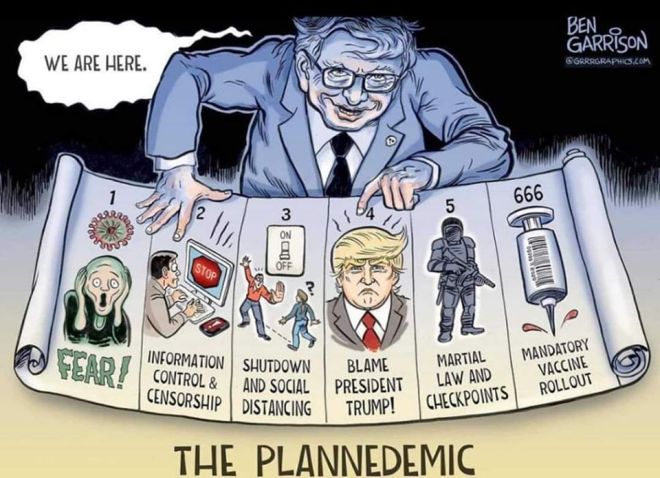
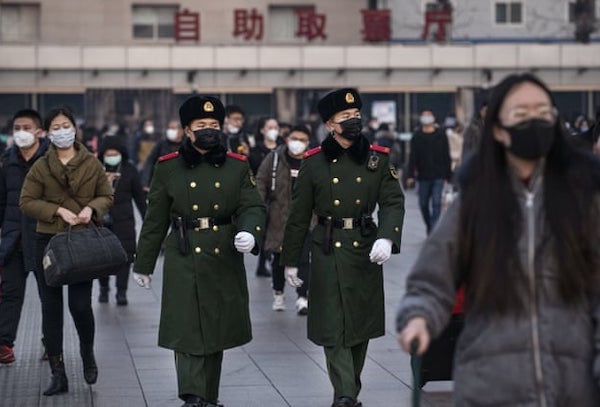 According to a new breaking news report from Politico, China is once again implementing mass quarantines to combat the coronavirus outbreak after their initial quarantine failed.
 Johnny Liberty, Editor’s Note: While it’s true both Russia and China have their own agendas so does the Unites States. The coronavirus has taken the world by storm, with nation states unprepared for the consequences of such a globally disruptive event. Whether the coronavirus was engineered in a bioweapons laboratory and accidentally released is of less consequence than the social and economic blowback which will be felt worldwide. If the truth ever be told (which unlikely it ever will be), unscrupulous propaganda agents from any country are not serving the best interests of humanity to protect themselves against the onslaught of this lethal virus.
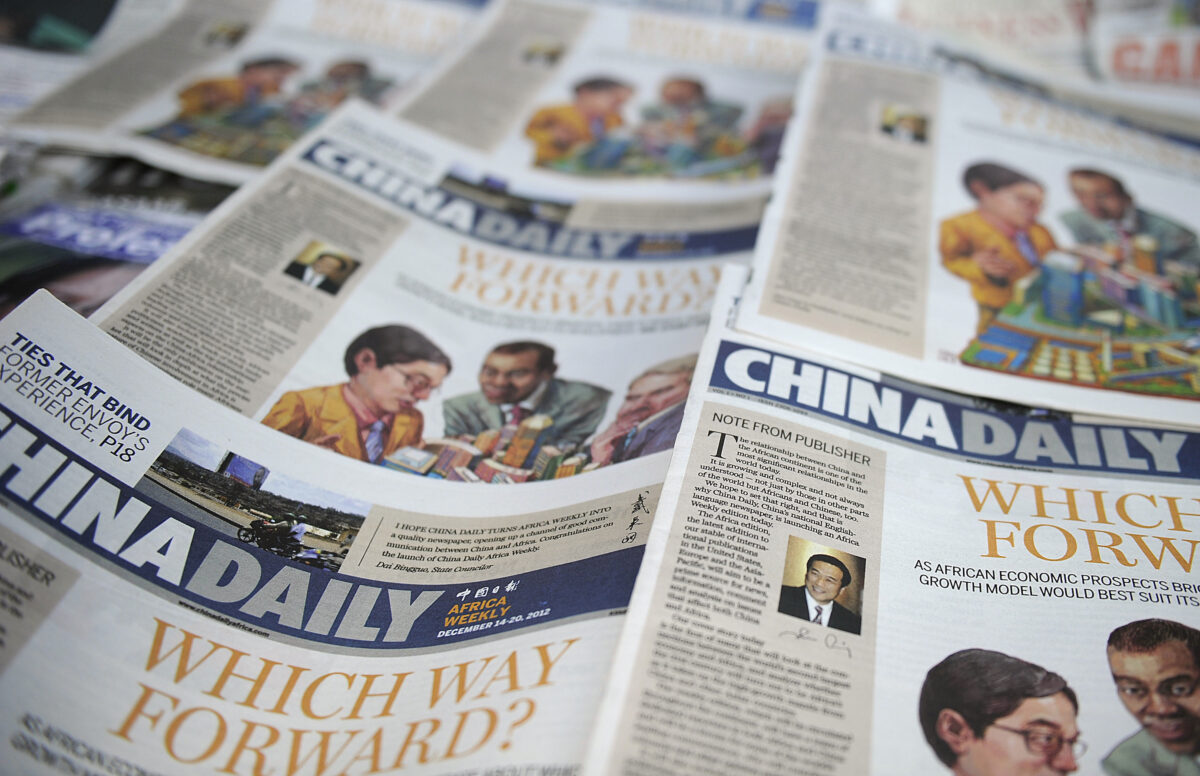

 By Ben Norton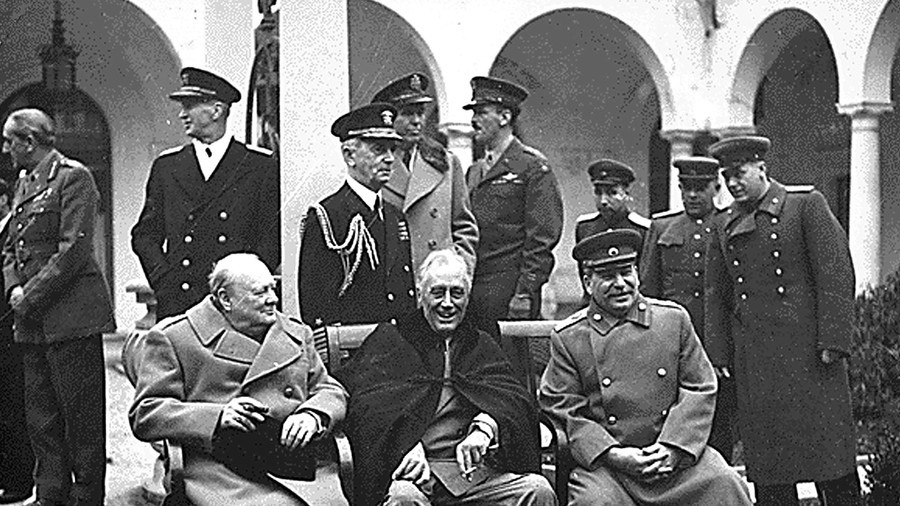


 By Jake Anderson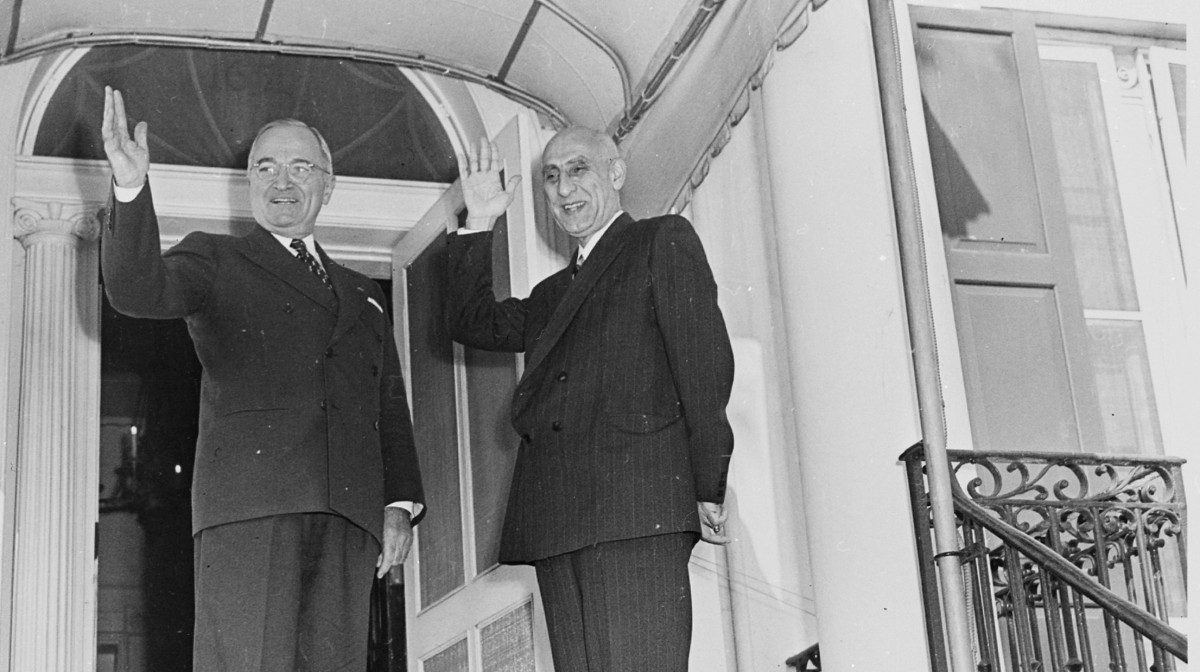
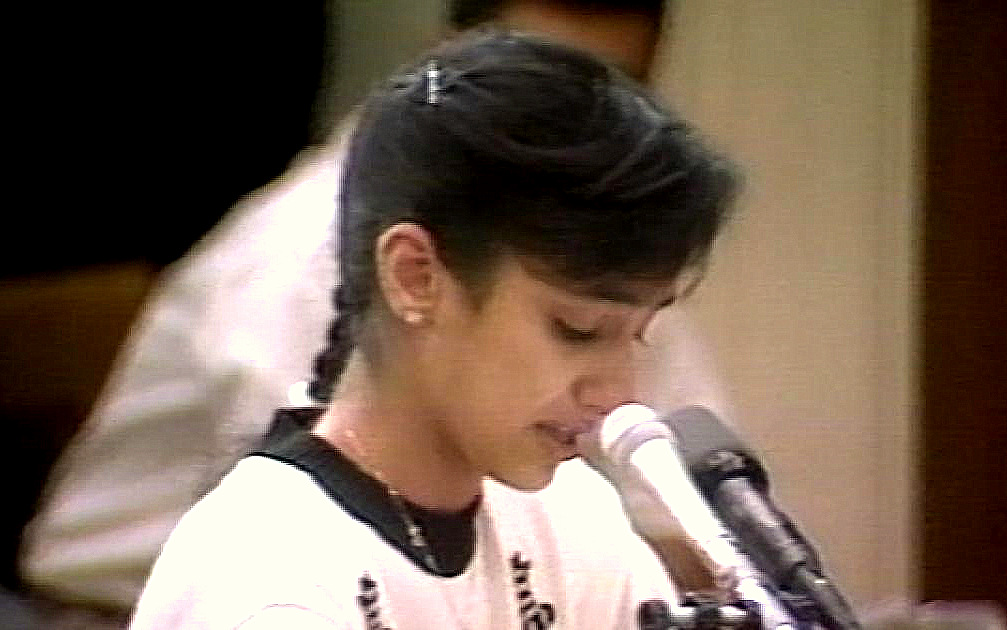

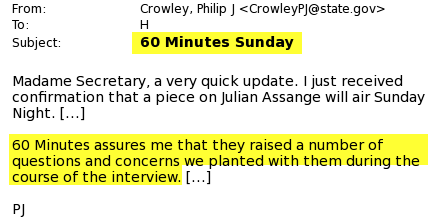
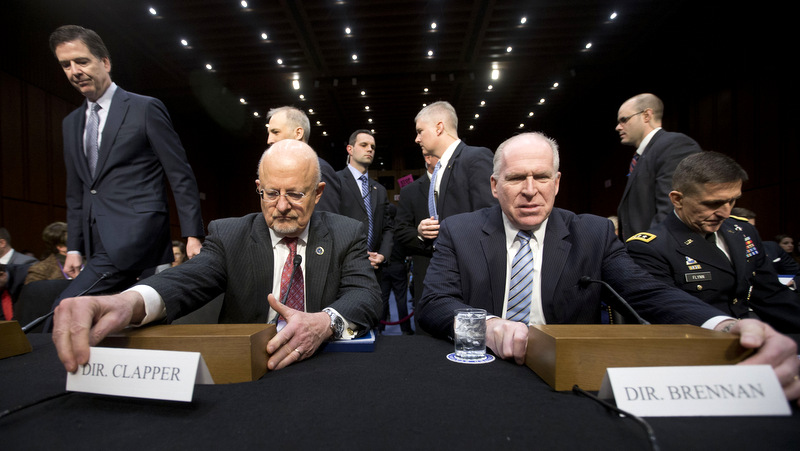
 By Gary Bentley
 Liberty International News