5 Minute Speech that Got Judge Napolitano Fired from Fox News | YouTube

Asking questions as Judge Andrew Napolitano did in a recent broadcast on his now cancelled daily show may very well be the reason behind his recent dismissal from Fox. Though specific details are hard to come by because the Judge has yet to give any interviews on the matter, it’s believed that his refusal to bow to commonly manufactured media narratives is among one of several key reasons he is no longer with the network.

The following 5-Minute Speech that Got Napolitano Fired from Fox News is one that should not only be forwarded and shared with every single man, woman and child in this country, but taught and expounded upon in every social studies, civics and government class from first grade through college.

Source: YouTube

King Dayne Aipoalani’s Story May Convince You That Hawaii Belongs To The Hawaiians | Business Insider

By Robert Johnson

The circumstances by which Hawaii was annexed by the U.S. are so sketchy that Congress felt obliged to issue an apology in 1993.

It all started 100 years earlier when a group of mostly American businessmen led a paramilitary coup to overthrow Queen Liliʻuokalani. They were passively supported by U.S. Marines who were deployed “to protect American lives and property.”

The coup resulted in a new Hawaiian government under the presidency of Sanford Dole, whose cousin would soon start the Hawaiian Pineapple Company, which became Dole Foods.

Although then-U.S. president Grover Cleveland criticized the events in Hawaii, which he had not authorized, his successor, William McKinley, had no problem annexing Hawaii in 1898.

With a history like this, it is not surprising that a Hawaiian sovereignty movement remains committed to reclaiming rights and land for native Hawaiians. While several contenders claim rights to the crown, Dayne Aipoalani of The Polynesian Kingdom of Atooi has taken the movement to regain his peoples’ rights and land in Hawaii to a whole new level.

Business Insider spent more than a week in Hawaii with Aipoalani , also known as Ali`i Nui Aleka Aipoalani. He guided us through his kingdom on two islands, explained what his plans were, and how he plans to fight Washington.

  • King Kamehameha III divided Hawaii among the monarchy’s lesser kings, chiefs, and commoners in the mid-19th century to make sure his people would always have a home in case of invasion.
  • King Kamehameha’s worst fears were confirmed decades later when a coup led by foreign businessmen and supported by the U.S. overthrew his descendant, Queen Liliuokalani, in January 1893.
  • Sanford Dole, who’d pushed for the overthrow, was put in charge of a provisional government, and Liliuokalani was imprisoned. In 1898, Hawaii was annexed by the U.S.
  • Like most Hawaiians, Dayne Gonsalves believes his homelands were taken illegally. He wants to restore Crown Lands to the monarchy under one king: himself.
  • Dayne says he is the great-great-great-grandson of King Kamehameha I and as the new Ali’i Nui, or King, of The Polynesian Kingdom of Atooi, he’s devoting his life to reclaiming the land and resources of his people.
  • To fund travel and diplomacy among islands throughout the South Pacific, Dayne relies on donations from supporters including more than 40,000 Atooi Kingdom citizens worldwide.
  • That money also helps buy U.N.-recognized drivers license and, soon, passport software and supplies. Atooi Federal Marshal Samson Kama says: “Local law enforcement is targeting us with traffic stops and arrests for false credentials. This goes against the U.N. mandate that allows us Native Rights through international law.”
  • The Atooi Kingdom also unveiled its new currency at the U.N. in May.
  • In addition, Atooi has law enforcement badges.
  • More than 100 Federal Marshals.
  • Official license plates.
  • A radio station to broadcast its message.
  • A former U.S. Navy pilot who serves as foreign ambassador.
  • And its own royal flag, which is prevalent throughout the Islands.
  • The Kingdom encompasses an array of Pacific islands, but its capital might be considered Kauai. This is where Dayne grew up and is raising his family in the largely native community of Waimea.
  • Waimea is “Ground Zero” in the fight against the largest agribusinesses in the world, which test and develop herbicides and pesticides in the area.
  • More than anything, The Atooi Kingdom wants indigenous and sustainable farms for its people.
  • Along with producing its own food, Dayne wants to clean up damage already done to the environment.
  • And provide a traditional healing clinic to all islanders, including the hundreds of homeless who live here in Oahu’s massive homeless camp.
  • The King would also place buffer zones around native schools (like this one) within 500 feet of experimental pesticide fields and genetically modified crops, where undisclosed chemicals are sprayed.
  • Waimea schools have twice been evacuated following pesticide applications at adjoining fields. Many believe the sickness among staff and students during these times are from the chemicals, though follow-up studies point a finger at the local stinkweed plant.
  • Many of the world’s largest agricultural giants moved to Kauai in the 1990s. Since then, locals have been demanding to know what chemicals are sprayed on their land, but they are still fighting through the courts for answers.
  • It’s a constant battle and it doesn’t stop there. When Business Insider was in Kauai, Dayne brought us to a sacred spot that had been bulldozed by local transportation crews.
  • Plowing under sacred sites is just one instance of ongoing land conflicts here on Hawaii between natives and local government.
  • Even at Iolani Palace, the last family home of the Hawaiian Royal Family, Dayne’s mission isn’t received with much warmth.
  • The native guide took issue with the Kingdom’s new currency. Since there are many Hawaiian Sovereignty groups claiming rights to the throne, conflict among native Hawaiians is common.
  • Even here, where the Queen was placed under house arrest, Dayne is told he can’t be video interviewed. He shows the guard his badge.
  • But the palace employee remained unimpressed.
  • It’s an ongoing and emotional struggle.
  • Dayne knows he has a long fight ahead of him. Native Hawaiians have the third-highest cancer rate in the country, extremely high rates of diabetes and incidents of infectious diseases — but there is hope.
  • Though the Atooi Nation is a recognized sovereign nation at the U.N., it is not listed as a Non-Self-Governing Territory, which is the U.N. category for countries that should be decolonized. That list includes, among others, American Samoa, Guam, and the U.S. Virgin Islands.
  • After a 30-year fight, French Polynesia recently made the U.N.’s Non-Self-Governing Territory list. Atooi wants to obtain the same status.
  • In the meantime native Hawaiians will carve out an existence wherever they can.
  • As bad as it is for most islanders, it’s even worse for some.

Source: Business Insider


Sedgwick, Maine is first town to declare total food sovereignty, opposing state and federal laws | NaturalNews

By  J.D. Hayes

There is a food revolution taking hold all over America, whether it is in the form of demanding labeling of GM foods, the right to produce and sell raw milk and other commodities, or – in the case of Sedgwick, Maine – declaring all local food transactions of any kind free and legal.

According to the website FoodRenegade.com, Sedgwick is the first city in the U.S. to free itself from the constraints of federal and state food regulation. Published reports say the town has passed an ordinance that gives its citizens the right “to produce, sell, purchase, and consume local foods of their choosing,” regulations be damned. The ordinance includes raw milk, meats that are slaughtered locally, all produce and just about anything else you might imagine.

And what’s more, three additional towns in Maine are expected to take up similar ordinances soon, said the FoodRenegade.com.

Gee – good, ol’ fashioned buyer-seller agreements?

Observers of the Sedgwick ordinance say it is much more than just “statement” legislation. Writes blogger David Grumpert, at TheCompletePatient.com:

This isn’t just a declaration of preference. The proposed warrant added, “It shall be unlawful for any law or regulation adopted by the state or federal government to interfere with the rights recognized by this Ordinance.” In other words, no state licensing requirements prohibiting certain farms from selling dairy products or producing their own chickens for sale to other citizens in the town.

What about potential legal liability and state or federal inspections? It’s all up to the seller and buyer to negotiate. “Patrons purchasing food for home consumption may enter into private agreements with those producers or processors of local foods to waive any liability for the consumption of that food. Producers or processors of local foods shall be exempt from licensure and inspection requirements for that food as long as those agreements are in effect.” Imagine that-buyer and seller can agree to cut out the lawyers. That’s almost un-American, isn’t it?

According to Deborah Evans, a Sedgwick citizen, the ordinance further states:

  1. Producers or processors of local foods in the Town of Sedgwick are exempt from licensure and inspection provided that the transaction is only between the producer or processor and a patron when the food is sold for home consumption.
  2. Producers or processors of local foods in the Town of Sedgwick are exempt from licensure and inspection provided that the products are prepared for, consumed or sold at a community social event.

For those questioning the legality of the ordinance – as in, it obviously circumvents state and federal food laws – she notes:

[W]e the radicals who concocted this mutinous act of infamy believe that according to the Home Rule provisions of our State Constitution, the citizens of Sedgwick have the right to enact an ordinance that is “local and municipal in character.”

‘It’s about time’

Many of the local farmers say the ordinance is just what is needed.

“This ordinance creates favorable conditions for beginning farmers and cottage-scale food processors to try out new products, and to make the most of each season’s bounty,” farmer Bob St. Peter told the website FoodFreedom.com. “My family is already working on some ideas we can do from home to help pay the bills and get our farm going.”

“Tears of joy welled in my eyes as my town voted to adopt this ordinance,” said Sedgwick resident and local farm patron Mia Strong. “I am so proud of my community. They made a stand for local food and our fundamental rights as citizens to choose that food.”

St. Peter, who is a board member of the National Family Farm Council, a food freedom advocacy group, notes that small farmers have a much tougher row to hoe, especially in today’s economy, so they need the ability to sell their products more freely.

“It’s tough making a go of it in rural America,” he said. “Rural working people have always had to do a little of this and a little of that to make ends meet. But up until the last couple generations, we didn’t need a special license or new facility each time we wanted to sell something to our neighbors. Small farmers and producers have been getting squeezed out in the name of food safety, yet it’s the industrial food that is causing food borne illness, not us.”

Sources:
http://www.foodrenegade.com/maine-town-declares-food-sovereignty/
http://www.thecompletepatient.com
http://foodfreedom.wordpress.com
http://www.nffc.net

Vision for a New America & The Taboo of Sovereignty with Johnny Liberty | Austin, Texas


Author, musician, producer, entrepreneur, community organizer, renaissance man & visionary Johnny Light is making a rare public appearance during his two-week “Spring 2012 Lecture Tour” from Austin, Texas, to Detroit, Michigan and as a participant at the Health Freedom Expo near Chicago, Illinois.

Mr. Liberty has lectured in many topic areas including individual sovereignty, freedom and liberty, history, law, economics, money and the nature of global power structures. He authored the best–selling “Global Sovereign’s Handbook” and nine other books, produced two audio courses and a film entitled “The Taboo of Sovereignty, Money, Love & Power.”

As a consequence of the apparently controversial notion that all people are born sovereign and free in America and the world, Mr. Liberty spent two years in federal prison, falsely convicted, and understands the legal system from the inside out.

Come out to Brave New Books and listen to Mr. Liberty’s prophetic wisdom re: collapse of the debt-based economic system, the rise of fascism in America, his unique perspective on modern culture, history, political foolishness, humorous anecdotes and the immortal wisdom of the ages!

Indian Reservations as Sovereign Nations | Native Heritage Project

NativeHeritageProject

Did you know that Indian reservations are independent nations?  Indian Nations are allowed, within limits to govern themselves.  Many have their own police forces and courts.

Tribal sovereignty in the United States refers to the inherent authority of indigenous tribes to govern themselves within the borders of the United States of America. The federal government recognizes tribal nations as “domestic dependent nations” and has established a number of laws attempting to clarify the relationship between the federal, state, and tribal governments. The Constitution and later federal laws grant local sovereignty to tribal nations, yet do not grant full sovereignty equivalent to foreign nations, hence the term “domestic dependent nations”.

However, in times of war, all men, including Indians have to register.  In WWI, this caused some consternation.  Each registrar had to record the county name in which the registrant registered.  If they registered on an Indian Reservation, even if the reservation was located within a county, the reservation itself was not part of the county, as it is considered a separate Nation.

TribalLandsThis bureaucratic anomaly became apparent in New York in states East of the Mississippi.  In New York, Indians who registered on the reservation are listed in our old friend, Miscellaneous County.  In other places, Miscellaneous is a sign that someone is either hospitalized, institutionalized or returned a late registration after the county office had closed.  In this case, it’s not necessarily a sign of any of those things, but each return has to be looked at individually to determine the individual circumstance.  Just as I was about to decide that all New York entrants in Miscellaneous County were Reservation Indians, I found one who lived on a reservation, followed by someone of the same name, also an Indian, in prison.  No assumptions allowed.

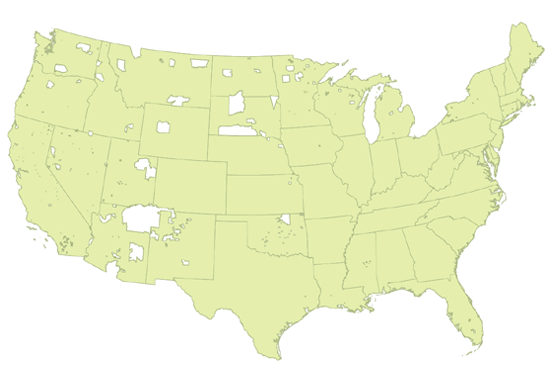
This map is a very different map of the US.  It’s a map of the US minus the sovereign Indian nations within the continental US.  Sort of looks like Swiss Cheese doesn’t it.  Some of these areas are much larger than one might expect.

Source: Native Heritage Project

Johnny Liberty’s “Vision for a New America” (videos) | YouTube

Here’s a series of videos from a recent lecture “Vision for a New America” in Austin, Texas…covering a five-point agenda including: 1) reclaiming personal sovereignty and internal authority over your life; 2) demanding accountability in government and limiting local, state and federal government to no more than 10% of GNP; 3) restoring a sound, debt-free monetary system; 4) building a renewable energy infrastructure; and 5) building a global network of community-based resource centers.

Fresh Violence Rages in Libya | Al Jazerra

Libyan forces loyal to Muammar Gaddafi are waging a bloody operation to keep him in power, with residents reporting gunfire in parts of the capital Tripoli and other cities, while other citizens, including the country’s former ambassador to India, are saying that warplanes were used to “bomb” protesters.

A Palestinian student holds up a placard displaying the Libyan flag flanked by the Tunisian (left) and Egyptian (right) flags during a protest against Libyan leader Moamer Kadhafi in Gaza City on Tuesday. (AFP/Mahmud Hams) Nearly 300 people are reported to have been killed in continuing violence in the capital and across the north African country as demonstrations enter their second week.

Navi Pillay, the UN high commissioner for human rights, has warned that the widespread attacks against civilians “amount to crimes against humanity”, and called for an international investigation in possible human rights violations.

Witnesses in Tripoli told Al Jazeera that fighter jets had bombed portions of the city in fresh attacks on Monday night. The bombing focused on ammunition depots and control centres around the capital.

Helicopter gunships were also used, they said, to fire on the streets in order to scare demonstrators away.

Several witnesses said that “mercenaries” were firing on civilians in the city, while pro-Gaddafi forces warned people not to leave their homes via loudspeakers mounted on cars.

Residents of the Tajura neighbourhood, east of Tripoli, said that dead bodies are still lying on the streets from earlier violence. At least 61 people were killed in the capital on Monday, witnesses told Al Jazeeera. Read more…

After Weeks of Revolution, ‘Day of Cleaning’ in Cairo | AOL News

At the epicenter of the protest that brought down the three-decade regime of Egyptian President Hosni Mubarak, young men and women took to the streets again today — only this time, with a different agenda. Armed with brooms, gloves and trash bags, they launched a massive cleanup following 18 straight days of unrest that debilitated the country.

“We’re taking care of the square, and then we’ll clean up the whole country,” Mohammed El Tayeb said while standing amid the volunteer cleaning crews sweeping up Tahrir Square. “This is a beautiful country. Now it’s ours and we’re going to take care of it.”

Across the crowded square, young men walked with paper signs taped to their chests that read: “Sorry for the disturbance, we’re building Egypt.” After days of protests that had such names as the “Day of Rage” and “Day of Millions,” today’s gathering was called the “Day of Cleaning.” A new era has dawned upon the country of 80 million. Read more…

U.S. Military Intervention in Egypt: A Chapter in America’s Saudi Arabian End-Game | Collapse.net

By Dale G. Sinner

US military intervention in Egypt is prompting speculation over motives. Extraction of American citizens is the stated objective, but does evacuating the American expat community in Egypt warrant the flotilla of US warships recently positioned in the Suez Canal?  Does evacuating this expat community warrant the helicopters, Special Forces squads, and 2,200 Marines aboard those ships?  Here in the land of endless budget cuts, the obvious answer is “doubtful”.

While protests flare across North Africa, why would the US stir up already seething anti-American sentiment in the region with such a move?  Could today’s intervention lead to a long-term, “stabilizing” US presence in Egypt? Or could these events presage something far greater?  What of Egypt’s neighbor to the East – Saudi Arabia – home to a quarter of world oil reserves?

Egyptian President Hosni Mubarak is clearly defying US pressure to step down from an office he’s held for nearly 30 years.  Continued port strikes and unrest threaten vital ship traffic along the Suez Canal, and the likelihood of imminent military extraction of American citizens may present a tantalizing opportunity for oil elites to close the circle around the Arabian peninsula and place a major US force presence in Egypt – a presence with a potentially ominous goal: the eventual destabilization and Balkanization of the Arabian peninsula.

The Saudi royals are clearly opposed to US intervention in Egypt.  See here, here, and here.  This opinion regarding US meddling is understandable, as even the slightest provocation could spark similar civilian revolt on the Saudi side of the Red Sea.

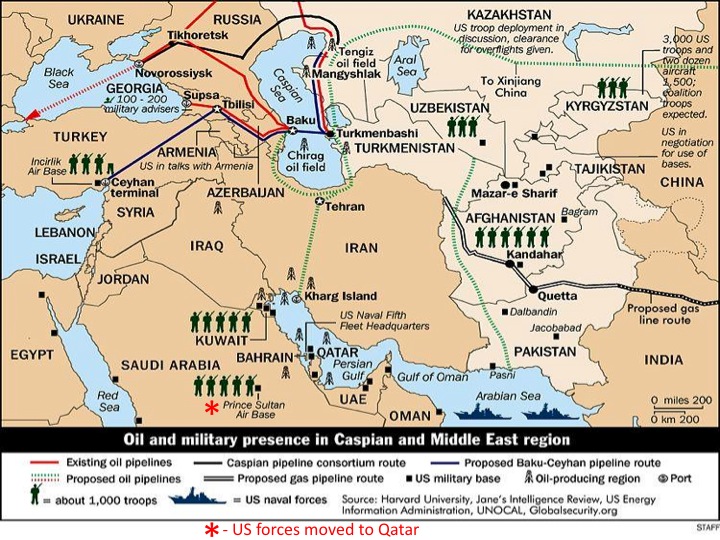
US forces were evicted from Saudi Arabia in mid-2003 and relocated to neighboring Qatar, but material and troop strength in US CENTCOM’s theatre of operations – including the permanent US “mega bases” in Iraq, might suggest a more lucrative alternative to Iran as the central target of US military strategic planning (see map below). Read more...