OOKLA 5G Map

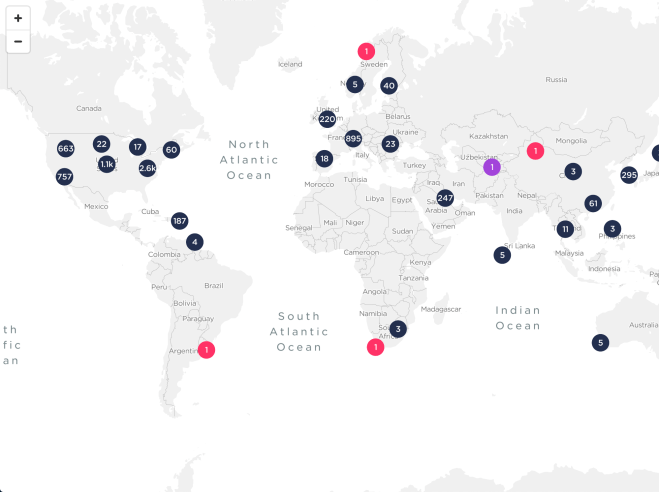
Screen Shot 2020-04-22 at 7.40.07 AMThe interactive Ookla 5G Map tracks 5G rollouts in cities across the globe. Updated weekly from verified public sources and Ookla data, you can follow operators’ newest 5G networks on @Ookla5GMap. Click above graphic to go to the interactive map…

Source: Speedtest

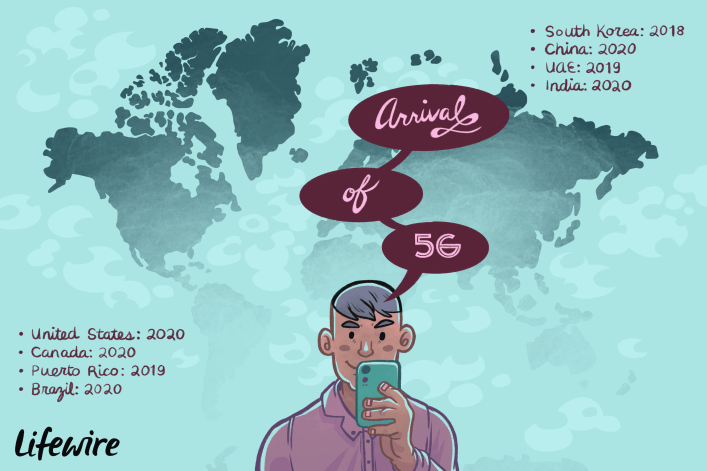
Most countries already have limited access to 5G networks | Lifewire

5g-availability-world-4156244_FINAL-dd0bf32187b74d6f94ed30f8aa8d4736
By Tim Fisher

5G is the newest wireless networking technology that phones, smartwatches, cars, and other mobile devices, and who knows what else, will use in the coming years, but it won’t be available in every country at the same time.

Some estimates forecast that by 2023, 5G will support more than 10 percent of the world’s mobile connections. For daily updates on how 5G is developing around the globe, see 5G: The Latest News & Updates. Also check out which 5G phones are available right now and when others are coming.

North America 5G

North Americans have already seen smaller iterations of 5G networks pop up, but it’s only just now, in 2020, taking off in most areas due to the elemental challenges of 5G networks. Estimates say that by 2023, up to 32 percent of North American mobile connections will be on a 5G network.

UNITED STATES

5G fixed wireless broadband internet from Verizon, C Spire, and Starry is currently available at a handful of locations, and Verizon, AT&T, Sprint, and T-Mobile have mobile 5G services available in various cities. More areas will get at-home and mobile 5G this year, from those companies and others like U.S. Cellular.

CANADA

Rogers Communications began rolling out a 5G network in early 2020 after investing over $4 billion USD on 5G in 2019. They also made a 5G test site on campus at the University of British Columbia. Learn more about the plans Rogers has for 5G to see when they expect a live network around the country.

Canada’s Telus Mobility has given 2020 as the year 5G is available to its customers, but explains that people in the Vancouver area can expect early access.

MEXICO

In late 2017, the Mexican telecommunications company América Móvilannounced the release of 4.5 networks in anticipation of a 5G release.

Its CEO says 5G should be available sometime in 2020 depending on the technology that’s available at that time.

PUERTO RICO

Wireless provider Claro began testing 5G in Puerto Rico in 2019.

Central America 5G

Central American countries will most likely see a slow 5G rollout.

HONDURAS

Ericsson announced in December 2018, that Tigo had chosen the company to modernize its radio access network. The deal “includes the provision of a 5G-ready multi-standard network.

There’s no word on when 5G will reach Honduras but this agreement is an important first step.

South America 5G

South American countries with the greatest populations began to see 5G come out in spurts beginning in late 2019.

CHILE

Entel is the largest telecommunications company in Chile and has partnered with Ericsson to bring 5G wireless service to Chilean customers.

ARGENTINA

Movistar and Ericsson tested 5G systems in 2017 and will likely roll it out to customers around the same time that Chile sees 5G.

BRAZIL

After having signed an agreement to help develop and deploy the technology, we expect Brazil to usher in 5G service starting sometime in 2020.

This time range is also supported by Qualcomm director Helio Oyama, who has stated that 5G will most likely hit Brazil a few years after it’s commercially available elsewhere in 2020.

COLOMBIA

Telefónica Telecom, Colombia’s largest telecommunications company, will likely have 5G services available for customers in 2020.

In July 2018, Ericsson and Telefónica Telecom demonstrated a 5G data transfer of 27 Gbps in Bogotá.

PARAGUAY

Telecommunications company Tigo reached a deal with Ericsson to prepare their network for 5G. Ericsson said in December 2018, that they will “expand TIGO’s existing network and modernize the existing 2G/3G and 4G sites, making the network the best fit for TIGO to deliver 5G and IoT services in the future.

It’s not yet clear when Tigo customers will see 5G in Paraguay, but this deal is definitely a good starting point.

ARUBA

SETAR is Aruba’s leading communications provider, and through a partnership with Nokia, the two expect full coverage on the island by 2022.

Asia 5G

5G is live in a handful of areas, with widespread coverage expected this year.

SOUTH KOREA

These three South Korean companies collaborated to bring mobile 5G to the country on December 1, 2018: SK Telecom, LG Uplus, and KT. They began with 5G service for select businesses only, but on April 5, opened up 5G for others, too, via the Samsung Galaxy S10 5G.

The SK Telecom service provider started offering 5G service to a wide population on April 5 via their four 5G plans. This came after the company started a limited 5G service with the Myunghwa Industry manufacturing company. SKT’s 5G service plans come after trialing 5G in 2017 and using 5G in their self-driving test site K-City.

LG Uplus’ 5G network went live in Seoul and surrounding locations, with LS Mtron as their first customer. With over 4,000 5G base stations positioned in Incheon, Seoul, and Gyeonggi, the company planned over 7,000 more to be deployed by the end of 2018.

KT Corporation launched pre-commercial 5G services at Lotte World Tower in Seoul and six other areas including Jeju, Ulleungdo, and Dokdo. On April 5, the company launched unlimited 5G services called KT 5G Super Plans, and expanded coverage in Korea to a total of 85 cities by the end of 2019.

KT previously collaborated with Intel to showcase 5G service at the 2018 Olympic Winter Games in PyeongChang, and plans to invest over $20 billionthrough 2023 in 5G and other innovative technologies.

According to the ICT and Broadcasting Technology Policy director at the Ministry of Science and ICT, Heo Won-seok, five percent of the country’s mobile users will be on a 5G network in 2020, and 90 percent by 2026.

JAPAN

NTT DOCOMO is Japan’s largest wireless carrier. They’ve been studying and experimenting with 5G since 2010 and launched pre-commercial 5G services in September 2019 before officially starting 5G services on March 25, 2020.

The 5G service launched with a maximum data rate of 3.4 Gbps that will increase to 4.1 Gbps in June 2020. See the NTT DOCOMO 5G smartphone pagefor device options.

In September 2018, NTT DOCOMO successfully achieved 25–27 Gbps download speeds in a 5G trial with Mitsubishi Electric. The test could be used to develop a high-speed 5G network that works with vehicles.

KDDI and Rakuten are providing 5G services in 2020 as well. KDDI’s 5G network launched on March 26.

SoftBank began its 5G services on March 27 for 1,000 yen /month ($9 USD).

CHINA

Three wireless carriers launched 5G in China on October 31, 2019: China Mobile, China Telecom, and China Unicom.

However, these companies don’t provide widespread 5G coverage just yet. The most popular areas with 5G in China right now include Beijing, Shanghai, and Shenzhen.

3 Hong Kong launched 5G on April 1, 2020. According to the press release, 5G is expected to cover indoor and outdoor areas in all districts in Hong Kong within 2020.

SmarTone is another company looking into serving 5G in China.

QATAR

According to Ooredoo, a telecom company in Qatar that has been working on implementing 5G since 2016, they were the first company in the world to provide commercial 5G access.

5G is currently only available in Qatar, but since Ooredoo has markets in Iraq, Oman, Palestine, Maldives, Singapore, Algeria, and other countries, it isn’t a stretch to think that we’ll see 5G reach those areas in 2020.

Ooredoo, in partnership with Ericsson, will also use 5G for home broadband service.

Vodafone is another company providing 5G in Qatar. In late 2018, the company launched a 5G network in Katara Cultural Village and Souq Waqif, and before that, in Abu Hamour, Azizya, Al Mamoura, Al Rayyan, Salwa Road, and Umm Salal Mohammed. Vodafone Qatar offers unlimited 5G plans and a handful of 5G phones.

KUWAIT

Two telecommunication companies in Kuwait have launched 5G service.

Zain was the first, announcing the 5G launch in June 2018. You can sign up herefor a 500 GB, 1 TB, 2 TB, or 4 TB plan. Currently, the only device you can use on Zain’s 5G network in Kuwait is the 5G Bolt router, for home broadband internet.

On the same day, just hours later, Ooredoo announced similar news. The 5G plans available from Ooredoo include a 500 GB 45 KWD /month plan and a 1 TB 65 KWD /month plan.

STC (formerly called VIVA) is another telecom company in Kuwait that has launched 5G services. See the 5G coverage map on their website for details.

STC launched a 5G Innovation Center that was created to “explore, develop, and launch new 5G use cases in Kuwait by 2019.” As of February 2019, they had over 1,000 5G NR sites ready to go, and will roll out nationwide 5G services in partnership with Huawei.

UNITED ARAB EMIRATES

UAE 5G became available via Etisalat UAE on May 30, 2019. There are several 5G phones available for purchase.

In early 2019, Etisalat UAE reached a deal with Huawei to “offer its latest state of the art network solutions including 5G wireless, 5G service oriented core and 5G ready transport network to facilitate smooth 5G technology adaption.” Etisalat UAE also selected Ericsson to deploy a 5G network in the United Arab Emirates, both mobile broadband and fixed wireless access.

5G is also coming to the United Arab Emirates from du. Officially called EITC, or Emirates Integrated Telecommunications Company, they announced in early 2019 the rollout of 700 5G sites. Their partners include Nokia and Huawei.

Virgin Mobile is another 5G-ready company deploying this next-gen network across the UAE. See which 5G phones Virgin Mobile has available.

INDIA

The Telecom Regulatory Authority of India released this PDF in late 2017 that outlines the 5G standard draft and shows a timeframe for when 5G should be deployed around the world.

According to Manoj Sinha, the minister of the Department of Telecommunications, India is set to adopt 5G this year: “When the world will roll out 5G in 2020, I believe India will be at par with them.”

On top of that, in August 2018, one of India’s largest telecom providers, Vodafone Idea Limited (previously called Idea Cellular), merged with Vodafone (which was the world’s second-largest phone company before the merger). Vodafone was already preparing for 5G, having set up “future ready technology” in 2017 by upgrading their entire radio network to support 5G.

Reliance Jio is another mobile network operator in India that plans to provide 5G services in 2020, as well as their own 5G handsets.

Another Indian telecom company working on 5G is Bharat Sanchar Nigam Limited (BSNL). They signed a memorandum of understanding with Ciena, a networking systems company, in early 2019 to prepare its network for 5G.

A 5G test network is being erected in 2020 from Cavil Wireless.

INDONESIA

Anyone who attended the Asian Games in 2018 could have tried out 5G in Jakarta, Indonesia. A special Telkomsel SIM card was needed in order to connect to the network.

It’s unclear whether Indonesia will see commercial 5G begin to roll out in 2020 or later, but a trial of this size was a great indicator that they’re on a track of some sort. Plus, the company has partnered with Ericsson to upgrade their network in preparation for 5G.

TURKEY

Turkcell is Turkey’s largest mobile phone operator. In early 2017, the company completed a 24.7 Gb/s 5G trial with Ericsson, and in September of 2018 announced an agreement with Nokia to develop 5G technologies.

In November, the company trialed 5G fixed wireless access solutions with Samsung in Istanbul. Turkcell’s CEO commented that “Today, with 5G, we have shown that the latest generation of high-speed wireless access is now possible for our customers. Our goal is clear: to make Turkey one of the first countries in the world with 5G technology.”

In early 2019, the Information and Communication Technologies Authority (BTK) in Turkey approved 5G trials in Istanbul, Izmir, and Ankara. The companies involved include Turkcell, Vodafone Turkey, and TT Mobil.

Turk Telekom is another company looking into bringing 5G to Turkey. In September 2019, the CEO said that the company is the “most ready operator for 5G in terms of fiber infrastructure prevalence.”

It’s clear that Turkcell is on the right path to providing Turkey with 5G, but it’s unclear when, exactly, customers can expect a live network.

VIETNAM

Vietnam will see 5G in 2020. According to the country’s state-owned and largest telecom company, Viettel, 5G trials were run in 2019 and they plan to have a network ready in June of 2020.

Mobifone is another mobile network operator that plans to launch 5G in Vietnam by June, 2020.

IRAN

There are a few mobile network operators in Iran, the largest of which is Mobile Telecommunication Company of Iran (MCI). MCI currently offers “4.5G” internet, which shows that they’re on a path to providing 5G in Iran. They also signed an agreement with Nokia in 2017 to develop 5G technology in Iran.

Iran’s second-largest provider, Irancell, provides both mobile and fixed wireless internet services. In late 2017, in collaboration with Ericsson, the two performed their first 5G test in Tehran and said that 5G will be available in Iran in 2020.

THAILAND

Advanced Info Service (AIS), the country’s largest mobile phone operator, will launch 5G in Thailand in 2020.

TAIWAN

Taiwan Star offers its customers a 5G upgrade experience that they can enroll in to take advantage of reduced prices once 5G rolls out in Taiwan.

SINGAPORE

StarHub announced in November 2018, that they, in partnership with Nokia, completed their first outdoor pilot of 5G on the 3.5 GHz frequency band. However, there’s no information on when StarHub will have a 5G network ready for Singaporean customers.

The IMDA (Info-communications Media Development Authority) is an organization of the Singaporean government that says a 5G network rollout will take place in 2020. There might even be two networks coming to Singapore since IMDA plans to allocate millimeter bands for 5G that “will be sufficient for at least two nationwide 5G networks.”

In fact, all four telcos might bring 5G to Singapore, including Singtel, M1, and TPG Telecom.

PHILIPPINES

The wireless communications company Smart has been testing 5G since 2016 and announced in June of 2018 the launch of 5G TehnoLab, their 5G innovation lab. Smart plans to have a 5G-ready network live for customers in 2020.

In November 2018, Smart rolled out their first 5G cell sites in the Philippines. They were set up in Makati Central Business District (Makati CBD) and at the Clark Freeport Zone in Pampanga.

In Smart’s 5G testing, they’ve managed to achieve speeds of over 14 Gb/s, and have completed a 5G-enabled video call.

Globe Telecom has a 5G fixed wireless broadband service called Globe At Home Air Fiber 5G, offering speeds up to 100 Mbps and data packages as large as 2 TB.

NOW Telecom is another company planning to deploy 5G in the Philippines.

PLDT is hoping to have a 5G network up and running before June 2020.

BANGLADESH

Although Bangladesh is one of the top 10 most populous countries in the world, it was very slow to roll out 4G and will likely also take much longer than other countries to implement 5G.

In early 2018, the country’s telecom regulator BTRC said that “The world will embrace 5G in 2020. So, we too will have to accept new technology and must move on to 5G. There is no option for procrastination.”

BTRC is expected to auction spectrum for 5G services before the end of 2020 to allow for widespread 5G coverage by 2026.

BTCL and Banglalink are two companies to watch for 5G in Bangladesh.

MALAYSIA

5G in Malaysia will likely start to be available in specific areas in 2020.

In early 2019, Maxis and Huawei and U Mobile and ZTE signed MoUs (memorandums of understanding) to collaborate on 5G deployment in Malaysia.

TM announced in late 2019 that they’d be participating in the 5G Demonstration Project to test new 5G features and learn how to best deploy 5G in Malaysia. They’ve tested using 5G for smart traffic lights, smart safety and security, and smart parking.

The Malaysian Communications and Multimedia Commission (MCMC) expects commercial deployment of 5G in Malaysia to take place by the third quarter of 2020.

PAKISTAN

5G might go live for consumers this year given that the Pakistan Telecommunication Authority prepared for public 5G trials in 2019.

Another tip that 5G is coming to Pakistan is that the country’s 4G pioneer Zongalso became the first company in the country to test 5G services in August 2019.

Telenor Pakistan is looking into bringing 5G to the country as well, but no dates have been released.

SAUDI ARABIA

5G has been available in Saudi Arabia through Saudi Telecom Company (STC)since June 2019, but only in specific areas of major cities and only through home routers (no mobile option, yet).

According to the company’s CEO:

5G is considered as a very important step toward digitalization and connecting everything, which supports Saudi Arabia’s Vision 2030 toward economic diversification.

The 5G release in Saudi Arabia took place months after the company reached a deal with Ericsson to launch 5G in the country. STC has also partnered with Nokia to roll out 5G in Saudi Arabia; they announced in early 2019 that the rollout phase had already started.

Another 5G provider in Saudi Arabia is Zain. Over 20 locations have 5G availability, including Riyadh, Al Khobar, Dhahran, Tabuk, Hail, Sabya, Ahad Rafidah, Taif, Bisha, Najran, and Jaizan; see a 5G coverage map here. The Samsung Galaxy Note10+ 5G and ZTE Axon 10 Pro 5G are Zain’s 5G products.

BAHRAIN

5G in Bahrain arrived in July 2019 when STC (previously called VIVA) launched their 5G data plans. You can get mobile 5G from STC with one of their 5G phones, or 5G at home with the 5G router. The service is available in areas like Reef Island, Amwaj Islands, and Riffa Views.

Batelco is another company bringing 5G to Bahrain, choosing Ericsson to provide the 5G equipment. Availability is limited to just a few areas as of right now: Amwaj Islands and Reef Island.

KAZAKHSTAN

5G in Kazakhstan isn’t coming as soon as other countries despite the fact that it’s the ninth-largest country in the world. However, according to Prime Minister Askar Mamin, 5G is definitely in sight, calling for an “Action Plan for the implementation of 5G in Kazakhstan.

Askar Mamin said in a meeting held in May 2019, that 5G is expected to cover all Kazakhstan settlements that have a population greater than 50 thousand people.

In October 2019, the VEON telecom company launched a 5G trial on a live network.

SRI LANKA

The country’s second-largest mobile network operator, Mobitel, invested $50 million USD in 2019 to roll out 5G in Sri Lanka.

Mobitel has been working on bringing 5G to Sri Lanka for years. In early 2017, they partnered with Ericsson with the signing of the 5G Island of Innovation Memorandum of Understanding (MoU) to bring 5G to Sri Lanka.

CAMBODIA

Service provider Smart Axiata will most likely be the first company to launch 5G in Cambodia. They were the first service provider to make 4G available in the country in 2014, and followed up in 2019 by showcasing the country’s first 5G live trial. The company expects the first few years of their 5G rollout in Cambodia to be focused on hotspots in major cities.

Viettel Cambodia (MetFone) is another company launching 5G service in Cambodia, in partnership with Telecom Cambodia.

Africa 5G

Vodacom Group, which was the first to introduce 4G, 3G, and 2G in South Africa, is at it again with the release of a 5G trial in Lesotho in August 2018. They showcased a fixed wireless access (FWA) network using a temporary license in the 3.5 GHz band.

Vodacom’s 5G network should launch this year through the use of Liquid Telecom, which will provide nationwide 5G wholesale services to the market in early 2020.

Rain is another South African telecom that’s rolling out 5G. From November 11, 2019 and onward, Rain customers can access the 5G network from home in parts of Johannesburg and Tshwane, with more areas becoming available throughout 2020. Check 5G coverage in South Africa with the Rain coverage map.

MTN Group Limited partnered with Ericsson in November 2018, to deploy a fixed wireless access 5G site in Midrand. Although MTN South African hasn’t announced a 5G release date, the trials and tests they’ve performed shows that they’re interested in developing 5G applications and might one day offer customers a 5G network.

NIGERIA

SENEGAL

Tigo Senegal and Ericsson are working together to upgrade its network to roll out LTE across 1,000 sites. While this isn’t 5G service, it is an important stepping stone.

EGYPT

Although a 5G release date for Egypt isn’t yet known, Telecom Egypt and Nokia agreed in early 2019 to introduce a 5G network.

MOROCCO

The telecom company Inwi, which covers over 90 percent of the country with mobile internet access, is bringing 5G to Morocco.

The two other licensed telecom companies in Morocco are Orange Morocco and Maroc Telecom, but both have been silent on a 5G deployment in the country.

DEMOCRATIC REPUBLIC OF THE CONGO

The release date for 5G in the Congo is unclear, but according to Léon Juste Ibombo, the country’s minister of Posts, Telecommunications and Digital Economy, we know that the 5G rollout will involve Applus and Congo Telecom:

Investments in Congo’s telecommunications sector are astronomical and the state needs credible companies to help it implement the digital economy ecosystem. This company will help our incumbent operator, Congo Telecom, to implement 5G.

TUNISIA

Ooredoo Tunisia has partnered with Nokia through the use of the company’s AirGile cloud-native core, to transition Ooredoo to a place where it can provide Tunisia customers with 5G.

KENYA

Safaricom will likely launch 5G in Nairobi in early 2020.

Europe 5G

5G networks are live right now in some European countries, and others will get 5G during 2020.

NORWAY

Telenor, the country’s biggest telecom operator, launched 5G in Norway in March, 2020, following early testing from 2017. These locations currently have access to the 5G network: Kongsberg, Elverum, Bodø, Askvoll, Fornebu, Kvitfjell, Longyearbyen and Spikersuppa in Oslo, and Trondheim.

Telia Company is another mobile network operator in Norway that opened its first 5G test network in December 2018. Their first trial partner was the Odeon movie theater in Oslo, marking the world’s first 5G cinema. Managing director of Telia Norway said in their December press release, “We are going to develop 5G-based solutions industry by industry, area by area.

Telia Norway also partnered with Norwegian ISP Get to launch a 5G pilot in a family home, complete with smart tech from Futurehome. Get’s product director said “This family is far ahead of the rest of us, with a home filled with clever things connected through 5G. It is something the rest of us will not experience for several years, but it’s really fun to see what we will get with the latest technology.

GERMANY

According to the 5G Strategy for Germany, released by Germany’s Federal Ministry of Transport and Digital Infrastructure (BMVI), trial installations began in 2018 with a commercial launch in 2020. 5G is planned to be rolled out “over the period to 2025.”

Deutsche Telekom rolled out 5G in Germany in Berlin, Darmstadt, Munich, Bonn, and Cologne in September 2019. Connectivity is possible through the Samsung Galaxy S10 5G, Samsung Galaxy Note10+ 5G, Huawei Mate 20 X 5G, and HTC 5G Hub. A total of at least 20 major German cities will have 5G by the end of 2020, and they plan to cover 90 percent of the country with 5G by 2025.

Another German telecom company that has launched 5G services in the country is Vodafone. They turned on their first 25 base stations on July 16, 2019, added Berlin a month later, and made it a goal to have 50 running before the end of August 2019. Customers can use 5G with the Huawei Mate 20 X 5G and Samsung Galaxy S10 5G.

Broadband telecom provider Telefónica Germany revealed in December 2018, that in collaboration with Nokia, they finished building their “Early 5G Innovation Cluster” in Berlin. It will be used to “test and measure the performance and coverage of first 5G services in a dense urban area.

German ISP United Internet AG is another potential 5G player, having announced in early 2019 that they’d be taking part in a 5G spectrum auction.

CZECH REPUBLIC

Vodafone will provide 5G services to customers in Karlovy Vary by July 2020. This will come a full year after the company tested a 5G holographic call in the same city.

UNITED KINGDOM

The UK’s largest network operator, EE, was the first to launch 5G in the UK on May 30, 2019. Service started in London, Cardiff, Edinburgh, Belfast, Birmingham, and Manchester, and the company now operates the 5G network in over 70 cities and towns.

EE was also the first in the world to offer the OnePlus 7 Pro 5G smartphone, but they also offer their customers the Samsung Galaxy S20 Ultra 5G, OPPO Reno 5G, LG V50 ThinQ, and other 5G phones. See their list of 5G phones for all of them.

Vodafone UK is another big mobile telecommunications provider in the UK. After testing how 5G can be used in car communications and successfully completing a holographic phone call using 5G, they launched their fifth-gen network in seven cities on July 3, bringing their total 5G coverage to 15 UK locations. The Vodafone 5G phones you can use on the network include the Samsung Galaxy S10 5G and Xiaomi Mi MIX 3 5G.

After announcing their commitment to invest billions in 5G, UK’s Three is another company that launched 5G in the UK, accessible first with Huawei’s 5G phone. After testing 5G for home use, the company also launched their 5G home broadband service on August 19 in London. Three has a list of everywhere you can get their mobile 5G in the UK.

BT Mobile launched 5G services in the UK on October 11, 2019, in 20 cities. See the 5G phones and plans you can get with BT Mobile.

O2 has a 5G network in the United Kingdom, too. It’s currently available in 20 locations, including London, Edinburgh, Cardiff, Belfast, Leeds, Slough, Leicester, Lisburn, Manchester, Birmingham, Glasgow, Liverpool, Newcastle, Bradford, Sheffield, Bristol, and other locations. There are several 5G phonesyou can use on the O2 5G network.

Tesco Mobile uses O2’s network and also began offering 5G to its customers in early 2020.

CityFibre and Arqiva are two more companies with 5G trials in London. They’re in the process of creating a “5G-ready network platform nationwide that will provide the best network at the best economics for Mobile Network Operators.”

ITALY

Vodafone launched 5G in Italy in these five cities in June 2019: Naples, Bologna, Milan, Turin, and Rome. The company plans to roll out 5G to 100 cities by 2021. There are several 5G phones you can buy through Vodafone’s website.

TIM (Telecom Italia), the largest telecom provider in Italy, made 5G available in Naples, Rome, and Turin as of July 5, 2019. Their 5G network went live in another six cities before the start of 2020: Milan, Bologna, Verona, Florence, Matera, and Bari. By 2021, 120 towns and cities will be covered with TIM’s 5G network.

Iliad, in partnership with Nokia, will deploy 5G across Italy.

SWITZERLAND

The first 5G network in Switzerland went live April 17, 2019, via Swisscom. It launched in 54 towns, including Basel, Bern, Chur, Davos, Geneva, Lausanne, and Zurich. According to Swisscom, more than 90 percent of the population is covered.

Swisscom currently offers the OPPO Reno 5G, LG V50 ThinQ 5G, and Samsung Galaxy S10 5G smartphones, but will have more available from other companies, such as Huawei, later in the year. These devices will work everywhere there’s 5G service from Swisscom, through their inOne mobile subscriptions.

The country’s second-largest telecommunications company, Sunrise, is also working to release 5G in Switzerland. They’ve already covered over 200 cities/villages with 5G, blanketing 80–98% of Dietikon, Bülach, Opfikon, Autafond, and other locations with 5G coverage. There’s a Sunrise 5G coverage map available, which also lists all the areas you can get Sunrise 5G service in Switzerland.

The company currently offers four 5G smartphones: Samsung Galaxy S10 5G, Samsung Galaxy Note10+ 5G, Huawei Mate 20 X 5G, and Xiaomi Mi MIX 3 5G. They also provide the HTC 5G Hub.

Sunrise ran an ultrafast, 3.28 Gbps 5G test in late 2017, erected their first 5G antenna in mid 2018, and then in November 2018, made live their first standardized 5G network at a ski resort.

Salt (formerly Orange Communications) is another telecom company planning 5G in Switzerland. They revealed in January 2019 that they selected Nokia to upgrade their radio and mobile core network to provide mobile 5G services.

SPAIN

Vodafone Spain was the first operator to launch 5G in Spain. On June 15, 5G became available to customers in these locations:

  • A Coruña
  • Barcelona
  • Bilbao
  • Gijón
  • Logroño
  • Madrid
  • Malaga
  • Pamplona
  • San Sebastian
  • Santander
  • Seville
  • Valencia
  • Vigo
  • Vitoria
  • Zaragoza

See if your specific address has 5G coverage with the Vodafone Mobile Coverage Map.

According to Vodafone, 5G speeds at launch can be up to 1 Gbps, but will increase to up to 2 Gbps before the end of the year. You need a 5G phone from Vodafone Spain to access the network.

After initially purchasing spectrum to implement 5G, Vodafone Spain launched 5G trials in various cities in June 2018, including Madrid, Valencia, Seville, and Barcelona. In late 2018, they installed a 5G network node in La Nave, Madrid, and in February 2019 used standards-based 5G phones to complete their first 5G video calls between Madrid and Barcelona.

Orange plans to launch 5G in Spain in 2020. The company revealed in early 2019 that they made their first 5G call using their next-gen network in Valencia and will continue testing the 5G technology in Seville, Vigo, Malaga, Barcelona, Bilbao, and other cities.

AUSTRIA

Network operator A1 kicked off their path toward 5G in Austria by making their first 5G data connection in Gmünd in early January 2019. See their 5G plans and phones here.

Magenta Telekom (previously called T-Mobile Austria) is deploying 5G mobile base stations across the country following a 110 MHz spectrum purchase in March 2019. In late March, the company revealed several of Austria’s 5G pioneers.

Hutchison Three Austria and ZTE are deploying 5G in Austria, too. Their first business client was in Linz, and with 20 5G sites set up by June 2019, it marked Austria’s first city with continuous 5G coverage.

FINLAND

The Elisa Oyj telecommunications company in Finland opened a commercial 5G network in Tampere in June 2018, claiming to be “first in world to launch commercial 5G.” According to their 5G coverage map, the network is also located in Oulu, Kuopio, Helsinki, Jyväskylä, and other areas.

Elisa has 5G Unlimited plans for 44.90 EUR /month at 1 Gbps and 34.90 EUR /month at 600 Mbps. The ZTE Axon 10 Pro 5G phone can be used on Elisa’s 5G network.

Telia revealed in early December 2018, that Helsinki Airport became the first 5G airport in the world and their first customer using their pre-commercial 5G network. In early 2019, the company began commercial use of its 5G network in three cities and has since expanded to include several more. See the Telia 5G devices you can buy right now for mobile and FWA 5G access.

DNA is another Finnish telecommunications company bringing 5G to Finland. They began offering fixed wireless access service in December, 2019. However, the company says that even with the introduction of 5G, 4G will remain the primary network technology used by most people.

RUSSIA

In 2018, Russia’s largest mobile operator, Mobile TeleSystems (MTS), partnered with Samsung to run various 5G tests that included video calls, ultra-low latency video games, and 4K video streaming.

These 5G tests were performed to show that not only is 5G coming to Russia but that Samsung’s 5G routers, tablets, and other devices are fully capable of running on a 5G network.

According to GSMA, 5G networks will cover over 80 percent of the Russian population by 2025, so it can be assumed that a big portion of the country will have access even sooner.

Another indicator that 5G in Russia is coming sooner than later is the 5G research center that’s open in Innopolis, a high-tech city in the Republic of Tatarstan.

Tele2 Russia is another telecom company bringing 5G to Russia. In collaboration with Ericsson, the company announced in February 2019 that they’d deploy 50,000 base stations in Russia. However, Tele2’s CEO says “Before launching 5G networks, Russia must first address several infrastructure issues.”, so customers might have to wait a while to receive 5G services.

LUXEMBOURG

Orange is currently the only European telecommunications company that has announced 5G plans for Luxembourg.

SLOVAKIA

It’s unclear when 5G is coming to Slovakia, but mobile operator SWAN Mobilesigned a 5G commercial contract with ZTE in early 2019 to kick off 5G rollout plans. In July 2019, the two performed the the country’s first 5G video call.

In early 2020, Orange Slovensko selected Nokia to prepare its Radio Access Network for 5G.

IRELAND

The telecom giant Vodafone went live with a 5G network in Cork, Dublin, Galway, Limerick, and Waterford on August 13, 2019.

eir’s 5G network is live as well. Its launch locations included Dublin, Limerick, Kilkenny, Waterford, Cork, Galway, Dundalk, and more. There’s an eir 5G coverage map with all the locations.

Vodafone is also working on fixed wireless access. In early December 2018, the company announced that they would begin trials for rural 5G broadband in Roscommon, Gorey, Dungarvan, and Clonmel, covering 20,000 premises.

Imagine is another telecom bringing 5G to Ireland. They announced the launch of their 5G-ready fixed broadband network in February 2019 and plan to build out over 300 sites to cover over one million premises by the fall of 2020.

CEO Sean Bolger had this to say about their 5G plan:

As an Irish company, we are delighted to announce this significant investment and a new approach which will finally solve this problem and deliver much needed, fast and reliable high-speed broadband to homes, businesses and communities across regional and rural Ireland, today and into the future.

Three Ireland is launching a 5G network in the country, too, but it’s not clear when.

FAROE ISLANDS

Føroya Tele, the Faroe Islands’ largest telecom provider, launched 5G on June 6, 2019.

CHANNEL ISLANDS

Jersey Telecom (JT) and ZTE have announced that 5G is coming to the Channel Islands. They began a pre-commercial launch in mid-2019 to test 5G.

BELARUS

ROMANIA

The Romanian government approved the 5G Strategy in June of 2019.

The 5G Strategy for Romania projects an action plan with concrete tasks and deadlines for deployment, targeting the launch of services in 2020 and 5G service coverage of all urban centers and major land transport routes by 2025.

On June 26 2019, Vodafone Romania launched the country’s first 5G subscriptions. All the details, and the 5G phones you can buy, are available on their Supernet 5G page.

RCS & RDS is the largest Romanian cable and satellite TV company, and they also have 5G available through the Digi Mobil 5G Smart network.

Orange launched 5G in Romania in November 2019. Coverage started in Bucharest, Cluj-Napoca, and Iasi, and will reach more areas throughout 2020. See the Orange 5G coverage map for details.

HUNGARY

Magyar Telekom, the largest Hungarian telecom company, launched 5G in Hungary in April 2020. Service began in parts of Budapest and Zalaegerszeg.

Vodafone is another company launching 5G in Hungary. In May of 2019, Vodafone launched Hungary’s first live 5G station in Zalaegerszeg.

CROATIA

Commercial 5G services are expected to come to Croatia by the end of 2020. Service will start in Osijek, within the region of Slavonia.

SWEDEN

Telia Company is planning a commercial launch of 5G in Sweden in 2020.

In late December 2018, in collaboration with Ericsson and KTH Royal Institute of Technology, Telia launched a 5G testbed in Stockholm to experiment with 5G applications.

In early 2019, in collaboration with Volvo CE and Ericsson, Telia erected a 5G network in Eskilstuna with the primary focus being industrial use, such as remote-controlled machines.

A Tele2 5G network is coming to Sweden as well. They plan on providing access in 2020, but confirms that it’ll take a few years before the majority of people will have high-speed access.

POLAND

Polish mobile phone network T-Mobile Polska announced on December 7, 2018, the launch of the country’s first 5G network. It’s currently available only in the center of Warsaw via five base stations, but T-Mobile plans to develop 5G in other locations to reach the entire country.

According to T-Mobile,

Devices providing access to the network have been distributed to selected T‑Mobile partners, so they can be used in order to develop new business solutions and products, which will be eventually offered on the mass market.

Orange is another European mobile network operator that will launch 5G in Poland, but it won’t have a commercially available network up and running until 2020 or 2021.

Polkomtel’s Plus mobile phone network operator is rolling out 5G in Poland in 2020 with Ericsson’s 5G technology. The network will initially be deployed across Warsaw, Gdańsk, Katowice, Łódź, Poznań, Szczecin, and Wrocław.

PORTUGAL

Vodafone brought Portugal its first 5G connection on December 12, 2018, via a 5G smartphone prototype from Qualcomm. The company also tested a virtual reality game and video call on Ericsson’s 5G network.

ANACOM, Portugal’s communications regulator, will hold a 5G spectrum auction in June 2020 and expects commercial rollouts before 2021.

FRANCE

French regulator Arcep expects commercial 5G rollout in France to take place in 2020.

Orange has launched 5G pilots in France in Lille, Douai, Marseille, and Châtillon.

Iliad, in partnership with Nokia, will deploy 5G across France.

ESTONIA

Estonia will likely see a commercially available 5G network in 2020.

The country’s first 5G test network went live on December 20, 2018. It was launched by Telia Company, TalTech University, and Ericsson.

According to Telia Company, the 5G network is a…

testbed for innovation and research for industry partners and academia. TalTech University´s scientists and students, as well as companies and startups can create and test solutions that require fast, high-quality data connection.

LATVIA

One company bringing 5G to Latvia is Tele2. They launched their first 5G base station in Riga in July of 2019, made their first 5G video call a few months later, have released 5G phones, and began offering their 5G network in Daugavpils and Jelgava in early 2020.

DENMARK

Telenor Group brought 5G tests to Denmark in 2019 via Nokia’s AirScale Base Stations.

According to Telenor, the trials:

support 5G use cases such as robotics control, industrial automation, 5G/LTE dual connectivity and Fixed Wireless Access for high performance last mile connectivity.

Telia Company is another mobile network operator that began live 5G tests in Denmark in June 2019.

AZERBAIJAN

Mobile telecom company Azercell is planning to launch 5G in Azerbaijan. In early 2019, the company chose Ericsson in a two-year 5G deal to provide the telecom company with radio equipment and related services.

ICELAND

Síminn is the leading provider of wireless communication services in Iceland. They announced in early 2019 that they’d be partnering with Ericsson to deploy 5G-ready equipment to the country.

THE NETHERLANDS

T-Mobile is promising nationwide 5G coverage in the Netherlands in 2020. In the summer of 2019, T-Mobile announced the launch of three 5G research locations: Scheveningen, The Hague Tech, and the T-Mobile head office in The Hague.

MONACO

Monaco Telecom customers have access to 5G across all of the Principality of Monaco via the Huawei Mate 20 X and the Xiaomi Mi MIX 3. Full coverage of the entire country was completed in July 2019.

BELGIUM

Proximus is the largest mobile telecommunications company in Belgium. Take a look at the Proximus 5G network coverage map for all the details on where you can get 5G in Belgium. You’ll need a 5G mobile subscription as well as a 5G phone that works on the Proximus network, such as the Oppo Find X2 Pro 5G.

In 2019, Orange and Proximus agreed to set up a shared mobile access network, a move that could mean 5G reaches across Belgium even faster.

MALTA

Vodafone Malta doesn’t have a solid 5G release date yet, but they’re working on bringing 5G to Malta. On October 4, 2019, Vodafone Malta began letting customers try out 5G in areas of Birkirkara, St Julians, and Sliema.

Oceania 5G

Most major countries in Oceania saw limited 5G roll-out in 2019 with greater availability arriving in 2020.

AUSTRALIA

Australia’s second largest telecommunications company, Optus, launched 5G for mobile and home use on November 4, 2019. The launch involved over 290 5G sites in Sydney, Canberra, Adelaide, Brisbane, Melbourne, Perth, and other locations in NSW, Victoria, and Queensland. See the Optus 5G coverage mapfor details.

Telstra announced in August 2018, that they had enabled 5G technology in areas of the Gold Coast, giving the state of Queensland the country’s first 5G-ready network. They also enabled 5G mobile base stations in Adelaide, Canberra, and Perth in October 2018, and in Melbourne and Sydney in December. According to the CEO, Telstra erected 200+ 5G-capable sites before the end of 2018.

In November 2018, Telstra confirmed that they completed Australia’s very first 5G connection on a live network. The company’s Network Engineering Executive said that they will “continue testing over the coming months to improve data rates and overall performance in readiness for device availability.”

In December 2018, Telstra revealed that their first customer using a 5G device — the HTC 5G Hub — was FKG Group in Toowoomba.

Vodafone has provided a 2020 release date for 5G in Australia. This is a reasonable time frame considering that not only is Vodafone the country’s largest mobile provider but because they partnered with Nokia in 2019 to agree to a 2020 5G rollout. Vodafone users can expect 5G in these areas.

NEW ZEALAND

According to Kris Faafoi, New Zealand’s Minister of Broadcasting, Communication and Digital Media,

First allocation of 5G spectrum will be the 3.5 GHz band, with national rights to this portion of the spectrum expected to be auctioned early in 2020.

Having already been laying the groundwork for 5G, and implementing 5G trials in March of 2018, New Zealand’s Spark NZ plans to have a full 5G network ready to go in 2020. They switched on 5G for the first time in September 2019for a limited number of customers, and launched 5G in five other towns in December, 2019.

Vodafone is another 5G player in New Zealand. They switched on 5G in parts of Auckland, Wellington, Christchurch, and Queenstown on December 10, 2019. See Vodafone New Zealand’s 5G-ready phones.

GUAM

5G fixed wireless access arrived in Guam in the second half of 2019 through SK Telecom and IT&E.

According to SK Telecom, the plan has been to start the 5G rollout in Guam in “highly concentrated central areas of cities, local business customers and areas that lack fixed-line infrastructure.” Coverage will then extend to wider areas.

Source: Lifewire
Apple, Google Bring Covid-19 Contact-Tracing to 3 Billion People | Bloomberg

By Mark Gurman

Apple Inc. and Google unveiled a rare partnership to add technology to their smartphone platforms that will alert users if they have come into contact with a person with Covid-19. People must opt in to the system, but it has the potential to monitor about a third of the world’s population.

The technology, known as contact-tracing, is designed to curb the spread of the novel coronavirus by telling users they should quarantine or isolate themselves after contact with an infected individual.

The Silicon Valley rivals said on Friday that they are building the technology into their iOS and Android operating systems in two steps. In mid-May, the companies will add the ability for iPhones and Android phones to wirelessly exchange anonymous information via apps run by public health authorities. The companies will also release frameworks for public health apps to manage the functionality.

This means that if a user tests positive for Covid-19, and adds that data to their public health app, users who they came into close proximity with over the previous several days will be notified of their contact. This period could be 14 days, but health agencies can set the time range.

The second step takes longer. In the coming months, both companies will add the technology directly into their operating systems so this contact-tracing software works without having to download an app. Users must opt in, but this approach means many more people can be included. Apple’s iOS and Google’s Android have about 3 billion users between them, over a third of the world’s population.

The pandemic has killed more than 100,000 and infected 1.63 million people. Governments have ordered millions to stay home, sending the global economy into a vicious tailspin. Pressure is building to relax these measures and get the world back to work. Contact-tracing is a key part of this because it can help authorities contain a potential resurgence of the virus as people resume regular activities.

Still, this technology is controversial because it involves sharing sensitive health information from billions of people via mobile devices that are constantly broadcasting their location. Some politicians and regulators have been warning that citizens’ privacy should be protected.

“We caution that actions taken to contain spreading of coronavirus must also preserve the right to privacy held by each and every American,” members of the House Freedom Caucus, a group of conservative Republicans in the House of Representatives, wrote in a letter to U.S. President Donald Trump. “Google’s colossal stores of data on daily movements of Americans, coupled with the might of local, state, and federal governments is an alarming prospect.”

Apple and Google stressed on Friday that their system preserves users’ privacy. Consent is required and location data is not collected. The technology also won’t notify users who they came into contact with, or where that happened. The companies said they can’t see this data either, and noted that the whole system can be shut down when needed.

Aside from privacy and trust concerns, challenges include the availability of widespread and free testing to complement the app, as well as access to mobile phones and other wireless devices, according to the American Civil Liberties Union.

“We must be realistic that such contact tracing methods are likely to exclude many vulnerable members of society who lack access to technology and are already being disproportionately impacted by the pandemic,” Jennifer Granick, ACLU’s surveillance and cybersecurity counsel, said in a statement.

For Apple and Google, such a close partnership between these longtime rivals is extremely rare. The technology giants have competed in smartphone operating systems, app stores, media services, and voice-recognition technology for years — while trading barbs over the privacy of each others’ platforms. However, both companies have been under pressure to use their prodigious resources to help fight the pandemic.

“All of us at Apple and Google believe there has never been a more important moment to work together to solve one of the world’s most pressing problems,” the companies said in a joint statement.

Their system uses Bluetooth, a standard way for most mobile devices to communicate with each other. Apple and Google shared a theoretical example to explain how it works.

Two people meet to chat for a few minutes, and in the background via Bluetooth their smartphones exchange anonymous identifiers to register that they have been in contact. These digital keys change every 15 minutes or so and remain on these people’s devices to preserve privacy.

Several days later, one of these individuals is diagnosed with Covid-19. The person enters the results into a health-agency app on their phone. The system then asks for this user’s consent. If granted, the person’s smartphone sends a record of the other mobile devices that have been in close proximity during the previous days. This information is temporarily stored in a remote computer server for about 14 days.

Meanwhile, the other person’s phone checks the server periodically to see if any identifier keys have been associated with a positive Covid-19 diagnosis. The phone downloads all positive keys and matches it anonymously to the key belonging to the individual from the original meeting days earlier. This sends a notification to the other person’s phone with information from health agencies about how to quarantine or self-isolate.

The contact-tracing technology isn’t the first step against Covid-19 for either company. Google launched an information website in March, while Apple has released its own screening tools for iPhone users. Apple has also donated over 20 million masks to health-care workers and has designed face shields, and Verily, a unit of Google parent Alphabet Inc., is running virus-testing sites in some parts of California.

Other organizations are also working on contact-tracing. Researchers at the Massachusetts Institute of Technology earlier this week announcedplans for a similar system. Some countries and third-party developers have also tried implementing contact-tracing on phones, but they have faced privacy and connectivity issues that the new system is designed to avoid.

Source: Bloomberg

The Coronavirus Conspiracy: How COVID-19 will Seize Your Rights & Destroy Our Economy | London Real

PlannedDemic

By Brian Rose & David Icke

As one of the world’s pre-eminent professional conspiracy theorists, David Icke has been a regular guest on London Real, discussing topics as diverse as 5G, 9/11 and censorship.

Often described as a maverick or a renegade, David is a unique voice in the space, propounding a number of predictions around his post-Orwellian vision of society and the future.

An introduction to David Icke

“Today’s mighty oak is just yesterday’s nut that held its ground.”

Since his spiritual awakening in 1990, David enjoys a sizable global following, regularly speaking for up to 10 hours at venues such as Wembley Arena to audiences of thousands of people.

As well as public speaking, David is an acclaimed author having written over 21 books including The Robots’ Rebellion (1994), And The Truth Shall Set You Free (1995), The Biggest Secret (1999) and Children of the Matrix (2001), in which he developed his worldview of New Age thinking.

With a mission to wake up society and free our minds from what governments and mainstream media are trying to make us do, his credentials make him one of the most influential thinkers and catalysts for change.

The episode they didn’t want you to see

We knew the world would be watching when David returned to the studio, but it seems some very powerful people indeed were also watching…

…and they didn’t like what they saw…

…and they didn’t want you to see it either!

In this interview which was reported heavily by the BBC and others and subsequently BANNED, David joined us to talk about the CORONAVIRUS PANDEMIC, the worldwide COVID-19 LOCKDOWN, how governments have manipulated their citizens and the wider agenda behind social control and a Surveillance Society.

We go deeper into the global crisis, the looming economic recession and the impact of 5G technology and the violation of our rights and freedom of speech.

While we don’t always agree with everything David says, London Real will defend his right to be able to say it. So with that in mind sit back and enjoy this incredible and informative episode with David Icke.

Join us as we discuss:

  • George Orwell, the U.S. First Amendment, and the RT-PCR test
  • Dr. Andrew Kaufman, 5G technology, and the COVID-19 hoax
  • The WHO, Eddie Large, and Lombardy air pollution
  • Wuhan reporting, Dr. Neil Ferguson, and Imperial College
  • Boris Johnson, the climate change scam, and Bill Gates
  • The Freemasons, global fascism and Trump
  • The Rockefeller family, Bill Gates and Elon Musk

Offering more than meets the eye on first glance, David Icke is a man with serious credentials and a challenging perspective on our species and planet.

See London Real host and founder Brian Rose’s interview with Alex Jones on Infowars discussing this controversially BANNED interview.

Source: London Real

Edward Snowden says COVID-19 could give governments invasive new data-collection powers that could last long after the pandemic | Business Insider

5e7de83b487c224a1c2a56b7Edward Snowden, the man who exposed the breadth of spying at the US’s National Security Agency, has warned that an uptick in surveillance amid the coronavirus crisis could lead to long-lasting effects on civil liberties.

During a video-conference interview for the Copenhagen Documentary Film Festival, Snowden said that, theoretically, new powers introduced by states to combat the coronavirus outbreak could remain in place after the crisis has subsided.

Fear of the virus and its spread could mean governments “send an order to every fitness tracker that can get something like pulse or heart rate” and demand access to that data, Snowden said.

“Five years later the coronavirus is gone, this data’s still available to them — they start looking for new things,” Snowden said. “They already know what you’re looking at on the internet, they already know where your phone is moving, now they know what your heart rate is. What happens when they start to intermix these and apply artificial intelligence to them?”

While no reports appear to have surfaced so far of states demanding access to health data from wearables like the Apple Watch, many countries are fast introducing new methods of surveillance to better understand and curb the spread of the coronavirus.

Numerous European countries, including Italy, the UK, and Germany, have struck deals with telecoms companies to use anonymous aggregated data to create virtual heat maps of people’s movements.

Israel granted its spy services emergency powers to hack citizens’ phones without a warrant. South Korea has been sending text alertsto warn people when they may have been in contact with a coronavirus patient, including personal details like age and gender. Singapore is using a smartphone app to monitor the spread of the coronavirus by tracking people who may have been exposed.

In Poland, citizens under quarantine have to download a government app that mandates they respond to periodic requests for selfies. Taiwan has introduced an “electronic fence” system that alerts the police if quarantined patients move outside their homes.

Source: Business Insider

The Truth Behind Coronavirus Pandemic: COVID-19 Lockdown & The Economic Crash | London Real


https://youtu.be/gMTZu6_TjU8

Johnny Liberty, Editor’s Notes: Why Destroy the Global Economic System During the Coronavirus Crisis (and replace it with another that better serves the Global Power Structure)?

  • Global Bankers will pull trillions of dollars of equity out of the economic system (stocks, real estate values, business values) to rollback the debt obligations of the international bankers (because of the nature of the debt-based monetary system)
  • Total Economic Shutdown will destroy millions of family businesses, small businesses and medium sized businesses leaving a larger share to the big, corporate players.
  • Total Economic Shutdown will drop millions of people in countries around the world to the very bottom of the economic ladder. This is economic suicide for We the People and a few thousand dollars of government subsidies will not restore even a fraction of the losses.
  • Don’t believe what you’re being told because somebody in a suit said so. Question authority and do your own independent research.
  • The Coronavirus crisis is not about public health or caring for the elderly.
  • The Global Power Structure doesn’t care one iota about the health and welfare of the elderly. Protecting the elderly is a convenient excuse to destroy the existing economic order and impose a New World Order run by an elite few at the top of the pyramid.
  • Who benefits? The Global Power Structure, or 1%, will be the one who will benefit.
  • What is the result? To impose a Global Technocracy run by experts, scientists, technocrats, politicians and artificial intelligence under their total control. Your every move will be watched and tracked. You will be plugged into “The Matrix”.
  • For this you can thank the Coronavirus panic and overreaction.

Source: London Real & YouTube

The U.S. Wants Smartphone Location Data to Fight Coronavirus. Privacy advocates are worried | NBC News

200318-coronavirus-new-york-oculus-se-1039p_e7dd421e936d5d4b551425cf3f86fb44.fit-1240wJohnny Liberty, Editor’s Note: As Edward Snowden was correct to reveal to the international press (at the sacrifice of his own well-being and freedom) that the NSA had abused their power and broke the law in gathering metadata on every American citizen, giving more power to the government is not a wise move regardless of the reason. Once they have that power, they’ll always have it (and will eventually abuse it). For example, the USA Patriot Act continues to be in force today without a tangible terrorist threat. Your civil liberties and sovereign rights continue to be compromised daily.
By Dylan Byers

Federal health officials say they could use anonymous, aggregated user data collected by the tech companies to map the spread of the virus.

The White House and the Centers for Disease Control and Prevention are asking Facebook, Google and other tech giants to give them greater access to Americans’ smartphone location data in order to help them combat the spread of the coronavirus, according to four people at companies involved in the discussions who are not authorized to speak about them publicly.

Federal health officials say they could use anonymous, aggregated user data collected by the tech companies to map the spread of the virus — a practice known as “syndromic surveillance” — and prevent further infections. They could also use the data to see whether people were practicing “social distancing.”

Some sources stressed that the effort would be anonymized and that government would not have access to specific individuals’ locations. They noted that users would be required to opt-in to the effort.

The federal effort, first reported by The Washington Post, will force the tech giants to weigh their commitments to user privacy against their desire to help combat a disease that has cost thousands of human lives and upended the global economy.

Full coverage of the coronavirus outbreak

The government officials have held at least two calls in recent days with representatives from the companies, the sources said. Those officials are “very serious” about making this happen, a person at one of the tech companies said.

Similar and more aggressive surveillance practices have already been put to use in China, South Korea and Israel. The moves have set off alarm bells among privacy advocates who fear what the government may do with users’ data.

Facebook already provides health researchers and nongovernmental organizations in some countries with anonymized data to help disease prevention efforts. Laura McGorman, policy lead of Facebook’s “Data for Good” program, said a similar effort could be used “to understand and help combat the spread of the virus.”

But other sources warned that providing the government with greater access to anonymized location data now could lead to the erosion of individual privacy down the line, especially if the government starts to ask for non-anonymized data.

Representatives from Facebook, Google, Twitter, Apple, Amazon, Microsoft, IBM and Cisco all took part in the call with White House and federal health officials. Spokespeople for the companies declined to comment on the discussions.

Source: NBC News

The Coronavirus COVID-19 Pandemic: The Real Danger is “Agenda ID2020” | Global Research

Screen-Shot-2020-03-12-at-12.06.03

Johnny Liberty, Editor’s Note: If the author of this article hadn’t worked for the World Bank and World Health Organization for decades I might have hesitated in publishing this article. But the premise for forced vaccinations are now more believable than ever as an objective of the Coronavirus crisis (engineered by the overreaction of global, national, state and local governments.

By Peter Koenig

What is the infamous ID2020? It is an alliance of public-private partners, including UN agencies and civil society. It’s an electronic ID program that uses generalized vaccination as a platform for digital identity.

“It seems, the more there is written about the causes of the Coronavirus – the more the written analyses are overshadowed by a propaganda and fear-mongering hype. Questions for the truth and arguments for where to look for the origins and how the virus may have spread and how to combat it, are lost in the noise of wanton chaos. But isn’t that what the “Black Men” behind this intended pandemic want – chaos, panic, hopelessness, leading to human vulnerability – a people becoming easy prey for manipulation?”

Today WHO declared the coronavirus COVID-19 a “pandemic” – when there is not the slightest trace of a pandemic. A pandemic might be the condition, when the death to infection rate reaches more than 12%. In Europe, the death rate is about 0.4%, or less. Except for Italy which is a special case, where the peak of the death rate was 6% (see below for further analysis).

China, where the death rate peaked only a few weeks ago at about 3%, is back to 0.7% – and rapidly declining, while China is taking full control of the disease – and that with the help of a not-spoken-about medication developed 39 years ago by Cuba, called “Interferon Alpha 2B (IFNrec)”, very effective for fighting viruses and other diseases, but is not known and used in the world, because the US under the illegal embargo of Cuba does not allow the medication to be marketed internationally.

WHO has most likely received orders from “above”, from those people who also manage Trump and the “leaders” (sic) of the European Union and her member countries, those who aim to control the world with force – the One World Order.

This has been on the drawing board for years. The final decision to go ahead NOW, was taken in January 2020 at the World Economic Forum (WEF) in Davos – behind very much closed doors, of course. The Gates, GAVI (an association of vaccination-promoting pharmaceuticals), Rockefellers, Rothschilds et al, they are all behind this decision – the implementation of Agenda ID2020.

After the pandemic has been officially declared, the next step may be – also at the recommendation either by WHO, or individual countries, “force vaccination”, under police and/or military surveillance. Those who refuse may be penalized (fines and / or jail – and force-vaccinated all the same).

If indeed force-vaccination will happen, another bonanza for Big Pharma, people really don’t know what type of cocktail will be put into the vaccine, maybe a slow killer, that acts-up only in a few years – or a disease that hits only the next generation – or a brain debilitating agent, or a gene that renders women infertile …. all is possible – always with the aim of full population control and population reduction. In a few years’ time, one doesn’t know, of course, where the disease comes from. That’s the level of technology our bio-war labs have reached (US, UK, Israel, Canada, Australia…).

Another hypothesis, at this point only a hypothesis, but a realistic one, is that along with the vaccination – if not with this one, then possibly with a later one, a nano-chip may be injected, unknown to the person being vaccinated. The chip may be remotely charged with all your personal data, including bank accounts – digital money. Yes, digital money that’s what “they” are aiming at, so you really have no control any more over your health and other intimate data, but also over your earnings and spending. Your money could be blocked, or taken away – as a ‘sanction’ for misbehavior, for swimming against the stream. You may become a mere slave of the masters. Comparatively, feudalism may appear like a walk in the park.

It’s not for nothing that Dr. Tedros, DG of WHO, said a few days ago, we must move towards digital money, because physical paper and coin money can spread diseases, especially endemic diseases, like the coronavirus. A precursor for things to come? – Or for things already here? – In many Scandinavian countries cash is largely banned and even a bar of chocalate can be paid only electronically.

We are moving towards a totalitarian state of the world. This is part of Agenda ID2020 – and these steps to be implemented now – prepared since long, including by the coronavirus computer simulation at Johns Hopkins in Baltimore on 18 October 2019, sponsored by the WEF and the Bill and Melinda Gates Foundation.

Bill Gates, one of the chief advocates of vaccinations for everybody, especially in Africa – is also a huge advocate of population reduction. Population reduction is among the goals of the elite within the WEF, the Rockefellers, Rothschilds, Morgens – and a few more. The objective: fewer people (a small elite) can live longer and better with the reduced and limited resources Mother Earth is generously offering.

This had openly been propagated already in the 1960s and 70s by Henry Kissinger, Foreign Secretary in de Nixon Administration, a co-engineer of the Vietnam war, and main responsible for the semi-clandestine bombing of Cambodia, a genocide of millions of unarmed Cambodian civilians. Along with the CIA-Kissinger engineered coup on 9/11, 1973, in Chile, killing the democratically elected Salvador Allende and putting the military dictator Pinochet in power, Kissinger has committed war crimes. Today, he is a spokesman (so to speak) for Rockefeller and their  “Bilderberger Society”.

Two weeks after the computer simulation at Johns Hopkins Medical Center in Baltimore, Maryland, that “produced” (aka simulated) 65 million deaths (!), the COVID-19 virus first appeared in Wuhan. By now it is almost certain that the virus was brought to Wuhan from outside, most likely from a bio-war lab in the US. See also this and this.

What is the infamous ID2020? It is an alliance of public-private partners, including UN agencies and civil society. It’s an electronic ID program that uses generalized vaccination as a platform for digital identity. The program harnesses existing birth registration and vaccination operations to provide newborns with a portable and persistent biometrically-linked digital identity. GAVI, the Global Alliance for Vaccines and Immunization, identifies itself on its website as a global health partnership of public and private sector organizations dedicated to “immunization for all”. GAVI is supported by WHO, and needless to say, its main partners and sponsors are the pharma-industry.

The ID2020 Alliance at their 2019 Summit, entitled “Rising to the Good ID Challenge”, in September 2019 in New York, decided to roll out their program in 2020, a decision confirmed by the WEF in January 2020 in Davos. Their digital identity program will be tested with the government of Bangladesh. GAVI, the Vaccine Alliance, and “partners from academia and humanitarian relief” (as they call it), are part of the pioneer party.

Is it just a coincidence that ID2020 is being rolled out at the onset of what WHO calls a Pandemic? – Or is a pandemic needed to ‘roll out’ the multiple devastating programs of ID2020?

Here is what Anir Chowdhury, policy advisor of the Bangladesh government program, has to say:

“We are implementing a forward-looking approach to digital identity that gives individuals control over their own personal information, while still building off existing systems and programs. The Government of Bangladesh recognizes that the design of digital identity systems carries far-reaching implications for individuals’ access to services and livelihoods, and we are eager to pioneer this approach.”

Wow! Does Mr. Anir Chowdhury know what he is getting into?

Back to the Pandemic and the panic. Geneva, the European seat of the United Nations, including the headquarters of WHO, is basically shot down. Not unlike the lock-down that started in Venice and later expanded to northern Italy until a few days ago – and now the lock-down covers all of Italy. Similar lock-down may soon also be adopted by France – and other European vassal states to the Anglo-Zionist empire.

Numerous memoranda with similar panic-mongering contents from different UN agencies in Geneva are circulating. Their key message is – cancel all mission travel, all events in Geneva, visits to the Palais des Nations, the Geneva Cathedral, other monuments and museums. The latest directives, many agencies instruct their staff to work from home, not to risk contamination from public transportation.

This ambiance of panic and fear – outstrips any sense of reality, when the truth doesn’t matter. People can’t even think any more about the causes and what may be behind it. Nobody believes you (anymore), when you refer to Event 201, the coronavirus simulation, the Wuhan Military Games, the closing last August 7, of the high-security biological war lab at Fort Detrick, Maryland…. what could have at one point been an eye opener for many, today is sheer conspiracy theory. The power of propaganda. A destabilizing power – destabilizing countries and people, destroying economies, creating hardship for people who may lose their jobs, usually the ones who can least afford it.

Also, at this time it becomes increasingly important to remind people that the outbreak in China was targeting the Chinese genome. Did it later mutate to transgress the ‘borders’ of Chinese DNA? When did that happen, if it happened? Because at the beginning it was clear that even the infected victims in other parts of the world, were to 99.9% of Chinese descent.

What happened later, when the virus spread to Italy and Iran, is another issue, and opens the way to a number of speculations.

(i) There were various strains of the virus circulated in sequence – so as to destabilize countries around the world and to confound the populace and media, so that especially nobody of the mainstream may come to the conclusion that the first strain was targeting China in a bio-war.

(ii) In Iran, I have a strong suspicion that the virus was an enhanced form of MERS (Middle East Respiratory Syndrome, man-made, broke out first in Saudi Arabia in 2012 , directed to the Arabic genome) – which was somehow introduced into government circles (by aerosol spray?) – with the goal of “Regime Change” by COVID19-caused death. Its Washington’s wishful thinking for at least the last 30 years.

(iii) In Italy – why Italy? – Maybe because Washington / Brussels wanted to hit Italy hard for having been officially the first country to sign a Belt and Road (BRI) accord with China (actually the first was Greece, but nobody is supposed to know that China came to the rescue of Greece, destroyed by Greece’s brothers, the EU members, mainly Germany and France).

(iv) The hype about the high death to infection rate in Italy, as of the time of this writing: 10,149 infections vs. 631 deaths = death rate of 6.2 (comparatively Iran: 8042 infections vs. 291 deaths = 3.6 death rate). The death rate of Italy is almost double that of Iran and almost ten-fold that of average Europe. (Are these discrepancies the result of failures in the establishing reliable data pertaining to “infections”, see our observations pertaining to Italy below).

Why? – Was is Italy being affected with virus panic? Was there a much stronger strain introduced to Italy?

The common flu in Europe in the 2019 / 2020 season, has apparently so far killed about 16,000 (in the US the death toll is, according to CDC between 14,000 and 32,000, depending on which CDC website you look at).

Could it be that among the Italian coronavirus deaths there were also common flu victims, as the affected victims are mostly elderly with respiratory preconditions? Also, symptoms are very similar between coronavirus and the common flu, and nobody questions and checks the official authorities’ narrative?

Maybe not all the coronavirus strains come from the same laboratory. A journalist from Berlin of Ukrainian origin, told me this morning that Ukraine is host to some 5 high security US bio-war labs. They test regularly new viruses on the population – yet, when strange diseases break out in the surroundings of the labs, nobody is allowed to talk about it. Something similar, she says, is happening in Georgia, where there are even more Pentagon / CIA bio-war labs – and where also new and strange diseases break out.

All of this makes the composite picture even more complicated. Overarching all is this super hype is profit driven, the quest for instant profit, instant benefits from the suffering of the people. This panic making is a hundred-fold of what it’s worth. What these kingpins of the underworld, who pretend to run the upper world, perhaps miscalculated, is that in today’s globalized and vastly outsourced world the west depends massively on China’s supply chain, for consumer goods, and for intermediary merchandise – and, foremost for medication and medical equipment. At least 80% of medication or ingredients for medication, as well as for medical equipment comes from China. The western China dependence for antibiotics is even higher, some 90%.  The potential impacts on health are devastating.

During the height of the COVID-19 epidemic China’s production apparatus for everything was almost shut-down. For deliveries that were still made, merchandise vessels were regularly and categorically turned back from many harbors all around the world. So, the west has tricked itself into a shortage-of-everything mode by waging a  de facto “economic war” on China. How long will it last? – Nobody knows, but China’s economy which was down by about half, has rapidly recovered to above 80% of what it was before the coronavirus hit. How long will it last to catch up with the backlog?

What is behind it all? – A total crackdown with artificially induced panic to the point where people are screaming “help, give us vaccinations, display police and military for our security” – or even if the public despair doesn’t go that far, it would be easy for the EU and US authorities to impose a military stage of siege for “health protection of the people”. In fact, CDC (Center for Disease Control in Atlanta), has already designed harshly dictatorial directives for a “health emergency”.

Along with forced vaccination, who knows what would be contained in the cocktail of ‘’mini-diseases” injected, and what their long-term effects might be. Similar to those of GMOs, where all sorts of germs could be inserted without us, the commons, knowing?

We may indeed be just at the beginning of the implementation of ID2020 – which includes, forced vaccination, population reduction and total digital control of everybody – on the way to One World Order – and global financial hegemony – Full Spectrum Dominance, as the PNAC (Plan for a New American Century) likes to call it.

A windfall for China. China has been purposely targeted for “economic destruction”, because of her rapidly advancing economy, an economy soon to overtake that of the now hegemon, the US of A, and because of China’s strong currency, the Yuan, also potentially overtaking the dollar as the world’s main reserve currency.

Both occurrences would mean the end of US dominance over the world. The coronavirus disease, now in more than 80 countries, has crashed the stock markets, a decline of at least 20% over the last few weeks – and rising; the feared consequences from the virus of an economic slow-down, if not recession, has slashed petrol prices within about two weeks almost in half. However, without China’s central bank interference, the Yuan’s value vis-à-vis the dollar has been rather stable, at around 7 Yuan to the dollar. That means, the Chinese economy, despite COVID-19, is receiving still much trust around the globe.

Advice to China – buy all the US and European corporate shares you can at current rock-bottom prices from the stock markets that collapsed by a fifth or more, plus buy lots of oil futures. When the prices recover, you have not only made billions, probably trillions from the west, but you also may own or hold significant and influence-yielding amounts of shares in most of the largest US and European corporations – and will be able to help call the shots of their future endeavors.

There is however, one little silver lining oscillating at the horizon full of dark clouds. It could miraculously be an awakening of consciousness of a critical mass that could put an end to it all. Although, we seem to be far from such a miracle, somewhere in a hidden corner of our brain, we all have a spark of consciousness left. We have the spiritual capacity to abandon the disaster path of western neoliberal capitalism, and instead espouse solidarity, compassion and love for each other and for our society. That may be the only way to break the gridlock and doom of western egocentric greed.

Peter Koenig is an economist and geopolitical analyst. He is also a water resources and environmental specialist. He worked for over 30 years with the World Bank and the World Health Organization around the world, including in Palestine, in the fields of environment and water. He lectures at universities in the US, Europe and South America. He writes regularly for Global Research; ICH; RT; Sputnik; PressTV; The 21st Century; Greanville Post; Defend Democracy Press, TeleSUR; The Saker Blog, the New Eastern Outlook (NEO); and other internet sites. He is the author of Implosion – An Economic Thriller about War, Environmental Destruction and Corporate Greed – fiction based on facts and on 30 years of World Bank experience around the globe. He is also a co-author of The World Order and Revolution! – Essays from the Resistance. He is a Research Associate of the Centre for Research on Globalization.

Source: Global Research

Top 9 ethical issues in artificial intelligence | World Economic Forum

HM_JF19_Page_37_Image_0001_0By Julie Bossmann

Optimizing logistics, detecting fraud, composing art, conducting research, providing translations: intelligent machine systems are transforming our lives for the better. As these systems become more capable, our world becomes more efficient and consequently richer.

Tech giants such as Alphabet, Amazon, Facebook, IBM and Microsoft – as well as individuals like Stephen Hawking and Elon Musk – believe that now is the right time to talk about the nearly boundless landscape of artificial intelligence. In many ways, this is just as much a new frontier for ethics and risk assessment as it is for emerging technology. So which issues and conversations keep AI experts up at night?


1. Unemployment. What happens after the end of jobs?

The hierarchy of labour is concerned primarily with automation. As we’ve invented ways to automate jobs, we could create room for people to assume more complex roles, moving from the physical work that dominated the pre-industrial globe to the cognitive labour that characterizes strategic and administrative work in our globalized society.

Look at trucking: it currently employs millions of individuals in the United States alone. What will happen to them if the self-driving trucks promised by Tesla’s Elon Musk become widely available in the next decade? But on the other hand, if we consider the lower risk of accidents, self-driving trucks seem like an ethical choice. The same scenario could happen to office workers, as well as to the majority of the workforce in developed countries.

This is where we come to the question of how we are going to spend our time. Most people still rely on selling their time to have enough income to sustain themselves and their families. We can only hope that this opportunity will enable people to find meaning in non-labour activities, such as caring for their families, engaging with their communities and learning new ways to contribute to human society.

If we succeed with the transition, one day we might look back and think that it was barbaric that human beings were required to sell the majority of their waking time just to be able to live.

2. Inequality. How do we distribute the wealth created by machines?

Our economic system is based on compensation for contribution to the economy, often assessed using an hourly wage. The majority of companies are still dependent on hourly work when it comes to products and services. But by using artificial intelligence, a company can drastically cut down on relying on the human workforce, and this means that revenues will go to fewer people. Consequently, individuals who have ownership in AI-driven companies will make all the money.

We are already seeing a widening wealth gap, where start-up founders take home a large portion of the economic surplus they create. In 2014, roughly the same revenues were generated by the three biggest companies in Detroit and the three biggest companies in Silicon Valley … only in Silicon Valley there were 10 times fewer employees.

If we’re truly imagining a post-work society, how do we structure a fair post-labour economy?

3. Humanity. How do machines affect our behaviour and interaction?

Artificially intelligent bots are becoming better and better at modelling human conversation and relationships. In 2015, a bot named Eugene Goostman won the Turing Challenge for the first time. In this challenge, human raters used text input to chat with an unknown entity, then guessed whether they had been chatting with a human or a machine. Eugene Goostman fooled more than half of the human raters into thinking they had been talking to a human being.

This milestone is only the start of an age where we will frequently interact with machines as if they are humans; whether in customer service or sales. While humans are limited in the attention and kindness that they can expend on another person, artificial bots can channel virtually unlimited resources into building relationships.

Even though not many of us are aware of this, we are already witnesses to how machines can trigger the reward centres in the human brain. Just look at click-bait headlines and video games. These headlines are often optimized with A/B testing, a rudimentary form of algorithmic optimization for content to capture our attention. This and other methods are used to make numerous video and mobile games become addictive. Tech addiction is the new frontier of human dependency.

On the other hand, maybe we can think of a different use for software, which has already become effective at directing human attention and triggering certain actions. When used right, this could evolve into an opportunity to nudge society towards more beneficial behavior. However, in the wrong hands it could prove detrimental.

4. Artificial stupidity. How can we guard against mistakes?

Intelligence comes from learning, whether you’re human or machine. Systems usually have a training phase in which they “learn” to detect the right patterns and act according to their input. Once a system is fully trained, it can then go into test phase, where it is hit with more examples and we see how it performs.

Obviously, the training phase cannot cover all possible examples that a system may deal with in the real world. These systems can be fooled in ways that humans wouldn’t be. For example, random dot patterns can lead a machine to “see” things that aren’t there. If we rely on AI to bring us into a new world of labour, security and efficiency, we need to ensure that the machine performs as planned, and that people can’t overpower it to use it for their own ends.

5. Racist robots. How do we eliminate AI bias?

Though artificial intelligence is capable of a speed and capacity of processing that’s far beyond that of humans, it cannot always be trusted to be fair and neutral. Google and its parent company Alphabet are one of the leaders when it comes to artificial intelligence, as seen in Google’s Photos service, where AI is used to identify people, objects and scenes. But it can go wrong, such as when a camera missed the mark on racial sensitivity, or when asoftware used to predict future criminals showed bias against black people.

We shouldn’t forget that AI systems are created by humans, who can be biased and judgemental. Once again, if used right, or if used by those who strive for social progress, artificial intelligence can become a catalyst for positive change.

6. Security. How do we keep AI safe from adversaries?

The more powerful a technology becomes, the more can it be used for nefarious reasons as well as good. This applies not only to robots produced to replace human soldiers, or autonomous weapons, but to AI systems that can cause damage if used maliciously. Because these fights won’t be fought on the battleground only, cybersecurity will become even more important. After all, we’re dealing with a system that is faster and more capable than us by orders of magnitude.

Proliferation of Armed Drones

7. Evil genies. How do we protect against unintended consequences?

It’s not just adversaries we have to worry about. What if artificial intelligence itself turned against us? This doesn’t mean by turning “evil” in the way a human might, or the way AI disasters are depicted in Hollywood movies. Rather, we can imagine an advanced AI system as a “genie in a bottle” that can fulfill wishes, but with terrible unforeseen consequences.

In the case of a machine, there is unlikely to be malice at play, only a lack of understanding of the full context in which the wish was made. Imagine an AI system that is asked to eradicate cancer in the world. After a lot of computing, it spits out a formula that does, in fact, bring about the end of cancer – by killing everyone on the planet. The computer would have achieved its goal of “no more cancer” very efficiently, but not in the way humans intended it.

8. Singularity. How do we stay in control of a complex intelligent system?

The reason humans are on top of the food chain is not down to sharp teeth or strong muscles. Human dominance is almost entirely due to our ingenuity and intelligence. We can get the better of bigger, faster, stronger animals because we can create and use tools to control them: both physical tools such as cages and weapons, and cognitive tools like training and conditioning.

This poses a serious question about artificial intelligence: will it, one day, have the same advantage over us? We can’t rely on just “pulling the plug” either, because a sufficiently advanced machine may anticipate this move and defend itself. This is what some call the “singularity”: the point in time when human beings are no longer the most intelligent beings on earth.

9. Robot rights. How do we define the humane treatment of AI?

While neuroscientists are still working on unlocking the secrets of conscious experience, we understand more about the basic mechanisms of reward and aversion. We share these mechanisms with even simple animals. In a way, we are building similar mechanisms of reward and aversion in systems of artificial intelligence. For example, reinforcement learning is similar to training a dog: improved performance is reinforced with a virtual reward.

Right now, these systems are fairly superficial, but they are becoming more complex and life-like. Could we consider a system to be suffering when its reward functions give it negative input? What’s more, so-called genetic algorithms work by creating many instances of a system at once, of which only the most successful “survive” and combine to form the next generation of instances. This happens over many generations and is a way of improving a system. The unsuccessful instances are deleted. At what point might we consider genetic algorithms a form of mass murder?

Once we consider machines as entities that can perceive, feel and act, it’s not a huge leap to ponder their legal status. Should they be treated like animals of comparable intelligence? Will we consider the suffering of “feeling” machines?

Some ethical questions are about mitigating suffering, some about risking negative outcomes. While we consider these risks, we should also keep in mind that, on the whole, this technological progress means better lives for everyone. Artificial intelligence has vast potential, and its responsible implementation is up to us.

Source: World Economic Forum