Whistleblower Broke Multiple Federal Laws And May Lose Protections | Trending Politics

Editor’s Note: After reading the federal law on whistleblower protections it seems evident that the mysterious whistleblower did not follow the proper legal procedures to afford himself/herself protections by reporting to the Intelligence Community Inspector General directly instead of Adam Schiff, the House Intelligence Committee head. If a C.I.A. officer is involved in “spying” on the President in the White House, then coordinating his complaint with the Democrats it sheds light on this political hit job against the President.

The New York Times dropped a bombshell report on Wednesday which revealed that the anti-Trump whistleblower coordinated with House Intelligence Committee Chairman Adam Schiff before the infamous complaint was even made.

“The early account by the future whistle-blower … explains how Mr. Schiff knew to press for the complaint when the Trump administration initially blocked lawmakers from seeing it,” The New York Times reported. “Before going to Congress, the C.I.A. officer had a colleague convey his accusations to the agency’s top lawyer. Concerned about how that avenue for airing his allegations was unfolding, the officer then approached a House Intelligence Committee aide, alerting him to the accusation against Mr. Trump. ”

This shocking report may be detrimental for the Democratic party considering the whistleblower may have broken a federal law and may lose their whistleblower protection status because they went to congressional Democrats before filing the complaint.

Check out what the Federalist reported:

Under federal law, whistleblowers within the intelligence community are required to report any allegations of wrongdoing to the Intelligence Community Inspector General (ICIG) in order to receive statutory whistleblower protections for their disclosures. The law does not provide any protections to employees or contractors who bypass the process required by law and go directly to Congress, nor does it provide any avenue to disclose classified information to Congress without first going through the ICIG. If the complainant or a colleague leaked classified information to Schiff or his committee, those individuals could be subject to criminal liability for illegal and unauthorized disclosure of classified information.

The Intelligence Community Whistleblower Protection act clearly states: “The employee may contact the intelligence committees directly [after filing a complaint with the inspector general] if the employee…before making such a contact, furnishes to the Director, through the Inspector General, a statement of the employee’s complaint or information and notice of the employee’s intent to contact the intelligence committees directly…and obtains and follows from the Director, through the Inspector General, direction on how to contact the intelligence committees in accordance with appropriate security practices.”

The Federalist continues:

The communication between the whistleblower and House Democrats prior to the complaint’s filing also raises questions about whether Schiff and his committee staff coordinated with the ICIG regarding the watchdog’s whistleblower forms and guidance stating that first-hand information is required in order for the agency to properly investigate “urgent concern” complaints.

The new revelations that Schiff and his staff coordinated with the anti-Trump complainant and his colleagues prior to a formal whistleblower complaint also suggest Schiff was less than truthful about his interactions with the whistleblower. On August 28, nearly two weeks before the ICIG formally informed Congress of a pending “urgent concern” whistleblower complaint from an intel operative, Schiff tweeted allegations from the complaint without disclosing their source.

Source: Trending Politics

Washington Post awards Adam Schiff ‘Four Pinocchios’ for false comments about whistleblower | Washington Post

The Washington Post awarded “Four Pinocchios” to House Intelligence Committee Chairman Adam Schiff on Friday, claiming he hadn’t told the truth about his knowledge of the whistleblower.

Schiff has played a leading role in investigating the Trump-Ukraine scandal but hasn’t been truthful in the process, according to Washington Post fact-checker Glenn Kessler.

Kessler laid out a compelling, fact-based argument that Schiff wasn’t honest when asked if he had advanced knowledge about the whistleblower’s concerns regarding the now-infamous phone call between President Trump and Ukrainian President Volodymyr Zelensky in a series of interviews.

“Schiff’s answers are especially interesting in the wake of reports in The New York Times and The Washington Post that the whistleblower approached a House Intelligence Committee staff member for guidance before filing a complaint with the Intelligence Community inspector general,” Kessler wrote.

Last month, Schiff sat down with CNN’s Anderson Cooper, who asked if he was in contact with the whistleblower, or even if he simply knew their identity.

“I don’t know the identity of the whistleblower … I don’t want to get into any particulars. I want to make sure that there’s nothing that I do that jeopardizes the whistleblower in any way,” Schiff told CNN when asked if the whistleblower has contacted him.

The Post called this answer a “classic dodge” and noted that the CNN host didn’t bother with a follow-up question – which helped Schiff avoid giving a potentially damaging answer.

“He managed not to mislead; he just simply did not answer the question,” Kessler wrote of Schiff.

“Schiff earns Four Pinocchios.” — Washington Post fact-checker Glenn Kessler

The very next day, Schiff appeared on MSNBC’s “Morning Joe,” where he seemingly graduated from dodging to lying, the Post says.

“We have not spoken directly with the whistleblower,” Schiff said on MSNBC.

Kessler noted that this is “flat-out false” given information that has since become available.

“Unlike the quick two-step dance he performed with Anderson Cooper, Schiff simply says the committee had not spoken to the whistleblower. Now we know that’s not true,” the Post’s fact-checker wrote.

A committee spokesman attempted to defend Schiff in a statement to the Post: “He intended to answer the question of whether the Committee had heard testimony from the whistleblower, which they had not… the whistleblower was then awaiting instructions from the Acting DNI as to how the whistleblower could contact the Committee. Nonetheless, he acknowledges that his statement should have been more carefully phrased to make that distinction clear.”

On Sept. 19, Schiff was at it again, according to the Post, when speaking with reporters at the Capitol.

“In the absence of the actions, and I want to thank the inspector general, in the absence of his actions in coming to our committee, we might not have even known there was a whistleblower complaint alleging an urgent concern,” Schiff said.

The Post’s fact-checker called this “misleading” comment “more dissembling” and noted that “his committee knew that something explosive was going to be filed with the IG.”

Kessler wrote there “are right ways and wrong ways to answer reporters’ questions if a politician wants to maintain his or her credibility” and there is “nothing wrong with dodging a question, as long as you don’t try to mislead.”

But Schiff “clearly made a statement that was false” on MSNBC and “compounded his falsehood” when speaking with reporters at the Capitol, Kessler wrote.

“The explanation that Schiff was not sure it was the same whistleblower especially strains credulity,” Kessler wrote. “Schiff earns Four Pinocchios.”

The Post’s Fact Checker team considered Four Pinocchios to be “whoppers” and most egregious offense outside of the rare “Bottomless Pinocchio.”

Republicans have also decried how Schiff, during a hearing last week, read a “parody” version of Trump’s phone call with Ukraine’s president.

Source: Fox News & Washington Post

Congressional Progressive Caucus | Wikipedia

Editor’s Note: The 98-member Congressional Progressive Caucus is closely allied with the Democratic Socialists of America. The Communist Party USA identifies Progressive Caucus members as its “allies in Congress.”

The Congressional Progressive Caucus (CPC) is a caucus within the Democratic congressional caucus in the United States Congress.[6] The CPC is a left-leaning organization that works to advance progressive and liberalissues and positions and represents the progressive faction of the Democratic Party.[7][8] It was founded in 1991 and has grown steadily since then.

Entering the 116th United States Congress, the CPC has 98 members, making it the second largest caucus within the Democratic Party and the third largest caucus in Congress. The CPC is currently co-chaired by U.S. Representatives Mark Pocan (D-WI) and Pramila Jayapal (D-WA).

Source: Wikipedia

President Trump’s $4 Trillion Debt Increase | Committee for a Responsible Federal Budget

Editor’s Note: Take note that continued federal deficit spending will land the United States corporation in an irreversible bankruptcy before 2029 when It would bring total debt to about 97 percent of Gross Domestic Product (GDP). That means the US would owe the Federal Reserve almost 100% of the GDP for the entire year (plus interest). 

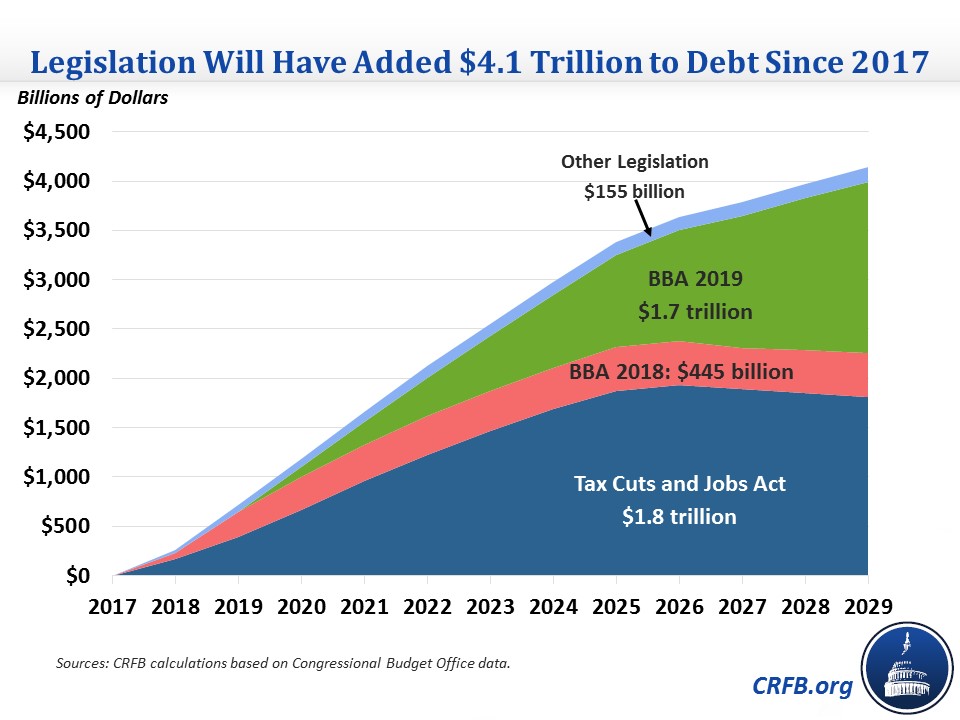
If the recent budget deal is signed into law, it will be the third major piece of deficit-financed legislation in President Trump’s term. In total, we estimate legislation signed by the President will have added $4.1 trillion to the debt between 2017 and 2029. Over a traditional ten-year budget window, the President will have added $3.4 to $3.8 trillion to the debt. The source of the debt expansion is split relatively evenly between tax and spending policy.

The Tax Cuts and Jobs Act (TCJA) was the single largest contributor to the $4.1 trillion figure, increasing debt by $1.8 trillion through 2029 (more than the entire cost is through 2027). This number could easily climb higher if lawmakers extend the individual tax cuts that are set to expire after 2025, which would add another $1 trillion to the debt.

The Bipartisan Budget Act (BBA) of 2018 was nearly as costly on an annual basis, adding nearly $450 billion to the debt due to its two-year nature. However, the Bipartisan Budget Act of 2019 would effectively make the increases in the BBA 2018 permanent, and in doing so, add another $1.7 trillion to the debt through 2029.

Smaller pieces of legislation are responsible for nearly $150 billion of debt. This includes several different bills containing disaster relief or emergency spending and continued delays of three Affordable Care Act (ACA) taxes, among other bills.

This analysis does not include the fiscal impact of many executive actions taken by the President, some which would increase deficits and others which would reduce them. It also assumes that temporary policies expire as scheduled.

If we evaluate the debt added over the standard ten-year window the Congressional Budget Office (CBO) uses, the numbers are similar but slightly smaller. Using the ten-year period (2018-2027) employed in 2017, lawmakers have added $3.8 trillion to deficits. Using the current ten-year period of 2020-2029, the debt increase is $3.4 trillion. Debt added is lower in the later period because some of the laws, like the TCJA and 2018 BBA, had larger short-term, rather than long-term, costs.

Debt Added Since 2017 Over Different Periods

Legislation 2018-2027 Cost 2020-2029 Cost 2017-2029 Cost
Tax Cuts and Jobs Act $1.9 trillion $1.4 trillion $1.8 trillion
Bipartisan Budget Act of 2019 $1.3 trillion $1.7 trillion $1.7 trillion
Bipartisan Budget Act of 2018 $420 billion $190 billion $445 billion
Other Legislation $140 billion $90 billion $155 billion
Total $3.8 trillion $3.4 trillion $4.1 trillion

Source: CRFB calculations based on Congressional Budget Office data.

Importantly, the $4.1 trillion of debt signed into law by President Trump is on top of the $16.2 trillion we already owe and the $9.8 trillion we were projected to borrow over the next decade absent these proposals. It would bring debt to about 97 percent of Gross Domestic Product (GDP) in 2029, compared to 84 percent if no debt-increasing legislation had been passed.

To avoid the huge run-up in debt that is projected in the coming decades, lawmakers should reject unpaid-for spending increases, pay for the tax bill, and address the rising costs and looming insolvency of our nation’s largest health and retirement programs.

Source: Committee for a Responsible Federal Budget

Jerrold Nadler: another socialist in Congress | Metro Voice

Editor’s Note: What is particularly disturbing is that the Judiciary Committee chairman was associated with the Socialist Party long before he was a U.S. Congressman. Afterwards, he led the Congressional Progressive Caucus which from a policy standpoint is synonymous with the Socialist Party. 

Jerrold Nadler, the socialist we will be exposing may surprise many people that really do not know who they elected. Let us hope that becomes true so we can get rid of these socialists within our Congress and Senate and replace them with people who will follow the Constitution rather than the ideology of the socialists they work for.

It was way back in the 1940s when the Socialist Party realized that the Democratic Party had begun to follow the same ideology as the Socialist Party. Just how can we make such a strong statement about the Democratic Party? It is simple.  It started with the man who tossed his Socialist Party into the Democratic Party after making the following statement.

“Norman Thomas, the six-time Socialist Party candidate for U.S. President, said the following in a 1944 speech:

“The American people will never knowingly adopt socialism. But, under the name of ‘liberalism,’ they will adopt every fragment of the socialist program, until one day America will be a socialist nation, without knowing how it happened…. I no longer need to run as a Presidential Candidate for the Socialist Party. The Democratic Party has adopted our platform.”

You must be wondering what this has to do with what is going on today.

We will now expose the man named Jerrold Nadler, the man who is working on impeaching or setting up impeachment ideas against President Donald Trump. We decided to look at Nadler because what he was stating sounded an awful lot like what prior socialists such as Elijah Cummings, among others, were saying. After a quick look into Mr. Nadler’s background, we found a very deep association and links to the Socialist Party and links to the Communist Party. Many will say, “So what?” but go back and read just what the Socialist and Communist Parties represent and you will quickly find that they both hate the United States Constitution and they both hate freedom. Both of those very far left parties work toward destroying our nation from within by placing their puppets, like Nadler and others, in office to slowly work their ideology into the American dream.

Here’s the truth about Jerrold Nadler, what he is and why he should never be in the position he is in now or ever.

Nadler got his start in 1992 as shown below.

“In 1992, longtime Democratic U.S. Congressman Ted Weiss died one day before his party’s primary election for New York City’s newly redrawn Eighth District. Using a weighted voting system, a convention of nearly 1,000 Democratic county committee members selected Nadler to replace Weiss on the November ballot. Nadler won easily and has had no serious challenge in any of his congressional re-election bids since then.” 

Here we see he won an election from a man that died in office. While there is not much in that, it does go downhill and deep into the socialistic ideology from there.

“Upon his election to the House of Representatives, Nadler promptly joined the Congressional Progressive Caucus and became a leader of the Congressional Pro-Choice Caucus. For an overview of his voting record on a number of key issues during the course of his legislative career, click here.”

So, just after his election, he joins the “Congressional Progressive Caucus.” This is not a good group to be in, but he was very quick to join showing his socialistic ideology was set before his election. Now, just what is the Congressional Progressive Party? Basically speaking, it is just a cover name for the Socialist Party.

But let’s take a brief look at this group that is ever expanding in the Democratic Party.

“The Congressional Progressive Caucus (CPC) was founded in 1991 by Bernie Sanders, a self-identified socialist who had recently been elected to the U.S. House of Representatives. Sanders’ CPC co-founders included House members Ron Dellums, Lane Evans, Thomas Andrews, Peter DeFazio, and Maxine Waters. The Institute for Policy Studies (IPS) was also involved in CPC’s founding and in Caucus activities thereafter; IPS continues to advise CPC on various matters to this day.

Another key player in establishing CPC was the Democratic Socialists of America(DSA), which has maintained a close alliance with the Caucus ever since. In 1997, DSA’s political director, Chris Riddiough, organized a meeting with CPC leaders to discuss how the two groups might be able to “unite our forces on a common agenda.” Among those who participated in the meeting were Bernie Sanders, labor leader Richard Trumka, professor Noam Chomsky, feminist Patricia Ireland, Rev. Jesse Jackson, Senator Paul Wellstone, journalist William Greider, and the socialist author Barbara Ehrenreich.

Beginning in 1997, CPC worked closely with the newly launched “Progressive Challenge, a coalition of more than 100 leftist organizations that sought to unite their activities and objectives under a “multi-issue progressive agenda.” To view a list of many of the major groups that co-sponsored the Progressive Challenge, click here.”

The first thing that should jump out from the page is that this group was started by none other than Bernie Sanders, a very strong socialist. Also, take notice that Maxine Waters is also involved with this, and there will be more on her in a future article. Getting back to Nadler’s association with this group, we also see that it is closely associated with the Democratic Socialists of America, just another Socialist branch of the now-defunct Democratic Party.

Let’s take a look at what Jerrold Nadler has aligned himself with.

“Throughout his years in politics, Nadler has maintained close ties to socialist organizations. In 1977, for instance, he was a member of the Democratic Socialist Organizing Committee (DSOC), and by 1983 he had joined the Democratic Socialists of America (DSA), which grew out of DSOC. On May 1, 1989, Nadler served on the sponsoring committee for a New York DSA screening of the pro-union film Matewan. That same year, he personally asked New York’s DSA to endorse his candidacy for NYC Comptroller. In 1990, Nadler endorsed the New York mayoral campaign of DSA member David Dinkins. In July 1996, DSA’s Political Action Committee endorsed Nadler for Congress. Each year from 1995-97, Nadler spoke at the DSA’s annual Socialist Scholars Conferences, where he participated in panel discussions with such notables as Stanley AronowitzWilliam Kornblum, and Frances Fox Piven. According to DSA’s rival Social Democrats USA, Nadler remains a DSA member to this day.”

Here, we see that Jerrold Nadler has maintained very close ties to the Socialist Party and organizations. Do the people in New York know this? Do the People of New York understand what this means? We would have to guess that if they do, they do not understand what the socialist ideology is trying to do to our nation.

Jerrold Nadler was on a panel with known anti-United States individual, Frances Fox Piventhat is a lady who worked hard to destroy the United States and the idea of freedom.  Look it up and see her background.  Just what we have shown here should be enough for a normal group of people to have an idea that Nadler is not good for their freedom.  After all, socialism does not promote freedom.  Just look at Venezuela, Cuba, and so many other socialist states.

“In 2003 Nadler, urged on by the ACLU and People For the American Wayintroduced legislation aimed at defeating the Bush administration’s Terrorism Information Awareness (TIA) program, which sought to help the government root out terrorists by analyzing and cross-referencing various databases for evidence of suspicious patterns of Internet activity, travel, credit-card purchases, and donations to charities and political causes. By Nadler’s reckoning, the TIA initiative constituted a massive “assault on our rights” and represented “perhaps the closest realization of an Orwellian ‘Big Brother’ government to date.”

Nadler fought to stop a program that would root out terrorists. That does not sound like someone that is out to protect the people who voted for him. However, Nadler doesn’t care because he believes he can never be defeated.  Yet, maybe it is just that the people who vote for him have not been told he is a flaming socialist.  Nadler is even making a statement that terrorists should not be drawn out if they have in mind to harm this nation. Just look at his words and try to understand how could this man have the people in his district in mind when he stated that. Let us take a look at something that he says below and see how close it resembles what he is now trying to do with President Trump.

“In a similar spirit, Nadler characterized the PATRIOT Act as an example of unnecessary “governmental intrusion” into the lives of Americans. Especially outrageous to Nadler was a PATRIOT Act clause enabling FBI investigators to access library records in the course of a terrorism investigation. “If [Attorney General] John Ashcroft has his way, bookstore customers could be investigated for something as arbitrary as buying Hillary Clinton’s new book,” warned Nadler. “People are outraged,” he added, “by the loss of civil liberties…. The government … should not be in the thought-police business.” Further, Nadler denounced the PATRIOT Act as “little more than the institution of a police state.”

Today, Nadler is making the very statement he hates in the paragraph above.

“People are outraged,” he added, “by the loss of civil liberties…. The government … should not be in the thought-police business.” Further, Nadler denounced the PATRIOT Act as “little more than the institution of a police state.”

Notice the phrase, “The government should not be in the thought police business.” But today he is using that very idea to go after President Trump even after President Trump has been cleared of all charges, or in Nadler’s case, all thoughts. Let us show just what Nadler thinks about our Constitution.

“In January 2011, when the new Speaker of the House, Republican John Boehner, announced his intention to open the year’s first session of Congress with a reading of the U.S. Constitution, Nadler complained that Republicans “are reading it [the Constitution] like a sacred text.” Boehner’s “ritualistic reading” was “total nonsense” and “propaganda,” said Nadler, adding that the document’s need for amendments to abolish slavery and other injustices showed that it was, from its inception, “highly imperfect.”

Here we see that Nadler complained about the reading of our Constitution, calling Boehner’s reading, “Total Nonsense and propaganda.” This is what seems to show his total dislike for the Constitution.

Now, let us show his connections to the Communist Party.

“* In 1997 Nadler was one of 33 original co-sponsors of the Job Creation and Infrastructure Restoration Act which was introduced into Congress by California Rep. Matthew Martinez. This emergency federal jobs legislation, supported by the New York State Communist Party, was designed to create jobs at union wages in financially foundering cities by putting the unemployed to work on infrastructure projects such as rebuilding schools, housing, hospitals, libraries, public transportation, highways, and parks. Rep. Martinez had already introduced an earlier version of this bill in the previous Congress at the request of the Los Angeles Labor Coalition for Public Works Jobs, whose leaders were known supporters or members of the Communist Party USA. To view a list of all the co-sponsors, click here.”

This shows that Jerrold Nadler supported a bill pushed forward by a group associated with the Communist Party.  Notice here how the Communist Party works:  placing people into jobs for which that may or may not be paid. This is how the Communist Party works:  it makes people think it is great because it creates certain jobs and after they get you into their group, then they use you to do their evil bidding. Of course, we all know that Communism has failed everywhere it has grown because it cannot sustain what it lays claim to be.

Let us close with a final show of what Nadler will do to keep his office.

“* During a June 2014 House briefing with Obama administration officials on the recent trade of five high-ranking Taliban commanders in exchange for American Sgt. Bowe Bergdahl, Nadler suggested that the Taliban, as non-state actors, had a status comparable to that of American soldiers who had fought the British during the Revolutionary War. When reports of Nadler’s statement sparked some public controversy, the congressman clarified: “I was told they [the Taliban] were unprivileged combatants, not prisoners of war, and I was trying to figure out the extent of that legal distinction. I was told they wore no uniform so I was curious if that gave them the legal status of militias in the American Revolution — who also did not wear uniforms…. In no way was I comparing their values, their efforts, and their cause to that of our founding fathers, and to suggest otherwise is absurd.”

Nadler quickly changed his tone when people questioned his words.

Maybe today “WE THE PEOPLE” should once again drag him across the rug to explain why he is thinking of placing impeachment charges on President Trump when he has been cleared of everything, not to mention the entire mess began with a very false report about collusion with Russia. By the way, does Nadler even know that once it comes up that the entire Russia idea was false it could overturn everything?  No doubt, he would once again be giving a very different explanation to the people.

With all this, we have to wonder if maybe the voters in New York were blindfolded when they voted for him, but he did not have anyone run against him. That is another way the socialists keep winning.  They set up districts where no one wants to challenge them.

Jerrold Nadler is a Socialist in Democrat clothing and has ties to the Communist Party too. Why in the world would people vote for an individual who has ties to groups that do not honor or like the Constitution?  Don’t you think it is time to get rid of this socialist and replace him with a person who honors the Constitution and freedom?

Source: Metro Voice

Unsealed documents shed new light on efforts to verify Trump-Russia dossier | CNN

Documents unsealed this week lend credence to a theory about Russian election meddling that was first put forward in the Trump-Russia dossier, however they do not corroborate the more explosive claims that the Trump campaign colluded with the Kremlin in the 2016 campaign.

A report from a retired agent who worked for the FBI’s cyber division, submitted as expert testimony in a civil lawsuit, presented new evidence about how Russian intelligence might have exploited a private web hosting company when it fooled top Democratic targets into giving up their passwords. The fruits of those hacks formed the basis of the WikiLeaks email dumps that roiled the race.

The controversial dossier had accused Russian hackers of using those companies, Webzilla and its parent company XBT, as part of their scheme to meddle in the presidential election. The memos, written by a retired British spy, Christopher Steele, also claimed that Russian entrepreneur Aleksej Gubarev assisted the cyberattacks “under duress” from Russian intelligence.

Gubarev vehemently denied those allegations and sued BuzzFeed for defamation after it published the dossier. That prompted BuzzFeed to commission the expert witness report from FTI Consulting’s Anthony Ferrante, who is also a CNN contributor. A federal judge dismissed the lawsuit in December, and ordered that dozens of documents be released to the public this week. The judge ruled on First Amendment grounds and did not assess the hacking-related allegations.

Details of the report

The FTI report concluded that one of the hyperlinks the Russians designed to trick Hillary Clinton’s campaign chairman John Podesta into giving up his email password was created on an internet protocol address owned by Root S.A., an XBT subsidiary.
In his deposition, retired FBI cyber official Ferrante admitted the evidence didn’t conclusively show XBT was aware of the Russian campaign against Democrats.

“I will further state that other than the fact that XBT employees did little to nothing to detect, stop and prevent the significant malicious activity, I have no evidence of them actually sitting behind a keyboard,” he said.

Gubarev’s team argued that an internet hosting company couldn’t be held responsible for the activities of people who use its services.
A rebuttal on Gubarev’s behalf, filed by a former CIA cybersecurity expert, Eric Cole, stressed that he and his staff were frequently unaware of the specific activity conducted on its servers.

“XBT/Webzilla is not responsible for every bit of data that a bad actor passes over its infrastructure any more than a post office is responsible for the actions of the Unabomber,” Cole wrote.

“Special Counsel Robert Mueller indicted the 12 Russians responsible for the hacking. Those are the folks responsible, not us,” Evan Fray-Witzer, an attorney for Gubarev, told CNN. The 11-count indictment against those hackers, which was filed in July 2018, did not mention Webzilla or XBT.

BuzzFeed News characterized the report as vindication of its decision to publish the Trump-Russia dossier. “We knew already that publishing the dossier was in the public interest,” spokesperson Matt Mittenthal told CNN. “Now, because BuzzFeed News published the dossier, we’re learning more about the facts of foreign influence in the 2016 presidential election.”

Gubarev sued BuzzFeed in 2017 and sought damages for defamation. As part of the legal process, some of the key players in the dossier saga were deposed, including Steele.

The court unsealed one page of that deposition, which happened last year in London. Steele testified that he tried to verify the allegations against Gubarev by doing, among other things, an “open source search,” which would likely include scouring news clippings and public records.

Steele has years of experience as a British spy in Moscow and has been a trusted source for the FBI. Allies of Democratic nominee Clinton funded Steele’s investigation in 2016. But he was so concerned by his findings that he shared his memo with senior US and UK officials.

In her decision to throw out the case, the judge confirmed that BuzzFeed got the dossier from an associate of Republican Sen. John McCain in December 2016, weeks after the election.

The memos were circulating in Washington, and CNN soon broke the story that senior US intelligence officials had briefed President-elect Trump and President Barack Obama about some of the unverified allegations. Hours later, BuzzFeed published the complete dossier online.
The most salacious allegations in the dossier remain unverified to this day. But the claims that form the bulk of the memos have held up over time, or at least proved to be partially true.

This notably includes Steele’s claim that Russian President Vladimir Putin oversaw an effort to interfere in the 2016 election. It also includes allegations of secret contacts between Trump’s team and the Russians during the campaign. Steele gathered this stunning information months before the Russian meddling campaign was publicly confirmed by US intelligence agencies and in court filings from special counsel Robert Mueller.

Kevin Collier, a cybersecurity reporter for CNN, previously worked for BuzzFeed News.

Source: CNN & BuzzFeed News

How Much Will Medicare for All Cost? | Committee for a Responsible Federal Budget

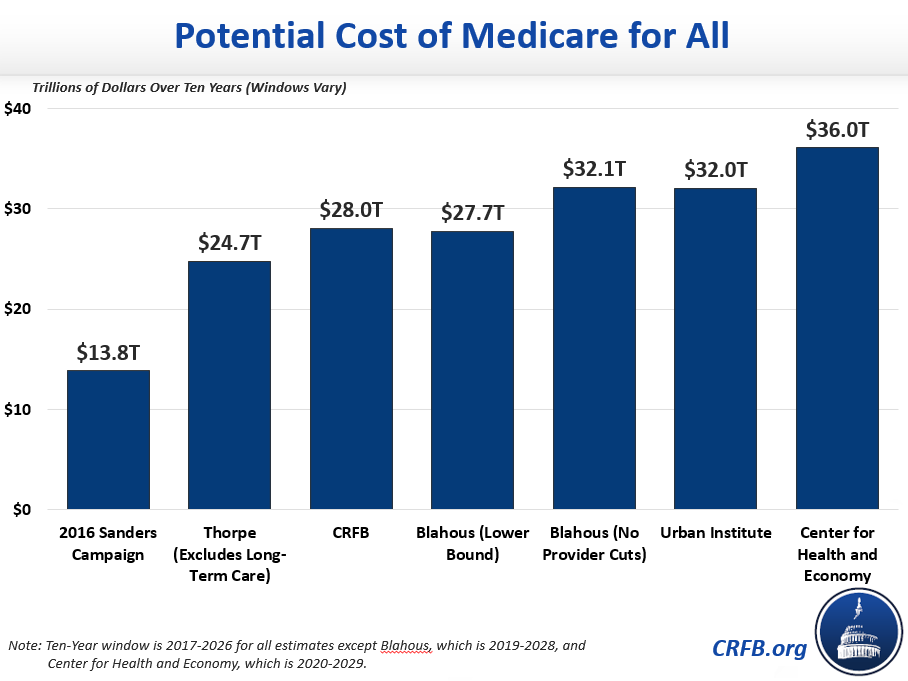
Representative Pramila Jayapal (D-WA), a co-chair of the Medicare for All Caucus, released a bill today that would adopt a single-payer system, where the federal government replaces private health insurance companies as the sole provider of most health care financing. While we are not aware of any estimates of this particular proposal, similar proposals have been estimated to cost the federal government roughly $28-32 trillion over a decade.

Representative Jayapal’s Medicare for All Act would replace nearly all current insurance with a government-run single-payer plan and extend that plan to those who currently lack health coverage. The plan itself would be far more generous than either Medicare or most private coverage, as it would include no deductibles or copayments, would not restrict beneficiaries to networks of care, and would offer a broad suite of benefits including dental care, vision care, transportation for disabled and low-income patients, certain dietary and nutritional care, long-term care, and other long-term services and support. The proposal also establishes a global health budget, moves away from fee-for-service and toward lump-sum payments for many providers, includes a number of measures to hold down drug prices, and makes a variety of other changes to the health care system.

The proposal is broadly similar to Senator Sanders’s proposed single-payer plan introduced during the 2016 Presidential campaign. While the campaign itself estimated that plan would cost the federal government about $14 trillion over a decade, most other estimates that we are aware of are at least twice that high.

At the time, for example, the Committee for a Responsible Federal Budget estimated roughly that the plan would cost $28 trillion through 2026 (we estimated the Sanders plan in particular would also raise $11 trillion of revenue, leading to $17 trillion of net costs). All other estimates come to similar conclusions.

For example, economist Kenneth Thorpe estimated that single-payer health care would cost the federal government $24.7 trillion through 2026, excluding the costs associated with long-term care benefits (likely about $3 trillion). The Urban Institute estimated a $32 trillion cost over the same period, including those long-term care benefits. The Center for Health and Economy (H&E) produced an estimate that the American Action Forum calculates would cost the federal government $36 trillion through 2029.

In addition, former Social Security and Medicare Trustee and current Mercatus Center fellow Chuck Blahous estimated that Medicare for All as proposed in Senator Sanders’s 2017 legislation would cost the federal government $27.7 trillion through 2028 assuming steep provider cuts and $32.1 trillion assuming no provider cuts (these estimates, like most others, assume immediate implementation).

Importantly, these totals represent the increased cost to the federal government, not the change of total national health expenditures. National health expenditures would likely change by no more than a few trillion dollars over decade. The direction of that change is unclear and would depending on the whether the increased cost of expanding coverage (by making health insurance more generous and offering it to more people) is larger or smaller than the amount saved from lower provider payments, drug payments, and administrative spending.

The totals also do not represent debt impact, which would depend not only on the cost to the federal government but also on any funds the government might choose to raise through premiums, taxes, or both. For example, Senator Sanders’s campaign plan included roughly $11 trillion of tax increases, which could fund more than one-third of Medicare for All.

While any new revenue would in part be replacing current premiums, identifying pay-fors still remains a challenge. Enacting this type of Medicare for All would mean increasing federal spending by about 60 percent (excluding interest), and financing a $30 trillion program would require the equivalent of tripling payroll taxes or more than doubling all other taxes.

Supporters of Medicare for All should work to identify new revenue, premiums, and/or spending cuts to finance new federal costs or else scale back their proposal if they are unable to identify sufficient funding.

Source: Committee for a Responsible Federal Budget


Bipartisan Criminal Justice Bill Closer To Becoming Law After Congressional Approval | NPR

By Ayesha Rascoe

A bipartisan bill aimed at overhauling federal prisons and reducing recidivism has been overwhelmingly approved by Congress.

The legislation is now on the verge of becoming law, with the House’s approval on Thursday, the Senate’s passage on Tuesday and the backing of President Trump.

Republican Speaker of the House Paul Ryan previously voiced support for the legislative package, pledging that the House was “ready to get it done.” They later passed the measure by a 358-36 margin.

The Senate on Tuesday voted 87-12 in favor of the bill, known as the First Step Act. The passage of the bill by the chamber is a significant victory for advocates on the left and the right, who have pressed for Congress to take action to lower the prison population.

It’s also a big win for the White House and for Trump adviser and son-in-law Jared Kushner, in particular. Kushner has made overhauling the criminal justice system one of his top projects in the White House.

Trump called Congress’ action a “great bi-partisan achievement” and “a wonderful thing for the U.S.A.!!” in a tweet on Thursday afternoon.

For months, the fate of the legislation seemed to be in a precarious position. Republican Sen. Chuck Grassley, who helms the Senate Judiciary Committee, stressed that he wanted to include sentencing provisions, which had been left out of the version of the bill passed by the House in May.

For a while, it was unclear whether Trump would back measures to cut down on lengthy sentences. His first attorney general, Jeff Sessions, was staunchly opposed to the move.

But, with Sessions pushed out of the administration in November, Trump came out in favor of the more expansive Senate package.

Some Republicans, like Sen. Tom Cotton of Arkansas, still oppose the legislation, which they argue will free dangerous criminals.

Facing pressure from advocates and the White House, Senate Majority Leader Mitch McConnell agreed to bring the bill up for a vote during the lame-duck session after its sponsors agreed to certain changes.

Here are some highlights from the legislation:

Measures focused on changing U.S. prisons

-Provides more access to rehabilitation and training programs that are aimed at helping prepare prisoners for life after their release. Certain prisoners would be eligible for incentives if they participate, including credits that would allow them to spend up to a year of their sentences in facilities like halfway houses or at home under supervision.

Republican critics of these incentives argue that prisoners could commit crimes while on supervised release. But, the bill’s sponsors say only offenders considered low or minimum risk would be eligible and the legislation excludes certain prisoners, including sex offenders and fentanyl traffickers.

-Makes it against the law to use restraints on pregnant inmates, unless they are an immediate threat to themselves or others or a flight risk.

-Requires that prisoners be incarcerated no more than 500 miles from their primary residence.

Measures focused on sentencing

-Ends automatic life sentences under the three-strike penalty for drug felonies. Instead of life, a third strike would now be a mandatory 25-year sentence. The mandatory sentence for a second offense would be reduced to 15 years compared to 20 years now.

This change would not be retroactive, so it would not help people already in prison serving life sentences under the three-strike rule. Some opponents of the bill have argued it does not go far enough to help people already affected by these laws.

-Expands the “safety valve” that allows judges to avoid imposing mandatory minimum sentences in certain cases.

-Addresses prisoners who were sentenced before laws were changed in 2010 to lessen disparities between the penalties for crack cocaine and powder cocaine. It would allow these prisoners to petition the courts to review their cases in light of the updated law.

Source: NPR

FBI releases part of Russia dossier summary used to brief Trump, Obama | Politico

The FBI released for the first time Friday night a two-page summary former FBI Director James Comey used to brief President-elect Donald Trump nearly two years ago on a so-called dossier about Trump’s ties to Russia.

The version made public Friday could reignite previous criticism from Republicans and Trump allies that the FBI was too vague in its description of the fact that the dossier was funded by the campaign of Trump’s nemesis in the 2016 presidential election, Democratic nominee Hillary Rodham Clinton, as well as the Democratic National Committee.

Comey, who was fired by Trump in May 2017, acknowledged during a book tour earlier this year that he did not inform Trump who paid for the research.

The brief passage the FBI left unredacted in the newly released memo gives some background on the former British intelligence officer who compiled the dossier, Christopher Steele, although Steele’s name does not actually appear in the newly released version. The released portion of the synopsis is vague about who financed the project, referring to it as sponsored by “private clients.”

“An FBI source … volunteered highly politically sensitive information … on Russian influence efforts aimed at the US presidential election,” the memo labeled as “Annex A” says. “The source is an executive of a private business intelligence firm and a former employee of a friendly intelligence service who has been compensated for previous reporting over the past three years. The source maintains and collects information from a layered network of identified and unidentified subsources, some of which has been corroborated in the past. The source collected this information on behalf of private clients and was not compensated for it by the FBI.”

“The source’s reporting appears to have been acquired by multiple Western press organizations starting in October,” the document from January 2017 declares.

Comey has said he did not show or give Trump the memo, but used it as a reference when briefing him on the dossier, which U.S. intelligence officials feared Russia might try to use as blackmail against Trump. The synopsis was also used to brief President Barack Obama, officials have said.

Republicans had previously complained that the FBI failed to inform a federal court about the dossier’s provenance — that Steele’s work was commissioned by Fusion GPS, a research firm that had been hired by the Clinton campaign’s law firm, Perkins Coie, to dig up information about Trump’s business relationships overseas. Based in part on the dossier’s information, the court granted an FBI application to surveil a former Trump campaign associate in October 2016.

Aspects of the FBI’s surveillance application have since been released and revealed that the FBI did inform the court that Steele had political animus toward Trump and that it was funded by a politically motivated backer.

The document was released Friday in response to a Freedom of Information Act lawsuit brought by a POLITICO reporter and the James Madison Project, a pro-transparency group.

In January, U.S. District Court Judge Amit Mehta ruled that that the FBI was legally justified in refusing to confirm or deny the existence of any records related to the dossier, despite several tweets from President Donald Trump that described the document as “fake” or “discredited.”

However, shortly after that ruling, Trump declassified a House Intelligence Committee memo that included various claims about the FBI’s handling of the dossier. In August, Mehta said the official release of that material vitiated the FBI’s ability to claim that it had offered no public confirmation of its role in vetting or verifying the dossier, a collection of accurate, inaccurate, unverified and sometimes salacious claims about ties between Russia and various figures in Trump’s circle.

“It remains no longer logical nor plausible for the FBI to maintain that it cannot confirm nor deny the existence of documents” related to attempts to verify information in the dossier, Mehta wrote.

The FBI withheld the remainder of the two-page synopsis on a variety of grounds, including that the material remains classified either Secret or Top Secret. The law enforcement agency also indicated the information is exempt from release because it pertains to ongoing investigations or court proceedings, originated with a confidential source or describes confidential investigative techniques or procedures.

The FBI said Friday it lacked any records indicating final conclusions about any information in the dossier, said Brad Moss, one of the attorneys pressing for release of the records.

“After two years of legal games, the FBI today finally confirmed two pieces of speculation about the scandalous allegations regarding which Director Comey briefed President Trump in January 2017: all of those allegations remain part of the ongoing Russian ‘collusion’ investigation, and the FBI has not rendered final determinations about the accuracy of any of them,” Moss said. “Far from being debunked, the issues that raised concerns for the Intelligence Community in 2017 remain unresolved to this day.”

Moss said he plans to challenge the FBI’s withholdings in the case and to ask Mehta to order more of the information released.

Source: Politico

Alexandria Ocasio-Cortez is already pulling back the curtain on the inner workings of Congress | CNBC

By Carmen Chapell

Alexandria Ocasio-Cortez is already pulling back the curtain on the inner workings of the Capitol.

The New York Democrat, along with other incoming freshman lawmakers, is trying to usher in a culture of openness that is enabled by a vast social media following. With nearly 3 million followers combined on Facebook, Instagram and Twitter, Ocasio-Cortez has used the platforms to involve her supporters during the transition period before she takes office.

Her enthusiastic and often pugnacious transparency campaign has earned her praise from inside and outside the Beltway. Yet it has also drawn criticism from several corners, including from President Donald Trump’s eldest son. Ocasio-Cortez hasn’t given any indication that she will let up, however.

In a series of pictures and videos on Instagram dubbed “Congress Camp,” she gave an inside look into new-member orientation, from choosing an office to voting for House leadership, while also showcasing the unique quirks of life on Capitol Hill.

“Guys, there are secret underground tunnels between all of these government buildings!” she whispers in one video. In another post, she polls her followers on whether she should choose an office with more space or one “close to our friends.”

But Ocasio-Cortez isn’t just focusing on the novelty of her experience. Last week, she tweeted sharp criticism of an orientation for new members of Congress hosted by Harvard. The event featured corporate CEOs but no labor representatives.

“Our ‘bipartisan’ Congressional orientation is cohosted by a corporate lobbyist group. Other members have quietly expressed to me their concern that this wasn’t told to us in advance,” she tweeted. “Lobbyists are here. Goldman Sachs is here. Where’s labor? Activists? Frontline community leaders?”

Fellow freshman member Rashida Tlaib, D-Mich., echoed her criticisms. Tlaib said that Gary Cohn, former chief economic advisor to President Donald Trump and former Goldman Sachs executive, told the new members at orientation that they don’t “know how the game is played.”

“No Gary, YOU don’t know what’s coming – a revolutionary Congress that puts people over profits,” Tlaib tweeted.

‘Those little things are very real’

Ocasio-Cortez rose to the spotlight after defeating longtime incumbent Joseph Crowley in the Democratic primary for New York’s 14th Congressional District, which encompasses parts of Queens and the Bronx. A self-identified Democratic socialist, she ran on a liberal platform and chose to emphasize her identity as a young woman of color. The 29-year-old’s victory in the general election anointed her as the youngest woman ever elected to Congress.

Ocasio-Cortez’s comments about her new role have also renewed longstanding debates on the financial challenges facing members of Congress and their staff. She has made it personal by revealing her own insecurities about her finances during the transition period.

“I have three months without a salary before I’m a member of Congress. So, how do I get an apartment? Those little things are very real,” she told The New York Times in an interview.

Many lawmakers struggle with the cost of living in Washington, D.C., even on the $174,000 congressional salary, going so far as to sleep in their offices to save on rent costs.

Ocasio-Cortez has also made it a point to talk about the economic conditions of congressional staff. Last week, she tweeted: “It is unjust for Congress to budget a living wage for ourselves, yet rely on unpaid interns & underpaid overworked staff just bc Republicans want to make a statement about ‘fiscal responsibility.'”

Low salaries as well as the prevalence of unpaid internships, which are often the first step to a full-time role, are seen as barriers to a more diverse congressional staff. Ocasio-Cortez pledged to pay her office’s interns $15 an hour, inspiring other lawmakers to make the same commitment.

She has also shared experiences that reveal the growing pains of an increasingly diverse Congress. “People keep giving me directions to the spouse and intern events instead of the ones for members of Congress,” she tweeted during orientation.

The changing face of Congress

Ocasio-Cortez is just one of the 42 women, 38 of them Democrats, part of Congress’ freshman class. They are being heralded as the faces of a new “Year of the Woman.” Ilhan Omar, D-Minn., and Michigan’s Tlaib are the first Muslim women elected to Congress, while Ayanna Pressley, a Democrat, is the first black woman elected to represent Massachusetts. Ocasio-Cortez posted a picture of the four women together on Instagram last month, captioning it “Squad.”

As a result of her high profile, Ocasio-Cortez’s unabashed takes on congressional life have frequently come under fire.

Eddie Scarry, a writer for the Washington Examiner, disputed Ocasio-Cortez’s account of her financial hardships based on her clothing choices.

“Hill staffer sent me this pic of Ocasio-Cortez they took just now,” Scarry tweeted. “I’ll tell you something: that jacket and coat don’t look like a girl who struggles.” The tweet has since been deleted after widespread backlash.

Rep. Sean Duffy, R-Wis., condemned the media for what he viewed as preferential treatment in coverage of Ocasio-Cortez. As a freshman congressman in 2011, Duffy received negative reactions after telling a constituent that he struggles to pay his bills.

“Hmm which headlines and article does media give to GOP and which to a Dem?” Duffy tweeted alongside screenshots of articles referencing himself and Ocasio-Cortez.

Last week, Donald Trump Jr., the president’s eldest son, shared a doctored image on Instagram in which Ocasio-Cortez asks, “Why are you so afraid of a socialist economy?” In the post, President Trump responds, “Because Americans want to walk their dogs, not eat them.” Trump Jr. captioned the meme “It’s funny cuz it’s true!!!”

Ocasio-Cortez fired back, tweeting: “Please, keep it coming Jr – it’s definitely a ‘very, very large brain’ idea to troll a member of a body that will have subpoena power in a month.” Democrats have made clear that they plan to use their new subpoena power in the House to further investigate potential Russian interference in the 2016 elections.

The representative-elect has also received praise for revealing parts of the political system that are typically left in the shadows.

Actress Kerry Washington, who stars in the political drama “Scandal,” commended Ocasio-Cortez’s behind-the-scenes revelations, tweeting, “@Ocasio2018 speaking truth to power. Sharing the NEEDED #BTS of our democracy at work. So grateful.”

“I’m learning more details about how the House actually works over the past two weeks than I ever did in the past 20 years,” one follower tweeted in reply to Ocasio-Cortez.

“Thank you so much for giving us the window into the inside baseball of Congress,” another follower said.

Paul Musgrave, assistant professor of political science at University of Massachusetts Amherst, praised Ocasio-Cortez on Twitter for “treating voters as neither super-sophisticated DC insiders, nor as people who can’t be trusted to make up their own minds, but rather as people who are curious and intelligent but who aren’t experts in DC process.”

“Sometimes,” he added, “you don’t need a new theory of politics to make change, just a willingness to state the obvious.”

Source: CNBC