Democrats are repudiating FDR’s precedent of détente with Russia | RT & The Nation

By Stephen F. Cohen

By criminalizing alleged “contacts with the Kremlin” – and by demonizing Russia itself – today’s Democrats are becoming the party of the new and more perilous Cold War.

Stephen F. Cohen, professor emeritus of Russian Studies and Politics (at NYU and Princeton), and John Batchelor hold their (usually) weekly discussions of the new US-Russian Cold War. (Previous installments, now in their fourth year, are at TheNation.com.)

In light of recent events, from Washington to the false alerts in Hawaii and Japan, Cohen returns to a theme he has explored previously: the ways in which the still-unproven Russiagate allegations, promoted primarily by the Democratic Party, have become the number-one threat to American national security. Historical context is needed, which returns Cohen briefly to related subjects he has also previously discussed with Batchelor.

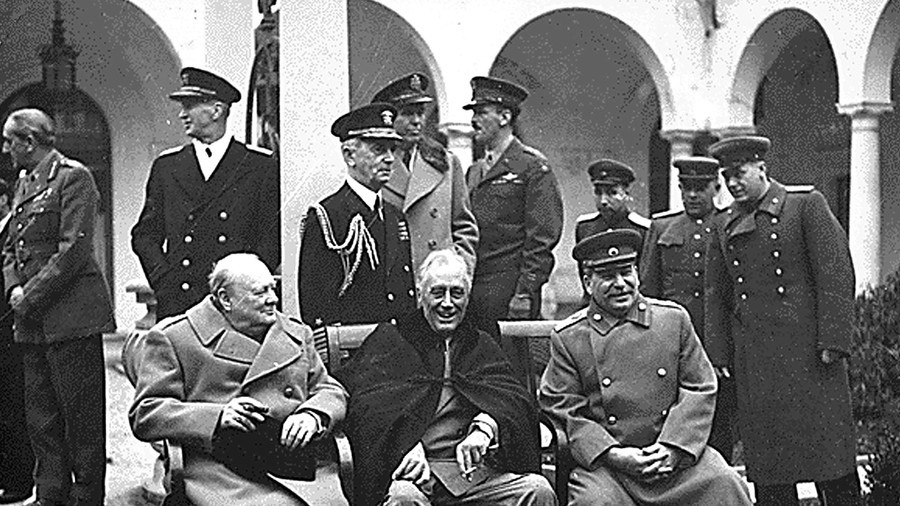
This year marks the 70th anniversary of what is usually said to have been the full onset of the long Cold War, in 1948. In fact, 2018 marks the 100th anniversary of US-Russian cold wars, which began with the Russian Civil War when, for the next 15 years, Washington refused to formally recognize the victorious Soviet government – surely a very cold relationship, though one without an arms race. The first of several détente policies – attempts to reduce the dangers inherent in cold war by introducing important elements of cooperation – was initiated by President Franklin D. Roosevelt in 1933, when he formally extended diplomatic recognition to the Soviet Union, then ruled by Stalin. That is, FDR was the father of détente, a circumstance forgotten or disregarded by many Democrats, especially today.

Three major détentes were pursued later in the 20th century, all by Republican presidents: Eisenhower in the 1950s, Nixon in the 1970s, and by Reagan in the second half of the 1980s, which was so fulsome and successful that he and his Soviet counterpart, Mikhail Gorbachev, thought they had ended the Cold War altogether.

And yet today, post–Soviet Russia and the United States are in a new and even more dangerous Cold War, one provoked in no small measure by the Democratic Party, from President Clinton’s winner-take-all policies toward Russia in the 1990s to President Obama’s refusal to cooperate significantly with Moscow against international terrorism, particularly in Syria; the role of his administration in the illegal overthrow of Ukrainian President Yanukovych in 2014 (a coup by any other name); and the still-shadowy role of Obama’s intelligence chiefs, not only those at the FBI, in instigating Russiagate allegations against Donald Trump early in 2016.

(Obama’s so-called “reset” of Russia policy was a kind of pseudo-détente and doomed from the outset. It asked of Moscow, and got, far more than the Obama administration offered; was predicated on the assumption that Vladimir Putin, then prime minister, would not return to the presidency; and was terminated by Obama himself when he broke his promise to his reset partner, then-Russian President Dmitry Medvedev, by overthrowing Libyan leader Gaddafi.)

It should also be remembered that the current plan to “modernize” US nuclear weapons by making them smaller, more precise, and thus more “usable” was launched by the Obama administration.

Which brings Cohen to President Trump, who, whether Trump fully understood it or not, sought to be the fourth Republican president to initiate a policy of détente – or “cooperate with Russia” – in times of perilous Cold War. In the past, a “dovish” wing of the Democratic Party supported détente, but not this time. Russiagate allegations, still mostly a Democratic project, have been leveled by leading Democrats and their mainstream media against Trump every time he has tried to develop necessary cooperative agreements with President Putin, characterizing those initiatives as disloyal to America, even “treasonous.”

Still more, the same Democratic actors have increasingly suggested that normal “contacts” with Russia at various levels – a practice traditionally encouraged by pro-détente US leaders – are evidence of “collusion with the Kremlin.” (A particularly egregious example is General Michael Flynn’s “contacts” with a Russian ambassador on behalf of President-elect Trump, a long-standing tradition now being criminalized.) Still worse, criticism of US policy toward Russia since the 1990s, which Cohen and a few other Russia specialists have often expressed, is being equated with “colluding” with Putin’s views, as in the case of a few words by Carter Page – that is, also as disloyal.

Until recently, Democratic Russiagate allegations were motivated primarily by a need to explain away and take revenge for Hillary Clinton’s defeat in the 2016 presidential election. Now, however, they are being codified into a Democratic Party program for escalated and indefinite Cold War against Russia, presumably to be a major plank in the party’s appeal to voters in 2018 and 2020, as evidenced by two recent publications: a flagrantly cold-warfare article coauthored by former Vice President Joseph Biden, who is clearly already campaigning for the party’s 2020 presidential nomination, in the current issue of Foreign Affairs; and an even more expansive “report” produced by Democratic Senator Ben Cardin purporting to show that Putin is attacking not only America, as he purportedly did in 2016, but democracies everywhere in the world and that America must respond accordingly.

Both are recapitulations of primitive American (and Soviet) “propaganda” that characterized the onset of the early stage of the post-1948 Cold War: full of unbalanced prosecutorial narratives, selective and questionable “facts,” Manichean accounts of Moscow’s behavior, and laden with ideological, not analytical, declarations.

Indeed, both suggest that “Putin’s Russia” is an even more fearsome threat than was Soviet Communist Russia. Tellingly, both implicitly deny that Russia has any legitimate national interests abroad and, with strong Russophobic undertones, that it is a nation worthy in any way. Both preclude, of course, any rethinking of US policy toward Russia except for making it more aggressive.

These latter approaches to Soviet Russia were eventually tempered or abandoned during the era of détente for the sake of diplomacy, relegated mainly to fringe groups. Now they are becoming the proposed policies of the Democratic Party.

Leave aside, Cohen continues, the consequences of another prolonged Cold War for a “progressive agenda” at home. Consider instead the supremely existential and real danger of nuclear war, which as Reagan wisely concluded, “cannot be won and therefore must never be fought.” And consider the false alarms of incoming nuclear missiles recently experienced in Hawaii and Japan. These episodes alone should compel any Democratic Party worthy of the name to support Trump’s pro-détente instincts, however inadequate they may be, and urge him to pursue with Putin agreements that would take all nuclear weapons off high alert, which gives both leaders only a few minutes to decide whether such alarms are authentic or false before launching massive retaliation; adopt a reassuring mutual doctrine of no-first-use of nuclear weapons; and move quickly toward radical reductions of those weapons on both sides.

But for that to happen, the Democratic Party would need to give American national security a higher priority than its obsession with Russiagate, which is currently very far from the case.

Some Democratic members of Congress seem to understand this imperative, at least privately, but evidently lack the civic courage to speak out. And, to be ecumenical, so do those Republican members and their media who now allege that Russiagate is somehow a function of “Russian propaganda” having been smuggled into American politics.

Hegel liked to say, “The Owl of Minerva spreads its wings only with the falling of dusk” — that wisdom comes too late. A Hegel-like historical irony may also be unfolding. FDR was the first pro-détente president. Due primarily to today’s Democrats, Trump might be the last.

Stephen F. Cohen is a professor emeritus of Russian studies and politics at New York University and Princeton University and a contributing editor of The Nation.

Source: RT & The Nation

George Washington’s Farewell Warning: Partisanship would lead to the “ruins of public liberty,” our first president said. He was more right than he knew. | POLITICO Magazine

washington

By John Avlon

When Barack Obama takes to the lectern to deliver his farewell address in Chicago on Tuesday, he’ll likely have a few things to say about a political climate that has grown viciously polarized over the past 8 years and culminated in a bruising, insult-driven campaign in 2016. If he does call out the destructive effects of hyper-partisanship on our democracy, he will be following in the footsteps of the first farewell address, by George Washington, printed in the American Daily Advertiser on September 19, 1796.

Washington warned of the dangers of political factions to democratic republics throughout history. His aversion to partisanship reflected the fact that just a few decades earlier, in 1746, political parties had driven England to civil war. This first farewell address, from our only truly independent president, hearkens back to an age when distrust of political divisions was perhaps higher than it is now—and offers a solution to what ails us today.

“I was no party man myself,” Washington wrote Thomas Jefferson,“and the first wish of my heart was, if parties did exist, to reconcile them.” As our first and only independent president, Washington’s independence was a function not only of his pioneering place in American history but also of political principles he developed over a lifetime.

To Washington, moderation was a source of strength. He viewed its essential judiciousness as a guiding principle of good government, rooted in ancient wisdom as well as Enlightenment-era liberalism. Much could be achieved “by prudence, much by conciliation, and much by firmness.” A stable, civil society depends on resisting intolerant extremes. The Constitution did not mention political parties, and during the debate over ratification, James Madison and Alexander Hamilton praised the Constitution’s “spirit of moderation” in contrast to the “intolerant spirit” of “those who are ever so much persuaded of their being in the right in any controversy.”

Washington was nonpartisan but he was not neutral. He was decisive after consulting differing opinions. “He seeks information from all quarters, and judges more independently than any man I ever knew,” attested Vice President John Adams.

Washington understood the danger of demagogues in a democracy. He was a passionate advocate of moderation as a means of calming partisan passions and creating problem-solving coalitions. Adams also believed that “without the great political virtues of humility, patience, and moderation … every man in power becomes a ravenous beast of prey.”

And it was a source of personal pain for Washington to see his Cabinet degenerate into exaggerated suspicions and vicious slanders during his presidency. Most frustrating was to watch his motives twisted and attacked for partisan gain by “infamous scribblers” in the newspapers. Even in the days after winning independence from Britain, Washington warned of the dangerous interplay between extremes. “There is a natural and necessary progression from the extreme of anarchy to the extreme of tyranny,” he wrote in his Circular Letter to the States, and “arbitrary power is most easily established on the ruins of liberty abused to licentiousness.” As liberty in France turned to anarchy and then tyranny during his administration, it confirmed his deepest instincts.

As a young man, Washington devoured the popular early-eighteenth century essays of Joseph Addison in the Spectator of London. Addison was the author of his favorite play, Cato, and while reflecting on the sources of England’s bloody civil war in the 1640s, he had written an influential essay on “the Malice of Parties.” It’s worth quoting at length: “There cannot a greater judgment befall a country than a dreadful spirit of division as rends a government into two distinct people, and makes them greater strangers, and more averse to one another, than if they were actually two different nations. The effects of such a division are pernicious to the last degree, not only with regard to those advantages which they give the common enemy, but to those private evils which they produce in the heart of almost every particular person. This influence is very fatal both to men’s morals and their understandings; it sinks the virtue of a nation, and not only so, but destroys even common sense. A furious party spirit, when it rages in its full violence, exerts itself in civil war and bloodshed; and when it is under its greatest restraints, naturally breaks out in falsehood, detraction, calumny, and a partial administration of justice. In a word, it fills a nation with spleen and rancor, and extinguishes all the seeds of good nature, compassion and humanity.”

Addison was not the only wise voice warning the revolutionary generation against the danger of hyper-partisanship. The English poet Alexander Pope declared that party spirit “is but the madness of many for the gain of a few.” The early 18th-century British opposition leader Henry St. John, 1st Viscount of Bolingbroke, described parties as “a political evil.” Informed by experience in both journalism and politics, Bolingbroke wrote that “a man who has not seen the inside of parties, nor had opportunities to examine nearly their secret motives, can hardly conceive how little share principle of any sort, though principle of some sort or other be always pretended, has in the determination of their conduct.”

The founding fathers’ suspicion of faction was rooted in the classical tradition that celebrated the virtue of moderation—and the subsequent independence of thought and action that moderation can create. “According to the classical doctrine, membership in a political party inevitably involved defending the indefensible vices of one’s allies and attempting to dominate one’s fellow citizens in order to satisfy a narrow self-interest,” wrote historian Carl J. Richard in The Founders and the Classics in 1994. “In the eighteenth century the greatest compliment one man could pay another was to call him ‘disinterested.’ To be disinterested was to place justice above all considerations, including one’s own interests and those of one’s family, friends and political allies.”

Throughout his career in Virginia’s House of Burgesses and as president of the Constitutional Convention, Washington took labors to remain in the role of moderate. In his twenties, while serving in the Virginia legislature, when the House of Burgesses was divided between moderates and militants in their resistance to the British royals, Washington played a pivotal role by bridging the divides with personal diplomacy, dining with leaders of the different factions.

During the war, there was no political will to raise revenue to pay the soldiers. Washington’s frustration with the weak and fractured Congress helped form his belief that a strong central government led by an honest, energetic executive was essential to a successful democracy.

Amid “the want of harmony in our councils—the declining zeal of the people,” Washington wrote his friend Gouverneur Morris, “it is well worth the ambition of a patriot statesman at this juncture to endeavor to pacify party differences—to give fresh vigor to the springs of government—to inspire the people with confidence.”

Washington’s call for a “patriot statesman” echoed Bolingbroke’s call for a “Patriot King” in a widely read 1749 pamphlet that articulated an antidote to the corruption and fanaticism of parties that led to England’s civil war. For Bolingbroke, the ideal was a benign monarch who could “defeat the designs, and break the spirit of faction” in a parliamentary democracy, toward the goal of delivering “true principles of government independent of all.” Washington’s substitution of “statesman” for “king” reframed the concept for an American audience. The ideal of a strong leader who operated beyond partisanship retained its attractiveness.

When Washington became president, he intended to establish a government above faction and special interests. “No local prejudices or attachments; no separate views, nor party animosities,” he promised in his first inaugural address, “will misdirect the comprehensive and equal eye which ought to watch over this great assemblage of communities and interests.”

Washington did not want or expect unanimity of opinion in his Cabinet, perhaps reflecting the idea that in a place where everyone thinks alike, no one is thinking very much. He was aware of his limits on specific issues—especially law and finance. A competition of ideas and opinions was something to be celebrated, as he made clear in a letter to the governor of North Carolina two months after taking the oath of office: “A difference of opinion on political points is not to be imputed to freemen as a fault, since it is to be presumed that they are all actuated by an equally laudable and sacred regard for the liberties of their country.”

But as Washington preached an enlightened self-interest consistent with classical liberalism, dissension grew in his Cabinet ranks, as political divisions hardened and suspicions drove onetime allies apart. He was always aware that these fault lines could rupture the fragile federal government.

“My greatest fear has been that the nation would not be sufficiently cool and moderate in making arrangements for the security of that liberty,” he wrote after nine months in office. “If we mean to support the liberty and independence which it has cost us so much blood and treasure to establish,” he wrote to Rhode Island governor Arthur Fenner, “we must drive far away the demon of party spirit and local reproach.”

In the spring of 1796, when he picked back up the first draft of his farewell address, which Washington had asked Madison to draft in his first term, Washington added new language explaining to the public that given the “considerable changes … both at home and abroad, I shall ask your indulgence while I express with more lively sensibility the following most ardent wishes of my heart.”

The next line in the draft drove right to the rise of faction: “That party disputes among all the friends and lovers of their country may subside, or, as the wisdom of Providence hath ordained that men, on the same subjects, shall not always think alike, that charity and benevolence, when they happen to differ, may so far shed their benign influence as to banish those invectives which proceed from illiberal prejudices and jealousy.”

In a line he deleted from the final draft, Washington went even further, warning that in a large republic, a military coup was unlikely to undermine democracy, even if backed by the wealthy and powerful. The base of the country was too broad. “In such republics,” he said, “it is safe to assert that the conflicts of popular factions are the chief, if not the only, inlets of usurpation and tyranny.”

Washington acknowledged that the spirit of party “unfortunately, is inseparable from our nature, having its root in the strongest passions of the human mind. It exists under different shapes in all governments.” But he understood partisans’ perspective, stating plainly, “there is an opinion that parties in free countries are useful checks upon the administration of the government and serve to keep alive the spirit of liberty. This within certain limits is probably true.”

Beyond those wise limits, Washington warned, rampant factions were a “fatal tendency” in democracies. The thin history of republics up to that point showed that partisan factions led by “cunning, ambitious and unprincipled men” distorted democracies by pursuing narrow agendas at the expense of the national interest. Washington identified regional parties based on “geographical discriminations” as a particular danger, because they undermined national unity in pursuit of power. “Designing men may endeavor to excite a belief that there is a real difference of local interests and views” by misrepresenting the “opinions and aims” of people from other states and regions. “You cannot shield yourselves too much against the jealousies and heartburnings which spring from these misrepresentations,” Washington warned. “They tend to render alien to each other those who ought to be bound together by fraternal affection.”

But the greatest danger could spring from the chaos of a dysfunctional democracy, compounded by relentless party warfare, which, Washington warned, would erode faith in the effectiveness of self-governance and open the door to a demagogue with authoritarian ambitions. “The disorders and miseries which result gradually incline the minds of men to seek security and repose in the absolute power of an individual; and sooner or later the chief of some prevailing faction, more able or more fortunate than his competitors, turns this disposition to the purposes of his own elevation, on the ruins of public liberty.”

Washington’s remedy was modest but comprehensive: Partisanship could not be removed from democracy, but it could be constrained by vigilant citizens and the sober-minded separation of powers. “The common and continual mischiefs of the spirit of party are sufficient to make it the interest and duty of a wise people to discourage and restrain it,” Washington wrote. Doubling down for emphasis, he added that “there being constant danger of excess, the effort ought to be, by force of public opinion, to mitigate and assuage it.”

For Washington, this wise balance was the prime pillar of our political liberty. By devoting so much of his farewell address to warning about the dangers of hyper-partisanship, Washington penned a manifesto for moderation, a guide for future leaders and citizens who would try to walk the line between the extremes, focused on the never-ending task of forming a more perfect union.

Now, in 2017, after an eight-year presidency that promised to bridge our divides but confronted the political reality of polarization and the election of a successor whose victory has highlighted the deep divisions in America, Washington’s vision for vigorous citizens checking the rise of extreme partisanship is striking in its relevance. We need to heed Washington’s warning.

Source: POLITICO Magazine

The 28th Amendment: Fact or Fiction? | Snopes

Proposed 28th Amendment to the United States Constitution:

“Congress shall make no law that applies to the citizens of the United States that does not apply equally to the Senators and Representatives; and, Congress shall make no law that applies to the Senators and Representatives that does not apply equally to the citizens of the United States.”Q: Does this text represent the actual 28th Amendment to the U.S. Constitution?

A: No. The U.S. Constitution has only 27 amendments, the last of which (a limit on Congressional pay increases) was ratified in 1992.

Q: Does this text represent a proposed 28th Amendment?

A: This item is a “proposed 28th amendment” only in the very loose sense that any change to the U.S. Constitution suggested since the ratification of the 27th Amendment is a “proposed 28th Amendment.” However, when this piece hit the Internet back in 2009 it was just a bit of online politicking, not something that had been introduced or proposed as a potential amendment by any member of Congress.

In August 2013, nearly four years after this item began making the rounds on the Internet, two Congressmen (Ron DeSantis of Florida and Matt Salmon of Arizona) did introduce a joint resolution (H.J.RES.55) similar to one of its elements, proposing an amendment to the Constitution stating that “Congress shall make no law respecting the citizens of the United States that does not also apply to the Senators and Representatives.” That bill died in committee, and it is exceedingly unlikely that any such broadly worded amendment could ever pass muster in Congress without the underlying idea being subject to a good many qualifications.

Q: Could this amendment be passed without Congress’ voting on it?

A: Possibly, not not likely. Article 5 of the U.S. Constitution specifies two procedures for amendments. One method is for two-thirds of states legislatures to call for a constitutional convention at which new amendments may be proposed, subject to ratification by three-fourths of the states. The constitutional convention method allows for the Constitution to be amended by the actions of states alone and cuts Congress out of the equation — no Congressional vote or approval is required. However, not once in the history of the United States have the states ever called a convention for the purpose of proposing new constitutional amendments.

The other method for amending the Constitution (the one employed with every amendment so far proposed or enacted) requires that the proposed amendment be approved by both houses of Congress (i.e., the Senate and the House of Representatives) by a two-thirds majority in each, and then ratified by three-fourths of the states. It’s probably safe to speculate that the odds that a supermajority of both houses of Congress would pass an amendment which placed such restrictions upon them are very low indeed.

Q: Can members of Congress retire with full pay after serving only a single term?

A: No. This is a long-standing erroneous rumor which we have covered in detail in a separate article.

Q: Are members of Congress exempt from paying into Social Security?

A: No. As noted in our article about Congressional pensions, although Congress initially participated in the Civil Service Retirement System (CSRS) rather than Social Security, since 1984 all members of Congress have been required to pay into the Social Security fund.

Q: Are members of Congress exempt from prosecution for sexual harassment?

A: No. The passage of Public Law 104-1 (the Congressional Accountability Act of 1995, also known as CAA) made a variety of laws related to civil rights and workplace regulations applicable to the legislative branch of the federal government. Section 1311(a) of the CAA specifically prohibits sexual harassment (as well as harassment on the basis of race, color, religion, or national origin).

Q: Are members of Congress exempt from the Patient Protection and Affordable Care Act (i.e., “Obamacare”) health care legislation?

A: No. One of the provisions of the Patient Protection and Affordable Care Act passed by Congress is a requirement that lawmakers give up the insurance coverage previously provided to them through the Federal Employees Health Benefits Program and instead purchase health insurance through the online exchanges that the law created:

An August 2013 ruling by the federal Office of Personnel Management (OPM) was widely and inaccurately reported as exempting members of Congress from the requirement that they give up their Federal Employees Health Benefits Program coverage and instead purchase health insurance through online exchanges. That reporting was incorrect: Lawmakers are still required to purchase health insurance through government-created exchanges; what the OPM’s ruling actually declared was that members of Congress and their staffs did not have to give up the federal subsidies covering part of the costs of their insurance premiums which they had previously been receiving (and which are afforded to millions of other federal workers).

An October 2011 variant of this item is prefaced by a statement made by Warren Buffett: “‘I could end the deficit in 5 minutes. You just pass a law that says that anytime there is a deficit of more than 3% of GDP, all sitting members of Congress are ineligible for re-election.’” This quote came from a 7 July 2011 CNBC interview in which the Oracle of Omaha addressed the then-current issue of raising the debt limit. The rest of the message however, has nothing to do with Warren Buffett.

Some versions of this item include a statement asserting that the children and staffers of U.S. Congressmen are exempt from paying back student loan obligations. That statement is false.

Later versions of this item have been prefaced with the statement that “Governors of 35 states have filed suit against the Federal Government for imposing unlawful burdens upon them. It only takes 38 (of the 50) States to convene a Constitutional Convention.” Actually, only 34 states are required to convene such a convention.

Source: Snopes