
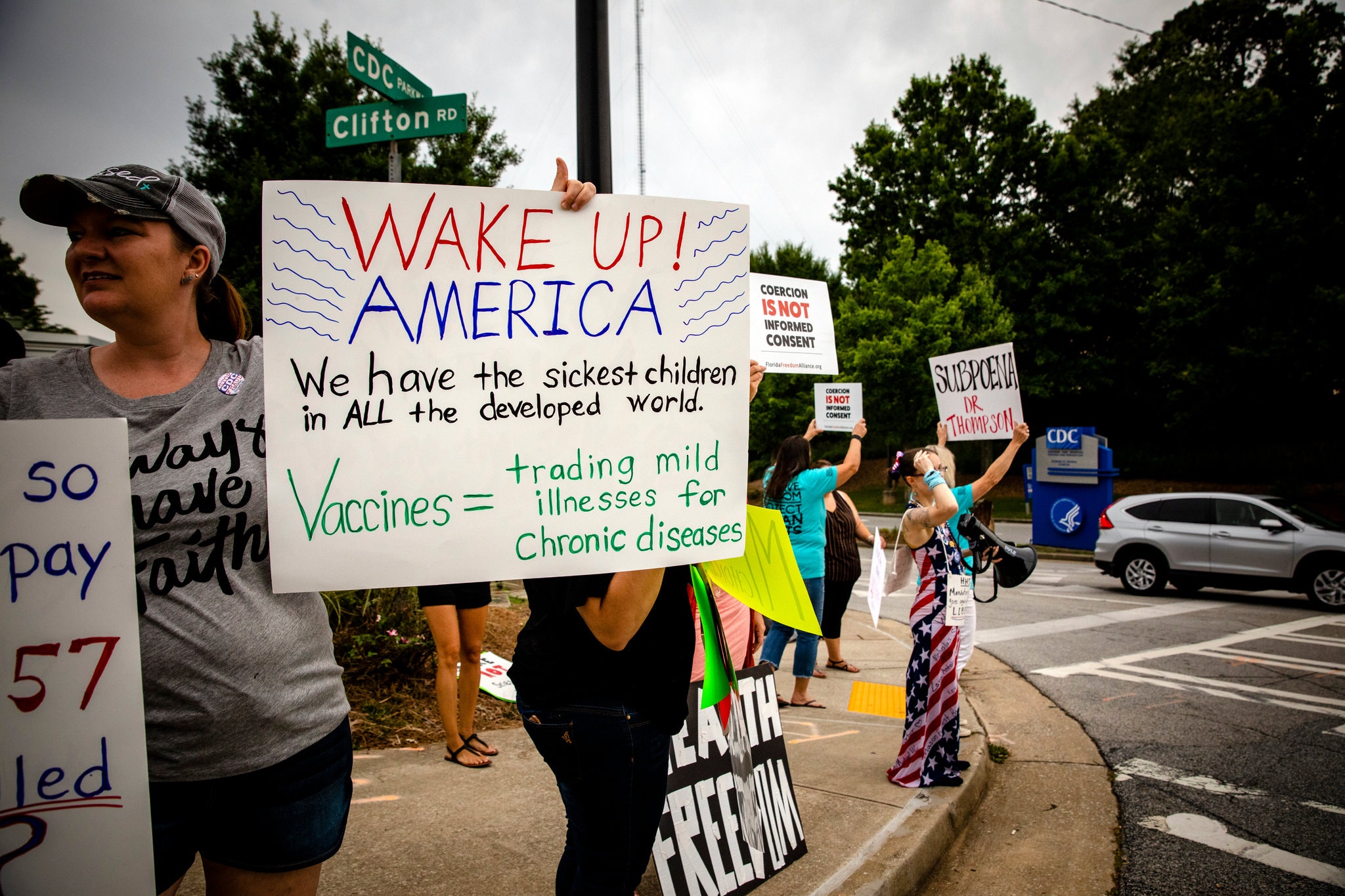
 Editor’s Note: The New York Times (and likely their biggest Big Pharma advertisers) are heralding a strongly-held opinion that choice regarding vaccines should not be an option for parents who may have good reason to believe their children are at risk. The almost completely unregulated vaccine industry is in denial regarding the potentially dangerous side effects, chronic illnesses that can result and in too many cases they’d rather not count – death. Not once in this well-written, one-sided article did the views, opinions or reasoning of the anti-vaccine crowd get acknowledged. This is but one of numerous op-ed articles the New York Times has recently published.
As families face back-to-school medical requirements this month, the country feels the impact of a vaccine resistance movement decades in the making. The question is often whispered, the questioners sheepish. But increasingly, parents at the Central Park playground where Dr. Elizabeth A. Comen takes her young children have been asking her: “Do you vaccinate your kids?”
Dr. Comen, an oncologist who has treated patients for cancers related to the human papillomavirus that a vaccine can now prevent, replies emphatically: Absolutely.
She never imagined she would be getting such queries. Yet these playground exchanges are reflective of the national conversation at the end of the second decade of the 21st century — a time of stunning scientific and medical advances but also a time when the United States may, next month, lose its World Health Organization designation as a country that has eliminated measles, because of outbreaks this year. The W.H.O. has listed vaccine hesitancy as one of the top threats to global health.
As millions of families face back-to-school medical requirements and forms this month, the contentiousness surrounding vaccines is heating up again, with possibly even more fervor.
Though the situation may seem improbable to some, anti-vaccine sentiment has been building for decades, a byproduct of an internet humming with rumor and misinformation; the backlash against Big Pharma; an infatuation with celebrities that gives special credence to the anti-immunization statements from actors like Jenny McCarthy, Jim Carrey and Alicia Silverstone, the rapper Kevin Gates and Robert F. Kennedy Jr. And now, the Trump administration’s anti-science rhetoric.
“Science has become just another voice in the room,” said Dr. Paul A. Offit, an infectious disease expert at Children’s Hospital of Philadelphia. “It has lost its platform. Now, you simply declare your own truth.”
The constituents who make up the so-called vaccine resistant come from disparate groups, and include anti-government libertarians, apostles of the all-natural and parents who believe that doctors should not dictate medical decisions about children. Labeling resisters with one dismissive stereotype would be wrongheaded.
“To just say that these parents are ignorant or selfish is an easy trope,” said Jennifer Reich, a sociologist at the University of Colorado Denver, who studies vaccine-resistant families.
[Why did we start listening to celebrities about vaccines? Read more.]
It remains true that the overwhelming majority of American parents have their children vaccinated. Parent-driven groups like Voices for Vaccines, formed to counter anti-vaccination sentiment, have proliferated. Five states have eliminated exemptions for religious and philosophical reasons, permitting only medical opt-outs.
But there are ominous trends. For highly contagious diseases like measles, the vaccine rate to achieve herd immunity — the term that describes the optimum rate for protecting an entire population — is typically thought to be 95 percent. The Centers for Disease Control and Prevention found that the vaccination rate for the measles, mumps and rubella (M.M.R.) injection in kindergartners in the 2017-2018 school year had slipped nationally to 94.3 percent, the third year in a row it dropped.
Seven states reported rates for the M.M.R. vaccine that were far lower for kindergartners, including Kansas at 89.1 percent; New Hampshire, 92.4 percent; the District of Columbia, 81.3 percent. (The highest is West Virginia at 98.4 percent.)
Almost all states have at least one anti-vaccine group. At least four have registered political action committees, supporting candidates who favor less restrictive vaccine exemption policies.
Public health experts say that patients and many doctors may not appreciate the severity of diseases that immunizations have thwarted, like polio, which can affect the spinal cord and brain — because they probably have not seen cases.
“Vaccines are a victim of their own success,” said Dr. Offit, a co-inventor of a vaccine for rotavirus, which can cause severe diarrhea in young children. “We have largely eliminated the memory of many diseases.”
The growth of vaccine doubt in America coincides with several competing forces and attitudes.
Since the early 2000s, as the number of required childhood vaccines was increasing, a generation of parents was becoming hypervigilant about their children and, through social media, patting each other on the backs for doing so. In their view, parents who permitted vaccination were gullible toadies of status quo medicine.
In 2011, Dana Fuqua, of Aurora, Colo., pregnant with her first child, felt that irresistible pull of groupthink parenting.
She had just moved to the area, so she reached out to mothers’ groups on Facebook. Colorado, with a kindergarten vaccination compliance rate of 88.7 percent, has a rambunctious vaccine-resistant movement. Ms. Fuqua’s new friends urged her to have a drug-free birth, use cloth diapers and never to let a drop of formula pass her baby’s lips. Vaccines, it followed, were anathema.
The women intimidated her. They had advanced degrees; she had only a bachelor of science and a nursing background.
“I didn’t argue with them,” Ms. Fuqua said. “I was so desperate for their support that I compromised by delaying the vaccine schedule, so I wouldn’t get kicked out of the group.”
But when her second child was born prematurely, susceptible to illness, the group’s approval was not as important as her baby’s safety. Her position, she said, shifted from, “‘I can’t hang out with you if you had a vaccine because you could be shedding a virus’” — a common, false belief among the vaccine resistant — to, “ ‘If you haven’t had a vaccine, I will not associate with you.’”
She had both children fully vaccinated.
There have been anti-vaccination movements at least since 1796, when Edward Jenner invented the smallpox vaccine. But many experts say that the current one can be traced to 1982, when NBC aired a documentary, “DPT: Vaccine Roulette,” that took up a controversy percolating in England: a purported tie between the vaccine for pertussis — a potentially fatal disease that can cause lung problems — and seizures in young children.
Doctors sharply criticized the show as dangerously inaccurate. But fear spread. Anti-vaccination groups formed. Many companies stopped making vaccines, which were considered loss-leaders and not worth the corporate headache.
Then, in 1998, Andrew Wakefield, a British gastroenterologist, published a Lancet study (since discredited and withdrawn), associating the M.M.R. vaccine with autism.
Faced with risking autism or measles, some parents thought the answer was obvious. Most had never seen measles, mumps or rubella because vaccines had nearly eliminated them. But they believed they knew autism.
And most people are notoriously poor at assessing risk, say experts in medical decision-making.
Many stumble on omission bias: “We would rather not do something and have something bad happen, than do something and have something bad happen,” explained Alison M. Buttenheim, an associate professor of nursing and health policy at the University of Pennsylvania School of Nursing.
People are flummoxed by numerical risk. “We pay more attention to numerators, such as ‘16 adverse events,’ than we do to denominators, such as ‘per million vaccine doses,’ ” Dr. Buttenheim said.
A concept called “ambiguity aversion” is also involved, she added. “Parents would like to be told that vaccines are 100 percent safe,” she said. “But that’s not a standard we hold any medical treatment to.”
Relatively few people are absolutists about refusing all vaccines. “But if you’re uncertain about a decision, you’ll find those who confirm your bias and cement what you think,” said Rupali J. Limaye, a social scientist who studies vaccine behaviors at the Johns Hopkins Bloomberg School of Public Health.
Nowhere is that reinforcement more clamorous than on social media, Dr. Limaye added. “You may only see your pediatrician a few times a year but you can spend all day on the internet,” she said.
People tend to believe an individual’s anecdotal narrative over abstract numbers. By 2007, when Ms. McCarthy, the actress, insisted that vaccines caused her son’s autism, thousands found her to be more persuasive than data showing otherwise. A nascent movement took hold.
At the same time that these powerful attacks on vaccine confidence were underway, a constellation of trends was emerging.
The definition of a good parent was becoming fraught with the responsibility for overseeing every aspect of a child’s life.
“As we adopted a culture of individualistic parenting, public health became a hard sell,” Dr. Reich said.
The primary reason for healthy people to get the flu shot is to protect those with compromised immune systems, like infants and older adults, from getting sick. But altruism isn’t a great motivator for parents, Dr. Buttenheim said. “They are much more concerned about protecting their own child at all costs,” she said.
Contrast that attitude with the collective good will of the 1950s, say medical sociologists, when American parents who had seen President Franklin Delano Roosevelt’s wheelchair as a debilitating symbol of polio patriotically sought to vaccinate their children to help eradicate the disease worldwide.
By 2014, studies showed that parental confidence in authorities like the C.D.C. and in pediatricians was dropping, especially around vaccines. Mistrust of Big Pharma was even more pronounced.
By then, Donald Trump was offering support on Twitter for the discredited link between autism and vaccination. As president-elect, he met with leaders of the anti-vaccination movement, although as measles cases surged, he endorsed vaccination.
As parenting became rife with orthodoxy, the Marcus Welby model of the paternalistic doctor retreated. Patients asserted autonomy, brandishing internet printouts at doctors. Shared decision-making became the model of doctor-patient engagement.
Pediatricians offered to stagger vaccine schedules. Some were even flexible about vaccinations altogether.
In 2011, shortly after Emma Wagner had given birth in Savannah, Ga., a pediatrician on the ward examined the baby. “He asked me if I was interested in the hepatitis B vaccine,” she said of an inoculation typically done at birth.
She was apprehensive.
He replied, “‘That’s fine, because your 2-day-old daughter isn’t a prostitute and isn’t using I.V. drugs, so hep B isn’t at the top of my worries.’”
Ms. Wagner said she “swallowed the anti-vax Kool-Aid. I was motivated by fear. I thought, ‘Until I know for certain that these are safe, I won’t do it.’ The pediatrician said, ‘I will support your decision and in a few years we’ll talk about exemptions for school.’”
She has since become a staunch supporter of immunization.
Libertarianism also courses through vaccine hesitation, with parents who assert that government should not be able to tell them what to put in their bodies — a position often marketed as “the right to choose.”
“Having the government order them to do something reinforces conspiracy theories,” said Daniel Salmon, director of the Institute for Vaccine Safety at Johns Hopkins. “And people perceive their risk to be higher when it’s not voluntary.”
In reality, he said, one’s risk of harm is greater while driving to an airport than it is being on the airplane itself. But driving is voluntary and gives the illusion of control. People fear flying because they cannot control the plane. By extension, many childhood vaccines are not voluntary, which rattles those who prefer to believe they can control their health.
With so many different but deeply held convictions, public health experts struggle to design vaccine-positive campaigns.
The results were intriguing. Those most resistant to vaccines scored highest in two values: purity (“my body is a temple”) and liberty (“I want to make my child’s health care decisions”).
A third, said Saad B. Omer, director of Yale’s Global Health Institute and an author of the study, was also telling: deference to authority — a score indicating whether one was likely to adhere to the advice of experts like a pediatrician or the C.D.C.
Dr. Salmon’s team at Johns Hopkins is working on an app to capture parents’ vaccine attitudes and to tailor information to persuade them to vaccinate their children.
Pediatricians are front-line persuaders, he said, and they should be compensated for the time it takes to educate parents.
Most experts note that physicians themselves, never mind parents, have no idea about the federal vaccine monitoring systems, which have been in place for more than 20 years.
“We ask parents in the first two years of their child’s life to protect them against 14 diseases, that most people don’t see, using fluids they don’t understand,” Dr. Offit said. “It’s time for us to stand back and explain ourselves better.”
Source: The New York Times

 Dr Chris Shaw, from the University of British Colombia’s (UBC) Department of Ophthalmology, Visual Sciences, Experimental Medicine and Neuroscience published a paper in the Journal Inorganic Biochemistry along with his colleague, Dr. Lucija Tomljenovic that revealed Government experts have known about the dangers associated with vaccinations. They investigated information exposing a 30 year scandal of official meetings by UK government vaccine committees and independent medical ‘experts’ with drug industry connections. The paper is at the bottom of the article under “sources”.
 Liberty International News