
Congressman Confronts Zuckerberg About Censoring Information About Vaccine Safety | Collective Evolution

By

  • The Facts: Senator Bill Posey from Florida recently questioned Mark Zuckerberg during a hearing on Capitol Hill about Facebook’s censorship on information that paints vaccines in a negative light,
  • Reflect On: Why do proponents of vaccines always use terms like . “anti-vax conspiracy theories” and ridicule instead of simply addressing the points and facts that are made by vaccine safety advocates like Bill Posey?

Editor’s Note: The end of free speech on the internet continues here with deliberate censorship of other perspectives re: vaccines by Facebook, Google and Apple News and other “gatekeepers” of information (and disinformation comes along with the package). 

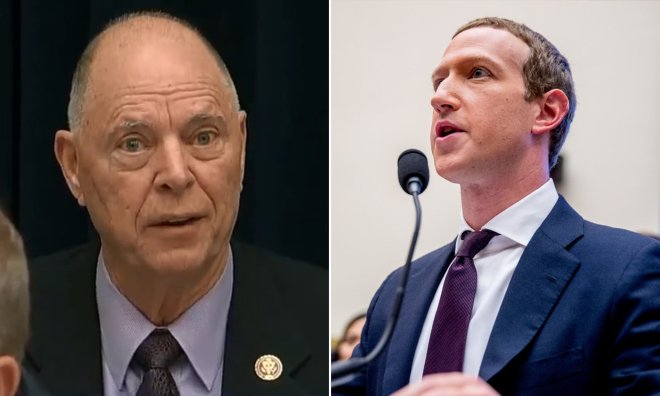
Mark Zuckerberg was recently confronted by Senator Bill Posey from Florida during a hearing on Capitol Hill about Facebook’s recent censorship on information about vaccine safety. Zuckerberg shared that they are simply conforming with the general scientific consensus, and do their best to censor information that may be harmful to people. This really shows his unawareness about vaccine safety, and he also used the term “anti-vaccine.” Furthermore, headlines are popping up within the mainstream once again reading “anti-vaccine conspiracy theories” and “vaccine misinformation.” This is a common tactic from the pharmaceutical controlled mainstream media, they always use these terms along with ridicule instead of addressing the concerns and points made by vaccine safety advocates. You can watch the Congressman and Zuckerberg’s exchange below, but first, I wanted to put a tidbit of information about why people are concerned about vaccines.

How safe are vaccines? More people are starting to realize that they are not as safe as they are marketed to be. This is why the National Childhood Vaccine Injury Act has paid out approximately $4 billion to compensate families of vaccine injured children. As astronomical as the monetary awards are, they’re even more alarming considering HHS claims that only an estimated 1% of vaccine injuries are even reported to the Vaccine Adverse Events Reporting, System (VAERS). Think about that for a minute, If the numbers from VAERS and HHS are correct – only 1% of vaccine injuries are reported and only 1/3 of the petitions are compensated – then up to 99% of vaccine injuries go unreported and the families of the vast majority of people injured by vaccines are picking up the costs, once again, for vaccine makers’ flawed products.

2010 HHS pilot study by the Federal Agency for Health Care Research (AHCR) conducted by Harvard doctors/researchers found that 1 in every 39 vaccines causes injury, a shocking comparison to the claims from the CDC of 1 in every million. You can read more about that here.

If we look at the MMR vaccine, for example, there have ben 93,929 adverse events, 1,810 disabilities, 6,902 hospitalizations, and 463 deaths. Furthermore, it’s well documented that the measles vaccine has been a complete failure. This is evident by the documented outbreaks in highly vaccinated populations up to the present day. A study published as far back as 1994 in JAMA Internal Medicine makes this quite clear.

We found 18 reports of measles outbreaks in very highly immunized school populations where 71% to 99.8% of students were immunized against measles. Despite these high rates of immunization, 30% to 100% (mean, 77%) of all measles cases in these outbreaks occurred in previously immunized students. In our hypothetical school model, after more than 95% of schoolchildren are immunized against measles, the majority of measles cases occur in appropriately immunized children. (source)

During the measles outbreak in California in 2015, a large number of suspected cases occurred in recent vaccinees. Of the 194 measles virus sequences obtained in the United States in 2015, 73 were identified as vaccine sequences. The media (Pharma-owned) generated high public anxiety. This fear mongering led to the demonization of unvaccinated children, who were perceived as the spreaders of this disease, this type of fear mongering happens all the time, and Facebook has been apart of it.

There are a number of concerns with vaccines, the list is quite large. Vaccine ingredients is another big concern.

A study published in 2011 makes the issue quite clear:

Aluminum is an experimentally demonstrated neurotoxin and the most commonly used vaccine adjuvant. Despite almost 90 years of widespread use of aluminum adjuvants, medical science’s understanding about their mechanisms of action is still remarkably poor. There is also a concerning scarcity of data on toxicology and pharmacokinetics of these compounds. In spite of this, the notion that aluminum in vaccines is safe appears to be widely accepted. Experimental research, however, clearly shows that aluminum adjuvants have a potential to induce serious immunological disorders in humans. (source)

The key takeaway here is that “medical science’s understanding about their mechanisms of action is still remarkably poor.”

After this study, more research came out to help us better understand what happens when aluminum is injected into the body. It has been found that injected aluminum does not exit the body; in fact, it stays in the body and travels to various organs in the brain, where it remains. This isn’t surprising since it’s the adjuvant, it’s designed to stay there or else the vaccine doesn’t work.

As the groundbreaking study in 2015 emphasized:

Evidence that aluminum-coated particles phagocytozed in the injected muscle and its draining lymph nodes can disseminate within phagocytes throughout the body and slowly accumulate in the brain further suggests that alum safety should be evaluated in the long term.

Furthermore, in 2018, a paper published in the Journal of Inorganic Biochemistry found that almost 100 percent of the intramuscularly injected aluminum in mice as vaccine adjuvants was absorbed into the systemic circulation and traveled to different sites in the body such as the brain, the joints, and the spleen, where it accumulated and was retained for years post-vaccination. (source)

You can watch a video here of Dr. Christopher Exley, a Professor in Bioinorganic Chemistry at Keele University explains what happens to aluminum when it is injected via a vaccine.

The Takeaway

Regardless of how mainstream media outlets are presenting this part of the hearing, it’s great to see Zuckerberg questioned about Facebook’s censoring of information regarding vaccines. We here at Collective Evolution have experienced this censorship, along with other independent media outlets, we’ve been heavily censored, blocked, and demonetized. A clear strategic agenda by Facebook, and those who control it, to shut down information and viewpoints that do not fit within the accepted framework of the global elite.

Senate Resolution Urges Formal House Vote on Initiating Impeachment Inquiry | The Epoch Times

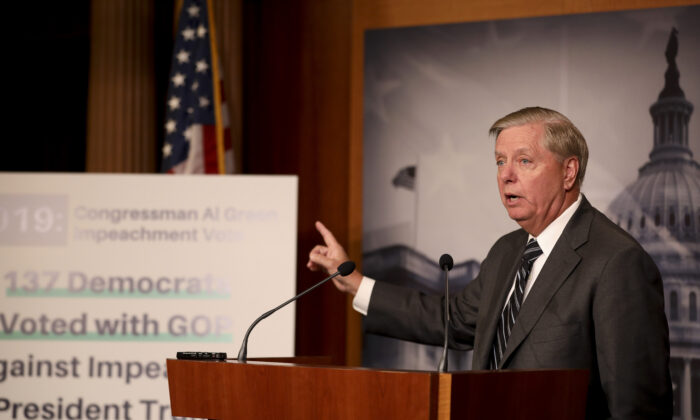
Sen. Lindsey Graham (R-S.C.) holds a press conference about the House impeachment inquiry process, on Capitol Hill in Washington on Oct. 24, 2019. (Charlotte Cuthbertson/The Epoch Times)

Editor’s Note: We the People are witnessing an attempted coup d’tat of our United States government in broad daylight and this impeachment inquiry is a smokescreen, a distraction, a false narrative and coverup orchestrated by the many co-conspirators who before Trump was elected in 2016 decided to manufacture a false accusation re: Russian collusion to discredit him. These “enemies of the state” decided that should Trump be elected that they would take it into their own hands to overthrow a duly elected President of the United States. If you are one of the many naive American’s who actually believe what you read in the mainstream, corporate newspapers and are not savvy enough to understand the hidden powers that pull the strings behind the curtain of the U.S. Congress, then shame on you. Wake Up America before it’s too late!

Sen. Lindsey Graham (R-S.C.) introduced a non-binding resolution on Oct. 24 calling on House Democrats to hold a formal vote on initiating an impeachment inquiry before moving any further in the investigation of President Donald Trump.

Thirty-five Republican senators co-sponsored the resolution, which also demands that the impeachment inquiry accommodate Trump with constitutional due-process protections. By early evening on Oct. 24, the number of co-sponsors had reached 46.

“The House of Representatives is abandoning more than a century’s worth of precedent and tradition in impeachment proceedings and denying President Trump basic fairness and due process accorded every American,” the resolution (pdf) states.

“One of the cornerstones of the American Constitution is due process: the right to confront your accuser, call witnesses on your behalf, and challenge the accusations against you.”

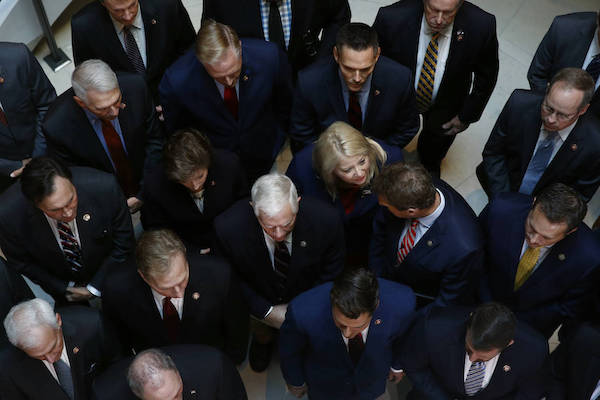
Senate Republicans unveiled the resolution one day after roughly three dozen House Republicans stormed a hearing room during a House Intelligence Committee impeachment deposition to demand that the closed-door hearings be opened to lawmakers and the public.

The resolution points out that during the three prior impeachment proceedings, the House held a formal vote to initiate an impeachment inquiry. In Trump’s case, the process was replaced by a press conference by House Speaker Nancy Pelosi (D-Calif.), the Republicans charge.

“The proposition that the Speaker acting alone may direct committees to initiate impeachment proceedings without any debate or a vote on the House floor is unprecedented and undemocratic,” the resolution states.

Prior impeachment proceedings allowed the presidents to have counsel present at hearings and depositions, according to the resolution. In each case, the presidents’ lawyers were allowed to introduce and object to evidence and call on and cross-examine witnesses.

“By contrast, the House’s current impeachment ‘inquiry’ provides none of these basic rights and protections to President Trump,” the co-sponsors say. “The main allegations against President Trump are based on assertions and testimony from witnesses whom he is unable to confront, as part of a process in which he is not able to offer witnesses in his defense or have a basic understanding of the allegations lodged against him.”

House Democrats are investigating allegations related to President Donald Trump’s phone call with Ukrainian President Volodymyr Zelensky. During the conversation on July 25, Trump asked Zelensky to look into two matters. The first request concerned a server tied to Crowdstrike, the cybersecurity firm that analyzed the Democratic National Committee server allegedly breached by Russian government hackers. The second request concerned allegations of corruption by former vice president Joe Biden and his son Hunter Biden.

The Democrats have conducted all of the hearings to date behind closed doors. The public’s access to the information has so far been limited to leaks to the media and a handful of documents published by the committees.

The Democrats have defended the process, claiming that lawmakers in prior impeachment proceedings worked from material collected through an investigation by a special counsel. Meanwhile, the lawmakers took up the current case without letting a special counsel conduct an inquiry. As a result, the process requires secrecy so that witnesses don’t adjust their testimony.

The constant leaks from the inquiry have undermined the advantages gained through secret proceedings. Republicans say they don’t have access to transcripts of the depositions. Meanwhile, leaked information seems to consist almost entirely of sections of testimony damaging to Trump.

The minority Republicans on the three committees conducting the impeachment inquiry don’t have the same rights as those that were granted to the minority Democrats during the House impeachment inquiry of President Bill Clinton, including the ability to issue subpoenas. The resolution calls on the Democrats to follow precedent and grant Republicans the same rights.

“We’re not telling the House they can’t impeach the president. What we’re telling the House is, there’s a right way to do it, and a wrong way to do it,” Graham told reporters. “This is one part legal, and two parts politics.”

The White House has refused to cooperate with the impeachment inquiry unless the Democrats hold a vote to formally launch the inquiry. The president has denied any wrongdoing in his call with Zelensky. The Ukrainian leader said he wasn’t pressured during the phone call.

Trump on Oct. 23 criticized the impeachment inquiry along lines similar to the Senate resolution.

“Do Nothing Democrats allow Republicans Zero Representation, Zero due process, and Zero Transparency,” the president wrote on Twitter. “Does anybody think this is fair?”

The Democrats allege that in order to pressure Zelensky, Trump placed a temporary hold on military aid to Ukraine. All of the witnesses who have testified to date say that Ukrainian officials were unaware of the hold until one month after the Trump–Zelensky phone call.

Source: The Epoch Times

Scientific American, The Oldest US Monthly Magazine, Issues Severe Warning on 5G | Waking Times

By Terence Newton

Editor’s Note: This is yet another tragic example of the unleashing of a new technology which has not been properly tested before deployment. Are these technology corporations so out of touch with their own humanity they do not consider the consequences beyond their own bottom line? 5G could very well be an end game for the human beings who cannot adapt to such high-levels of EMF in the environment and an extinction level event for many other creatures as well.

In a recently published article entitled, We Have No Reason to Believe 5G is Safe, Scientific American (SciAm) magazine issued a stern warning about the known and potential dangers of 5G technology.

Of particular significance is the fact that SciAm is the oldest continuously published monthly magazine in the United States, founded by inventor and publisher Rufus M. Porter in 1845, and running monthly since 1921. It is a highly influential publication, widely reputed for its rigorous scientific standards, and lauded by today’s fact-checkers as highly credible and staunchly pro-science.

In the article, University of California, Berkeley public health researcher Joel M. Moskowitz argues that 5G, along with previous w-fi and cellular technology, is much more harmful than the government and telecomm industry wants the public to believe.

READ: UN STAFFER WARNS THAT 5G IS A ‘WAR ON HUMANITY’

His primary concerns center around a recent FCC announcement, made in a press release, that the FCC is close to reaffirming the radio frequency radiation (RFR) exposure limits that were previously adopted by the commission in the 1990’s… well before the introduction of 5G, 4G, 3G, 2G or even WiFi.

In short, the safety standards that the FCC wishes to maintain are severely outdated and fail to reflect the growing body of scientific evidence demonstrating harm.

Moskowitz notes that the ’90’s exposure limits only address the singular concern over the potential effects of the intensity of exposure to RFR. With the research we now have available the health concerns are much broader, including a sincere risk of cancer, among other things.

READ: 5G NETWORK USES SAME EMF WAVES AS PENTAGON CROWD CONTROL SYSTEM

Moskowitz also cites the the International EMF Scientist Appeal, which elaborates on the now-known dangerous effects of RFR:

Moskowitz points out that,”the scientists who signed this appeal arguably constitute the majority of experts on the effects of nonionizing radiation. They have published more than 2,000 papers and letters on EMF in professional journals.” Inviting readers and policy makers to consider the weight of more than 500 peer-reviewed research studies finding, “harmful biologic or health effects from exposure to RFR at intensities too low to cause significant heating,” Moskowitz believes that more rigorous studies are necessary before the rollout goes forward.

READ: PROMINENT BIOCHEMISTRY PROFESSOR WARNS – 5G IS THE ‘STUPIDEST IDEA IN THE HISTORY OF THE WORLD’

In other words, the scientific jury is already out on the harmful effects of RFR, and the FCC is flat-out derelict in its duty to put public safety above telecomm industry interests.

Regarding the propaganda dimension of this debate, Moskowitz addresses the fact that industry spokepersons and related government officials frequently refer to contrarian viewpoints as ‘fear-mongering,’ pointing out that the current scientific research is legitimate, leaving the scientific community with a genuine responsibility to speak out about these concerns.

Final Thoughts

Cracks are showing in the government and telecom industry’s blanket assertion that 5G is safe, and many prominent and influential scientists, dignitaries, and organizations are now speaking out against 5G – the global human experiment without consent.  For the editorial board of Scientific American to run a piece this condemning 5G is a very strong signal that even the most mainstream elements of the scientific community are genuinely concerned.

Read more articles from Terence Newton.

Terence Newton is a staff writer for WakingTimes.com, interested primarily with issues related to science, the human mind, and human consciousness.

This article (Scientific American, the Oldest US Monthly Magazine, Issues Severe Warning on 5G) was originally created and published by Waking Times and is published here under a Creative Commons license with attribution to Terence Newton and WakingTimes.com. It may be re-posted freely with proper attribution, author bio, and this copyright statement. 

Source: Waking Times

GOP Members Storm Closed Door House Session | Trending Politics

Editor’s. Note: An impeachment process must be transparent, open and factual. There’s something terribly wrong and one-sided if Republicans are not allowed to participate in the inquiry. 

On Wednesday, GOP members made the move to storm a closed door impeachment session, forcing far-left Rep. Adam Schiff to suspend the meeting and run from the scene.

Democrats have made the ongoing impeachment inquiry as secret as possible, offering no public transparency.

During a press conference before storming the hearing, Rep. Matt Gaetz (R-FL) said: “We’re going to try and go in there, and we’re going to try to figure out what’s going on, on behalf of the millions of Americans that we represent that want to see this Congress working for them and not obsess with attacking a president who we believe has not done anything to deserve impeachment.”

House Minority Whip Steve Scalise also spoke out: “What is Adam Schiff trying to hide? I think that’s the question so many people have, so many of my colleagues have, so many people in the press should have.”

“Voting members of Congress are being denied access from being able to see what’s happening behind these closed doors where they’re trying to impeach the president of the United States with a one-sided set of rules,” Scalise continued. “They call the witnesses. They don’t let anybody else call the witnesses.”

“We’re gonna’ go and see if we can get inside,” Gaetz added.

It was then when the 30 Republicans stormed the closed-door hearing, forcing Schiff to run out and hide.

“He doesn’t have the guts to come talk to us,” Rep. Roger Marshall said. “He left, he just got up and left. He doesn’t have the guts to tell us why we can’t come in the room, why he doesn’t want this to be transparent. It’s the biggest facade, biggest farce of my life.”

Rep. Bradley Byrne too to Twitter saying: “Adam Schiff just SHUT DOWN his secret underground impeachment hearing after I led a group of Republicans into the room. Now he’s threatening me with an Ethics complaint! I’m on the Armed Services Cmte but being blocked from the Dept. Asst. SecDef’s testimony. This is a SHAM!” he wrote.

Republicans are clearly upset with the lack of transparency from Schiff and the rest of the Democrats. Gaetz has tried to attend the meetings however “he could not attend because he is not part of the House Intelligence Committee, which is conducting the investigation along with the House Oversight and Foreign Affairs Committees,” Fox New reported.

“Judiciary Chairman [Jerry Nadler] claimed to have begun the impeachment inquiry weeks ago,” Gaetz previously said. “Now, his own Judiciary members aren’t even allowed to participate in it. And yes — my constituents want me actively involved in stopping the #KangarooCourtCoup run by Shifty Schiff.”

House Democrats defended Schiff, saying that Schiff was in the right.

“I guess when you’re desperate you go back to complaining about the process, and that’s what they’re doing,” said Rep. Val Demings said.

“I think it’s completely inappropriate. I think when the facts are against you, the law is against you, the President apparently committed a crime, you are left with arguing process, and that’s what they’re arguing,” Rep. Harley Rouda (D-CA) said.

“We’re embarrassing ourselves in front of company,” said Rep. Mike Quigley of the House Intelligence Committee.

Source: Trending Politics

Citing 1851 Treaty, Water Protectors Establish Road Blockade and Expand Frontline #NoDAPL Camp | LR inspire

Editor’s Note: Indigenous nations are still seeking respect for the sovereignty of their lands stolen by military occupation and Treaties the United States did not honor. Here’s another action re: DAPL pipeline.

Cannon Ball, ND – This morning, at approximately 8am central, water protectors took back unceded territory affirmed in the 1851 Treaty of Ft. Laramie as sovereign land under the control of the Oceti Sakowin, erecting a frontline camp of several structures and tipis on Dakota Access property, just east of ND state highway 1806. This new established camp is 2.5 miles north of the Cannon Ball River, directly on the proposed path of the Dakota Access Pipeline (DAPL). This site is directly across the road from where DAPL security dogs attacked water protectors on September 3rd.

To ensure the protection of this new camp from overtly militarized law enforcement, water protectors have established three road blockades:

North of the Frontline Camp, on Highway 1806
South of the Cannon Ball River, on Highway 1806
And Immediately west of Highway 1806, on county road 134

Police have discharged weapons, using rubber bullets to shoot down drones being used to document the police activity and actions.

This frontline camp is located on the final three 3 miles of the proposed pipeline route, before it connects with the drill pad that will take the pipeline beneath the Missouri River. Active construction of the Dakota Access pipeline is 2 miles west of this frontline camp. Oceti Sakowin water protectors continue an on-going pledge to halt active construction as frequently as possible.

Mekasi Camp-Horinek, an Oceti Sakowin camp coordinator states, “Today, the Oceti Sakowin has enacted eminent domain on DAPL lands, claiming 1851 treaty rights. This is unceded land. Highway 1806 as of this point is blockaded. We will be occupying this land and staying here until this pipeline is permanently stopped. We need bodies and we need people who are trained in non-violent direct action. We are still staying non-violent and we are still staying peaceful.”

Joye Braun, Indigenous Environmental Network organizer states, “We have never ceded this land. If DAPL can go through and claim eminent domain on landowners and Native peoples on their own land, then we as sovereign nations can then declare eminent domain on our own aboriginal homeland. We are here to protect the burial sites here. Highway 1806 has become the no surrender line.”

Ladonna Bravebull Allard, Sacred Stone Camp, “We stand for the water, we stand on our treaties, we stand for unci maka- we stand and face the storm.”

Contact: LaDonna Allard (CSS), ladonnabrave1@aol.com, (701) 426-2064
Dallas Goldtooth (IEN), dallas@ienearth.org, 708-515-6158
Tara Houska (HTE), tara@honorearth.org, (612) 226-9404
Cody Hall (RWC), cody.hall.605@gmail.com, (605) 220-2531

Source: LR Inspire

Bill Gates is continuing the work of Monsanto | FRANCE 24

Source: YouTube

Former House lawyer says Pelosi’s impeachment inquiry ‘is illegal’ | The Washington Times

Editor’s Note: The House Permanent Select Committee on Intelligence led by Rep. Adam B. Schiff is not authorized under the rules to lead an impeachment probe. Under H.Res 658 established by the 95th Congress (1977- 78), this Select Committee has oversight over the activities of the CIA and has no jurisdiction to conduct an impeachment inquiry against the President of the USA.

Thanks to a flurry of Ukraine activity, House Speaker Nancy Pelosi and her Democratic majority have approved more subpoenas to investigate President Trump than they have written laws.

The subpoena issued Tuesday morning to former Ambassador William Taylor marked the 56th that has been publicly acknowledged and aimed at Mr. Trump and his team. That is 10 more than the 46 House bills that have become law this year.

It’s far from a subpoena record, but it is complicating Mrs. Pelosi’s attempt to portray her troops as focused on their agenda.

Perhaps more worrying to Mrs. Pelosi’s cause is the conclusion of a former senior oversight attorney for the House, who said the spate of subpoenas issued this month as part of Democrats’ impeachment inquiry is illegal.

Samuel Dewey, a lawyer at McDermott Will & Emery who used to lead investigations for the House Financial Services Committee, said the House Permanent Select Committee on Intelligence, led by Rep. Adam B. Schiff of California, is not authorized under the rules to lead an impeachment probe.

“Unless there’s a bunch of stuff that’s not public, which would in itself be extraordinary, there is no way he has jurisdiction to conduct an impeachment inquiry. I think his proceeding is illegal,” Mr. Dewey said.

Mr. Schiff’s impeachment inquiry subpoenas have all centered around Mr. Trump’s attempts to rope Ukraine into investigating a potential political opponent, former Vice President Joseph R. Biden. The Washington Times counts 15 publicly acknowledged subpoenas issued on the Ukraine matter so far, including the one Tuesday to Mr. Taylor.

The House also has approved 22 subpoenas related to special counsel Robert Mueller’s investigation into Russian meddling and Trump campaign behavior in 2016, seven subpoenas dealing with the president’s finances, three concerning White House matters such as security clearances or the activities of Trump aide Kellyanne Conway, five subpoenas over immigration policy, three over Mr. Trump’s now-abandoned attempt to ask about citizenship on the 2020 census, and one subpoena to the State Department over U.S. policy in Afghanistan.

Those are publicly acknowledged subpoenas that have been approved or for which chairmen have given notice. Other subpoenas may have been sent in secret, which would mean the ratio of subpoenas to bills could be even higher.

“This is becoming a do-nothing Congress, and it will ultimately cost them the majority in 2020,” said Corey Lewandowski, a confidant of Mr. Trump and the target of one of the 56 subpoenas, sent in August.

Mr. Lewandowski questioned the way Democrats went about calling him. He said it seemed more about confrontation than getting information.

His subpoena was issued even though his attorney told the House Judiciary Committee that he was willing to testify voluntarily — as he had already done for two other committees. But Chairman Jerrold Nadler of New York issued a subpoena anyway. Mr. Lewandowski said he learned about it first from a reporter, hours before his own attorney received notice from the committee.

“Perhaps they wanted to make it a media story,” he said. “I think that the hearing itself was for show.”

He pointed out that the subpoena was issued the same day Mr. Trump was traveling to New Hampshire, where he all but endorsed a potential U.S. Senate bid for Mr. Lewandowski.

He also said the committee treated him differently than Mr. Mueller, who, unlike Mr. Lewandowski, demanded to be subpoenaed.

When during his July hearing a lawmaker asked Mr. Mueller to read parts of his report and he declined, the committee accepted that. When Mr. Lewandowski was asked and tried to decline, he was castigated.

“I just wanted to be treated the same,” he said. “I don’t think they did that.”

Mr. Lewandowski said he doesn’t question the legality of his subpoena. By that point, Mr. Nadler was arguing to the courts that he was engaged in an impeachment inquiry and had received his committee’s approval for 18 subpoenas related to the Russia investigation.

That probe petered out after Mr. Lewandowski’s testimony.

Now the focus is on Ukraine, and Mr. Nadler’s committee has been sidelined.

The Washington Times reached out to staff for Mr. Nadler’s committee and three others responsible for almost all of the subpoenas. None of them responded.

But Rep. Gerald E. Connolly, a Virginia Democrat and senior member of the Oversight and Reform Committee, challenged The Times’ comparison of laws to subpoenas. He said the House can issue the subpoenas on its own but needs cooperation from the Republican-led Senate and Mr. Trump to write legislation.

He said Senate Majority Leader Mitch McConnell, Kentucky Republican, is refusing to pass Democrats’ bills, hurting their legislative record.

“Something becomes law when both parties vote for it. And we’ve passed easily 100 pieces of legislation waiting at the grim reaper’s — Mitch McConnell — desk,” he said. “We’ve got at least 100 more ready to go. They won’t bring it up.”

The House is on a good pace with 46 bills signed into law. Eight years ago, when Democrats controlled the White House and Senate and Republicans led the lower chamber, the House had written 32 bills signed into law at this point.

In 1995, when Republicans took both houses of Congress under a Democratic president, just 23 House bills were signed into law by this point.

Mrs. Pelosi’s tally this year is inflated by nine ceremonial pieces of legislation, such as renaming post offices. Even among the substantive bills, many are tweaks or extensions to current law, leaving few marquee accomplishments.

Mr. Connolly said whatever the ratio, the House is well behind Republicans in terms of subpoena records. When Republicans controlled the House and Barack Obama was in the White House, he said, the Oversight and Government Reform Committee alone fired off “well over 100 subpoenas.”

During the 1990s, when President Clinton was in office, Rep. Dan Burton sent out more than 1,000, including one notorious incident in which he sent a subpoena to the wrong person because he confused two people with similar Asian surnames.

But Rep. Jim Jordan of Ohio, the top Republican on the oversight committee, said the subpoena numbers summed up Mrs. Pelosi’s tenure.

“We’ve been saying this. When the Democrats are completely focused on attacking the president, it’s tough to do what’s best for the country,” he told The Times.

Mr. Dewey, the former House attorney, indicated that Democrats have been more publicly confrontational in their approach to subpoenas than past congresses.

He said his own usual approach was to make a voluntary request to a target for documents or testimony and try to reach accommodations with those who resisted. Only after that failed would a subpoena be necessary, he said. He also said he worked with his counterparts in the other party, notifying them when subpoenas were issued.

“Honestly, if you’re cutting corners on procedure, my experience is you’re hiding something or you’re just lazy,” he said.

Mr. Dewey said Democrats could face a legal challenge over any impeachment-related subpoenas because the House has yet to vote to authorize an inquiry. Mrs. Pelosi created an inquiry by proclamation, turning the reins over to Mr. Schiff. Mr. Nadler, meanwhile, has argued to the courts that he has been in the midst of an inquiry for months.

Mr. Dewey said those arguments aren’t frivolous, but “I think they’re wrong.”

“I do not think as a matter of law that the Judiciary Committee can exercise the impeachment power without a vote of the full House,” he said. “And I think independently of that, I do not think any other committee can exercise the impeachment power.”

He said that could be an argument Mr. Trump’s team could make to defy some of the impeachment inquiry’s demands.

“It’s the defense to a subpoena,” he said. “I think that you would have a way to challenge it.”

Source: The Washington Times

Final Note: The committee oversees all or part of the following executive branch departments and agencies:

Four lessons from the biggest riots in decades | Sovereign Man

Editor’s Note: When stupid people take to the streets and cause reckless destruction everybody pays the price. Don’t let these radical fools destroy well-being for the rest of us because they’re angry, because they don’t like something, because they are do-nothing complainers. It’s everybody’s responsibility to cool down the flames of discontent and find meaningful ways to solve social, economic and political problems without resorting to violence. Martin Luther King would be ashamed of such violence!

If you’re been following the news, you might have seen reports about civil unrest in Chile– the worst in decades.

I lived in Chile for more than seven years before moving to Puerto Rico; I still have business interests there, along with hundreds of employees (both foreign and local), many of whom I’ve been speaking to over the last few days.

First things first, Chile is ordinarily a quiet, stable, peaceful country.

The last time Chile went to war was 140 years ago back in 1879. They even skipped both world wars.

And while there are occasional protests, Chile is quite tame by Latin American standards.

It’s also the most modern and advanced nation in the region– this is not a destitute, impoverished country.

Chile has thriving industries and a large middle class that’s in better shape than just about anywhere else in the region.

But just like every other country in the world, there are countless imperfections.

Inflation has eaten away at the purchasing power of workers’ incomes, and a lot of people are struggling to make ends meet.

The proverbial straw that broke the camel’s back was a 3% increase in metro fares.

It’s nothing. But it was enough to make thousands of people become completely unglued, resulting in riots, looting, arson, and all-out mayhem.

Let’s talk about some of the key lessons from this:

1) It can happen anywhere.

It’s not just Chile. Looking around the world right now we can see major demonstrations and even violence in places like Hong Kong, Spain, Haiti, Lebanon, etc.

The ‘yellow vest’ movement in France in late 2018/early 2019 brought hundreds of thousands of people out into the streets to torch cars and destroy property, all apparently in protest of rising fuel prices.

Political tensions, social tensions, economic tensions… they exist everywhere, in rich countries and poor countries alike.

People everywhere are tightly wound, and it doesn’t take much for them to become unhinged. If you think this can’t happen where you live, think again.

2) It can happen faster than anyone realizes.

The weather in central Chile is one of the great benefits of living there; it’s warm, sunny, and dry… southern California climate.

And this past Friday was a particularly beautiful day. By lunchtime, people were out in the parks enjoying the weather. It was calm, peaceful, and joyful.

Within a matter of hours the city had turned into a war zone. Hours.

One of my team members told me on the phone yesterday, “If you had said on Friday afternoon that Santiago would be in chaos by nightfall, I would have laughed… And then it happened.”

3) It only takes a few idiots.

There are roughly 18 million people living in Chile. And there may even be a few million people nationwide who are deeply frustrated about the rising cost of living.

But only a few thousand have been stupid enough to cause such chaos and devastation; they’ve destroyed dozens of metro stations, buses, and even lit office buildings and grocery stores on fire.

Innocent people have died. And almost everyone else has had their lives heavily disrupted.

They can’t get to work. Schools are closed. Grocery store lines are crazy. There’s a curfew. Tanks are in the streets.

Most people are rational and peaceful. They might be angry about certain issues, but they know that torching property and killing innocents won’t solve anything.
Only a trivial fraction of a percent of the population are acting like cowards– the ones who steal a bunch of flat-screen televisions from the neighborhood electronics store before setting it on fire.

And they’re selfish and delusional enough to believe in their own righteousness– that their actions are justified as payback because of some economic injustice.

Yeah. Because nothing proves your moral superiority more than looting flat-screen TVs.

4) They often think Socialism is the answer.

Human beings seem hardwired to think that they can solve any economic injustice with Socialism.

More often than not, people don’t even think through the issues. They feel symptoms– difficulty making ends meet, difficulty getting ahead in life, etc. and they get angry.

And that’s where the analysis stops. There is no analysis actually. It’s just anger.

A rational person thinks things through– why is my cost of living increasing? Why aren’t I getting ahead? What’s the root cause of these problems? How can I fix it?

Again, Chile isn’t perfect. Not by a long shot.

But think about the 18-year old kid taking selfie videos while lighting a grocery store on fire because he’s angry… angry that his education was sub-par, angry that he can’t find a good paying job.

And he’s partially right. Public education in Chile is pretty bad, and he doesn’t have the skills for a high-paying career.

But I wonder how many books he’s read this year? How many free online courses has he taken? What has he done to solve his own problem?

Instead of torching buildings, he could have been at home watching countless videos on YouTube learning how to code in Python. For free.

And in developing real, marketable skills, he would become much more valuable and able to command a substantial wage and work remotely for prospective clients and employers worldwide.

But the Socialist mentality is not about solving your own problems.

Socialism means that you don’t have to lift a finger (except to light a match).

You just have to throw a temper tantrum until someone else solves your problems… even if you can’t even define your problem or present a reasonable solution.

I don’t want to make light of the issues; there are several problems that protesters have bought up which I agree with. But neither Socialism nor burning buildings ever solved any problems.

It may take time, but Chile is undoubtedly going to recover from this nightmare and move on. The ‘sane’ population (i.e. the vast majority) is already fighting back and defending their neighborhoods.

Source: Sovereign Man

Trump’s Error-filled Cabinet Meeting | FactCheck.org

By , , , and

For more than an hour, President Donald Trump presided over a cabinet meeting, reeling off numerous false or misleading claims:

  • Trump claimed, without evidence, that President Barack Obama tried to call North Korean leader Kim Jong Un “11 times” but that “the man on the other side … did not take his call” due to a “lack of respect.” Obama’s national security adviser and deputy national security adviser both called Trump’s claim false.
  • Trump took credit for making a “deal” between Turkey and the Syrian Kurds that he said “people have been trying to make” for years. One expert called this claim “nonsense.” The deal is only a five-day pause in the conflict that arose when Trump pulled U.S. troops from the Syria-Turkey border.
  • The president boasted that “nobody has ever done” a National Prescription Drug Take Back Day until he took office. In fact, it started in 2010.
  • He wrongly claimed that “many” of the “ambassadors” House Democrats are interviewing in the impeachment inquiry were “put there” by past administrations. Seven of the nine officials who have testified behind closed doors so far were appointed to their most recent positions under Trump’s administration.
  • Trump made the illogical and unsubstantiated claim that there was no informant who provided information to the whistleblower, whose complaint triggered an impeachment inquiry. And even more absurdly, Trump suggested the informant was Rep. Adam Schiff, chairman of the House intelligence committee.
  • Trump was wrong in saying “no other president” has donated his salary. John F. Kennedy and Herbert Hoover also did so, according to news reports and Hoover’s library.
  • In defending the quashed plans to hold the next G-7 at his own resort, Trump suggested that Obama getting a book deal was like “running a business” while Obama was in office. The deal came after Obama left office.
  • Trump said, “China is doing very poorly — worst year they’ve had in 57 years.” China announced its economy grew by 6% in the third quarter of 2019, when compared with the same period the previous year. That was “the weakest pace in at least 27-1/2 years,” according to a Reuter’s analysis of quarterly data.

Trump made his remarks during an Oct. 21 cabinet meeting, which started — after a prayer from Housing and Urban Development Secretary Ben Carson — with the president talking about the U.S. economy, which he described as doing “fantastically well.” (See “Trump’s Numbers October 2019 Update” for a statistical measure of how things have changed since Trump took office.)

Calling Kim Jong Un

Trump claimed, without evidence, that President Barack Obama tried to call North Korean leader Kim Jong Un “11 times,” but Kim “did not take his call.”

Trump, Oct. 21: I like Kim; he likes me. We get along. I respect him; he respects me. You could end up in a war. President Obama told me that. He said, “The biggest problem — I don’t know how to solve it.” He told me doesn’t know how to solve it. I said, “Did you ever call him?” “No.” Actually, he tried 11 times. But the man on the other side — the gentleman on the side did not take his call. Okay? Lack of respect. But he takes my call.

Obama’s national security adviser and deputy national security adviser both called Trump’s claim false.

Susan Rice, who served under Obama as the U.S. ambassador to the United Nations from 2009 to 2013 and as Obama’s national security adviser from 2013 to 2017, tweeted that Trump’s claim is “a total fabrication.” She added, “Trump is completely delusional, and it’s scary.”

Likewise, Ben Rhodes, who served as Obama’s deputy national security adviser, tweeted, “Obama never called Kim Jong Un. Obama never tried to meet Kim Jong Un. Trump is a serial liar and not well.”

Trump’s claim is similar to one we fact-checked back in July. Then, Trump said Obama was “constantly … begging for meetings” but that Kim Jong Un refused. As we wrote then, Obama administration officials and experts on U.S.-North Korea relations said that’s not true.

“At the risk of stating the obvious, this is horse-sh*t,” Rice tweeted then. “Yes. It’s horseshit,” added Gen. Michael Hayden, via TwitterHayden served as director of the CIA from 2006 to Feb. 12, 2009, shortly after Obama took office.

A Deal Between Turkey and Syrian Kurds

Trump praised his decision to withdraw U.S. troops from northern Syria, saying the subsequent fighting that resulted between Turkey and the Syrian Kurds sparked a “deal” that he claimed “people have been trying to make” for years.

Trump, Oct. 21: If shooting didn’t start for a couple of days, I don’t think the Kurds would have moved. I don’t think, frankly, you would’ve been able to make a very easy deal with Turkey. … If they didn’t go through two and a half days of hell, I don’t think they would’ve done it. I think you couldn’t have made a deal. And people have been trying to make this deal for years. But we’re close to making it. We’ll see what happens.

Henri Barkey, a professor of international relations at Lehigh University and adjunct senior fellow for Middle East studies at the Council on Foreign Relations, called Trump’s claim of failed past attempts to broker such a deal “complete nonsense.”

“There is no effort of any sorts in the past between Turkey and Syrian Kurds,” Barkey told us in an email. “He is making things up.”

On Oct. 6, the White House announced it would withdraw U.S. special forces in northern Syria and that Turkey would soon move “forward with its long-planned [military] operation” against the Syrian Kurds, who had been U.S. allies in the fight against the Islamic State. Three days later, Turkish President Recep Tayyip Erdogan started “Operation Peace Spring,” resulting in dozens of deaths of civilians and Kurdish fighters.

After bipartisan criticism, Trump sent Vice President Mike Pence to meet with Erdogan in Ankara, Turkey, where on Oct. 17 they announced a five-day pause in the Turkish military operation to “allow for the withdrawal of YPG” from “the nearly 20-mile-wide safe zone area, south of the Turkish border in Syria.” The People’s Protection Units, or the YPG, is the armed wing of the Syrian Kurdish Democratic Union Party.

Turkey does have a long history of conflict with the Kurds, but direct Turkish involvement in northern Syria dates only to 2016. In August 2016, Turkey began Operation Euphrates Shield in northern Syria to clear the area of Islamic State terrorists and “prevent the YPG from establishing an autonomous area along the northern Syrian border with Turkey,” as explained in a January Congressional Research Service report.

Turkey felt threatened by the Syrian Kurds on its border. The Kurds were hoping for support from their allies in Washington, D.C. “Syrian Kurds wanted political recognition from DC,” and “down the road support for their autonomous state” in northern Syria, Barkey said.

National Prescription Take Back Day

Trump falsely said that “nobody has ever done” a National Prescription Drug Take Back Day, an event in which Americans can safely dispose of unused prescription drugs. The Drug Enforcement Administration began holding such national events in 2010.

Trump’s claim followed a briefing from White House counselor Kellyanne Conway on an upcoming take-back day on Oct. 26. After thanking Conway, he said, “Take Back Day is a big deal. And they’ve been talking about it for a long time. Nobody has ever done it. But it is big.”

The scheduled take back day, however, will not be the first, nor was the first national take back under Trump’s watch.

The initiative launched under Obama in 2010, with the primary aim of reducing misuse of old prescription drugs. The DEA has since organized two events each year — one in the spring and one in the fall — to encourage people to get rid of drugs lingering in their medicine cabinets. The most recent one was in April; Saturday’s take back will be the 18th event.

At the April 2016 event, the DEA collected a then-record 893,498 pounds of unwanted medicines. A new record was set two years later with 949,046 pounds. So far, across all 17 completed events, the DEA has collected nearly 12 million pounds of drugs.

During a take back, people can drop off their expired, unused or unwanted medications anonymously and for free — no questions asked — at a variety of locations across the country. This year, for the first time, the DEA will accept vaping devices and cartridges, in light of the recent spate of deaths and lung injuries linked to those products.

This isn’t the first time that Trump has falsely taken credit for launching a new program.

Last October, he took credit for the Veterans Choice Program, which allows veterans to seek health care outside of the VA if there are long wait times or travel burdens, and falsely added that it had taken “44 years” to pass the legislation. In fact, the program was created in 2014 under Obama. And in July 2018, Trump inaccurately said that prior to a law he signed in 2017, there was “nothing you could do” to get rid of VA employees who mistreat military veterans. On average, around 2,300 VA workers were fired each fiscal year before Trump’s legislation going back to 2005.

Trump Appointees

In remarks about the ongoing House impeachment inquiry, Trump wrongly claimed that “many” of the “ambassadors” Democratic-controlled House committees are interviewing were “put there during Obama, during Clinton, during the Never Trump or Bush era.”

Actually, among the nine government officials who have testified in closed sessions so far, just two were appointed to their current or recently resigned positions under the Obama administration. The other seven were appointed by Trump or Trump appointees, such as Secretary of State Mike Pompeo.

Trump, Oct. 21: They’re interviewing — they’re interviewing ambassadors who I’d never heard of. I don’t know who these people are. I never heard of them. … Don’t forget, many of these people were put there during Obama, during Clinton, during the Never Trump or Bush era.

Let’s go through the list:

  • Steve A. Linick, the State Department inspector general, met with impeachment investigators on Oct. 2 and provided documents pertaining to Ukraine. Linick was appointed to the IG job by then-President Obama in 2013, and had served in the Justice Department under then-President George W. Bush and Obama from 2006 to 2010.
  • Kurt Volker was appointed special representative for Ukraine negotiations on July 7, 2017, by then-Secretary of State Rex Tillerson, a Trump appointee. Volker resigned from that job on Sept. 27 and testified before the House committees on Oct. 3.
  • Michael K. Atkinson, the inspector general of the intelligence community, was nominated to the post by Trump in November 2017 and sworn in on May 17, 2018. Atkinson, who worked in the Justice Department for more than 15 years under both Republican and Democratic administrations, testified on Oct. 4.
  • George P. Kent, the deputy assistant secretary of state in the European and Eurasian bureau, assumed that job on Sept. 4, 2018, under Secretary of State Pompeo, a Trump appointee. He joined the foreign service in 1992; he testified Oct. 15.
  • Gordon Sondland, a Trump nominee, was confirmed as ambassador to the European Union on June 29, 2018. Sondland, the founder and CEO of Provenance Hotels, donated $1 million to Trump’s inauguration committee through four companies registered to him, according to The Intercept. He testified on Oct. 17.
  • Marie “Masha” Yovanovitch was nominated to be ambassador to Ukraine by Obama on May 18, 2016, and confirmed by the Senate two months later. Yovanovitch, who joined the foreign service in 1986, was removed from her post by the Trump administration in May. She testified on Oct. 11.
  • Michael McKinley, another career diplomat, who joined the foreign service in 1982, was appointed senior adviser to Pompeo in May 2018. He testified on Oct. 16, days after resigning.
  • William B. Taylor served under the Bush and Obama administrations and was appointedchargé d’affaires of the U.S. Embassy in Ukraine in June after Yovanovitch was removed as ambassador. Taylor had been ambassador to Ukraine from 2006 to 2009. He testified on Oct. 22.
  • Fiona Hill became deputy assistant to the president and senior director for European and Russian Affairs under the National Security Council in 2017. Hill resigned this summer and testified on Oct. 14.

That list doesn’t include Acting Director of National Intelligence Joseph Maguire, a Trump appointee, who publicly testified before the House intelligence committee on Sept. 26.

Trump’s Strange Whistleblower Theory

Trump also made the illogical claim that there was no informant who provided information to the whistleblower. And even more absurdly, Trump suggested the informant was Rep. Adam Schiff.

Trump said the whistleblower relied on “second- and thirdhand information” and Trump questioned the very existence of an informant who told the whistleblower about the content of Trump’s July phone conversation with Ukrainian President Volodymyr Zelensky.

Trump, Oct. 21: Now, I happen to think there probably wasn’t an informant. You know, the informant went to the whistleblower, the whistleblower had second- and thirdhand information. You remember that. It was a big problem. But the information was wrong. So was there actually an informant? Maybe the informant was Schiff. It could be Shifty Schiff. In my opinion, it’s possibly Schiff.

Later, in an interview with Sean Hannity on Fox News, Trump reiterated his groundless theory.

Trump, Oct. 21: And where is the person who gave the whistleblower the information? Because is that person a spy? Or does that person even exist? I have a feeling that person doesn’t exist. I think Schiff might’ve made it up.

Let’s quickly deconstruct why Trump’s theory makes no sense.

Despite Trump repeatedly claiming that the whistleblower “gave a totally false account of my conversation” with the Ukrainian president, as we have written, the whistleblower’s account of the phone call matches up with the White House-released memo. (Though the president takes issue with the whistleblower’s allegation that he “pressured” Zelensky to investigate the Bidens.)

Specifically, the whistleblower made these three claims that were corroborated by the memo: Trump asked Zelensky to “initiate or continue an investigation” into former Vice President Joe Biden and his son, Hunter Biden; assist the U.S. in investigating allegations that “Russian interference in the 2016 U.S. presidential election originated in Ukraine”; and “meet or speak” about these matters with Trump’s personal attorney Rudy Giuliani and Attorney General William Barr.

The whistleblower, described by the New York Times as a CIA officer who was detailed to the National Security Council, wrote in his complaint that while he did not participate in Trump’s phone call with the Ukraine president, “in the course of official interagency business” he was informed about details of the phone call by “multiple White House officials with direct knowledge of the call.”

The intelligence community’s inspector general conducted a preliminary review of the whistleblower’s complaint and determined there were “reasonable grounds to believe that the complaint relating to the urgent concern ‘appears credible.’” Fox News reported that during the closed-door testimony of Intelligence Community Inspector General Michael Atkinson to House lawmakers, it was revealed that the preliminary investigation included interviews with a handful of witnesses, including two of the whistleblower’s supervisors.

Since then, the New York Times reported that a second whistleblower, one with firsthand knowledge of the phone call, has stepped forward and was interviewed by Atkinson’s office.

Given that the original whistleblower did not participate directly in the Ukraine phone call, and yet got key details about it correct, it stands to reason he was provided that information by an informant.

As for Trump’s theory that the informant might be Schiff, that makes no sense. As we wrote, Schiff, chair of the House intelligence committee, wrongly implied that his committee had no contact with the whistleblower before receiving the complaint, when the whistleblower had in fact reached out to a committee aide before filing a complaint. Trump has speculatedthat Schiff “probably helped write” the complaint, but there’s no evidence of that, and a spokesman for Schiff and the House intelligence committee said in a statement, “At no point did the Committee review or receive the complaint in advance.”

But Schiff did not participate in the phone call, and therefore could not have provided details to the whistleblower about it, at least not unless Schiff was debriefed on the call by — an informant.

Trump Isn’t Only President to Donate Salary

Trump does indeed donate his salary, which we’ve written about before, but he was wrong when he said “no other president has done it.”

Trump, Oct. 21: I give away my salary. It’s, I guess, close to $450,000. I give it away. Nobody ever said he gives away his salary.  … They say that no other president has done it. … They think George Washington did, but they say no other.

Trump’s annual salary is $400,000, and the press has covered the quarterly announcementson which government programs would be receiving Trump’s donated salary.

But John F. Kennedy also donated his salary in 1961, according to a Nov. 14, 1962, news article that attributed that information to the Minneapolis Tribune and Des Moines Register. The article said Kennedy was following the practice of Herbert Hoover, who “banked his presidential salary and gave it entirely to charity,” according to the Hoover presidential library.

Snopes.com wrote about this issue before Trump took office, noting that in Washington’s case, according to one book, he did refuse the salary at first but then accepted it at Congress’ urging.

In his book, “George Washington’s 1791 Southern Tour,” Warren L. Bingham wrote: “At first, Washington refused the salary, but Congress insisted on the principle, on which Washington also agreed, that the presidency should not be reserved for only those wealthy enough to work for free.”

Obama’s Book Deal

In defending his decision to host the 2020 G-7 at his Doral golf resort in Miami — and his subsequent reversal in the face of criticism — Trump claimed that other presidents “ran their business” while in office, citing Obama’s book and Netflix deals. But the book, reportedly a memoir on his presidency, and Netflix collaboration were announced after Obama left office.

Trump, Oct. 21: Hey, Obama made a deal for a book. Is that running a business? I’m sure he didn’t even discuss it while he was President. Oh, yeah. He has a deal with Netflix. When did they start talking about that? That’s only, you know, a couple of examples.

Penguin Random House announced on Feb. 28, 2017, a month after Obama left office, that it would publish books both by the former president and former First Lady Michelle Obama. The deal is reportedly worth about $65 million. Netflix announced a production deal with the Obamas in May 2018.

Trump also overlooks the fact that hosting the G-7 at Doral was akin to awarding a government contract to himself and accepting payments from foreign governments.

China’s Economy

Trump made several claims about China’s economy, and some of them were inaccurate.

First, Trump said, “China is doing very poorly — worst year they’ve had in 57 years.” Later, he claimed, “they announced that they have the worst numbers they’ve had in 20 years.” He was closer to being accurate the second time.

“They announced six,” Trump said, referring to China’s growth in its real gross domestic product.

Most recently, China announced its economy grew by 6% in the third quarter of 2019, when compared with the same period the previous year. That was “the weakest pace in at least 27-1/2 years,” according to a Reuters’ analysis of quarterly data.

On an annual basis, China is currently projected to have real GDP growth of 6.1% for all of 2019, according to the International Monetary Fund. But that would be the lowest annual growth in 29 years — since China’s GDP grew by 3.9% in 1990, according to World Bank data going back to 1961.

Trump went on to say: “So, if I weren’t elected, by right now, China would be the largest economy in the world. It was expected. It was said by many people that China would, right now — they were expecting around the second year of this term.”

We don’t know where Trump saw that China was projected to surpass the U.S. as the world’s largest economy in 2018. As of 2016, China’s GDP in nominal dollars was $11.2 trillion, which was still about 40 percent less than the U.S. GDP of $18.7 trillion.

Plus, by one measure — purchasing power parity, which accounts for differences in prices across countries — China had already become the leading economy in 2014, according to a Congressional Research Service report updated in June. Citing figures from the IMF and World Economic Forum, the CRS report said, based on PPP, China ($25.27 trillion) was still ahead of the U.S. ($20.49 trillion) in 2018, while the U.S. ($20.49 trillion) still outranked China ($13.40 trillion) in nominal dollars.

Trump also was wrong when he said, “And we’re getting bigger, and they’re not.” China’s economic growth has slowed in recent years, but it is still increasing at a faster rate than real U.S. GDP, which grew by 2.9% in 2018 and at an annual rate of 2% in the second quarter of 2019.

And as the IMF noted in July 2018, “[e]ven with a gradual slowdown in growth, China,” in nominal figures, “could become the world’s largest economy by 2030.”

Source: FactCheck.org

Four Ways Pelosi Impeachment Inquiry Fails Hillary’s Watergate Tests | The Epoch Times

Editor’s Note: Hillary Clinton was a brilliant attorney who understood constitutional law and the pre-requisites for impeachment which she furthered during the Watergate era and the impeachment proceedings against her husband Bill Clinton. It would be a great day in America if these standards of justice would be applied today towards our current President.

Speaker of the House Nancy Pelosi’s impeachment inquiry against President Donald Trump appears to be failing four tests described by the Democrat he defeated in 2016, Hillary Clinton.

Clinton was part of a team that produced a 1974 staff report for the House Judiciary Committee on how impeachments should be done that Democrats and Republicans both cite today.

But the path Democrats are blazing in 2019 falls short on four key factors that Clinton described as vital to the process’s credibility in an interview last year about her experience in helping produce one of the key documents in the Watergate impeachment.

Clinton has until recently said little about the impeachment effort against Trump and Pelosi may wish the former Secretary of State kept quiet as a result of her previously unnoticed comments in a July 9, 2018, interview for the Richard Nixon Presidential Library.

The Nixon Library interview was recently spotlighted by Politico but not as a yardstick for the present impeachment process.

Clinton occupies a unique place among contemporary Americans because she was involved in both the impeachment that prompted Nixon’s resignation in 1974 and the Monica Lewinsky inspired impeachment (but not conviction) of her husband as President in 1998.

It was as a 26-year-old staff member of the House Judiciary Committee that investigated Nixon in the Watergate scandal that Clinton worked “16 and 18 hour days,” including many on one of the key documents of the 1974 drama.

Clinton, who was then single, had not yet passed her first bar exam when she joined the committee staff team that researched and wrote the “Constitutional Grounds for Impeachment” (CGI) report first made public on Feb. 22, 1974, by judiciary panel chairman Rep. Peter Rodino (D-N.J.).

The report provided a comprehensive review of the history of impeachment to that point, first as it was understood from English history by the authors of the U.S. Constitution, and second as the process had been practiced since 1787 in the impeachments of 10 federal judges, a U.S. senator, a Secretary of War, and President Andrew Johnson.

“There was the issue of how do you proceed, how do you actually set up an appropriate process to consider all of these issues,” Clinton told the interviewer about the origin of the document.  “There were the process standards that I worked on a lot about okay, what do we do and how do we do it …”

Her focus in helping prepare the report makes her recent observations especially relevant in pointing to four ways the Pelosi impeachment falls short of the 1974 standards.

No Pre-Conceived Verdicts:

Perhaps the most important of the four is not prejudging the guilt or innocence of the President.

Clinton told the Nixon library interviewer that “we didn’t know how this was going to end up. I certainly didn’t come into it with any preconceived notions that this was going to be easy, we’re going to lay out all this stuff and the House will impeach and [Nixon] will be convicted. I certainly didn’t and I don’t know anybody who did” on the 1974 impeachment team.

But Pelosi disclosed her verdict the day she announced the official impeachment inquiry, saying “this week, the President has admitted to asking the president of Ukraine to take actions which would benefit him politically.

“The actions of the Trump presidency revealed the dishonorable fact of the President’s betrayal of his oath of office, betrayal of our national security, and betrayal of the integrity of our elections. Therefore, today, I am announcing the House of Representatives moving forward with an official impeachment inquiry…”

Her Sept. 24 announcement was based in great part on media reports about a whistleblower complaint that had not yet been provided to Congress, though it would later be learned the whistleblower had in fact consulted weeks earlier with Democratic staffers on the impeachment effort.

The next day, Pelosi admitted that she also had not read the transcript of Trump’s July 25 call to Ukrainian President Volodymyr Zelensky, which Trump made public earlier in the day.

Even so, Pelosi reiterated what she declared the previous day, saying, “the fact is, the President of the United States in breach of his constitutional responsibilities has asked a foreign government to help him in his political campaign, at the expense of our national security, as well as undermining the integrity of our elections. That cannot stand. He will be held accountable, no one is above the law.”

No Partisan Purposes:

Second is a closely related factor about adjuring partisanship as a threat to the credibility of the impeachment effort.

“Restrain yourself from grandstanding and holding news conferences and playing to your base,” Clinton said in the interview. “This goes way beyond whose side…you’re on or who’s on your side. And try to be faithful purveyors of the history and the solemnity of the process.”

Clinton also told the Nixon library interviewer that in reviewing the previous presidential impeachment effort, she and her colleagues realized “there was a lot wrong with what was done to [President] Andrew Johnson. It was more than it should have been, in our assessment, a proceeding based on politics, not on evidence of high crimes and misdemeanors.”

Clinton and her colleagues repeatedly touted the importance of bipartisanship, including in the report’s opening paragraphs, noting the 410-4 vote by the House of Representatives on Feb. 6, 1974, to authorize the impeachment process.

The report emphasized that “this action was not partisan. It was supported by the overwhelming majority of both political parties. Nor was it intended to obstruct or weaken the President.”

In the Nixon Library interview, Clinton repeatedly praised the impeachment committee’s staff director, John Doar, a Republican-turned-Independent who had served in the civil rights division of the Department of Justice during Kennedy and Johnson administrations.

Doar, she said, rigorously enforced a bipartisan approach with the staff, a lesson she thinks was unfortunately lost in succeeding years.

“That lesson was not learned. And that’s why I think it’s important to keep talking about how serious this is. It should not be done for political, partisan purposes, so those who did it in the late 1990s and those who talk about it now should go back and study the painstaking approach” of the 1974 process.

No Tampering With Evidence:

Clinton approvingly told the Nixon interviewer that Doar believed in 1974 that “the whole enterprise really turned on there being sufficient evidence, not necessarily to the level of being beyond a reasonable doubt … enough to be persuasive, clear and convincing …”

The 1974 report on which Clinton worked also declared that “not all presidential misconduct is sufficient to constitute grounds for impeachment.”

That reality put a premium on the staff presenting solidly credible reasoning and evidence to members of the committee prior to their voting on articles of impeachment, Clinton said.

Even so, Pelosi declared her pride in House Select Committee on Intelligence Chairman Rep. Adam Schiff (D-Calif.), saying, “I’m very proud of the work that Adam Schiff is doing. I value the way he is conducting this.”

Pelosi’s pride in Schiff’s conduct was made clear after he had made up his own version of the Trump call transcript, which he read during a hearing on national television. Schiff conceded a few hours later that his version was in fact a “fable.”

As of this writing, 135 House Republicans have co-sponsored a resolution to censure the intelligence panel chairman. Republicans on the intelligence committee also claim Schiff is withholding evidence, while allowing carefully slanted leaks from testimony given to the committee behind closed doors.

No Denial of Due Process:

Clinton added in the Nixon library interview that “we were trying to impose an understanding of the law and history, combined with a process that would be viewed as fair, providing due process to the president if articles of impeachment were decided.”

Schiff’s secret meetings to hear testimony from selected witnesses while barring witnesses sought by Republicans on the committee has drawn particular ire.

Some legal experts see unfortunate parallels between the Speaker’s actions and England’s infamous Star Chamber Court during the reign of Charles I.

“We established basic rules of due process in this country in order to avoid the way things had been done in England with secret, anonymous accusations, with witnesses you couldn’t confront and cross-examine,” Heritage Foundation Senior Fellow Hans von Spakovsky told The Epoch Times on Oct. 15.

“I mean, all the kinds of things the way Star Chambers operated, and even though impeachment isn’t a legal prosecution or legal case in the courts, it is such a serious undertaking, with such substantial consequences that those same basic rules of due process should apply even more so than in court,” he said.

Source: The Epoch Times