Source: YouTube

Source: YouTube
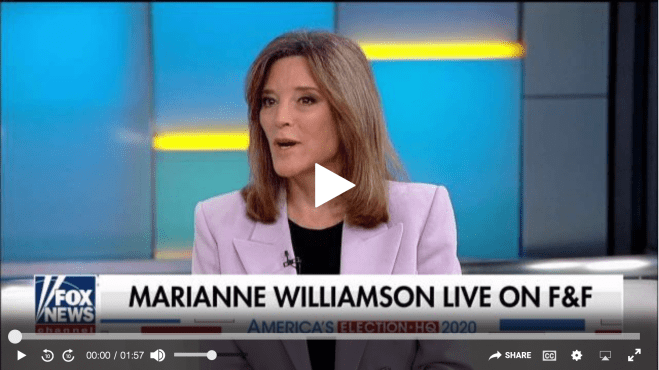 Editor’s Note: We love Marianne for her fresh and insightful views originating from as an outsider to mainstream politics. In her appearance in the Democratic candidates debate she pointed out quite astutely that true health care cannot be achieved with the current system in place (whether it’s Obamacare or Medicare for All). The health care system is completely broken and must be rebuilt from the bottom up beginning with prevention and wellness. Thanks for contributing to this most important conversation and acknowledging the important of intelligent debate and civil discourse.
Marianne Williamson, a 2020 presidential hopeful and author, said she’s discovered the political system to be “even more corrupt” than she imagined, during a Tuesday interview with “Fox & Friends.”
“I was known in a world where people loved you and bought things from you. Now I’m in a world where a lot of people hate you,” she said. “I would say that I feel that I’ve learned the system is even more corrupt than I knew and people are even more wonderful than I hoped.”
Williamson also said there is a tendency in politics today to stifle opposing opinions, which weakens democracy and limits genuine debate.
“I have seen on the left as on the right, there are too many people who do not recognize how important honorable debate is in a democracy,” she said.
“You can disagree with somebody’s opinion but that doesn’t mean you should be shutting them down or lying about them or misrepresenting their views. That’s not a left-right issue. There’s a rough-and-tumble in politics.”
Co-host Lisa Boothe asked Williamson if she felt abandoned by the Democratic Party because she didn’t qualify for the upcoming debate, and she said that even if she did, she wouldn’t air her private grievances.
“No, I don’t feel abandoned,” she replied. “I’m a passionate Democrat… My mother always said if you have a problem with your family don’t talk about it outside the family. I’m not going to come on Fox and bad-mouth. The DNC has its rules and, listen, I signed up for this. And I’m playing by those rules”
Source: Fox News
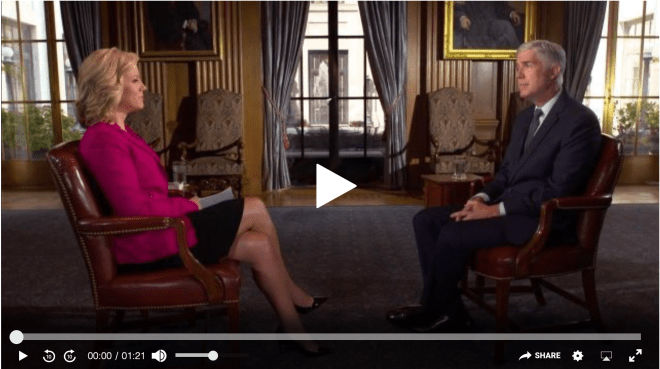 Editor’s Note: Sadly, we have one of the most ignorant and poorly educated citizenries ever, thus Gorsuch’s affirmation of the importance of an informed and educated public (and a transparent government as well) must be heard and understood. Seems not even our elected representatives know how to govern effectively these days.
In an exclusive Fox Nation interview, Supreme Court Justice Neil Gorsuch revealed his deep concerns for the future of America, which drove him to write his new book, “A Republic, if you can keep it.”
The book’s title is inspired by a famous phrase attributed to Founding Father Benjamin Franklin. As Franklin left the Constitutional Convention of 1787, after the drafting of the U.S. Constitution, he was reportedly asked what form of government had been created. Franklin answered, “A Republic, if you can keep it”, suggesting that the country’s fate lay in the hands of its citizenry.
JUSTICE GORSUCH REVEALS THE TWO RULES HE TELLS HIS LAW CLERKS
Justice Gorsuch told Fox News anchor Shannon Bream in his first televised interview as a Supreme Court Justice that an uninformed public is a danger to the country. “Republics have a checkered history in our history books, and we need to make sure that the people know how to run their own government.”
Gorsuch said, “I am concerned on the civics front when I read that about a third of Americans can’t name the three branches of government. 60% apparently would fail the American naturalization examination — that worries me.”
Justice Gorsuch also believes that an understanding of America’s past is central to the nation’s future success, and he credits the musical “Hamilton” for educating America’s youngest generations.
Gorsuch explained, “You’ve seen a secretary of Treasury and a vice president of the United States have a duel. That’s part of our history. It’s always been a ruckus republic. We used to have Senators cane one another on the floor. I’m glad we don’t have that anymore, at least, but it is a ruckus republic. That is what makes us strong. We can appreciate and embrace different ideas and open ourselves to one another and remember that that person with whom we disagree is coming at it from the same angle, the same hope of making a more perfect union.”
SUPREME COURT JUSTICE REVEALS HOW HIS NOMINATION TRIP BEGAN
“I think democracy is a really hard business and that’s because its strength comes from disagreements and the ability to air — comfortably and confidently — your point of view. Share it with others and have it heard and pick the best at the end of the day. That’s the idea of democracy. But for it to work, we have to listen as well as speak. We have to tolerate as well as expect tolerance for our point of view,” added Gorsuch.
Source: Fox News
 Japan will not develop and invest in the creation of fifth-generation mobile networks. This is stated on the official website of the Ministry of High Technologies of the country. Officials expressed the opinion that the creation of a faster Internet than previously is dangerous for the population and may adversely affect people’s health and labor productivity.
A study by the University of Nagasaki provides figures confirming the increase in the number of mental disorders and fatigue among high-speed Internet users. According to scientists, the more a person manages to conduct intellectual operations per minute, the more he is prone to the development of stress, absent-mindedness and an increase in nervous excitement. The Ministry of Health supplements colleagues and assures that using 5G networks can reduce the average life expectancy in the country for the first time in 60 years, and the impact of high-speed Internet is comparable to the effects of radiation on the human body.
“We need to think about the health of the Japanese. Our country has already accelerated economically so that today we have nowhere to hurry. It is necessary to stabilize this state. 5G is fraught with great danger. So we think not only we, yesterday this information was confirmed by the US ambassador to Japan. If America, China or the EU countries are ready to risk their people for the sake of progress, then such a strategy is unacceptable for our welfare state, ”said Nobunari Kabato, Minister of High Technologies.
The bill to ban fifth-generation mobile networks in the country has already been submitted to the Japanese parliament.
Source: Красная Армия & Web Archive
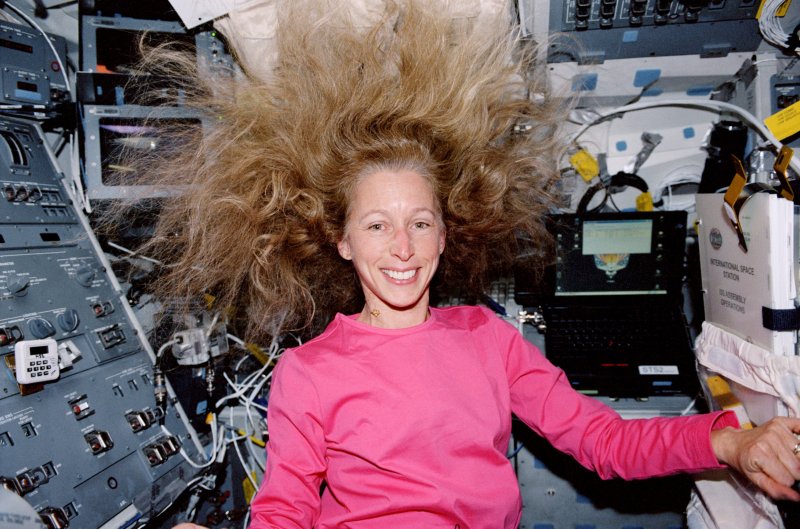
STS098-348-015 (7-20 February 2001) — Astronaut Marsha S. Ivins, STS-98 mission specialist, is photographed on the mid deck of the Earth-orbiting Space Shuttle Atlantis.
Editor’s Note: In America women have almost achieved equity with men and in many ways often unspoken have more opportunities than ever before. But you have to step up to take advantage of those opportunities. All it takes is courage. So American women, quit complaining about what you don’t have and appreciate what opportunities you do have. So many women of the world would love to trade places with you if only they could.
By Marsha Ivins
On Tuesday August 21, Vice President Pence chaired the sixth meeting of the recently revived National Space Council, a group originally chartered in 1958, disbanded in 1993 and then revived under the current administration to help chart the direction of America’s activities in space. There were four guest panelists highlighted at the end of the session. One spoke about nuclear power and nuclear thermal propulsion for spaceflight; one spoke about in situresource utilization on the Moon and Mars; and one spoke about planetary exploration, the Dragonfly mission to Saturn’s moon Titan in particular. All were interesting and appropriate topics for a meeting whose topic was, well, the future of space exploration.
And then there was Saralyn Mark, an M.D. and specialist in gender-based medicine, who spoke about gender bias. Her main point: NASA needs to — no kidding — realize there are gender differences because sending “gender diverse” crews to Mars is going to be difficult. At least I think that was her point. It was frankly hard to listen to because enough already!
We’ve been sending gender-diverse crews to space since 1983. We’ve had women do every job a man does in space. Every one. Space walks? Check. Shuttle commander? Check. Space Station commander? Check. Record for long-duration flights? Check. So what’s going to be the new gender-bias thing NASA needs to start — start? — paying attention to?
Oh I could tell you tales from bygone days of the male engineers’ original ideas of clothing and hygiene products for women astronauts. I was working as an engineer at NASA then in the human factors and cockpit design group. And I was there to support our first women in space, but we are talking the late ’70s, early ‘80s. By the time I flew in space in the ‘90s, those things had changed; they’d evolved, emerged, progressed and been accommodated for. By then a crew member was just a crew member. The same is true today. They get what they need physically, personally and emotionally to support them in spaceflight. Not a big deal. So why the continued insistence on making it a big deal?
And why keep bringing up the NASA-doesn’t-make-a-spacesuit-that-fits-a-woman story? The truth behind the cancellation last April of the “all-female spacewalk” was that it was a woman’s call! After doing her first spacewalk, Anne McClain realized that the task on the next one would require a longer arm reach than she had. Sure, they could have redesigned the choreography for that spacewalk, taken the time and the effort to delay the mission, replan and retrain for it. “But why?” she said. Let crewmate Nick Hague do it — he’s trained and he has a longer reach. Need a different tool to get the job done? Go to the toolbox and get a different tool.
It was never the crew’s idea to do an all-female spacewalk in the first place. They are all professional, trained, hardworking, no-nonsense crew members. That’s teamwork at its finest, not a defeat for womankind. Nothing to see here.
Dr. Mark’s big pitch is that diversity demands attention, especially in situations like a long space flight during which people have to understand their differences and get along. Well, what about six men and women on the Space Shuttle or the International Space Station representing multiple nationalities, different ethnicities and religions, and — in their home countries — competitive political ideologies? That’s not diverse enough for you? NASA has been doing this quietly and efficiently and without fanfare for the better part of the past 36 years.
After Dr. Mark’s testimony, NASA Administrator Jim Bridenstine once again mentioned how inspired his 11-year old daughter would be to see women taking leadership positions in space exploration. Well, Mr. Bridenstine, your agency has had women in leadership roles on and off the planet far longer than you have held your current position. And there have been women astronauts living, working and leading on spacecraft decades longer than your daughter has been alive. Why is she not inspired by that?
Source: Time Magazine
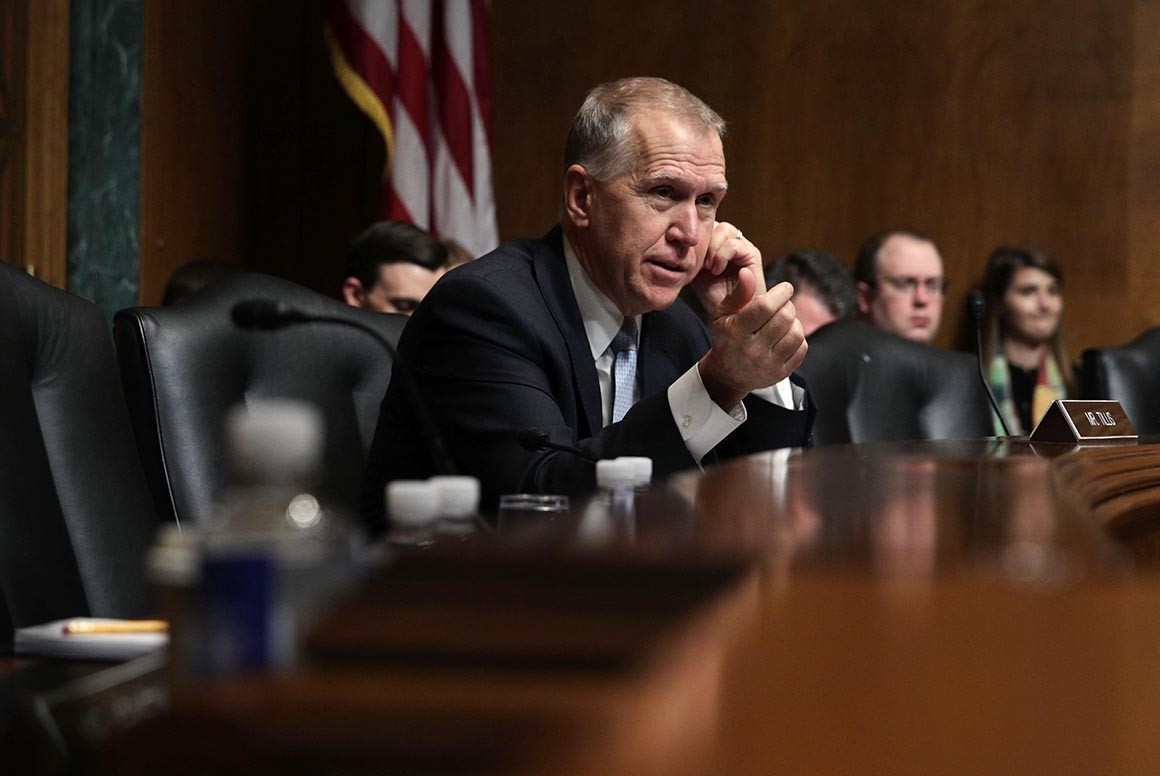 Editor’s Note: As a sovereignty educator for over twenty years I taught millions of people about the Federal Reserve, how it was created, the nature of money, banking, etc., and how this forever altered our constitutional Republic. That anybody in the Senate, except Former Congressmen Ron Paul and President Trump, is talking about Federal Reserve independence is good news for the Republic.
Republican Sen. Thom Tillis is calling for the Senate Banking Committee to probe the Federal Reserve’s independence after a former agency official suggested the upcoming presidential election “falls within the Fed’s purview” as it considers whether to cut interest rates.
Tillis, who is up for reelection next fall in swing state North Carolina, is siding with President Donald Trump in his ongoing feud with Federal Reserve Chairman Jay Powell. Bill Dudley, a former president of the Federal Reserve Bank of New York, wrote in a Bloomberg op-ed that the Fed should consider refusing to offer new economic stimuli because doing so could encourage Trump to plunge further into a trade war with China and would “reassert the Fed’s independence by distancing it from the administration’s policies.”
Tillis said he plans to ask the Banking Committee’s chairman, Sen. Mike Crapo (R-Idaho), about convening a hearing “regarding Fed independence and the danger of this institution taking unprecedented and inappropriate steps to meddle in the presidential election.”
“I am very disappointed that former Fed monetary Vice Chairman Bill Dudley is lobbying the Fed to use its authority as a political weapon against President Trump,” Tillis said in a statement. “The President is standing up for America against China after 30 years of our country and our workers being ripped off and there is now an effort to get the Fed to try to sabotage the President’s efforts.”
Senate Republicans generally stay out of Federal Reserve politics, but Tillis is aligning himself closely with Trump as he faces a primary challenge and a potentially difficult general election. The first-term senator previously supported a bill protecting special counsels, including Robert Mueller, and initially opposed Trump’s declaration of a national emergency on the southern border. He later supported it and has generally not deviated from Trump since.
The president has berated Powell, whom he appointed, for declining to further slash interest rates.
“The only problem we have is Jay Powell and the Fed,” Trump tweeted last week. “He’s like a golfer who can’t putt, has no touch. Big U.S. growth if he does the right thing, BIG CUT — but don’t count on him! So far he has called it wrong, and only let us down.”
The repeated attacks motivated Dudley to wade into the dispute and implore Powell to consider standing firm. He argued that the Federal Reserve’s desire to stay out of politics was admirable “but Trump’s ongoing attacks on Powell and on the institution have made that untenable.”
“Central bank officials face a choice: enable the Trump administration to continue down a disastrous path of trade war escalation, or send a clear signal that if the administration does so, the president, not the Fed, will bear the risks — including the risk of losing the next election,” Dudley wrote. “Trump’s reelection arguably presents a threat to the U.S. and global economy, to the Fed’s independence and its ability to achieve its employment and inflation objectives.”
Source: Politico
 Editor’s Note: I include this post as an interesting conversation starter, but do not consider the Green New Deal a sound proposal for addressing climate change (unless you intend on bankrupting the country to achieve it).
By Gregory King
Sen. Bernie Sanders on Thursday added progressive meat to the bones of the Green New Deal with the release of his comprehensive $16.3 trillion climate change program ahead of a campaign stop in Paradise, California, the city leveled by a devastating 2018 wildfire.
Sanders was an early backer of the activist-inspired Green New Deal framework and introduced, with Reps. Alexandria Ocasio-Cortez and Earl Blumenauer, a resolution in July to declare climate change a national emergency.
“Young people, advocates, tribes, cities and states all over this country have already begun this important work,” the campaign says in its new pitch, “and we will continue to follow their lead.”
The Sanders plan channels the rhetoric of the climate movement, calling for a World War II-style mobilization to halt and reverse the effects of global warming over a decade. In the process, the campaign claims, it would create 20 million new jobs in “steel and auto manufacturing, construction, energy efficiency retrofitting, coding and server farms, and renewable power plants.” Sanders’ blueprint will be compared to proposals put forward by Sen. Elizabeth Warren and Washington Gov. Jay Inslee, who released a robust suite of cross-sector plans before ending his campaign on Wednesday.
In a CNN poll from late April, 96% of potential Democratic voters said “aggressive action to slow the effects of climate change” was somewhat or very important — the closest to a unanimous finding in the survey. The Democratic National Committee has so far not hosted a climate-specific debate, but 10 of the 2020 primary candidates will take part in a September 4 CNN town hall focused exclusively on the crisis.
During his time in office, President Donald Trump has rolled back dozens of environmental rules and regulations. Sanders in his plan promises to “aggressively enforce” the Clean Air Act, through the Environmental Protection Agency, to restrict dangerous emissions.
But the proposals unveiled Thursday go much further.
Sanders’ prime targets include meeting the Intergovernmental Panel on Climate Change’s goal of 100% renewable energy for electricity and transportation by 2030; cutting domestic emissions by 71% over that period; creating a $526 billion electric “smart grid;” investing $200 billion in the Green Climate Fund; and prioritizing what activists call a “just transition” for fossil fuel workers who would be dislocated during the transition.
The Vermont independent would also cut off billions in subsidies to fossil fuel companies and impose bans on extractive practices, including fracking and mountaintop coal mining, while halting the import and export of coal, oil and natural gas. Additionally, he would use his Justice Department and the Securities and Exchange Commission to pursue criminal and civil cases against energy companies that hid or withheld information — over decades — about the damage their businesses were doing to the environment.
Sanders in 2015 and 2016, during his first presidential campaign, memorably called climate change the foremost national security threat. In recent remarks on the campaign trail, he has promised to reassert US power internationally by taking a more assertive role in climate talks.
“Climate change cannot only be addressed by the United States. It is a global issue,” Sanders said this week in Iowa. “But my promise to you is, instead of ignoring this issue as Trump does, I will help lead the world in bringing countries together to address the issue.”
The proposal is the most in-depth to date from Sanders, who says it will “pay for itself over 15 years” and includes new details on the potential funding sources.
The most significant, at an estimated $6.4 trillion, would come from revenue generated by the sale of clean energy — which will be administered by publicly owned utilities — between 2023 and 2035. Before that, Sanders would cut military spending used to protect global energy interests by more than $1.2 trillion while hitting up fossil fuel companies for more than $3 trillion in “litigation (against polluters), fees, and taxes.” An additional $2.3 trillion, the campaign says, would be raised from the taxes paid on the 20 million new jobs it promises to create.
Part of that money would go toward mitigating the damage already done by climate change — with $162 billion set aside for coastal communities under threat and an additional $18 billion going toward firefighters to combat a spike in dangerous wildfires like the one in Paradise.
To deliver the political will for such a radical transformation, Sanders, as he has throughout his presidential campaigns, is counting on the youth-led activists and progressive movements that he has often inspired and, now, hopes to count on as a source of electoral strength.
Their continued vigor and ability to successfully pressure elected officials is written into the plan.
“We will do this,” the campaign says, “by coming together in a truly inclusive movement that prioritizes young people, workers, indigenous peoples, communities of color, and other historically marginalized groups to take on the fossil fuel industry and other polluters to push this over the finish line and lead the globe in solving the climate crisis.”
Editor’s Note: Enough talk from the Democrats about identifying with the working class. Every one of these candidates are multi-millionaires, part of the 1% they so enthusiastically despise. So Bernie and Elizabeth, you might want to change your narrative and get real. Running for office and getting elected makes you pretty darn rich (especially with all those special congressional benefits).
By Dan Alexander, Chase Peterson-Withorn and Michela Tindera
Everyone knows Donald Trump is rich. But how about the 25 people jockeying to replace him as president? Forbes dug into the details—examining financial disclosure statements, scouring local real estate records and calculating pension benefits—to figure out the finances of the 2020 candidates.
There were some surprises. Bernie is a millionaire. So is “middle-class Joe” Biden. Elizabeth Warren is richer than both of them, worth an estimated $12 million. But she’s a long way from John Delaney, whose $200 million fortune makes him twice as wealthy as every other Democratic candidate not named Tom Steyer. The hedge fund tycoon, who announced his candidacy in July 2019, is worth an estimated $1.6 billion.
Aside from Trump and Steyer, the average net worth is $12.9 million—the same as it was for the 2016 contenders. The median net worth is $2 million. The poorest is Pete Buttigieg, who has an estimated $100,000—or about 0.003% of Trump’s fortune.
We reached out to all of the candidates. No one, not even the Democrats who spend the most time bashing Trump for his financial dealings, answered every question. So we ranked the entire field on transparency, assigning scores ranging from 0 (lips sealed) to 5 (full disclosure). In the end, we uncovered the money, regardless of whether the candidates wanted it out in the open.


 Editor’s Note: Perhaps colleges and universities established as non-profits for the benefit of society should pay off a share of the student debt with a share of their massive endowment funds worth billions and billions of dollars (instead of passing on the burden of debt cancellation for colleges and universities to the American taxpayers). Great socialist idea, but bad for the overall economy.
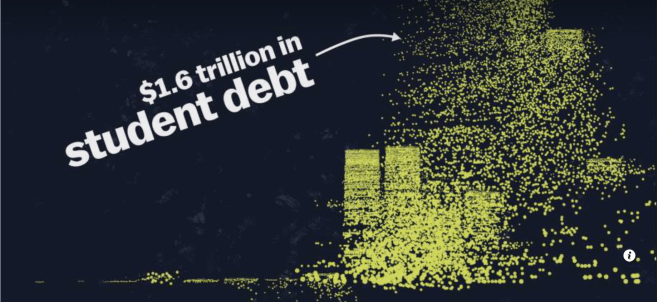
Student loan debt has increased exponentially in the past few decades. So now, some Democratic presidential candidates propose canceling those debts — all $1.6 trillion of it. But is this a good idea? Who exactly does it benefit? Watch this video…
Source: MSN & Vox
Editor’s Note: I found this video to be not only informative as to what’s behind the scenes of Democratic Socialists, but some strange, dark comedy regarding the social behaviors of this particular subculture which has greatly influenced many of the Democratic candidates in the 2020 Presidential election.
Source: Fox News/YouTube
 Liberty International News