Source: The Real News Network
The Real News Network
Source: The Real News Network

Source: The Real News Network
 By DeAnna Martin & Susan Partnow
At the recent National Conference on Dialogue and Deliberation, we attended a panel of speakers who consider themselves “conservatives” to help us understand why dialogues seem to narrowly attract “progressives” and especially of a certain age, white, and middle class.
We want to share some of the things we heard and lessons learned to consider the implications for Conversation Cafes and similar endeavors to dialogue across divides.
First, there are certain fears that tend to turn conservatives off to dialogue. These fears create barriers to showing up if they feel they have to:
1) Give up the Truth. If dialogue assumes all truths are relative, it is an unwelcome environment for someone who has fundamentalist convictions about right and wrong.
2) Be coerced towards some hidden agenda. Questions come up about what the ultimate goal of dialogue really is: to convince me of something? To get me involved in some sort of larger social change? Is there really an authentic space for conservative views?
3) Be changed. Perhaps this is connected to a hidden agenda to convince me that my views are wrong?
One way that individuals in the evangelical community have found their way through these fears is by engaging in what they call, “convicted civility.” Individuals engage in dialogue, sharing candidly about where they are convicted, from their place of The Truth, while the other seeks to understand “living the friendship, not the argument.’
We learned that conservatives may be turned off by how the dialogue is framed. Particular triggers for conservatives are words like:
Second, there are certain values that shed light on what conservatives find important. By looking at these we can understand better how to appeal across divides to bring people together.
Some of the values expressed by panelists were:
So let’s consider these insights as they relate to how we go about our Conversation Cafes and other dialogue efforts.
Frame & Identify Issues We Have in Common
Dialogue can be framed as a desire to understand and know each other and must include all aspects of the self, including religious values. We must find nonpartisan issues we all care about, such as transparency, integrity, and accountability. These issues might stem from where there is a felt need to link political will with deliberation, then be careful about how decision makers are involved in the cycles of discussion and be transparent about everyone’s commitment and role in the process.
Be Careful about Liberal Blind Spots
Taking our cue from the trigger words shared previously, we must find language that doesn’t assume we intend to evolve people to a particular end, organize them, or that limits our scope for what and who is ultimately responsible. Cultivate humility. Be willing to let go of our own agendas and accept that we have more to learn and understand.
Define Dialogue as Part of Broader Civic Engagement
Respect that each of us is self-governing and we are self-governing together. Be open to seeing the free market as civic engagement, i.e. in a free market businesses are figuring out what people want and providing it. Dialogue in our civic engagement is about integrating the values of the republic with the needs of the republic.
Emphasize Non-Coercive Outcomes
Dialogue as an end in itself, not about reaching some pre-determined outcome. Just the talking is valuable without the pressure to generate some kind of agreement or shared outcome. Sell the mapping of the issues, rather than an outcome; deeper understanding, empathy, and connection to what this issue looks like from many perspectives. So the outcome is discovery. Mutual respect and appreciation, humanization. Self understanding to be more personally responsible. Emphasize that it’s not about seeking change.
Demonstrate Value in Terms of Enhancing Social Capital
Dialogue creates opportunities for connections where none existed before, which builds the health and vitality of a community ˆ essential to safety and security. Express how conversations with others gives life to the expression, “Love thy neighbor as thyself.”
Listening to our Conservative speakers and panelists was stimulating, mind opening and humbling. We hope sharing these thoughts with you will serve us all in broadening our conversations to include more diversity of thought, which will ultimately serve us all in moving forward in this complex world.
 By Victor Thorn
FOR TWO YEARS, Americans have heard an unrelenting mantra of change emanating from the campaign trail. But now that President-elect Barack Obama has begun forming his cabinet, we’re seeing a cadre of more deeply entrenched insiders than any administration that has preceded it.
In regard to key foreign policy advisors, all three of Obama’s selections either initially supported the Iraq war, or still do. On the economic front, each appointee maintains a close relationship with the triad of Ben Bernanke, Robert Rubin and Alan Greenspan—as well as bailout engineer Henry Paulson. Barack Obama himself is a Council on Foreign Relations member, has strong ties to Zbigniew Brzezinski, and participated in a clandestine meeting with Hillary Clinton at Bilderberg member Diane Feinstein’s house at the time when 2008 Bilderberg members were congregating only a few miles away.
Below is an overview of Obama’s top 14 selections to date. When considering their collective histories, a trend becomes clear, proving that the more things change under Obama, the more they stay the same.
1. TIMOTHY GEITHNER – TREASURY SECRETARY
Bilderberg, Council on Foreign Relations, Trilateral Commission, president and CEO of Federal Reserve Bank of New York, director of policy development for IMF, member Group of Thirty (G30), employed at Kissinger & Associates, architect of the recent 2008 financial bailouts, mentored by Lawrence Summers and Robert Rubin.
2. PAUL VOLCKER – ECONOMIC RECOVERY ADVISORY BOARD
Bilderberg, Council on Foreign Relations, North American chairman of Trilateral Commission, Federal Reserve chairman during Carter and Reagan administrations, president of Federal Reserve Bank of New York, G30 member, chairman Rothschild Wolfensohn Company, key figure in the collapse of the gold standard during the Nixon administration, longtime associate of the Rockefeller family.
3. RAHM EMANUEL – CHIEF OF STAFF
Member of Israeli Defense Force, staunch Zionist, senator, Board of Directors for Freddie Mac, member of Bill Clinton’s finance campaign committee, made $16.2 million during 2.5 years as an investment banker for Wasserstein Perella. His father was a member of the Israeli Irgun terrorist group.
4. LAWRENCE SUMMERS – NATIONAL ECONOMIC COUNCIL
Bilderberg, Council on Foreign Relations, Trilateral Commission, treasury secretary during Clinton administration, chief economist at World Bank, former president of Harvard University, Brookings Institute board member, huge proponent of globalization while working for the IMF, protg of David Rockefeller, mentored by Robert Rubin.
5. DAVID AXELROD – SENIOR ADVISOR
Political consultant whose past clients include Sens. Hillary Clinton, John Edwards and Christopher Dodd; main Obama fixer in the William Ayers and Reverend Wright scandals.
6. HILLARY CLINTON – SECRETARY OF STATE
Bilderberg, Council on Foreign Relations, Trilateral Commission, clandestine CIA asset used to infiltrate the anti-war movement at Yale University and the Watergate hearings, senior partner at the Rose Law Firm, key figure in the Mena drug trafficking affair, architect of the Waco disaster, implicated in the murder/ cover-up of Vince Foster, and many other deaths.
7. JOSEPH BIDEN – VICE PRESIDENT
Bilderberg, Council on Foreign Relations, U.S. Senator since 1972, member of the Senate Judiciary Committee, current chairman of the U.S. Senate Committee on Foreign Relations, strong Zionist sympathizer who recently told Rabbi Mark S. Golub of Shalom TV, “I am a Zionist. You don’t have to be a Jew to be a Zionist.”
8. BILL RICHARDSON – COMMERCE SECRETARY
Bilderberg, Council on Foreign Relations, former U.S. congressman, chairman of the Democratic National Convention in 2004, employee of Kissinger Associates, UN ambassador, governor of New Mexico, energy secretary, major player in the Monica Lewinsky cover-up with Bilderberg luminary Vernon Jordan.
9. ROBERT GATES – DEFENSE SECRETARY
Bilderberg, Council on Foreign Relations, former CIA Director, defense secretary under President Bush, co-chaired CFR task force with Zbigniew Brzezinski, knee-deep in the Iran-Contra scandal, named in a 1999 class action lawsuit pertaining to the Mena drug trafficking affair.
10. TOM DASCHLE – HEALTH SECRETARY
Bilderberg, Council on Foreign Relations, former Senate majority leader, Citibank lackey, mentored by Robert Rubin.
11. ERIC HOLDER – ATTORNEY GENERAL
Key person in the pardon of racketeer Marc Rich, deputy attorney general under Janet Reno, facilitated the pardon of 16 Puerto Rican FALN terrorists under Bill Clinton.
12. JANET NAPOLITANO – HOMELAND SECURITY DIRECTOR
Council on Foreign Relations, Arizona governor, attorney for Anita Hill during the Clarence Thomas hearings, U.S. attorney during the Clinton administration, instrumental in the OKC cover-up, where she declared, “We’ll pursue every bit of evidence and every lead,” described as another Janet Reno, soft on illegal immigration (i.e. pro-amnesty and drivers licenses to illegals).
13. GEN. JAMES L. JONES – NATIONAL SECURITY ADVISOR
Bilderberg, Trilateral Commission, European supreme allied commander, special envoy for Middle-East Security during Bush administration, board of directors for Chevron and Boeing, NATO commander, member of Brent Scowcroft’s Institute for International Affairs along with Zbigniew Brzezinski, Bobby Ray Inman, Bilderberg luminary Henry Kissinger and former CIA Director John Deutch.
14. SUSAN RICE – U.N. AMBASSADOR
Council on Foreign Relations, Rhodes scholar, campaign foreign policy advisor to presidential candidates John Kerry and Michael Dukakis, member of Bill Clinton’s National Security Council and assistant secretary of state for Africa, member of the Brookings Institute (funded by the Ford Foundation and the Rockefellers), and member of the Aspen Strategy Group (teeming with Bilderberg insiders such as Richard Armitage, Brent Scowcroft, and Madeleine Albright).
Source: Ashland Resource Center
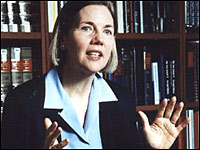
Fresh Air from WHYY, December 11, 2008 · Bankruptcy and commercial law expert Elizabeth Warren explains how taxpayer money is being spent in the financial bailout program. A professor at Harvard Law School, Warren chairs the oversight panel appointed by Congress to monitor the spending of the $700 billion bailout money. The committee issues its first report on Dec. 10.
Photo: Elizabeth Warren is the author (with her daughter Amelia Warren Tyagi) of All Your Worth. Harvard Law School
Source: NPR
 By Stephen Holden
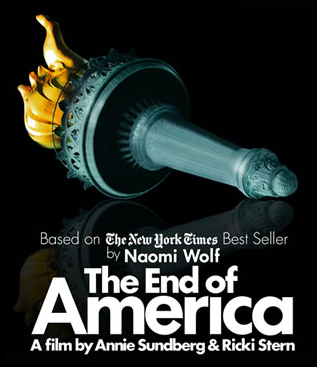
“The End of America,” an unsettling documentary polemic about the erosion of civil liberties in the wake of 9/11, brings up matters many of us would rather not contemplate in the middle of a financial crisis and on the eve of a new administration. Federal laws enacted during the last seven years that threaten our constitutional rights, it reminds us, remain in effect.
The pointedly inflammatory film, adapted from Naomi Wolf’s book “The End of America: A Letter of Warning to a Young Patriot,” compares the Bush administration’s attempts to discourage dissent and to wield increasingly unchecked power to the events preceding the establishment of 20th-century dictatorships in Germany, Italy, Chile and elsewhere. Without explicitly invoking the word, it implies that since 2001 the United States has drifted toward fascism in the name of fighting terror.
Tightly constructed and fiercely one-sided, “The End of America,” directed by Annie Sundberg and Ricki Stern (“The Devil Came on Horseback”), interweaves excerpts from a lecture in New York given by Ms. Wolf with film clips and interviews illustrating her contention that the rise of those dictatorships created a “blueprint” that the Bush administration, consciously or not, has followed.
According to Ms. Wolf, the first and fundamental tool for acquiring power is the manipulation of fear. In the shell-shocked post-
9/11 climate, the overwhelming public reaction to the Patriot Act of 2001, which gave law enforcement agencies expanded powers of surveillance, was mute acceptance of whatever was deemed necessary to keep us safe. Since then, she says, a color-coded system of terror alerts has been effectively wielded to keep us on edge.
From here, Ms. Wolf describes a 10-step program toward authoritarian rule that includes the creation of secret prisons where torture takes place; the deployment of a paramilitary force (Blackwater, which the film calls a contemporary American variation on Mussolini’s private army of “black shirts”); the development of an internal surveillance system; the harassment of citizens’ groups; and the arbitrary detention and release of ordinary civilians.
The film’s most disturbing moments are its accounts of James Yee, a United States Army chaplain at Guantánamo, who was accused of espionage and held in solitary confinement for 76 days before being released, and Maher Arar, a Syrian-born Canadian telecommunications engineer, who was detained at Kennedy International Airport, then later deported to Syria, where he was imprisoned for a year and tortured. He was eventually cleared of charges of terrorism.
The seventh step, selecting key individuals for harassment, cites the Dixie Chicks and Dan Rather as prominent cases. The eighth step, the restriction of the press, focuses on the case of Josh Wolf, a journalist jailed for 226 days for refusing to turn over videotapes he made of police brutality at a July 2005 demonstration in San Francisco.
The ninth step, the equating of political dissidents with traitors, fleetingly examines the Bush administration’s floating of the word “treason” to describe The New York Times’s publication of classified information about the government’s monitoring of overseas telephone calls. All these middle steps might be described as examples of selective intimidation intended to inhibit dissent. The case histories are glossed over.
The final step in Ms. Wolf’s Top 10 is the suspension of the rule of law. She cites the refusal of Bush administration insiders subpoenaed to appear before Congress to testify in the United States attorneys scandal. The film ends on a note of stern warning: the 11th step might be the imposing of martial law.
If the film’s vision of the steps leading toward a homegrown fascist state qualifies as paranoid, there is still enough here to make you shiver. Could it happen here? Maybe. A little fear — not the collective panic that followed 9/11 — can be a useful thing.
Source: New York Times/Movies

Indigenous peoples were the earliest known settlers of this diverse and bountiful land – and others followed.
One individual, Gilbert Gable from Port Orford and others, including, members of the 20-30 club in Yreka, the Yreka Chamber of Commerce, the Siskiyou County Board of Supervisors, State Senator Randolph Collier and Judge John L. Childs of Crescent City made the most successful and most publicized attempt at creating a new state from the bottom portion of Oregon and the top portion of California.
There have been many attempts at forming a new state comprised of northern California and southern Oregon, but none has gained so much attention and retained it as the secession movement of 1941.
The abundant supply of minerals and timber in this region was largely inaccessible due to the lack of sufficient roads and bridges into the rugged mountain border country. The local pioneering people grew weary of unfulfilled promises from Salem and Sacramento to help fund sufficient highway projects in the region while building campgrounds in the cities where there were more votes.
Representatives from the mountain border counties involved met in Yreka, CA on November 17, 1941 to form an alliance to obtain federal aid for the construction and repair of bridges and roads. The Siskiyou County Board of Supervisors voted to allocate $100 to research the possibility of seceding from the state of California and joining the other counties to form a new 49th state. The Yreka Chamber of Commerce was very instrumental in persuading the Board.

The local newspaper ran a contest to name the new state and the winning entry was Jefferson. The winner of the contest pocketed $2 for his efforts. Yreka was designated the temporary state capital where the ‘State of Jefferson Citizen’s Committee’ was formed.
They proceeded to stop traffic on Highway 99 outside of town and handed their ‘Proclamation of Independence’ out to travelers.
Jefferson made the papers nearly every day, competing with headlines of Germany’s ravaging of Europe. The San Francisco Chronicle sent a young reporter, Stanton Delaplane, to cover the events. He traveled the rain-soaked roads to speak with locals to get a feel for the secession movement from their point of view. He got stuck in the mud down the Klamath River but that did not stop him from writing a series of colorful articles on the rebellion which earned him the coveted Pulitzer Prize.
On December 4, Judge John L. Childs of Crescent City in Del Norte County was elected governor. A torchlight parade complete with horses, marching bands and sign-carrying young people riding in trucks was held in Yreka followed by a ceremonious inauguration held on the courthouse lawn.
Hollywood newsreel companies were present to record the events, including the highway barricades. The State of Jefferson was off to a banner start.

The newsreels were to air nationally the week of December 8, but tragically on December 7th Pearl Harbor was bombed and the State of Jefferson rebellion of 1941 came to an end. The people of the region went to work for the war effort and good roads were eventually built into the backcountry to access strategic minerals and timber. These same roads have helped countless numbers of rural families make a living from the land that continues to produce abundant, quality natural resources.
The State of Jefferson ‘state of mind’ remains in the hearts and minds of people everywhere.
Source: Jefferson State
Resources:
Siskiyou History
State of Jefferson Website & Archives
 America has had a non-violent revolution.
As long as there are historians writing about the United States, this moment of fundamental re-alignment of our national purpose will be remembered, pored over and analyzed. It will be seen as one of the shining points along the evolutionary arc of the American story. Yet it will never submit itself to being summed up in a nice little package that reason alone can understand.
“It’s been noted before that Americans get excited about politics every forty years.” Then, in the words of comedian Will Rogers, “We have to go sleep it off.”
We were certainly excited in the l960’s. And this is 2008; exactly forty years since the most dramatic and violent year of the Sixties decade: the year when both Bobby Kennedy and Martin Luther King Jr. were literally killed before our eyes.
At that point, a generation of young people — looking much like the youthful army so out in full force today, only grungier — marched in the streets to repudiate an oppressive system and to try to stop an unjust war.
And then bullets stopped us. The shots that killed the Kennedys and King carried a loud, unspoken message for all of us: that we were to go home now, that we were to do whatever we wanted within the private sector, yet leave
the public sector to whomever wanted it so much that they were willing to kill for it. And for all intents and purposes, we did as we were told. According to ancient Asian philosophers, history moves not in a circle but in a spiral. Whether as an individual or as a nation, whatever lessons we were presented once and failed to learn will come back again but in a different form. For the generation of the Sixties and for our children, the lessons of that time — as well as its hopes and dreams and idealism — came back in 2008.
During our forty years in the desert, we learned many things. Then, we marched in the streets; this time, we marched to the polls. Then, we shouted, Hell no, we won’t go! This time, we shouted, Yes, we can. Then, we were so angry that our anger consumed us. This time, we made a more compassionate humanity the means by which we sought our goal as well as the goal itself.
In the words of Gloria Steinem, I feel like our future has come back. And indeed it has. For in the words of Martin Luther King, Jr., No lie can last forever. What Bobby Kennedy tried to do, and was killed for trying; what Martin Luther King tried to do, and was killed for trying; what the students at Kent state were trying to protest, and were killed for daring to; Barack Obama and his army of millions of idealists with the audacity to hope have now succeeded at doing.
Praise God. Praise God.
And that praise to God didn’t just go out last night, when Obama’s election to the Presidency was finally achieved. That praise was part of what allowed the waters to part here in the first place. Millions of Americans have been deeply aware that this kind of historic and fundamentally positive effort has not gone well in the recent past, and the
spiritual understanding of this generation of Americans — an understanding not yet fully formed forty years ago — created an invisible light around the Obama campaign. How many people over the last twenty-one months have
posted, in their own way, angels to Obama’s left and angels to his right, angels in front of him and angels behind him, angels above him and angels below him. I know I have, and so has everyone I know. Hopefully we will continue to do so.
The Obama phenomenon did not come out of nowhere. It emerged as much from our story as from his — as much from our yearning for meaning as from his ambition to be President; as much from our determination to achieve
collective redemption as from his determination to achieve an individual accomplishment. And those who fail to recognize the invisible powers at work here — who see the external drama of a political win yet fail to discern the profound forces that moved mountains by moving the American heart — well, they’re just like Bob Dylan’s Thin Man to whom he sang, You don’t know what’s going on here, do you, Mr. Jones?
Back then, Mr. Jones didn’t know what was going on, but many of us did. We knew what was going on then and we knew what needed to happen; we simply weren’t mature enough and we were too wounded then, as people
and as a culture, to pull it off.
This time, we both knew and we did. We knew who we had to become and we knew what we had to do. The violent American revolution of 1776 entailed separating from another country. The non-violent revolution of 2008 — a
non-violent revolution that did not quite fail, yet also did not quite succeed in the l960’s — has entailed separating from who we used to be.
In the l960’s, we wanted peace but we ourselves were angry. This time, after hearing Gandhi’s call that we must be the change we want to see happen in the world, we came to our political efforts with an understanding that we
must cast violence from our hearts and minds if we are to cast it from our world; that we must try to love our enemies as well as our friends; and that when a genius of world-historic proportions emerges among us, we
cannot and we must not fail to do everything humanly and spiritually possible to support him. For his sake.. and for ours.
Having gone to a higher place within ourselves, a higher level of leadership began to emerge among us. A higher level of leader now having emerged among us, he calls us to an even higher place within ourselves. These two forces together can and will, as Obama has said, truly change the world. Having moved one mountain, we’ll now remove the ones that remain. With God’s help, yes we can. Yes we did. And yes we will.
Source: Ashland Resource Center
For the second time this month, Fiji’s military government has threatened to send a newspaper editor and its publisher to prison for publishing a letter to the editor alleged to be in contempt of court.
In mid-October, the Fiji Times and Fiji Daily Post printed a letter from a certain Vili Navukitu of Queensland, Australia complaining about a recent high court ruling that legitimized the actions of the country’s president in dissolving the Parliament, and the elected government of Laisenia Qarase, immediately following the December 2006 coup that brought into power Commodore Frank Bainamairama.
The letter (which has been reprinted in this post) pointed out that Bainimarama had undue influence on the jurors because he had previously removed the court’s chief justice.
After the letter was published, Fiji’s Attorney General Aiyaz Sayed-Khaiyum accused the Fiji Times of being in contempt according to Fiji’s laws because it casted doubts on the integrity and independence of the courts. The Fiji Times printed a front-page apology admitting contempt and offering to pay all court costs.
The Attorney General, unimpressed with the apology, has asked the court to jail the editor and publisher of the paper and apply stiff fines to the paper. The case is in recess until December. The editor and publisher of the Fiji Daily Post, where the letter also appeared, could meet the same fate, the Attorney General declared this week. Both newspapers have been asked to provide full details of the letter writer.
The scandal comes at the heels of the announcement that press freedom group Reporters Without Borders ranked Fiji 79th for press freedom out of 173 countries, a large leap from the previous year, where it was 107.
Fiji’s bloggers have largely expressed outrage at the case against the two newspapers.
Source: Global Voices Online
 By Jeff Golden
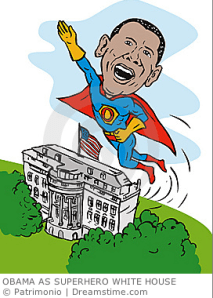
Author’s Note: Obama’s reminded us every way he can that he’s not Superman. Hearing the bliss of the last week, I’m not sure we’ve fully heard him. He aptly pointed out last week that what we’ve won is not change, but the chance to create change.
Last week I used this space to write to Joe the Plumber. I asked if he’d be willing to cool his jets before jumping on the campaign to make life as miserable as possible for the new administration.
I asked him to “try on the possibility that Barack Obama is not an agent of evil. That his plan to raise the marginal tax rate — the rate paid on just the highest increment of income — on the wealthiest Americans from 35% back up to 39%, where it was ten years ago and less than the top rate in almost every other democracy, doesn’t qualify as raging socialism or class warfare. That his plan to withdraw gradually from Iraq in deliberate cooperation with Iraq’s neighbors may not be surrendering to terrorism or trashing our national security. That a full-on plan to develop green energy won’t send you and your family into a cold cave to eat roots and berries. That we’ll have to step outside our comfort zones — yours, mine, everyone’s — to deal effectively with what’s coming.”
I haven’t heard back from him yet. But think how busy the poor guy’s been.
One reader didn’t think it’s realistic to ask Joe to give any slack when he’s apparently not getting any in return: Obama is off to a bad start in reaching out to conservatives, or anyone who thinks he should not have been elected. 1. Choosing homeboy pitbull armtwister Emmanuel [sic] as CoS (a man who said “F**k Republicans” on the record); (2) not calling on a Fox News reporter at his presser… (3) evading a question on taxes, despite changed economic realities since Aug; (4) dissing Nancy Reagan.
 Which just shows how much is in the eye of the beholder: people I know see the selection of Rahm Emanuel and other early Obama moves as worrisome steps towards Clintonian pragmatism that leans more right than left. continued
Source: Ashland Daily Tidings
Jeff Golden is the author of As If We Were Grownups, Forest Blood and the new novel Unafraid (with excerpts at www.unafraidthebook.com)
 MEMORANDUM
TO: BARACK OBAMA
FR: SHARIF ABDULLAH
DT: TODAY
RE: SOME ADVICE ON FORGING A COMMON WAY AHEAD
Yes, congratulations, you made history, yada, yada, yada. Not to diminish your amazing accomplishment, but since you’ve heard it all so many times by now, I won’t dwell on it (although, if you and I had a few hours, I COULD!)
No, I would rather not take up your time on that. I have a few pieces of advice for you. If I had five minutes of your time, the following is what I would say to you directly.
But first, who am I to be offering you advice? I have been exploring our need for a value-driven, inclusive and sustainable society for decades, including as Founder and Executive Director of Commonway Institute. The title to my second book sums up my philosophy and my life goal: “Creating a World That Works for All”. I offer my counsel to you.
ADVICE #1: REMEMBER WHO YOU ARE
This part goes without saying: while you are in fact the first African-American President (Elect) of the US, that is an IDENTITY, it is not the core essence of who you are. One day, even being President will be a past accomplishment. You, however, will still be you.
You are the first President (Elect) of the 21st Century – I expect you to act like it. (We obviously aren’t going to count the last 8 years. We are now seeing the close of the last Presidency of the 19th Century). As the first 21st Century President, you will set the model for all of the other Presidents to follow. Aim high.
Bill Clinton was a very admirable bridge between the 20th and 21st Centuries. There are many advisors around you who would like to copy those times. Don’t listen to them. Your arc must be higher.
ADVICE #2: BARACK OBAMA – CATALYST IN CHIEF
In our days of fear and ignorance, many Americans needed a “Commander in Chief”, the father figure to command and control their lives. Now, we have just elected you, our first “Catalyst in Chief”. We don’t need you to “lead” or “command”. We know that the federal bureaucracy is virtually ungovernable and incomprehensible. (Of course, we do expect you to do your job and govern as best as a human being can.)
We most need you to display the skills that you demonstrated so well during the primaries and election: the ability to inspire, to engage and to motivate an entire movement of people to act.
It is indeed comforting that your heroes are similar to mine. I too am inspired by the words and deeds of Abraham Lincoln. He presided over the US when it underwent its most painful transition (to date). Now seen as one of our greatest Presidents, he was HATED by half of the country – the half that could not face the future, the half that could not live up to the vision laid down by the Founders in the Declaration of Independence.
I remind you of Lincoln so that you can remember to inspire – even though many of our fellow citizens would rather revile you than listen to you. Right now, they CAN’T listen to you – they can’t get past the color of your skin. However, they too will change. They too are caught on the arc of history. They will forget their hate – it simply is not sustainable. We can wait them out – time is on our side.
ADVICE #3: DON’T LET THE WEASELS GET YOU DOWN
You are a man, a model and a symbol. You symbolize and personify our quest for a new vision for our society, a vision that is hopeful, practical, inclusive and sustainable.
You need advisors who hold all of the above qualities, who can think outside the box.
I know that you have many “real-world” political advisors surrounding you – they are needed, they are necessary and you could not effectively govern without them. But, don’t let them be your sole source of advice – we didn’t vote for you so that you could fill the White House with the old political crowd (Democrats or Republicans).
You need advisors who can think outside the box (who actually don’t even recognize that there IS a box!) Balance your team with visionaries, ones with some dirt under their fingernails from doing real work in the world. There is a real difference between a visionary with achievements versus a visionary with just dreams. You need doers, not just talkers.
ADVICE #4: YOU ARE NOT A “CENTRIST”
Neither the “Right” nor the “Left” have the vision for an America that works for all. Both the Left and the Right have flawed, myopic, partial viewpoints. But, paradoxically, both the Left and the Right hold key elements to the future of this country; they hold parts of the solution. Neither side should be dismissed out of hand.
Your job is to get the dinosaurs to play well together. Only together can those Left-Right viewpoints be transcended, harmonized, and resolved into one greater image.
You know that the traditional “Democratic” and “Republican” parties are outmoded and out of step with 21st Century realities. You know that your campaign for the Presidency has ignited a passion for politics (with the small “p”) that the major parties cannot understand, let alone harness. You know that you can harness this energy.
Your job is not to sit between these two warring camps. Your job is to sit ABOVE them. You are not a “centrist”. You are a “trans-centrist”. Let’s elevate the conversations beyond the uninspiring rhetoric that has been such a turn-off for many in the electorate. (I quote in my book a line from the movie “Slackers”: “Withdrawing in disgust is not the same thing as apathy”.) Your candidacy hit the “on” switch for tens of millions of us. And, you can help keep us turned on.
Of course, you will have to drag the mainstream media, kicking and screaming, into this new viewpoint. They still can’t comprehend what your victory means for America. Yesterday, CNN was reporting on how “black” churches were celebrating your election, completely missing the fact that there were at least a few “white” churches that were just as celebratory. They can’t see it. You can. WE can. And the media will, too… eventually.
ADVICE #5: YOU ARE THE LEADER OF A MOVEMENT
As you correctly stated, your job as President doesn’t start until mid-January. (Do not deny Bush the opportunity to further lower his poll ratings or to increase his historic position as the worst president in modern history. It’s his karma.)
However, you are not just “President” — you are also the leader of a movement. That job started decades, perhaps centuries, ago – it has just reached a powerful nexus point.
I started in this movement to save our human family and our planet 45 years ago (yes, you were 2 years old). The movement will continue when both of us are dust. This movement is the legacy that we leave to your daughters and my grandsons.
Unless there is a transformation in how we interact with each other, with our neighbors, with the Earth and with the Divine, those young ones have no future. Once we make these transformations, the future for our children and grandchildren is limitless.
Your role in the movement is obvious: KEEP IT MOVING. The politicos will want the people to sit down, shut up, and “leave it to the pros”. RESIST THIS. The movement for an inclusive, sustainable and loving society will not wait. Leading this movement is the single most important thing that you can do as President. It far exceeds any piece of legislation, any Executive Order, any policy initiative of your Administration.
Although you take the Oath of Office in January, you can stimulate and catalyze this movement RIGHT NOW. Don’t wait for the Inauguration – put us to work.
ADVICE # 6: TAKE THE FIRST STEPS
What you can do, right now, is catalyze a community, regional and national dialog on the fundamental issues facing us as we enter the 21st Century. (Given your present world stature, this dialog could be global.) Ask us: what can we do, on the local level, to address our social, political, economic, ecological and spiritual mega-crises?
This dialog would NOT be: “What must government do for us?” (You are about to find out how little government can actually do!) But, by bringing the conversation to the local level, you can catalyze building the most powerful people’s movement America (and the world) has yet seen.
So, what are these first steps?
We are long overdue.
We obviously cannot start with a Constitutional Convention – that would be suicidal. Most Americans have spent so much time as “consumers” instead of “citizens”, we no longer recognize the principles that lie at the foundations of our society. (This is why President Bush could get away with using the Constitution like toilet paper – most of us didn’t know what was in it to begin with.) We are going to have to start over again – to teach ourselves to become the intelligent, informed citizenry that Jefferson and the other Founders envisioned.
We can start with an interactive national dialog on “American Vision and Values”. According to the Bible, “Where there is no vision, the people perish.” (Proverbs 29: 18). You can catalyze a dialog process with teeth – the people need not perish.
ADVICE #7: DON’T FORGET TO BREATHE.
I strongly encourage every person who works with me to have a daily meditation practice. It is the best (perhaps only) way to stay focused on the long haul, to not get caught up in the swirling madness of our times. It is the best way to stay true to our common mission: to create a world that truly works for all beings.
Peace,
Sharif Abdullah
PS: Incidentally – if you are interested in my help with any of the above, please do not hesitate to call.
Resources:
Commonway Institute
 By
By  Liberty International News