Liberty and Taboos

TabooScreen

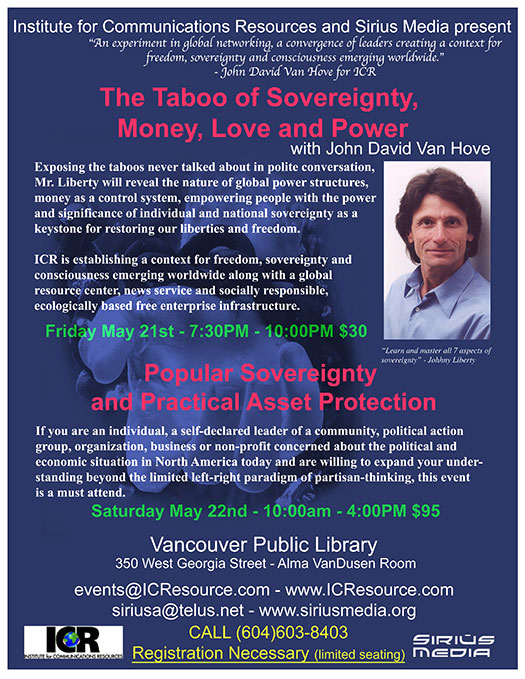
Sirius Media produced and packaged a film of one of my seminars in Vancouver, BC entitled The Taboo of Sovereignty, Money, Love and Power” several years ago at the Vancouver Public Library. The film is about the conversations we’re afraid to engage in as a society. The film has not been released.

In the meantime if you want a taste of some of my favorite videos visit the VodPod ICResource channel or YouTube ICResource channel and subscribe. There’s even a short clip somebody posted of the infamous Johnny Liberty speaking on freedom and sovereignty way back in 1995 at the Granada Forum.

Remembering the fallen: To those who paid the ultimate price for their journalism

Frontline Club logo

By Robert Fox, 22 Jun 2008

The dedication of Jaume Plensa’s giant glass vase ‘Breathing’ on the roof of the BBC at Portland Place as a memorial to all who have fallen in the cause of news and reporting  was moving, fitting and strangely remote.

It is fitting and timely because reporting is an increasingly dangerous business. The grim numbers of the killed and wounded and disappeared among reporters and news people of all kinds in conflicts from Iraq, Afghanistan, to Darfur, Zimbabwe and the Caucasus are testimony enough to this.

The sense of remoteness of the BBC memorial ceremony was encouraged by the fact that the giant sculpture is way up on a roof. The public can’t see it close-up to read the names and James Fenton’s verses on the fallen of  the ranks of journalism.

In some ways this is a metaphor. We all see the fruits of journalism in increasing volume and intensity, through TV and radio, print, the blogosphere, telephone text and video, Youtube and MySpace. But the essence of what is going on in, say, remoter Zabul, Bulawayo, the water wars of the Fergama valley and Darfur is perennially baffling. As Gordon Burn writes in his wonderful fable ‘Born Yesterday’ (last year’s news a novel) of “the feeling we all increasingly have of seeing everything but of being able to do nothing.”

Remembering the fallen and the wounded in body and spirit of the craft and calling of news reporting touches the core of  Frontline. Prominent in our memory are our fallen friends and comrades, Rory Peck, intrepid cameraman and Kurt Schork, king of the agency correspondents, Nick della Casa, who with his wife Rosanna and Charles Maxwell were murdered by their guide in northern Iraq in 1991, Carlos Mavroleon died in his Peshawar hotel in 1998, Roddy  Scott, ambushed and killed by Russians in  Chechnya (2002), James Miller cut down by the IDF in Gaza in 2003, and Richard Wild, murdered in Baghdad in 2003.

Most of these were not salaried, insured and protected correspondents of a large news organisation, but worked by the piece and day, freelance or on short contract. They did what they did because they believed in what they were doing, and telling a story that was vital.

They were prepared to go to the dark and dangerous places, on the map of the world, and into the darker inner map of human minds. So much of the news coverage in the most difficult but crucial zones of conflict depend on the freelance going the extra mile, or in most cases extra hundreds of miles, to get to the story.

In this motley crew of the non-staffers the vital links, the turn-keys of the whole enterprise, are the fixers, drivers, interpreters and helpers. They have no insurance policies, or regular income to support them when one of theirs is killed or wounded – and of course there is no safety in hazardous environments procedure, or health and safety regulation to protect them. Nearly all of us owe our lives, and our stories, to this strangely uplifting band – who do not seem  to know the meaning of the word ‘whinge’.

Some 21 years ago I was wandering the shores of the Mediterranean for a book when I went down to Tyre, to look, among other things, at the remains of the Roman circus (which was used in the Charlton Heston movie of Ben Hur). Under one of the arches of the auditorium I interviewed a bunch of ‘soeurs Islamiques’ supporters of Amal, when my companion and driver Abed spotted some Hezbollah gunmen going down for a spot of target practice. Realising they hadn’t seen me, he neatly diverted them with a torrent of  aimless conversation. Abed and his family worked for the BBC for decades, particularly for Jeremy Bowen. He was killed when Israeli gunners deliberately targeted his car in southern Lebanon a couple of years ago.

The Frontline Club’s Fixers Fund is a vital line to the families, often pretty extended, of those stringers and fixers  who are killed and injured – or simply never come back.  I would hope something can be done for educational facilities, just things as simple as books and DVDs are welcome, both for the young interpreters and their families.

As the news world becomes an ever expanding and fragmenting universe, we should remember the pioneers and bold spirits who did, and said something new – though their bosses didn’t want it. Ernie Pyle lived the life of a soldier on the frontline in Normandy, Belgium and the Pacific, telling the story through the words of his archetypal hero, GI Joe. He was killed in Okinawa in the last weeks of the Pacific war in 1945 – when the Japanese took back the island recently, his was one of only three American memorials they allowed to stay.

We should remember other bold spirits who showed courage in a different way in bringing us the news deemed unfit by the bosses  to print or broadcast, yet they believed it should – people like I. F. Stone and Ed Murrow.

From the roof opposite Jaume Plensa’s memorial sculpture Murrow made live broadcasts in the Blitz to a reluctant audience in America.

Source: Frontline Club

Bilderberg Meeting

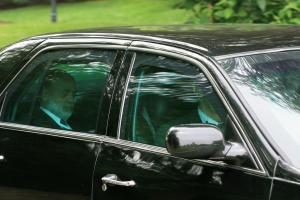
benThe Bilderberg Meeting is taking place at the Westfields Marriott Hotel, Chantilly, VA, June 6-8, 2008.

Photo: Federal Reserve Board Chairman Ben Bernanke, leaving the Bilderberg Conference.

Source: Cryptome

U.S. Federal and State Drug Laws

Drug Charges – An Overview

Drug charges cover a broad range of offenses, from the less severe, such as simple possession of a small amount of certain drugs, to the more serious, such as participation in an ongoing drug-related criminal enterprise or manufacturing and distributing drugs. Even minor charges can be terrifying, however, and carry the risk of serious penalties upon conviction; the more serious charges, of course, can give rise to even graver consequences. An experienced criminal defense attorney can take some of the terror out of drug charges by answering questions and guiding an accused offender through the complex legal maze that awaits.

Federal and State Drug Laws

Although in earlier times drugs were an accepted part of many religious rituals and were lauded for their medicinal effects, society’s view of drug use changed and the first narcotics laws began to appear in the early 1900s. In 1970, the federal government passed the Drug Abuse Prevention and Control Act, which codified federal drug law into a uniform system. The Act classifies drugs into five categories, listed in schedules, and establishes regulatory requirements and penalties for the misuse of the drugs on each schedule. The Act also allows the United States Attorney General to add drugs to the schedules as necessary. Most states have drug laws that mirror the federal act, but the penalties may be less harsh and more flexible under state sentencing schemes than under the federal sentencing guidelines. A conviction of simple possession, for example may result in a sentence under state law of drug treatment rather than jail time, and probation may be available to first-time offenders for even the more serious crimes.

The most severe legal restrictions and penalties involve Schedule I and II drugs as set forth in the federal law. Schedule I drugs are those with a high potential for abuse, with an absence of any medical use, and that are dangerous to the user even under medical supervision. The most well known of these drugs are heroin, LSD, mescaline, marijuana, and peyote. Schedule II drugs have a high potential for abuse and a high potential for severe psychological or physical dependency, but a currently accepted medical use. Schedule II drugs include opium, cocaine, methadone, amphetamines, and methamphetamines. Schedule III drugs, by comparison have less potential for abuse than Schedule II drugs, a potential for moderate psychological or physical dependency, and an accepted medical use. The most well known Schedule III drug is nalline, which is used to detect narcotic use. Schedule IV drugs have less potential for abuse than Schedule III drugs, they have a limited potential for dependency, and they are accepted in medical treatment. These drugs include tranquilizers, meprobamate, chloral hydrate, most drugs that cause sleep, and sedatives. Schedule V drugs, which have a low potential for abuse, limited risk for dependency, and accepted medical uses, include drugs with small amounts of codeine or other narcotics in them.

Drug-Related Crimes and Penalties

The federal sentencing guidelines begin with forty-three base offense levels for drug charges and add or subtract a few levels depending on certain specified criteria. The higher the offense level, the harsher the sentence. The base offense level under the federal guidelines differs for different drugs and for different amounts of the same drug. For instance, if the conviction is for the crime of manufacturing 300 kilograms of heroin, the base offense level is forty-two. If the conviction is for manufacturing 300 kilograms of cocaine, the base offense level is thirty-eight. Crack is a form of cocaine and is listed on the same schedule of controlled substances, but the quantity of crack needed to impose a certain sentence is much less than the quantity of powdered cocaine. A person convicted of the crime of delivering five grams of crack will receive a sentence in the federal system of five to forty years, for example, whereas to receive that same sentence on a cocaine charge, a person would have to be convicted of delivering 500 grams of powdered cocaine. It is essential for an accused to be represented by attorneys who have experience navigating these sentencing issues.

The crime of “simple possession” requires that the offender knowingly and intentionally possess a scheduled drug without a valid prescription. The government must prove that the offender knew the drug was a controlled substance and that he or she had either actual possession of it or other control over it, either alone or with another.

Manufacturing, delivering, or possessing with intent to deliver a controlled substance is a crime with escalating penalties depending on the drug involved, the quantity of the drug, and the offender’s prior record. For example, a first offender convicted of possessing with intent to deliver 100 grams to five kilograms of heroin will receive a mandatory minimum sentence of five years in prison, but possibly as many as forty years. Three crimes-distributing controlled substances to persons under twenty-one years of age, distributing controlled substances near a school, and causing persons under age eighteen to violate drug laws-are penalty-enhancement crimes for which the sentence is double or triple what it would otherwise be for distributing that particular amount and type of drug under other circumstances.

The offense of “continuing criminal enterprise” is charged when the defendant commits a felony drug violation as part of a continuing enterprise or scheme with five or more individuals, and from which substantial income is derived. The penalty is twenty years to life in prison, or even the death penalty if the offender intentionally kills another in the course of the enterprise.

Conclusion

Drug crimes carry harsh penalties, particularly under the federal law. If you have been charged with a drug-related crime, you could be facing time in prison-a frightening thought for most people. If your future is on the line because of a drug charge, do not hesitate to call an experienced criminal defense attorney, who will put his or her skill and knowledge to work for you at once.

Source: Brucar and Yetter P.C.

Blogged with the Flock Browser

3 to 4.3 Billion Barrels of Technically Recoverable Oil Assessed in North Dakota and Montana’s Bakken Formation – 25 Times More Than 1995 Estimate | USGS

North Dakota and Montana have an estimated 3.0 to 4.3 billion barrels of undiscovered, technically recoverable oil in an area known as the Bakken Formation.

A U.S. Geological Survey assessment, released April 10, shows a 25-fold increase in the amount of oil that can be recovered compared to the agency’s 1995 estimate of 151 million barrels of oil.

Technically recoverable oil resources are those producible using currently available technology and industry practices. USGS is the only provider of publicly available estimates of undiscovered technically recoverable oil and gas resources.

New geologic models applied to the Bakken Formation, advances in drilling and production technologies, and recent oil discoveries have resulted in these substantially larger technically recoverable oil volumes. About 105 million barrels of oil were produced from the Bakken Formation by the end of 2007.

The USGS Bakken study was undertaken as part of a nationwide project assessing domestic petroleum basins using standardized methodology and protocol as required by the Energy Policy and Conservation Act of 2000.

The Bakken Formation estimate is larger than all other current USGS oil assessments of the lower 48 states and is the largest “continuous” oil accumulation ever assessed by the USGS. A “continuous” oil accumulation means that the oil resource is dispersed throughout a geologic formation rather than existing as discrete, localized occurrences. The next largest “continuous” oil accumulation in the U.S. is in the Austin Chalk of Texas and Louisiana, with an undiscovered estimate of 1.0 billions of barrels of technically recoverable oil. Read more…

Beijing 2008 – Olympic Prisoners

Scores of Chinese journalists, bloggers and human rights activists were arrested, put under house arrested or expelled from Beijing before and during the Olympic Games. The Games have now finished and we call for their release.

Hu Jia

Hu Jia was sentenced to three and a half years in prison on 3 April 2008, for posting articles on websites and giving interviews to foreign journalists. He had criticised the poor state of freedom of expression before the Games. Hu was arrested on 27 December 2007, for “inciting subversion of state power” before being tried by a Beijing court on 18 March. He was transferred on 8 May to Hubai prison in Tianjin, 200 kilometres east of the capital, where he is being held in harsh conditions. His wife, Zeng Jinyan, and their young daughter are under house arrest in Beijing.

Sign the petition for his release.

Yang Chunlin

Main mover of the campaign “We want human rights not Olympic games”, Yang Chunlin was sentenced on 24 March 2008 to five years in prison, followed by two years loss of civil rights by the intermediate court of Jiamusi, in the north-east, for “inciting subversion of state power”. He was maltreated during the early period of his detention.

Yu Changwu and Wang Guilin

Activists Wang Guilin and Yu Changwu are in custody for having taken part in Yang Chunlin’s campaign “We want human rights not Olympic Games”. Wang Guilin was sentenced on 28 January 2008, to 18 months re-education through work, while Yu Changwu continues to be held secretly.

Dhondup Wangchen and Jigme Gyatso

Dhondup Wangchen, director of a documentary on Tibet, and Jigme Gyatso, his friend and cameraman, have been held since March 2008 for interviewing Tibetans, particularly in the Amdo region. The film about the work of Dhondup Wangchen and Jigme Gyatso is a 25-minute short entitled Leaving Fear Behind (www.leavingfearbehind.com), which was shown during the Olympic Games. In it, Tibetans in the Amdo region gave their opinions about the Dalai Lama, the Olympics and Chinese law. Dhondup Wangchen is believed to be held in Ershilipu prison, in the city of Xining, where his brother-in-law tried without success to see him. Jigme Gyatso was reportedly seen for the last time in a detention centre in the town of Kachu, in Ganzu province.

Chen Guangcheng

Blind lawyer Chen Guangcheng is serving a prison sentence of four years and three months in Linyi prison in Shandong province in southern China. He was sentenced for bringing a law suit against the local authorities in connection with a campaign of sterilisation and forced abortions. On the eve of the Beijing Paralympics, the Chinese authorities blocked the mobile phones of Chen’s associates and family members. This police action affected the residents of his village and his lawyer, Li Fangping. Several foreign journalists were prevented from meeting his family.

Du Daobin

Writer Du Daobin was arrested in Yingcheng on 21 July 2008 by the authorities in Hubei province, central China. Local police were apparently reacting to his stance ahead of the Games. He was found guilty of “inciting subversion of the state” and sentenced on 11 June 2004 to three years in prison, followed by four years house arrest. Du Daobin posted a number of pro-democracy articles online and some urging greater freedom of expression in China. He actively called for the release of Liu Di, a young student imprisoned in 2003 for pro-democracy articles she posted on Internet forums.

Wang Guilan

Petitioner and human rights activist, Wang Guilan, was sentenced to 15-months re-education through work on 28 August 2008 for agreeing to a telephone interview with a foreign journalist the previous month. Wang had been arrested in Beijing on 28 February 2008, after writing an open letter on human rights ahead of the Olympic, which attracted more than 12,000 signatures. From 17 April, she was placed in a prison in Hubei to prevent any activities during the Olympics. She is currently being held in Enshi, Hubei. She has been arrested several times since 2001.

Zhang Wenhe

Pro-democracy activist Zhang Wenhe waved a banner in Beijing streets in October 2007, that read, “We want human rights and democracy and not the fascist Olympic Games” that led to his arrest and forced incarceration in a psychiatric hospital.

Zheng Mingfang

Human rights activist, Zheng Mingfang, was sent to a re-education through work camp for two years at the beginning of April 2008, because of an open letter she wrote about the Olympics. She was arrested by the authorities in Beijing on 29 February 2008, shortly before a parliamentary session. She is reportedly being held in Xian district in Tianjin, east of the capital. She is beginning to go blind and was reportedly ill-treated during her period in detention. Her husband has spoken about the methods used by the authorities since her arrest to prevent her from communicating with foreigners “a central condition of Zheng’s release”, according to district police officials.

Source: Reporters Without Borders

We Are the New Civilization

sanctuarylabyrinth-432.jpg
Photo: Crestone, Colorado

As Gandhi once said, “Civilization, would be a good idea.”

We are here.
We are waking up now, out of the past, to dream a bigger dream.
We are friends and equals, we are diverse and unique and we’re united for something bigger than our differences.
We believe in freedom and cooperation, abundance and harmony.
We are a culture emerging, a renaissance of the essence of humanity.
We find our own guidance, and we discern our own truth.
We go in many directions, and yet we refuse to disperse.
We have many names, we speak many languages.
We are local, we are global.

We are in all regions of the world, we’re everywhere in the air.
We are universe being aware of itself, we are the wave of evolution.
We are in every child’s eyes, we face the unknown with wonder and excitement.
We are messengers from the future, living in the present.
We come from silence and we speak our truth.
We cannot be quieted, because our voice is within everyone.

We have no enemies, no boundaries can hold us.
We respect the cycles and expressions of nature, because we are nature.
We don’t play to win, we play to live and learn.
We act out of inspiration, love and integrity.
We explore, we discover, we feel and we laugh.
We are building a world that works for everyone.
We endeavor to live our lives to their fullest potential.
We are independent, self-sufficient and responsible.
We relate to each other in peace, with compassion and respect, we unite in community.
We celebrate the wholeness within and around us all.
We dance to the rhythm of creation.
We weave the threads of the new times.
We are the new civilization.

Source: Submitted by Linda, Author Unknown

Top Mafia Figure, Tony Gambino Implicates Vatican and Bush in Prior Knowledge and Complicity in 911 Mass Murder |

By Greg Szymanski
VaticanArmsTony Gambino of the infamous Gambino New York crime family said besides Mob Bosses, the outfits that benefit most from organized crime are the corrupt Vatican and U.S. government.

The grandson of Lucky Luciano, Gambino made a guest appearance Tuesday on Greg Szymanski’s radio show, The Investigative Journal on Liberty Radio at www.libertyradiolive.com The entire interview can be heard at www.arcticbeacon.com as well as Liberty Radio.

The high-level former mobster talked openly for an hour, indicting top Vatican and U.S. government officials with complicity in high crimes, treason and assassinations as they worked together “like a tight-knit happy family” with the Gambino and other Mafia families.

With America’s fascination of the Mafia, Gambino’s statements should shake the halls of St. Peter’s Basilica, as well as Capitol Hill, since he talked about his first hand knowledge of George Bush, the Pope and other high level Jesuits complicity and knowledge of 9/11.

“When you grow up in “The Family” like I did, you learn right off the bat that protection comes from everywhere, including the CIA, FBI and blessings from the Vatican who are at the top of the ladder when it comes to benefiting from Mafia street crime,” said Gambino, who became a “Made Man” at the age of five, a Mafia term used for their top street captains.

“The Vatican officials, federal judges, top politicians all used to get regular pay-offs from the Gambino Family and, in fact, the Vatican and U.S. government make more money off the illegal drug trade then we did.

“That is why I am talking after just getting out of jail after 20 years. I am talking because people need to know the U.S. government and the Vatican are more dangerous and corrupt then the Mafia ever was.

“For example, I know for a fact the Cardinal in Palermo runs the Sicilian mob and former Cardinal Spellman of New York was considered the Vatican’s American Godfather since he pulled the strings and had his hands deep into organized crime.

“I know for a fact Bush, the Pope and other top Vatican and U.S. government leaders had prior knowledge and help organize 9/11. They did it for many obvious reason, one being instigating the war in Iraq. But they also did it to get their hands on all the gold that was hidden below in the Twin Towers.

“My grandfather’s construction company built the Twin Towers and after it was completed, I know they went in and put in big underground vaults to house an enormous amount of gold which is now in Bush’s and Vatican hands in order to fund the war.”

Besides implicating the Vatican and Bush in 9/11, Gambino set the record straight about the JFK assassination, saying he was in Dallas when Kennedy was shot and the fatal bullet came from a shooter located in an underground storm drain.

“I was there when he was shot and I know for a fact Rosselli was in the storm drain doing the shooting and Frank Sturgiss was also part of the hit team,” said Gambino. “The same group of guys we have talked about in the Vatican and U.S. government gave the orders and asked the Mafia families for help in taking down Kennedy.”

Growing up on the streets of New York in one of the top crime families, Gambino recalls getting his first lesson of Mafia life at the age of 13.

“My grandfather was Lucky Luciano so I had it made,” said Gambino, now 63 and living on the East Coast with a probation stipulation that he can’t associate or talk with any organized crime figures. “Lucky had all the politicians and even the Vatican heads in his pocket. He was making $55 to $100 million a week and when Vegas opened the money really started to roll in.

“He got Frank Sinatra and many others like Marylin Monroe, Tony Bennett, Dean Martin, Clint Eastwood, Sammy Davis started in Hollywood. He then would take a percentage of their earnings and this went on for their entire careers.

“Remember, the horse’s head being cut-off in Godfather I and then put in the Hollywood producer’s bed? That really happened and it had to do with forcing a Hollywood producer to star Sinatra in one of his movies.”

Gambino also had inside information about how union boss Jimmy Hoffa was really killed, saying his time ran out when a huge Mafia debt wasn’t repaid.

“Hoffa was working behind the scenes with crack head and truck hi-jacker, John Gotti,” recalls Gambino. “That’s all Gotti was good at and when they brought in a $5 million drug truckload, Hoffa got deeper in debt to the other Mafia bosses.

“He never gave his courtesy calls to the bosses for repayment and finally his time ran out so he was killed. They picked him up, put him in a body bag alive and then dumped his body in one of the concrete abutments at the George Washington Bridge while the concrete was being poured. All they did was pay the concrete man $150,000 and the whole thing has been covered up. But that is where Hoffa’s body is today and I know that for a fact.”

Although Gambino knows he’s crossing a sensitive line for going public about the inner-workings of the Mafia and its complicity with the Vatican and U.S. government, he added that it’s important for Americans to finally understand how things “really work on the streets” and how Church, State and big business are working together to destroy America.

And if there remains any doubters that the Vatican and Jesuit Order have had its dirty hands in organized crime in order to destroy the moral and financial fabric of the U.S., Gambino’s confessions should lay that to rest.

Source: 911justicehalifax
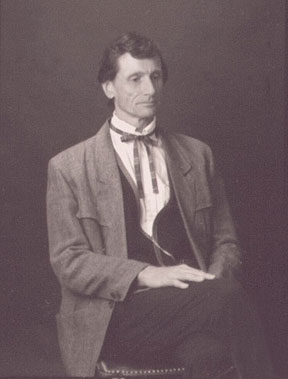
Johnny Liberty & Braveheart

Felt all that William Wallace experienced and more without the bloodshed and war. He was motivated by a desire for freedom as well as the patriotism of his country free from English despotism. Having lost his beloved in death to the nobles occupying his country he was vengeful and angry at the injustice.

Then as now the hope of the masses was to experience true freedom, but such hope was lost when they were not willing to unite, stand together and pay the price. Like Wallace I experienced the loneliness and betrayal of my brethren who were unwilling to take a stand even for their own sovereignty.

When push came to shove as the IRS came knocking down my door, they ran for the hills. When I was arrested and sent to prison all but a few walked away and left me alone without support or even the comfort of solidarity. Such cowardice is met with the loss of something so dear it’s unspeakable.

Yet there were those who stood by, weathered the storm, comforted and loved me while I was in prison. Those dear souls were enriched and forever blessed.

Different than Wallace I falsely admitted guilt for crimes I didn’t commit. This was not though an act of cowardice, but an act of self-love. Such an admission was necessary to minimize the prison sentence and return home to my loved ones as soon as possible.

I was not willing to be martyred or sacrificed at the hands of an unjust court for a cause too few believed in. Still I believe in the sovereignty of the people, to one day awaken to that fact and act accordingly. But this was not the time for the people to rise up and challenge their government as I’d expected, hoped and done myself for over a decade.

Admittedly, I was weakened by the fight, alone to the core, but refused to fight anymore. My spiritual path was to surrender and allow the greater power to enter my heart from within, not challenge the hardened walls of external authority.

Reclaiming internal authority over our lives, over my life was the essence of the teachings all those years (not to topple the government). In my utter defeat I lost one kind of power and gained yet another without the horrible death and torture Wallace suffered while screaming out “Freedom!”

His cry, as was mine, was for liberty and justice to prevail once more in the “land of the (allegedly) free.” Distinctly from Wallace my battle cry was to “wake up America (and the world).” Like Wallace I’ll cry “Freedom” until the end of my days.

So in prison I waited and bided my time well. I did my time as punishment for the crimes of standing courageously tall against an impossible force, telling the truth amidst very dangerous situations and being a responsible leader. I went boldly where very few men have had the courage to go. I may have been the last free American, a man who hadn’t already embraced the slave state-of-mind.

My friends, there’s a greater story yet to be told. But for now I am a silent, forgotten legend of a man who once lived tall and raised his banner of “liberty” for all to see. This “Johnny Liberty” rides no more in America.

This “John David Van Hove” is a free-spirit still (as the judge observed), a free man in the spiritual realms, the incarnation of Hyoka and Crazy Horse, a “braveheart” indeed who took “liberty” as far as he could and challenged external authority and the law that plundered his people.

Now, he’s refocused on being a true human being, recognizing and remembering always the bell that tolls within, a “liberty” that still rings true to his soul.