Health Insurance Costs Surpass $20,000 Per Year, Hitting a Record (for Employees) | Bloomberg

Editor’s Note: Sixty-seven years old and I’ve never had health insurance, haven’t seen a medical doctor since 1983, stay away from pharmaceutical and recreational drugs of all kinds, get plenty of exercise, eat healthy, mostly vegan and raw food. Although such a lifestyle may seem radical or unrealistic for many people, it’s a better option than paying through the nose for a morsel of health security. Hippocrates once said, “If you’re not your own doctor, you’re a fool.”

The cost of family health coverage in the U.S. now tops $20,000, an annual survey of employers found, a record high that has pushed an increasing number of American workers into plans that cover less or cost more, or force them out of the insurance market entirely.

“It’s as much as buying a basic economy car,” said Drew Altman, chief executive officer of the Kaiser Family Foundation, “but buying it every year.” The nonprofit health research group conducts the yearly survey of coverage that people get through work, the main source of insurance in the U.S. for people under age 65.

While employers pay most of the costs of coverage, according to the survey, workers’ average contribution is now $6,000 for a family plan. That’s just their share of upfront premiums, and doesn’t include co-payments, deductibles and other forms of cost-sharing once they need care.

The seemingly inexorable rise of costs has led to deep frustration with U.S. health care, prompting questions about whether a system where coverage is tied to a job can survive. As premiums and deductibles have increased in the last two decades, the percentage of workers covered has slipped as employers dropped coverage and some workers chose not to enroll. Fewer Americans under 65 had employer coverage in 2017 than in 1999, according to a separate Kaiser Family Foundation analysis of federal data. That’s despite the fact that the U.S. economy employed 17 million more people in 2017 than in 1999.

“What we’ve been seeing is a slow, slow kind of drip-drip erosion in employer coverage,” Altman said.

Employees’ costs for health care are rising more quickly than wages or overall economy-wide prices, and the working poor have been particularly hard-hit. In firms where more than 35% of employees earn less than $25,000 a year, workers would have to contribute more than $7,000 for a family health plan. It’s an expense that Altman calls “just flat-out not affordable.” Only one-third of employees at such firms are on their employer’s health plans, compared with 63% at higher-wage firms, according to the Kaiser Family Foundation’s data.

The survey is based on responses from more than 2,000 randomly selected employers with at least three workers, including private firms and non-federal public employers.

Deductibles are rising even faster than premiums, meaning that patients are on the hook for more of their medical costs upfront. For a single person, the average deductible in 2019 was $1,396, up from $533 in 2009. A typical household with employer health coverage spends about $800 a year in out-of-pocket costs, not counting premiums, according to research from the Commonwealth Fund. At the high end of the range, those costs can top $5,000 a year.

While raising deductibles can moderate premiums, it also increases costs for people with an illness or who get hurt. “Cost-sharing is a tax on the sick,” said Mark Fendrick, director of the Center for Value-Based Insurance Design at the University of Michigan.

Under the Affordable Care Act, insurance plans must cover certain preventive services such as immunizations and annual wellness visits without patient cost-sharing. But patients still have to pay out-of-pocket for other essential care, such as medication for chronic conditions like diabetes or high blood pressure, until they meet their deductibles.

Many Americans aren’t prepared for the risks that deductibles transfer to patients. Almost 40% of adults can’t pay an unexpected $400 expense without borrowing or selling an asset, according to a Federal Reserve surveyfrom May.

That’s a problem, Fendrick said. “My patient should not have to have a bake sale to afford her insulin,” he said.

Source: Bloomberg

How Anti-Vaccine Sentiment Took Hold in the United States | The New York Times

Editor’s Note: The New York Times (and likely their biggest Big Pharma advertisers) are heralding a strongly-held opinion that choice regarding vaccines should not be an option for parents who may have good reason to believe their children are at risk. The almost completely unregulated vaccine industry is in denial regarding the potentially dangerous side effects, chronic illnesses that can result and in too many cases they’d rather not count – death. Not once in this well-written, one-sided article did the views, opinions or reasoning of the anti-vaccine crowd get acknowledged. This is but one of numerous op-ed articles the New York Times has recently published. 

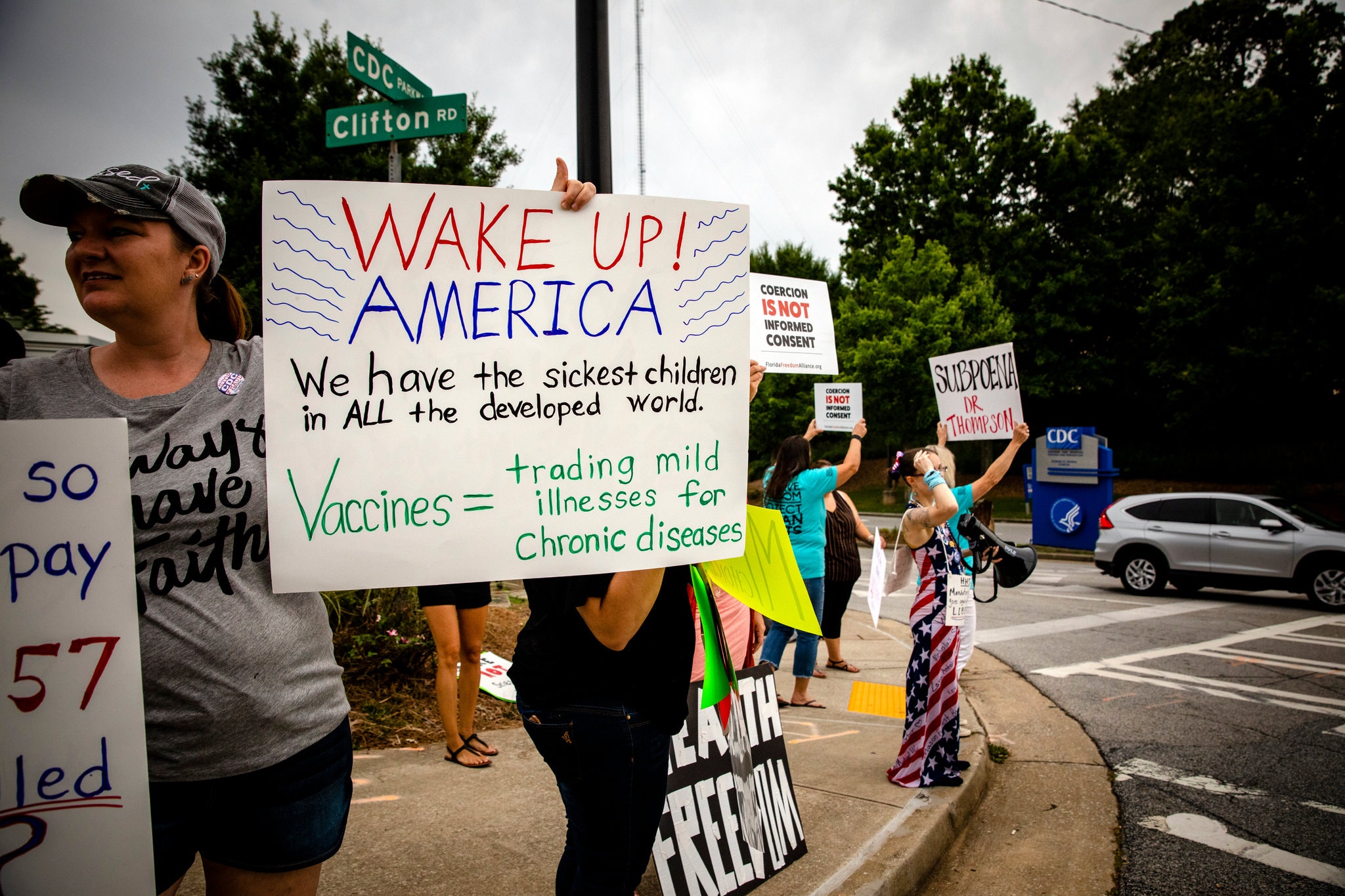
As families face back-to-school medical requirements this month, the country feels the impact of a vaccine resistance movement decades in the making. The question is often whispered, the questioners sheepish. But increasingly, parents at the Central Park playground where Dr. Elizabeth A. Comen takes her young children have been asking her: “Do you vaccinate your kids?”

Dr. Comen, an oncologist who has treated patients for cancers related to the human papillomavirus that a vaccine can now prevent, replies emphatically: Absolutely.

She never imagined she would be getting such queries. Yet these playground exchanges are reflective of the national conversation at the end of the second decade of the 21st century — a time of stunning scientific and medical advances but also a time when the United States may, next month, lose its World Health Organization designation as a country that has eliminated measles, because of outbreaks this year. The W.H.O. has listed vaccine hesitancy as one of the top threats to global health.

As millions of families face back-to-school medical requirements and forms this month, the contentiousness surrounding vaccines is heating up again, with possibly even more fervor.

Though the situation may seem improbable to some, anti-vaccine sentiment has been building for decades, a byproduct of an internet humming with rumor and misinformation; the backlash against Big Pharma; an infatuation with celebrities that gives special credence to the anti-immunization statements from actors like Jenny McCarthy, Jim Carrey and Alicia Silverstone, the rapper Kevin Gates and Robert F. Kennedy Jr. And now, the Trump administration’s anti-science rhetoric.

“Science has become just another voice in the room,” said Dr. Paul A. Offit, an infectious disease expert at Children’s Hospital of Philadelphia. “It has lost its platform. Now, you simply declare your own truth.”

The constituents who make up the so-called vaccine resistant come from disparate groups, and include anti-government libertarians, apostles of the all-natural and parents who believe that doctors should not dictate medical decisions about children. Labeling resisters with one dismissive stereotype would be wrongheaded.

“To just say that these parents are ignorant or selfish is an easy trope,” said Jennifer Reich, a sociologist at the University of Colorado Denver, who studies vaccine-resistant families.

[Why did we start listening to celebrities about vaccines? Read more.]

It remains true that the overwhelming majority of American parents have their children vaccinated. Parent-driven groups like Voices for Vaccines, formed to counter anti-vaccination sentiment, have proliferated. Five states have eliminated exemptions for religious and philosophical reasons, permitting only medical opt-outs.

But there are ominous trends. For highly contagious diseases like measles, the vaccine rate to achieve herd immunity — the term that describes the optimum rate for protecting an entire population — is typically thought to be 95 percent. The Centers for Disease Control and Prevention found that the vaccination rate for the measles, mumps and rubella (M.M.R.) injection in kindergartners in the 2017-2018 school year had slipped nationally to 94.3 percent, the third year in a row it dropped.

Seven states reported rates for the M.M.R. vaccine that were far lower for kindergartners, including Kansas at 89.1 percent; New Hampshire, 92.4 percent; the District of Columbia, 81.3 percent. (The highest is West Virginia at 98.4 percent.)

Almost all states have at least one anti-vaccine group. At least four have registered political action committees, supporting candidates who favor less restrictive vaccine exemption policies.

Public health experts say that patients and many doctors may not appreciate the severity of diseases that immunizations have thwarted, like polio, which can affect the spinal cord and brain — because they probably have not seen cases.

“Vaccines are a victim of their own success,” said Dr. Offit, a co-inventor of a vaccine for rotavirus, which can cause severe diarrhea in young children. “We have largely eliminated the memory of many diseases.”

The growth of vaccine doubt in America coincides with several competing forces and attitudes.

Since the early 2000s, as the number of required childhood vaccines was increasing, a generation of parents was becoming hypervigilant about their children and, through social media, patting each other on the backs for doing so. In their view, parents who permitted vaccination were gullible toadies of status quo medicine.

In 2011, Dana Fuqua, of Aurora, Colo., pregnant with her first child, felt that irresistible pull of groupthink parenting.

She had just moved to the area, so she reached out to mothers’ groups on Facebook. Colorado, with a kindergarten vaccination compliance rate of 88.7 percent, has a rambunctious vaccine-resistant movement. Ms. Fuqua’s new friends urged her to have a drug-free birth, use cloth diapers and never to let a drop of formula pass her baby’s lips. Vaccines, it followed, were anathema.

The women intimidated her. They had advanced degrees; she had only a bachelor of science and a nursing background.

“I didn’t argue with them,” Ms. Fuqua said. “I was so desperate for their support that I compromised by delaying the vaccine schedule, so I wouldn’t get kicked out of the group.”

But when her second child was born prematurely, susceptible to illness, the group’s approval was not as important as her baby’s safety. Her position, she said, shifted from, “‘I can’t hang out with you if you had a vaccine because you could be shedding a virus’” — a common, false belief among the vaccine resistant — to, “ ‘If you haven’t had a vaccine, I will not associate with you.’”

She had both children fully vaccinated.

There have been anti-vaccination movements at least since 1796, when Edward Jenner invented the smallpox vaccine. But many experts say that the current one can be traced to 1982, when NBC aired a documentary, “DPT: Vaccine Roulette,” that took up a controversy percolating in England: a purported tie between the vaccine for pertussis — a potentially fatal disease that can cause lung problems — and seizures in young children.

Doctors sharply criticized the show as dangerously inaccurate. But fear spread. Anti-vaccination groups formed. Many companies stopped making vaccines, which were considered loss-leaders and not worth the corporate headache.

Then, in 1998, Andrew Wakefield, a British gastroenterologist, published a Lancet study (since discredited and withdrawn), associating the M.M.R. vaccine with autism.

Faced with risking autism or measles, some parents thought the answer was obvious. Most had never seen measles, mumps or rubella because vaccines had nearly eliminated them. But they believed they knew autism.

And most people are notoriously poor at assessing risk, say experts in medical decision-making.

Many stumble on omission bias: “We would rather not do something and have something bad happen, than do something and have something bad happen,” explained Alison M. Buttenheim, an associate professor of nursing and health policy at the University of Pennsylvania School of Nursing.

People are flummoxed by numerical risk. “We pay more attention to numerators, such as ‘16 adverse events,’ than we do to denominators, such as ‘per million vaccine doses,’ ” Dr. Buttenheim said.

A concept called “ambiguity aversion” is also involved, she added. “Parents would like to be told that vaccines are 100 percent safe,” she said. “But that’s not a standard we hold any medical treatment to.”

Relatively few people are absolutists about refusing all vaccines. “But if you’re uncertain about a decision, you’ll find those who confirm your bias and cement what you think,” said Rupali J. Limaye, a social scientist who studies vaccine behaviors at the Johns Hopkins Bloomberg School of Public Health.

Nowhere is that reinforcement more clamorous than on social media, Dr. Limaye added. “You may only see your pediatrician a few times a year but you can spend all day on the internet,” she said.

People tend to believe an individual’s anecdotal narrative over abstract numbers. By 2007, when Ms. McCarthy, the actress, insisted that vaccines caused her son’s autism, thousands found her to be more persuasive than data showing otherwise. A nascent movement took hold.

At the same time that these powerful attacks on vaccine confidence were underway, a constellation of trends was emerging.

The definition of a good parent was becoming fraught with the responsibility for overseeing every aspect of a child’s life.

“As we adopted a culture of individualistic parenting, public health became a hard sell,” Dr. Reich said.

The primary reason for healthy people to get the flu shot is to protect those with compromised immune systems, like infants and older adults, from getting sick. But altruism isn’t a great motivator for parents, Dr. Buttenheim said. “They are much more concerned about protecting their own child at all costs,” she said.

Contrast that attitude with the collective good will of the 1950s, say medical sociologists, when American parents who had seen President Franklin Delano Roosevelt’s wheelchair as a debilitating symbol of polio patriotically sought to vaccinate their children to help eradicate the disease worldwide.

By 2014, studies showed that parental confidence in authorities like the C.D.C. and in pediatricians was dropping, especially around vaccines. Mistrust of Big Pharma was even more pronounced.

By then, Donald Trump was offering support on Twitter for the discredited link between autism and vaccination. As president-elect, he met with leaders of the anti-vaccination movement, although as measles cases surged, he endorsed vaccination.

As parenting became rife with orthodoxy, the Marcus Welby model of the paternalistic doctor retreated. Patients asserted autonomy, brandishing internet printouts at doctors. Shared decision-making became the model of doctor-patient engagement.

Pediatricians offered to stagger vaccine schedules. Some were even flexible about vaccinations altogether.

In 2011, shortly after Emma Wagner had given birth in Savannah, Ga., a pediatrician on the ward examined the baby. “He asked me if I was interested in the hepatitis B vaccine,” she said of an inoculation typically done at birth.

She was apprehensive.

He replied, “‘That’s fine, because your 2-day-old daughter isn’t a prostitute and isn’t using I.V. drugs, so hep B isn’t at the top of my worries.’”

Ms. Wagner said she “swallowed the anti-vax Kool-Aid. I was motivated by fear. I thought, ‘Until I know for certain that these are safe, I won’t do it.’ The pediatrician said, ‘I will support your decision and in a few years we’ll talk about exemptions for school.’”

She has since become a staunch supporter of immunization.

Libertarianism also courses through vaccine hesitation, with parents who assert that government should not be able to tell them what to put in their bodies — a position often marketed as “the right to choose.”

“Having the government order them to do something reinforces conspiracy theories,” said Daniel Salmon, director of the Institute for Vaccine Safety at Johns Hopkins. “And people perceive their risk to be higher when it’s not voluntary.”

In reality, he said, one’s risk of harm is greater while driving to an airport than it is being on the airplane itself. But driving is voluntary and gives the illusion of control. People fear flying because they cannot control the plane. By extension, many childhood vaccines are not voluntary, which rattles those who prefer to believe they can control their health.

With so many different but deeply held convictions, public health experts struggle to design vaccine-positive campaigns.

In 2017, researchers applied the six values of “the moral foundations theory” to vaccine attitudes, surveying 1,007 American parents.

The results were intriguing. Those most resistant to vaccines scored highest in two values: purity (“my body is a temple”) and liberty (“I want to make my child’s health care decisions”).

A third, said Saad B. Omer, director of Yale’s Global Health Institute and an author of the study, was also telling: deference to authority — a score indicating whether one was likely to adhere to the advice of experts like a pediatrician or the C.D.C.

Dr. Salmon’s team at Johns Hopkins is working on an app to capture parents’ vaccine attitudes and to tailor information to persuade them to vaccinate their children.

Pediatricians are front-line persuaders, he said, and they should be compensated for the time it takes to educate parents.

Most experts note that physicians themselves, never mind parents, have no idea about the federal vaccine monitoring systems, which have been in place for more than 20 years.

“We ask parents in the first two years of their child’s life to protect them against 14 diseases, that most people don’t see, using fluids they don’t understand,” Dr. Offit said. “It’s time for us to stand back and explain ourselves better.”

Source: The New York Times

Congressional Progressive Caucus | Wikipedia

Editor’s Note: The 98-member Congressional Progressive Caucus is closely allied with the Democratic Socialists of America. The Communist Party USA identifies Progressive Caucus members as its “allies in Congress.”

The Congressional Progressive Caucus (CPC) is a caucus within the Democratic congressional caucus in the United States Congress.[6] The CPC is a left-leaning organization that works to advance progressive and liberalissues and positions and represents the progressive faction of the Democratic Party.[7][8] It was founded in 1991 and has grown steadily since then.

Entering the 116th United States Congress, the CPC has 98 members, making it the second largest caucus within the Democratic Party and the third largest caucus in Congress. The CPC is currently co-chaired by U.S. Representatives Mark Pocan (D-WI) and Pramila Jayapal (D-WA).

Source: Wikipedia

Fake news is real — Artificial Intelligence is going to make it much worse | CNBC

“The Boy Who Cried Wolf” has long been a staple on nursery room shelves for a reason: It teaches kids that joking too much about a possible threat may turn people ignorant when the threat becomes an actual danger.

President Donald Trump has been warning about “fake news” throughout his entire political career putting a dark cloud over the journalism professional. And now the real wolf might be just around the corner that industry experts should be alarmed about.

The threat is called “deepfaking,” a product of AI and machine learning advancements that allows high-tech computers to produce completely false yet remarkably realistic videos depicting events that never happened or people saying things they never said. A viral video starring Jordan Peele and “Barack Obama” warned against this technology in 2018, but the message was not enough to keep Jim Carrey from starring in “The Shining” earlier this week.

The danger goes far beyond manipulating 1980s thrillers. Deepfake technology is allowing organizations that produce fake news to augment their “reporting” with seemingly legitimate videos, blurring the line between reality and fiction like never before — and placing the reputation of journalists and the media at greater risk.

Ben Zhao, a computer science professor at the University of Chicago, thinks the age of getting news on social media makes consumers very susceptible to this sort of manipulation.

“What the last couple years has shown is basically fake news is quite compelling even in [the] absence of actual proof. … So the bar is low,” Zhao said.

The bar to produce a convincing doctored video is lower than people might assume.

Earlier this year a clip purporting to show Democratic leader Nancy Pelosi slurring her words when speaking to the press was shared widely on social media, including at one point by Trump’s attorney Rudy Giuliani. However, closer inspection revealed that the video had been slowed to 75% of its normal speed to achieve this slurring effect, according to the Washington Post. Even with the real video now widely accessible, Hany Farid, a professor at UC Berkeley’s School of Information and a digital forensics expert, said he still regularly receives emails from people insisting the slowed video is the legitimate one.

“Even in these relatively simple cases, we are struggling to sort of set the record straight,” Farid said.

It would take a significant amount of expertise for a fake news outlet to produce a completely fabricated video of Oprah Winfrey endorsing Trump, but researchers say the technology is improving every day. At the University of Washington, computer vision researchers are developing this technology for positive, or at least benign, uses like making video conferencing more realistic and letting students talk to famous historical figures. But this research also leads to questions about potential dangers, as the attempts made by attackers are expected to continually improve.

How to detect a deepfake

To make one of these fake videos, computers digest thousands of still images of a subject to help researchers build a 3-D model of the person. This method has some limitations, according to Zhao, who noted the subjects in many deepfake videos today never blink, since almost all photographs are taken with a person’s eyes open.

However, Farid said these holes in the technology are being filled incredibly rapidly.

“If you asked me this question six months ago, I would’ve said, ‘Yeah, [the technology] is super cool, but there’s a lot of artifacts, and if you’re paying attention, you can probably tell that there’s something wrong,’” Farid said. “But I would say we are … quickly but surely getting to the point where the average person is going to have trouble distinguishing.”

In fact, Zhao said researchers believe the shortcomings that make deepfake videos look slightly off to the eye can readily be fixed with better technology and better hardware.

“The minute that someone says, ‘Here’s a research paper telling you about how to detect this kind of fake video,’ that is when the attackers look at the paper and say, ‘Thank you for pointing out my flaw. I will take that into account in my next-generation video, and I will go find enough input … so that the next generation of my video will not have the same problem,’” Zhao said.

“Once we live in an age where videos and images and audio can’t be trusted … well, then everything can be fake.” – Hany Farid, Professor at UC Berkeley’s School of Information

One of the more recent developments in this field is in generating speech for a video. To replicate a figure such as Trump’s voice, computers can now simply analyze hundreds of hours of him speaking. Then researchers can type out what they want Trump to say, and the computer will make it sound as if he actually said it. Facebook, Google and Microsoft have all more or less perfected this technology, according to Farid.

Manipulated videos of this sort aren’t exactly new — Forest Gump didn’t actually meet JFK, after all. However, Farid says this technology is hitting its stride, and that makes the danger new.

“To me the threat is not so much ‘Oh, there’s this new phenomenon called deepfakes,’” Farid said. “It’s the injection of that technology into an existing environment of mistrust, misinformation, social media, a highly polarized electorate, and now I think there’s a real sort of amplification factor because when you hear people say things, it raises the level of belief to a whole new level.”

The prospect of widespread availability of this technology is raising eyebrows, too. Tech-savvy hobbyists have long been using deepfakes to manufacture pornography, a consistent and comically predictable trend for new technology. But Zhao believes it is only a matter of time before the research-caliber technology gets packaged and released for mass-video manipulation in much broader contexts.

“At some point someone will basically take all these technologies and integrate and do the legwork to build a sort of fairly sophisticated single model, one-stop shop … and when that thing hits and becomes easily accessible to many, then I think you’ll see this becoming much more prevalent,” Zhao said. “And there’s nothing really stopping that right now.”

Facing a massive consumer trust issue

When this happens, the journalism industry is going to face a massive consumer trust issue, according to Zhao. He fears it will be hard for top-tier media outlets to distinguish a real video from a doctored one, let alone news consumers who haphazardly stumble across the video on Twitter.

“Once we live in an age where videos and images and audio can’t be trusted … well, then everything can be fake,” Farid said. “We can have different opinions, but we can’t have different facts. And I think that’s sort of the world we’re entering into when we can’t believe anything that we see.”

Zhao has spent a great deal of time speaking with prosecutors, judges — the legal profession is another sector where the implications are huge — reporters and other professors to get a sense for every nuance of the issue. However, despite his clear understanding of the danger deepfakes pose, he is still unsure of how news outlets will go about reacting to the threat.

“Certainly, I think what can happen is … there will be even less trust in sort of mainstream media, the main news outlets, legitimate journalists [that] sort of react and report real-time stories because there is a sense that anything that they have seen … could be in fact made up,” Zhao said.

Then it becomes a question of how the press deal with the disputes over reality.

“And if it’s someone’s word, an actual eyewitness’ word versus a video, which do you believe, and how do you as an organization go about verifying the authenticity or the illegitimacy of a particularly audio or video?” Zhao asked.

Defeating the deepfakes

Part of this solution may be found in the ledger technology that provides the digital infrastructure to support cryptocurrencies like bitcoin — the blockchain. Many industries are touting blockchain as a sort of technological Tylenol. Though few understand exactly how it works, many swear it will solve their problems.

Farid said companies like photo and video verification platform Truepic, to which he serves as an advisor, are using the blockchain to create and store digital signatures for authentically shot videos as they are being recorded, which makes them much easier to verify later. Both Zhao and Farid are hoping social platforms like Facebook and Twitter will then promote these videos that are verified as authentic over non-verified videos, helping to halt the spread of deepfakes.

“The person creating the fake always has the upper hand,” Farid said. “Playing defense is really, really hard. So I think in the end our goal is not to eliminate these things, but it’s to manage the threat.”

Until this happens, Zhao said the fight against genuinely fake news may not start on a ledger, but in stronger consumer awareness and journalists banding together to better verify sources through third parties.

“One of the hopes that I have for defeating this type of content is that people are just so inundated with news coverage and information about these types of videos that they become fundamentally much more skeptical about what a video means and they will look closer,” Zhao said. “There has to be that level of scrutiny by the consumer for us to have any chance of fighting back against this type of fake content.”

Nicholas Diakopoulos, assistant professor in Northwestern University’s School of Communication and expert on the future of journalism, said via email that the best solutions involve a mix of educational and sociotechnical advances.

“There are a variety of perceptual cues that can be tip-offs to a deepfake and we should be teaching those broadly to the public,” he said.

Diakopoulos has referenced Farid’s work on photo forensics among ideas outlined in an article he wrote for the Columbia Journalism Review last year. He also cited a research project called FaceForensics that uses machine learning to detect, with 98.1% accuracy, whether a video of a face is real. Another research technique under study: Blood flow in video of a person’s face can be analyzed in order to see if pixels periodically get redder when the heart pumps blood.

“On the sociotechnical side, we need to develop advanced forensics techniques that can help debunk synthesized media when put into the hands of trained professionals,” he told CNBC. “Rapid response teams of journalists should be trained and ready to use these tools during the 2020 elections so they can debunk disinformation as quickly as possible.”

Diakopoulos has studied the implications of deepfakes for the 2020 electionsspecifically. He also has written papers on how journalists need to think when “reporting in a machine reality.”

And he remains optimistic.

“If news organizations develop clear and transparent policies of their efforts using such tools to ensure the veracity of the content they publish, this should help buttress their trustworthiness. In an era when we can’t believe our eyes when we see something online, news organizations that are properly prepared, equipped and staffed are poised to become even more trusted sources of information.”

Source: CNBC

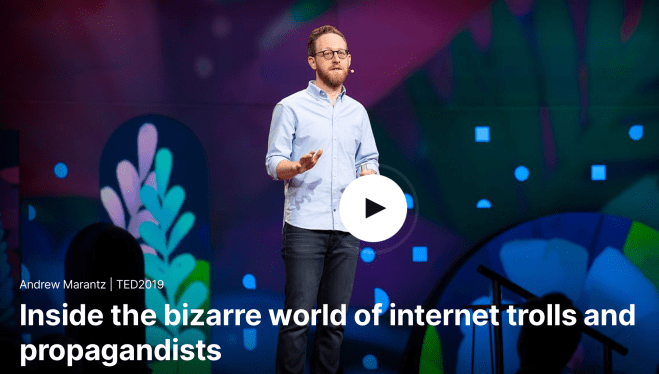
Inside the bizarre world of internet trolls and propagandists | TEDTalks

Journalist Andrew Marantz spent three years embedded in the world of internet trolls and social media propagandists, seeking out the people who are propelling fringe talking points into the heart of conversation online and trying to understand how they’re making their ideas spread. Go down the rabbit hole of online propaganda and misinformation — and learn we can start to make the internet less toxic.

Source: TEDTalks

Unsealed documents shed new light on efforts to verify Trump-Russia dossier | CNN

Documents unsealed this week lend credence to a theory about Russian election meddling that was first put forward in the Trump-Russia dossier, however they do not corroborate the more explosive claims that the Trump campaign colluded with the Kremlin in the 2016 campaign.

A report from a retired agent who worked for the FBI’s cyber division, submitted as expert testimony in a civil lawsuit, presented new evidence about how Russian intelligence might have exploited a private web hosting company when it fooled top Democratic targets into giving up their passwords. The fruits of those hacks formed the basis of the WikiLeaks email dumps that roiled the race.

The controversial dossier had accused Russian hackers of using those companies, Webzilla and its parent company XBT, as part of their scheme to meddle in the presidential election. The memos, written by a retired British spy, Christopher Steele, also claimed that Russian entrepreneur Aleksej Gubarev assisted the cyberattacks “under duress” from Russian intelligence.

Gubarev vehemently denied those allegations and sued BuzzFeed for defamation after it published the dossier. That prompted BuzzFeed to commission the expert witness report from FTI Consulting’s Anthony Ferrante, who is also a CNN contributor. A federal judge dismissed the lawsuit in December, and ordered that dozens of documents be released to the public this week. The judge ruled on First Amendment grounds and did not assess the hacking-related allegations.

Details of the report

The FTI report concluded that one of the hyperlinks the Russians designed to trick Hillary Clinton’s campaign chairman John Podesta into giving up his email password was created on an internet protocol address owned by Root S.A., an XBT subsidiary.
In his deposition, retired FBI cyber official Ferrante admitted the evidence didn’t conclusively show XBT was aware of the Russian campaign against Democrats.

“I will further state that other than the fact that XBT employees did little to nothing to detect, stop and prevent the significant malicious activity, I have no evidence of them actually sitting behind a keyboard,” he said.

Gubarev’s team argued that an internet hosting company couldn’t be held responsible for the activities of people who use its services.
A rebuttal on Gubarev’s behalf, filed by a former CIA cybersecurity expert, Eric Cole, stressed that he and his staff were frequently unaware of the specific activity conducted on its servers.

“XBT/Webzilla is not responsible for every bit of data that a bad actor passes over its infrastructure any more than a post office is responsible for the actions of the Unabomber,” Cole wrote.

“Special Counsel Robert Mueller indicted the 12 Russians responsible for the hacking. Those are the folks responsible, not us,” Evan Fray-Witzer, an attorney for Gubarev, told CNN. The 11-count indictment against those hackers, which was filed in July 2018, did not mention Webzilla or XBT.

BuzzFeed News characterized the report as vindication of its decision to publish the Trump-Russia dossier. “We knew already that publishing the dossier was in the public interest,” spokesperson Matt Mittenthal told CNN. “Now, because BuzzFeed News published the dossier, we’re learning more about the facts of foreign influence in the 2016 presidential election.”

Gubarev sued BuzzFeed in 2017 and sought damages for defamation. As part of the legal process, some of the key players in the dossier saga were deposed, including Steele.

The court unsealed one page of that deposition, which happened last year in London. Steele testified that he tried to verify the allegations against Gubarev by doing, among other things, an “open source search,” which would likely include scouring news clippings and public records.

Steele has years of experience as a British spy in Moscow and has been a trusted source for the FBI. Allies of Democratic nominee Clinton funded Steele’s investigation in 2016. But he was so concerned by his findings that he shared his memo with senior US and UK officials.

In her decision to throw out the case, the judge confirmed that BuzzFeed got the dossier from an associate of Republican Sen. John McCain in December 2016, weeks after the election.

The memos were circulating in Washington, and CNN soon broke the story that senior US intelligence officials had briefed President-elect Trump and President Barack Obama about some of the unverified allegations. Hours later, BuzzFeed published the complete dossier online.
The most salacious allegations in the dossier remain unverified to this day. But the claims that form the bulk of the memos have held up over time, or at least proved to be partially true.

This notably includes Steele’s claim that Russian President Vladimir Putin oversaw an effort to interfere in the 2016 election. It also includes allegations of secret contacts between Trump’s team and the Russians during the campaign. Steele gathered this stunning information months before the Russian meddling campaign was publicly confirmed by US intelligence agencies and in court filings from special counsel Robert Mueller.

Kevin Collier, a cybersecurity reporter for CNN, previously worked for BuzzFeed News.

Source: CNN & BuzzFeed News

FBI releases part of Russia dossier summary used to brief Trump, Obama | Politico

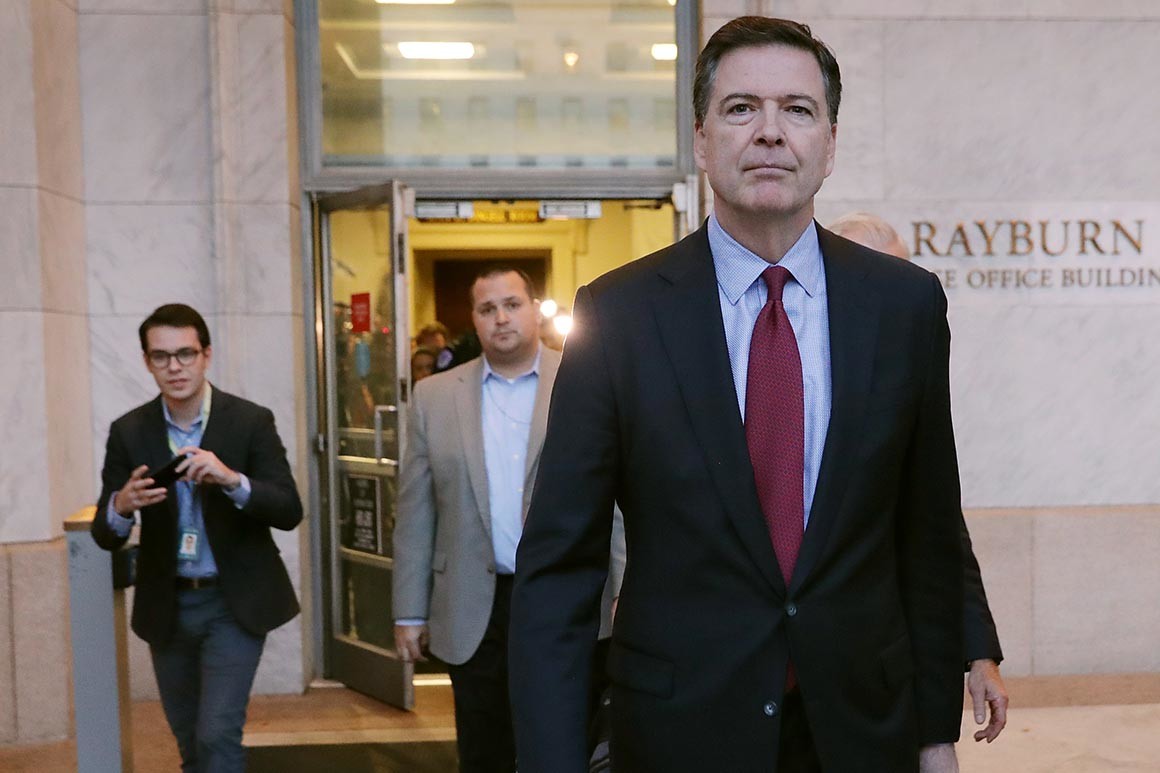
The FBI released for the first time Friday night a two-page summary former FBI Director James Comey used to brief President-elect Donald Trump nearly two years ago on a so-called dossier about Trump’s ties to Russia.

The version made public Friday could reignite previous criticism from Republicans and Trump allies that the FBI was too vague in its description of the fact that the dossier was funded by the campaign of Trump’s nemesis in the 2016 presidential election, Democratic nominee Hillary Rodham Clinton, as well as the Democratic National Committee.

Comey, who was fired by Trump in May 2017, acknowledged during a book tour earlier this year that he did not inform Trump who paid for the research.

The brief passage the FBI left unredacted in the newly released memo gives some background on the former British intelligence officer who compiled the dossier, Christopher Steele, although Steele’s name does not actually appear in the newly released version. The released portion of the synopsis is vague about who financed the project, referring to it as sponsored by “private clients.”

“An FBI source … volunteered highly politically sensitive information … on Russian influence efforts aimed at the US presidential election,” the memo labeled as “Annex A” says. “The source is an executive of a private business intelligence firm and a former employee of a friendly intelligence service who has been compensated for previous reporting over the past three years. The source maintains and collects information from a layered network of identified and unidentified subsources, some of which has been corroborated in the past. The source collected this information on behalf of private clients and was not compensated for it by the FBI.”

“The source’s reporting appears to have been acquired by multiple Western press organizations starting in October,” the document from January 2017 declares.

Comey has said he did not show or give Trump the memo, but used it as a reference when briefing him on the dossier, which U.S. intelligence officials feared Russia might try to use as blackmail against Trump. The synopsis was also used to brief President Barack Obama, officials have said.

Republicans had previously complained that the FBI failed to inform a federal court about the dossier’s provenance — that Steele’s work was commissioned by Fusion GPS, a research firm that had been hired by the Clinton campaign’s law firm, Perkins Coie, to dig up information about Trump’s business relationships overseas. Based in part on the dossier’s information, the court granted an FBI application to surveil a former Trump campaign associate in October 2016.

Aspects of the FBI’s surveillance application have since been released and revealed that the FBI did inform the court that Steele had political animus toward Trump and that it was funded by a politically motivated backer.

The document was released Friday in response to a Freedom of Information Act lawsuit brought by a POLITICO reporter and the James Madison Project, a pro-transparency group.

In January, U.S. District Court Judge Amit Mehta ruled that that the FBI was legally justified in refusing to confirm or deny the existence of any records related to the dossier, despite several tweets from President Donald Trump that described the document as “fake” or “discredited.”

However, shortly after that ruling, Trump declassified a House Intelligence Committee memo that included various claims about the FBI’s handling of the dossier. In August, Mehta said the official release of that material vitiated the FBI’s ability to claim that it had offered no public confirmation of its role in vetting or verifying the dossier, a collection of accurate, inaccurate, unverified and sometimes salacious claims about ties between Russia and various figures in Trump’s circle.

“It remains no longer logical nor plausible for the FBI to maintain that it cannot confirm nor deny the existence of documents” related to attempts to verify information in the dossier, Mehta wrote.

The FBI withheld the remainder of the two-page synopsis on a variety of grounds, including that the material remains classified either Secret or Top Secret. The law enforcement agency also indicated the information is exempt from release because it pertains to ongoing investigations or court proceedings, originated with a confidential source or describes confidential investigative techniques or procedures.

The FBI said Friday it lacked any records indicating final conclusions about any information in the dossier, said Brad Moss, one of the attorneys pressing for release of the records.

“After two years of legal games, the FBI today finally confirmed two pieces of speculation about the scandalous allegations regarding which Director Comey briefed President Trump in January 2017: all of those allegations remain part of the ongoing Russian ‘collusion’ investigation, and the FBI has not rendered final determinations about the accuracy of any of them,” Moss said. “Far from being debunked, the issues that raised concerns for the Intelligence Community in 2017 remain unresolved to this day.”

Moss said he plans to challenge the FBI’s withholdings in the case and to ask Mehta to order more of the information released.

Source: Politico

FBI’s 37 secret pages of memos about Russia, Clintons and Uranium One | The Hill

By John Soloman

Eight years after its informant uncovered criminal wrongdoing inside Russia’s nuclear industry, the FBI has identified 37 pages of documents that might reveal what agents told the Obama administration, then-Secretary of State Hillary Clinton and others about the controversial Uranium One deal.

There’s just one problem: The FBI claims it must keep the memos secret from the public.

Their excuses for the veil of nondisclosure range from protecting national security and law enforcement techniques to guarding the privacy of individual Americans and the ability of agencies to communicate with each other.

Sound familiar?

It’s a lot like the initial reasons the bureau was reluctant to turn over documents in the Russia collusion investigation, such as former FBI agent Peter Strzok’s “stop Trump” texts or the revelation that Clinton and the Democrats funded the Steele dossier.

The FBI’s declaration and list of withheld documents — entitled simply “Uranium One Transaction” — were posted recently inside its Freedom of Information Act (FOIA) online vault.

The bureau actually released a handful of documents, but it wasn’t a big stretch of either freedom or information. It actually just released already public letters from members of Congress demanding answers in the Uranium One case.

I was the reporter who first disclosed last fall that a globetrotting American businessman, William Douglas Campbell, managed to burrow his way inside Russian President Vladimir Putin’s nuclear giant, Rosatom, in 2009 posing as a consultant while working as an FBI informant.

Campbell gathered extensive evidence for his FBI counterintelligence handlers by early 2010 that Rosatom’s main executive in the United States, Vadim Mikerin, orchestrated a racketeering plot involving kickbacks, bribes and extortion that corrupted the main uranium trucking company in the United States. That is a serious national security compromise by any measure.

The evidence was compiled as Secretary Clinton courted Russia for better relations, as her husband former President Clinton collected a $500,000 speech payday in Moscow, and as the Obama administration approved the sale of a U.S. mining company, Uranium One, to Rosatom.

The sale — made famous years later by author Peter Schweizer and an epic New York Times exposé in 2015 — turned over a large swath of America’s untapped uranium deposits to Russia.

Mikerin was charged and convicted, along with some American officials, but not until many years later. Ironically, the case was brought by none other than current Deputy Attorney General Rod Rosenstein — a magnet for controversy, it turns out.

But the years-long delay in prosecution mean that no one in the public, or in Congress, was aware that the FBI knew through Campbell about the Russian bribery plot as early as 2009 — well before the Obama-led Committee on Foreign Investment in the United States (CFIUS) approved Uranium One in fall 2010.

Since the emergence of Campbell’s undercover work, there has been one unanswered question of national importance.

Did the FBI notify then-President Obama, Hillary Clinton and other leaders on the CFIUS board about Rosatom’s dark deeds before the Uranium One sale was approved, or did the bureau drop the ball and fail to alert policymakers?

Neither outcome is particularly comforting. Either the United States, eyes wide open, approved giving uranium assets to a corrupt Russia, or the FBI failed to give the evidence of criminality to the policymakers before such a momentous decision.

Campbell tells me his FBI handlers assured him they had briefed Obama and then-FBI Director Robert Mueller, now the Russia special prosecutor, on Rosatom’s criminal activities as part of the president’s daily briefing and that agents suggested to him that “politics” was the reason the sale was allowed to go through.

After I broke the Campbell story, a predictable pattern occurred. President Trump and the Republicans took note. On the flip side, Democrats attacked the credibility of the informer — despite evidence the FBI had given him a hefty $50,000 award of thanks after the case was finished.

And the Jeff Sessions-Rod Rosenstein Justice Department, likely feeling the heat of President Trump’s watchful eye, announced that a prosecutor from Utah was named to look into the matter.

Campbell was interviewed by the FBI, but that was 10 months ago. Since then, nothing has been made public to address the overriding public interest issue.

Perhaps the FBI’s unexpected “release” — and I use that word loosely, since they gave up no public information of importance — in the FOIA vault was a warning flare designed to remind America there might be evidence worth looking at.

One former U.S. official, who had access to the evidence shared with CFIUS during the Uranium One deal, said this to me: “There is definitely material that would be illuminating to the issues that have been raised. Somebody should fight to make it public.”

That somebody could be President Trump, who could add these 37 pages of now-secret documents to his declassification order he is considering in the Russia case.

Or, those Republicans leading the charge on exposing failures in the Russia probe could use their bully pulpits to pressure for the release.

From what we now know, either the CFIUS process was corrupted or broken, or the FBI dropped the ball.

Either outcome is a matter of national interest.

Source: The Hill

Author: John Solomon is an award-winning investigative journalist whose work over the years has exposed U.S. and FBI intelligence failures before the Sept. 11 attacks, federal scientists’ misuse of foster children and veterans in drug experiments, and numerous cases of political corruption. He is The Hill’s executive vice president for video.

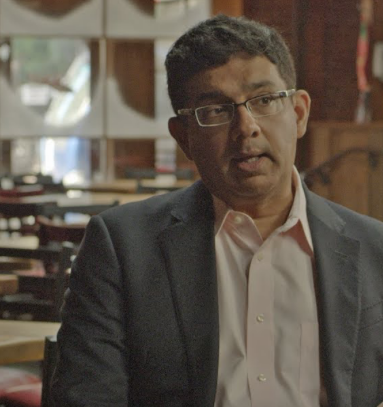
Dinesh D’Souza reveals the big lie about Charlottesville | Western Journal

So the white nationalists are once again coming to Charlottesville. Get ready not only for some bombastic theatrics, but also for a replay of the progressive media’s Charlottesville narrative: Hey, look at those racists in MAGA hats! This proves that, whatever the history of Democratic Party bigotry, racism today is in the Trump column. Bigotry now is on the right.

But this narrative is a lie. First of all, no one has ever conducted a valid empirical survey of neo-Nazis or Ku Klux Klansmen to prove they voted for Trump. This is why the media needs visual images that seem to confirm an unproven thesis. In the aftermath of the initial Charlottesville, I was struck by a solitary white supremacist in a MAGA hat being interviewed by more than a dozen reporters. This one guy — otherwise culturally and politically impotent — was portrayed as visual proof that white nationalism is a malevolent Trump phenomenon.

In my new book, Death of a Nation, I examined the lives of the leading white nationalists in America today. Virtually without exception, they are on the left. Let’s start with Jason Kessler, organizer of last year’s Charlottesville rally. The Southern Poverty Law Center looked into his background and was astounded to discover that he had been an Obama supporter and active in the left-wing Occupy Wall Street movement.

What could be more interesting than to examine why an Obama supporter could become a white supremacist? Or how an Occupy activist transitioned into a defender of the white cause? Yet the progressive media went dead silent on this one. Only one local Charlottesville newspaper, The Daily Progress, bothered to dig into this, noting that Kessler’s previous tweets, his neighbors and several of his friends “attest that he held strong liberal convictions.”

Laura Kleiner is a Democratic activist who dated Kessler for several months in 2013. According to the article, “She said Kessler was very dedicated to his liberal principles, and that he was a strict vegetarian, abstained from alcohol and drugs, embraced friends of different ethnicities, and was an atheist.” Kleiner added of Kessler, “He broke up with me and a lot of it was because I was not liberal enough. I am a very progressive Democrat, but he didn’t like that I’m a Christian.”

I mentioned Kessler’s leftist background on social media and he lashed out angrily by releasing a video denouncing me. The video itself is rambling, incoherent and laced with obscenities. The most interesting thing about it is that Kessler attacks me as a rich, brown-skinned guy who only stands up for big business and special interests. In other words, notwithstanding his disavowal of my portrait of him, Kessler sounds just like the left-wing racist I made him out to be.

Andrew Anglin is the co-editor of the neo-Nazi website Daily Stormer. In March 2007, Anglin posted about Donald Trump, attaching a video clip from a roast of former New York mayor Rudy Guiliani. Giuliani appears in the video in drag, and Trump rams his face into Giuliani’s chest. It was all apparently in fun. Even so, Anglin describes them both as “fags” and writes that Giuliani is clearly involved in a “twisted homosexual transvestite affair with Donald Trump.”

Anglin visited Southeast Asia in 2010-2011 where he became a rainforest activist, dated Filipina women, and railed on his podcast against Christian missionaries. “You see the way white people — and it is white people — went around the whole world and f***ed everybody. I think the white race should be bred out.” This was a sentiment he routinely expressed.

Lisa Turner, women’s coordinator of a white nationalist group called the World Church of the Creator — which is interestingly enough an atheist organization — insists that the greatest problem in the world is Christianity. “The philosophy behind Christianity,” she says, “is utterly poisonous. Turn the other cheek, love your enemy—these kinds of ideas have put a guilt trip on the white race. The biggest enemies we have out there are the Christian churches.” Doesn’t sound very much like Trump to me.

Finally, there is Richard Spencer, the poster boy of white supremacy, who is so controversial that when he showed up to speak in Florida the governor declared a state of emergency. Spencer is unfailingly portrayed in the mainstream media as a right-winger. To check this out, I interviewed Spencer for my new movie Death of a Nation. The film is now out nationwide, and when the audiences hear Spencer describe his convictions in his own words, they gasp out loud.

Why? Because it becomes clear that Spencer is no conservative; in fact, he is firmly on the left. He flatly rejects the idea that “all men are created equal.” He insists that rights don’t come from God; they come from the centralized state. He rejects the Reagan agenda of individual liberty and free market capitalism, embracing the concept of an expanded welfare state including nationalized health care. He doesn’t think Reagan was a great president, naming as his favorites a series of Democratic presidents including Democratic Party founder Andrew Jackson. At one point he breaks down and confesses he’s a progressive.

What really blows away the audience is not merely Spencer’s left-wing politics, but the full realization that we have all been victims of a bogus narrative. Some white nationalists collaborate in this narrative, because it brings fame and notoriety to their otherwise powerless group. In exchange they provide the mainstream media with an ideological script extremely useful to the left. But the script is fake, because in reality conservatives and white nationalists are not only in different camps, they are in opposed camps.

Source: Dinesh D’Souza

JFK to 911 Everything Is A Rich Man’s Trick (film) | YouTube & IMDB

Authoritatively written and narrated by Francis Richard Conolly, the film begins its labyrinthine tale during the era of World War I, when the wealthiest and most powerful figures of industry discovered the immense profits to be had from a landscape of ongoing military conflict. The film presents a persuasive and exhaustively researched argument that these towering figures formed a secret society by which they could orchestrate or manipulate war-mongering policies to their advantage on a global scale, and maintain complete anonymity in their actions from an unsuspecting public. Conolly contends that these sinister puppet masters have functioned and thrived throughout history – from the formation of Nazism to the build-up and aftermath of September 11.

Source: IMDB & YouTube