

Despite Majority Opposition, GMO Corn Gets Green Light in Europe | EcoWatch

By John Deike

GMOCornCorporations, backed by influential lobbyists and western governments, dealt major blows this month against activists who are fighting to limit the cultivation of genetically modified organisms (GMOs).

On Feb. 11, the European Commission gave DuPont Pioneer the green light to freely grow insecticidal corn, also known as TC1507. Nineteen of the European Union’s 28 states voted against the cultivation and openly criticized the commission, which, in 2005, concluded the corn was safe to import and consume in Europe, reports Food Freedom News.

“The European Parliament, the majority of member states and 80% of citizens do not want GMOs in Europe,” said French activist and politician Jose Bove in a statement. Bove continued saying it was “inconceivable” and “political” of the commission to approve the corn.

In response, French politicians are continuing their fight with new legislation that would ban genetically modified corn within the country.

U.S. sees similar trend

Monsanto, the world’s largest seed company, had similar success when it spent $9 million to promote the passage of the Food Safety Modernization Act, which was signed into law in by President Obama in 2011.

The law doesn’t address the food safety risks of pesticide residue or genetically modified crops, but it does tighten water quality levels for smaller farms that typically don’t grow GMO food, according to Food Freedom News.

“The 1,200 page act was designed to put small family farms out of business,” said Michael Tabor in a recent Farm-to-Consumer interview. “Most farmers irrigate their fields from nearby streams. Now those streams have to be tested on a weekly basis.”At $87.50 per test, the cost of doing business has now increased by as much as $5,000.

Chemical farms growing biotech crops follow more lenient pollution regulations, added Tabor.

In a recent standoff, protestors, with signs in hand, converged at the Monsanto headquarters in suburban St. Louis, MO during the company’s annual investors meeting in support of two shareholder resolutions that questioned the level of contamination passed onto non-GMO crops and requested the seed giant end its fight against mandatory labels on foods containing GMO ingredients, reports Reuters.

The resolutions failed by considerable margins and 11 protestors were arrested after attempting to disrupt traffic near the Monsanto gates.

Source: EcoWatch

Pesticide Companies Sue EU Commission for Protecting Pollinators | EcoWatch

CourtsandMoneyOn Nov. 6 BASF, a German agrochemical company, took legal action in the General Court of the European Union (EU) to challenge the EU Commission’s decision to restrict seed treatment uses of the insecticide fipronil. BASF joins chemical companies Bayer and Syngenta in challenging the EU’s decision to restrict the use of certain pesticides that are harmful to pollinators.

The EU Commission’s decision to restrict the use of fipronil in July came after the Commission’s landmark decision announcing a two-year continent-wide ban on the neonicotinoid pesticides clothianidinimidacloprid and thiamethoxam. The pesticides have been linked to the decline in bee populations. Twenty-three European Union Member States supported the fipronil restriction, two Member States voted against and three Member States abstained during the standing committee vote. BASF argued that its legal action against the EU is based on a disproportionate application of the precautionary principle. However, overwhelming scientific evidence supports the position that fipronil is highly toxic to bees.

Fipronil, a phenyl pyrazole broad-spectrum insecticide, was first introduced in the U.S. in 1996 for commercial turf and indoor pest control and is highly toxic to bees. A recent investigation reveals that fipronil is responsible for the death of  thousands of bees in Minnesota. Fipronil also has been shown to reduce behavioral function and learning performances in honey bees. A 2011 French study reported that newly emerged honey bees exposed to low doses of fipronil and thiacloprid succumbed more readily to the parasite Nosema ceranae compared to healthy bees, supporting the hypothesis that the synergistic combination of parasitic infection and high pesticide exposures in beehives may contribute to colony decline.

Fipronil is also harmful to humans and has been linked to hormone disruption, thyroid cancer, neurotoxicity and reproductive effects in mammals. Recently, a federal grand jury in Macon, GA, alleged that a pest company wrongly applied fipronil in multiple nursing homes in Georgia.

beeBy challenging the EU commission’s decision to ban pesticides that are suspected to be harmful to bee health, BASF joins Bayer and Sygenta, which are also challenging the new restrictions. This past August, Syngenta filed a legal challenge to the European Union’s suspension of one of its insecticides, thiamethoxan. In a press release, Syngenta claims that the European Commission made its decision on the basis of a flawed process.

Bayer Crop Science filed a similar legal challenge with the Court of Justice of the European Union in mid-August. Bayer claims that its pesticides, imidacloprid and clothianidin, have been on the market for many years and have been extensively tested and approved. According to EU guidelines, approved products can only be banned if there is new evidence of their negative effects, Bayer Crop Science said. These actions taken by the agrochemical industry that challenge the ban on neonicotinoids ignore the increasing body of new science that documents neonicotinoid toxicity to bees and other pollinators.

As Europe has moved toward creating stronger regulations designed to protect declining bee health, the U.S. has remained woefully behind. Recently, the U.S. Environmental Protection Agency (EPA) acknowledged that current pesticide labels do not adequately protect honey bees and announced new label language to prohibit the use of neonicotinoid pesticides when bees are present. The new labels will also include a “bee advisory box” and icon with information on routes of exposure and spray drift precautions. However, beekeepers and environmental groups question the efficacy and enforceability of the new label changes in curtailing systemic pesticides that result in long-term residues in the environment, contaminating nectar and pollen, and poisoning wild bees that the EPA seems to ignore in its decision-making process.

Due to the absence of strong regulatory safeguards for pollinators in the U.S., it is important for the public to become engaged in pollinator protection. Beyond Pesticides’ BEE Protective campaign supports a shift away from the use of these toxic chemicals by encouraging organic methods and sustainable land management practices in your home, campus, or community and in food production.

Source: EcoWatch

Monsanto Drops Bid To Approve GMO Crops In Europe | Collective Evolution

-It’s becoming evidently clear that GMO products are hazardous to human health. Numerous countries all over the world are well aware of this fact and as a result many have banned all GMO crops. Monsanto seems to be feeling the opposition, as they’ve recently dropped its bid to get more genetically modified crops (GMOs) onto the European market. Thanks to activism and the sharing of information, it’s clear that a mass, wide-spread opposition to the world’s largest seed corporation has indeed contributed and existed for a long time. It continues to grow exponentially, as more people on the planet continue to wake up.
We will no longer be pursuing approvals for cultivation of new biotech crops in Europe. Instead, we will focus on enabling imports of biotech crops into the EU and the growth of our current business there” – Monsanto Corp

This means that Monsanto will no longer seek land to grow their GMO crops in Europe. Instead they will try to enable importing the crops into Europe. Hopefully they aren’t successful. Recently, we’ve seen countries like Japan, South Korea, and China ban the import of Monsanto’s GMO crops. It’s going to be difficult for Monsanto to even import GM crops into Europe, they currently have a zero tolerance policy on all GM products, you can read more about that here. The pending applications for GM crops included 6 types of corn, a soybean variety and a modified sugar beet. There aren’t many GM crops approved in Europe right now. In fact, only two have been given the ‘go ahead,’ that includes the MON810 maize and a modified potato created by BASF, a German biotech company. Most of the allowed GM produce is in animal feed, which is also unfortunate. Not to long ago, a study linked GMO animal feed to severe stomach inflammation and enlarged Uteri in Pigs. You can read more about that here.

A recent YouGov poll released last month shows that only 21 percent of Britons are in favour of growing GMO crops, with 35 percent opposed to the technology. Monsanto actually said that they will invest in its European non-GMO seed business instead to boost the corporation’s sales. Maybe they are trying to get on the people’s good side?  Despite harsh worldwide opposition, Monsanto-produced GMO crops and aggro-chemicals are widely used in the US and other parts of the world. At the same time, they are widely banned in many parts of the world as well!

A lot is going on with Monsanto right now. Planet Earth has seen a tremendous amount of activism with regards to GMOs, pesticides and more. The world is speaking up, and clearly showing that it no longer desires corporations like Monsanto. With all of the recent activism as of late, mainstream media outlets have responded by supporting GMOs, and corporations like Monsanto.  For example, the major mainstream media outlet in Canada, CBC News, recently aired a discussion with billionaire Kevin O’leary. On the show he praised Monsanto, designating them as a hero. Right away, a 14 year old GMO activist responded and got the attention of the entire planet! You can read more about that  here. Another example of how activism is working was the Monsanto protection act, you can read more about that here. This was signed the night before millions of people united across the planet against Monsanto. Was this a message from the elite? Most likely, but the Monsanto protection act may soon be repealed as some United States senators like Jeff Merkley are currently working on that.

It seems that North America is catching up to the over 60 countries that have banned GMOs. There are a number of scientific studies that prove GMOs are hazardous to human health. You can browse through our health, science & tech, alternative news, and multimedia sections for more information. We have a number of articles and studies that are sourced within them if you are doubting this fact. Hopefully this inspires more to do their research.

Source: Collective Evolution

(1) http://corporateeurope.org/news/eus-zero-tolerance-gm-under-fire
(2) http://rt.com/news/monsanto-europe-gmo-food-309
(3) http://www.activistpost.com/2013/07/monsanto-drops-bid-to-advance-new-gm.html
(4) http://www.edmontonjournal.com/technology/Monsanto+drops+grow+crops+European+Union/8676522/story.html
(5) http://www.latimes.com/business/money/la-fi-mo-monsanto-gmo-crops-europe-20130718,0,1502761.story

Portugal Decriminalized All Drugs Eleven Years Ago And The Results Are Staggering | Business Insider

By Samuel Blackstone

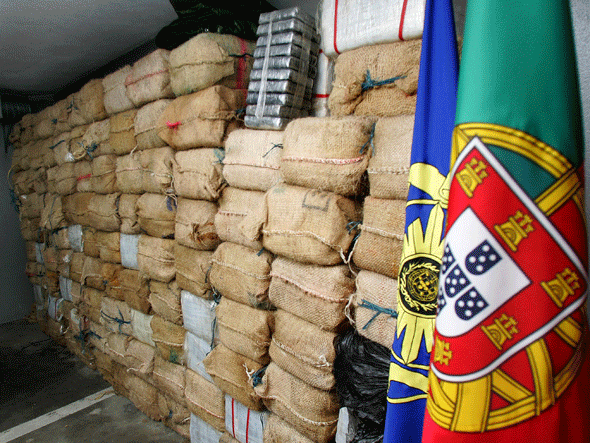
PortugalDrugsOn July 1st, 2001, Portugal decriminalized every imaginable drug, from marijuana, to cocaine, to heroin. Some thought Lisbon would become a drug tourist haven, others predicted usage rates among youths to surge.Eleven years later, it turns out they were both wrong.

Over a decade has passed since Portugal changed its philosophy from labelling drug users as criminals to labelling them as people affected by a disease. This time lapse has allowed statistics to develop and in time, has made Portugal an example to follow.

First, some clarification.

Portugal’s move to decriminalize does not mean people can carry around, use, and sell drugs free from police interference. That would be legalization. Rather, all drugs are “decriminalized,” meaning drug possession, distribution, and use is still illegal. While distribution and trafficking is still a criminal offence, possession and use is moved out of criminal courts and into a special court where each offender’s unique  situation is judged by legal experts, psychologists, and social workers. Treatment and further action is decided in these courts, where addicts and drug use is treated as a public health service rather than referring it to the justice system (like the U.S.), reports Fox News.

The resulting effect: a drastic reduction in addicts, with Portuguese officials and reports highlighting that this number, at 100,000 before the new policy was enacted, has been halved in the following 10 years. Portugal’s drug usage rates are now among the lowest of EU member states, according to the same report.

One more outcome: a lot less sick people. Drug related diseases including STDs and overdoses have been reduced even more than usage rates, which experts believe is the result of the government offering treatment with no threat of legal ramifications to addicts.

While this policy is by no means news, the statistics and figures, which take years to develop and subsequently depict the effects of the change, seem to be worth noting. In a country like America, which may take the philosophy of criminalization a bit far (more than half of America’s federal inmates are in prison on drug convictions), other alternatives must, and to a small degree, are being discussed.

For policymakers or people simply interested in this topic, cases like Portugal are a great place to start.

Source: Business Insider