China Starts Mass Quarantines Again After Failing to Stop COVID-19: real death toll from the coronavirus in Wuhan, China may be over 40,000, more than 16 times the amount of deaths currently reported by China | Trending Politics

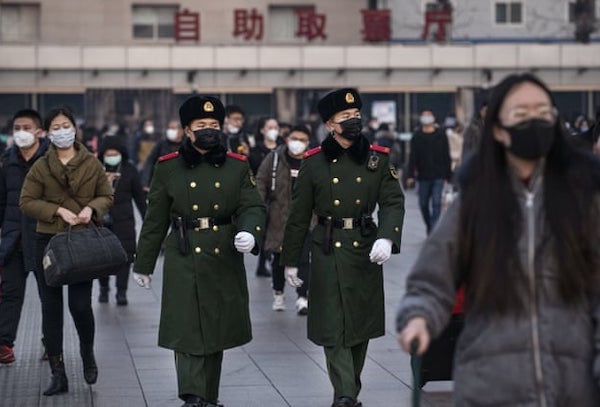
5e87b504daa4b7133According to a new breaking news report from Politico, China is once again implementing mass quarantines to combat the coronavirus outbreak after their initial quarantine failed.

“Henan province in central China has taken the drastic measure of putting a mid-sized county in total lockdown as authorities try to fend off a second coronavirus wave in the midst of a push to revive the economy,” Politico reported. “Curfew-like measures came into effect on Tuesday in Jia county, near the city of Pingdingshan, with the area’s roughly 600,000 residents told to stay home, according to a notice on the country’s official microblog account.”

This breaking news comes at the same time as a new report from Washington Post Beijing bureau chief Anna Fifield stated that the real death toll from the coronavirus in Wuhan, China may be over 40,000, more than 16 times the amount of deaths currently reported by China.

Check out what the The Washington Post reported:

The coronavirus pandemic ravaging the globe officially claimed 2,563 lives in Wuhan, where it began in a market that sold exotic animals for consumption. But evidence emerging from the city as it stirs from its two-month hibernation suggests the real death toll is exponentially higher. …

Using photos posted online, social media sleuths have estimated that Wuhan funeral homes had returned 3,500 urns a day since March 23. That would imply a death toll in Wuhan of about 42,000 — or 16 times the official number. Another widely shared calculation, based on Wuhan’s 84 furnaces running nonstop and each cremation taking an hour, put the death toll at 46,800.

This bombshell report comes not much after Bloomberg News reported that U.S. intelligence officials shared a classified report with President Donald Trump stating that China had lied about how bad the coronavirus was in their country.

“China’s public reporting on cases and deaths is intentionally incomplete,” Bloomberg News reported. “Two of the officials said the report concludes that China’s numbers are fake.”

Vice President Mike Pence also spoke out on the matter: “The reality is that we could have been better off if China had been more forthcoming. What appears evident now is that long before the world learned in December that China was dealing with this, and maybe as much as a month earlier than that, that the outbreak was real in China.”

Dr Deborah Birx, the head of the White House Coronavirus Response also spoke out, indicating that China may have lied about their coronavirus numbers.

“When you talk about could we have known something different, you know, I think all of us, I was overseas when this happened in Africa and I think when you look at the China data originally, and you said, there’s 80 million people, or 20 million people in Wuhan and 80 million people in Hubei, and they come up with the number of 50,000, you start thinking of this more like SARS than you do this kind of global pandemic,” Birx said.

Based on the information that China provided, Birx stated that she did not think that the coronavirus would escalate into a global pandemic.

“So, I think the medical community interpreted the Chinese data as this was serious, but smaller than anyone expected because I think probably we were missing a significant amount of the data” from China, Birx said.

Source: Trending Politics, Politico, Bloomberg & Washington Post

Facebook Censoring Former U.S. Congressman Ron Paul Based on Bogus Politifact ‘Fact-Check’ | Ron Paul Institute

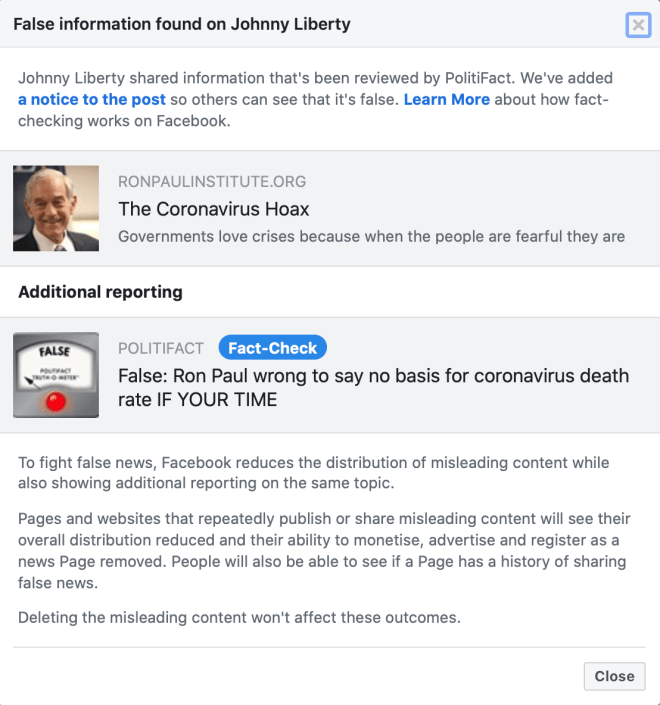
FalseinformationfoundonJohnnyLibertySocial media behemoth Facebook has just acted to censor and suppress Ron Paul’s latest weekly column, “The Coronavirus Hoax,” based on a hatchet job “fact check” by the notoriously biased “Politifact” organization.

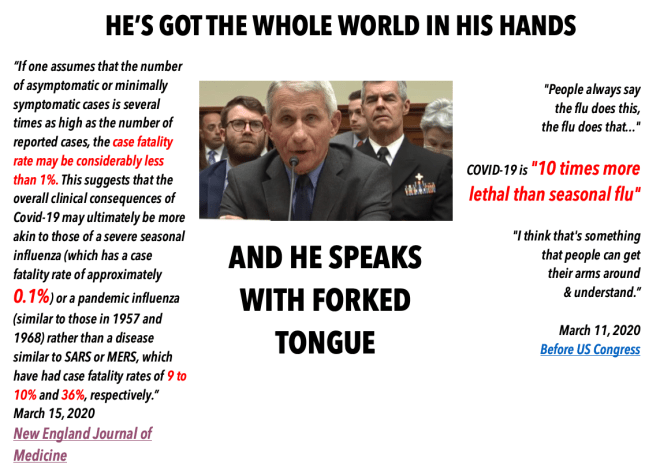
At issue is Dr. Paul’s statement that National Institute of Allergy and Infectious Diseases director Anthony Fauci’s claim that the coronavirus is “ten times more deadly” than the seasonal influenza virus is “without any scientific basis.” Fauci made the claim recently in testimony before the US Congress in a move that significantly ramped up the fear factor in the US over the virus.

The Politifact “fact check” is literally drenched in sarcasm and bias, with Ron Paul being described as “a sometimes conspiracy-minded Texas doctor” and Fauci described as a “universally trusted person.”

For a “just the facts” analysis, that’s a lot of editorializing.

The Politifact hit piece admits that, “It’s not yet known what the death rate from the current coronavirus, COVID-19, will be,” but concludes nevertheless that, “early data indicate it is more than 10 times higher than the death rate for the flu.”

So if you don’t know how can you know?

One reason to question the “scientific basis” of Fauci’s claim is that Fauci contradicted his own statement before Congress in a recent article he co-authored in the New England Journal of Medicine.

If a scientist writes one thing in a scholarly journal and testifies very differently before Congress, does it not raise questions as to the “scientific basis” of the divergent claims?

Here are the two Anthony Faucis. Which one is scientifically based? Both can’t be:

fa

Founded by the Poynter Institute, Politifact is an outfit with a clear political agenda and it is not to promote truth and accuracy in the media. Rather, it is all about suppressing media outlets with which they disagree. It is all about creating blacklists in a McCarthyite push to control the flow of information.

Interestingly enough, major funders of the Poynter Institute include “open society” advocate George Soros along with Charles Koch (both founders and major funders of the “Quincy Institute“).

Soros loves an “open society” as long as it does not in any way challenge his own political biases. If anyone holds different views, he’ll spend millions to shut down debate.

The Poynter Institute is also funded by the United States government itself, via major grants from the National Endowment for Democracy. So here is what happens when you scratch below the surface a bit: The suppression of views like those of Ron Paul which are unpopular among those who control the foreign policy narrative are actually financed by the US government itself.

Do any of our dear readers support the US government taking our tax money and using it to shut Ron Paul up?

How is it that Facebook tries to sell itself as politically neutral, just making sure only facts are allowed through, while at the same time partnering with such a politically biased and unethical organization as Politifact and the Poynter Institute? Is Facebook really about fostering a lively debate or is it about controlling the narrative favored by the Washington elites?

We have fact-checked Politifact’s fact checkers and we find them to be biased, sloppy, and inimical to the values we should share as Americans in favor of open debate.

And Facebook? End your suppression of Dr. Ron Paul’s op-ed on the coronavirus!

Source: Ron Paul Institute

99% of Those Who Died From Virus Had Other Illness, Italy Says | Bloomberg

16Italy-Bodies01-superJumboJim Jordan, Editor’s Note: So why are not these deaths labeled: heart disease, respiratory disease, diabetes, etc? How these deaths are labeled drives the narrative. Yes, if you have underlying serious health conditions this virus could push that person over the edge; however, that does not mean the COVID -19 is THE CAUSE of death in any of these cases. It is a factor that has to be addressed and perhaps if government and health agencies put this in perspective there wouldn’t be this panic and crashing down of the economies, unnecessary fear and its consequences. Addressing chronic health conditions with better policies would mitigate the consequences of these viral outbreaks.

By Tommaso Ebhardt, Chiara Remondini & Marco Bertacche

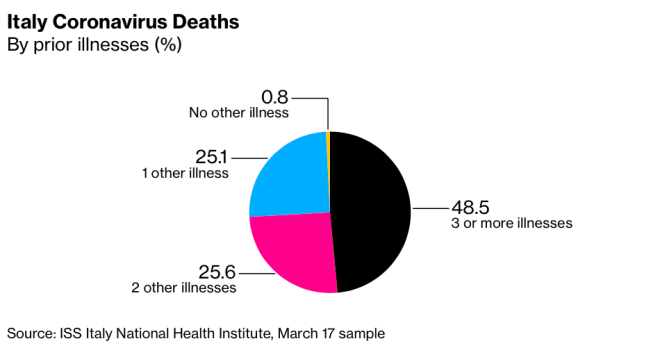
More than 99% of Italy’s coronavirus fatalities were people who suffered from previous medical conditions, according to a study by the country’s national health authority.

After deaths from the virus reached more than 2,500, with a 150% increase in the past week, health authorities have been combing through data to provide clues to help combat the spread of the disease.

Prime Minister Giuseppe Conte’s government is evaluating whether to extend a nationwide lockdown beyond the beginning of April, daily La Stampa reported Wednesday. Italy has more than 31,500 confirmed cases of the illness.

Screen Shot 2020-03-18 at 4.26.23 PMThe new study could provide insight into why Italy’s death rate, at about 8% of total infected people, is higher than in other countries.

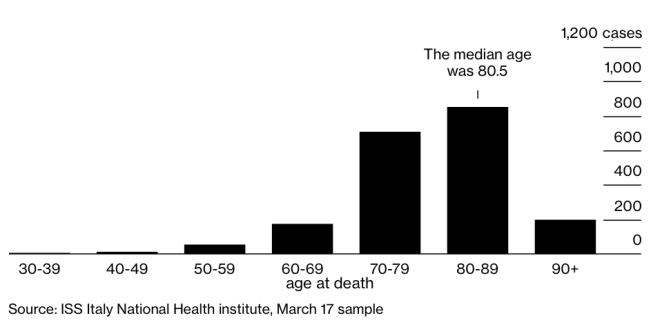
The Rome-based institute has examined medical records of about 18% of the country’s coronavirus fatalities, finding that just three victims, or 0.8% of the total, had no previous pathology. Almost half of the victims suffered from at least three prior illnesses and about a fourth had either one or two previous conditions.

More than 75% had high blood pressure, about 35% had diabetes and a third suffered from heart disease.

Screen Shot 2020-03-18 at 4.27.41 PMThe average age of those who’ve died from the virus in Italy is 79.5. As of March 17, 17 people under 50 had died from the disease. All of Italy’s victims under 40 have been males with serious existing medical conditions.

While data released Tuesday point to a slowdown in the increase of cases, with a 12.6% rise, a separate study shows Italy could be underestimating the real number of cases by testing only patients presenting symptoms.

According to the GIMBE Foundation, about 100,000 Italians have contracted the virus, daily Il Sole 24 Ore reported. That would bring back the country’s death rate closer to the global average of about 2%.

Source: Bloomberg

Trump’s Error-filled Cabinet Meeting | FactCheck.org

By , , , and

For more than an hour, President Donald Trump presided over a cabinet meeting, reeling off numerous false or misleading claims:

  • Trump claimed, without evidence, that President Barack Obama tried to call North Korean leader Kim Jong Un “11 times” but that “the man on the other side … did not take his call” due to a “lack of respect.” Obama’s national security adviser and deputy national security adviser both called Trump’s claim false.
  • Trump took credit for making a “deal” between Turkey and the Syrian Kurds that he said “people have been trying to make” for years. One expert called this claim “nonsense.” The deal is only a five-day pause in the conflict that arose when Trump pulled U.S. troops from the Syria-Turkey border.
  • The president boasted that “nobody has ever done” a National Prescription Drug Take Back Day until he took office. In fact, it started in 2010.
  • He wrongly claimed that “many” of the “ambassadors” House Democrats are interviewing in the impeachment inquiry were “put there” by past administrations. Seven of the nine officials who have testified behind closed doors so far were appointed to their most recent positions under Trump’s administration.
  • Trump made the illogical and unsubstantiated claim that there was no informant who provided information to the whistleblower, whose complaint triggered an impeachment inquiry. And even more absurdly, Trump suggested the informant was Rep. Adam Schiff, chairman of the House intelligence committee.
  • Trump was wrong in saying “no other president” has donated his salary. John F. Kennedy and Herbert Hoover also did so, according to news reports and Hoover’s library.
  • In defending the quashed plans to hold the next G-7 at his own resort, Trump suggested that Obama getting a book deal was like “running a business” while Obama was in office. The deal came after Obama left office.
  • Trump said, “China is doing very poorly — worst year they’ve had in 57 years.” China announced its economy grew by 6% in the third quarter of 2019, when compared with the same period the previous year. That was “the weakest pace in at least 27-1/2 years,” according to a Reuter’s analysis of quarterly data.

Trump made his remarks during an Oct. 21 cabinet meeting, which started — after a prayer from Housing and Urban Development Secretary Ben Carson — with the president talking about the U.S. economy, which he described as doing “fantastically well.” (See “Trump’s Numbers October 2019 Update” for a statistical measure of how things have changed since Trump took office.)

Calling Kim Jong Un

Trump claimed, without evidence, that President Barack Obama tried to call North Korean leader Kim Jong Un “11 times,” but Kim “did not take his call.”

Trump, Oct. 21: I like Kim; he likes me. We get along. I respect him; he respects me. You could end up in a war. President Obama told me that. He said, “The biggest problem — I don’t know how to solve it.” He told me doesn’t know how to solve it. I said, “Did you ever call him?” “No.” Actually, he tried 11 times. But the man on the other side — the gentleman on the side did not take his call. Okay? Lack of respect. But he takes my call.

Obama’s national security adviser and deputy national security adviser both called Trump’s claim false.

Susan Rice, who served under Obama as the U.S. ambassador to the United Nations from 2009 to 2013 and as Obama’s national security adviser from 2013 to 2017, tweeted that Trump’s claim is “a total fabrication.” She added, “Trump is completely delusional, and it’s scary.”

Likewise, Ben Rhodes, who served as Obama’s deputy national security adviser, tweeted, “Obama never called Kim Jong Un. Obama never tried to meet Kim Jong Un. Trump is a serial liar and not well.”

Trump’s claim is similar to one we fact-checked back in July. Then, Trump said Obama was “constantly … begging for meetings” but that Kim Jong Un refused. As we wrote then, Obama administration officials and experts on U.S.-North Korea relations said that’s not true.

“At the risk of stating the obvious, this is horse-sh*t,” Rice tweeted then. “Yes. It’s horseshit,” added Gen. Michael Hayden, via TwitterHayden served as director of the CIA from 2006 to Feb. 12, 2009, shortly after Obama took office.

A Deal Between Turkey and Syrian Kurds

Trump praised his decision to withdraw U.S. troops from northern Syria, saying the subsequent fighting that resulted between Turkey and the Syrian Kurds sparked a “deal” that he claimed “people have been trying to make” for years.

Trump, Oct. 21: If shooting didn’t start for a couple of days, I don’t think the Kurds would have moved. I don’t think, frankly, you would’ve been able to make a very easy deal with Turkey. … If they didn’t go through two and a half days of hell, I don’t think they would’ve done it. I think you couldn’t have made a deal. And people have been trying to make this deal for years. But we’re close to making it. We’ll see what happens.

Henri Barkey, a professor of international relations at Lehigh University and adjunct senior fellow for Middle East studies at the Council on Foreign Relations, called Trump’s claim of failed past attempts to broker such a deal “complete nonsense.”

“There is no effort of any sorts in the past between Turkey and Syrian Kurds,” Barkey told us in an email. “He is making things up.”

On Oct. 6, the White House announced it would withdraw U.S. special forces in northern Syria and that Turkey would soon move “forward with its long-planned [military] operation” against the Syrian Kurds, who had been U.S. allies in the fight against the Islamic State. Three days later, Turkish President Recep Tayyip Erdogan started “Operation Peace Spring,” resulting in dozens of deaths of civilians and Kurdish fighters.

After bipartisan criticism, Trump sent Vice President Mike Pence to meet with Erdogan in Ankara, Turkey, where on Oct. 17 they announced a five-day pause in the Turkish military operation to “allow for the withdrawal of YPG” from “the nearly 20-mile-wide safe zone area, south of the Turkish border in Syria.” The People’s Protection Units, or the YPG, is the armed wing of the Syrian Kurdish Democratic Union Party.

Turkey does have a long history of conflict with the Kurds, but direct Turkish involvement in northern Syria dates only to 2016. In August 2016, Turkey began Operation Euphrates Shield in northern Syria to clear the area of Islamic State terrorists and “prevent the YPG from establishing an autonomous area along the northern Syrian border with Turkey,” as explained in a January Congressional Research Service report.

Turkey felt threatened by the Syrian Kurds on its border. The Kurds were hoping for support from their allies in Washington, D.C. “Syrian Kurds wanted political recognition from DC,” and “down the road support for their autonomous state” in northern Syria, Barkey said.

National Prescription Take Back Day

Trump falsely said that “nobody has ever done” a National Prescription Drug Take Back Day, an event in which Americans can safely dispose of unused prescription drugs. The Drug Enforcement Administration began holding such national events in 2010.

Trump’s claim followed a briefing from White House counselor Kellyanne Conway on an upcoming take-back day on Oct. 26. After thanking Conway, he said, “Take Back Day is a big deal. And they’ve been talking about it for a long time. Nobody has ever done it. But it is big.”

The scheduled take back day, however, will not be the first, nor was the first national take back under Trump’s watch.

The initiative launched under Obama in 2010, with the primary aim of reducing misuse of old prescription drugs. The DEA has since organized two events each year — one in the spring and one in the fall — to encourage people to get rid of drugs lingering in their medicine cabinets. The most recent one was in April; Saturday’s take back will be the 18th event.

At the April 2016 event, the DEA collected a then-record 893,498 pounds of unwanted medicines. A new record was set two years later with 949,046 pounds. So far, across all 17 completed events, the DEA has collected nearly 12 million pounds of drugs.

During a take back, people can drop off their expired, unused or unwanted medications anonymously and for free — no questions asked — at a variety of locations across the country. This year, for the first time, the DEA will accept vaping devices and cartridges, in light of the recent spate of deaths and lung injuries linked to those products.

This isn’t the first time that Trump has falsely taken credit for launching a new program.

Last October, he took credit for the Veterans Choice Program, which allows veterans to seek health care outside of the VA if there are long wait times or travel burdens, and falsely added that it had taken “44 years” to pass the legislation. In fact, the program was created in 2014 under Obama. And in July 2018, Trump inaccurately said that prior to a law he signed in 2017, there was “nothing you could do” to get rid of VA employees who mistreat military veterans. On average, around 2,300 VA workers were fired each fiscal year before Trump’s legislation going back to 2005.

Trump Appointees

In remarks about the ongoing House impeachment inquiry, Trump wrongly claimed that “many” of the “ambassadors” Democratic-controlled House committees are interviewing were “put there during Obama, during Clinton, during the Never Trump or Bush era.”

Actually, among the nine government officials who have testified in closed sessions so far, just two were appointed to their current or recently resigned positions under the Obama administration. The other seven were appointed by Trump or Trump appointees, such as Secretary of State Mike Pompeo.

Trump, Oct. 21: They’re interviewing — they’re interviewing ambassadors who I’d never heard of. I don’t know who these people are. I never heard of them. … Don’t forget, many of these people were put there during Obama, during Clinton, during the Never Trump or Bush era.

Let’s go through the list:

  • Steve A. Linick, the State Department inspector general, met with impeachment investigators on Oct. 2 and provided documents pertaining to Ukraine. Linick was appointed to the IG job by then-President Obama in 2013, and had served in the Justice Department under then-President George W. Bush and Obama from 2006 to 2010.
  • Kurt Volker was appointed special representative for Ukraine negotiations on July 7, 2017, by then-Secretary of State Rex Tillerson, a Trump appointee. Volker resigned from that job on Sept. 27 and testified before the House committees on Oct. 3.
  • Michael K. Atkinson, the inspector general of the intelligence community, was nominated to the post by Trump in November 2017 and sworn in on May 17, 2018. Atkinson, who worked in the Justice Department for more than 15 years under both Republican and Democratic administrations, testified on Oct. 4.
  • George P. Kent, the deputy assistant secretary of state in the European and Eurasian bureau, assumed that job on Sept. 4, 2018, under Secretary of State Pompeo, a Trump appointee. He joined the foreign service in 1992; he testified Oct. 15.
  • Gordon Sondland, a Trump nominee, was confirmed as ambassador to the European Union on June 29, 2018. Sondland, the founder and CEO of Provenance Hotels, donated $1 million to Trump’s inauguration committee through four companies registered to him, according to The Intercept. He testified on Oct. 17.
  • Marie “Masha” Yovanovitch was nominated to be ambassador to Ukraine by Obama on May 18, 2016, and confirmed by the Senate two months later. Yovanovitch, who joined the foreign service in 1986, was removed from her post by the Trump administration in May. She testified on Oct. 11.
  • Michael McKinley, another career diplomat, who joined the foreign service in 1982, was appointed senior adviser to Pompeo in May 2018. He testified on Oct. 16, days after resigning.
  • William B. Taylor served under the Bush and Obama administrations and was appointedchargé d’affaires of the U.S. Embassy in Ukraine in June after Yovanovitch was removed as ambassador. Taylor had been ambassador to Ukraine from 2006 to 2009. He testified on Oct. 22.
  • Fiona Hill became deputy assistant to the president and senior director for European and Russian Affairs under the National Security Council in 2017. Hill resigned this summer and testified on Oct. 14.

That list doesn’t include Acting Director of National Intelligence Joseph Maguire, a Trump appointee, who publicly testified before the House intelligence committee on Sept. 26.

Trump’s Strange Whistleblower Theory

Trump also made the illogical claim that there was no informant who provided information to the whistleblower. And even more absurdly, Trump suggested the informant was Rep. Adam Schiff.

Trump said the whistleblower relied on “second- and thirdhand information” and Trump questioned the very existence of an informant who told the whistleblower about the content of Trump’s July phone conversation with Ukrainian President Volodymyr Zelensky.

Trump, Oct. 21: Now, I happen to think there probably wasn’t an informant. You know, the informant went to the whistleblower, the whistleblower had second- and thirdhand information. You remember that. It was a big problem. But the information was wrong. So was there actually an informant? Maybe the informant was Schiff. It could be Shifty Schiff. In my opinion, it’s possibly Schiff.

Later, in an interview with Sean Hannity on Fox News, Trump reiterated his groundless theory.

Trump, Oct. 21: And where is the person who gave the whistleblower the information? Because is that person a spy? Or does that person even exist? I have a feeling that person doesn’t exist. I think Schiff might’ve made it up.

Let’s quickly deconstruct why Trump’s theory makes no sense.

Despite Trump repeatedly claiming that the whistleblower “gave a totally false account of my conversation” with the Ukrainian president, as we have written, the whistleblower’s account of the phone call matches up with the White House-released memo. (Though the president takes issue with the whistleblower’s allegation that he “pressured” Zelensky to investigate the Bidens.)

Specifically, the whistleblower made these three claims that were corroborated by the memo: Trump asked Zelensky to “initiate or continue an investigation” into former Vice President Joe Biden and his son, Hunter Biden; assist the U.S. in investigating allegations that “Russian interference in the 2016 U.S. presidential election originated in Ukraine”; and “meet or speak” about these matters with Trump’s personal attorney Rudy Giuliani and Attorney General William Barr.

The whistleblower, described by the New York Times as a CIA officer who was detailed to the National Security Council, wrote in his complaint that while he did not participate in Trump’s phone call with the Ukraine president, “in the course of official interagency business” he was informed about details of the phone call by “multiple White House officials with direct knowledge of the call.”

The intelligence community’s inspector general conducted a preliminary review of the whistleblower’s complaint and determined there were “reasonable grounds to believe that the complaint relating to the urgent concern ‘appears credible.’” Fox News reported that during the closed-door testimony of Intelligence Community Inspector General Michael Atkinson to House lawmakers, it was revealed that the preliminary investigation included interviews with a handful of witnesses, including two of the whistleblower’s supervisors.

Since then, the New York Times reported that a second whistleblower, one with firsthand knowledge of the phone call, has stepped forward and was interviewed by Atkinson’s office.

Given that the original whistleblower did not participate directly in the Ukraine phone call, and yet got key details about it correct, it stands to reason he was provided that information by an informant.

As for Trump’s theory that the informant might be Schiff, that makes no sense. As we wrote, Schiff, chair of the House intelligence committee, wrongly implied that his committee had no contact with the whistleblower before receiving the complaint, when the whistleblower had in fact reached out to a committee aide before filing a complaint. Trump has speculatedthat Schiff “probably helped write” the complaint, but there’s no evidence of that, and a spokesman for Schiff and the House intelligence committee said in a statement, “At no point did the Committee review or receive the complaint in advance.”

But Schiff did not participate in the phone call, and therefore could not have provided details to the whistleblower about it, at least not unless Schiff was debriefed on the call by — an informant.

Trump Isn’t Only President to Donate Salary

Trump does indeed donate his salary, which we’ve written about before, but he was wrong when he said “no other president has done it.”

Trump, Oct. 21: I give away my salary. It’s, I guess, close to $450,000. I give it away. Nobody ever said he gives away his salary.  … They say that no other president has done it. … They think George Washington did, but they say no other.

Trump’s annual salary is $400,000, and the press has covered the quarterly announcementson which government programs would be receiving Trump’s donated salary.

But John F. Kennedy also donated his salary in 1961, according to a Nov. 14, 1962, news article that attributed that information to the Minneapolis Tribune and Des Moines Register. The article said Kennedy was following the practice of Herbert Hoover, who “banked his presidential salary and gave it entirely to charity,” according to the Hoover presidential library.

Snopes.com wrote about this issue before Trump took office, noting that in Washington’s case, according to one book, he did refuse the salary at first but then accepted it at Congress’ urging.

In his book, “George Washington’s 1791 Southern Tour,” Warren L. Bingham wrote: “At first, Washington refused the salary, but Congress insisted on the principle, on which Washington also agreed, that the presidency should not be reserved for only those wealthy enough to work for free.”

Obama’s Book Deal

In defending his decision to host the 2020 G-7 at his Doral golf resort in Miami — and his subsequent reversal in the face of criticism — Trump claimed that other presidents “ran their business” while in office, citing Obama’s book and Netflix deals. But the book, reportedly a memoir on his presidency, and Netflix collaboration were announced after Obama left office.

Trump, Oct. 21: Hey, Obama made a deal for a book. Is that running a business? I’m sure he didn’t even discuss it while he was President. Oh, yeah. He has a deal with Netflix. When did they start talking about that? That’s only, you know, a couple of examples.

Penguin Random House announced on Feb. 28, 2017, a month after Obama left office, that it would publish books both by the former president and former First Lady Michelle Obama. The deal is reportedly worth about $65 million. Netflix announced a production deal with the Obamas in May 2018.

Trump also overlooks the fact that hosting the G-7 at Doral was akin to awarding a government contract to himself and accepting payments from foreign governments.

China’s Economy

Trump made several claims about China’s economy, and some of them were inaccurate.

First, Trump said, “China is doing very poorly — worst year they’ve had in 57 years.” Later, he claimed, “they announced that they have the worst numbers they’ve had in 20 years.” He was closer to being accurate the second time.

“They announced six,” Trump said, referring to China’s growth in its real gross domestic product.

Most recently, China announced its economy grew by 6% in the third quarter of 2019, when compared with the same period the previous year. That was “the weakest pace in at least 27-1/2 years,” according to a Reuters’ analysis of quarterly data.

On an annual basis, China is currently projected to have real GDP growth of 6.1% for all of 2019, according to the International Monetary Fund. But that would be the lowest annual growth in 29 years — since China’s GDP grew by 3.9% in 1990, according to World Bank data going back to 1961.

Trump went on to say: “So, if I weren’t elected, by right now, China would be the largest economy in the world. It was expected. It was said by many people that China would, right now — they were expecting around the second year of this term.”

We don’t know where Trump saw that China was projected to surpass the U.S. as the world’s largest economy in 2018. As of 2016, China’s GDP in nominal dollars was $11.2 trillion, which was still about 40 percent less than the U.S. GDP of $18.7 trillion.

Plus, by one measure — purchasing power parity, which accounts for differences in prices across countries — China had already become the leading economy in 2014, according to a Congressional Research Service report updated in June. Citing figures from the IMF and World Economic Forum, the CRS report said, based on PPP, China ($25.27 trillion) was still ahead of the U.S. ($20.49 trillion) in 2018, while the U.S. ($20.49 trillion) still outranked China ($13.40 trillion) in nominal dollars.

Trump also was wrong when he said, “And we’re getting bigger, and they’re not.” China’s economic growth has slowed in recent years, but it is still increasing at a faster rate than real U.S. GDP, which grew by 2.9% in 2018 and at an annual rate of 2% in the second quarter of 2019.

And as the IMF noted in July 2018, “[e]ven with a gradual slowdown in growth, China,” in nominal figures, “could become the world’s largest economy by 2030.”

Source: FactCheck.org

FactChecking the October Democratic Debate | FactCheck.org

By , , , , , , and

Summary

We found several false and misleading claims in the October Democratic presidential debate:

  • Former Housing and Urban Development Secretary Julián Castro claimed that the most recent jobs data show that “Ohio, Michigan and Pennsylvania … have lost jobs not gained them.” In fact, total nonfarm employment in all three states was up in August — and since President Donald Trump took office — according to the most recent preliminary federal data.
  • Former Vice President Joe Biden was wrong when he said that American troops withdrawing from Syria were “being fired on by [Syrian President Bashar] Assad’s people.”
  • Activist and former hedge fund manager Tom Steyer claimed 90% of workers haven’t had a raise in 40 years — but a liberal think tank says their real annual wages are up more than 22%.
  • Sen. Cory Booker claimed that “raising the minimum to $15 an hour … would put more money in people’s pockets than giving them $1,000 a month” under businessman Andrew Yang’s universal basic income plan. But Yang’s plan would put more money in more pockets than Booker’s bill to raise the minimum wage.
  • Leading economists and tax experts disagree about whether Sen. Elizabeth Warren’s proposed wealth tax would generate enough revenue to fund a host of Warren’s education priorities. Yang rightly noted that several European countries repealed their wealth taxes, in part because they did not raise as much revenue as projected. But Warren’s plan seeks to address some of the weaknesses of those plans.
  • Yang and Steyer both exaggerated the number of opioid overdose deaths in America by using total drug overdose death figures. Yang also inaccurately attributed all of the deaths to Purdue Pharma.
  • Biden claimed Medicare for All will cost “at least $30 trillion over 10 years. That is more on a yearly basis than the entire federal budget.” It may cost that much, but federal spending is projected to exceed $50 trillion over 10 years. And, while Medicare for All would significantly increase federal spending, it also would eliminate health care spending by individuals, businesses and local governments.
  • Sen. Bernie Sanders repeated two claims on health care. He said that “500,000 people” are “going bankrupt” due to cancer, but the study he cites only says that medical issues contributed to those bankruptcies — they were not the sole reason. He also said that “87 million Americans are uninsured or underinsured.” The figure includes 19.3 million who were insured but had a gap in coverage in the previous year.
  • Sanders referred to climate change as an “existential threat.” Scientists agree climate change does pose a threat to humans and ecosystems, but they do not envision that climate change will obliterate all people from the planet.
  • Yang repeated a baseless claim that Amazon is responsible for closing “30% of America’s stores and malls.” In fact, there’s evidence that the number of retail stores may actually be increasing.

Twelve candidates for president met for the Oct. 15 debate hosted by CNN and the New York Times in Westerville, Ohio.

Analysis

Castro Wrong About Job Losses

Castro, a former mayor of San Antonio and HUD secretary, was wrong when he said, “Donald Trump has broken his promises because Ohio, Michigan and Pennsylvania — actually in the latest jobs data — have lost jobs, not gained them.”

In August, which is the most recent month for seasonally adjusted data from the U.S. Bureau of Labor Statistics, total nonfarm employment went up by 16,500 in Pennsylvania, by 6,100 in Michigan and by 3,700 in Ohio.

Castro’s campaign issued a press release during the debate that said the “data from August … is preliminary due to incomplete data and will be revised by the Bureau of Labor Statistics at the end of this month.” The press release added, “This fiscal year, from March through July, the latest month with final numbers from the Bureau of Labor Statistics, non-farm payrolls are down in Ohio, Michigan, and Pennsylvania.”

That’s all true, but it’s not the claim that Castro made during the debate. The “latest jobs data” for states, although preliminary, is for August — not July.

The estimated job gains in August for Pennsylvania and Michigan surpassed the job losses from March through July. However, Ohio has lost 3,600 jobs from March through August.

Furthermore, the campaign’s argument is misleading. The fact is, since Trump took office in January 2017, total nonfarm employment is up — not down — in those three states and nationwide. That’s whether one measures up to July or August.

Biden Wrong on Syria

Biden mistakenly said that American troops withdrawing from Syria were “being fired on by [Syrian President Bashar] Assad’s people.”

According to news reports, Turkish militias fired artillery rounds near a U.S. military outpost in northeastern Syria last week, though no U.S. forces were injured. There have been no reports of Assad’s Syrian government forces firing on American troops.

Biden: I would not have withdrawn the troops and I would not have withdrawn the additional thousand troops who are in Iraq, which are in retreat now, being fired on by Assad’s people.

After a phone call on Oct. 6 with Turkey’s president, Recep Tayyip Erdogan, President Donald Trump announced he would be withdrawing troops from northern Syria. After initially withdrawing 50 American troops from the Syrian border with Turkey, the Pentagon this week began pulling out all of its 1,000 soldiers from Syria, a process that was expected to take several weeks.

With the U.S. troop withdrawal, Syrian government forces have moved to retake territory in the country’s northeast, but there have been no reports that they have fired upon retreating U.S. forces, as Biden said.

New York Times, Oct. 14: Syrian government forces streamed into the country’s northeast on Monday, seizing towns where they had not stepped foot in years and filling a vacuum opened up by President Trump’s decision to abandon the United States’ Syrian Kurdish allies.

Less than a week after Turkey launched an incursion into northern Syria with Mr. Trump’s assent, President Bashar al-Assad of Syria, considered a war criminal by the United States, has benefited handsomely, striking a deal with the United States’ former allies to take the northern border and rapidly gaining territory without a fight.

News reports made no mention of Syrian forces firing upon withdrawing U.S. troops, though.

Steyer Wrong on Wages

Tom Steyer, the billionaire liberal activist, was wrong when he claimed that “90 percent of Americans have not had a raise for 40 years.”

Even the liberal Economic Policy Institute — a think tank that advocates for low- and middle-income earners — reported in February of this year that the annual wages of the bottom 90% of wage earners have gone up 22.2% since 1979, even after adjustment for inflation. (See Appendix Figure A.)

And that’s only through 2017. Wages have risen further since then. Average weekly earnings of all production and nonsupervisory wage earners in the private sector have gone up 2.1%(after adjustment for inflation) between December 2017 and last month, according to the Bureau of Labor Statistics.

EPI reports that wage growth has been “sluggish” for the vast majority of workers, compared with a 157% increase for the highest-paid 1% of earners since 1979. But Steyer goes too far when he claims there has been no growth at all.

Minimum Wage Hike vs. Universal Basic Income

When asked about how he would convince GM workers to end their strike, Booker took the opportunity to compare his bill to increase the federal minimum wage to $15 an hour to Yang’s universal basic income plan.

Booker: Well, first of all, the one point I wanted to make about the UBI conversation — and I hope that my friend, Andrew Yang, will come out for this — doing more for workers than UBI would actually be just raising the minimum wage to $15 an hour. It would put more money in people’s pockets than giving them $1,000 a month.

Raising the minimum wage to $15 an hour would eventually put more than $1,000 a month in some pockets, but Yang’s so-called “Freedom Dividend” would pay “$1,000 per month, or $12,000 per year, to all U.S. citizens over the age of 18 … no questions asked.”

Booker is a cosponsor of “Raise the Wage Act,” which would increase the minimum wage to $15, but not until six years after enactment. Under the bill, there would be a seven-step phase-in period, beginning with $8.40 an hour and then increasing $1.10 per hour each year for the next six years.

“The annual earnings for a full-time minimum-wage worker is $15,080 at the current federal minimum wage of $7.25,” according to the Center for Poverty Research at the University of California, Davis. An increase to $15 per hour would more than double that to $31,200 — a difference of $16,120, or $1,343 a month.

But it would take five years for a person earning minimum wage to earn more than $1,000 a month in additional income.

Under the Raise the Wage Act, the minimum raise would increase to $8.40 an hour no later than 90 days after the bill is signed into law. That’s an increase of $199 more per month — compared with Yang’s $1,000-per-month plan.

Five years after the bill takes effect, the minimum wage would increase to $13.90 an hour, providing an additional $1,153 per month. The $15 minimum wage would be fully implemented six years after the bill takes effect, providing $1,343 per month in additional income.

After seven years, Yang’s plan would have provided $1,000 a month, while the phasing-in of the minimum wage would provide only an average of $771 a month.

Also, unlike Yang’s plan, the minimum wage pay hike would not affect every American. And increasing the minimum wage to $15 per hour would result in job losses, according to the Congressional Budget Office.

In a July report, CBO said a $15 minimum wage would directly increase the wages of 17 million workers, but “1.3 million other workers would become jobless.”

Yang’s plan would put more money in more pockets than raising the minimum wage.

Warren’s Wealth Tax

As she has in past debates, Warren ticked off a list of things she says could be paid for with her proposal for an annual wealth tax on all assets over $50 million. As we have written, it is a matter of debate among economists and tax experts as to whether her plan would raise as much as she expects.

One of Warren’s challengers at the debate, Yang, noted that several European countries have repealed their wealth taxes “because it had massive implementation problems and did not generate the revenue that they’d projected.” That’s backed up in a report from the Organization for Economic Cooperation and Development. But the report also argues that a wealth tax is likely needed to close the wealth inequality gap, and it outlines a number of proposed improvements to make a wealth tax more effective than those in Europe. Warren’s plan incorporates many of those suggestions.

Under Warren’s plan, households would pay an annual 2% tax on all assets — net worth — above $50 million, and a 3% tax on every dollar of net worth above $1 billion. During the debate, Warren highlighted some of the things that tax could bankroll.

Warren: And right now in America, the top 0.1 percent have so much wealth — understand this — that if we put a 2 cent tax on their 50 millionth and first dollar, and on every dollar after that, we would have enough money to provide universal child care for every baby in this country, age zero to 5, universal pre-K for every child, raise the wages of every child care worker and preschool teacher in America, provide for universal tuition-free college, put $50 billion into historically black colleges and universities … and cancel student loan debt for 95 percent of the people who have it.

Warren estimates her wealth tax would raise $2.75 trillion over 10 years, based on an analysis by University of California, Berkeley economists Gabriel Zucman and Emmanuel Saez, who study wealth inequality.

When we wrote about Warren’s plan back in June in our story “Facts on Warren’s Wealth Tax Plan,” we noted that several prominent economists and tax experts cast doubt on Warren’s estimate of the revenue the tax would generate, warning that wealthy people would find ways to avoid the tax.

Yang noted that that was one of the reasons several European countries scrapped their wealth tax plans.

Yang: And a wealth tax makes a lot of sense in principle. The problem is that it’s been tried in Germany, France, Denmark, Sweden, and all those countries ended up repealing it, because it had massive implementation problems and did not generate the revenue that they’d projected. If we can’t learn from the failed experiences of other countries, what can we learn from? We should not be looking to other countries’ mistakes.

Indeed, while as many as a dozen countries in Europe had a wealth tax in the early 1990s, that number has dropped to three as of 2018, according to an OECD report. (In 2018, Francereplaced its net wealth tax with a new real estate wealth tax.)

“Decisions to repeal net wealth taxes have often been justified by efficiency and administrative concerns and by the observation that net wealth taxes have frequently failed to meet their redistributive goals,” the report stated. “The revenues collected from net wealth taxes have also, with a few exceptions, been very low.”

However, the report “also argues that capital income taxes alone will most likely not be enough to address wealth inequality and suggests the need to complement capital income taxes with a form of wealth taxation.”

The report makes several recommendations to bolster the effectiveness of a wealth tax — lessons learned from the European examples. Warren’s plan has attempted to incorporate many of those suggestions.

For example, the OECD report recommends a wealth tax only be levied on the very wealthy, that the rate should be low, exemptions and reliefs should be limited (to prevent those subject to the tax from moving assets into exempted categories), and that payments should be allowed in installments for those “facing liquidity constraints.” All of those are part of Warren’s plan.

Under the Warren plan, those with liquidity issues would be able to defer tax payments, with interest, for up to five years. And to guard against wealthy Americans simply moving out of the country to avoid the wealth tax, Warren’s plan would assess a one-time 40% “exit tax” on the net worth above $50 million for those who renounce their citizenship.

We take no position on whether those provisions in the Warren plan would address the lower-than-expected revenues generated by some European countries that tried a wealth tax, but we simply note that there is significant disagreement among economists and tax experts.

Biden on Medicare for All

As he has done in past debates, Biden repeatedly criticized the Medicare for All proposal as a budget buster, saying it would increase federal spending by $30 trillion over 10 years. But Biden ignored that nearly all health care spending by businesses, local governments and individuals would go away.

At one point, Biden said: “The plan is going to cost at least $30 trillion over 10 years. That is more on a yearly basis than the entire federal budget.” He turned to the issue later in the debate, saying something similar: “It costs $30 trillion. Guess what? That’s over $3 trillion — it’s more than the entire federal budget.”

We should start out by saying that $30 trillion over 10 years is not “more than the entire federal budget.” In its August report on long-term budget projections, the Congressional Budget Office estimates federal outlays will be $57.8 trillion over 10 years, from 2020 to 2029.

Also, as we’ve explained before, we don’t know how much Medicare for All would cost, since many details are yet to be determined. But two estimates, one by the Urban Institute and another by the Mercatus Center at George Mason University, said the federal government cost would be $32 trillion or $32.6 trillion over 10 years.

The government would have to raise taxes or fees, or cut other spending, to cover the costs. But Biden ignores the fact that current health care spending by private insurers, employers, individuals and states would shift to the federal government.

Opioid Epidemic

In relating the severity of the opioid epidemic, Yang and Steyer gave inaccurate figures for the number of overdose deaths from opioids.

“I think this is one of the most heartbreaking experiences that America’s had — 72,000 people died of opioid overdoses last year,” Steyer said in response to a moderator’s question about how he would address the opioid epidemic.

Steyer’s statistic, however, is for 2017, and applies to deaths from overdoses from any drug, not just those from opioids. According to the Centers for Disease Control and Prevention’s website, there were 70,237 deaths from any drug in 2017, with 47,600, or 67.8%, involving opioids.

For 2018, provisional CDC data suggest that overdose deaths fell, to 68,618 deaths from any drug. The agency estimates that 47,625 deaths, or 69%, were opioid-related.

The 72,000 number that Steyer used is well known because it was widely reported as a provisional 2017 figure from the CDC in August 2018 (the final data, which we report above, differs slightly, and is limited to U.S. residents).

Yang made a similar error when he claimed that Purdue Pharma was responsible for eight deaths per hour.

Yang: There was a point when there were more opiate prescriptions in the state of Ohio than human beings in the state of Ohio. And for some reason, the federal government thought that was appropriate. They ended up levying a $600 million fine against Purdue Pharma, which sounds like a lot of money, until you realize that company made $30 billion. They got a 2% fine, and they killed tens of thousands of Americans, eight an hour.

We contacted the Yang campaign to find out the source of the eight deaths an hour claim, and we were directed to a Vox news article reporting on the initial 2017 estimate of 72,000 overdose deaths, which noted that the death toll was equivalent to nearly 200 per day. The campaign then spelled out the math, explaining that 200 divided by 24 hours was 8.33.

The math checks out, but as with Steyer, those eight deaths per hour were not due just to opioids. Rather, opioids were involved in about 5 deaths per hour in 2017.

Yang’s other error is to ascribe all of the overdose deaths to Purdue Pharma. While Purdue Pharma, as the maker of OxyContin, is arguably responsible for many opioid-related deaths, the company isn’t responsible for all of them.

Medical Bankruptcies and the ‘Underinsured’

Sanders stated that “500,000 people” are “going bankrupt” because “they came down with cancer.” As we wrote in September, Sanders is referencing a March 2019 editorial article in the American Journal of Public Health. Of the 910 respondents who declared bankruptcy between 2013 and 2016, 66.5% said medical expenses or medical problems either “somewhat” or “very much” contributed to their bankruptcies. This percentage translates to just under half a million bankruptcies when applied to the 750,489 non-business bankruptcies filed from 2015-2019.

Medical issues weren’t the sole reason for some of those bankruptcies. Also, the survey did not ask about specific medical conditions, so there’s no evidence those bankruptcies happened only because of medical expenses related to cancer or any other disease.

Sanders repeated another claim he has made in previous debates, saying that “87 million Americans are uninsured or underinsured.” As we’ve written before, this figure comes from a Commonwealth Fund study and includes 19.3 million who were insured when they were surveyed but had a gap in coverage in the previous year.

“Of the 194 million U.S. adults ages 19 to 64 in 2018, an estimated 87 million, or 45 percent, were inadequately insured,” the study said. It broke down the “inadequately insured” into three different categories: 24 million uninsured, 43.8 million who were “underinsured” and 19.3 million who were insured but had been uninsured at some point in the prior year.

Climate Change

Debate moderators did not ask candidates about climate change, but that didn’t stop a few candidates from referring to it, including Sanders, who used a descriptor that could use some clarification.

“We’re forgetting about the existential threat of climate change,” Sanders said early on in the debate.

“Existential” has become a popular word among Democrats to describe the danger that climate change poses. As we’ve written in our coverage of a previous debate, it’s not entirely clear what politicians mean when they use the word. But if taken literally to mean the end of humanity, the descriptor is incorrect.

Penn State climate scientist Michael Mann told us previously in an email that the idea that humans would go extinct because of climate change “simply cannot be defended scientifically.”

Yet scientists are clear that climate change does pose serious risks to civilization through increased temperatures, sea level rise and extreme weather, among other factors — especially if greenhouse gas emissions continue unabated.

In some cases, this could even mean a specific location would be uninhabitable, said Benjamin Cook, a climate scientist at NASA. But does he think climate change is going to wipe humanity off the face of the Earth? “No,” he said.

Yang Wrong About Amazon — Again

Yang doubled down on a false claim about Amazon.com.

Yang: Amazon alone is closing 30% of America’s stores and malls, soaking up $20 billion in business while paying zero in taxes.

As we reported Aug. 1, after he made the same claim in the second Democratic debate, Yang went way beyond the facts. We found no factual basis for the claim that 30% of stores have closed, and some evidence that the number may be increasing. The National Retail Federation reports that “54 percent of surveyed retailers plan to open new stores in 2019, and 36 percent of those surveyed will have a higher store count than in 2018.” Furthermore, the retail services firm JLL reported last year that 850 new stores were being planned over the next five years by firms that previously had sold only through the internet.

We also noted that the Wall Street Journal has estimated that Amazon paid 8% of its income in taxes for the years 2012 through 2018 — which the Journal noted was “low, but not zero or negative.”

It’s true that a 2017 Business Insider report estimated that 30% of retail malls (not stores) were being pushed “to the brink of death” (but not necessarily over it) by a wave of store closings by old-line retailers including JCPenney and Sears. But malls are not stores, and even that report didn’t cite Amazon’s competition as the sole cause of the malls’ distress.

Sources

Kiely, Eugene et. al. “FactChecking July’s Round Two Debate.” FactCheck.org. 1 Aug 2019.

Cook, Benjamin. Climate scientist, NASA. Interview with FactCheck.org. 26 Jul 2019.

Mann, Michael. Distinguished Professor of Atmospheric Science, Pennsylvania State University. Email sent to FactCheck.org. 23 Jul 2019.

Kiely, Eugene et. al. “FactChecking the Second Democratic Debate.” FactCheck.org. 31 Jul 2019.

Collins, Sara R. et. al. “Health Insurance Coverage Eight Years After the ACA.” The Commonwealth Fund. 7 Feb 2019.

Robertson, Lori et. al. “FactChecking the September Democratic Debate.” FactCheck.org. 13 Sep 2019.

Himmelstein, David U. et. al. “Medical Bankruptcy: Still Common Despite the Affordable Care Act.” Am J Public Health. 109(3):431-433, 2019.

United States Courts. Bankruptcy Filings Continue to Decline. 22 Apr 2019.

U.S. Bureau of Labor Statistics. “Employment, Hours, and Earnings from the Current Employment Statistics survey (National); Total Nonfarm Employment, Seasonally Adjusted.” Data accessed 15 Oct 2019.

U.S. Bureau of Labor Statistics. “State and Area Employment, Hours, and Earnings (Pennsylvania); Total Nonfarm Employment, Seasonally Adjusted.” Data accessed 15 Oct 2019.

U.S. Bureau of Labor Statistics. “State and Area Employment, Hours, and Earnings (Ohio); Total Nonfarm Employment, Seasonally Adjusted.” Data accessed 15 Oct 2019.

U.S. Bureau of Labor Statistics. “State and Area Employment, Hours, and Earnings (Michigan); Total Nonfarm Employment, Seasonally Adjusted.” Data accessed 15 Oct 2019.

Castro, Julian. “FACT: Ohio, Michigan and Pennsylvania Have Lost Jobs Under Trump.” Press release. 15 Oct 2019.

Gould, Elise. “State of Working America Wages 2018.” Economic Policy Institute. 20 Feb 2019.

Bureau of Labor Statistics. “Employment, Hours, and Earnings from the Current Employment Statistics survey (National); Average Weekly Earnings of production and nonsupervisory employees, 1982-1984 Dollars.” Data extracted 16 Oct 2019.

Rubin, Richard. “Does Amazon Really Pay No Taxes? Here’s the Complicated Answer.” Wall Street Journal. 14 Jun 2019.

Peterson, Haley and Skye Gould. “Store closures will push 30% of US malls to the brink of death.” Business Insider. 7 Mar 2017.

Aronholt, Bethany. “Setting the record straight on the state of retail and store closures.” National Retail Federation. 15 Apr 2019.

Maloney, Greg. “Once-Online-Only Brands Will Open 850 Brick-And-Mortar Stores Over Next Five Years.” Forbes. 12 Nov 2018.

Congressional Budget Office. “An Update to the Budget and Economic Outlook: 2019 to 2029.” 21 Aug 2019.

Robertson, Lori. “The Facts on Medicare for All.” FactCheck.org. 24 Apr 2019.

Holahan, John, et. al. “The Sanders Single-Payer Health Care Plan.” Urban Institute. May 2016.

Blahous, Charles. “The Costs of a National Single-Payer Healthcare System.” Mercatus Center, George Mason University. Jul 2018.

What is the Freedom Dividend?” Friends of Andrew Yang. Undated. Accessed 16 Oct 2019.

U.S. Senate. “S. 150, Raise the Wage Act.” (as introduced 16 Jan 2019.)

What are the annual earnings for a full-time minimum wage worker?” Center for Poverty Research at the University of California, Davis. 12 Jan 2018.

Congressional Budget Office. “The Effects on Employment and Family Income of Increasing the Federal Minimum Wage.” Jul 2019.

LaMothe, Dan. “U.S. forces say Turkey was deliberately ‘bracketing’ American troops with artillery fire in Syria.” Washington Post. 12 Oct 2019.

White House website. “Statement from the Press Secretary.” 06 Oct 2019.

Vanden Brook, Tom. “Pentagon to withdraw 1,000 troops from Syria within weeks, pulling back in fight against ISIS.” USA Today. 14 Oct 2019.

Hubbard, Ben and Schmitt, Eric. “Assad Forces Surge Forward in Syria as U.S. Pulls Back.” New York Times. 14 Oct 2019.

OECD Tax Policy Studies. “The Role and Design of Net Wealth Taxes in the OECD.” 2018.

Farley, Robert. “Facts on Warren’s Wealth Tax Plan.” FactCheck.org. 25 Jun 2019.

OECD iLibrary. “Overview of individual net wealth taxes in OECD countries.” 2018.

Summers, Lawrence H. and Sarin, Natasha. “Opinions: A ‘wealth tax’ presents a revenue estimation puzzle.” Washington Post. 4 Apr 2019.

Saez, Emmanuel and Zucman, Gabriel. “Response to Summers and Sarin, ‘A wealth tax presents a revenue estimation puzzle,’ Washington Post, April 4.” 25 Jun 2019.

CDC. “Drug Overdose Deaths.” Accessed 16 Oct 2019.

CDC, National Center for Health Statistics. “Vital Statistics Rapid Release: Provisional Drug Overdose Death Counts.” Accessed 16 Oct 2019.

Hedegaard, Holly et. al. “Drug overdose deaths in the United States, 1999–2017.” NCHS Data Brief, no 329. Hyattsville, MD: National Center for Health Statistics. 2018.

Ingraham, Christopher. “Fentanyl use drove drug overdose deaths to a record high in 2017, CDC estimates.” Washington Post. 15 Aug 2018.

Sanger-Katz, Margot. “Bleak New Estimates in Drug Epidemic: A Record 72,000 Overdose Deaths in 2017.” New York Times. 15 Aug 2018.

Lopez, German. “2017 was the worst year ever for drug overdose deaths in America.” Vox. 16 Aug 2018.

Allyn, Bobby. “Purdue Pharma, Accused Of Fueling Opioid Crisis, Files For Chapter 11.” NPR. 16 Sep 2019.

Source: FactCheck.org
Fake news is real — Artificial Intelligence is going to make it much worse | CNBC

“The Boy Who Cried Wolf” has long been a staple on nursery room shelves for a reason: It teaches kids that joking too much about a possible threat may turn people ignorant when the threat becomes an actual danger.

President Donald Trump has been warning about “fake news” throughout his entire political career putting a dark cloud over the journalism professional. And now the real wolf might be just around the corner that industry experts should be alarmed about.

The threat is called “deepfaking,” a product of AI and machine learning advancements that allows high-tech computers to produce completely false yet remarkably realistic videos depicting events that never happened or people saying things they never said. A viral video starring Jordan Peele and “Barack Obama” warned against this technology in 2018, but the message was not enough to keep Jim Carrey from starring in “The Shining” earlier this week.

The danger goes far beyond manipulating 1980s thrillers. Deepfake technology is allowing organizations that produce fake news to augment their “reporting” with seemingly legitimate videos, blurring the line between reality and fiction like never before — and placing the reputation of journalists and the media at greater risk.

Ben Zhao, a computer science professor at the University of Chicago, thinks the age of getting news on social media makes consumers very susceptible to this sort of manipulation.

“What the last couple years has shown is basically fake news is quite compelling even in [the] absence of actual proof. … So the bar is low,” Zhao said.

The bar to produce a convincing doctored video is lower than people might assume.

Earlier this year a clip purporting to show Democratic leader Nancy Pelosi slurring her words when speaking to the press was shared widely on social media, including at one point by Trump’s attorney Rudy Giuliani. However, closer inspection revealed that the video had been slowed to 75% of its normal speed to achieve this slurring effect, according to the Washington Post. Even with the real video now widely accessible, Hany Farid, a professor at UC Berkeley’s School of Information and a digital forensics expert, said he still regularly receives emails from people insisting the slowed video is the legitimate one.

“Even in these relatively simple cases, we are struggling to sort of set the record straight,” Farid said.

It would take a significant amount of expertise for a fake news outlet to produce a completely fabricated video of Oprah Winfrey endorsing Trump, but researchers say the technology is improving every day. At the University of Washington, computer vision researchers are developing this technology for positive, or at least benign, uses like making video conferencing more realistic and letting students talk to famous historical figures. But this research also leads to questions about potential dangers, as the attempts made by attackers are expected to continually improve.

How to detect a deepfake

To make one of these fake videos, computers digest thousands of still images of a subject to help researchers build a 3-D model of the person. This method has some limitations, according to Zhao, who noted the subjects in many deepfake videos today never blink, since almost all photographs are taken with a person’s eyes open.

However, Farid said these holes in the technology are being filled incredibly rapidly.

“If you asked me this question six months ago, I would’ve said, ‘Yeah, [the technology] is super cool, but there’s a lot of artifacts, and if you’re paying attention, you can probably tell that there’s something wrong,’” Farid said. “But I would say we are … quickly but surely getting to the point where the average person is going to have trouble distinguishing.”

In fact, Zhao said researchers believe the shortcomings that make deepfake videos look slightly off to the eye can readily be fixed with better technology and better hardware.

“The minute that someone says, ‘Here’s a research paper telling you about how to detect this kind of fake video,’ that is when the attackers look at the paper and say, ‘Thank you for pointing out my flaw. I will take that into account in my next-generation video, and I will go find enough input … so that the next generation of my video will not have the same problem,’” Zhao said.

“Once we live in an age where videos and images and audio can’t be trusted … well, then everything can be fake.” – Hany Farid, Professor at UC Berkeley’s School of Information

One of the more recent developments in this field is in generating speech for a video. To replicate a figure such as Trump’s voice, computers can now simply analyze hundreds of hours of him speaking. Then researchers can type out what they want Trump to say, and the computer will make it sound as if he actually said it. Facebook, Google and Microsoft have all more or less perfected this technology, according to Farid.

Manipulated videos of this sort aren’t exactly new — Forest Gump didn’t actually meet JFK, after all. However, Farid says this technology is hitting its stride, and that makes the danger new.

“To me the threat is not so much ‘Oh, there’s this new phenomenon called deepfakes,’” Farid said. “It’s the injection of that technology into an existing environment of mistrust, misinformation, social media, a highly polarized electorate, and now I think there’s a real sort of amplification factor because when you hear people say things, it raises the level of belief to a whole new level.”

The prospect of widespread availability of this technology is raising eyebrows, too. Tech-savvy hobbyists have long been using deepfakes to manufacture pornography, a consistent and comically predictable trend for new technology. But Zhao believes it is only a matter of time before the research-caliber technology gets packaged and released for mass-video manipulation in much broader contexts.

“At some point someone will basically take all these technologies and integrate and do the legwork to build a sort of fairly sophisticated single model, one-stop shop … and when that thing hits and becomes easily accessible to many, then I think you’ll see this becoming much more prevalent,” Zhao said. “And there’s nothing really stopping that right now.”

Facing a massive consumer trust issue

When this happens, the journalism industry is going to face a massive consumer trust issue, according to Zhao. He fears it will be hard for top-tier media outlets to distinguish a real video from a doctored one, let alone news consumers who haphazardly stumble across the video on Twitter.

“Once we live in an age where videos and images and audio can’t be trusted … well, then everything can be fake,” Farid said. “We can have different opinions, but we can’t have different facts. And I think that’s sort of the world we’re entering into when we can’t believe anything that we see.”

Zhao has spent a great deal of time speaking with prosecutors, judges — the legal profession is another sector where the implications are huge — reporters and other professors to get a sense for every nuance of the issue. However, despite his clear understanding of the danger deepfakes pose, he is still unsure of how news outlets will go about reacting to the threat.

“Certainly, I think what can happen is … there will be even less trust in sort of mainstream media, the main news outlets, legitimate journalists [that] sort of react and report real-time stories because there is a sense that anything that they have seen … could be in fact made up,” Zhao said.

Then it becomes a question of how the press deal with the disputes over reality.

“And if it’s someone’s word, an actual eyewitness’ word versus a video, which do you believe, and how do you as an organization go about verifying the authenticity or the illegitimacy of a particularly audio or video?” Zhao asked.

Defeating the deepfakes

Part of this solution may be found in the ledger technology that provides the digital infrastructure to support cryptocurrencies like bitcoin — the blockchain. Many industries are touting blockchain as a sort of technological Tylenol. Though few understand exactly how it works, many swear it will solve their problems.

Farid said companies like photo and video verification platform Truepic, to which he serves as an advisor, are using the blockchain to create and store digital signatures for authentically shot videos as they are being recorded, which makes them much easier to verify later. Both Zhao and Farid are hoping social platforms like Facebook and Twitter will then promote these videos that are verified as authentic over non-verified videos, helping to halt the spread of deepfakes.

“The person creating the fake always has the upper hand,” Farid said. “Playing defense is really, really hard. So I think in the end our goal is not to eliminate these things, but it’s to manage the threat.”

Until this happens, Zhao said the fight against genuinely fake news may not start on a ledger, but in stronger consumer awareness and journalists banding together to better verify sources through third parties.

“One of the hopes that I have for defeating this type of content is that people are just so inundated with news coverage and information about these types of videos that they become fundamentally much more skeptical about what a video means and they will look closer,” Zhao said. “There has to be that level of scrutiny by the consumer for us to have any chance of fighting back against this type of fake content.”

Nicholas Diakopoulos, assistant professor in Northwestern University’s School of Communication and expert on the future of journalism, said via email that the best solutions involve a mix of educational and sociotechnical advances.

“There are a variety of perceptual cues that can be tip-offs to a deepfake and we should be teaching those broadly to the public,” he said.

Diakopoulos has referenced Farid’s work on photo forensics among ideas outlined in an article he wrote for the Columbia Journalism Review last year. He also cited a research project called FaceForensics that uses machine learning to detect, with 98.1% accuracy, whether a video of a face is real. Another research technique under study: Blood flow in video of a person’s face can be analyzed in order to see if pixels periodically get redder when the heart pumps blood.

“On the sociotechnical side, we need to develop advanced forensics techniques that can help debunk synthesized media when put into the hands of trained professionals,” he told CNBC. “Rapid response teams of journalists should be trained and ready to use these tools during the 2020 elections so they can debunk disinformation as quickly as possible.”

Diakopoulos has studied the implications of deepfakes for the 2020 electionsspecifically. He also has written papers on how journalists need to think when “reporting in a machine reality.”

And he remains optimistic.

“If news organizations develop clear and transparent policies of their efforts using such tools to ensure the veracity of the content they publish, this should help buttress their trustworthiness. In an era when we can’t believe our eyes when we see something online, news organizations that are properly prepared, equipped and staffed are poised to become even more trusted sources of information.”

Source: CNBC

Fact Check: So who’s checking the fact-finders? | The Florida Times-Union & Jacksonville Times

Journalists have always been fact-checkers. Now, thanks to the Internet and social media, everyone has a soapbox, and everyone can send truths and untruths to hundreds of people with the push of a button. Spoofs and satires become gospel. Unpopular viewpoints and people are targeted.

To get at the truth, many news organizations now include fact-checking columns, like this one.

But the fact-checkers themselves are not free from criticism. More often than not, the criticism comes from the right because, with a Democrat in the White House, that’s where most of the viral criticism comes from. So most of the fact-checking is of those allegations. Fact-finding sources that appear in the Times-Union, however, pride themselves on being accurate – using original reporting, source-checking, corroborating research and well-documented reports from other fact-finding groups to get at the truth.

So how do we know if we’re getting the straight skinny?

When we use other sources, we corroborate results. If we can’t be certain about something, we say so. But we do rely on some fact-finders that repeatedly have come under fire.

SNOPES.COM

Snopes.com is at the top of that list. An email circulating since 2008 warns not to use Snopes.com because of its political leanings: “I have recently discovered that Snopes.com is owned by a flaming liberal and this man is in the tank for Obama. …”

Snopes.com is the oldest fact-finder on the Internet. It was well-respected for years when it fact-checked urban legends, such as whether more domestic abuse occurs on Super Bowl Sunday than on any other day. But when Snopes.com starting debunking rumors about candidate-then-President Barack Obama, it was roundly criticized.

Snopes.com is owned and run by David and Barbara Mikkelson of California, who have not hidden their identities as one of the viral email claims. Check out the list that shows this at www.snopes.com/info/articles.asp.

As far as being liberal, other fact-checkers, such as Truthorfiction.com; David Emery, who researches urban legends for the information website About.com; and FactCheck.org have researched Snopes.com and none has found any instance where the Mikkelsons have stated a political preference or affiliation.

Barbara Mikkelson is a Canadian citizen, so she can’t contribute to a political campaign or vote in U.S. elections. David Mikkelson provided his voter registration papers to FactCheck.org that show he registered as a Republican in 2000, and had no party affiliation in 2008.

A check of the donor list at the Center for Responsive Politics, which tracks campaign contributions (1990-2012), shows no contributions by Mikkelson to any candidate from any party. You can check yourself at www.opensecrets.org.

If there is proof that refutes this, or shows that the Mikkelsons are “flaming liberals,” no one has come up with it.

Truth be told, there are emails that present what they say is verifiable proof that Snopes.com is biased.

One viral email suggested that Elena Kagan was nominated to the Supreme Court because as solicitor general she fended off all the lawsuits challenging Obama’s eligibility to be president. Snopes.com was castigated for debunking the rumor, but all it did was look at the docket items cited by the email and found that not a single one was about Obama’s eligibility. A check of those dockets at www.supremecourt.gov confirms that.

Emery, who said he has looked at the texts about Obama forwarded to Snopes.com, states that he “has found no any evidence of advocacy for or against. To the contrary, I see a consistent effort to provide even-handed analyses. …”

FactCheck.org also fact-checked Snopes.com: “We reviewed a sampling of their political offerings, including some on rumors about George W. Bush, Sarah Palin and Barack Obama, and we found them [Snopes.com] to be utterly poker-faced.”

There have also been viral emails charging that Snopes.com is financed by business magnate and philanthropist George Soros. There have been no verifiable reports of a Soros connection, but Snopes.com’s books are not open for all to see, so we can’t say for absolutely certain.

Some of the emails disparaging Snopes.com cite that TruthorFiction.com is a much more reliable site. TruthorFiction.com lauds Snopes.com as an “excellent” and “authoritative” resource (www.truthorfiction.com/rumors/s/snopes.htm).

Although Snopes.com could do a better job of linking to sources within its stories, it does list its sources, so it is easy to confirm accuracy.

FACTCHECK.ORG

FactCheck.org is a nonpartisan fact-finding project of the Annenberg Public Policy Center at the University of Pennsylvania. It has been attacked as a leftist group in an email that says that Wallis Annenberg, president and CEO of the Annenberg Foundation, contributed $25,000 to the Democratic National Committee.

In March 2007, Wallis Annenberg did personally donate $25,000 to the Democratic Congressional Campaign Committee. This had nothing to do with FactCheck.org. And, according to the Federal Election Commission campaign contribution database (www.fec.gov), she has also given to numerous Republican campaigns.

Brooks Jackson, a journalist who launched FactCheck.org, told the Times-Union that the group’s charter stipulates nonpartisanship.

It is ironic that the viral emails charge FactCheck.org as being a leftist organization when philanthropist Walter Annenberg was a fervid Republican, as was his wife Leonore. But even so, the foundation has never influenced FactCheck.org one way or the other, Jackson said.

TRUTHORFICTION.COM

TruthorFiction.com was founded in 1999 by the late Rich Buhler, a Christian radio broadcaster, speaker, author and producer who researched and wrote about urban legends for more than 30 years, according to various media reports. Its staff researches the rumors; original sources are usually listed or linked, so it is a good site to corroborate facts.

POLITIFACT.COM

PolitiFact.com is a fact-finding project of the Tampa Bay Times (formerly The St. Petersburg Times) and has been assailed as a partisan member of the “liberal media.”

PolitiFact.com, which was awarded a Pulitzer Prize, examines statements by politicians and pundits and rates what they say on its Truth-O-Meter. The website also tracks promises by Obama and Republican leaders.

It is true that some of its reporters work for the Tampa Bay Times, a fact not lost on a website called PolitiFactbias.com, which exposes what it calls liberal bias by PolitiFact.com.

But PolitiFact.com uses strict journalistic standards, according to its mandate. Its reporters and researchers use original reports rather than news stories. When possible, PolitiFact.com uses original sources to verify the claims and interviews impartial experts.

These fact-finders all help to arrive at the truth. But we believe that confirming accuracy through multiple sources and original reporting is the best guarantee. And as Emery says:

“In the thorny search for truth, there’s no substitute for doing one’s own research and applying one’s own considered judgment before thinking oneself informed.”

Source: The Florida Times-Union & Jacksonville Times