Saudi-Sized Cracks in the 9/11 Wall of Silence | WhoWhatWhy.com

By Russ Baker

123President Obama is apparently thinking about his presidential library. So now might be a good time to ponder whether anyone will want to visit it.

If he cared about revivifying his brief reputation as a good-guy outsider ready to shine light on the hidden recesses of our governing apparatus (remember his election-night victory speech that brought tears and rare hope to America?), Obama could certainly start at this late date by taking a stand for transparency.

Here’s how: Two Congressmen, a Democrat and a Republican, are asking Obama to declassify the congressional report on 9/11, which the Bush administration heavily redacted.

The two members of the House of Representatives have read the blacked-out portions, including 28 totally blank pages that deal largely with Saudi government ties to the alleged 9/11 hijackers.

This is apparently major connect-the-dots stuff—much more significant than what one may remember from Michael Moore’s film Fahrenheit 911, about Saudi royals and other Saudis studying and living in the US, who were allowed to go home without being interviewed in the aftermath of the attacks. This is about actual financial and logistical support of terrorism against the United States—by its ally, the Saudi government.

As a Hoover Institution media scholar wrote in the New York Post (normally no bastion of deep investigative inquiry):

The Saudis deny any role in 9/11, but the CIA in one memo reportedly found “incontrovertible evidence” that Saudi government officials — not just wealthy Saudi hardliners, but high-level diplomats and intelligence officers employed by the kingdom — helped the hijackers both financially and logistically. The intelligence files cited in the report directly implicate the Saudi embassy in Washington and consulate in Los Angeles in the attacks, making 9/11 not just an act of terrorism, but an act of war.

Congressmen “absolutely shocked”

The two outspoken Representatives, Walter Jones (R-NC) and Stephen Lynch (D-Mass) would be violating federal law if they offered any specifics about what they know, or even named any countries mentioned—but did say they were  “absolutely shocked” by revelations of foreign state involvement in the attacks. Now, they want a resolution requesting Obama declassify the entire document.

If the media were to do its job and create the kind of wall-to-wall coverage it bestows upon, say, inter-spousal murder trials, Obama might feel he had to release the full 9/11 report. He’d have to concede there is a public right to know, or at least explain in detail why he doesn’t think so. Either way, there would be major fireworks. But we’re not betting on either the president or the media doing the right thing.

Mainstream Media: out to lunch, so far

How much publicity is this enormously significant story getting? Very, very little. A search of the Nexis-Lexis database turned up just 13 articles or transcripts. One was a very short, cautious piece from the Boston Globe. One was a transcript of TV commentator Lou Dobbs on Fox News. All of the others were specialty or ideological publications or blogs—Investor’s Business Daily, the Blaze, Prairie Pundit, Right Wing News, etc. (CNN’s Piers Morgan did interview Rep. Lynch). Nothing showed up from the New York Times, Washington Post, Politico, MSNBC or the broadcast networks.

That’s a remarkable oversight, given that the media did cover similar concerns expressed by former senators Bob Kerrey and Bob Graham almost two years ago. In an affidavit for a lawsuit by the families of 9/11 victims, Graham, head of the joint 2002 congressional 9/11 inquiry, said, “I am convinced that there was a direct line between at least some of the terrorists who carried out the September 11th attacks and the government of Saudi Arabia.” Kerrey, who served on the non-congressional 9/11 Commission, said in his own affidavit, “Evidence relating to the plausible involvement of possible Saudi government agents in the September 11th attacks has never been fully pursued.”

But two House members, one a Democrat, one a Republican, explicitly calling for the President to make the full report available? That’s certainly news.

What Will Obama Do?

If President Obama does declassify the records, that would be surprising, if not outright shocking.

Although he has belatedly (and under heavy pressure from his base) begun to shift more toward at least the rhetoric of openness, Obama failed to stand up for release of still-classified documents related to the John F. Kennedy assassination (a half century after that tragedy), and he has presided over myriad actions that take us further than ever from transparency. Meanwhile, the media has all but abdicated its responsibility to hold the administration’s feet to the fire on these and related matters.

At WhoWhatWhy, we understand how hard it is to get this kind of material into the hands of the American people. Our groundbreaking reporting on ties between prominent and powerful Saudis and the men said to have been on the planes attacking on September 11 (via a house in Sarasota, Florida) was almost entirely ignored by the establishment media, including many so-called “alternative” and “progressive” outlets, though it has nonetheless spread widely thanks to the Internet and social media. Even the above-mentioned New York Post only now has acknowledged our reporting on the Saudi-Sarasota connection, without mentioning our name or linking to us.

No matter. The significance is that others have come forward to ask tough questions about the daunting reach and self-protective reflexes of our government’s ever-expanding “secret sector.” With a related meta-issue—NSA surveillance—odd bedfellows like “leftie” Glenn Greenwald and “rightie” Larry Klayman (with a Bush appointed judge ruling in his favor) are going at the surveillance state simultaneously, mightily aided by former intelligence analyst Edward Snowden.

Whatever one thinks of the 9/11 story—and one needn’t buy the more extreme theories to be open to examining new, documented facts—there’s clearly more to that trauma than we have been allowed to know; and we suspect there are many more establishment figures with a hunger for the truth. And once more “respectable” Washington insiders like House (and Senate) members start saying shocking things—well, that’s a man-bites-dog story few news organizations can turn down.

As for the executive branch, representatives of the State Department, Department of Justice and FBI have repeatedly denied knowing anything about the Saudi angle. If those documents are ever declassified, the denials themselves—and those issuing those denials—should also be news.

Source: WhoWhatWhy.com

9/11 Silence on Saudis | WhoWhatWhy

BushSaudisPresident Obama is apparently thinking about his presidential library. So now might be a good time to ponder whether anyone will want to visit it.

If he cared about revivifying his brief reputation as a good-guy outsider ready to shine light on the hidden recesses of our governing apparatus (remember his election-night victory speech that brought tears and rare hope to America?), Obama could certainly start at this late date by taking a stand for transparency.

Here’s how: Two Congressmen, a Democrat and a Republican, are asking Obama to declassify the congressional report on 9/11, which the Bush administration heavily redacted.

The two members of the House of Representatives have read the blacked-out portions, including 28 totally blank pages that deal largely with Saudi government ties to the alleged 9/11 hijackers.

This is apparently major connect-the-dots stuff—much more significant than what one may remember from Michael Moore’s film Fahrenheit 911, about Saudi royals and other Saudis studying and living in the US, who were allowed to go home without being interviewed in the aftermath of the attacks. This is about actual financial and logistical support of terrorism against the United States—by its ally, the Saudi government.

As a Hoover Institution media scholar wrote in the New York Post (normally no bastion of deep investigative inquiry):

The Saudis deny any role in 9/11, but the CIA in one memo reportedly found “incontrovertible evidence” that Saudi government officials — not just wealthy Saudi hardliners, but high-level diplomats and intelligence officers employed by the kingdom — helped the hijackers both financially and logistically. The intelligence files cited in the report directly implicate the Saudi embassy in Washington and consulate in Los Angeles in the attacks, making 9/11 not just an act of terrorism, but an act of war.

Congressmen “absolutely shocked”

The two outspoken Representatives, Walter Jones (R-NC) and Stephen Lynch (D-Mass) would be violating federal law if they offered any specifics about what they know, or even named any countries mentioned—but did say they were  “absolutely shocked” by revelations of foreign state involvement in the attacks. Now, they want a resolution requesting Obama declassify the entire document.

If the media were to do its job and create the kind of wall-to-wall coverage it bestows upon, say, inter-spousal murder trials, Obama might feel he had to release the full 9/11 report. He’d have to concede there is a public right to know, or at least explain in detail why he doesn’t think so. Either way, there would be major fireworks. But we’re not betting on either the president or the media doing the right thing.

Mainstream Media: out to lunch, so far

How much publicity is this enormously significant story getting? Very, very little. A search of the Nexis-Lexis database turned up just 13 articles or transcripts. One was a very short, cautious piece from the Boston Globe. One was a transcript of TV commentator Lou Dobbs on Fox News. All of the others were specialty or ideological publications or blogs—Investor’s Business Daily, the Blaze, Prairie Pundit, Right Wing News, etc. (CNN’s Piers Morgan did interview Rep. Lynch). Nothing showed up from the New York Times, Washington Post, Politico, MSNBC or the broadcast networks.

That’s a remarkable oversight, given that the media did cover similar concerns expressed by former senators Bob Kerrey and Bob Graham almost two years ago. In an affidavit for a lawsuit by the families of 9/11 victims, Graham, head of the joint 2002 congressional 9/11 inquiry, said, “I am convinced that there was a direct line between at least some of the terrorists who carried out the September 11th attacks and the government of Saudi Arabia.” Kerrey, who served on the non-congressional 9/11 Commission, said in his own affidavit, “Evidence relating to the plausible involvement of possible Saudi government agents in the September 11th attacks has never been fully pursued.”

But two House members, one a Democrat, one a Republican, explicitly calling for the President to make the full report available? That’s certainly news.

What Will Obama Do?

If President Obama does declassify the records, that would be surprising, if not outright shocking.

Although he has belatedly (and under heavy pressure from his base) begun to shift more toward at least the rhetoric of openness, Obama failed to stand up for release of still-classified documents related to the John F. Kennedy assassination (a half century after that tragedy), and he has presided over myriad actions that take us further than ever from transparency. Meanwhile, the media has all but abdicated its responsibility to hold the administration’s feet to the fire on these and related matters.

At WhoWhatWhy, we understand how hard it is to get this kind of material into the hands of the American people. Our groundbreaking reporting on ties between prominent and powerful Saudis and the men said to have been on the planes attacking on September 11 (via a house in Sarasota, Florida) was almost entirely ignored by the establishment media, including many so-called “alternative” and “progressive” outlets, though it has nonetheless spread widely thanks to the Internet and social media. Even the above-mentioned New York Post only now has acknowledged our reporting on the Saudi-Sarasota connection, without mentioning our name or linking to us.

No matter. The significance is that others have come forward to ask tough questions about the daunting reach and self-protective reflexes of our government’s ever-expanding “secret sector.” With a related meta-issue—NSA surveillance—odd bedfellows like “leftie” Glenn Greenwald and “rightie” Larry Klayman (with a Bush appointed judge ruling in his favor) are going at the surveillance state simultaneously, mightily aided by former intelligence analyst Edward Snowden.

Whatever one thinks of the 9/11 story—and one needn’t buy the more extreme theories to be open to examining new, documented facts—there’s clearly more to that trauma than we have been allowed to know; and we suspect there are many more establishment figures with a hunger for the truth. And once more “respectable” Washington insiders like House (and Senate) members start saying shocking things—well, that’s a man-bites-dog story few news organizations can turn down.

As for the executive branch, representatives of the State Department, Department of Justice and FBI have repeatedly denied knowing anything about the Saudi angle. If those documents are ever declassified, the denials themselves—and those issuing those denials—should also be news.

Source: WhoWhatWhy

Mexican Congress passes bill opening oil industry to U.S., others | CBS News

MexicoProtestsMexico’s Congress voted Thursday to open the country’s moribund state-run oil industry to foreign and domestic investors, casting aside nationalist opposition to approve the most dramatic energy reform in seven decades.

The 353-134 vote will allow the government to give private companies contracts and licenses to explore and drill for oil and gas, deals now prohibited under Mexico’s constitution.

The final step, approval by 17 of Mexico’s 31 states, is widely seen as assured.

The state-run oil company, Petroleos Mexicanos, or Pemex, has had a monopoly since the government took over operations of foreign oil companies in 1938, a move that has been revered ever since as a symbol of national sovereignty.

Opponents say they fear that multinationals, especially from the U.S., will once again regain the sort of domination they had over Mexico’s oil before 1938. Mexico remains one of the top five crude exporters to the U.S., shipping more than 1 million barrels a day.

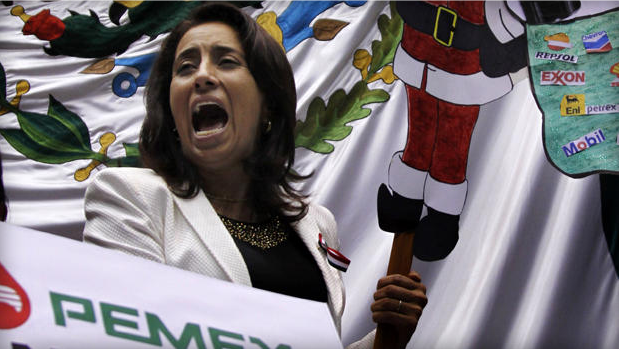
Leftist lawmakers tried to block discussion of the measure on Wednesday by seizing the main chamber of the House of Deputies, blocking access with chairs and tables.

When the debate was moved to another room, they dragged out discussion for 20 hours before the measure was finally approved.

“The homeland is not for sale! The homeland is to be defended!” they shouted while holding protest signs and Mexican flags.

One congressman of the leftist Democratic Revolution Party, Antonio Garcia Conejo, undressed during a speech Wednesday to dramatize his assertion the bill is a “plunder of the nation.”

But most oil analysts had a positive view of the bill hashed out by President Enrique Pena Nieto’s Institutional Revolutionary Party and the conservative National Action Party.

They say major change is needed to rescue Mexico’s oil industry, where production has declined, and where Pemex hasn’t had the finances or expertise needed to tap the country’s vast deep-water and shale reserves.

While oil output has been rising in the U.S. and Canada, Mexico’s production has fallen 25 percent since 2004 despite increased investment.

According to Pemex statistics, the company has nearly 14 billion barrels in proven reserves and up to 115 billion barrels in prospective reserves, about half of which are in deep water or shale oil and gas.

“The opening of Mexico’s markets to put it bluntly, we believe is very good for the people of Mexico and the people everywhere in the world that uses energy,” William Colton, Exxon Mobil’s vice president of corporate strategic planning, said in a webcast before the vote Thursday. “It’s win-win if there ever was one.”

Supporters say a better energy sector could add at least a full percentage point to Mexico’s annual growth rate, which was scaled back dramatically this year from a projected 3.5 percent to 1.3 percent. Backers also say it will be a boon to all three countries, the U.S., Canada and Mexico, in the North American Free Trade Agreement.

“We are going to be able to develop services and competencies in dealing with energy that are transferrable from one country to another,” Thomas Donohue, president of the U.S. Chamber of Commerce, told The Associated Press. “They all have some differences in commodities and have their own regulatory systems, but all of it will be in the context of a lot oil, a lot of gas, a lot of coal and a fundamental ability to attract manufacturing, to improve supply chain and to drive the creation of jobs and economic growth.”

Barclays Research, part of the Corporate and Investment Banking division of Barclays Bank, says the process of boosting production will be slow. Pemex estimates it needs more than $60 billion a year in investment to explore reserves, and currently gets about $24 billion.

“We have to recognize that this is an important effort in a historic sense. However, the challenges are huge because of the amount that has to be done to implement the reform as it is designed,” said Michelle Michot Foss, head of the University of Texas’ Center for Energy Economics.

The measure would allow contracts for profit- and production-sharing as well as licenses under which companies would pay royalties and taxes to the Mexican government for the right to explore and drill.

Private companies could post reserves as long as they specify in contracts that all oil and gas belongs to Mexico. The constitution would continue to prohibit oil concessions, considered the most liberal kind of access for private oil companies.

The bill also calls for mechanisms to prevent, detect and punish corruption in all new contracts, though the specifics must be worked out in what’s known as the secondary laws.

It also appears to reduce the influence of the powerful oil union run by Carlos Romero Deschamps, whose family is famous for its ostentatious lifestyle.

Pemex has an estimated 155,000 employees, of which about 101,000 are unionized, according to Mexico’s Center for Economic Investigation and Education.

Romero Deschamps, who is also a senator for Pena Nieto’s Institutional Revolutionary Party, was initially in favor of the reform proposal, which barely touched Pemex or the union. But in a last-minute change approved by both houses, the bill effectively removed the union’s representation on the Pemex board of directors.

Romero Deschamps walked out of the Senate and didn’t vote.

Source: CBS News

Modern Prohibition Takes It On The Chin With Uruguay’s Marijuana Legalization | Dollar Vigillante

Uruguay became the first country to legalize marijuana completely yesterday.

We’re not just talking about “decriminalizing” it, or allowing recreational use while still prosecuting pot’s cultivation and selling. The government will still limit amounts to six plants per home per year. And as with alcohol purchases in the US, selling pot in Uruguay will require a license.

In typical government meddling fashion, allowing personal use but not production and sale made a mockery of sense. Speaking of mockeries of sense, the usual arguments about marijuana being a “gateway” drug were out in force among the drug warriors. Colorado Senator Alfredo Solari, whose state is set to alllow its first legal weed sales in just a few days, said, “Competing with drug traffickers by offering marijuana at a lower price will just increase the market for a drug that has negative effects on public health.”

Apparently it is much, much better for “public health” for prohibition to breed cartel and gang violence, which is the inevitable result when politicians use their armed enforcers to prevent people from engaging in the procurement and consumption of something they really, really enjoy.

You know how most of the world laughs at alcohol prohibition now? Well, in the future they’ll laugh at us for not being able to see that prohibition of other substances was just as silly and destructive. Prohibition doesn’t actually stop anyone who wants drugs from getting drugs. It just makes the drugs a lot more expensive while adding a thick layer of violence and danger in the resulting black market.

It also gives government opportunity to fill its cages with non-violent drug consumers and low-level retailers, all of whom have their chances for employment permanently ruined as a result. That, however, is a mild insult added to the injury of incarceration resulting in their brutalization and possible rape.

So when people like Senator Solari talk about negative effects on public health, we can’t help but think that the same number people getting high without the cartels, gangs and government kidnappings represents an incalculable improvement in public health. Hell, it would be great if a few more people got high if it meant an end to police home raids, corner pushers and cartel mass murders. Busybodies and the fully propagandized will blanch, but a little pot next to the whiskey in the liquor cabinet will mean society becomes richer, happier and more peaceful. That’s what happens when you diminish ugly bits of political violence like prohibition.

The drug that has a negative effect on public health is violence itself, a substance to which politicians and their world of enablers are severely addicted. They love using violence to get people to do what they want. Violence, however, begets more of the same. Prohibition is the clearest, most demoralizing example of this. Recreational drug use is a personal choice, a matter of aesthetics, but it’s exactly the kind of thing busybodies make a moral and collective issue that presumes ownership of other people. It’s exactly the kind of thing governments can’t help but get in on.

Like we’ve said before, the state is a self-licking ice cream cone; it creates its own demand. By manufacturing a crime, states create the need for their brand of monopolized, violent policy enforcement. But marijuana prohibition is now so nakedly absurd that it seems that the state is going to have to relent.

It’s still annoying to hear that there will be monitoring of purchases and other regulation, like where one can buy it and how much one can grow per unit of time. For our part we will not be celebrating till all the armed thugs who claim the right to monitor and control people go away. But we can hope that Uruguay’s legalization is another small sign that faith in the state and its proscriptions is flagging.

Portugal decriminalized the individual possession of small amounts of various recreational drugs and has seen addiction rates plummet. Uruguay is also going to see fantastic results.

It’s also important to note that this is happening in Uruguay. This is just another example of why we at TDV, along with many of our clients, are so enthusiastic about South America. TDV Passports offers a very popular passport program from neighboring Paraguay, and in keeping with our PT (Prior Taxpayer/Permanent Traveler) recommendations, clients who opt for the Paraguay citizenship and passport spend much of their time in Uruguay.

While the USSA continues on the road of more imperialism, more fascistic regulation, more inflation and more debt, things are heading in the opposite direction in Latin America. That’s why Latin America, particularly the nation-state of Chile, was chose as the place to found Galt’s Gulch. Imagine yourself with a Paraguayan passport, a home in Galt’s Gulch Chile, and able to get some quality time in Uruguay where they are leading the way in a vital area of freedom. Click here to take your first step.

Source: Dollar Vigillante

Iceland thumbs nose at international opposition to advance $1.2bn debt relief plan | Russia Times

IcelandHousesIceland’s government has announced that it will be writing off up to 24,000 euros ($32,600) of every household’s mortgage, fulfilling its election promise, despite overwhelming criticism from international financial institutions.

The measure was introduced by the country’s prime minister, Sigmundur David Gunnlaugsson, the leader of the Progressive Party which won the late-April elections on a promise of household debt relief.

According to the government’s website the household debt will be reduced by 13 percent on average.

Citizens of Iceland have been suffering from debt since the 2008 financial crisis, which led to high borrowing costs after the collapse of the krona against other currencies.

“Currently, household debt is equivalent to 108 percent of GDP, which is high by international comparison,” highlighted a government statement, according to AFP. “The action will boost household disposable income and encourage savings.”

The government said that the debt relief will begin by mid-2014 and according to estimates the measure is set to cost $1.2 billion in total. It will be spread out over four years.

The financing plan for the program has not yet been laid out. However, Gunnlaugsson has promised that public finances will not be put at risk. It was initially proposed that the foreign creditors of Icelandic banks would pay for the measure.

International organizations have confronted the idea with criticism. The International Monetary Fund (IMF) and the Organization for Economic Cooperation and Development (OECD) have advised against it, citing economic concerns.

Iceland has “little fiscal space for additional household debt relief” according to the IMF, while the OECD stated that Iceland should limit its mortgage relief to low-income households.

In the meantime, ratings service, Standard & Poor’s, cut back on its outlook for Iceland’s long-term credit rating to negative from stable, stating that the economic measure could affect the confidence of foreign investors if it ends up being paid for by the existing creditors of Icelandic banks.

Source: Russia Times

Voluntary Governance | Thrive Movement

Picture_6By Foster Gamble

I imagine a world where each being is free to act according to his or her inner guidance, provided there is no violation of any other’s person or property.

Association is voluntary, not coerced. Exchange is by choice, not force. There is no involuntary taxation (plunder), so there is no involuntary governance (tyranny). Money is a medium of exchange based on real value (sound currency) rather than arbitrary “fiat” decree (counterfeit and fraud). There are no wars of aggression (mass murder). A truly free market has led to prosperity beyond current imagining, where people have the time and the resources to follow their passions and to care for one another, as needed, voluntarily.

Introduction

What if citizens were given a choice over the type of government they wanted? Or if they wanted a government at all? What if people were really to have a say in the decisions that determine the content and quality of their lives? Could we self-govern and create more resilient, peaceful, prosperous communities?

Today, involuntary governance is all that exists.  When you step back to look at what government really is, it basically comes down to a group of people who are granted more power than the rest of us.  They are able to make laws that we have to obey, they are able to charge us money in the form of taxes without our consent, they are able to put us in jail if we don’t go along with their self-proclaimed power, and they are able to go to war –with our money – without our approval.

It seems like voluntary governance is such a radical notion that it is common to reject it without really exploring it fully. We have chosen to examine our assumptions about government and are grateful that there are many great thinkers who have devoted their time and energy to exploring the problems and the solutions related to involuntary governance. People often say that government is necessary for protection. But governments have killed more of their own citizens and innocent civilians than any other institution in history – more than 200 million people in the 20th Century alone.  Would voluntary governance result in this kind of brutality and violence?  The fact that all current governments are involuntary – ranging from dictatorships to democracies – puts them at risk of being overthrown. Involuntary governments create state militaries not necessarily to protect the people, but to protect themselves. Are there more effective ways of optimizing our security, in a voluntary society?

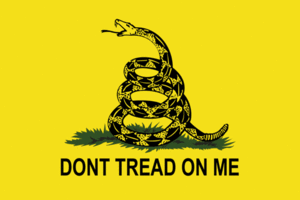
dont_tread_on_meInvoluntary governments also require money to be funded, which is collected in the form of taxes. The people have no say in how taxes are spent but we are nonetheless required to pay them. Americans are terrified of the IRS. How is it that government can order us to fund their activities without us having a say in it? This economic dynamic doesn’t exist anywhere else. People in society make money by voluntarily selling goods and services or by receiving voluntary gifts. The government, on the other hand, collects money by force. Imagine if people had a say in where their taxes went. Would we be spending so much on the military? Would we have taxes at all? What if we only put funds toward services we wanted, and kept the rest of our money to support the businesses, inventions, educational opportunities and upkeep of our infrastructure that we valued? Could we create a more prosperous economy if involuntary governments didn’t collect a large portion of our income?

Making the transition to voluntary governance would obviously take a lot of work, but we believe it’s absolutely essential if what we are after are equal rights and true freedom – not as a philosophical ideal but as a reality.  As discussed in our Solutions Strategies article, Stage One of the transition will likely involve reforming current systems to make governments accountable while taking care of those most disenfranchised without increasing the government’s funding or power –  and at the same time empowering individuals and communities to organize on their own.  Some key areas to address to get the transition underway are election and campaign finance reform.

The good news is a lot of valuable thinking has already been done envisioning voluntary societies. (The Liberty Resource Tree at the bottom of this page is rich with decades of extraordinary ethical and practical thinking.)

Because such profound change cannot happen all at once, there are three overlapping stages of the solutions process: Stage One: Bringing integrity and healing to our current condition; Stage Two: limiting government control to the protection of individual rights and the commons; and Stage Three:  living solely by voluntary cooperation – rules, but no rulers.

This three-staged approach is a radical shift from most strategies. Rather than just trying to improve the status quo, it integrates traditional progressive, conservative, and liberty viewpoints, reconciling divisions that have long kept us separated.

Source: Thrive Movement

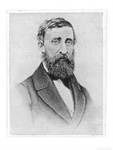
Henry-David-Thoreau

There are a thousand hacking at the branches of evil to one who is striking at the root.

– Henry David Thoreau

Radiation Protection | What Is Radiation

radiationprotection144Radiation protection is surprisingly easy. The primary concern for most people is not shielding from direct exposure as a nuclear power plant worker might experience. Instead, radiation protection from internal exposure is what matters to most people.

Simple Radiation Protection Steps:

Radiation Protection From Internal Exposure

Ever since the first atomic test, radionuclides have been accumulating in the environment but radiation protection has been only a passing concern.

Some radionuclides, such as Iodine-131 with a half life of 8 days, pose only a short-term threat. Although it is a good idea to keep one’s Iodine levels up as part of a healthy nutrition regimen, overdosing on Potassium Iodide in reaction to news reports is not recommended. The most vulnerable are infants and developing fetuses, since radioactive Iodine-131 bio-concentrates by a factor of 1,000 in their growing tissues. Three months later, the opportunity for radiation protection will have passed.

Most radionuclides have longer half-lives and constitute a greater threat over time. In particular as regards radiation protection:

  • Cesium-137 has a half-life of  about 30 years and chemically mimics Potassium in the body. This means that quantities as a result of atmospheric atomic testing are still present in the environment at somewhere between 10-25 percent of their original strength. Quantities created from the Chernobyl catastrophe are still present at about 50% of their original levels. This Cesium-137 can find its way into our bodies through consumption of fruits, vegetables and meats.
  • Strontium-90 has a half-life of about 28 years and chemically mimics Calcium in the body and thus shows up in the bones and teeth. This means that it is still present in the environment in quantities similar to Cesium-137.
  • Uranium-235 has a half-life of about 704 million years and chemically mimics Iron in the body. This means quantities released into the environment through atmospheric nuclear testing or nuclear accidents have not diminished substantially in their radioactivity over time.
  • Plutonium-239 has a half-life of about 24,000 years and chemically mimics Iron in the body. This means quantities released into the environment through atmospheric nuclear testing or nuclear accidents have not diminished substantially in their radioactivity over time.

Radiation protection for the above contaminants is accomplished through mineralization and chelation. Although these radionuclides have been accumulating in the environment since the first atomic test, it is difficult to establish direct cause-and-effect links between exposure and subsequent cancers for two reasons:

  1. There is a latency period of from 5 to 20 years between exposure and the appearance of associated cancers.
  2. Many consequences may be classified as “Stochastic Effects” meaning that chance plays a role. This means that statistically, cancers will show up as percentages within an exposed population, but it is difficult to predict individual outcomes.

Source: What Is Radiation?

Time lapse map of every nuclear explosion ever on Earth

By Isao Hashimoto

Japanese artist Isao Hashimoto has created a beautiful, undeniably scary time-lapse map of the 2053 nuclear explosions which have taken place between 1945 and 1998, beginning with the Manhattan Project’s “Trinity” test near Los Alamos and concluding with Pakistan’s nuclear tests in May of 1998. This leaves out North Korea’s two alleged nuclear tests in this past decade (the legitimacy of both of which is not 100% clear).

Each nation gets a blip and a flashing dot on the map whenever they detonate a nuclear weapon, with a running tally kept on the top and bottom bars of the screen. Hashimoto, who began the project in 2003, says that he created it with the goal of showing”the fear and folly of nuclear weapons.” It starts really slow — if you want to see real action, skip ahead to 1962 or so — but the buildup becomes overwhelming.

Source: Isao Hashimoto

Documents in JPMorgan settlement reveal how every large bank in U.S. has committed mortgage fraud | The Real News Network

This’ll be the first installment in what can we learn from the statement of facts that constitutes JPMorgan’s admissions. This in that settlement that the Department of Justice is billing as the $13 billion settlement. As I’ve explained in the past, it’s not that big, but it’s still quite large in dollar terms. And we owe a debt of gratitude to Judge Rakoff, who’s been giving the Securities and Exchange Commission a hard time about settling cases and getting absolutely no useful admissions from the people that perpetrated the frauds.

Source: The Real News Network

DEA, IRS raid Denver area pot businesses | NBC News

By Colleen Slevin and Kristen Wyatt

PotRaidsThe raids, conducted on a snowy morning, were the first in Colorado since the U.S. Department of Justice said in August that it wouldn’t interfere with state marijuana laws as long as the states keep the drug away from children, the black market and federal property.

The U.S. Attorney’s Office in Denver said the federal action “comports with the Department’s recent guidance” but would not elaborate. The U.S. Attorney’s Office said authorities were executing sealed search and seizure warrants and wouldn’t disclose how many businesses are being targeted or what they’re being investigated for.

Retail marijuana sales are to begin Jan. 1 in Colorado, though not all municipalities will be ready to go by then. For now, dispensaries are supposed to sell only to people with medical permission to use the drug. Many of the state’s 500 or so existing dispensaries are making plans to convert to recreational sales.

The Justice Department said in August that it wouldn’t stand in the way of votes in Colorado and Washington to legalize recreational pot but warned there needed to be effective controls to keep marijuana away from children, the black market and federal property.

At one of the raided dispensaries, VIP Cannabis, agents took boxes out of the business and loaded them into a U-Haul truck. One officer wore a surgical mask.

In Boulder, agents raided a number of marijuana-growing warehouses, leaving a chest-high pile of marijuana plants on the side of a road before loading them into trucks, The Daily Camera reported.

Colorado’s marijuana industry was quick to point out that the raids did not necessarily mean that the federal government was going back on its word or planning to interfere with Colorado’s plans to a recreational market.

Mike Elliott, a spokesman for the Medical Marijuana Industry Group, said the industry itself has pushed for “robust” regulations and expects industry compliance with lengthy state regulations on how the drug is grown and sold.

“While everyone involved in these raids should be considered innocent until proven guilty, enforcement is a sign that this program is working and maturing,” he said in a statement.

Mason Tvert of the Marijuana Policy Project said it wasn’t clear how many businesses were raided. Many dispensaries and growing warehouses were operating as usual Thursday.

“The Justice Department said it would respect states’ rights to regulate marijuana, and that it would not go after businesses as long as they are complying with state laws,” he said in a statement. “We hope they are sticking to their word and not interfering with any state-regulated, law-abiding businesses.”

Source: