GOP Members Storm Closed Door House Session | Trending Politics

Editor’s. Note: An impeachment process must be transparent, open and factual. There’s something terribly wrong and one-sided if Republicans are not allowed to participate in the inquiry. 

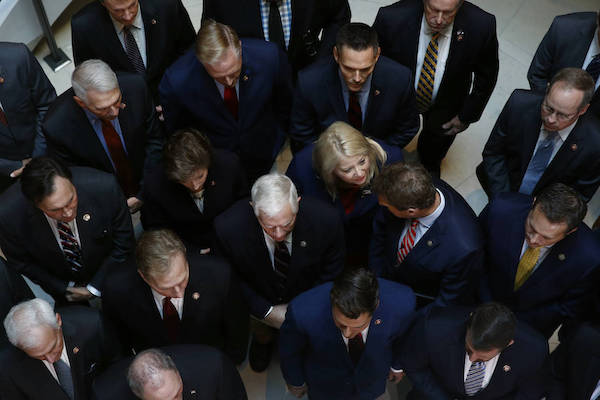
On Wednesday, GOP members made the move to storm a closed door impeachment session, forcing far-left Rep. Adam Schiff to suspend the meeting and run from the scene.

Democrats have made the ongoing impeachment inquiry as secret as possible, offering no public transparency.

During a press conference before storming the hearing, Rep. Matt Gaetz (R-FL) said: “We’re going to try and go in there, and we’re going to try to figure out what’s going on, on behalf of the millions of Americans that we represent that want to see this Congress working for them and not obsess with attacking a president who we believe has not done anything to deserve impeachment.”

House Minority Whip Steve Scalise also spoke out: “What is Adam Schiff trying to hide? I think that’s the question so many people have, so many of my colleagues have, so many people in the press should have.”

“Voting members of Congress are being denied access from being able to see what’s happening behind these closed doors where they’re trying to impeach the president of the United States with a one-sided set of rules,” Scalise continued. “They call the witnesses. They don’t let anybody else call the witnesses.”

“We’re gonna’ go and see if we can get inside,” Gaetz added.

It was then when the 30 Republicans stormed the closed-door hearing, forcing Schiff to run out and hide.

“He doesn’t have the guts to come talk to us,” Rep. Roger Marshall said. “He left, he just got up and left. He doesn’t have the guts to tell us why we can’t come in the room, why he doesn’t want this to be transparent. It’s the biggest facade, biggest farce of my life.”

Rep. Bradley Byrne too to Twitter saying: “Adam Schiff just SHUT DOWN his secret underground impeachment hearing after I led a group of Republicans into the room. Now he’s threatening me with an Ethics complaint! I’m on the Armed Services Cmte but being blocked from the Dept. Asst. SecDef’s testimony. This is a SHAM!” he wrote.

Republicans are clearly upset with the lack of transparency from Schiff and the rest of the Democrats. Gaetz has tried to attend the meetings however “he could not attend because he is not part of the House Intelligence Committee, which is conducting the investigation along with the House Oversight and Foreign Affairs Committees,” Fox New reported.

“Judiciary Chairman [Jerry Nadler] claimed to have begun the impeachment inquiry weeks ago,” Gaetz previously said. “Now, his own Judiciary members aren’t even allowed to participate in it. And yes — my constituents want me actively involved in stopping the #KangarooCourtCoup run by Shifty Schiff.”

House Democrats defended Schiff, saying that Schiff was in the right.

“I guess when you’re desperate you go back to complaining about the process, and that’s what they’re doing,” said Rep. Val Demings said.

“I think it’s completely inappropriate. I think when the facts are against you, the law is against you, the President apparently committed a crime, you are left with arguing process, and that’s what they’re arguing,” Rep. Harley Rouda (D-CA) said.

“We’re embarrassing ourselves in front of company,” said Rep. Mike Quigley of the House Intelligence Committee.

Source: Trending Politics

We Have No Reason to Believe 5G is Safe | Scientific American

By Joel Moskovitz

Editor’s Note: Science is allegedly the foundation for sound reasoning when it comes to evaluating the short and long-term benefits (and drawbacks) of any new technology, but in the case of 5G there is no reliable science to assure us of its safety. Quite the contrary, it’s being deployed globally without concern for the safety of those exposed.

The telecommunications industry and their experts have accused many scientists who have researched the effects of cell phone radiation of “fear mongering” over the advent of wireless technology’s 5G. Since much of our research is publicly-funded, we believe it is our ethical responsibility to inform the public about what the peer-reviewed scientific literature tells us about the health risks from wireless radiation.

The chairman of the Federal Communications Commission (FCC) recently announced through a press release that the commission will soon reaffirm the radio frequency radiation (RFR) exposure limits that the FCC adopted in the late 1990s. These limits are based upon a behavioral change in rats exposed to microwave radiation and were designed to protect us from short-term heating risks due to RFR exposure.

Yet, since the FCC adopted these limits based largely on research from the 1980s, the preponderance of peer-reviewed research, more than 500 studies, have found harmful biologic or health effects from exposure to RFR at intensities too low to cause significant heating.

Citing this large body of research, more than 240 scientists who have published peer-reviewed research on the biologic and health effects of nonionizing electromagnetic fields (EMF) signed the International EMF Scientist Appeal, which calls for stronger exposure limits. The appeal makes the following assertions:

“Numerous recent scientific publications have shown that EMF affects living organisms at levels well below most international and national guidelines. Effects include increased cancer risk, cellular stress, increase in harmful free radicals, genetic damages, structural and functional changes of the reproductive system, learning and memory deficits, neurological disorders, and negative impacts on general well-being in humans. Damage goes well beyond the human race, as there is growing evidence of harmful effects to both plant and animal life.”

The scientists who signed this appeal arguably constitute the majority of experts on the effects of nonionizing radiation. They have published more than 2,000 papers and letters on EMF in professional journals.

The FCC’s RFR exposure limits regulate the intensity of exposure, taking into account the frequency of the carrier waves, but ignore the signaling properties of the RFR. Along with the patterning and duration of exposures, certain characteristics of the signal (e.g., pulsing, polarization)increase the biologic and health impacts of the exposure. New exposure limits are needed which account for these differential effects. Moreover, these limits should be based on a biological effect, not a change in a laboratory rat’s behavior.

The World Health Organization’s International Agency for Research on Cancer (IARC) classified RFR as “possibly carcinogenic to humans” in 2011. Last year, a $30 million study conducted by the U.S. National Toxicology Program (NTP) found “clear evidence” that two years of exposure to cell phone RFR increased cancer in male rats and damaged DNA in rats and mice of both sexes. The Ramazzini Institute in Italy replicated the key finding of the NTP using a different carrier frequency and much weaker exposure to cell phone radiation over the life of the rats.

Based upon the research published since 2011, including human and animal studies and mechanistic data, the IARC has recently prioritized RFR to be reviewed again in the next five years. Since many EMF scientists believe we now have sufficient evidence to consider RFR as either a probable or known human carcinogen, the IARC will likely upgrade the carcinogenic potential of RFR in the near future.

Nonetheless, without conducting a formal risk assessment or a systematic review of the research on RFR health effects, the FDA recently reaffirmed the FCC’s 1996 exposure limits in a letter to the FCC, stating that the agency had “concluded that no changes to the current standards are warranted at this time,” and that “NTP’s experimental findings should not be applied to human cell phone usage.” The letter stated that “the available scientific evidence to date does not support adverse health effects in humans due to exposures at or under the current limits.”

The latest cellular technology, 5G, will employ millimeter waves for the first time in addition to microwaves that have been in use for older cellular technologies, 2G through 4G. Given limited reach, 5G will require cell antennas every 100 to 200 meters, exposing many people to millimeter wave radiation. 5G also employs new technologies (e.g., active antennas capable of beam-forming; phased arrays; massive multiple inputs and outputs, known as massive MIMO) which pose unique challenges for measuring exposures.

Millimeter waves are mostly absorbed within a few millimeters of human skin and in the surface layers of the cornea. Short-term exposure can have adverse physiological effects in the peripheral nervous system, the immune system and the cardiovascular system. The research suggests that long-term exposure may pose health risks to the skin (e.g., melanoma), the eyes (e.g., ocular melanoma) and the testes (e.g., sterility).

Since 5G is a new technology, there is no research on health effects, so we are “flying blind” to quote a U.S. senator. However, we have considerable evidence about the harmful effects of 2G and 3G. Little is known the effects of exposure to 4G, a 10-year-old technology, because governments have been remiss in funding this research. Meanwhile, we are seeing increases in certain types of head and neck tumors in tumor registries, which may be at least partially attributable to the proliferation of cell phone radiation. These increases are consistent with results from case-control studies of tumor risk in heavy cell phone users.

5G will not replace 4G; it will accompany 4G for the near future and possibly over the long term. If there are synergistic effects from simultaneous exposures to multiple types of RFR, our overall risk of harm from RFR may increase substantially. Cancer is not the only risk as there is considerable evidence that RFR causes neurological disorders and reproductive harm, likely due to oxidative stress.

As a society, should we invest hundreds of billions of dollars deploying 5G, a cellular technology that requires the installation of 800,000 or more new cell antenna sites in the U.S. close to where we live, work and play?

Instead, we should support the recommendations of the 250 scientists and medical doctors who signed the 5G Appeal that calls for an immediate moratorium on the deployment of 5G and demand that our government fund the research needed to adopt biologically based exposure limits that protect our health and safety.

Source: Scientific American

Schiff Collusion with Whistleblower the Last Straw | American Thinker

By Daniel John Sobieski, a former editorial writer for Investor’s Business Daily and freelance writer whose pieces have appeared in Human Events, Reason Magazine, and the Chicago Sun-Times among other publications.

Perhaps House Intelligence Committee chairman Rep. Adam Schiff (D-Calif.), would like to produce a transcript of his secret meeting with Fusion GPS founder Glenn Simpson at the Aspen Security Forum in July 2018.  Or maybe someone like ranking member Devin Nunes (R-Calif.) can make up a “parody” and read it into the record, as Schiff did with President Trump’s call with Ukrainian president Volodymyr Zelensky, both of whom publicly denied any collusion, pressure, or quid pro quo.

Liar and leaker Schiff had a transcript of the call and still made up his fable rivaling his fairy tale about having mounds of available evidence for everyone to see abut Trump’s mythical collusion with Russia.  We don’t have a transcript of Schiff’s meeting with Simpson, so we should be even freer to make stuff up about what each said, what each meant and heard, and what quid was promised for which quo.

Like Schiff’s Russian collusion delusion, Ukrainegate, to coin a phrase, is a made up scandal involving a questionable document with unverifiable or incorrect statements and allegations, chock-full of made up stuff and hearsay.  Like the Steele dossier produced through Fusion GPS, the Ukraine “whistleblower’s” letter to the inspector general is largely unverifiable hearsay or outright fiction.  Written by a CIA mole assigned to the White House who was not in the room or on the call, it is designed for one purpose: to bring down a sitting and duly elected president.

Now we find that Adam Schiff and committee staff had a copy of the letters before it was submitted to the I.G.  On Wednesday, the New York Times published a report that Schiff “learned about the outlines of a C.I.A. officer’s concerns that President Trump had abused his power days before the officer filed a whistle-blower complaint.”  As the New York Times related:

The early account by the future whistle-blower shows how determined he was to make known his allegations that Mr. Trump asked Ukraine’s government to interfere on his behalf in the 2020 election.  It also explains how Mr. Schiff knew to press for the complaint when the Trump administration initially blocked lawmakers from seeing it. …

Before going to Congress, the C.I.A. officer had a colleague convey his accusations to the agency’s top lawyer.  Concerned about how that avenue for airing his allegations was unfolding, the officer then approached a House Intelligence Committee aide, alerting him to the accusation against Mr. Trump.  In both cases, the original accusation was vague.

The House staff member, following the committee’s procedures, suggested the officer find a lawyer to advise him and file a whistle-blower complaint.  The aide shared some of what the officer conveyed to Mr. Schiff.

Schiff and his staff claim they had no hand in writing or editing the letter and did not coach the so-called whistleblower, even though his letter reads more like a legal brief written by a committee of lawyers.  Schiff, with  his track record, is not to be believed.

Take Schiff’s meeting with Simpson, an exercise in hypocrisy if nothing else.  Schiff, it may be remembered, accused House Intelligence Committee chair Devin Nunes of conspiracy with President Trump.  Conspiracies against President Trump and conspiring with Deep-State players are okay in Schiff’s alternate universe.  As Chuck Ross writes in the Daily Caller:

The Schiff-Simpson meeting has come under scrutiny because of Simpson’s role in pushing the unverified Trump-Russia collusion conspiracy theory.  Simpson has also been accused by some Republican lawmakers of lying to the House Intelligence Committee about his interactions with government officials while working on the dossier.

During testimony to the House panel on Nov. 14, 2017, Simpson withheld that he met with Justice Department official Bruce Ohr prior to the November 2016 election.  Simpson said that he met Ohr only after the election.  But Ohr told Congress on Aug. 28, 2018 that he and Simpson met on Aug. 22, 2016 at Simpson’s request.  They met again on Dec. 10, 2016.

Ohr’s wife worked as a contractor for Fusion during the 2016 campaign.  And after the election, Ohr served as the back channel between the FBI and Christopher Steele, the former British spy who worked for Fusion GPS on the dossier project.

During the same testimony in which Simpson has been accused of lying, Schiff sought investigative leads from the Fusion GPS founder.

Schiff,  who once called the rooftop heroes of Benghazi liars, is at it again.  He is not uncovering corruption; he is part of it.  His is the corruption that needs to be exposed, and his Intelligence Committee is part of the swamp that needs to be drained.

Count Schiff among the many leakers who have released classified information and testimony designed to damage and slander the Trump administration.  During the testimony of Donald Trump, Jr. before the House Intelligence Committee, Rep. Schiff repeatedly left the room.  Coincidentally, of course, leaked information from that testimony began appearing in anti-Trump media even before the testimony concluded:

Donald Trump Jr. and his lawyer formally requested an investigation Tuesday into leaks from the House Intelligence Committee that followed Trump’s participation in a closed-door interview with committee members and staffers last week.

“The public release of confidential non-public information by Committee members continued unabated” for 24 hours after Trump’s supposedly confidential interview last week, Trump’s lawyer, Alan Futerfas, wrote in a letter delivered Tuesday afternoon.

The four-page letter, addressed to Rep. K. Michael Conaway (R-Tex.), the panel chairman overseeing the Russia investigation, complains about public comments made by three members of the panel, all Democrats, including the highest-ranking minority member of the panel, Rep. Adam B. Schiff (D-Calif.).  The letter says that members and staffers began “selectively leaking information” even before the closed-door meeting ended.

Schiff sent a House intel staffer on a trip to Ukraine during August 24–31, just 12 days after receiving the whistleblower complaint.  To do what?  To dig up what?  It is reported the staffer met with the previous president of Ukraine, a friend of President Obama’s.

As reported by Gateway Pundit, Adam Schiff has strong ties to a prominent Ukrainian arms-dealer, Igor Pasternak, who has organized fundraisers for Schiff:

In 2013 Ukrainian Igor Pasternak held two different fund raisers for Schiff asking for contributions between $1,000 and $2,500[.] … Pasternak was reportedly in and around the Ukraine at the same time that Vice President Joe Biden had his son appointed to the Board of the Ukraine’s largest oil and gas producer[.]

Let’s investigate collusion with Ukraine to affect U.S. elections, Rep. Schiff.  Yours.

Schiff has defended Hillary Clinton and lied about her involvement in Uranium One and giving Russia 20 percent of our uranium reserves.  Talk about collusion with Russia!

Adam Schiff is a political hack, a swamp creature slithering past the truth while saying the American people can’t handle the truth.  What they can’t handle is swamp things like Adam Schiff.  It is he who should be impeached and removed from office

Source: American Thinker

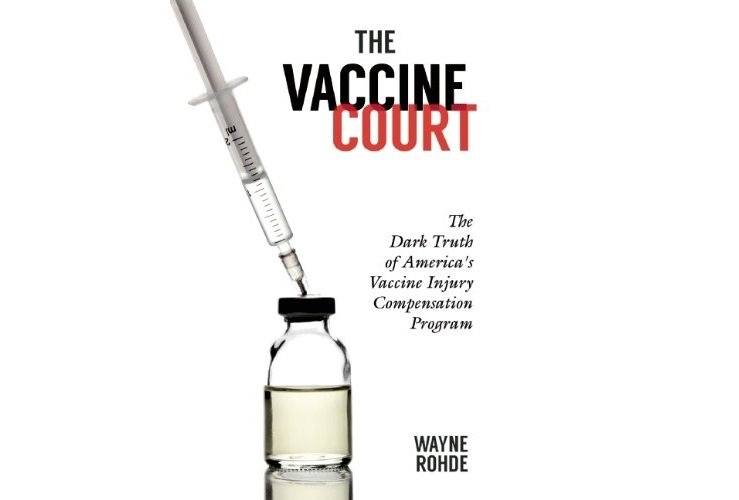
US Vax Court Sees 400% Spike in Vaccine Injuries, Flu Shot Wins Top Honors for Biggest Payout | Vaccine Impact

Vaccine injury cases are on the rise people, so if you’ve got your head in the sand and you haven’t been paying attention, it’s time to wake up.

Here’s a little background for those of you just getting started.

Ronnie Reagan… almost 30 years ago to the day, the 40th president of the United States signed away the rights of Americans to sue vaccine makers, replacing them with a law that forces families who have suffered vaccine injury or death to sue the U.S. government instead of a pharmaceutical company.

As a result, special masters from the United States Special Claims Court, also known for our purposes as the vaccine court, are given full authority as judge with no jury to decide the fate of Americans who have had the unfortunate ‘luck’ to be stricken by a vaccine injury — which can range from chronic, mild symptoms to death.

Once a year, this non-traditional court provides the public with a glimpse into its inner workings, by issuing an annual report on its website — a ritual that happens every January.  The report is sent to the President of Congress, otherwise known as the Vice President of the United States, where it is intended to serve as a bell weather monitoring reactions the American public may be having to vaccinations that are increasingly becoming forced by government mandates around the country.

Great, right?  Accountability in action?

Wrong.

The report, which is consistently ignored by mainstream media/politicians/health officials and the CDC, lies dormant on the reports page of the U.S. Special Claims Court website.

No headlines, no press release, no analysis, no alert the media, no nothing.

No surprise, given that most people in America don’t even know that vaccines were ruled to be unavoidably unsafe by the U.S. Supreme Court in 2011.  Also no surprise, that mainstream, co-opted, globalist elite media constantly ignore this report, along with sane arguments made by health freedom advocates about the dangers and risks of vaccine injury (‘look! a unicorn!’), instead using terms like ‘the science is in,’ and vaccine risk has been ‘debunked,’ to deter rational discussion pertaining to evidence that is hiding in plain sight.

Also no surprise that the U.S. Special Claims Court offers up an ineffective, low tech, archaic version of the report every year.  Instead of a nice, sort-able spread sheet, the court posts a scanned PDF document — a format which requires labor-intensive activities to conduct any sort of concrete analysis.  One must either re-data-entry all 220+ pages which would take weeks, or conduct an extensive, hand-written breakdown by vaccine of each case, combined with extensive tallying and organization efforts in order to identify statistical relevance and trends emerging from the vaccine court.

Is this by design?  Perhaps.  Most definitely it is at the very least a deterrent from having anybody actually sit down and try to analyze the damn thing.

Which is exactly why we do it, every year since 2014.  Not to be deterred, it took us 10 months to finally finish our analysis of this year’s report.  But once we did, the trends we found were shocking — not just because of what they revealed about the continual increase in vaccine injury, but also because of the deafening silence present among the halls of mainstream media, as vaccine injury continues to be a subject that journalists and media outlets ignore — chalking it up to yet another conspiracy theory from yet another fake news site.

Well pull up a chair and hold on to your hats, because guess what we discovered:

  1. Vaccine court settlement payouts increased in total $91.2 million in 2015, up from $22.8 million in 2014 to $114 million in 2015 — a 400% increase. 
  2. Vaccine court settlement payments for flu shots increased the most, from $4.9 million in 2014 to $61 million in 2015 —  an increase of more than 1000%, despite autumnal onslaughts every year of media/pr/advertising campaigns urging Americans to ‘get your flu shot,’ with total abandon for the statistical facts coming out of the vaccine court.
  3. Varicella (chicken pox) had the third biggest increase — from $0 in 2014 to $5.8 million in 2015.  (No surprise shingles is on the rise among the elderly population, as recently vaccinated grandchildren continuously shed live virus to their unsuspecting elders.)
  4. Hepatitis B was the fourth largest increase in vaccine court settlements, increasing 321% in 2015 to more than $8 million in 2015 from $1.9 million in 2014.
  5. TDap/DTP/DPT and D/T shots were the fifth largest increase, leaping 75% in 2014 from $5.5 million to $9.8.

The rest of the settlements not pictured here are: Tetanus, $4 million; HPV $3.4 million, up from almost nothing in 2014 (one to watch in January when the 2016 report is issued); MMR, which actually decreased from the number one position last year to under $1 m — an 88%+ decrease in payouts; pertussis, $1.7 million; thimerisol $1.5 million; HIB, $345k, menginococal $500k, HEP A $408k, DPT & Polio, $210k & rotovirus $76k. 

You may have noticed we omitted the second place winner, ‘other.’  Here’s why.

‘Other’ illustrates perfectly the dodgy nature of the vaccine court report, and its lack of transparency in the vaccine court process.  Instead of identifying which combination of vaccines are being charged with injury or death and labeling the case accordingly, a special master can decide to label a vaccine case ‘other,’ thereby diluting its affect on the overall numbers in the final analysis.

In 2015, the ‘other’ category was the second largest increase in vaccine settlement payments, totaling $21.5 million in payouts, up 388% from $4.4 million in payouts the year before.

We’re not accusing anybody of anything.  But, 388% increase is a lot.  What combination of vaccines is causing such an increase?  Doesn’t the public have a right to know?  If the court decided, for example, that there were too many flu shot settlements mounting for the year, couldn’t it simply skew the data by categorizing certain cases as ‘other,’ which would artificially deflate the flu category?

Did we mention that these results are ONLY for the judgements — cases that are found in favor of the plaintiff.  It does NOT include the EXTENSIVE legal fees for both sides, which are paid for by the U.S. government whether the lawyer wins or loses the case?  Those are categorized as costs.  And instead of submitting them in the report along with any judgments that are awarded, often they are entered as separate entries, making the exercise of linking them with their judgement payouts that much harder, requiring yet another step in the arduous, analysis of data.

The total dollar payout of legal fees for the vaccine court in 2015 is $42 million.

Also, a hand full of settlements in the payout are based on annuities — that means that the payouts (many of which total more than $1 million) reoccur annually.  That’s because life as they knew it for some plaintiffs disappeared after their vaccine injury occurred, and the costs to care for them in perpetuity for the life of the plaintiff requires an annual sum that is often extensive.

Share far and wide people, it’s time to turn the tide.

Republished with permission of The Mom Street Journal. Read the full article at TheMomStreetJournal.com.

Source: Vaccine Impact & TheMomStreetJournal.com

GOP Leader McCarthy Makes Huge Move Against Pelosi Impeachment Push | Trending Politics

Editor’s Note: The rush to impeachment without Congressional rules conducted fairly, objectively with non-partisan impartiality is a violation of due process and should be addressed consistent with the U.S. Constitution and prior impeachment proceedings.

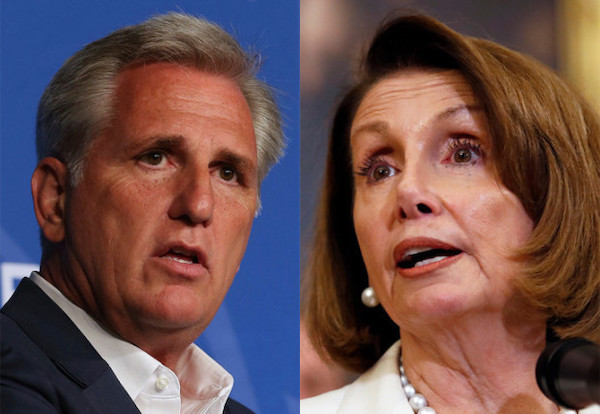
On Thursday, House Minority Leader Kevin McCarthy wrote a letter to Speaker of the House Nancy Pelosi, calling on her to suspend the impeachment inquiry into President Trump because of its lack of transparency.

“I am writing to request you suspend all efforts surrounding your ‘impeachment inquiry’ until transparent and equitable rules and procedures are established to govern the inquiry, as is customary,” McCarthy said. “As you know, there have only been three prior instances in our nation’s history when the full House has moved to formally investigate whether sufficient grounds exist for the impeachment of a sitting president.”

“I should hope that if such an extraordinary step were to be contemplated a fourth time, it would be conducted with an eye towards fairness, objectivity, and impartiality,” he continued. “Unfortunately, you have given no clear indication as to how your impeachment inquiry will proceed — including whether key historical precedents or basic standards of due process will be observed.”

Pelosi’s move towards impeachment is an obvious political hit job. Last Tuesday, Pelosi announced an official impeachment inquiry against President Trump based off of a second-hand politically biased whistleblower’s claim that President Trump bribed Ukraine’s President with military funds to start an investigation into Joe Biden for getting a Ukrainian prosecutor fired who was investigating his son.

This move by the Speaker is an obvious political hit job with the sole intention of removing our duly elected president from office.

***Get Your Free USA 45 Hat While Supplies Last***

The whistleblower claimed that President Trump set up a quid pro quo agreement regarding military aid with Ukraine and in return, Ukraine would investigate Joe Biden. Pelosi used the whistleblower’s claim to begin an impeachment inquiry, however the transcript of the call which was released the next day, revealed that President Trump did not leverage military aid in any way. The Democrats started an impeachment inquiry based on lies.

“The actions of the Trump presidency revealed dishonorable facts of the president’s betrayal of his oath of office, betrayal of his national security and betrayal of the integrity of our elections,” Pelosi said on Tuesday before the actual transcript of the call was even released.

The Democrats saw this opportunity as their chance to ruin President Trump however it seems that they are shooting themselves in the foot considering the whole whistleblower situation seems to be an Adam Schiff set up.

On Wednesday, the New York Times dropped a bombshell report which revealed that House Intelligence Committee Chairman Adam Schiff knew about the CIA ‘whistleblower’s’ allegation against President Trump well before the complaint was even made.

“The early account by the future whistle-blower … explains how Mr. Schiff knew to press for the complaint when the Trump administration initially blocked lawmakers from seeing it,” The New York Times reported. “Before going to Congress, the C.I.A. officer had a colleague convey his accusations to the agency’s top lawyer. Concerned about how that avenue for airing his allegations was unfolding, the officer then approached a House Intelligence Committee aide, alerting him to the accusation against Mr. Trump.”

Source: Trending Politics

Washington Post awards Adam Schiff ‘Four Pinocchios’ for false comments about whistleblower | Washington Post

The Washington Post awarded “Four Pinocchios” to House Intelligence Committee Chairman Adam Schiff on Friday, claiming he hadn’t told the truth about his knowledge of the whistleblower.

Schiff has played a leading role in investigating the Trump-Ukraine scandal but hasn’t been truthful in the process, according to Washington Post fact-checker Glenn Kessler.

Kessler laid out a compelling, fact-based argument that Schiff wasn’t honest when asked if he had advanced knowledge about the whistleblower’s concerns regarding the now-infamous phone call between President Trump and Ukrainian President Volodymyr Zelensky in a series of interviews.

“Schiff’s answers are especially interesting in the wake of reports in The New York Times and The Washington Post that the whistleblower approached a House Intelligence Committee staff member for guidance before filing a complaint with the Intelligence Community inspector general,” Kessler wrote.

Last month, Schiff sat down with CNN’s Anderson Cooper, who asked if he was in contact with the whistleblower, or even if he simply knew their identity.

“I don’t know the identity of the whistleblower … I don’t want to get into any particulars. I want to make sure that there’s nothing that I do that jeopardizes the whistleblower in any way,” Schiff told CNN when asked if the whistleblower has contacted him.

The Post called this answer a “classic dodge” and noted that the CNN host didn’t bother with a follow-up question – which helped Schiff avoid giving a potentially damaging answer.

“He managed not to mislead; he just simply did not answer the question,” Kessler wrote of Schiff.

“Schiff earns Four Pinocchios.” — Washington Post fact-checker Glenn Kessler

The very next day, Schiff appeared on MSNBC’s “Morning Joe,” where he seemingly graduated from dodging to lying, the Post says.

“We have not spoken directly with the whistleblower,” Schiff said on MSNBC.

Kessler noted that this is “flat-out false” given information that has since become available.

“Unlike the quick two-step dance he performed with Anderson Cooper, Schiff simply says the committee had not spoken to the whistleblower. Now we know that’s not true,” the Post’s fact-checker wrote.

A committee spokesman attempted to defend Schiff in a statement to the Post: “He intended to answer the question of whether the Committee had heard testimony from the whistleblower, which they had not… the whistleblower was then awaiting instructions from the Acting DNI as to how the whistleblower could contact the Committee. Nonetheless, he acknowledges that his statement should have been more carefully phrased to make that distinction clear.”

On Sept. 19, Schiff was at it again, according to the Post, when speaking with reporters at the Capitol.

“In the absence of the actions, and I want to thank the inspector general, in the absence of his actions in coming to our committee, we might not have even known there was a whistleblower complaint alleging an urgent concern,” Schiff said.

The Post’s fact-checker called this “misleading” comment “more dissembling” and noted that “his committee knew that something explosive was going to be filed with the IG.”

Kessler wrote there “are right ways and wrong ways to answer reporters’ questions if a politician wants to maintain his or her credibility” and there is “nothing wrong with dodging a question, as long as you don’t try to mislead.”

But Schiff “clearly made a statement that was false” on MSNBC and “compounded his falsehood” when speaking with reporters at the Capitol, Kessler wrote.

“The explanation that Schiff was not sure it was the same whistleblower especially strains credulity,” Kessler wrote. “Schiff earns Four Pinocchios.”

The Post’s Fact Checker team considered Four Pinocchios to be “whoppers” and most egregious offense outside of the rare “Bottomless Pinocchio.”

Republicans have also decried how Schiff, during a hearing last week, read a “parody” version of Trump’s phone call with Ukraine’s president.

Source: Fox News & Washington Post

Trump impeachment effort: The Swamp strikes (again) to deflect attention | RT.com

Editor’s Note: Excellent analysis of the misguided, self-sabotaging behavior of the Democrats to destroy the President regardless of the consequences to their own political futures and the integrity of the USA.
Robert Bridge is an American writer and journalist. Former Editor-in-Chief of The Moscow News, he is author of the book, ‘Midnight in the American Empire,’ released in 2013.
Washington’s political football has taken another bounce, skipping from Russia to Ukraine in just days. Democrats made the move to impeach Trump, but why only now?

Like some rogue cyborg responding to a programmed ‘terminate’ command, the Democratic Party has shown a relentless, laser-guided determination to destroy Donald Trump regardless of the consequences not only to their own political fortunes, but to the very integrity and viability of the nation.

Indeed, rather than humbly accept defeat following the Russiagate debacle, which held the Republic in a suspended state of mind-numbing animation for three tortuous years, the malevolent machine was merely rebooted. Today, the Democrats and their liberal gimp media are no longer obsessed by the Kremlin, Wikileaks, and a pee-stained hotel bed somewhere in central Moscow, but rather a phone call between Trump and Ukrainian President Volodymyr Zelensky.

Hello Russiagate 2.0

For those who have lost the plot for this latest DC thriller, here is the abridged version.

During a July 25 telephone conversation, the full transcript of which is accessible here, Trump asked Zelensky to “do us a favor,” which involved digging up dirt on Joe Biden, a leading Democratic contender in the 2020 presidential race. The task wouldn’t require a very large shovel, of course, since Biden had already implicated himself when he publicly bragged about forcing Ukraine to terminate its chief prosecutor Viktor Shokin, or risk losing a cool billion dollars in US financial aid. Who is Viktor Shokin? None other than the guy leading an investigation of Biden’s son, Hunter, who received millions of dollars for the pleasure of squatting on the board of a Ukrainian gas company.

In other words, Biden offered Ukraine a bald-faced quid pro quo, exactly what the Democrats are accusing Trump of doing. There’s just one glaring problem, however, with the Democratic charges: nowhere in the transcript of the call does Trump ever suggest he will compensate Kiev for carrying out his requests.

That nagging detail, however, did not stop the Democratic crazy train, with 300 million jaded American passengers on board, from departing the station for a non-stop ride to impeachment proceedings.

This latest rush by the Democrats to bring down Trump seems less of an effort based on sound political strategy than one that is driven by raw desperation. How else to explain the decision by the Speaker of the House Nancy Pelosi to announce an impeachment inquiry against the president when she hadn’t even read the transcript? That is an incredible admission, especially considering what the country has already been through for the past three years. Moreover, impeaching a sitting president is a radical, almost unheard of step that has only occurred twice in the nation’s history, against Andrew Jackson and Bill Clinton. Neither effort resulted in those leaders being forced from office. So, why on earth risk it?

There are other telltale signs that the Democrats, with no small help from the fawning media, are spinning yet another tale of intrigue every bit as Clancy-esque as Russiagate. Not unlike Pelosi, the White House whistle-blower – alleged to have been a CIA ‘conscientious objector,’ quite possibly a historic first in the dark underworld of espionage – issued a complaint based on second-hand sources. And the plot keeps thickening.

Until just days before the transcript was made public, such ‘evidence’ would have been considered inadmissible since only firsthand knowledge was deemed worthy of consideration. Some bureaucrat, however, showed amazing acuity in altering those conditions just before the Democrats would lower the hammer. Now, just in time for the impeachment show trial, the intelligent community’s new and improved complaint form, as reported by the Federalist, “no longer requires potential whistleblowers… to have direct, first-hand knowledge of the alleged wrongdoing that they are reporting.”

In other words, it looks like the Democrats are up to their usual dirty tricks. At this point it must be asked, what is the driving force behind their obsessive hatred of Trump, which has provoked a dire situation in the country that conservative commentator Rush Limbaugh has dubbed a “cold civil war” between the two parties?

Is Democratic desperation a sign of guilt?

Without bothering to educate herself first on the Trump-Zelensky conversation, Pelosi has disgraced her office, while, at the same time, opening up the Democrats to the possibility of massive setbacks, possibly even self-destruction, on the political front.

Pelosi admitted nearly as much when she said “it doesn’t matter” when asked by a reporter if the Democrats’ push for impeachment may damage their chances of holding onto the House down the road. “Our first responsibility is to protect and defend the Constitution of the United States,” she affirmed. Is anybody buying that explanation?

As much as we would all like to believe that modern US politicians are intrinsically guided by some patriotic and lyrical ‘love of country’ and ‘duty to the constitution,’ the evidence points to far less altruistic motives. Considering the collective wealth of congressional members alone suggests that the overwhelming majority of US politicians are in the political swamp known as Washington DC merely to enrich themselves.

Others may argue that the Democrats have essentially launched a preemptive strike against the 2020 presidential election, which they have a very narrow chance of winning given their lackluster field of contenders. Considering the high risks of pressing forward with impeachment, however, which the Democrats have admitted could even cost them the House, that suggestion also sounds implausible.

So, what is it? Why so much non-stop fear and loathing from the Democratic camp ever since Trump took over the White House in 2016?

Much of the Democratic angst goes back to the 2016 campaign trail when Trump boldly proclaimed that he would ‘drain the swamp.’ I don’t think he was just speaking rhetorically. Many Americans are unaware of it, simply because the mainstream media has concealed the news, but the Democrats are under investigation by the White House.

Back in May, Trump awarded sweeping powers to his Attorney General Bill Barr to investigate claims that the Democrats were “spying” on his campaign, a very serious charge that would make Watergate resemble a picnic by comparison. Meanwhile, in the same week that the Democrats were recklessly pushing forward with their impeachment inquiry, the New York Times reported that the US State Department had reopened its investigation into Hillary Clinton’s abuse of her email service, which compromised an untold number of classified government documents.

“As many as 130 officials have been contacted in recent weeks by State Department investigators — a list that includes senior officials who reported directly to Clinton…” The Washington Post reported.

In other words, the gloves have come off in the US capital. If you doubt that, consider this: if some Washington whistleblower, or “spy” as Trump has called the individual, was able to receive second-hand information about a classified phone call between Trump and a foreign leader, then it stands to reason that these same people knew for a long time that the Barr investigation had begun to focus on Clinton’s insecure email box. Thus, the Democrats could very well be engaged in ‘obstruction of justice’ while portraying Trump as the villain. Now, should the US president attempt to proceed with criminal charges against his opponents, the Democrats will scream in one media-backed voice that Trump is the one attempting to avoid persecution.

The Democrats, displaying incredible recklessness and impulsiveness in their latest effort to take down the House of Trump, may be less interested in winning back the White House in 2020 and far more interested in avoiding jail time. Nothing else adequately explains their crazed level of vindictiveness.

Source: RT.com

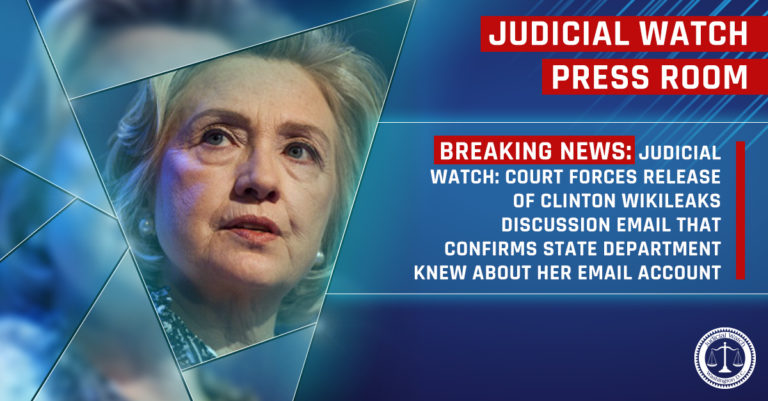
Court Forces Release of Clinton Wikileaks discussion email that confirms State Department knew about her email account | Judicial Watch

Editor’s Note: There is a long chain of events leading to this misguided impeachment inquiry initiated by the Democrats in the House of Representatives and it began during the Obama Administration when Hillary Clinton was Secretary of State. She was breaking with long-standing national security procedures by establishing a private server for her government and personal communications and the State Department knew she was doing this all along. Here’s the proof.

Judicial Watch announced today that the State Department provided a previously hidden email which shows that top State Department officials used and were aware of Hillary Clinton’s email account.

On December 24, 2010, Daniel Baer, an Obama State Department deputy assistant secretary of state, writes to Michael Posner, a then-assistant secretary of state about Clinton’s private email address:

Baer: “Be careful, you just gave the secretary’s personal email address to a bunch of folks …”

Posner answers: “Should I say don’t forward? Did not notice”

Baer responds: “Yeah-I just know that she guards it pretty closely”

Mr. Posner had forwarded Clinton’s email address, which was contained in an email sent to State Department senior leadership, about WikiLeaks.

It appears the State Department produced this email in 2016 in redacted form, blacking out Clinton’s personal email address and the discussion about Clinton’s wanting to keep her email address closely guarded.

Judicial Watch sought the email after a former top Freedom of Information Act (FOIA) State Department official testified to Judicial Watch about reviewing it between late 2013 and early 2014.

The testimony and the email production comes in discovery granted to Judicial Watch on the Clinton email issue in a FOIA lawsuit (Judicial Watch v. U.S. Department of State (No. 1:14-cv-01242)). Clinton also faces potential questioning under oath in this lawsuit.

Despite a recent court order requiring production of the email, the DOJ and State Departments only produced it 10 days ago after Judicial Watch threatened to seek a court order to compel its production.

“Judicial Watch just caught the State Department and DOJ red-handed in another email cover-up – they all knew about the Clinton email account but covered up the smoking-gun email showing this guilty knowledge for years,” stated Judicial Watch President Tom Fitton.

The scope of court-ordered discovery that produces this email find includes: whether Secretary Clinton used private email in an effort to evade the Freedom of Information Act (FOIA); whether the State Department’s attempt to settle this FOIA case in 2014 and 2015 amounted to bad faith; and whether the State Department has adequately searched for records responsive to Judicial Watch’s FOIA request.

During a recent hearing, Judge Lamberth specifically raised concerns about a Clinton email cache, carterheavyindustries@gmail.com, discussed in a letter to Senator Charles Grassley (R-IA) and wants Judicial Watch to “shake this tree” on this issue.

Judge Lamberth also criticized the State Department’s handling and production of Clinton’s emails in this case stating, “There is no FOIA [Freedom of Information Act] exemption for political expedience, nor is there one for bureaucratic incompetence.” 

The court rejected DOJ and State efforts to derail further Judicial Watch discovery. Judge Lamberth called their arguments “preposterous” and cited a prior Judicial Watch FOIA case in which he ordered U.S. Marshals to seize records from a Clinton administration official.

Judge Lamberth detailed how the State Department “spent three months from November 2014 trying to make this case disappear,” and that after discovering the State Department’s actions and omissions, “Now we know more, but we have even more questions than answers. So I won’t hold it against Judicial Watch for expanding their initial discovery request now.”

Judge Lamberth stated his goal was to restore the public’s faith in their government, which may have been damaged because of the Clinton email investigation.

The court granted Judicial Watch seven additional depositions, three interrogatories and four document requests related to former Secretary of State Hillary Clinton’s use of a private email server. Hillary Clinton and her former top aide and current lawyer Cheryl Mills were given 30 days to oppose being deposed by Judicial Watch.

On December 6, 2018, Judge Lamberth ordered Obama administration senior State Department officials, lawyers and Clinton aides to be deposed or answer written questions under oath. The court ruled that the Clinton email system was “one of the gravest modern offenses to government transparency.”

This Judicial Watch FOIA lawsuit led directly to the disclosure of the Clinton email system in 2015.

Judicial Watch’s discovery over the last several months found many more details about the scope of the Clinton email scandal and cover-up:

  • John Hackett, former Director of Information Programs and Services (IPS) testified under oath that he had raised concerns that former Secretary of State Hillary Clinton’s staff may have “culled out 30,000” of the secretary’s “personal” emails without following strict National Archives standards. He also revealed that he believed there was interference with the formal FOIA review process related to the classification of Clinton’s Benghazi-related emails.
  • Heather Samuelson, Clinton’s White House liaison at the State Department, and later Clinton’s personal lawyer, admitted under oath that she was granted immunity by the Department of Justice in June 2016.
  • Justin Cooper, former aide to President Bill Clinton and Clinton Foundation employee who registered the domain name of the unsecure clintonemail.com server that Clinton used while serving as Secretary of State, testified he worked with Huma Abedin, Clinton’s deputy chief of staff, to create the non-government email system.
  • In the interrogatory responses of E.W. (Bill) Priestap, assistant director of the FBI Counterintelligence Division, he stated that the agency found Clinton email records in the Obama White House, specifically, the Executive Office of the President.
  • Jacob “Jake” Sullivan, Clinton’s senior advisor and deputy chief of staff when she was secretary of state, testified that both he and Clinton used her unsecure non-government email system to conduct official State Department business.
  • Eric Boswell, former assistant secretary of state for diplomatic security during Clinton’s tenure as secretary of state, testified that Clinton was warned twice against using unsecure BlackBerry’s and personal emails to transmit classified material.

Source: Judicial Watch

Fake news is real — Artificial Intelligence is going to make it much worse | CNBC

“The Boy Who Cried Wolf” has long been a staple on nursery room shelves for a reason: It teaches kids that joking too much about a possible threat may turn people ignorant when the threat becomes an actual danger.

President Donald Trump has been warning about “fake news” throughout his entire political career putting a dark cloud over the journalism professional. And now the real wolf might be just around the corner that industry experts should be alarmed about.

The threat is called “deepfaking,” a product of AI and machine learning advancements that allows high-tech computers to produce completely false yet remarkably realistic videos depicting events that never happened or people saying things they never said. A viral video starring Jordan Peele and “Barack Obama” warned against this technology in 2018, but the message was not enough to keep Jim Carrey from starring in “The Shining” earlier this week.

The danger goes far beyond manipulating 1980s thrillers. Deepfake technology is allowing organizations that produce fake news to augment their “reporting” with seemingly legitimate videos, blurring the line between reality and fiction like never before — and placing the reputation of journalists and the media at greater risk.

Ben Zhao, a computer science professor at the University of Chicago, thinks the age of getting news on social media makes consumers very susceptible to this sort of manipulation.

“What the last couple years has shown is basically fake news is quite compelling even in [the] absence of actual proof. … So the bar is low,” Zhao said.

The bar to produce a convincing doctored video is lower than people might assume.

Earlier this year a clip purporting to show Democratic leader Nancy Pelosi slurring her words when speaking to the press was shared widely on social media, including at one point by Trump’s attorney Rudy Giuliani. However, closer inspection revealed that the video had been slowed to 75% of its normal speed to achieve this slurring effect, according to the Washington Post. Even with the real video now widely accessible, Hany Farid, a professor at UC Berkeley’s School of Information and a digital forensics expert, said he still regularly receives emails from people insisting the slowed video is the legitimate one.

“Even in these relatively simple cases, we are struggling to sort of set the record straight,” Farid said.

It would take a significant amount of expertise for a fake news outlet to produce a completely fabricated video of Oprah Winfrey endorsing Trump, but researchers say the technology is improving every day. At the University of Washington, computer vision researchers are developing this technology for positive, or at least benign, uses like making video conferencing more realistic and letting students talk to famous historical figures. But this research also leads to questions about potential dangers, as the attempts made by attackers are expected to continually improve.

How to detect a deepfake

To make one of these fake videos, computers digest thousands of still images of a subject to help researchers build a 3-D model of the person. This method has some limitations, according to Zhao, who noted the subjects in many deepfake videos today never blink, since almost all photographs are taken with a person’s eyes open.

However, Farid said these holes in the technology are being filled incredibly rapidly.

“If you asked me this question six months ago, I would’ve said, ‘Yeah, [the technology] is super cool, but there’s a lot of artifacts, and if you’re paying attention, you can probably tell that there’s something wrong,’” Farid said. “But I would say we are … quickly but surely getting to the point where the average person is going to have trouble distinguishing.”

In fact, Zhao said researchers believe the shortcomings that make deepfake videos look slightly off to the eye can readily be fixed with better technology and better hardware.

“The minute that someone says, ‘Here’s a research paper telling you about how to detect this kind of fake video,’ that is when the attackers look at the paper and say, ‘Thank you for pointing out my flaw. I will take that into account in my next-generation video, and I will go find enough input … so that the next generation of my video will not have the same problem,’” Zhao said.

“Once we live in an age where videos and images and audio can’t be trusted … well, then everything can be fake.” – Hany Farid, Professor at UC Berkeley’s School of Information

One of the more recent developments in this field is in generating speech for a video. To replicate a figure such as Trump’s voice, computers can now simply analyze hundreds of hours of him speaking. Then researchers can type out what they want Trump to say, and the computer will make it sound as if he actually said it. Facebook, Google and Microsoft have all more or less perfected this technology, according to Farid.

Manipulated videos of this sort aren’t exactly new — Forest Gump didn’t actually meet JFK, after all. However, Farid says this technology is hitting its stride, and that makes the danger new.

“To me the threat is not so much ‘Oh, there’s this new phenomenon called deepfakes,’” Farid said. “It’s the injection of that technology into an existing environment of mistrust, misinformation, social media, a highly polarized electorate, and now I think there’s a real sort of amplification factor because when you hear people say things, it raises the level of belief to a whole new level.”

The prospect of widespread availability of this technology is raising eyebrows, too. Tech-savvy hobbyists have long been using deepfakes to manufacture pornography, a consistent and comically predictable trend for new technology. But Zhao believes it is only a matter of time before the research-caliber technology gets packaged and released for mass-video manipulation in much broader contexts.

“At some point someone will basically take all these technologies and integrate and do the legwork to build a sort of fairly sophisticated single model, one-stop shop … and when that thing hits and becomes easily accessible to many, then I think you’ll see this becoming much more prevalent,” Zhao said. “And there’s nothing really stopping that right now.”

Facing a massive consumer trust issue

When this happens, the journalism industry is going to face a massive consumer trust issue, according to Zhao. He fears it will be hard for top-tier media outlets to distinguish a real video from a doctored one, let alone news consumers who haphazardly stumble across the video on Twitter.

“Once we live in an age where videos and images and audio can’t be trusted … well, then everything can be fake,” Farid said. “We can have different opinions, but we can’t have different facts. And I think that’s sort of the world we’re entering into when we can’t believe anything that we see.”

Zhao has spent a great deal of time speaking with prosecutors, judges — the legal profession is another sector where the implications are huge — reporters and other professors to get a sense for every nuance of the issue. However, despite his clear understanding of the danger deepfakes pose, he is still unsure of how news outlets will go about reacting to the threat.

“Certainly, I think what can happen is … there will be even less trust in sort of mainstream media, the main news outlets, legitimate journalists [that] sort of react and report real-time stories because there is a sense that anything that they have seen … could be in fact made up,” Zhao said.

Then it becomes a question of how the press deal with the disputes over reality.

“And if it’s someone’s word, an actual eyewitness’ word versus a video, which do you believe, and how do you as an organization go about verifying the authenticity or the illegitimacy of a particularly audio or video?” Zhao asked.

Defeating the deepfakes

Part of this solution may be found in the ledger technology that provides the digital infrastructure to support cryptocurrencies like bitcoin — the blockchain. Many industries are touting blockchain as a sort of technological Tylenol. Though few understand exactly how it works, many swear it will solve their problems.

Farid said companies like photo and video verification platform Truepic, to which he serves as an advisor, are using the blockchain to create and store digital signatures for authentically shot videos as they are being recorded, which makes them much easier to verify later. Both Zhao and Farid are hoping social platforms like Facebook and Twitter will then promote these videos that are verified as authentic over non-verified videos, helping to halt the spread of deepfakes.

“The person creating the fake always has the upper hand,” Farid said. “Playing defense is really, really hard. So I think in the end our goal is not to eliminate these things, but it’s to manage the threat.”

Until this happens, Zhao said the fight against genuinely fake news may not start on a ledger, but in stronger consumer awareness and journalists banding together to better verify sources through third parties.

“One of the hopes that I have for defeating this type of content is that people are just so inundated with news coverage and information about these types of videos that they become fundamentally much more skeptical about what a video means and they will look closer,” Zhao said. “There has to be that level of scrutiny by the consumer for us to have any chance of fighting back against this type of fake content.”

Nicholas Diakopoulos, assistant professor in Northwestern University’s School of Communication and expert on the future of journalism, said via email that the best solutions involve a mix of educational and sociotechnical advances.

“There are a variety of perceptual cues that can be tip-offs to a deepfake and we should be teaching those broadly to the public,” he said.

Diakopoulos has referenced Farid’s work on photo forensics among ideas outlined in an article he wrote for the Columbia Journalism Review last year. He also cited a research project called FaceForensics that uses machine learning to detect, with 98.1% accuracy, whether a video of a face is real. Another research technique under study: Blood flow in video of a person’s face can be analyzed in order to see if pixels periodically get redder when the heart pumps blood.

“On the sociotechnical side, we need to develop advanced forensics techniques that can help debunk synthesized media when put into the hands of trained professionals,” he told CNBC. “Rapid response teams of journalists should be trained and ready to use these tools during the 2020 elections so they can debunk disinformation as quickly as possible.”

Diakopoulos has studied the implications of deepfakes for the 2020 electionsspecifically. He also has written papers on how journalists need to think when “reporting in a machine reality.”

And he remains optimistic.

“If news organizations develop clear and transparent policies of their efforts using such tools to ensure the veracity of the content they publish, this should help buttress their trustworthiness. In an era when we can’t believe our eyes when we see something online, news organizations that are properly prepared, equipped and staffed are poised to become even more trusted sources of information.”

Source: CNBC

Why Americans Don’t Cheat on Their Taxes | The Atlantic

If such a thing as American exceptionalism remains, maybe it can be found in this: Despite deep IRS budget cuts, an average audit rate that has plunged in recent years to just 0.6 percent, and a president who has bragged that dodging federal taxes is “smart,” most Americans still pay their income taxes every year. Even more remarkable, most of us feel obliged to pay. To quote the findings of a 2017 IRS survey: “The majority of Americans (88%) say it is not at all acceptable to cheat on taxes; this ethical attitude is not changing over time.”

True, tax crooks might not confess their real feelings in an IRS survey. But other data confirm that the U.S. is among the world’s leaders when it comes to what economists call the voluntary compliance rate (VCR). In recent decades, America’s VCR has consistently hovered between 81 and 84 percent. Most countries don’t calculate their VCR regularly, but when they do, they lag behind the U.S. One paper that gathered what comparative data were available reported that Germany, the top European Union economy, had a VCR of 68 percent.

Other countries score worse, among them Italy (62 percent), the site of a sprawling tax scandal in which about 1,000 citizens were charged last year with bilking the government out of 2.3 billion euros in tax revenue. The public didn’t seem terribly bothered; ex–Prime Minister Silvio Berlusconi, who was convicted of tax fraud in 2013, may have tapped a common sentiment when he said back then that “evasion of high taxes is a God-given right.”

Then there’s Greece, where economists have struggled to even calculate a VCR. According to the International Monetary Fund, more than half of Greek households pay zero income tax. Indeed, tax evasion is practically a national sport. Take the swimming-pool trick. After the 2008 recession, the government placed a luxury tax on private pools. When only 324 residents in the ritzy suburbs of Athens admitted to having one, tax collectors knew they were being swindled—but didn’t know how badly until Google Earth photos revealed the real pool count: 16,974. It’s now common to conceal chlorinated assets with floating tiles, army nets, and pool interiors painted to mimic grass.

What separates Americans from Greeks or Italians? It’s not income-tax withholding, which the U.S. pioneered but Europe has since copied. Higher tax rates may be one factor. Illegal shadow economies, in which goods are sold off the books for cash, are another. (Greece’s black market is the biggest in the eurozone, accounting for 21.5 percent of its GDP.)

Economists say a third factor, one with profound political implications, is tax morale. This is a catchall term for various forces that motivate people to pay taxes, including social norms, democratic values, civic pride, transparent government spending, and trust in leadership and fellow citizens. People are more inclined to fudge (yes, economists use that word) their tax forms if they think others aren’t paying their fair share.

None of this would seem to bode especially well for tax morale in the U.S., where faith in government has been dropping for decades. So why are Americans still paying? One possibility is that declining trust has been offset by reforms that made cheating harder. Since 1987, to take one example, tax filers have been required to list Social Security numbers for dependents, a change that generated almost $3 billion in revenue, as the number of dependents nationwide shrank by millions. (Suspiciously, some of the disappeared had names like Fluffy.)

A more worrisome possibility is that tax morale has lagged behind declining trust, and will yet fall. High-profile tax-avoidance schemes—like those detailed in the so-called Panama Papers, or by The New York Times’s reporting on the Trump family’s tax dodges—could help erode morale. “Our sense of right and wrong is dramatically influenced by other people,” says Dan Ariely, a professor of psychology and behavioral economics at Duke. “If people think that the government is corrupt and not doing the right thing,” he told me, they may be more inclined to say, “Oh, I don’t want to pay money to a government that is misbehaving.”

Source: The Atlantic