If you have ever heard talk or been to a seminar about “sovereignty”, then very likely those conversations were influenced by the foundational research of the author and educator.
His research and educational journey reaching millions of people worldwide began in 1992 and culminated in 2022 with the 3-Volume book release – his final word on the subject.
At the turn of the millennium his books and audio courses facilitated in part – a sovereignty and tax-honesty movement that involved millions of Americans.
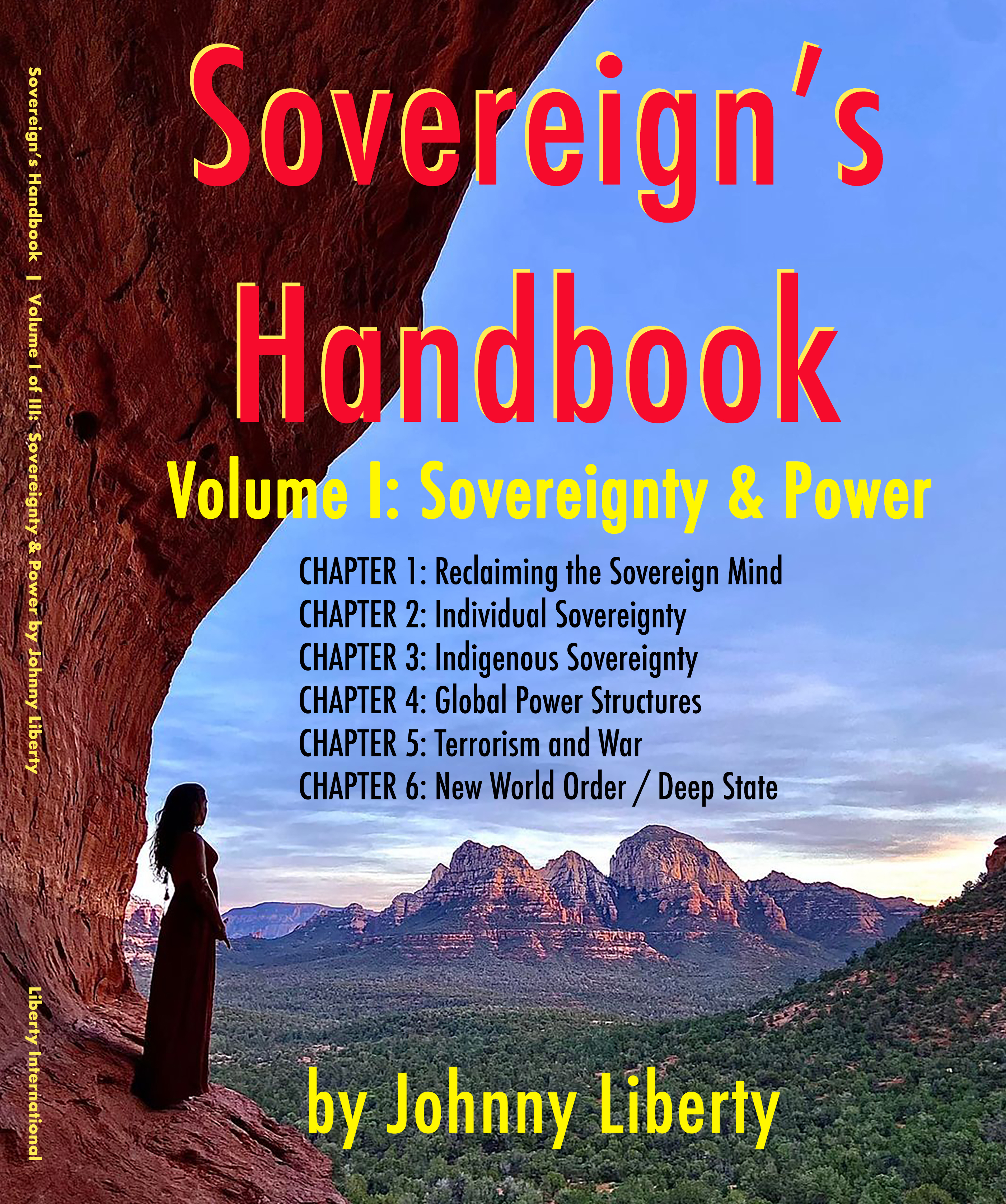
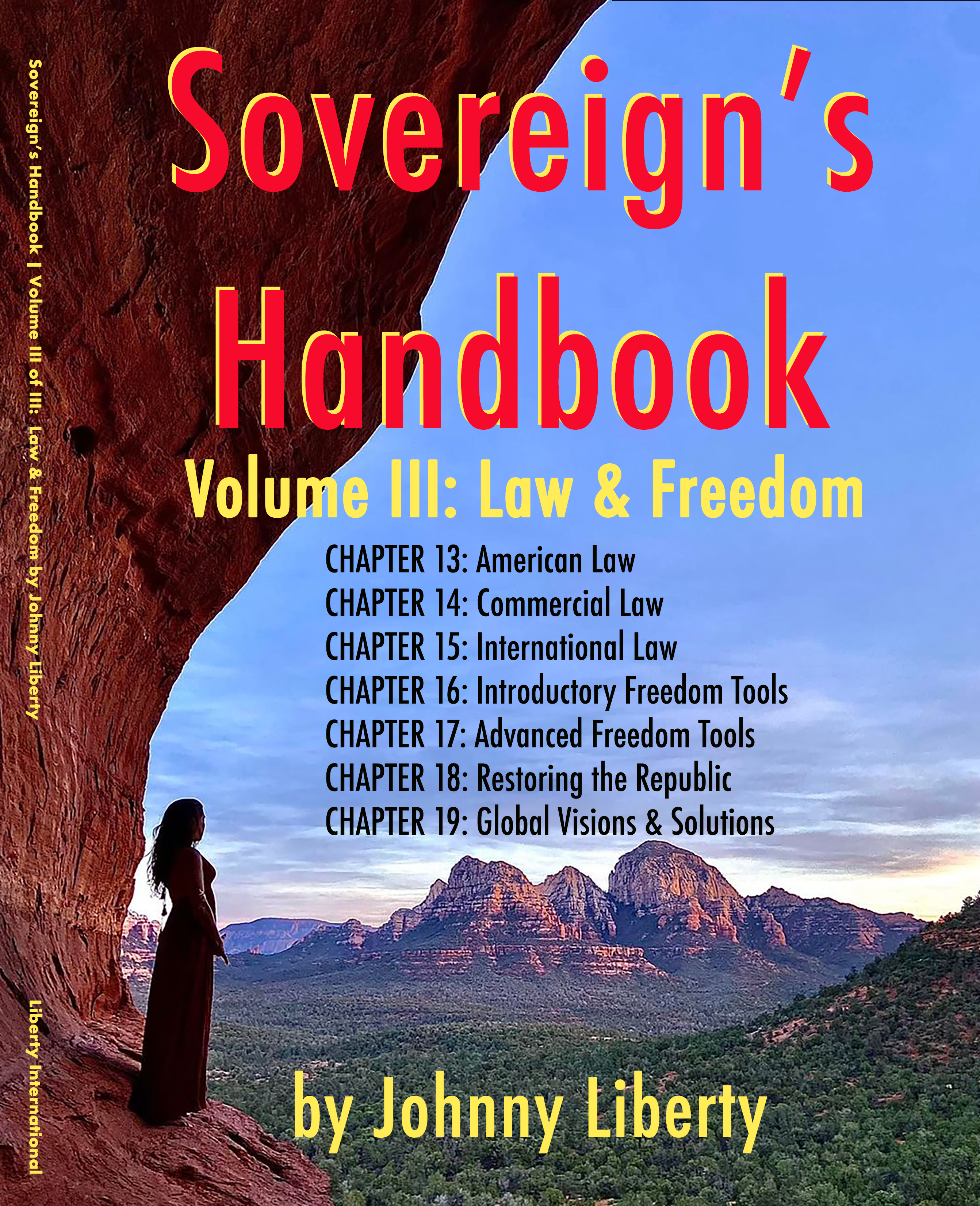
This 3 Volume series comprises the life’s work of Johnny Liberty filled with comprehensive insights into the last few hundred years of history, law, economics, money, citizenship and governance.
These books show how it is supposed to be done in a constitutional Republic.
How did We the People get to where we are today?
What can we do to reclaim our inherent sovereignty and natural rights?
Many of the answers may be found within these revolutionary pages. Available as a paperback, E-Book (PDF) or an Amazon Kindle format. Thank you for supporting the author.
Sincerely,
With Freedom For All, ~ Johnny Liberty
Sovereign’s Handbook by Johnny Liberty (30th Anniversary Edition)
A three-volume, 750 page tome with an extensive update of the renowned underground classic ~ the Global Sovereign’s Handbook.
Still after all these years, it is the most comprehensive book on sovereignty, economics, law, power structures and history ever written.
Served as the primary research behind the best-selling Global One Audio Course.
The 3 Volume Sovereign’s Handbook by Johnny Liberty is textbook material for everyone including educators/teachers, homeschoolers, historians, activists, leaders/politicians, attorneys/judges/law schools, police officers, and state Citizens/Nationals.
Sovereign’s Handbook by Johnny Liberty (30th Anniversary Edition) (3-Volume Printed, Bound Book or PDF)
A three-volume, 750+ page tome with an extensive update of the renowned underground classic ~ the Global Sovereign’s Handbook. Still after all these years, this is the most comprehensive book on sovereignty, economics, law, power structures and history ever written. Served as the primary research behind the best-selling Global One Audio Course. Available Now!
Dawning of the Corona Age: Navigating the Pandemic by Johnny Freedom (3rd Edition) (Printed, Bound Book or PDF)
This comprehensive book, goes far beyond the immediate impact of the “pandemic”, but, along with the reader, imagines how our human world may be altered, both positively and negatively, long into an uncertain future. Available Now!
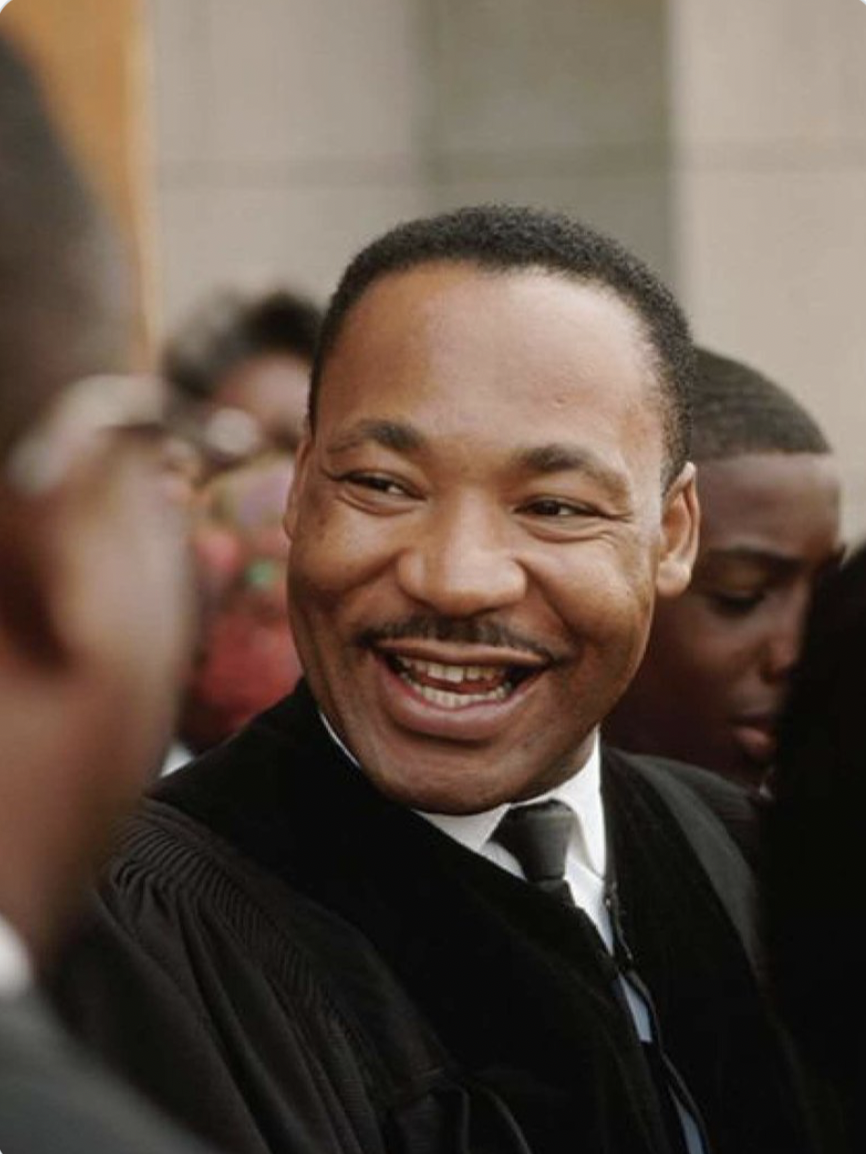
As Americans celebrate Martin Luther King Day on Monday, across America, many tribal, federal, state and local governments will be closed to honor the legacy of the Reverend Dr. Martin Luther King, Jr.
Monday should be more than a day off work or school. It should be a day of reflection.
It should be a day to reflect on justice and equality in the United States. Working for justice and equality for all Americans helped define Dr. King’s pilgrimage during America’s Civil Rights Movement. Even though he was faced with a constant barrage of death threats, harassment by the FBI and numerous arrests, Dr. King still worked hard to bring justice and equality for all Americans.
While Dr. King happened to be an African American, his leadership and dream transcended racial boundaries. Martin Luther King, Jr. was an American leader.
The effects of his great work impacted the lives of all Americans.
For instance, the passage of the momentous Civil Rights Act of 1964 benefited American Indians and Latinos, as well as African Americans. We can now go places we could not go prior to 1964. We can now stay in hotels we could not stay in prior to 1964.
Prior to the passage of the Civil Rights Act of 1964, American Indians were not allowed in many establishments simply because we were Indians. Many establishments prominently displayed signs that read:
“No Indians or Dogs Allowed”
in various parts of this country. There is a major difference between an Indian and a dog, I may add.
One Ottawa elder recalls, when the Civil Rights Act of 1964 became a federal law, business proprietors, who owned restaurants, hotels and shops, in the upper portion of Michigan’s Lower Peninsula held a meeting to discuss “what they were going to do now that they had to serve Indians.”
In his effort to bring justice and equality for all Americans, Dr. King noted the gross mistreatment of American Indians in the United States, as he reflected on the origins of racism in America in his 1963 book, “Why We Can’t Wait:”
“Our nation was born in genocide when it embraced the doctrine that the original American, the Indian, was an inferior race. Even before there were large numbers of Negroes on our shores, the scar of racial hatred had already disfigured colonial society. From the sixteenth century forward, blood flowed in battles of racial supremacy. We are perhaps the only nation which tried as a matter of national policy to wipe its indigenous population. Moreover, we elevated that tragic experience into a noble crusade. Indeed, even today we have not permitted ourselves to reject or to feel remorse for this shameful episode. Our literature, our films, our drama, our folklore all exalt it.”
Personally, I am glad Americans celebrate Martin Luther King Day. It makes me reflect on what was and what still needs to be done as we work towards justice and equality in America. We know there is still much work to be done.
Native-American nation’s land was turned into a nuclear test site. Now, they suffer from illnesses.
‘The most nuclear bombed nation on the planet’ is the unwanted accolade claimed by the Shoshone Native American tribe. This has had devastating effects for the community, and RT spoke with one campaigner fighting for justice.
“They are occupying our country, they are stealing our opportunities and we are expected to die because of that. We are still trying to grapple with and understand what happened to us, and find ways to stop it, correct it and prevent it happening in the future.”
Ian Zabarte’s voice is angry but does not falter as he describes the stark fate of his people, Native Americans who for decades have been – by any measure – subjected to the most unimaginable horrors, all perpetrated by their government in Washington.
Zabarte, 57, is the Principal Man of the Western Bands of the Shoshone Nation and he is spearheading a campaign to expose what he describes as the “ethnic cleansing” of his tribe.
Shoshone land stretches from Death Valley in the Mojave Desert in eastern California to Yellowstone Park in Wyoming. But in 1951 the US started nuclear weapons testing on Western Shoshone territory, at the Nevada Proving Grounds (now known as the Nevada National Security Site). The Shoshone can now lay claim to be the most nuclear-bombed nation on the planet.
Over a period of just over 40 years, there were 928 tests conducted there – around 100 in the atmosphere and more than 800 underground – resulting in nuclear fallout of around 620 kilotons, according to a 2009 study. In comparison, there were 13 kilotons of fallout when Hiroshima was bombed in 1945.
This is obviously a massive health risk and Zabarte, who lives in Las Vegas but runs a healing center at Death Valley, is understandably angry. Although he’s engaging and friendly, a sense of rage regularly creeps into his voice as he becomes more animated about the injustices his people have endured. But he never lapses into self-pity; there’s always a steely aura of defiance.
The Shoshone signed the Treaty of Ruby Valley in 1863, which handed certain rights to the United States. But they did not give up their land. “We wouldn’t have signed a treaty that would end in our ultimate destruction,” Zabarte told RT.
According to the tribe, Washington’s testing programme has killed thousands of people, with many since developing a range of cancers and illnesses.
Zabarte’s grandfather’s skin fell off due to an autoimmune deficiency, and he died soon after from a heart attack. Other family members have had pacemakers fitted at very young ages, while his cousin’s twins died aged 11.
“My family have a high incidence of thyroid cancer, but we’re not following those individuals – we don’t have the capacity,” he explained.
“The United States doesn’t want to study our own adverse health consequences. [It] would be no different to Nazi Germany studying the health consequences of their testing on Jewish people. That is so far from right. We have to do it ourselves and we need help.”
The Shoshone have no medical equipment or computer databases to track their people. So deaths from suspicious conditions are generally not recorded. In addition, the Shoshone are, by tradition, proud people, so not all of them speak out about their health issues.
As Zabarte explained, “Even though it went underground, venting took place and we don’t know where that fallout went.”
That’s borne out by the Mighty Oak incident, a botched test that destroyed $32-million-worth of equipment in April 1986. It was weeks before Chernobyl and experts claim the US government vented the radiation under the cover that everyone would assume it was from the Soviet catastrophe.
“The Department of Energy doesn’t consider that an accident because they manually released the gas inside the underground chamber where the weapon detonated. It went around the world and beat the Chernobyl radiation back to the United States,” Zabarte claimed.
Of course, the US is not the only country to have conducted nuclear testing. The United Kingdom also used Western Shoshone land, in 24 tests that were joint operations with the US.France completed 210 nuclear tests in Algeria and the South Pacific from 1960 to 1996. And the Soviet Union used the Semipalatinsk site in Kazakhstan until 1989 to perform its testing.
But, even to this day, lots of secret activities continue on Shoshone land, as proven by JANET flights regularly flying from Las Vegas to the classified Area 51. (The call sign stands for Just Another Non-Existent Terminal).
There’s also the contentious issue of the Yucca Mountain Nuclear Waste Repository, first planned in 1987 and later approved by the Obama administration, which the Shoshone have stalled. It’s intended to store high-level radioactive waste.
Zabarte has a US Department of Energy study for the project which he says refers to “cultural triage”defined as “a forced choice situation in which an ethnic group is faced with the decision to rank in importance equally valued cultural resources that could be affected by a proposed development project.”
It goes on to state that this triage could be “emotionally taxing for the Indian person.” The United Nationsbacked these claims in a 2006 report, and Zabarte believes they perfectly encapsulate the problems faced by his people.
“We have a deliberate act by the United States government to dismantle the living life ways of my people, my family, in relation to our property, our sacred land.
“The United States has developed a systematic process to ethnically cleanse us from that land, so that they take all the profits and give them to other Americans,” he said. “In order to prove genocide we need to consider, what is the intent? It is the culture of secrecy, that is the intent.”
A prime example of how the Shoshone’s life has been eradicated came in 1971 with the Wild Free-Roaming Horses Act. As Zabarte explained: “Politicians in Washington DC defined our Indian horses as wild and started coming after our ranchers, who have a guaranteed right as hunters or herdsmen under the treaty to have livestock.
There is no economy or sustainable lifestyle, and the nearest town is 80 miles away. “I have nothing on my reservation to go back to,” said Zabarte, who can trace his direct descendants to the Kawich region, which houses Area 51. “They stole my horses, they stole my livelihood. There are no jobs, there are no opportunities; the United States has stolen our economy, our hunting, our fishing… and made us trespassers in our own country.”
But the reservation only makes up a tiny part of the entire Shoshone land. The rest is used by the American government and population, sometimes unwittingly. People are buying houses and living on land that the Shoshone feel they should control – but all tax from economic activity goes to the US. The Shoshone have no claim over it.
“The United States cannot prove ownership to it but they come into our country and they provide tax money to the state of Nevada, and the state of Nevada takes that money and provides it to every other non-Shoshone unit of local government, and we get nothing. That is taxation without representation,”Zabarte said.
Despite the obvious sense of injustice, he feels an obligation to warn Americans who live in or go through the Shoshone nation of the danger it presents.
“My grandfather always said, ‘don’t kick up dust’ because of the radioactive fallout. I care for these people because of that treaty of peace and friendship, and have an obligation to provide aid and comfort to other Americans passing through. But I watch them kick up dust in their off-road vehicles and they are quite likely exposing themselves. There is plutonium in a lot of the roofs of their houses, too.”
The key for Zabarte is awareness. The more people know the history of the land and understand the issue, there greater the chance of meaningful action. That could involve providing medical surveillance and advising the next generation how to protect themselves.
Zabarte is also keen to build momentum so the Shoshone, including his own son, can have access to all of their land and create a functioning economy that fits with their traditions.
“We need to continue to make our people aware the next generation don’t have a safe place to live; we have these tiny reservations and they are colonies created by the United States. They exist only to the extent that the United States provides the funding. We don’t have ways to survive on our own land.”
He is a man on a mission and has sacrificed his life to shoulder this burden. “I have dignity and my family has dignity and that’s what I’m fighting for. These a**holes aren’t going to get away with it.”
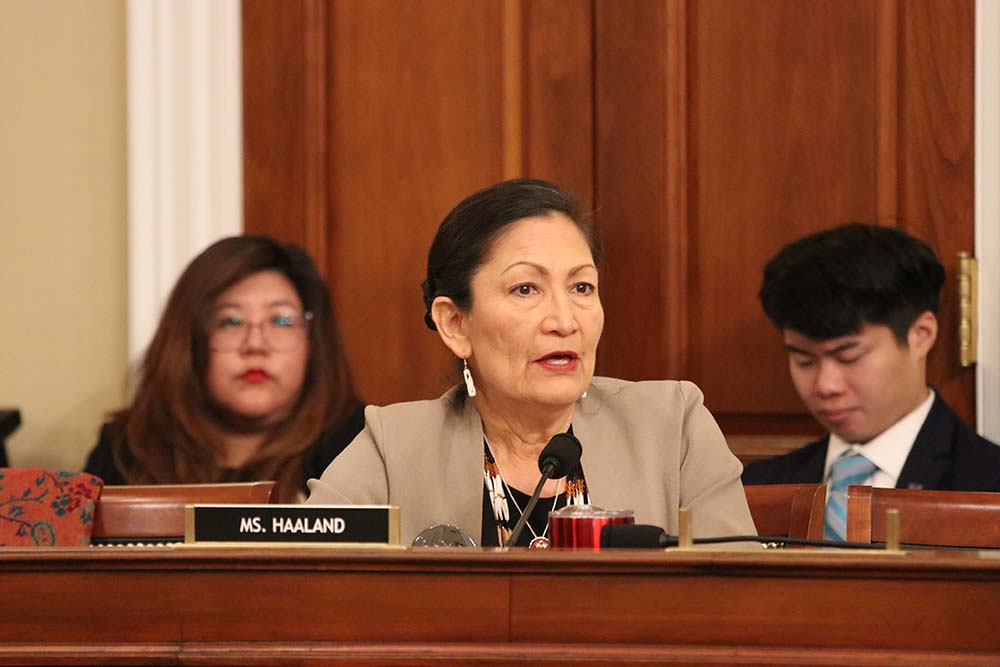
Interior Secretary Deb Haaland (Laguna Pueblo) will outline the Interior Department’s next steps to “begin to reconcile the troubled legacy of federal boarding school policies” on June 22 during the National Congress of American Indians (NCAI) 2021 Mid Year Conference, the department announced Monday.
The announcement follows the recent discovery of a mass unmarked grave of 215 Indigenous children on the grounds of the former Kamloops Indian Residential School in British Columbia, Canada. The finding was met by widespread media coverage, reopening the conversation around the harm and trauma wrought by the federal boarding school systems for Indigenous peoples in the U.S. and Canada.
On June 11, Haaland called for acknowledgement of the past and present impacts of the boarding school system in an op-ed published in The Washington Post.
“Though it is uncomfortable to learn that the country you love is capable of committing such acts, the first step to justice is acknowledging these painful truths and gaining a full understanding of their impacts so that we can unravel the threads of trauma and injustice that linger,” Haaland wrote.
There were 357 Indian boarding schools operating throughout the U.S. from 1819 to the 1960s. In 1925, more than 60,000 children attended the schools. The federal government and church organizations were responsible for managing the schools, where students were forbidden from practicing their culture or speaking their native language, and many endured physical, sexual, emotional, and psychological abuse.
The Canadian residential school system operated from the 1880s to the late 1990s for the same purpose: taking Indigenous children from their families and stripping them of their culture. There, Indigenous children experienced similar horrors of physical and sexual abuse, as well as high mortality rates in the schools.
Poor, overcrowded conditions and disease led to thousands of student deaths in the boarding school systems, and many students’ remains were not returned to their families. The harmful intergenerational effects of the schools lives on in many Indigenous communities in the U.S. and Canada.
Along with Principal Deputy Assistant Secretary for Indian Affairs Bryan Newland, Haaland will announce the next steps in addressing the legacy of the U.S. federal boarding school system during the NCAI’s “Department of the Interior Update” at 2:50 p.m. EDT.
The conference’s full agenda, which runs from June 20-24, is accessible here.
Editor’s Note: Indigenous nations are still seeking respect for the sovereignty of their lands stolen by military occupation and Treaties the United States did not honor. Here’s another action re: DAPL pipeline.
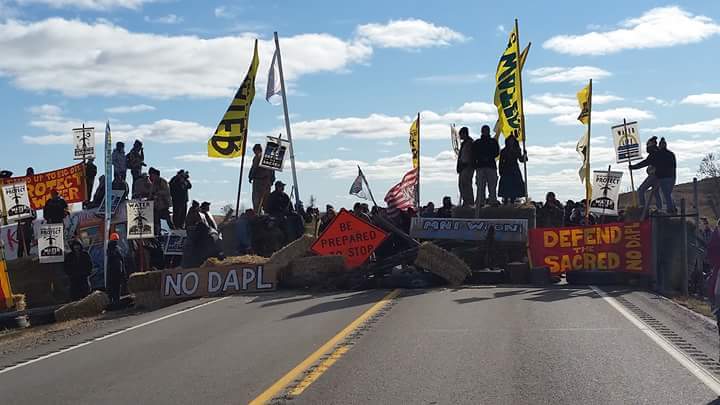
Cannon Ball, ND – This morning, at approximately 8am central, water protectors took back unceded territory affirmed in the 1851 Treaty of Ft. Laramie as sovereign land under the control of the Oceti Sakowin, erecting a frontline camp of several structures and tipis on Dakota Access property, just east of ND state highway 1806. This new established camp is 2.5 miles north of the Cannon Ball River, directly on the proposed path of the Dakota Access Pipeline (DAPL). This site is directly across the road from where DAPL security dogs attacked water protectors on September 3rd.
To ensure the protection of this new camp from overtly militarized law enforcement, water protectors have established three road blockades:
North of the Frontline Camp, on Highway 1806
South of the Cannon Ball River, on Highway 1806
And Immediately west of Highway 1806, on county road 134
Police have discharged weapons, using rubber bullets to shoot down drones being used to document the police activity and actions.
This frontline camp is located on the final three 3 miles of the proposed pipeline route, before it connects with the drill pad that will take the pipeline beneath the Missouri River. Active construction of the Dakota Access pipeline is 2 miles west of this frontline camp. Oceti Sakowin water protectors continue an on-going pledge to halt active construction as frequently as possible.
Mekasi Camp-Horinek, an Oceti Sakowin camp coordinator states, “Today, the Oceti Sakowin has enacted eminent domain on DAPL lands, claiming 1851 treaty rights. This is unceded land. Highway 1806 as of this point is blockaded. We will be occupying this land and staying here until this pipeline is permanently stopped. We need bodies and we need people who are trained in non-violent direct action. We are still staying non-violent and we are still staying peaceful.”
Joye Braun, Indigenous Environmental Network organizer states, “We have never ceded this land. If DAPL can go through and claim eminent domain on landowners and Native peoples on their own land, then we as sovereign nations can then declare eminent domain on our own aboriginal homeland. We are here to protect the burial sites here. Highway 1806 has become the no surrender line.”
Ladonna Bravebull Allard, Sacred Stone Camp, “We stand for the water, we stand on our treaties, we stand for unci maka- we stand and face the storm.”
The Goldwater Institute will launch a new project to reform the Indian Child Welfare Act and similar state laws that give abused and neglected Native American children fewer rights and protections than other American children. A major part of the project will be a federal class action lawsuit.
“When an abused child is removed from his or her home and placed in foster care or made available for adoption, judges are required to make a decision about where the child will live based on the child’s best interest. Except for Native American children. Courts are bound by federal law to disregard a Native American child’s best interest and place the child in a home with other Native Americans, even if it is not in his or her best interest,” said Darcy Olsen, president of the Goldwater Institute. “We want federal and state laws to be changed to give abused and neglected Native American children the same protections that are given to all other American children: the right to be placed in a safe home based on their best interests, not based on their race.”
On July 7, the Goldwater Institute will file a federal class action lawsuit to challenge the constitutionality of core provisions of the federal Indian Child Welfare Act. The same day, the Institute will release an investigative report that documents how federal law leaves Native American children with fewer protections under the law than all other American children, and the serious consequences that have resulted from this unequal treatment. Recommendations for changes to state and federal law will also be announced.
Media is invited to a press briefing that will formally announce the details of the lawsuit, release the investigation, and policy recommendations, and screen an 8-minute original documentary film. The briefing will featureDr. William B. Allen, the former chairman of the U.S. Commission on Civil Rights.
What: Press conference announcing the Equal Protection for Indian Children Project and federal class action lawsuit
When: Tuesday, July 7, 2015, 9:00 a.m. Pacific time
Where: Goldwater Institute, 500 East Coronado Road, Phoenix
Who: Press event will feature Darcy Olsen, president of the Goldwater Institute, Clint Bolick, the Institute’s vice president of litigation, Mark Flatten, the author of the Institute’s investigative report to be released, Dr. William Allen
The circumstances by which Hawaii was annexed by the U.S. are so sketchy that Congress felt obliged to issue an apology in 1993.
It all started 100 years earlier when a group of mostly American businessmen led a paramilitary coup to overthrow Queen Liliʻuokalani. They were passively supported by U.S. Marines who were deployed “to protect American lives and property.”
The coup resulted in a new Hawaiian government under the presidency of Sanford Dole, whose cousin would soon start the Hawaiian Pineapple Company, which became Dole Foods.
Although then-U.S. president Grover Cleveland criticized the events in Hawaii, which he had not authorized, his successor, William McKinley, had no problem annexing Hawaii in 1898.
With a history like this, it is not surprising that a Hawaiian sovereignty movement remains committed to reclaiming rights and land for native Hawaiians. While several contenders claim rights to the crown, Dayne Aipoalani of The Polynesian Kingdom of Atooi has taken the movement to regain his peoples’ rights and land in Hawaii to a whole new level.
Business Insider spent more than a week in Hawaii with Aipoalani , also known as Ali`i Nui Aleka Aipoalani. He guided us through his kingdom on two islands, explained what his plans were, and how he plans to fight Washington.
King Kamehameha III divided Hawaii among the monarchy’s lesser kings, chiefs, and commoners in the mid-19th century to make sure his people would always have a home in case of invasion.
King Kamehameha’s worst fears were confirmed decades later when a coup led by foreign businessmen and supported by the U.S. overthrew his descendant, Queen Liliuokalani, in January 1893.
Sanford Dole, who’d pushed for the overthrow, was put in charge of a provisional government, and Liliuokalani was imprisoned. In 1898, Hawaii was annexed by the U.S.
Like most Hawaiians, Dayne Gonsalves believes his homelands were taken illegally. He wants to restore Crown Lands to the monarchy under one king: himself.
Dayne says he is the great-great-great-grandson of King Kamehameha I and as the new Ali’i Nui, or King, of The Polynesian Kingdom of Atooi, he’s devoting his life to reclaiming the land and resources of his people.
To fund travel and diplomacy among islands throughout the South Pacific, Dayne relies on donations from supporters including more than 40,000 Atooi Kingdom citizens worldwide.
That money also helps buy U.N.-recognized drivers license and, soon, passport software and supplies. Atooi Federal Marshal Samson Kama says: “Local law enforcement is targeting us with traffic stops and arrests for false credentials. This goes against the U.N. mandate that allows us Native Rights through international law.”
The Atooi Kingdom also unveiled its new currency at the U.N. in May.
In addition, Atooi has law enforcement badges.
More than 100 Federal Marshals.
Official license plates.
A radio station to broadcast its message.
A former U.S. Navy pilot who serves as foreign ambassador.
And its own royal flag, which is prevalent throughout the Islands.
The Kingdom encompasses an array of Pacific islands, but its capital might be considered Kauai. This is where Dayne grew up and is raising his family in the largely native community of Waimea.
Waimea is “Ground Zero” in the fight against the largest agribusinesses in the world, which test and develop herbicides and pesticides in the area.
More than anything, The Atooi Kingdom wants indigenous and sustainable farms for its people.
Along with producing its own food, Dayne wants to clean up damage already done to the environment.
And provide a traditional healing clinic to all islanders, including the hundreds of homeless who live here in Oahu’s massive homeless camp.
The King would also place buffer zones around native schools (like this one) within 500 feet of experimental pesticide fields and genetically modified crops, where undisclosed chemicals are sprayed.
Waimea schools have twice been evacuated following pesticide applications at adjoining fields. Many believe the sickness among staff and students during these times are from the chemicals, though follow-up studies point a finger at the local stinkweed plant.
Many of the world’s largest agricultural giants moved to Kauai in the 1990s. Since then, locals have been demanding to know what chemicals are sprayed on their land, but they are still fighting through the courts for answers.
It’s a constant battle and it doesn’t stop there. When Business Insider was in Kauai, Dayne brought us to a sacred spot that had been bulldozed by local transportation crews.
Plowing under sacred sites is just one instance of ongoing land conflicts here on Hawaii between natives and local government.
Even at Iolani Palace, the last family home of the Hawaiian Royal Family, Dayne’s mission isn’t received with much warmth.
The native guide took issue with the Kingdom’s new currency. Since there are many Hawaiian Sovereignty groups claiming rights to the throne, conflict among native Hawaiians is common.
Even here, where the Queen was placed under house arrest, Dayne is told he can’t be video interviewed. He shows the guard his badge.
But the palace employee remained unimpressed.
It’s an ongoing and emotional struggle.
Dayne knows he has a long fight ahead of him. Native Hawaiians have the third-highest cancer rate in the country, extremely high rates of diabetes and incidents of infectious diseases — but there is hope.
Though the Atooi Nation is a recognized sovereign nation at the U.N., it is not listed as a Non-Self-Governing Territory, which is the U.N. category for countries that should be decolonized. That list includes, among others, American Samoa, Guam, and the U.S. Virgin Islands.
After a 30-year fight, French Polynesia recently made the U.N.’s Non-Self-Governing Territory list. Atooi wants to obtain the same status.
In the meantime native Hawaiians will carve out an existence wherever they can.
As bad as it is for most islanders, it’s even worse for some.
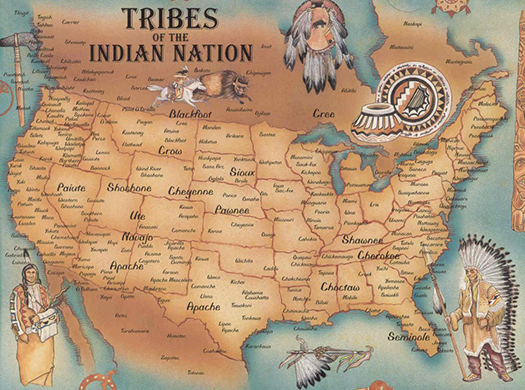
Did you know that Indian reservations are independent nations? Indian Nations are allowed, within limits to govern themselves. Many have their own police forces and courts.
Tribal sovereignty in the United States refers to the inherent authority of indigenous tribes to govern themselves within the borders of the United States of America. The federal government recognizes tribal nations as “domestic dependent nations” and has established a number of laws attempting to clarify the relationship between the federal, state, and tribal governments. The Constitution and later federal laws grant local sovereignty to tribal nations, yet do not grant full sovereignty equivalent to foreign nations, hence the term “domestic dependent nations”.
However, in times of war, all men, including Indians have to register. In WWI, this caused some consternation. Each registrar had to record the county name in which the registrant registered. If they registered on an Indian Reservation, even if the reservation was located within a county, the reservation itself was not part of the county, as it is considered a separate Nation.
This bureaucratic anomaly became apparent in New York in states East of the Mississippi. In New York, Indians who registered on the reservation are listed in our old friend, Miscellaneous County. In other places, Miscellaneous is a sign that someone is either hospitalized, institutionalized or returned a late registration after the county office had closed. In this case, it’s not necessarily a sign of any of those things, but each return has to be looked at individually to determine the individual circumstance. Just as I was about to decide that all New York entrants in Miscellaneous County were Reservation Indians, I found one who lived on a reservation, followed by someone of the same name, also an Indian, in prison. No assumptions allowed.
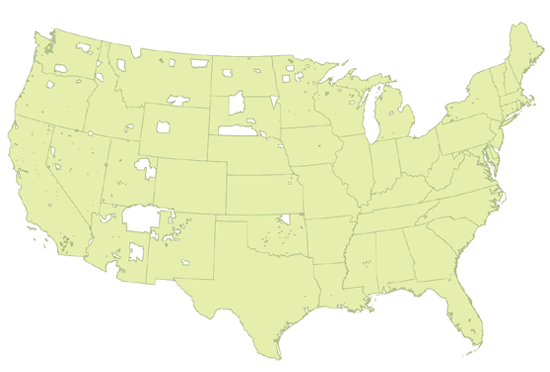
This map is a very different map of the US. It’s a map of the US minus the sovereign Indian nations within the continental US. Sort of looks like Swiss Cheese doesn’t it. Some of these areas are much larger than one might expect.

 Liberty International News