Assange psychologically tortured to ‘breaking point’ by ‘democratic states,’ UN rapporteur tells RT | RT.com

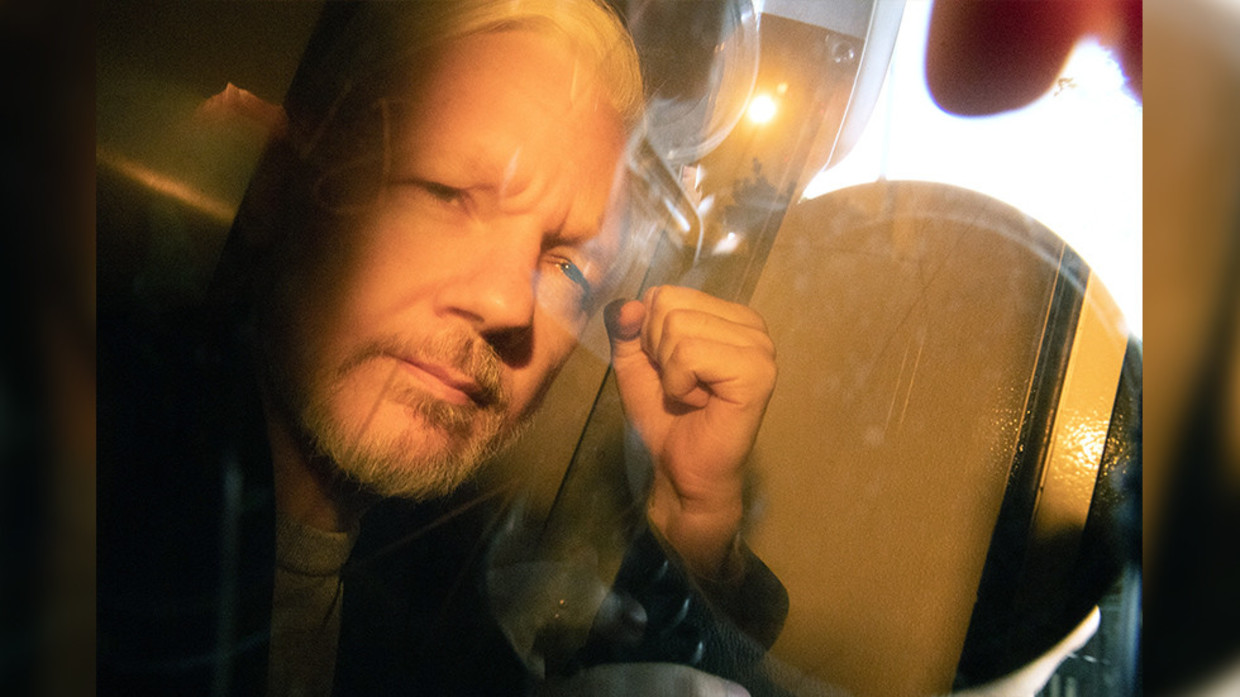
Jailed WikiLeaks co-founder Julian Assange shows clear signs of degrading and inhumane treatment which only adds to his deteriorating health, UN Special Rapporteur on Torture Nils Melzer told RT.

Assange has “all the symptoms typical for a person who has been exposed to prolonged psychological torture,” Melzer told RT’s Afshin Rattansi. This adds to the toll of his deteriorating physical state caused by a lack of adequate medical care for several years, he said.

Melzer said he was judging from two decades of experience in working with POWs and political prisoners, and only after applying “scientific” UN methods to assess Assange’s condition. But the journalist’s case still “shocked” him.

An individual has been isolated and singled out by several democratic states, and persecuted systematically… to the point of breaking him.

Earlier this month, a UK court sentenced the WikiLeaks co-founder to nearly a year in jail for skipping bail in 2012. The courts are now deciding whether to extradite Assange to the US where he is wanted for 17 charges under the Espionage Act. He can end up serving up to 175 years in prison if proven guilty.

Also in May, Sweden reopened an investigation into the allegations of rape by Assange, which he denies. The probe was originally dropped in 2017.

WikiLeaks warned that the journalist’s health had “significantly deteriorated” during the seven years he spent living in the Ecuadorian Embassy in London, and continued to worsen after he was evicted in April and placed in a British prison. According to WikiLeaks, he was recently moved to the prison’s “hospital wing.”


How 5G will change (destroy) the world | World Economic Forum

large_m297nKs9NwkwFNcZIsHG-pB8DPtURngI4QodH4rR8Rc

Editor’s Note: The unforeseen consequences of unleashing an electronic network worldwide with nowhere to hide, with a bombardment of such powerful frequencies as to disrupt every living system with proven oxygen shattering and immune suppressing technology is beginning to unfold. This article is an industry puff piece for the global leaders of industry promoting 5G as the next panacea for all our problems. My friends, this is a crisis of consciousness and will forever map the trajectory of human evolution. Only robots will survive this 5G rollout. Read it and weep!

By Don Rosenberg

It is not an easy time to be an internationalist, to seek global solutions to global problems amid what feels like one of history’s periodic inclinations toward divisiveness.

Yet, ironically, we’re on the verge of a new age of interconnectedness, when the daily lives of people across the planet will be more closely intertwined than ever. Advances in technology will usher in the age of fifth generation, or 5G, telecommunications. And, if past is prologue, this technological evolution will lead to dramatic societal changes.

The first generation of mobile communications, with brick-sized phones, brought just a handful of users expensive and often unreliable analogue voice calling. The second generation introduced digital voice service that was less likely to be dropped, available to many more people and ultimately cheaper to use. 3G ushered in the mobile internet, mobile computing, and the proliferation of apps. 4G (often called LTE) made possible all we have come to expect of mobile broadband: streaming video and audio; instantaneous ride hailing; the explosion of social media.

We take all this connectivity for granted, but the engineering inside the device in your bag or pocket today would have seemed impossible less than 20 years ago.

So, where will 5G take us?

Think about a world in which not just people but all things are connected: cars to the roads they are on; doctors to the personal medical devices of their patients; augmented reality available to help people shop and learn and explore wherever they are. This requires a massive increase in the level of connectivity.

5G is the technological answer, making possible billions of new connections, and making those connections secure and instantaneous. 5G will impact every industry – autos, healthcare, manufacturing and distribution, emergency services, just to name a few. And 5G is purposely designed so that these industries can take advantage of cellular connectivity in ways that wouldn’t have been possible before, and to scale upwards as use of 5G expands.

But generational change in mobile communications doesn’t just appear overnight. It requires significant effort in research and development and the resources necessary to support that effort. Work on 4G took nearly a decade and the challenges were not easy. Consider one of tens of thousands of problems that needed to be solved as described by an engineer at Qualcomm, where much of this technology was invented:

“When the signal leaves the base station, it can undergo a loss of up to 130 decibels before it reaches your mobile phone. To put that loss into perspective, if you consider the transmitted signal power to be roughly the size of the Earth, then the received signal power would be equivalent to the size of a tiny bacteria.”

That is a tremendous loss of power, and it requires some pretty impressive engineering to compensate for the effect of the loss on the words, pictures, and other data we send and receive across the airwaves in a transparent, seamless and instantaneous way.

But we weren’t alone. The international engineering co-operation that goes into development of a telecom standard illustrates how much can be achieved when disparate national, commercial and scientific parties work together for the common good.

Like 3G and 4G, 5G is the responsibility of the standards-setting organisation 3GPP, where the handful of companies that invent technologies come together with many, many more companies who will develop products that implement those technologies.

Think about this process for a moment: engineers from rival inventing companies, rival product makers, rival wireless network operators, all from different countries and continents, discussing, testing, striving to perfect tens of thousands of different technical solutions that ultimately make up a standard like 5G.

They judge each technical solution using a merit-based, consensus-building approach. This process has been at the foundation of a technological revolution that spawned myriad new industries, millions of new jobs and well over a $1 trillion in economic growth.

It’s the fusion of commercial self-interest with the recognition that some problems are best solved by working together. And it’s not a bad model of human behaviour if we are to meet the World Economic Forum’s goal this year to address the problems of “a fractured world”.

The benefits and advantages of 5G technology are expected to be available sometime in 2019. We believe 5G will change the world even more profoundly than 3G and 4G; that it will be as revolutionary as electricity or the automobile, benefitting entire economies and entire societies.

Developing nations have rivalled or surpassed their industrialised counterparts in benefiting from the deployment of mobile technology, and there’s every reason to think 5G will have an even bigger levelling effect than its predecessors.

Economists estimate the global economic impact of 5G in new goods and services will reach $12 trillion by 2035 as 5G moves mobile technology from connecting people to people and information, towards connecting people to everything.


Many of the benefits probably aren’t yet apparent to us. Wireless network operators initially resisted proposals to give their customers mobile access to the internet, questioning why they would want it. At the dawn of 4G’s adoption no one could have predicted the new business models that grew on the back of mobile broadband, like Uber, Spotify and Facebook.

Now, according to the European Patent Office, the number of patent applications related to “smart connected objects” has surged 54% over the last three years, suggesting new, related and as-yet unknown inventions will arrive even before 5G becomes available.

This is news that should encourage us amid glum commentaries on the state of the world. There is promise yet in what we’re capable of achieving.

Source: World Economic Forum

With the latest WikiLeaks revelations about the CIA – is privacy really dead? | The Guardian

ComeyBy Olivia Solon

Comey, has said that Americans should not have expectations of “absolute privacy”.

“There is no such thing as absolute privacy in America: there is no place outside of judicial reach,” Comey said at a Boston College conference on cybersecurity. The remark came as he was discussing the rise of encryption since Edward Snowden’s 2013 revelations of the NSA’s mass surveillance tools, used on citizens around the world.

Both the Snowden revelations and the CIA leak highlight the variety of creative techniques intelligence agencies can use to spy on individuals, at a time when many of us are voluntarily giving up our personal data to private companies and installing so-called “smart” devices with microphones (smart TVs, Amazon Echo) in our homes.

So, where does this leave us? Is privacy really dead, as Silicon Valley luminaries such as Mark Zuckerberg have previously declared?

Not according to the Electronic Frontier Foundation’s executive director, Cindy Cohn.

“The freedom to have a private conversation – free from the worry that a hostile government, a rogue government agent or a competitor or a criminal are listening – is central to a free society,” she said.

While not as strict as privacy laws in Europe, the fourth amendment to the US constitution does guarantee the right to be free from unreasonable searches and seizures.

That doesn’t mean citizens have “absolute privacy”.

“I don’t think there’s been absolute privacy in the history of mankind,” said Albert Gidari, director of privacy at the Stanford Center for Internet and Society. “You walk out in public and it’s no longer private. You shout from one window to another and someone will hear you in conversation.”

“At the same time things are more intrusive, persistent, searchable, they never die. So our conception of what is or isn’t risk from a privacy perspective does change and evolve over time.”

The law hasn’t kept pace with digital technologies. For example, there is a legal theory called the “third-party doctrine” that holds that people who give up their information to third parties like banks, phone companies, social networks and ISPs have “no reasonable expectation of privacy”. This has allowed the US government to obtain information without legal warrants.

Unlike the NSA techniques revealed by Snowden, the CIA appears to favour a more targeted approach: less dragnet, more spearfishing.

The WikiLeaks files show that the CIA has assembled a formidable arsenal of cyberweapons designed to target individuals’ devices such as mobile phones, laptops and TVs by targeting the operating systems such as Android, iOS and Windows with malware.

It’s encouraging to note that the government has yet to crack the encryption of secure messaging apps such as WhatsApp, Signal and Confide. However, it does not need to if it can instal malware on people’s devices that can collect audio and message traffic before encryption is applied.

Gidari isn’t that surprised. “It confirms what everyone saw in last week’s episode of 24. People expect these tools to exist,” he said, adding that people were more surprised that the FBI was initially incapable of breaking into the San Bernardino killer’s iPhone.

“People expect the government to have these magic tools,” he said.

American citizens should not be lulled into a false sense of security that the CIA only targets foreign nationals. The “Vault 7” documents show a broad exchange of tools and information between the CIA, the National Security Agency, and other US federal agencies, as well as intelligence services of close allies Australia, Canada, New Zealand and the United Kingdom.

“We can’t spy on our own citizens but we can spy on anyone else’s,” explained Neil Richards, a law professor from Washington University. “If agencies are friends with each other, they have everybody else do their work for them and they just share the data.”

“Dividing the world into American citizens and non-American citizens is a false dichotomy,” Gidari added. “We don’t have a monopoly on spy tools.”

This leaves us with a terrifying new prospect: government spies essentially deploying viruses and trojans against their own citizens.

The onus is now on the companies that make the devices to plug any holes in their operating systems – something they do regularly through bug bounty programs, where security researchers disclose vulnerabilities in return for rewards.

It’s clear from the CIA files that the US government has flouted this custom in order to stockpile “zero days” – undisclosed exploits – for its own advantage. This is a practice the US government has previously publicly denied.

“If companies aren’t aware that a vulnerability exists they can’t patch it. If it exists it can be exploited by any malicious actor – whether that’s a hacker, foreign state or criminal enterprise,” said Neema Singh Guliani, legislative counsel with the American Civil Liberties Union.

“I have a big problem with the government leaving us vulnerable to the same tools in hand so other nation states and hackers could exploit them,” Gidari said. “That isn’t protecting American citizens.”

Gidari’s view echoes Apple’s stance when the FBI demanded the company build a backdoor to the iPhone so they could access data on the San Bernardino killer’s phone.

“Apple believes deeply that people in the United States and around the world deserve data protection, security and privacy. Sacrificing one for the other only puts people and countries at greater risk,” the company said at the time. The iPhone maker was more muted in its response to the Vault 7 dump, vowing to “rapidly address” any security holes.

“There is nearly universal consensus from technologists that it’s impossible to build weaknesses or access mechanisms into technology that can only be used by the good guys and not the bad,” Cohn said.

This week’s revelations are sure to increase the strain on relations between Silicon Valley and the US government. While some of the older telephony companies such as AT&T and Verizon, which rely heavily on government contracts, have a history of compliance with government requests, tech giants Google, Facebook, Microsoft and Apple have proved to be less compliant.

It’s not possible to meaningfully participate in modern life without relationships with some or all of these technology companies processing our data, Richards added. So it’s important to know where their loyalties lie – to their customers or to government.

Since Snowden’s revelations of mass surveillance, companies such as Apple, Google and Microsoft have been working hard to rebuild trust with consumers through strengthening security, fighting government data requests and releasing transparency reports highlighting when and how many requests are made.

“It’s a very encouraging development if we care about civil liberties and the right to privacy, but at the same time it’s unsatisfying if the discretion of a company is the only real protection for our data,” Richards said.

“We need to build the digital society we want rather than the one handed to us by default,” he added.

This will require a complete overhaul of the laws relating to when the government can collect location and content information, something civil liberty campaigners have been pushing for.

“These decisions need to be made by the public, not by law enforcement or tech executives sitting in private,” Richards said.

Source:  The Guardian

Snowden (Film Review) | The Guardian

Review By Wendy Ide

For a director who customarily tackles subjects with the approach of a gorilla playing American football, Oliver Stone’s take on whistleblower Edward Snowden seems curiously muted. Audiences who are already familiar with Citizenfour, Laura Poitras’s exemplary documentary on the same subject, will be struck by the fact that, in dramatising Snowden’s story, Stone seems to have leached out much of the drama. The aim was clearly to create an All the President’s Men for the age of cyber-surveillance. But somehow the sense of peril is downplayed, diluted by too much inert exposition and pacing that could be tighter.

Playing Edward Snowden, Joseph Gordon-Levitt is one of the film’s main assets. His character’s ferocious intelligence is signposted with cheap details – he is forever fiddling with a Rubik’s cube and has a nerd’s enthusiasm for arcane enciphering equipment. But Snowden’s intellect is most effectively conveyed in Gordon-Levitt’s eyes – watchful, sober and clouded by doubt, they are a window into his impossible ethical quandary.

Melissa Leo is somewhat underused as Poitras. And playing Guardian reporter Glenn Greenwald, Zachary Quinto is tonally jarring. It feels as though Stone realised that some of the scenes were flagging, so got Quinto to shout angrily at random moments, to keep the audience on their toes.

There are some fun elements, many involving Rhys Ifans’s ruthlessly unprincipled CIA trainer Corbin O’Brian (the fact the character shares a surname with the villain of Orwell’s Nineteen Eighty-Four is no accident). I particularly enjoyed a scene in which O’Brian’s massive glowering face is beamed into a conference room to berate Snowden. His carnivorous snarl fills the immense screen; he looks like a malevolent version of the Wizard of Oz. There’s a playful visual flair to this moment that is sadly lacking elsewhere in the film.

Source: The Guardian

State of Surveillance with Edward Snowden | VICE News

When NSA whistleblower Edward Snowden leaked details of massive government surveillance programs in 2013, he ignited a raging debate over digital privacy and security. That debate came to a head this year, when Apple refused an FBI court order to access the iPhone of alleged San Bernardino Terrorist Syed Farook. Meanwhile, journalists and activists are under increasing attack from foreign agents. To find out the government’s real capabilities, and whether any of us can truly protect our sensitive information, VICE founder Shane Smith heads to Moscow to meet the man who started the conversation, Edward Snowden.

Source: VICE News