 By Yoichi Shimatsu
Dana Durnford, a former commercial diver who plies a rubber dinghy along the Canadian Pacific coast to study the effects of Fukushima radiation on marine life, has been arrested for making alleged death threats against a chemistry professor at University of Victoria in British Columbia. Mr. Durnford is facing trial on two counts of harassment related to his comments on video at his webpage, the Nuclear Proctologist. The video clips in question have been removed by YouTube at the request of unnamed complainants.
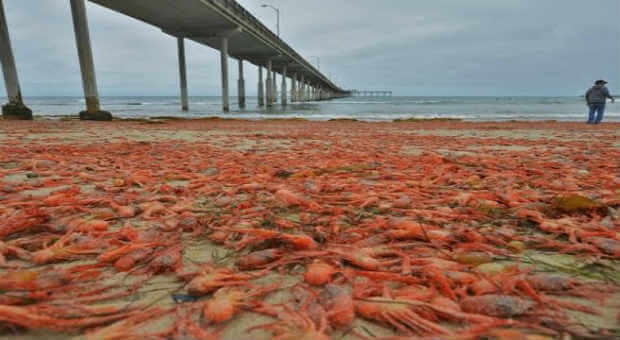
Whatever the substance those controversial statements, Canadians should realize his frustration arises in response to the official campaign of denial of Fukushima’s lethal effects. I have often enjoyed dialogues with Dana on the rense.com radio program on Monday nights, especially stories of his harrowing experiences at sea amid 15-foot swells. After a career of diving for shellfish, he developed a passion for coastal research two years ago after discovering that the once-lush seafloor and tidal pools of British Columbia have been denuded of vegetation and are now devoid of marine-animal life. A burning curiosity prompted him to obtain Geiger counters, a microscope and underwater cameras to search for the root cause of this unprecedented natural catastrophe along North America’s Pacific coast,
Durnford has an encyclopedic recall for identifying marine species that few marine biologists can equal. His estimate, four years after the Fukushima nuclear disaster, is that out of more than 2,000 coastal species only about 200 still survive. The absence of any other plausible cause prompted his conclusion that low-level radiation from Fukushima arriving in immense volumes is responsible for the greatest extermination event in human history. His field research shows that the ongoing ecocide of the Pacific is a man-made catastrophe and not a natural disaster, and the nuclear industry bears the entire culpability. For his tireless campaign of gathering a vast body of smoking-gun evidence, Durnford is being persecuted in a modern-day witch trial by the high priests of the nuclear industry.
Durnford stands accused on trumped-up charges of a “hate crime” against those marine chemists who categorically deny radiation as a potential factor in the oceanic kill-off, a priori, that is even before they start to gather data from the shore. As quoted in the Globe and Mail, Durnford said, “in court I was charged with criminal harassment of nuclear industry PR people, and one of those was from Woods Hole and the other one was from UVic, British Columbia, Canada.”
Correction: Durnford is not aware of the fact, and probably neither are the students at University of Victoria, that one of his accusers, Professor Jay Cullen, served as a postdoctoral researcher at Woods Hole Oceanographic Institution in Massachusetts, which throughout its history has been an “ocean environment” research front funded by the U.S. Navy’s Office of Naval Research.
“Zero risk” from Fukushima
To be fair, as far as possible when presented with transparent scientific fraud, let us now pay attention to the opinions of the main “victim” of this alleged heinous murder plot.
Chemistry professor Jay T. Cullen, with the University of Victoria, British Columbia, gave his account of a “hate crime” and “harassment” from critics of the Fukushima meltdowns to a sympathetic Globe and Mail in its November 11 edition:
Jay Cullen never expected the world of hate he encountered when he began to post scientific information about the impact of the Fukushima accident on the Pacific Ocean. Criticism was anticipated but then he started getting death threats.
“I knew there were lots of individuals who felt strongly about nuclear power. So it wasn’t a surprise that there were those who didn’t accept what the scientific research was showing, but I have to admit the hatred and the threats I received, that was somewhat of a surprise.”
Dr. Cullen started a radionuclide-monitoring program in 2014. The Integrated Fukushima Ocean Radionuclide Monitoring project (or InFORM, as he optimistically called it) worked with a broad network of scientists to gather the latest research and distribute it to the public.
Shortly after he began blogging about the findings, which showed just about zero risk to the environment and to the public in North America, he became the target of a hate campaign.
So there you have it from both sides, the Rashomon effect. Truth is in the eye of the beholder, or is the payoff in a Swiss bank account? Who to believe: Dastardly Dana or the Professor of Culling?
The Wheelchair Murders
When the Durnford case reaches trial, the prosecution must prove that the accused made a threat with murderous intent that could be actualized in a physical assault or with a weapon. The defendant, however, is disabled and requires the assistance of a wheelchair or crutches for mobility. It is highly unlikely that Durnford could mount a successful physical attack against any person capable of running, making the harassment charges simply a bad joke that exposes the folly of this spurious court case.
If anything, the scene of Professors Cullen and Buesseler being chased around the docks by a wheelchair would make a hilarious episode for the Canadian comic-reality show “Just for Gags”.
Apologists for Nuclear Ecocide
Here, I present arguments for Durnford’s defense, much of which cannot be entered into the court record in a national judicial system constrained by a blanket nuclear-security regime and Official Secrets Act that grossly subvert the Rule of Law:
– First, it will be shown that the accusers Cullen and Buesseler have institutional links with the nuclear industry and nuclear weapons, and are therefore implicated in the Fukushima cover-up for their assigned task of countering anti-nuclear critics. Their illicit connections to the military-nuclear complex prompt them to concoct flawed research methodologies that purposely underestimate levels of radioactive contamination. Their grotesque violations of science ethics are here exposed, followed by a call for their being defrocked and excluded from academic discourse.
– Second, the funding from the nuclear industry to the University of Victoria, located on Vancouver Island, is “hush money” timed to coincide with the imminent start of uranium shipments across Western Canada through Vancouver harbour to Asia by TEPCO Resources, yes, the same Tokyo Electric Power Company responsible for Fukushima and co-owner of the Cigar Lake uranium mine, which recently started extraction operations in Sasketchewan. TEPCO is hitting Canada in more ways than one.
– Third, the Canadian government’s nuclear-secrecy regulations backed by the Official Secrets Act encourages extralegal suppression of anti-nuclear critics and enables the duplicitous export of uranium for nuclear weapons despite a long-standing export ban imposed by Prime Minister Pierre Trudeau. The Crown-owned Atomic Energy of Canada Ltd. connected with the funding for Cullen’s inFORM radiation-monitoring project got its start as the uranium supplier to the Manhattan Project, which constructed the atomic bombs that exterminated up to a quarter-million civilians in Hiroshima and Nagasaki.
– Fourth, the principle of international law set by the highest Tribunal in postwar history ruled that scientists who participate in genocidal programs must be meted out capital punishment. To repeat emphatically, for the education of plaintiffs Cullen and Buesseler, researchers implicated in mass murder deserve to be executed, according to the unanimous decision at the Nuremberg Doctors Trial.
Downplaying the Radiation Threat
Before doing a single stitch of field research, Cullen stated that the Canadian coast is free of dangerous levels of radiation and categorically disputed that Fukushima radioactive contamination as a causal factor in the numerous reports of mass deaths of marine mammals, fish, sea birds and invertebrates over the past two years. Since 2014, his inFORM network has involved willing NGOs to set up monitoring stations north of Vancouver Island to measure radiation in water.
Professor Cullen is using a bogus methodology, Water is known to be a highly unreliable medium for radiation measurement due to the diffraction and diffusion of gamma and beta rays, on the same principle as the reflection of visible light in a glass of liquid. Therefore, the only effectual method to determine exposure levels is by measuring radiation levels in marine vegetation and sea-animal tissue, to determine the “bio-accumulation” of radioactive isotopes. In an urgent crisis like Fukushima, the effect of radiation on life is all that matters.
A low level of radioactive does not eliminate the risk of harmful health effects or lethal consequences. What matters more is the time-length of exposure because of its cumulative effect. The vast area of contamination of the atmosphere and water across the Pacific, resupplied by unstoppable releases from the Fukushima plant, has resulted in practically year-round 24X7 exposure for residents of the North American Pacific coastal region. An apt analogy is the cancer threat from secondary cigarette smoke. While the nonsmoker does not inhale high concentrations of carcinogens, constant exposure to low levels of indoor smoke can lead to lung cancer.
Bioaccumulation is, therefore, the focus of my field research in measuring radiation along the Fukushima coast and on the beaches of Southern California and Washington State over the past four years since the meltdowns. Some of those field studies were done at the tip of Makah Indian territory where the Pacific meets the Salish Sea channel. This area, which directly faces Vancouver Island where Dr. Cullen’s laboratory is located, showed disturbing levels of radiation contamination in varieties of seaweed and plastic flotsam. The fact that Professor Cullen cannot find any substantial traces of radiation in that same vicinity of the Salish Sea discloses him to be a huckster for the nuclear lobby and a disgrace for the University of Victoria.
Cesium-137 Deception and Flat-Earth Theory
The veracity of Buesseler and his apprentice Cullen rides on a claim they made to the PBS Nova science program:
Cullen and Ken Buesseler, a senior scientist at the Woods Hole Oceanographic Institute, found no trace of radioactivity from the meltdown of the Fukushima Dai-ichi nuclear reactor in fish collected off British Columbia. Rather, the faint traces of radioactivity they found can be traced to weapons testing done over the Pacific in the 1960s and ’70s. Fukushima’s fingerprint is cesium-134, a radioactive isotope with a half-life of two years. Because it will decay almost completely within a decade, the presence of cesium-134 can only be explained by recent exposure, such as the discharge of radioactive coolant that occurred at Fukushima. By contrast, the isotope lingering from weapons testing, cesium-137, has a half-life of 30 years.
In an interview with the Juneau Empire newspaper in Alaska in April 2015, Cullen was dismissive of the health risk from Fukushima:
“The prediction is that we will not approach levels that will present a danger to anybody’s health,” Cullen said, adding “that it’s unlikely marine organisms will be at risk. I would say that there’s a small proportion of the public who hold the belief that the Pacific Ocean and our coasts are void of life because of radiation from Fukushima.”
The Buesseler-Cullen thesis, summarized, is that since March 1, 2013 (two years after the 311 crisis), Fukushima radiation in seawater poses absolutely no threat due to the 2-year half-life of cesium-134. Any radiation from cesium-137 (half-life of 30 years) is from atmosphere tests more than three decades ago, meaning there is at present no radioactive threat at all.
Their fantastic fable for idiots is shattered by factual reporting by the Kyodo news agency (10 May 2014):
At the European Geosciences Union meeting in Vienna, Michio Aoyama, a professor at Fukushima University’s Institute of Environmental Radioactivity who is part of the research team, said that TEPCO underestimates the amount of cesium-137 that was released into the atmosphere and later fell into the sea.
Scientists are trying to detect the levels of radioactive cesium due to its potential, long-term risks to the land and sea. Cesium-137, which has a half-life of around 30 years, can cause cancer.The study estimates that 14,000 to 17,000 terabecquerels of cesium-137 were released into the atmosphere, while about 3,500 terabecquerels directly flowed into the ocean. (A terabequerel is equal to 1 trillion bequerels.)
Aoyama said the release of radioactive cesium-137 has a ‘big impact on the ocean’ since the Fukushima nuclear complex is near the coast. The study also found that 12,000 to 15,000 terabecquerels of the cesium-137 released into the atmosphere fell into the sea, while the remaining amount fell into the soil. Of the amount that fell on land, up to 400 terabecquerels fell on North America.
No cesium-137 from Fukushima, Professors Cullen and Buesseler? Have you never heard about the mixed oxide (MOX) fuel rods of uranium and plutonium that went up in smoke from Reactor 3? And that these burnt-out rods continue to bleed radioactive isotopes including Cs-137 into the Pacific?
The Buesseler-Cullen thesis collapses like flat-earth theory crumbled when challenged by one astronomer’s observations through a telescope in the late 16th century. Knowing full well the flaws in his own argument, Cullen reacts in the same manner at the flat-earther scientists did against Galileo, by denouncing Dana Durnford as a dangerous heretic. Unable to counter Durnford’s massive biological data findings, Cullen resorts to calling the police just like the top scientists of the past called in the Vatican’s thought-control priesthood against Galileo, who was imprisoned for the high crime of reporting the facts and nothing but the facts.
Class dismissed, and you Professor Cullen and Dr. Buesseler are fired and fork over the grant money. That, departments heads at U. Victoria, is how to deal with scientific fraud.
Atomic Energy of Canada
What Jay Cullen failed to mention to the Toronto-based Global and Mail is that the 630,000 dollar grant to his inFORM project came from the MEOPAR foundation, whose Board chairman is Robert Walker, former CEO and President of Atomic Energy of Canada Ltd. (AECL). The federal Crown corporation is Canada’s largest nuclear laboratory, which developed the CANDU reactors and was the wartime uranium-supplier for the Manhattan Project, which built and detonated the world’s first atomic bombs.
The Pentagon links to AECL were revealed early-on, in December 1952, when the NRX reactor at AECL’s Chalk River lab suffered a partial meltdown in the world’s first major nuclear accident. One of the American naval officers dispatched to Chalk River by then-Captain Hyman Rickover, founder of the U.S. nuclear fleet, was Lt. Jimmy Carter. His assignment was to enter and inspect the damaged reactor building, and this is the probable cause for his struggles with cancer. The nuclear industry, which has shown no regrets about harming a president, certainly has nothing but contempt for ordinary citizens.
Before his appointment at Victoria, Cullen was a postgraduate researcher at the Woods Hole Oceanographic Institution (WHOI), where obviously he was inducted into the radiation cover-up operation by Ken Buesseler. Woods Hole provide civilian cover for the U.S. Office of Naval Research (ONR), the marine component of DARPA. WHOI got its start during World War II with its development of sonar, needed to detect and target German U-boats and Japanese submarines. Sonar invention was a crash program for the Office of Naval Intelligence (ONI), which later created the CIA.
Buesseller is a dissembler who has made extraordinary efforts to conceal his secret work for military programs. His focus on Fukushima radiation was initiated soon after the 311 disaster under assignment with the Naval Research Laboratory (NRL). Attached to that study of radioactivity in the seas south of Fukushima was postdoctoral researcher Elizabeth Douglass with the NRL. Funding for Woods Hole comes from the Defense Department; the Department of Energy, which produces nuclear warheads; weapons manufacturer Raytheon; and environmental polluter Chevron.
The team of Buesseler and Cullen, like a Sith lord and his eager apprentice, are agents of the nexus of the nuclear-weapons establishment and corporate merchants of death.
Canada’s Nuclear Conundrum
Canada, in its less-than glorious moments, is capable of committing acts of official repression of the type Edward Snowden warned of coming from its neighbor to the south. The Canadian government deploys an arsenal of press censorship and repression of anti-nuclear critics.
An arrest similar to Durnford’s occurred in Yellowknife in the Northern Territories soon after the Fukushima disaster targeted a local radio host who had discussed the radiation levels in northern Canada. He was soon thereafter taken away in a raid by uniformed men and silenced. His name was never identified to the public and he has not been heard from since. Yellowknife is the center of operations for the Pentagon-supported Canadian Arctic command.
Despite the best efforts of the elder Trudeau against nuclear weapons, secret uranium shipments from Canada continued for nuclear-warhead production in the United States. In blatant violation of the nuclear Non-Proliferation Treaty (NPT) Canada has supplied uranium to the Indian, Pakistani and Israeli nuclear program under the thinnest pretext of supporting “peaceful” civilian energy. Bureaucratic duplicity, of course, is connected with corruption.
Devil in the Details
What is interesting today about the Fukushima-related arrest of Durnford is the eagerness of the Canadian authorities to suppress its own citizens who criticize Japan’s nuclear industry. This is because Fukushima-perpetrator TEPCO is a shareholder in Canada’s largest untapped deposit of high-grade uranium, which began production in September 2015. If ever there was a deal with the devil, it is called, appropriately, Cigar Lake.
TEPCO is sending the uranium not to its own nuclear plants, which have little chance of restart-up. Instead, the nuclear-energy giant is morphing into a supplier of fuel rods for new reactors being promoted by the Abe government in Turkey, Vietnam, the UAE and India. Therefore, much of that uranium from Cigar Lake will be sent by truck on the public highways of Western Canada and loaded onto ships in Vancouver harbour. The planned massive expansion of uranium shipment will without doubt threatened public health in that fair city. This is why Jay Cullen is needed by TEPCO and CAMECO to be posted in the Vancouver region to dispel any concerns of local residents when local children start dying of thyroid cancer and leukemia.
Fouling the Arctic
The Cigar Lake mine is located 450 meters underground in northern Saskatchewan. Deep below the lake bed, the uranium deposit rests on dense ancient bedrock. Above this subterranean trove is the Athabascan aquifer, a canyon-like labyrinth carved into porous sandstone by underground streams, which eventually feed into the northward-flowing MacKenzie River.
The mining is done by CAMECO, the world’s largest publicly traded uranium miner, which was spun off by the federal government and Saskatchewan Province. The uranium deposit is blasted to pieces by water-jet technology. Pressured water, focused in a small radius, can easily cut through metal, as is done at fabrication workshops. The difficult challenge is to prevent loosened particles from contaminating the aquifer. Therefore a barrier between the mining and the aquifer is created by pumping super-chilled water into the sandstone to create an “ice wall”.
Ice walls have a dismal record. Engineers at the Fukushima nuclear plant made many attempts to surround the facility with an ice barrier but have repeatedly failed. So too at Cigar Lake, where recurrent flooding has delaying mining for years on end. The simple fact that the brightest engineers cannot comprehend is that water when frozen expands, thereby shattering the matrix of sandstone.
Cigar Lake has probably already started to contaminate the springs that fill the MacKenzie River, which drains into the Beaufort Sea. The waste material from Cigar Lake will add more radioactive material in the Arctic atop the massive amounts of isotopes and tritium carried by the jetstream from Fukushima. The destruction of the Arctic ice cap, along with the opening of a polar atmospheric ozone hole, suddenly started just a month after the Fukushima radioactive releases in 2011. The destruction of Arctic wildlife, including polar bears and walruses, are undoubtedly being caused by that surge of radiation contamination. All of these realities are denied by the scientific establishment and its military bosses.
Nuremberg Verdict on Murderous Science
Only a halfwit or a numskull could misconstrue Dana’s comments as a direct death threat against Cullen or Buesseler. To dare mention that an evil scientist deserves to die constitutes a crime, but to spew lies that abet the deaths of millions is just a job.
His comments were essentially along the same lines as Jean Rostand’s in Thoughts of a Biologist: “Kill one man, and you are a murderer. Kill millions of men, and you are a conqueror. Kill them all, and you are a god.” TEPCO has achieved the status of a deity, worshiped by Canada’s bankers and politicians. CAMECO and Atomic Energy of Canada are now trying to join the same major league. (As for diabolical metaphors, the AECL logo is just one ray from being a pentagram.)
There are strong reasons why scientists are expected to live up to higher standards for truthfulness and ethical conduct, in contrast with the money-grubbing merchant or obedient technocrat. Communities and nations depend on the ethical integrity and moral conscience of science professionals who control vast powers over life and death.
The temptation to destructive power was described by nuclear physicist Robert Oppenheimer in his chilling words on his newly devised atomic bomb: “Now I am become Death, destroyer of worlds.” Death on a planetary scale is being realized in the ongoing spread of radioactive contamination out of Fukushima. How a scientist reacts to this unending catastrophe, whether with a dismissive attitude or serious consideration, is an ethical litmus test.
The higher responsibility of scientific researchers to defend the public interest was accorded special emphasis at the the Nuremberg Doctor’s Trial. The tribunal’s counts against the German medical researchers included “common design or conspiracy”, “crimes against humanity” and “membership in a criminal organization.” Among those who received the maximum penalty of hanging by the neck were Red Cross chief Karl Gebhardt, the Reich’s chief hygeinist Joachim Mrugowsky, and Wolfram Sieverts, head of military science research. The Nuremberg verdict set the standard for dealing with serious abuse of scientific authority.
The Globe and Mail article reported that Cullen was shocked that “he was not only called a ‘shill for the nuclear industry’ and a ‘sham scientist’ but was told he and other researchers who were reporting that the Fukushima radiation wasn’t a threat deserved to be executed.”
Well, Doktor Cullen, did you not choose to enter into a “common design or conspiracy” to deny the dangers to public health posed by radioactivity? Do you and Dr. Buesseler not make excuses for “crimes against humanity”? And, by any chance, do the two of you belong to a “criminal organization” that dares not reveal its existence?
Do scientists who sell out their ethics for pieces of silver when millions of civilian lives are at stake “deserve to be executed”? According to the highest standard of international law on criminal abuse by scientific researcher, the Nuremberg Doctors Trial, the answer is an emphatic affirmative: Scientists involved in genocide should be put to death. There are no ifs, buts or maybes about it. You, Professor Cullen and Dr. Buesseler, are guilty, and Dana Durnford is innocent. The defense rests.
Canada on Trial
While Durnford faces an official inquisition, it is actually Canada on trial. Will that northern dominion abide by its own principles of nonproliferation, opposition to nuclear war and environmental protection for the welfare of its communities, its children and its threatened wildlife? Or will Canada self-destruct like Shinzo Abe’s Japan under militarism, war denial and unstoppable radioactive contamination?
The new Canadian prime minister faces the daunting challenge posed by his father: “Nuclear weapons exist. They probably always will. And they work, with horrible efficiency. They threaten the very future of our species. We have no choice but to manage that risk. Never again can we put the task out of our minds; nor trivialize it; nor make it routine. Nor dare we lose heart.”
Yoichi Shimatsu, former editor of The Japan Times Weekly, is a science journalist who has conducted extensive radiation studies inside the Fukushima nuclear exclusion zone since April 2011. He shares a weekly online radio program at rense.com with Dana Durnford.
Source: Activist Post

 Liberty International News